62
सुचिरमनुनयेन प्रीणयित्वा मृगाक्षीं
गतवति कृतवेशे केशवे कुञ्जशय्याम् ।
रचितरुचिरभूषां दृष्टिमोषे प्रदोषे
स्फुरति निरवसादां कापि राधां जगाद ॥ ६२ ॥
suciram anunayena prīṇayitvā mṛgākṣīṁ
gatavati kṛta-veśe keśave kuñja-śayyām |
racita-rucira-bhūṣāṁ dṛṣṭi-moṣe pradoṣe
sphurati niravasādāṁ kāpi rādhāṁ jagāda || 62 ||
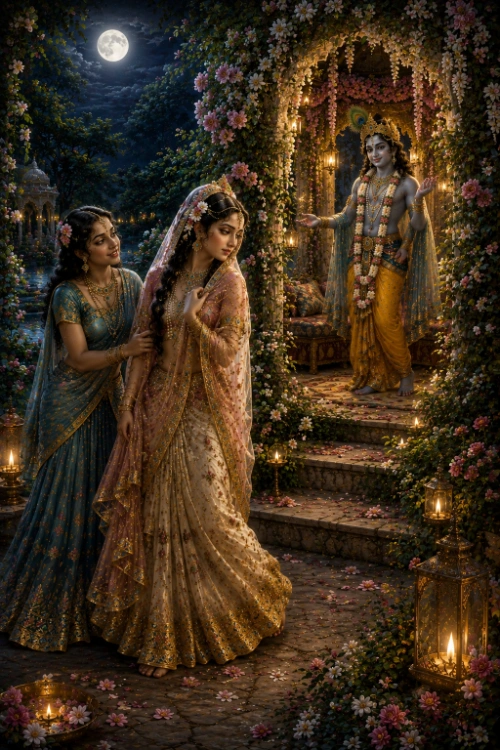
After long conciliation, Keśava had pleased the doe-eyed Rādhā. Having adorned himself appropriately, he went to the bed prepared in the bower. As evening deepened and stole away clear vision, a certain sakhī spoke to Rādhā, who had adorned herself beautifully and whose despondency had now vanished.
Commentary
At last Kṛṣṇa’s pleading had reached her heart. The doe-eyed Rādhā was no longer sunk in despair. Keśava dressed himself for the meeting and went ahead to the flower-bower. There he waited. Evening thickened. Shapes disappeared into darkness. Rādhā too had adorned herself beautifully. Her grief had begun to lift. Seeing that the moment had finally come, one intimate sakhī approached her and said: Go to him.
Song 20
Viracita-cāṭu-vacana-racanam — vasanta rāga — yati tāla
मुग्धे मधुमथनमनुगतमनुसर राधिके
mugdhe madhu-mathanam anugatam anusara rādhike
Refrain: “Enchanting Rādhikā, follow Madhumathana, who has gone ahead for you.”
Commentary
Follow Madhumathana, Rādhā
Kṛṣṇa has already gone to the rendezvous, and this time there is no uncertainty about whether he will appear. He is waiting. Rādhā now needs only to move toward him. The song is pure persuasion to move: Rādhā is still outside, and the sakhī’s whole task is to get her walking.
S20.1
विरचितचाटुवचनरचनं चरणे रचितप्रणिपातम् ।
सम्प्रति मञ्जुलवञ्जुलसीमनि केलिशयनमनुयातम् ॥
viracita-cāṭu-vacana-racanaṁ caraṇe racita-praṇipātam |
samprati mañjula-vañjula-sīmani keli-śayanam anuyātam ||
Rādhā, follow Madhumathana. He who composed so many flattering words for you, he who bowed at your feet, has now gone to the bed of love within the beautiful vañjula bower. Enchanting Rādhikā— follow him.
Commentary
The sakhī reminds Rādhā of what Kṛṣṇa has already done. He did not merely demand reconciliation. He: spoke humbly; praised her; bowed; surrendered. The implication is clear: he has crossed the emotional distance toward you. Now cross the final physical distance toward him.
S20.2
घनजघनस्तनभारभरे दरमन्थरचरणविहारम् ।
मुखरितमणिमञ्जीरमुपैहि विधेहि मरालविकारम् ॥
ghana-jaghana-stana-bhāra-bhare dara-manthara-caraṇa-vihāram |
mukharita-maṇi-mañjīram upaihi vidhehi marāla-vikāram ||
Heavy with the fullness of your hips and breasts, move with slightly slow steps. Let your jeweled anklets ring. Approach him with the graceful gait of a royal swan. Enchanting Rādhikā, follow Madhumathana.
Commentary
Earlier, during the secret abhisāra, the sakhī told Rādhā to silence her anklets. Now she says the opposite: मुखरितमणिमञ्जीरम् mukharita-maṇi-mañjīram “Let the jeweled anklets sound.” The secrecy has changed character. The anklets no longer threaten the meeting. Their sound becomes an announcement: Rādhā is coming.
From Silence to Sound
This small reversal is important. In Sarga V: remove the anklets. Their sound might betray you. In Sarga XI: let them ring. Their sound will delight the waiting Kṛṣṇa. The same ornament that was once an obstacle becomes part of reunion.
S20.3
शृणु रमणीयतरं तरुणीजनमोहनमधुपविरावम् ।
कुसुमशरासनशासनवन्दिनि पिकनिकरे भज भावम् ॥
śṛṇu ramaṇīyataraṁ taruṇī-jana-mohana-madhupa-virāvam |
kusuma-śarāsana-śāsana-vandini pika-nikare bhaja bhāvam ||
Listen to the exceedingly beautiful humming of the bees that enchants young women. Listen to the flocks of cuckoos, heralds proclaiming the command of the flower-bowed god of Love. Let their mood enter you. Follow Madhumathana, Rādhā.
Commentary
Nature, which repeatedly tortured Rādhā in separation, changes function again. Earlier: bees → pain; cuckoos → pain; spring → pain. Now the same sounds encourage union.
The cuckoos become almost royal heralds of Kāma: शासनवन्दिन् — śāsana-vandin, those who praise or proclaim the command of the ruler. The ruler is Kāma. His command is: Go.
S20.4
अनिलतरलकिसलयनिकरेण करेण लतानिकुरम्बम् ।
प्रेरणमिव करभोरु करोति गतिं प्रतिमुञ्च विलम्बम् ॥
anila-tarala-kisalaya-nikareṇa kareṇa latā-nikurambam |
preraṇam iva karabhoru karoti gatiṁ prati muñca vilambam ||
O Rādhā, whose thighs are graceful like an elephant’s trunk— the cluster of vines waves its wind-stirred young leaves like hands, as though urging you forward. Abandon delay. Go.
Commentary
The Forest Itself Gestures Toward Kṛṣṇa
The young leaves become: कर — kara hands. The wind moves them. The vines therefore seem to signal: “This way, Rādhā.” Nature no longer merely reflects emotion. It actively participates in the reconciliation.
S20.5
स्फुरितमनङ्गतरङ्गवशादिव सूचितहरिपरिरम्भम् ।
पृच्छ मनोहरहारविमलजलधारममुं कुचकुम्भम् ॥
sphuritam anaṅga-taraṅga-vaśād iva sūcita-hari-parirambham |
pṛccha manohara-hāra-vimala-jaladhāram amuṁ kuca-kumbham ||
Ask these vessel-like breasts of yours, across which the beautiful necklace streams like pure water. Trembling beneath waves of bodiless Love, they seem already to announce Hari’s coming embrace.
Commentary
If you still hesitate— ask your own body. Your breasts tremble beneath the waves of Love. Your necklace moves across them like a bright stream of water. They already know what is coming. They already anticipate Hari’s embrace.
The sakhī repeatedly uses Rādhā’s own body as evidence against hesitation. Her mind may still contain modesty. Her body has already answered.
S20.6
अधिगतमखिलसखीभिरिदं तव वपुरपि रतिरणसज्जम् ।
चण्डि रसितरशनारवडिण्डिममभिसर सरसमलज्जम् ॥
adhigatam akhila-sakhībhir idaṁ tava vapur api rati-raṇa-sajjam |
caṇḍi rasita-raśanā-rava-ḍiṇḍimam abhisara sarasam alajjam ||
Fierce Rādhā, all your sakhīs have understood it: your very body is prepared for the battle of love. Go now, full of rasa and without false shame. Let the ringing of your girdle sound like the drum announcing the beginning of Love’s battle.
Commentary
The Girdle as War Drum
Again erotic union becomes: रतिरण — rati-raṇa “the battle of love.” The girdle becomes: डिण्डिम — ḍiṇḍima a drum. Its ringing proclaims that the contest is about to begin. The metaphor is playful because Rādhā and Kṛṣṇa have spent many cantos in another kind of battle: the battle of pride, jealousy and reconciliation. Now that conflict can be transformed into intimacy.
S20.7
स्मरशरसुभगनखेन करेण सखीमवलम्ब्य सलीलम् ।
चल वलयक्वणितैरवबोधय हरिमपि निजगतिशीलम् ॥
smara-śara-subhaga-nakhena kareṇa sakhīm avalambya salīlam |
cala valaya-kvaṇitair avabodhaya harim api nija-gati-śīlam ||
Take your sakhī gracefully by the hand— that hand whose beautiful nails resemble the arrows of Love— and move forward. With the ringing of your bracelets, let Hari know the manner of your approach.
Commentary
This is not the solitary, fearful journey of Sarga V. Rādhā now approaches supported by the sakhī. The mediator who has carried messages between the lovers will literally help Rādhā cross the final steps.
S20.8
श्रीजयदेवभणितमधरीकृतहारमुदासितवामम् ।
हरिविनिहितमनसामधितिष्ठतु कण्ठतटीमविरामम् ॥
śrī-jayadeva-bhaṇitam adharī-kṛta-hāram udāsita-vāmam |
hari-vinihita-manasām adhitiṣṭhatu kaṇṭha-taṭīm avirāmam ||
May this song spoken by Śrī Jayadeva— surpassing even a necklace in beauty and casting aside contrary resistance— remain ceaselessly upon the throats of those whose minds are fixed upon Hari.
Commentary
The song itself becomes an ornament: not merely something understood, but something meant to remain upon the voice. That is appropriate to the Gīta-govinda, which is fundamentally a work for singing and embodied performance.
63
सा मां द्रक्ष्यति वक्ष्यति स्मरकथां प्रत्यङ्गमालिङ्गनैः
प्रीतिं यास्यति रंस्यते सखि समागत्येति चिन्ताकुलः ।
स त्वां पश्यति वेपते पुलकयत्यानन्दति स्विद्यति
प्रत्युद्गच्छति मूर्च्छति स्थिरतमःपुञ्जे निकुञ्जे प्रियः ॥ ६३ ॥
sā māṁ drakṣyati vakṣyati smara-kathāṁ praty-aṅgam āliṅganaiḥ
prītiṁ yāsyati raṁsyate sakhi samāgatyeti cintākulaḥ |
sa tvāṁ paśyati vepate pulakayaty ānandati svidyati
pratyudgacchati mūrcchati sthira-tamaḥ-puñje nikuñje priyaḥ || 63 ||
“O friend, she will come. She will see me. She will speak of love. With embraces she will delight every limb. She will experience pleasure with me.” Thus overwhelmed by these thoughts, your beloved waits in the bower filled with dense darkness. He imagines seeing you. He trembles. His hairs stand erect. He rejoices. He perspires. He rises to meet you. He nearly faints.
Commentary
What Kṛṣṇa Is Doing While Rādhā Approaches
The sakhī now describes Kṛṣṇa’s state. Inside the dark bower Kṛṣṇa is thinking only of you: “She will come.” “She will see me.” “She will speak to me of love.” “She will embrace me.” “At last we will be together.” And then every sound makes expectation become almost reality. He thinks he sees you. He trembles. Horripilation covers him. Joy surges through him. He begins to perspire. He rises suddenly to meet you— and the intensity nearly makes him faint.
The Symmetry Is Complete
Compare this to earlier cantos. Rādhā once saw Kṛṣṇa everywhere. Kṛṣṇa once saw Rādhā everywhere. Both mistook external signs for the beloved. Now imagination is about to become reality. This is the last moment before the imagined beloved becomes actually present.
64
अक्ष्णोर्निक्षिपदञ्जनं श्रवणयोस्तापिच्छगुच्छावलीं
मूर्ध्नि श्यामसरोजदाम कुचयोः कस्तूरिकापत्रकम् ।
धूर्तानामभिसारसत्वरहृदां विष्वङ्निकुञ्जे सखि
ध्वान्तं नीलनिचोलचारु सुदृशां प्रत्यङ्गमालिङ्गति ॥ ६४ ॥
akṣṇor nikṣipad añjanaṁ śravaṇayos tāpiccha-gucchāvalīṁ
mūrdhni śyāma-saroja-dāma kucayoḥ kastūrikā-patrakam |
dhūrtānām abhisāra-satvara-hṛdāṁ viṣvaṅ nikuñje sakhi
dhvāntaṁ nīla-nicola-cāru sudṛśāṁ praty-aṅgam āliṅgati || 64 ||
Friend, the darkness of the bower embraces every limb of the beautiful women whose hearts hurry toward their secret rendezvous. It becomes: collyrium upon their eyes; clusters of dark tāpiccha flowers at their ears; a garland of black lotuses upon their heads; musk decoration upon their breasts; and a beautiful dark-blue cloak surrounding the whole body.
Commentary
Darkness Becomes the Ornament of the Abhisārikā
Earlier Rādhā embraced darkness because she mistook it for Kṛṣṇa. Now darkness itself lovingly dresses the abhisārikā. It protects her secrecy. It ornaments her. It embraces her body. Darkness has become an ally of love.
65
काश्मीरगौरवपुषामभिसारिकाणाम्
आबद्धरेखमभितो रुचिमञ्जरीभिः ।
एतत्तमालदलनीलतमं तमिश्रं
तत्प्रेमहेमनिकषोपलतां तनोति ॥ ६५ ॥
kāśmīra-gaura-vapuṣām abhisārikāṇām
ābaddha-rekham abhito ruci-mañjarībhiḥ |
etat tamāla-dala-nīlatamaṁ tamiśraṁ
tat-prema-hema-nikaṣopalatāṁ tanoti || 65 ||
This night, black as the darkest tamāla leaf, becomes a touchstone for testing the golden love of the fair-bodied abhisārikās. Their radiant bodies draw streaks of brightness across the surrounding darkness.
Commentary
The Night Tests the Gold of Love
A nikaṣopala is a touchstone upon which gold is rubbed to test its quality. Jayadeva creates: dark night → black touchstone; golden-bodied lover → gold; her journey through darkness → test of love. The abhisārikā proves her love by crossing the night. Her body leaves metaphorical golden marks upon darkness itself.
66
हारावलीतरलकाञ्चनकाञ्चिदाम-
केयूरकङ्कणमणिद्युतिदीपितस्य ।
द्वारे निकुञ्जनिलयस्य हरिं निरीक्ष्य
व्रीडावतीमथ सखी निजगाद राधाम् ॥ ६६ ॥
hārāvalī-tarala-kāñcana-kāñci-dāma-
keyūra-kaṅkaṇa-maṇi-dyuti-dīpitasya |
dvāre nikuñja-nilayasya hariṁ nirīkṣya
vrīḍāvatīm atha sakhī nijagāda rādhām || 66 ||
Then the sakhī saw Hari at the doorway of the bower, illuminated by the glittering jewels of his necklaces, golden girdle, armlets and bracelets. Seeing Rādhā overcome with bashfulness, her friend spoke to her again.
Commentary
The Sakhī Sees Kṛṣṇa at the Door of the Bower
The Threshold
This is one of the most important spatial moments of the whole poem. Rādhā is now at the door. The entire Gīta-govinda has brought her here. Kṛṣṇa is visible. The bower is prepared. Only vrīḍā, bashfulness, remains. The next Aṣṭapadī is therefore spoken almost literally at the threshold of union.
Song 21
Mañjutara-kuñja-tala-keli-sadane — varāḍī rāga — rūpaka tāla
प्रविश राधे माधवसमीपमिह
praviśa rādhe mādhava-samīpam iha
Refrain: “Enter, Rādhā. Come here beside Mādhava.”
Commentary
Enter, Rādhā
Rādhā has reached the doorway, and the second song exists only to get her across the threshold. The sakhī is no longer persuading Rādhā to make a journey. She is standing at the doorway saying: Enter.
Textual Note
The refrain in the common recension is the single imperative प्रविश राधे माधवसमीपमिह praviśa rādhe mādhava-samīpam iha. The line of blessing कुरु मुरारे मङ्गलशतानि kuru murāre maṅgala-śatāni “O Murāri, bestow a hundred blessings” is sometimes recited with the refrain; in the Kāvyamālā, Gauḍīya and Miller texts alike it stands as the middle line of the eighth stanza, and it is printed there here.
S21.1
मञ्जुतरकुञ्जतलकेलिसदने ।
विलस रतिरभसहसितवदने ॥
mañjutara-kuñja-tala-keli-sadane |
vilasa rati-rabhasa-hasita-vadane ||
Enter, Rādhā. Come beside Mādhava in this exceedingly beautiful pleasure-bower beneath the vines. O you whose face smiles with the excitement of love— enter and delight here.
Commentary
The key verb is no longer: go. It is: प्रविश — praviśa “enter.” The journey is over.
S21.2
नवभवदशोकदलशयनसारे ।
विलस कुचकलशतरलहारे ॥
nava-bhavad-aśoka-dala-śayana-sāre |
vilasa kuca-kalaśa-tarala-hāre ||
Enter and delight upon the excellent bed made from newly opened aśoka leaves, O Rādhā, whose necklace trembles upon the vessels of your breasts.
Commentary
The Aśoka
The name aśoka literally suggests: “without sorrow.” The tree that earlier belonged to the painful spring landscape now forms the bed upon which sorrow is to end. Whether Jayadeva intended an explicit lexical pun here or not, the symbolism is perfect: the bed of aśoka becomes the place where śoka, sorrow, is overcome.
S21.3
कुसुमचयरचितशुचिवासगेहे ।
विलस कुसुमसुकुमारदेहे ॥
kusuma-caya-racita-śuci-vāsa-gehe |
vilasa kusuma-sukumāra-dehe ||
Enter the pure dwelling made from masses of flowers. O Rādhā, whose body is itself delicate as a flower— delight there beside Mādhava.
Commentary
The environment and Rādhā mirror one another. flower chamber contains flower-soft Rādhā. The bower has been constructed almost as though it were an extension of her body.
S21.4
चलमलयवनपवनसुरभिशीते ।
विलस रसवलितललितगीते ॥
cala-malaya-vana-pavana-surabhi-śīte |
vilasa rasa-valita-lalita-gīte ||
Enter where the moving breeze from the Malaya forests is cool and fragrant. O you whose graceful song is filled with rasa— delight there.
Commentary
Textual Note
An important variant gives: मदनशरनिकरभीते madana-śara-nikara-bhīte “you who are fearful of the multitude of Love’s arrows” in place of: रसवलितललितगीते rasa-valita-lalita-gīte “you whose graceful song is filled with rasa.” Both readings are transmitted.
S21.5
मधुमुदितमधुपकुलकलितरावे ।
विलस मदनरससरसभावे ॥
madhu-mudita-madhupa-kula-kalita-rāve |
vilasa madana-rasa-sarasa-bhāve ||
Enter where swarms of bees, delighted by spring sweetness, fill the bower with their humming. O Rādhā, whose heart is saturated with the rasa of Love— delight there.
Commentary
Textual Note
Another important reading has: मदनशररभसभावे madana-śara-rabhasa-bhāve “you whose state is impetuously stirred by Love’s arrows.” The alternative reading emphasizes Rādhā’s condition as one produced by Kāma’s assault.
S21.6
मधुतरलपिकनिकरनिनदमुखरे ।
विलस दशनरुचिरुचिरशिखरे ॥
madhu-tarala-pika-nikara-ninada-mukhare |
vilasa daśana-ruci-rucira-śikhare ||
Enter where flocks of cuckoos, excited by spring, fill the grove with their calls. O Rādhā, whose radiant teeth make the peak of your smile beautiful— delight there.
Commentary
Textual Note
The printed editions read मधुरतर madhuratara “sweeter still” where the text given here has मधुतरल madhu-tarala “made restless by spring”; Miller records madhu-tarala from the Birbhum and Ahmedabad manuscripts, and it is the reading translated above. The order of the fifth, sixth and seventh stanzas also differs between editions: Miller prints them as here, while the Kāvyamālā and Gauḍīya texts place विततबहुवल्लि vitata-bahu-valli first of the three.
S21.7
विततबहुवल्लिनवपल्लवघने ।
विलस चिरमलसपीनजघने ॥
vitata-bahu-valli-nava-pallava-ghane |
vilasa ciram alasa-pīna-jaghane ||
Enter where spreading vines and fresh leaves grow thick around the bower. O Rādhā, graceful and languid, with beautiful full hips— remain there and delight for a long time.
Commentary
Textual Note
An important commentarial reading gives: पीनकुचकुम्भजघने pīna-kuca-kumbha-jaghane emphasizing the fullness of Rādhā’s breasts and hips, while other witnesses have: चिरमलसपीनजघने ciram alasa-pīna-jaghane. The first line describing the dense vine-covered bower is stable.
S21.8
विहितपद्मावतीसुखसमाजे ।
कुरु मुरारे मङ्गलशतानि ।
भणति जयदेवकविराजराजे ॥
vihita-padmāvatī-sukha-samāje |
kuru murāre maṅgala-śatāni |
bhaṇati jayadeva-kavi-rāja-rāje ||
As Jayadeva, king among poets, sings— he who creates the assembly of joy for Padmāvatī— O Murāri, bestow a hundred blessings, and may this delight unfold.
Commentary
Padmāvatī Appears Again
Jayadeva again introduces Padmāvatī into the poem. This is especially striking in a canto devoted to the union of Rādhā and Kṛṣṇa. The poet’s own beloved is not erased from his poetry of divine love. She appears almost as a quiet personal signature within it.
Textual Note
The middle line कुरु मुरारे मङ्गलशतानि kuru murāre maṅgala-śatāni stands in the Kāvyamālā, Gauḍīya and Miller texts alike and has been restored here, where it had been dropped. Miller prints the last word as कविराजे kavi-rāje; the Kāvyamālā and Gauḍīya editions read कविराजराजे kavi-rāja-rāje, which the rhyme with समाजे samāje supports and which is followed here.
67
त्वां चित्तेन चिरं वहन्नयमतिश्रान्तो भृशं तापितः
कन्दर्पेण च पातुमिच्छति सुधासम्बाधबिम्बाधरम् ।
अस्याङ्गं तदलङ्कुरु क्षणमिह भ्रूक्षेपलक्ष्मीलव-
क्रीते दास इवोपसेवितपदाम्भोजे कुतः सम्भ्रमः ॥ ६७ ॥
tvāṁ cittena ciraṁ vahann ayam atiśrānto bhṛśaṁ tāpitaḥ
kandarpeṇa ca pātum icchati sudhā-sambādha-bimbādharam |
asyāṅgaṁ tad alaṅkuru kṣaṇam iha bhrū-kṣepa-lakṣmī-lava-
krīte dāsa ivopasevita-padāmbhoje kutaḥ sambhramaḥ || 67 ||
He has carried you in his mind for so long that he is utterly exhausted. He has been severely tormented by Kandarpa. He longs to drink your bimba-red lips, crowded with nectar. Therefore, adorn his body with yours for a moment. Why be afraid? He is like a slave purchased merely by a fraction of the splendour of one movement of your eyebrow— a slave who has already served your lotus feet.
Commentary
“Kṛṣṇa Has Carried You in His Heart for So Long”
The sakhī now gives Rādhā one final reason to cross the threshold. Why hesitate now, Rādhā? Kṛṣṇa has carried you in his heart for so long that longing has exhausted him. Kāma has burned him. He desires the nectar of your lips. Go and let your body become his ornament. And why should you fear him? This is the same Kṛṣṇa who made himself your servant. One movement of your eyebrow was enough to purchase him. He has already bowed at your lotus feet.
The Slave Purchased by an Eyebrow
This extraordinary expression continues the theology of Sarga X: भ्रूक्षेपलक्ष्मीलवक्रीते दासे bhrū-kṣepa-lakṣmī-lava-krīte dāse He is a slave purchased by only a fraction of the beauty of Rādhā’s moving eyebrow. The cosmic Lord has become purchasable— but the currency is Rādhā’s beauty and love.
Textual Note
The Kāvyamālā and Gauḍīya editions read अस्याङ्कं asyāṅkaṁ “his lap” where the text given here has अस्याङ्गं asyāṅgaṁ “his body”; both are transmitted, and the translation above follows the published reading.
68
सा ससाध्वससानन्दं गोविन्दे लोललोचना ।
सिञ्जानमञ्जुमञ्जीरं प्रविवेश निवेशनम् ॥ ६८ ॥
sā sa-sādhvasa-sānandaṁ govinde lola-locanā |
siñjāna-mañju-mañjīraṁ praviveśa niveśanam || 68 ||
With eyes restlessly fixed upon Govinda, Rādhā entered the bower filled simultaneously with fear and joy. Her beautiful anklets rang as she stepped inside.
Commentary
Rādhā Finally Enters
The Two Emotions Together
Jayadeva does not say that Rādhā enters simply in happiness. She enters: ससाध्वससानन्दम् sa-sādhvasa-sānandam with both: sādhvasa — trembling apprehension, nervous excitement; and ānanda — joy. This is psychologically exact. The reunion she has desired for so long is itself overwhelming. And once again: the anklets sound. The approach is no longer imaginary. Kṛṣṇa can hear her entering.
Song 22
Rādhā-vadana-vilokana-vikasita — varāḍī rāga — yati tāla
हरिमेकरसं चिरमभिलषितविलासं
सा ददर्श गुरुहर्षवशंवदवदनमनङ्गनिवासम् ॥
harim eka-rasaṁ ciram abhilaṣita-vilāsaṁ
sā dadarśa guru-harṣa-vaśaṁvada-vadanam anaṅga-nivāsam ||
Refrain: “She saw Hari — of one unchanging essence, long desired, his face given over to overwhelming joy, the dwelling place of Love himself.”
Commentary
Rādhā Sees Kṛṣṇa
Until now the sakhī has described Kṛṣṇa to Rādhā. Here the intermediary becomes unnecessary: Rādhā enters and sees him herself, and the song turns into an extended portrait of Kṛṣṇa through her own eyes. Its first stanza gives the governing image — Kṛṣṇa catching sight of Rādhā is the ocean catching sight of the moon, every wave in him rising at once.
S22.1
राधावदनविलोकनविकसितविविधविकारविभङ्गम् ।
जलनिधिमिव विधुमण्डलदर्शनतरलिततुङ्गतरङ्गम् ॥
rādhā-vadana-vilokana-vikasita-vividha-vikāra-vibhaṅgam |
jala-nidhim iva vidhu-maṇḍala-darśana-taralita-tuṅga-taraṅgam ||
She saw Hari— wholly absorbed in one rasa, long desirous of love-play with her, his face completely under the power of immense joy, the very dwelling of Anaṅga. At the sight of Rādhā’s face, many transformations of emotion blossomed within him, like the ocean whose high waves become restless when it sees the disk of the moon.
Commentary
And then Rādhā saw Kṛṣṇa. The instant he saw her face, his entire being changed. Joy rose through him in wave after wave. He was like the ocean at moonrise— still for one moment, and then suddenly alive with great surging tides. Rādhā was his moon. Kṛṣṇa was the ocean rising toward her.
The Ocean and Moon
The image reverses ordinary emotional hierarchy once again. The moon does not chase the ocean. It simply appears. The ocean responds. Likewise Rādhā merely enters. And Kṛṣṇa’s entire body becomes turbulent with emotion.
S22.2
हारममलतरतारमुरसि दधतं परिरभ्य विदूरम् ।
स्फुटतरफेनकदम्बकरम्बितमिव यमुनाजलपूरम् ॥
hāram amalatara-tāram urasi dadhataṁ parirabhya vidūram |
sphuṭatara-phena-kadamba-karambitam iva yamunā-jala-pūram ||
She saw upon his broad chest a brilliantly pure pearl necklace spreading widely across it— making his dark body resemble the waters of the Yamunā covered with bright masses of foam.
Commentary
His Necklace Is Foam upon the Yamunā
The Image: Kṛṣṇa’s body: dark Yamunā water. His white pearl necklace: foam upon the river. The landscape of Vṛndāvana is reproduced upon Kṛṣṇa’s body.
S22.3
श्यामलमृदुलकलेवरमण्डलमधिगतगौरदुकूलम् ।
नीलनलिनमिव पीतपरागपटलभरवलयितमूलम् ॥
śyāmala-mṛdula-kalevara-maṇḍalam adhigata-gaura-dukūlam |
nīla-nalinam iva pīta-parāga-paṭala-bhara-valayita-mūlam ||
His dark, soft body was wrapped in bright yellow silk, like a blue lotus whose base is surrounded by masses of golden-yellow pollen.
Commentary
The Blue Lotus and Yellow Pollen
Again Jayadeva makes colour relational. Kṛṣṇa’s darkness becomes more beautiful through yellow. The familiar pairing: dark-blue Kṛṣṇa + yellow garment is transformed into botanical imagery: blue lotus + golden pollen.
S22.4
तरलदृगञ्चलचलनमनोहरवदनजनितरतिरागम् ।
स्फुटकमलोदरखेलितखञ्जनयुगमिव शरदि तडागम् ॥
tarala-dṛg-añcala-calana-manohara-vadana-janita-rati-rāgam |
sphuṭa-kamalodara-khelita-khañjana-yugam iva śaradi taḍāgam ||
His charming face, animated by the movement of restless sidelong glances, awakened passion. It resembled an autumn lake in which a pair of khañjana birds plays inside an open lotus.
Commentary
His Eyes Become Birds in a Lotus Pond
The khañjana, a small quick-moving bird, is frequently used in Sanskrit poetry as an image for darting eyes. Thus: face → lotus / autumn lake; eyes → two restless birds. Kṛṣṇa’s gaze can no longer remain still because Rādhā is before him.
S22.5
वदनकमलपरिशीलनमिलितमिहिरसमकुण्डलशोभम् ।
स्मितरुचिरुचिरसमुल्लसिताधरपल्लवकृतरतिलोभम् ॥
vadana-kamala-pariśīlana-milita-mihira-sama-kuṇḍala-śobham |
smita-ruci-rucira-samullasitādhara-pallava-kṛta-rati-lobham ||
His earrings shone beside his lotus-face like suns coming near to attend the flower. The brilliance of his smile illuminated his tender, leaf-like lips and awakened longing for love.
Commentary
His Smile Awakens Desire
The image of the sun beside the lotus is especially appropriate: the lotus responds to sunlight. But here the “lotus” is Kṛṣṇa’s face. His own ornaments become cosmic attendants to his beauty.
S22.6
शशिकिरणच्छुरितोदरजलधरसुन्दरसकुसुमकेशम् ।
तिमिरोदितविधुमण्डलनिर्मलमलयजतिलकनिवेशम् ॥
śaśi-kiraṇa-cchuritodara-jaladhara-sundara-sa-kusuma-keśam |
timirodita-vidhu-maṇḍala-nirmala-malayaja-tilaka-niveśam ||
His flower-decked dark hair was beautiful like the interior of a rain cloud pierced by moonbeams. The pure sandalwood tilaka upon him shone like the disk of the moon rising from darkness.
Commentary
Flowers in a Rain Cloud; Moon in Darkness
The Cosmic Body Returns
Jayadeva again turns Kṛṣṇa into a sky: dark hair → cloud / night; flowers → moonlit brightness; sandal tilaka → rising moon. Rādhā is not simply seeing a handsome man. Her vision continually expands Kṛṣṇa into landscape and cosmos.
S22.7
विपुलपुलकभरदन्तुरितं रतिकेलिकलाभिरधीरम् ।
मणिगणकिरणसमूहसमुज्ज्वलभूषणसुभगशरीरम् ॥
vipula-pulaka-bhara-danturitaṁ rati-keli-kalābhir adhīram |
maṇi-gaṇa-kiraṇa-samūha-samujjvala-bhūṣaṇa-subhaga-śarīram ||
His body was roughened by abundant horripilation and restless with anticipation of the arts of love. His beautiful form shone beneath ornaments blazing with masses of rays from countless jewels.
Commentary
Kṛṣṇa’s Body Reveals His Excitement
The word: pulaka returns again. Kṛṣṇa’s skin itself betrays him. The joy of Rādhā’s presence has moved beyond controlled speech into involuntary bodily transformation.
S22.8
श्रीजयदेवभणितविभवद्विगुणीकृतभूषणभारम् ।
प्रणमत हृदि सुचिरं विनिधाय हरिं सुकृतोदयसारम् ॥
śrī-jayadeva-bhaṇita-vibhava-dviguṇī-kṛta-bhūṣaṇa-bhāram |
praṇamata hṛdi suciraṁ vinidhāya hariṁ sukṛtodaya-sāram ||
Place Hari deeply within your heart and bow to him— Hari whose wealth of ornament has been doubled by the splendour of Śrī Jayadeva’s song, Hari who is the very essence of the arising of blessed merit.
69
अतिक्रम्यापाङ्गं श्रवणपथपर्यन्तगमन-
प्रयासेनेवाक्ष्णोस्तरलतरतारं गमितयोः ।
इदानीं राधायाः प्रियतमसमालोकसमये
पपात स्वेदाम्बुप्रसर इव हर्षाश्रुनिकरः ॥ ६९ ॥
atikramyāpāṅgaṁ śravaṇa-patha-paryanta-gamana-
prayāsenevākṣṇos taralatara-tāraṁ gamitayoḥ |
idānīṁ rādhāyāḥ priyatama-samāloka-samaye
papāta svedāmbu-prasara iva harṣāśru-nikaraḥ || 69 ||
At the moment when Rādhā beheld her beloved, the pupils of her eyes grew exceedingly tremulous, as though straining beyond the limits of ordinary sidelong vision all the way toward the region of the ears. Then a multitude of tears of joy fell from them, like streams of perspiration produced by the exertion of that effort.
Commentary
Rādhā’s Eyes Overflow
Now Jayadeva leaves the song and describes Rādhā’s reaction. Rādhā looked at him. Her glance stretched farther and farther— as though her eyes were trying to widen beyond their own limits so they could contain more of Kṛṣṇa. And then tears came. Not the tears of jealousy. Not the tears of abandonment. Tears of joy. Jayadeva imagines them almost playfully: perhaps her eyes had worked so hard to see him that they began to perspire.
A Major Emotional Marker
This is one of the clearest signs that the great arc of separation has ended. Earlier Rādhā’s tears arose from: jealousy; waiting; abandonment; anger. Now: हर्षाश्रु — harṣāśru tears of joy. The same bodily phenomenon has completely changed its emotional meaning.
70
भजन्त्यास्तल्पान्तं कृतकपटकण्डूतिपिहित-
स्मितं याते गेहाद्बहिरवहितालीपरिजने ।
प्रियास्यं पश्यन्त्याः स्मरशरसमाहूतसुभगं
सलज्जा लज्जापि व्यगमदिव दूरं मृगदृशः ॥ ७० ॥
bhajantyās talpāntaṁ kṛta-kapaṭa-kaṇḍūti-pihita-
smitaṁ yāte gehād bahir avahitālī-parijane |
priyāsyaṁ paśyantyāḥ smara-śara-samāhūta-subhagaṁ
sa-lajjā lajjāpi vyagamad iva dūraṁ mṛga-dṛśaḥ || 70 ||
As Rādhā moved toward the edge of the bed, the attentive circle of sakhīs went outside the bower, concealing their smiles by pretending to scratch themselves. As the doe-eyed Rādhā gazed upon the beautiful face of her beloved, summoned by Love’s arrows, even her own bashfulness seemed itself to become ashamed and depart far away.
Commentary
The Sakhīs Leave
The final obstacle is not anger. It is bashfulness. So the sakhīs understand that they must leave the lovers alone. The sakhīs saw what was happening. They smiled. Trying not to embarrass Rādhā, they pretended to scratch themselves so that their hands could hide their laughter. Then one by one they slipped quietly outside the bower. Rādhā moved toward the bed. She looked at Kṛṣṇa. His face was beautiful, restless beneath the arrows of Love. And then something remarkable happened. Rādhā’s modesty itself seemed to become embarrassed— and fled.
“Even Shame Was Ashamed”
The final phrase is one of Jayadeva’s finest: सलज्जा लज्जापि व्यगमत् sa-lajjā lajjāpi vyagamat “Even shame, becoming ashamed, went away.” The personification is brilliant. Rādhā does not violently throw away modesty. Rather, the situation has become so intimate and so inevitable that modesty itself recognizes that its work is finished. It withdraws. The lovers are finally alone.
Benediction
जयश्रीविन्यस्तैर्महित इव मन्दारकुसुमैः
स्वयं सिन्दूरेण द्विपरणमुदा मुद्रित इव ।
भुजापीडक्रीडाहतकुवलयापीडकरिणः
प्रकीर्णासृग्बिन्दुर्जयति भुजदण्डो मुरजितः ॥
jaya-śrī-vinyastair mahita iva mandāra-kusumaiḥ
svayaṁ sindūreṇa dvipa-raṇa-mudā mudrita iva |
bhujāpīḍa-krīḍā-hata-kuvalayāpīḍa-kariṇaḥ
prakīrṇāsṛg-bindur jayati bhuja-daṇḍo mura-jitaḥ ||
Victorious is the mighty arm of Mura’s conqueror— the arm that slew the elephant Kuvalayāpīḍa in the sport of combat. Drops of the elephant’s scattered blood upon that arm appear like heavenly mandāra flowers placed there by the goddess of Victory, or as though the arm had marked itself with red sindūra in delight after the elephant battle.
Commentary
A Fuller Recensional Benediction
Some fuller commentarial traditions preserve an additional stanza after the dramatic ending. As often in the fuller benedictions, Jayadeva suddenly restores Kṛṣṇa’s heroic identity. The same Kṛṣṇa who has just stood trembling before Rādhā is also the destroyer of Kuvalayāpīḍa. The contrast remains central: hero in battle; servant in love.
Colophon
इति श्रीगीतगोविन्दे राधिकामिलने सानन्ददामोदरो नामैकादशः सर्गः ॥ ११ ॥
iti śrī-gīta-govinde rādhikā-milane sānanda-dāmodaro nāmaikādaśaḥ sargaḥ || 11 ||
Thus ends the eleventh sarga, named Sānanda-Dāmodara, in the union of Rādhikā, of the illustrious Gīta-govinda.
Commentary
Textual Note on the Close of the Canto
The sequence given here — verses 62–70 around the three songs, followed by a single benedictory stanza — is that of the Haridāsa recension, which Miller’s edition also follows. The Kāvyamālā text (GRETIL numbering GG 11.34 and 11.36) carries two further stanzas in this closing group, सानन्दं नन्दसूनुर्दिशतु sānandaṁ nanda-sūnur diśatu before the benediction and सौन्दर्यैकनिधेरनङ्गललना saundaryaika-nidher anaṅga-lalanā after it; both are expressly absent from the Haridāsa recension and are therefore not printed here. The canto’s title also varies: सामोद sāmoda- in some witnesses, and सानन्दगोविन्द sānanda-govinda in the Haridāsa redaction.