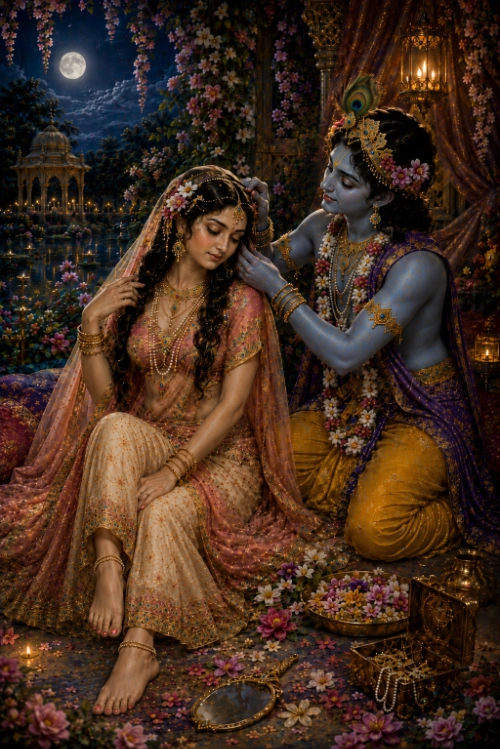
71
गतवति सखीवृन्देऽमन्दत्रपाभरनिर्भर-
स्मरपरवशाकूतस्फीतस्मितस्नपिताधरम् ।
सरसमनसं दृष्ट्वा राधां मुहुर्नवपल्लव-
प्रसवशयने निक्षिप्ताक्षीमुवाच हरिः प्रियाम् ॥ ७१ ॥
gatavati sakhī-vṛnde ’manda-trapā-bhara-nirbhara-
smara-paravaśākūta-sphīta-smita-snapitādharam |
sarasa-manasaṁ dṛṣṭvā rādhāṁ muhur nava-pallava-
prasava-śayane nikṣiptākṣīm uvāca hariḥ priyām || 71 ||
When the company of sakhīs had departed, Hari saw his beloved Rādhā— filled with abundant bashfulness, yet inwardly overcome by Love; her lips bathed in an expanding smile that revealed her secret intention; her heart saturated with rasa; and her eyes repeatedly falling upon the bed made of fresh shoots and flowers. Then Hari spoke to her.
The sakhīs were gone. At last there was no one else in the bower. Rādhā remained— still intensely shy, yet unable to conceal what Love had awakened within her. A smile slowly spread across her lips. Again and again her eyes wandered toward the bed of fresh leaves. Kṛṣṇa saw. He understood. And he spoke.
Commentary
The Difference Between Sarga XI and Sarga XII
Sarga XI ended with Rādhā entering. Sarga XII begins after the sakhīs have left. This distinction is important. The intermediary is no longer required. There are now only: Rādhā and Kṛṣṇa. The dialogue becomes entirely theirs.
Song 23
Kiśalaya-śayana-tale kuru kāmini — vibhāsa rāga — ekatālī tāla
क्षणमधुना नारायणमनुगतमनुभज राधिके
kṣaṇam adhunā nārāyaṇam anugatam anubhaja rādhike
Refrain: “Rādhikā, now for a moment enjoy Nārāyaṇa, who has submitted himself to you.”
Commentary
Now, Rādhikā, Enjoy Nārāyaṇa
Kṛṣṇa invites Rādhā to the flower-bed, and the medical metaphor that has run through the whole poem finally resolves. Rādhā could be cured only by Kṛṣṇa; then Kṛṣṇa could be cured only by Rādhā; now the remedy has stopped being imagined and the lovers simply provide it.
Prabandha XXIII — Aṣṭapadī 23
The older commentarial tradition assigns this song to Vibhāsa rāga and Ekatālī tāla. The recurring line is transmitted in two principal forms. One important recension gives: क्षणमधुना नारायणमनुगतमनुभज राधिके kṣaṇam adhunā nārāyaṇam anugatam anubhaja rādhike “Rādhikā, now for a moment enjoy Nārāyaṇa, who has submitted himself to you.” Other texts read anusara, “follow,” rather than anubhaja, “enjoy / partake of / love.” The fuller anubhaja reading is especially appropriate to the situation and is followed here.
S23.1
किसलयशयनतले कुरु कामिनि चरणनलिनविनिवेशम् ।
तव पदपल्लववैरि पराभवमिदमनुभवतु सुवेशम् ॥
kisalaya-śayana-tale kuru kāmini caraṇa-nalina-viniveśam |
tava pada-pallava-vairi parābhavam idam anubhavatu suveśam ||
Beloved, place your lotus-feet upon this bed of tender leaves. Let this beautifully prepared couch, which dares to rival the softness of your leaf-like feet, experience defeat. Rādhikā— now enjoy Nārāyaṇa, who has submitted himself to you.
Place your feet upon the bed, Rādhā. These young leaves imagine themselves soft. Let them discover their mistake. Against your tender feet, even fresh leaves must admit defeat. And now— receive Nārāyaṇa, who has come entirely under your power.
Commentary
1. “Let the Leaf-Bed Admit Defeat Before Your Feet”
The rhetoric is playful but significant. The bed is not merely soft enough for Rādhā. Rādhā is softer than the bed. The leaves become competitors: पदपल्लववैरि — pada-pallava-vairi “rivals of your leaf-like feet.” They lose.
“Nārāyaṇa Has Followed You”
Equally important is: नारायणमनुगतम् nārāyaṇam anugatam Nārāyaṇa has followed, submitted to, or become dependent upon Rādhā. The divine name makes the reversal unmistakable. It is not merely a cowherd lover who has surrendered. It is: Nārāyaṇa.
S23.2
करकमलेन करोमि चरणमहमागमितासि विदूरम् ।
क्षणमुपकुरु शयनोपरि मामिव नूपुरमनुगतिशूरम् ॥
kara-kamalena karomi caraṇam aham āgamitāsi vidūram |
kṣaṇam upakuru śayanopari mām iva nūpuram anugati-śūram ||
You have travelled a long distance to reach me. Let me attend to your feet with my lotus-like hands. And now upon this bed, favour me for a moment— me who have followed you faithfully, like the anklet that never abandons your foot.
Commentary
2. “You Have Come So Far—Let Me Serve Your Feet”
Kṛṣṇa presents himself as analogous to Rādhā’s nūpura, her anklet. The image is remarkably humble. An anklet does not lead the foot. It: follows it. So does Kṛṣṇa.
S23.3
वदनसुधानिधिगलितममृतमिव रचय वचनमनुकूलम् ।
विरहमिवापनयामि पयोधररोधकमुरसि दुकूलम् ॥
vadana-sudhā-nidhi-galitam amṛtam iva racaya vacanam anukūlam |
viraham ivāpanayāmi payodhara-rodhakam urasi dukūlam ||
Speak favourable words to me, like nectar flowing from the reservoir of sweetness that is your face. And I shall remove from your chest the silk that covers your breasts— as though I were removing separation itself.
Speak to me, Rādhā. Let one tender word fall from your face like nectar from an inexhaustible spring. And this cloth between us— let me remove it. Let it disappear the way our separation has disappeared.
Commentary
3. “Speak to Me—and Let Me Remove Separation”
The Cloth as Separation
The metaphor is especially elegant: garment between bodies → viraha between lovers. Removing one becomes an image of removing the other. The external barrier reproduces the emotional barrier— and both are now being removed.
S23.4
प्रियपरिरम्भणरभसवलितमिव पुलकितमतिदुरवापम् ।
मदुरसि कुचकलशं विनिवेशय शोषय मनसिजतापम् ॥
priya-parirambhaṇa-rabhasa-valitam iva pulakitam ati-duravāpam |
mad-urasi kuca-kalaśaṁ viniveśaya śoṣaya manasija-tāpam ||
Place upon my chest the vessel-like fullness of your breast— already thrilled as though by the excitement of your beloved’s embrace, so difficult to attain. Extinguish the burning inflicted upon me by Manasija.
Commentary
4. “Place Your Heart Against Mine”
The medical metaphor running through the poem reaches fulfilment. Earlier: Rādhā could be cured only by Kṛṣṇa. Then: Kṛṣṇa could be cured only by Rādhā. Now the remedy is no longer imagined. The lovers themselves provide the cure.
S23.5
अधरसुधारसमुपनय भामिनि जीवय मृतमिव दासम् ।
त्वयि विनिहितमनसं विरहानलदग्धवपुषमविलासम् ॥
adhara-sudhā-rasam upanaya bhāmini jīvaya mṛtam iva dāsam |
tvayi vinihita-manasaṁ virahānala-dagdha-vapuṣam avilāsam ||
Radiant Rādhā, bring me the nectar of your lips. Revive your servant, who is almost as though dead— his mind fixed entirely upon you, his body burned by the fire of separation, deprived of joy.
Commentary
5. “Revive Your Servant”
Textual Note
The address is transmitted as both: भामिनि — bhāmini “radiant / passionate woman” and भाविनि — bhāvini in different witnesses. The fuller commentarial text records the variation explicitly.
The Crucial Word: Dāsa
Kṛṣṇa calls himself: दास — dāsa “your servant.” This continues the surrender of Sarga X. The relationship has not suddenly reverted to ordinary male dominance because the union has begun. Kṛṣṇa continues to define himself through service to Rādhā.
S23.6
शशिमुखि मुखरय मणिरशनागुणमनुगुणकण्ठनिदानम् ।
श्रुतियुगले पिकरुतविकले मम शमय चिरादवसादम् ॥
śaśi-mukhi mukharaya maṇi-raśanā-guṇam anuguṇa-kaṇṭha-nidānam |
śruti-yugale pika-ruta-vikale mama śamaya cirād avasādam ||
Moon-faced Rādhā, let your jeweled girdle become musical, harmonizing with the sound of your voice. My ears have long been tormented by the calls of cuckoos in separation. At last remove their sorrow.
Commentary
6. “Let Your Girdle Sing”
Again sounds are transformed. The cuckoo that tormented Kṛṣṇa in separation is replaced by: Rādhā’s voice and Rādhā’s ornaments. Nature’s substitute gives way to the beloved herself.
S23.7
मामतिविफलरुषा विकलीकृतमवलोकितुमधुनेदम् ।
मीलति लज्जितमिव नयनं तव विरम विसृज रतिखेदम् ॥
mām ati-viphala-ruṣā vikalīkṛtam avalokitum adhunedam |
mīlati lajjitam iva nayanaṁ tava virama visṛja rati-khedam ||
Your eye now closes as though embarrassed to look upon me— me whom your long and ultimately fruitless anger has reduced to such distress. Enough. Let the suffering of love go.
Commentary
7. “Your Anger Has Already Done Enough”
Textual Note
The line is also transmitted with: मीलित — mīlita rather than: मीलति — mīlati The former makes the eye explicitly “closed”; the latter presents it dynamically as “closing.”
S23.8
श्रीजयदेवभणितमिदमनुपदनिगदितमधुरिपुमोदम् ।
जनयतु रसिकजनेषु मनोरमरतिरसभावविनोदम् ॥
śrī-jayadeva-bhaṇitam idam anupada-nigadita-madhu-ripu-modam |
janayatu rasika-janeṣu manorama-rati-rasa-bhāva-vinodam ||
May these words spoken by Śrī Jayadeva, describing step by step the delight of Madhuripu, produce within rasika hearts the enchanting enjoyment of the rasa and bhāva of love.
Commentary
8 — Jayadeva’s Signature
The Beginning of Their Union
A fuller commentarial recension now preserves a series of highly refined ślokas describing the lovers’ union. They are not numbered consistently in all printed traditions and are omitted from some compact recensions. They are nevertheless important witnesses to the fuller transmitted poem.
72
प्रत्यूहः पुलकाङ्कुरेण निबिडाश्लेषे निमेषेण च
क्रीडाकूतविलोकितेऽधरसुधापाने कथानर्मभिः ।
आनन्दाधिगमेन मन्मथकलायुद्धेऽपि यस्मिन्नभू-
दुद्भूतः स तयोर्बभूव सुरतारम्भः प्रियंभावुकः ॥
pratyūhaḥ pulakāṅkureṇa nibiḍāśleṣe nimeṣeṇa ca
krīḍākūta-vilokite ’dhara-sudhā-pāne kathā-narmabhiḥ |
ānandādhigamena manmatha-kalā-yuddhe ’pi yasminn abhūd
udbhūtaḥ sa tayor babhūva suratārambhaḥ priyaṁ-bhāvukaḥ ||
Their love-play began in such a way that even its interruptions became delightful. Horripilation interfered with their tight embrace. Blinking interrupted their playful gazes. Joking conversation interrupted the drinking of nectar from one another’s lips. And the very attainment of bliss interrupted the battle of Love’s arts. Yet every obstacle only increased their pleasure.
Commentary
Even Obstacles Become Pleasurable
This is an extraordinarily subtle idea: in complete intimacy, even interruption becomes part of enjoyment. The obstacle is absorbed into rasa.
73
दोर्भ्यां संयमितः पयोधरभारेणापीडितः पाणिजै-
राविद्धो दशनैः क्षताधरपुटः श्रोणितटेनाहतः ।
हस्तेनानमितः कचेऽधरमधुस्यन्देन सम्मोहितः
कान्तः कामपि तृप्तिमाप तदहो कामस्य वामा गतिः ॥
dorbhyāṁ saṁyamitaḥ payodhara-bhāreṇāpīḍitaḥ pāṇijair
āviddho daśanaiḥ kṣatādhara-puṭaḥ śroṇi-taṭenāhataḥ |
hastenānamitaḥ kace ’dhara-madhu-syandena sammohitaḥ
kāntaḥ kām api tṛptim āpa tad aho kāmasya vāmā gatiḥ ||
The beloved was bound by her arms, pressed by the weight of her breasts, pierced by her nails, his lips marked by her teeth, struck by her hips, his hair seized and his head drawn down by her hand, and bewildered by the flowing honey of her lips— yet he attained extraordinary satisfaction. Ah! How contrary is the path of Love.
Commentary
Love’s “Contrary” Path
Vāmā gatiḥ
The phrase: कामस्य वामा गतिः kāmasya vāmā gatiḥ means that Love moves in a paradoxical, “contrary” manner. Actions that would ordinarily constitute injury— scratching, biting, binding— within mutual love-play become sources of pleasure. Jayadeva is deliberately playing upon the reversal of ordinary meanings.
74
माराङ्के रतिकेलिसङ्कुलरणारम्भे तया साहस-
प्रायं कान्तजयाय किञ्चिदुपरि प्रारम्भि यत्सम्भ्रमात् ।
निष्पन्दा जघनस्थली शिथिलता दोर्वल्लिरुत्कम्पितं
वक्षो मीलितमक्षि पौरुषरसः स्त्रीणां कुतः सिध्यति ॥ ७४ ॥
mārāṅke rati-keli-saṅkula-raṇārambhe tayā sāhasa-
prāyaṁ kānta-jayāya kiñcid upari prārambhi yat sambhramāt |
niṣpandā jaghana-sthalī śithilatā dor-vallir utkampitaṁ
vakṣo mīlitam akṣi pauruṣa-rasaḥ strīṇāṁ kutaḥ sidhyati || 74 ||
In the arena of Love, when the confused battle of erotic play began, Rādhā boldly attempted for a moment to take the superior position and conquer her lover. But from the intensity of excitement her hips became still, her vine-like arms weakened, her chest trembled and her eyes closed. How long can the assumption of the hero’s role be maintained?
Commentary
Rādhā Attempts to Conquer Kṛṣṇa
Literary Note
The verse belongs to an old Sanskrit erotic convention in which lovers playfully exchange dominant and receptive roles. Its concluding rhetorical question reflects the gendered poetics of Jayadeva’s literary world rather than a universal statement about women. The important dramatic fact is simpler: Rādhā attempts to conquer Kṛṣṇa. And Kṛṣṇa delights in being conquered.
75
तस्याः पाटलपाणिजाङ्कितमुरो निद्राकषाये दृशौ
निर्धौतोऽधरशोणिमा विलुलिताः स्रस्ताः स्रजो मूर्धजाः ।
काञ्चीदाम दरश्लथाञ्चलमिति प्रातर्निखातैर्दृशो-
रेभिः कामशरैस्तदद्भुतमभूत्पत्युर्मनः कीलितम् ॥
tasyāḥ pāṭala-pāṇijāṅkitam uro nidrā-kaṣāye dṛśau
nirdhauto ’dhara-śoṇimā vilulitāḥ srastāḥ srajo mūrdhajāḥ |
kāñcī-dāma dara-ślathāñcalam iti prātar nikhātair dṛśor
ebhiḥ kāma-śarais tad adbhutam abhūt patyur manaḥ kīlitam ||
In the morning Kṛṣṇa looked upon Rādhā. Her chest bore the rose-red marks of nails. Her eyes were reddened from sleeplessness. The redness of her lips had been worn away. Her hair was disordered and its flower garlands had fallen. Her girdle and garment had loosened. These signs entered Kṛṣṇa’s eyes like the arrows of Kāma— and pierced his heart all over again.
Commentary
The Marks of Love Become Kāma’s Arrows
A fuller recension preserves this striking morning image.
The Great Reversal from Sarga VIII
This is particularly beautiful when compared with Sarga VIII. There: Rādhā read signs of love-play upon Kṛṣṇa’s body. Now: Kṛṣṇa reads signs of love-play upon Rādhā’s body. The visual grammar has reversed. But jealousy has disappeared. The marks now produce renewed desire rather than accusation.
76
व्यालोलः केशपाशस्तरलितमलकैः स्वेदलोलौ कपोलौ
क्लिष्टा बिम्बाधरश्रीः कुचकलशरुचा हारिता हारयष्टिः ।
काञ्चीकान्तिर्हताशा स्तनजघनपदं पाणिनाच्छाद्य सद्यः
पश्यन्ती सत्रपा मां तदपि विलुलितस्रग्धरेयं धिनोति ॥
vyālolaḥ keśa-pāśas taralitam alakaiḥ sveda-lolau kapolau
kliṣṭā bimbādhara-śrīḥ kuca-kalaśa-rucā hāritā hāra-yaṣṭiḥ |
kāñcī-kāntir hatāśā stana-jaghana-padaṁ pāṇinācchādya sadyaḥ
paśyantī sa-trapā māṁ tad api vilulita-sragdhareyaṁ dhinoti ||
Her hair is loosened and restless. Her curls are disordered. Her cheeks are moist with perspiration. The splendour of her bimba-red lips has been disturbed. Her necklace is overwhelmed by the brilliance of her breasts. The beauty of her girdle is disarrayed. Yet as she modestly covers her breasts and hips with her hand and looks toward me with bashfulness— this Rādhā, though her garlands are disordered, delights me all the more.
Commentary
Rādhā After Love-Play
This verse prepares the final action of the poem. Rādhā is beautiful in disorder. But she will now ask Kṛṣṇa personally to restore that order.
77
अथ कान्तं रतिश्रान्तमभिमण्डनवाञ्छया ।
जगाद माधवं राधा मुग्धा स्वाधीनभर्तृका ॥ ७७ ॥
atha kāntaṁ rati-śrāntam abhi-maṇḍana-vāñchayā |
jagāda mādhavaṁ rādhā mugdhā svādhīna-bhartṛkā || 77 ||
Then Rādhā, lovely and enchanting, desiring to be adorned again, spoke to Mādhava, her beloved who was exhausted from love-play.
Commentary
The Final Transformation of the Nāyikā
She had now become the: स्वाधीनभर्तृका — svādhīna-bhartṛkā the heroine whose beloved is completely under her influence.
The Final Aṣṭa-Nāyikā State
This is extremely important. Across the later cantos Jayadeva has moved Rādhā through several classical nāyikā conditions: Vipralabdhā The lover does not come. Khaṇḍitā He comes bearing suspicious marks. Kalahāntaritā She drives him away in anger and then suffers from the quarrel. Māninī She maintains proud resistance. And now: Svādhīna-bhartṛkā The beloved is: svādhīna under her influence, subject to her loving command. This is where Jayadeva chooses to end the story. Not with abandoned Rādhā. Not with angry Rādhā. Not even merely with reunited Rādhā. But with: Rādhā whose Kṛṣṇa willingly serves her.
Song 24
Kuru yadu-nandana candana-śiśiratareṇa — rāmakarī rāga — yati tāla
निजगाद सा यदुनन्दने
क्रीडति हृदयानन्दने
nijagāda sā yadu-nandane
krīḍati hṛdayānandane
Refrain: “Thus she spoke while Yadunandana, the delight of her heart, played beside her.”
Commentary
Thus She Spoke to Yadunandana
The last Aṣṭapadī of the poem, assigned to Rāmakarī rāga and Yati tāla, consists almost entirely of Rādhā giving instructions and Kṛṣṇa obeying them. Paint me; restore my collyrium; arrange my hair; fasten my girdle; put bracelets on my hands and anklets on my feet. This is the aesthetic category svādhīna-bhartṛkā — the heroine whose beloved is willingly under her control — turned into visible action.
Prabandha XXIV — Aṣṭapadī 24
The final Aṣṭapadī of the entire Gīta-govinda is traditionally assigned to Rāmakarī rāga and Yati tāla. The recurring statement is: निजगाद सा यदुनन्दने क्रीडति हृदयानन्दने nijagāda sā yadu-nandane krīḍati hṛdayānandane “Thus she spoke while Yadunandana, the delight of her heart, played beside her.”
S24.1
कुरु यदुनन्दन चन्दनशिशिरतरेण करेण पयोधरे ।
मृगमदपत्रकमत्र मनोभवमङ्गलकलशसहोदरे ॥
kuru yadu-nandana candana-śiśiratareṇa kareṇa payodhare |
mṛgamada-patrakam atra manobhava-maṅgala-kalaśa-sahodare ||
“Yadunandana, with your hand cooler than sandalwood, paint a delicate musk-leaf design upon my breast— this breast resembling the auspicious ceremonial vessel of Manobhava.” Thus Rādhā spoke to Yadunandana, the delight of her heart.
Commentary
1. “Paint My Breasts with Musk”
The first action Rādhā asks of Kṛṣṇa is not abstract. It is artistic. She makes Kṛṣṇa her body-painter. The Lord becomes the artist. Rādhā becomes the surface upon which he creates beauty.
S24.2
अलिकुलगञ्जनमञ्जनकं रतिनायकसायकमोचने ।
त्वदधरचुम्बनलम्बितकज्जलमुज्ज्वलय प्रिय लोचने ॥
ali-kula-gañjanam añjanakaṁ rati-nāyaka-sāyaka-mocane |
tvad-adhara-cumbana-lambita-kajjalam ujjvalaya priya locane ||
“Beloved, restore the brilliant collyrium upon my eyes— eyes that release the arrows of the Lord of Love. The black pigment, dark enough to defeat a swarm of bees, has been smudged away by the kisses of your lips.”
Commentary
2. “Restore the Collyrium Your Kisses Removed”
One of the Most Intimate Lines in the Poem
Rādhā does not simply say: “My makeup is damaged.” She says: “You damaged it. Now restore it.” The aftermath of love becomes service.
S24.3
नयनकुरङ्गतरङ्गविकासनिरासकरे श्रुतिमण्डले ।
मनसिजपाशविलासधरे शुभवेश निवेशय कुण्डले ॥
nayana-kuraṅga-taraṅga-vikāsa-nirāsa-kare śruti-maṇḍale |
manasija-pāśa-vilāsa-dhare śubha-veśa niveśaya kuṇḍale ||
“Beautifully adorned one, place the earrings again upon my ears— those ears which restrain the wandering movements of my deer-like eyes and display the noose of Manasija.”
Commentary
3. “Put My Earrings Back”
Jayadeva continues to turn Rādhā’s anatomy into Kāma’s arsenal. Earlier: eyebrows → bow glances → arrows Now: ear ornaments → Love’s noose.
S24.4
भ्रमरचयं रचयन्तमुपरि रुचिरं सुचिरं मम सम्मुखे ।
जितकमले विमले परिकर्मय नर्मजनकमलकं मुखे ॥
bhramara-cayaṁ racayantam upari ruciraṁ suciraṁ mama sammukhe |
jita-kamale vimale parikarmaya narma-janakam alakaṁ mukhe ||
“Standing before me, arrange beautifully the playful curls upon my spotless face— a face that defeats the lotus— so that the dark locks resemble a swarm of bees gathered above it.”
Commentary
4. “Arrange the Curls upon My Face”
The Returning Bee-Lotus Image
The beloved’s face as lotus and dark hair as bees is a conventional image. But here Kṛṣṇa himself must construct the image. He becomes the arranger of the metaphor.
S24.5
मृगमदरसवलितं ललितं कुरु तिलकमलिकरजनीकरे ।
विहितकलङ्ककलं कमलानन विश्रमितश्रमशीकरे ॥
mṛgamada-rasa-valitaṁ lalitaṁ kuru tilakam alika-rajanī-kare |
vihita-kalaṅka-kalaṁ kamalānana viśramita-śrama-śīkare ||
“Lotus-faced one, now that the drops of perspiration have subsided, make a beautiful musk tilaka upon my forehead— like the dark mark decorating the moon.”
Commentary
5. “Restore My Tilaka”
The body that earlier bore signs of passion is now being ritually and aesthetically restored. The disorder of union becomes: reordered beauty.
S24.6
मम रुचिरे चिकुरे कुरु मानद मनसिजध्वजचामरे ।
रतिगलिते ललिते कुसुमानि शिखण्डिशिखण्डकडामरे ॥
mama rucire cikure kuru mānada manasija-dhvaja-cāmare |
rati-galite lalite kusumāni śikhaṇḍi-śikhaṇḍaka-ḍāmare ||
“Honour-giving Kṛṣṇa, place flowers again in my beautiful hair— hair loosened during love-play, splendid like a ceremonial chowrie upon the banner of Manasija, magnificent like peacock plumage.”
Commentary
6. “Put Flowers Back into My Hair”
The flowers that fell during union are not replaced by Rādhā herself. Kṛṣṇa replaces them.
S24.7
सरसघने जघने मम शम्बरदारणवारणकन्दरे ।
मणिरशनावसनाभरणानि शुभाशय वासय सुन्दरे ॥
sarasa-ghane jaghane mama śambara-dāraṇa-vāraṇa-kandare |
maṇi-raśanā-vasanābharaṇāni śubhāśaya vāsaya sundare ||
“Beautiful-hearted one, restore upon my lovely full hips my jeweled girdle, garments and ornaments— the secret domain of the mighty power of Love.”
Commentary
7. “Restore My Girdle, Garments and Ornaments”
The compound involving Śambara and the elephant-like imagery of Kāma is dense and treated differently by commentators. The essential sense is unmistakable: Rādhā directs Kṛṣṇa to restore the ornaments and clothing displaced during their union.
S24.8
श्रीजयदेवरुचिरवचने रुचिरे हृदयं सदयं कुरु मण्डने ।
हरिचरणस्मरणामृतकृतकलिकलुषभवज्वरखण्डने ॥
śrī-jayadeva-rucira-vacane rucire hṛdayaṁ sadayaṁ kuru maṇḍane |
hari-caraṇa-smaraṇāmṛta-kṛta-kali-kaluṣa-bhava-jvara-khaṇḍane ||
Let your heart become tender toward the beautiful words of Śrī Jayadeva— words that are themselves an ornament, words whose nectar of remembrance of Hari’s feet destroys the fever of worldly existence produced by the impurity of the Kali age.
Commentary
The Final Signature of the 24 Aṣṭapadīs
The Gīta-govinda began with divine praise. It travelled through intensely embodied erotic poetry. And here, in the final Aṣṭapadī, Jayadeva explicitly returns to: हरिचरणस्मरणामृत hari-caraṇa-smaraṇāmṛta “the nectar of remembrance of Hari’s feet.” The erotic and devotional dimensions are not treated as competing truths. For Jayadeva they exist inside a single poetic vision.
78
रचय कुचयोः पत्रं चित्रं कुरुष्व कपोलयो-
र्घटय जघने काञ्चीमञ्च स्रजा कबरीभरम् ।
कलय वलयश्रेणीं पाणौ पदे कुरु नूपुरा-
विति निगदितः प्रीतः पीताम्बरोऽपि तथाकरोत् ॥ ७८ ॥
racaya kucayoḥ patraṁ citraṁ kuruṣva kapolayor
ghaṭaya jaghane kāñcīm añca srajā kabarī-bharam |
kalaya valaya-śreṇīṁ pāṇau pade kuru nūpurāv
iti nigaditaḥ prītaḥ pītāmbaro ’pi tathākarot || 78 ||
“Paint decorative leaf-patterns upon my breasts. Make designs upon my cheeks. Fasten the girdle around my hips. Arrange my mass of hair with a garland. Place rows of bracelets upon my hands. Put the anklets upon my feet.” Thus commanded, the delighted Yellow-Robed One did exactly as she asked.
Commentary
And Kṛṣṇa Obeys
This is the verse that provides the actual dramatic ending of the Rādhā-Kṛṣṇa story.
The Most Important Words at the End
प्रीतः पीताम्बरोऽपि तथाकरोत् prītaḥ pītāmbaro ’pi tathākarot “And Pītāmbara, delighted, did exactly so.” That is the dramatic conclusion. Rādhā commands. Kṛṣṇa serves. And he does not serve reluctantly. He is: प्रीत — prīta pleased. His service itself is his joy.
The Structural Answer to Sarga X
Recall Kṛṣṇa’s request in Sarga X: देहि पदपल्लवमुदारम् “Give me your tender foot.” Now in Sarga XII: Rādhā tells him to put the anklets upon those feet. The progression is perfect. Sarga X Kṛṣṇa asks for Rādhā’s foot upon his head. Sarga XII Rādhā gives those feet to Kṛṣṇa to adorn. The symbolic surrender becomes practical service.
79
पर्यङ्कीकृतनागनायकफणाश्रेणीमणीनां गणे
सङ्क्रान्तप्रतिबिम्बसङ्कलनया विभ्रद्विभूप्रक्रियाम् ।
पादाम्भोरुहधारिवारिधिसुतामक्ष्णां दिदृक्षुः शतैः
कायव्यूहमिवाचरन्नापचितीभूतो हरिः पातु वः ॥
paryaṅkī-kṛta-nāga-nāyaka-phaṇā-śreṇī-maṇīnāṁ gaṇe
saṅkrānta-pratibimba-saṅkalanayā vibhrad vibhū-prakriyām |
pādāmbhoruha-dhāri-vāridhi-sutām akṣṇāṁ didṛkṣuḥ śataiḥ
kāya-vyūham ivācarann āpacitī-bhūto hariḥ pātu vaḥ ||
May Hari protect you— Hari reclining upon the lord of serpents, whose many hood-jewels multiply his reflected image; Hari who seems to create many forms of himself so that with hundreds of eyes he may gaze upon the Daughter of the Ocean, Lakṣmī, who holds his lotus feet.
Commentary
A Fuller Benediction: Hari Wants Hundreds of Eyes
A fuller commentarial tradition preserves this benediction. The verse returns suddenly to Viṣṇu and Lakṣmī. After the intimate Rādhā-Kṛṣṇa drama, Jayadeva again reminds the reader of the larger divine identity.
80
त्वामप्राप्य मयि स्वयंवरपरां क्षीरोदतीरोदरे
शङ्के सुन्दरि कालकूटमपिबन्मूढो मृडानीपतिः ।
इत्थं पूर्वकथाभिरन्यमनसो विक्षिप्य वक्षोऽञ्चलं
राधायाः स्तनकोरकोपरि मिलन्नेत्रो हरिः पातु वः ॥
tvām aprāpya mayi svayaṁvara-parāṁ kṣīroda-tīrodare
śaṅke sundari kālakūṭam apiban mūḍho mṛḍānī-patiḥ |
itthaṁ pūrva-kathābhir anya-manaso vikṣipya vakṣo ’ñcalaṁ
rādhāyāḥ stana-korakopari milan-netro hariḥ pātu vaḥ ||
“Beautiful one, I suspect that during the churning of the Milk Ocean, Śiva drank the Kālakūṭa poison because he failed to obtain you when you chose me at your svayaṁvara.” Distracting Rādhā with such playful ancient stories, Hari moves aside the cloth upon her chest and directs his eyes toward her— may that Hari protect you.
Commentary
A Playful Mythological Benediction
Another fuller stanza has Kṛṣṇa joking with Rādhā. Jayadeva deliberately merges mythological registers. Rādhā is playfully spoken of in the position of Lakṣmī emerging from the Milk Ocean and choosing Viṣṇu. The verse should not be read as a sober Purāṇic genealogy. It is Kṛṣṇa’s amorous myth-making.
81
यद्गान्धर्वकलासु कौशलमनुध्यानं च यद्वैष्णवं
यच्छृङ्गारविवेकतत्त्वरचनाकाव्येषु लीलायितम् ।
तत्सर्वं जयदेवपण्डितकवेः कृष्णैकतानात्मनः
सानन्दाः परिशोधयन्तु सुधियः श्रीगीतगोविन्दतः ॥ ८१ ॥
yad gāndharva-kalāsu kauśalam anudhyānaṁ ca yad vaiṣṇavaṁ
yac chṛṅgāra-viveka-tattva-racanā-kāvyeṣu līlāyitam |
tat sarvaṁ jayadeva-paṇḍita-kaveḥ kṛṣṇaikatānātmanaḥ
sānandāḥ pariśodhayantu sudhiyaḥ śrī-gīta-govindataḥ || 81 ||
Let discerning people joyfully discover in this Śrī Gīta-govinda all that belongs to Jayadeva, the learned poet whose whole being is concentrated upon Kṛṣṇa: his mastery of the musical arts; his Vaiṣṇava contemplation; his understanding of the subtle principles of erotic rasa; and the graceful play of poetry through which these are expressed.
Commentary
Jayadeva Reflects upon His Own Poem
Why This Verse Matters
Jayadeva himself identifies several dimensions of the work: gāndharva-kalā — musical art; vaiṣṇava-anudhyāna — Vaiṣṇava contemplation; śṛṅgāra-viveka-tattva — discriminating understanding of erotic rasa; kāvya — poetry. The Gīta-govinda is therefore not reducible to only one category. It is simultaneously: song, poetry, erotic rasa, and Vaiṣṇava meditation.
82
यन्नित्यैर्वचनैर्विरिञ्चगिरिजाप्राणेशमुख्यैर्मुहुः
नानाकारविचारसारचतुरैर्नाद्यापि निश्चीयते ।
तत्सर्वैर्जयदेवकाव्यघटितैः सत्सूरिसंशोधितै-
राद्यं वस्तु चकास्तु चेतसि परं सारस्यसीमाजुषाम् ॥
yan nityair vacanair viriñca-girijā-prāṇeśa-mukhyair muhuḥ
nānākāra-vicāra-sāra-caturair nādyāpi niścīyate |
tat sarvair jayadeva-kāvya-ghaṭitaiḥ sat-sūri-saṁśodhitair
ādyaṁ vastu cakāstu cetasi paraṁ sārasya-sīmā-juṣām ||
May that supreme primordial Reality— which even the profound and varied reflections associated with Brahmā, Śiva and the great sages have not fully determined— shine within the hearts of those who dwell at the highest limit of spiritual and aesthetic relish, through the poetic compositions of Jayadeva, refined by the wise.
Commentary
A Fuller Philosophical Benediction
Some commentarial recensions additionally preserve this stanza. This fuller ending makes explicit something only implicit elsewhere: the erotic drama is being directed toward contemplation of a supreme reality.
83
साध्वी माध्वीक चिन्ता न भवति भवतः शर्करे कर्कशासि
द्राक्षे द्रक्ष्यन्ति के त्वाममृत मृतमसि क्षीर नीरं रसस्ते ।
माकन्द क्रन्द कान्ताधर धरणितलं गच्छ यच्छन्ति भावं
यावच्छृङ्गारसारस्वतमिह जयदेवस्य विष्वग्वचांसि ॥ ८३ ॥
sādhvī mādhvīka cintā na bhavati bhavataḥ śarkare karkaśāsi
drākṣe drakṣyanti ke tvām amṛta mṛtam asi kṣīra nīraṁ rasas te |
mākanda kranda kāntādhara dharaṇi-talaṁ gaccha yacchanti bhāvaṁ
yāvac chṛṅgāra-sārasvatam iha jayadevasya viṣvag vacāṁsi || 83 ||
Honey-wine— no one will even think of you now. Sugar— you taste coarse. Grape— who will bother to look at you? Nectar— you are dead. Milk— your flavour is mere water. Mango— weep! Even the lips of the beloved— fall to the ground in defeat. For as long as Jayadeva’s words spread through the world, they pour forth the very essence of the Sarasvatī of śṛṅgāra.
Commentary
The Final Poetic Boast
The last numbered verse in an important full recension is playful, exuberant and perfectly suited to Jayadeva.
What Is Jayadeva Doing?
He ends by claiming that the sweetness of his poetry defeats every conventional standard of sweetness: honey, sugar, grapes, nectar, milk, mango, even the beloved’s lips. It is intentionally extravagant poetic self-confidence. But the boast is not merely: “My poem is sweet.” The sweetness comes from: शृङ्गारसारस्वत — śṛṅgāra-sārasvata the full poetic stream of erotic rasa associated with Sarasvatī.
Colophon
इति श्रीजयदेवकृतौ गीतगोविन्दे सुप्रीतपीताम्बरो नाम द्वादशः सर्गः ॥ १२ ॥ इति गीतगोविन्दं समाप्तम् ॥
iti śrī-jayadeva-kṛtau gīta-govinde suprīta-pītāmbaro nāma dvādaśaḥ sargaḥ || 12 || iti gīta-govindaṁ samāptam ||
Thus ends the twelfth sarga, named Suprīta-Pītāmbara, of the Gīta-govinda composed by Śrī Jayadeva. Thus the Gīta-govinda is complete.
Commentary
A Note on the Close of the Canto
The end of Sarga XII is the least stable stretch of the whole poem, and editions differ over how many stanzas close it. The Kāvyamālā text (as given in GRETIL, with the Bāla-bodhinī variants) and the Nirṇaya-Sāgara tradition carry, after Aṣṭapadī 24, a run of eight stanzas: racaya kucayoḥ patram; paryaṅkī-kṛta-nāga-nāyaka; tvām aprāpya mayi svayaṁvara-parām; yad gāndharva-kalāsu; sādhūnāṁ svata eva saṁmatir; śrī-bhojadeva-prabhavasya; sādhvī mādhvīka cintā; and itthaṁ keli-tatir vihṛtya. The last of these is absent from the editions that follow the Bāla-bodhinī, and several of the others are treated by one tradition or another as later additions. Compact recensions stop at yad gāndharva-kalāsu.
Measured against that sequence, the text given here (verses 78–83) omits three stanzas that the fuller printed editions carry — sādhūnāṁ svata eva saṁmatir, śrī-bhojadeva-prabhavasya (the poet’s parentage) and itthaṁ keli-tatir vihṛtya — and it carries one stanza, verse 82 (yan nityair vacanair viriñca-girijā-prāṇeśa-mukhyair muhuḥ), which is not found in the Kāvyamālā, Bāla-bodhinī, Nirṇaya-Sāgara or Gauḍīya witnesses consulted here; it should be treated as a supplementary benediction of uncertain authority. Two further readings stand outside those witnesses: verse 77 here (atha kāntaṁ rati-śrāntam abhi-maṇḍana-vāñchayā) stands where the printed editions unanimously read atha sahasā suprītaṁ suratānte sā nitānta-khinnāṅgī; and the stanza īṣan-mīlita-dṛṣṭi mugdha-vilasat-śītkāra, which those editions place between verses 76 and 77, is not given here. The order of verses 79 and 80 follows the Kāvyamālā; some Gauḍīya printings reverse them.
The Dramatic Meaning of Sarga XII
The final canto does more than consummate a romance. It resolves virtually every major motif introduced earlier in the poem.
1. Separation Becomes Union
The fundamental movement of the Gīta-govinda has been: vipralambha → sambhoga separation → union. But Jayadeva shows why separation mattered. The lovers’ eventual meeting carries enormous emotional force precisely because both have experienced: jealousy; regret; longing; imagination; fear; anger; humiliation; uncertainty. Union is not simply the opposite of separation. It is separation transformed.
2. The Empty Bed Is Finally Occupied
Beds have appeared repeatedly. Rādhā prepared them. Kṛṣṇa prepared them. They waited beside them. They imagined one another upon them. A bed of leaves became fire during separation. Now the same leaf-bed becomes the actual site of reunion. The symbol has completed its journey: empty bed → painful bed → imagined bed → shared bed.
3. The Body Stops Lying
Earlier the body produced ambiguity. Rādhā read Kṛṣṇa’s bodily marks as evidence of betrayal. Kṛṣṇa imagined Rādhā through memory. Darkness became Kṛṣṇa. Sounds became Rādhā. The senses were unreliable because separation forced imagination into perception. In Sarga XII there is no longer uncertainty. The body is simply present. Touch replaces speculation.
4. The Marks of Love Change Meaning
In Sarga VIII: nail marks, bite marks and cosmetic traces = evidence of betrayal. In Sarga XII: nail marks, disordered hair, faded lip-colour and loosened ornaments = evidence of mutual union. The same signs that once provoked jealousy now produce delight. This is one of the most elegant large-scale reversals in the whole poem.
5. Rādhā Becomes Svādhīna-bhartṛkā
This may be the single most important aesthetic conclusion. Jayadeva does not end with Rādhā merely “getting Kṛṣṇa back.” He explicitly names her: स्वाधीनभर्तृका — svādhīna-bhartṛkā the heroine whose beloved is willingly under her control. And immediately afterward we see what that means. She says: Paint me. Kṛṣṇa paints. Restore my collyrium. Kṛṣṇa restores it. Arrange my hair. Kṛṣṇa arranges it. Put on my girdle. Kṛṣṇa does so. Put bracelets on my hands. He does. Put anklets on my feet. He obeys. The aesthetic category becomes visible action.
6. Kṛṣṇa Becomes Rādhā’s Śṛṅgāra Attendant
The Sanskrit word śṛṅgāra contains a beautiful double resonance. It can refer to: erotic love and also: adornment, decoration. The poem has been devoted to śṛṅgāra as erotic rasa. It ends with Kṛṣṇa performing śṛṅgāra as adornment. That is not accidental in effect, even if the exact lexical play need not be forced. Love becomes service.
7. Kṛṣṇa Repairs What Love Disordered
There is also a subtle tenderness in the final scene. Kṛṣṇa does not simply admire the disorder created by their union. Rādhā asks him to take responsibility for restoring her. The one who participated in disarranging: her hair, makeup, flowers, girdle, ornaments must now restore them. The conclusion is therefore not merely erotic consummation. It is care after intimacy. That makes the ending unusually humane.
8. The Final Word Is Not Domination but Service
The Gīta-govinda repeatedly gives Kṛṣṇa majestic divine names: Hari Nārāyaṇa Madhusūdana Murāri Lakṣmīpati Caturbhuja Govinda Keśava Yet the emotional trajectory continually lowers him in relation to Rādhā—not as degradation, but as the deepest expression of love. He searches for her. He laments. He repents. He bows. He calls himself her servant. He says she is his life. He asks for her foot upon his head. And finally: प्रीतः पीताम्बरोऽपि तथाकरोत् “The delighted Pītāmbara did exactly as she told him.” That is Jayadeva’s final image of Kṛṣṇa within the narrative.
The Complete Emotional Architecture of the Gīta-govinda
Seen now from Sarga XII, the twelve cantos form an exceptionally coherent progression. Sarga I — Sāmoda-Dāmodara Kṛṣṇa delights among the gopīs. ↓ Sarga II — Akleśa-Keśava Rādhā becomes jealous, withdraws, and remembers him. ↓ Sarga III — Mugdha-Madhusūdana Kṛṣṇa abandons the others and suffers for Rādhā. ↓ Sarga IV — Snigdha-Mādhava The sakhī tells Kṛṣṇa how Rādhā is suffering. ↓ Sarga V — Sākāṅkṣa-Puṇḍarīkākṣa Kṛṣṇa waits for Rādhā at the rendezvous. ↓ Sarga VI — Kuṇṭha-Vaikuṇṭha Rādhā tries to reach him but is overcome by longing. ↓ Sarga VII — Nāgara-Nārāyaṇa She waits in vain and imagines Kṛṣṇa with another woman. ↓ Sarga VIII — Vilakṣya-Lakṣmīpati Kṛṣṇa returns; Rādhā angrily rejects him. ↓ Sarga IX — Manda-Mukunda The sakhī begins dissolving Rādhā’s māna. ↓ Sarga X — Catura-Caturbhuja Kṛṣṇa personally submits and pleads for reconciliation. ↓ Sarga XI — Sānanda-Dāmodara Rādhā enters the bower, and the lovers finally meet. ↓ Sarga XII — Suprīta-Pītāmbara Union is consummated. Rādhā becomes svādhīna-bhartṛkā. Kṛṣṇa joyfully adorns her.
The Final Theological Paradox
The poem began with a world centered upon Kṛṣṇa. Women seek him. Women surround him. His flute draws everyone toward him. He appears to be the irresistible center of desire. But the poem gradually reveals another center. Rādhā. Kṛṣṇa can enchant the world. Rādhā enchants Kṛṣṇa. Kṛṣṇa is sought by the gopīs. Kṛṣṇa searches for Rādhā. Kṛṣṇa is worshipped at his feet. Kṛṣṇa asks for Rādhā’s foot upon his head. Kṛṣṇa is the Lord. Yet love makes him willingly become Rādhā’s servant. The final message of the dramatic arc is therefore not simply: Rādhā loves Kṛṣṇa. It is equally: Kṛṣṇa belongs to Rādhā. And Jayadeva chooses to end with the supreme Lord expressing that belonging through the simplest possible act: he dresses and ornaments the woman he loves.
Separation transformed, not merely ended
The movement of the whole poem has been vipralambha to sambhoga, separation to union. But Jayadeva has spent eleven cantos showing why the separation mattered. The meeting carries the force it does precisely because both lovers have passed through jealousy, regret, longing, imagination, fear, anger, humiliation and doubt. Union here is not the opposite of separation. It is separation transformed.
The bed is finally occupied
Beds have run through the poem. Rādhā prepared one; Kṛṣṇa prepared one; each waited beside a bed and imagined the other upon it; and in the fourth canto a bed of tender leaves turned to fire in her sight. Now that same leaf-bed becomes the actual place of reunion. The symbol has completed its journey: empty bed, painful bed, imagined bed, shared bed.
The body stops lying
For most of the poem the senses have been unreliable, because separation forced imagination into the place of perception. Rādhā read marks on Kṛṣṇa’s body as evidence of betrayal; Kṛṣṇa assembled her out of memory; darkness became Kṛṣṇa and every sound became Rādhā. In the twelfth canto there is nothing left to interpret. The body is simply present, and touch replaces speculation.
The marks of love change meaning
This is one of the most elegant large-scale reversals in the work. In the eighth canto nail marks, bite marks and traces of cosmetics were evidence of betrayal, and Rādhā read them as an indictment. In the twelfth the same signs — nail marks, disordered hair, faded lip-colour, loosened ornaments — are evidence of mutual union, and they produce delight. Nothing about the marks has changed. Everything about what they mean has.
Rādhā as svādhīna-bhartṛkā
The poem does not end with Rādhā simply getting Kṛṣṇa back. Jayadeva names her: svādhīna-bhartṛkā, the heroine whose beloved is willingly under her control — and then shows exactly what the name means. She says paint me, and he paints. Restore my collyrium, and he restores it. Arrange my hair, fasten my girdle, put bracelets on my hands, put anklets on my feet; and he does each thing in turn. The aesthetic category becomes visible action, and the canto ends with it.
Kṛṣṇa as her śṛṅgāra attendant
The word śṛṅgāra carries a double resonance: erotic love, and also adornment or decoration. Both senses are active in the closing scene. The Lord who has been called Madhusūdana, Keśava, Nārāyaṇa and Lakṣmīpati through eleven cantos finishes the poem kneeling over a woman’s ankle with a bangle in his hand — and the title of the canto, Suprīta-Pītāmbara, the delighted yellow-robed Lord, insists that this is where his pleasure actually lies.