55
अत्रान्तरे मसृणरोषवशामसीम-
निःश्वासनिःसहमुखीं सुमुखीमुपेत्य ।
सव्रीडमीक्षितसखीवदनां दिनान्ते
सानन्दगद्गदपदं हरिरित्युवाच ॥ ५५ ॥
atrāntare masṛṇa-roṣa-vaśām asīma-
niḥśvāsa-niḥsaha-mukhīṁ sumukhīm upetya |
sa-vrīḍam īkṣita-sakhī-vadanāṁ dinānte
sānanda-gadgada-padaṁ harir ity uvāca || 55 ||
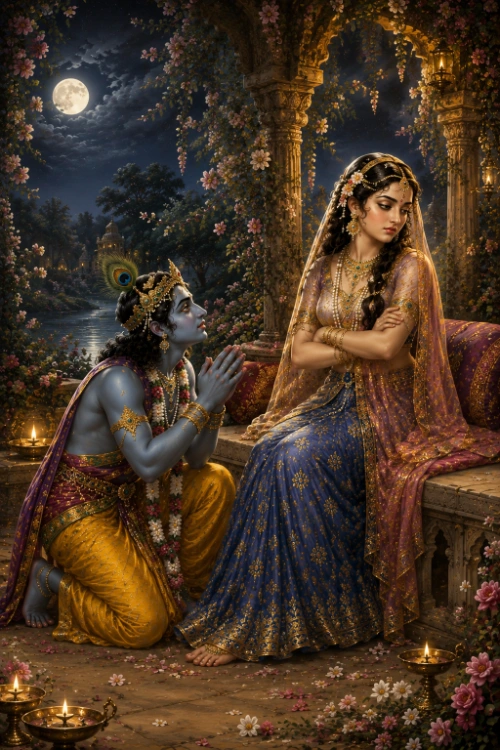
Meanwhile, at the end of the day, Hari approached beautiful-faced Rādhā. Her anger had become softened; her face was exhausted by endless sighing, and she bashfully looked toward the face of her friend. Filled with joy, his words faltering with emotion, Hari spoke.
Evening came. Rādhā’s anger had not vanished— but it was no longer hard. Endless sighing had exhausted her. Almost embarrassed by the change within her own heart, she glanced toward her sakhī. Kṛṣṇa understood. He approached. Joy rose in him so strongly that his voice itself began to tremble. And Hari spoke to Rādhā.
Commentary
The key phrase is: मसृणरोष — masṛṇa-roṣa literally “softened anger.” Rādhā has not abruptly forgotten what happened. Her māna is melting gradually. The sakhī’s work in Sarga IX has succeeded. Also important is: गद्गद — gadgada a voice broken, indistinct or choked by emotion. The clever Kṛṣṇa of this canto is not emotionally detached. He is deeply invested in Rādhā’s response.
Textual Note
The reading followed here, मसृणरोषवशाम् असीम — masṛṇa-roṣa-vaśām asīma, is that of the Gauḍīya recension and of the anvaya tradition, and Miller likewise translates “the force of her anger softened”; the Kāvyamālā text printed at GRETIL instead reads अमसृणरोषवशाम् अपार — amasṛṇa-roṣa-vaśām apāra, “possessed by unsoftened anger, boundless in sighing.” For दिनान्ते dinānte, “at day’s end,” the Gauḍīya edition prints प्रदोषे pradoṣe, “at nightfall.”
Song 19
Vadasi yadi kiñcid api danta-ruci — deśa-varāḍī rāga — aṣṭatālī tāla
प्रिये चारुशीले मुञ्च मयि मानमनिदानम् ।
सपदि मदनानलो दहति मम मानसं
देहि मुखकमलमधुपानम् ॥
priye cāru-śīle muñca mayi mānam anidānam |
sapadi madanānalo dahati mama mānasaṁ
dehi mukha-kamala-madhu-pānam ||
“Beloved, beautiful in character, give up this groundless anger toward me. The fire of Love burns my heart. Let me drink the honey of your lotus-face.”
Commentary
Beloved, Give Up This Anger
These lines are the dhruva-pada, the refrain returning after every stanza of the song. Kṛṣṇa now speaks for himself, and he does not defend himself. There is no account of the night, no explanation of the marks on his body. He simply places himself beneath her authority, praises her, invites her to punish him, and asks to be allowed to speak with her again.
The Kāvyamālā text and the Gauḍīya edition agree in prescribing deśa-varāḍī rāga and aṣṭatālī tāla for this song; some editions print aṣṭatāla for aṣṭatālī.
S19.1
वदसि यदि किञ्चिदपि दन्तरुचिकौमुदी
हरति दरतिमिरमतिघोरम् ।
स्फुरदधरसीधवे तव वदनचन्द्रमा
रोचयतु लोचनचकोरम् ॥
vadasi yadi kiñcid api danta-ruci-kaumudī
harati dara-timiram ati-ghoram |
sphurad-adhara-sīdhave tava vadana-candramā
rocayatu locana-cakoram ||
If you speak even a little, the moonlight radiance of your teeth dispels the exceedingly terrible darkness of my fear. May the moon of your face delight my cakora-like eyes with the intoxicating nectar of your trembling lips.
Rādhā— just say something. One word. When your lips open, the moonlight of your shining teeth drives away the darkness of my fear. Let the moon of your face rise before me. My eyes are like cakora birds that live only to drink its light. And your trembling lips hold another nectar still.
Commentary
The Cakora Image
Indian poetic tradition imagines the cakora bird as living upon moonlight. Kṛṣṇa therefore makes Rādhā’s face the moon and his own eyes the cakora birds. His sight depends upon her appearance almost as though it were nourishment.
Anidāna-māna
Kṛṣṇa calls her anger: अनिदान — anidāna “without cause” or “without sufficient basis.” This is Kṛṣṇa’s rhetoric of appeasement; it should not be mistaken for the poet denying Rādhā’s genuine experience. From Rādhā’s perspective, her anger has had very substantial causes.
S19.2
सत्यमेवासि यदि सुदति मयि कोपिनी
देहि खरनखरशरघातम् ।
घटय भुजबन्धनं जनय रदखण्डनं
येन वा भवति सुखजातम् ॥
satyam evāsi yadi sudati mayi kopinī
dehi khara-nakhara-śara-ghātam |
ghaṭaya bhuja-bandhanaṁ janaya rada-khaṇḍanaṁ
yena vā bhavati sukha-jātam ||
Beautiful-toothed one, if you truly are angry with me, then strike me with the sharp arrows of your nails. Bind me with your arms. Mark me with your teeth. Do whatever gives rise to your satisfaction.
Commentary
If You Are Angry, Punish Me
Kṛṣṇa does not merely ask Rādhā to suppress her anger. He says: express it upon me. Scratch me. Bite me. Bind me. Punishment becomes preferable to emotional distance. This marks an important shift: Kṛṣṇa is willing to make his own body the place where Rādhā’s anger is resolved.
Textual Note
The word for “nail” here is नखर nakhara, not नख nakha: the Kāvyamālā text and the Gauḍīya edition both read खरनखरशरघातम् khara-nakhara-śara-ghātam, and the shorter form leaves the line a mātrā short of the fourteen its metre requires.
S19.3
त्वमसि मम भूषणं त्वमसि मम जीवनं
त्वमसि मम भवजलधिरत्नम् ।
भवतु भवतीह मयि सततमनुरोधिनी
तत्र मम हृदयमतियत्नम् ॥
tvam asi mama bhūṣaṇaṁ tvam asi mama jīvanaṁ
tvam asi mama bhava-jaladhi-ratnam |
bhavatu bhavatīha mayi satatam anurodhinī
tatra mama hṛdayam ati-yatnam ||
You are my ornament. You are my life. You are my jewel in the ocean of worldly existence. May you always remain lovingly favourable toward me. Toward that alone my heart strives with the greatest intensity.
Commentary
You Are My Ornament, My Life
The Three Declarations
Kṛṣṇa makes three increasingly powerful statements. त्वमसि मम भूषणम् tvam asi mama bhūṣaṇam “You are my ornament.” Rādhā does not merely wear ornaments. She ornaments Kṛṣṇa’s existence.
त्वमसि मम जीवनम् tvam asi mama jīvanam “You are my life.” This is stronger. Without Rādhā, Kṛṣṇa says, his life itself loses meaning.
त्वमसि मम भवजलधिरत्नम् tvam asi mama bhava-jaladhi-ratnam “You are my jewel in the ocean of existence.” The entire world of becoming becomes an ocean— and Rādhā is the treasure found within it.
Textual Note
The Gauḍīya edition and the anvaya tradition read त्वमसि भवजलधिरत्नम् without the second mama. The Kāvyamālā text preserves त्वमसि मम भवजलधिरत्नम्, which produces the elegant threefold parallel: mama bhūṣaṇam — mama jīvanam — mama bhava-jaladhi-ratnam.
S19.4
नीलनलिनाभमपि तन्वि तव लोचनं
धारयति कोकनदरूपम् ।
कुसुमशरबाणभावेन यदि रञ्जयसि
कृष्णमिदमेतदनुरूपम् ॥
nīla-nalinābham api tanvi tava locanaṁ
dhārayati kokanada-rūpam |
kusuma-śara-bāṇa-bhāvena yadi rañjayasi
kṛṣṇam idam etad anurūpam ||
Slender one, your eye normally resembles a blue lotus— yet now it has assumed the form of a red lotus. If, acting as the arrow of the flower-armed god of Love, it colours Kṛṣṇa red with passion, then this transformation is entirely fitting.
Commentary
Rādhā’s Eyes Become Kāma’s Arrows
Wordplay: Rañjayasi Kṛṣṇam
The line contains beautiful colour-play. Rādhā’s eye is normally blue lotus-like. Anger and emotion have reddened it so that it resembles kokanada, the red lotus. Kṛṣṇa then says that this red eye may: रञ्जयसि कृष्णम् — rañjayasi kṛṣṇam which can suggest both “colour the dark Kṛṣṇa” and “delight / inflame Kṛṣṇa with passion.” Thus even Rādhā’s angry glance becomes one of Kāma’s arrows.
S19.5
स्फुरतु कुचकुम्भयोरुपरि मणिमञ्जरी
रञ्जयतु तव हृदयदेशम् ।
रसतु रशनापि तव घनजघनमण्डले
घोषयतु मन्मथनिदेशम् ॥
sphuratu kuca-kumbhayor upari maṇi-mañjarī
rañjayatu tava hṛdaya-deśam |
rasatu raśanāpi tava ghana-jaghana-maṇḍale
ghoṣayatu manmatha-nideśam ||
Let the cluster of jewels tremble upon the vessels of your breasts and beautify the region of your heart. Let the girdle ring upon the fullness of your hips— proclaiming the command of Manmatha.
Commentary
Let Your Ornaments Announce Love’s Command
The scene now shifts from silence to sound. Rādhā has been withholding speech. Kṛṣṇa imagines another kind of speech: her ornaments themselves will speak. The moving necklace and ringing girdle become heralds announcing: मन्मथनिदेश — manmatha-nideśa “the command of Love.”
Textual Note
The word for girdle appears as both रशना — raśanā and रसना — rasanā in different witnesses. Both are transmitted in the Gīta-govinda textual tradition.
S19.6
स्थलकमलगञ्जनं मम हृदयरञ्जनं
जनितरतिरङ्गपरभागम् ।
भण मसृणवाणि करवाणि चरणद्वयं
सरसलसदलक्तकरागम् ॥
sthala-kamala-gañjanaṁ mama hṛdaya-rañjanaṁ
janita-rati-raṅga-parabhāgam |
bhaṇa masṛṇa-vāṇi karavāṇi caraṇa-dvayaṁ
sarasa-lasad-alaktaka-rāgam ||
Soft-spoken one, speak! Let me colour with shining fresh lac your two feet— which put land-grown lotuses to shame, delight my heart, and produce supreme beauty in the play of love.
Speak to me, gentle-voiced Rādhā. Let me take your feet into my hands. Even the finest lotus growing upon the earth is defeated by their softness and beauty. Let me paint them crimson with fresh lac. Let me serve the very feet that delight my heart.
Commentary
Let Me Paint Your Feet
A Major Reversal from Sarga VII
This stanza deserves special attention. In Sarga VII, tortured by jealousy, Rādhā imagined Kṛṣṇa decorating another woman’s feet: यावकभरणम् applying red lac as ornament. Now Kṛṣṇa stands before Rādhā and says: “Let me paint your feet.” The imagined rival is disappearing. The action Rādhā feared belonged to another woman is offered directly to her.
Textual Note
The reading चरणद्वयम् — caraṇa-dvayam, “your two feet,” is given by every edition consulted here — the Kāvyamālā text, the Gauḍīya recension and the anvaya tradition — and Miller likewise translates a plural; this page previously printed पदपङ्कजम् pada-paṅkajam, “lotus-foot,” which none of them supports and which anticipates the पदपल्लवम् pada-pallavam of the following stanza.
S19.7
स्मरगरलखण्डनं मम शिरसि मण्डनं
देहि पदपल्लवमुदारम् ।
ज्वलति मयि दारुणो मदनकदनारुणो
हरतु तदुपाहितविकारम् ॥
smara-garala-khaṇḍanaṁ mama śirasi maṇḍanaṁ
dehi pada-pallavam udāram |
jvalati mayi dāruṇo madana-kadanāruṇo
haratu tad-upāhita-vikāram ||
Place upon my head your generous, tender leaf-like foot— the destroyer of the poison of Smara and an ornament for my head. The terrible fire-red torment of Love burns within me. May your foot remove the agitation produced by it.
Rādhā— give me your tender foot. Place it upon my head. Let the foot that destroys the poison of Love become my crown. The fire of desire burns terribly within me. Only your touch can cure what Love has done.
Commentary
The Great Verse: Place Your Foot Upon My Head
Why This Verse Is So Extraordinary
The line is not merely an erotic compliment. Kṛṣṇa says that Rādhā’s foot is: मम शिरसि मण्डनम् mama śirasi maṇḍanam “an ornament upon my head.” The normal hierarchy is reversed. The head represents honour and superiority. The foot ordinarily occupies the lowest physical position. Kṛṣṇa deliberately asks for Rādhā’s lowest limb upon his highest limb. It is difficult to imagine a more complete poetic expression of surrender.
Smara-garala: The Poison of Love
Kṛṣṇa calls desire: स्मरगरल — smara-garala “the poison of Smara,” the poison of Kāma. Earlier both Rādhā and Kṛṣṇa suffered under Kāma’s arrows. Now Kṛṣṇa identifies a single antidote: Rādhā’s foot. The medical metaphor that appeared in Sarga IV therefore returns. There Rādhā could be cured only by contact with Kṛṣṇa. Here Kṛṣṇa can be cured only by contact with Rādhā. The reciprocity is complete.
A Famous Devotional Tradition
A much-loved later tradition surrounding Jayadeva connects itself specifically with this verse. According to the story, Jayadeva hesitated when he reached the idea of Kṛṣṇa asking Rādhā to place her foot upon his head. Could the supreme Lord really be represented in such a subordinate position? Jayadeva left the line unfinished and went to bathe. During his absence, Kṛṣṇa himself is said to have appeared in Jayadeva’s form before Padmāvatī, entered the house and completed the verse: देहि पदपल्लवमुदारम् dehi pada-pallavam udāram When the real Jayadeva returned and saw the completed line, he understood the event as divine confirmation that the verse should remain. This story belongs to the later devotional reception and hagiography of Jayadeva, not to the narrative text of the Gīta-govinda itself. But its popularity reveals how astonishing generations of readers found this line. The scandalous question was precisely: Can God place Rādhā’s foot upon his head? The devotional tradition answers: yes—and Kṛṣṇa himself approved the statement.
A Significant Textual Variant
The second half of the stanza is transmitted in more than one form. The reading followed above, मदनकदनारुणः — madana-kadanāruṇaḥ, suggesting the burning, fiery-red torment produced by Love, is that of the Kāvyamālā text, and Miller renders it accordingly; the Gauḍīya edition and the anvaya tradition read मदनकदनानलः — madana-kadanānalaḥ, “the fire of the torment of Love,” which makes the fire metaphor completely explicit. Both lead to the same dramatic meaning: Kṛṣṇa burns, and Rādhā is the remedy. Some witnesses also read धेहि dhehi, “place,” for देहि dehi, “give.”
S19.8
इति चटुलचाटुपटुचारु मुरवैरिणो
राधिकामधि वचनजातम् ।
जयति पद्मावतीरमणजयदेवकवि-
भारतीभणितमतिशातम् ॥
iti caṭula-cāṭu-paṭu-cāru mura-vairiṇo
rādhikām adhi vacana-jātam |
jayati padmāvatī-ramaṇa-jayadeva-kavi-
bhāratī-bhaṇitam atiśātam ||
Victorious are these charming, flattering, skilful and beautiful words spoken by the enemy of Mura to Rādhikā— words uttered through the poetic voice of Jayadeva, beloved of Padmāvatī, producing supreme delight.
Commentary
Jayadeva’s Signature
This signature is especially personal. Jayadeva identifies himself as: पद्मावतीरमण — Padmāvatī-ramaṇa “the beloved / husband of Padmāvatī.” The poet celebrating the intimate love of Rādhā and Kṛṣṇa thus inscribes his own beloved Padmāvatī into the poem.
Textual Variant
The Kāvyamālā text and the Gauḍīya edition print the ending as जयति जयदेवकविभारतीभूषितं मानिनीजनजनितशातम्, describing the song as adorned by Jayadeva’s poetic speech and giving delight to proud heroines; both record the Padmāvatī-ramaṇa reading followed above as the variant carried by the commentaries.
56
परिहर कृतातङ्के शङ्कां त्वया सततं घन-
स्तनजघनयाक्रान्ते स्वान्ते परानवकाशिनि ।
विशति वितनोरन्यो धन्यो न कोऽपि ममान्तरं
स्तनभरपरीरम्भारम्भे विधेहि विधेयताम् ॥ ५६ ॥
parihara kṛtātaṅke śaṅkāṁ tvayā satataṁ ghana-
stana-jaghanayākrānte svānte parānavakāśini |
viśati vitanor anyo dhanyo na ko ’pi mamāntaraṁ
stana-bhara-parīrambhārambhe vidhehi vidheyatām || 56 ||
Anxious one, abandon your suspicion. My heart is constantly occupied by you—by your full breasts and hips—and leaves no room for another. Apart from the bodiless god of Love, no other fortunate being enters within me. Therefore be gracious when I begin to embrace the fullness of your breasts.
Rādhā— stop doubting me. My heart is already completely occupied. You are inside it. There is no space left for another woman. Only bodiless Kāma enters there beside you— and he enters because of you. So let suspicion end. Let me embrace you.
Commentary
There Is No Room in My Heart for Another
Kṛṣṇa continues speaking after the Aṣṭapadī.
The Argument Against the Rival
This directly addresses the fear dominating Sargas VII and VIII. Rādhā feared: another woman occupies Kṛṣṇa’s desire. Kṛṣṇa answers: परानवकाशिनि स्वान्ते parānavakāśini svānte my heart “leaves no space for another.” Whether Rādhā immediately believes him is secondary. The important point is that Kṛṣṇa finally addresses the underlying wound: her fear of being replaceable.
Vitanu
वितनु — vitanu “bodiless,” refers to Kāma, equivalent to Anaṅga, after Śiva burned his body. Thus Kṛṣṇa says that the only “other” who enters his heart is Love itself.
Textual Note
The fourth quarter is transmitted both as स्तनभरपरीरम्भारम्भे stana-bhara-parīrambhārambhe, followed here and rendered by Miller as “when I start to press your heavy breasts,” and as प्रणयिनि परीरम्भारम्भे praṇayini parīrambhārambhe, “beloved, as I begin the embrace,” which is the reading of the Kāvyamālā text and the Gauḍīya edition.
57
मुग्धे विधेहि मयि निर्दयदन्तदंश-
दोर्वल्लिबन्धनिबिडस्तनपीडनानि ।
चण्डि त्वमेव मुदमञ्च न पञ्चबाण-
चण्डालकाण्डदलनादसवः प्रयान्तु ॥ ५७ ॥
mugdhe vidhehi mayi nirdaya-danta-daṁśa-
dor-valli-bandha-nibiḍa-stana-pīḍanāni |
caṇḍi tvam eva mudam añca na pañca-bāṇa-
caṇḍāla-kāṇḍa-dalanād asavaḥ prayāntu || 57 ||
Enchanting one, inflict upon me your merciless bites. Bind me with your vine-like arms. Crush me tightly with your breasts. Fierce Rādhā— you yourself take pleasure in punishing me. Do not let my life depart beneath the destroying shafts of that outcaste Five-Arrowed Kāma.
Commentary
Punish Me Yourself—Do Not Let Kāma Kill Me
Kāma is called: पञ्चबाण — pañcabāṇa “the Five-Arrowed One.” But Kṛṣṇa adds the deliberately abusive: चण्डाल — caṇḍāla “outcaste, cruel wretch.” The logic is humorous and erotic: “If someone is going to torment me, let it be you—not Kāma.” Once again Rādhā’s anger is transformed from obstacle into possible intimacy.
Textual Note
The reading मुदमञ्च न mudam añca na, followed here, is that of the Gauḍīya edition; the Kāvyamālā text reads मुदमुद्वह mudam udvaha, “go on rejoicing,” leaving असवः प्रयान्तु unnegated.
58
शशिमुखि तव भाति भङ्गुरभ्रूः
युवजनमोहकरालकालसर्पी ।
तदुदितविषभञ्जनाय यूनां
त्वदधरसीधुसुधैव सिद्धमन्त्रः ॥
śaśi-mukhi tava bhāti bhaṅgura-bhrūr
yuva-jana-moha-karāla-kāla-sarpī |
tad-udita-viṣa-bhañjanāya yūnāṁ
tvad-adhara-sīdhu-sudhaiva siddha-mantraḥ ||
Moon-faced one, your curved eyebrow appears like a terrible black serpent capable of bewildering young men. And for destroying the poison produced by that serpent, the nectar-wine of your lips is the one proven mantra.
Commentary
A Fuller Recensional Verse: Rādhā’s Eyebrow as a Serpent
Some important commentarial recensions preserve an additional verse here that is absent from the most compact form of the text; Miller’s translation, for example, passes directly from the preceding stanza to the next.
The imagery returns to a motif already used earlier: the eyebrow becomes serpent, bow and weapon, while the lips become the antidote. Rādhā is simultaneously the source of Kṛṣṇa’s wound and the medicine for it. That structure repeatedly defines Jayadeva’s erotic theology.
Textual Note
This page previously read युवजनमोहन yuva-jana-mohana, one syllable too many for the puṣpitāgrā metre; the Kāvyamālā text and the Gauḍīya edition both read युवजनमोह yuva-jana-moha, which the metre requires. Those same editions read तदुदितभयभञ्जनाय tad-udita-bhaya-bhañjanāya, “to break the fear arising from it,” where the anvaya tradition followed above reads तदुदितविषभञ्जनाय tad-udita-viṣa-bhañjanāya, “to break the poison arising from it.”
59
व्यथयति वृथा मौनं तन्वि प्रपञ्चय पञ्चमं
तरुणि मधुरालापैस्तापं विनोदय दृष्टिभिः ।
सुमुखि विमुखीभावं तावद्विमुञ्च न मुञ्च मां
स्वयमतिशयस्निग्धो मुग्धे प्रियोऽयमुपस्थितः ॥ ५९ ॥
vyathayati vṛthā maunaṁ tanvi prapañcaya pañcamaṁ
taruṇi madhurālāpais tāpaṁ vinodaya dṛṣṭibhiḥ |
sumukhi vimukhī-bhāvaṁ tāvad vimuñca na muñca māṁ
svayam atiśaya-snigdho mugdhe priyo ’yam upasthitaḥ || 59 ||
Slender one, your needless silence torments me. Unfold the fifth note. Young woman, remove my suffering with sweet speech and with your glances. Beautiful-faced one, give up turning away—but do not give me up. Enchanting Rādhā, your exceedingly affectionate beloved has himself come before you.
Your silence hurts me, Rādhā. Speak. Let your voice rise like the fifth musical note. Give me your sweet words. Give me one glance. Turn away from turning away— but do not turn away from me. Your lover has come himself. I am standing here before you.
Commentary
Your Silence Hurts Me
The Musical Phrase: Pañcama
प्रपञ्चय पञ्चमम् — prapañcaya pañcamam literally means “expand the fifth.” Pañcama is the fifth note of the classical scale—Pa. Kṛṣṇa turns Rādhā’s speech into music. He does not merely say: “Talk to me.” He says: “Let me hear the music of your voice again.”
The Wordplay of Vimuñca / Na Muñca
विमुखीभावं विमुञ्च abandon the state of turning away; but: न मुञ्च माम् do not abandon me. The sound repetition makes the plea especially elegant.
60
बन्धूकद्युतिबान्धवोऽयमधरः स्निग्धो मधूकच्छवि-
र्गण्डश्चण्डि चकास्ति नीलनलिनश्रीमोचनं लोचनम् ।
नासाभ्येति तिलप्रसूनपदवीं कुन्दाभदन्ति प्रिये
प्रायस्त्वन्मुखसेवया विजयते विश्वं स पुष्पायुधः ॥ ६० ॥
bandhūka-dyuti-bāndhavo ’yam adharaḥ snigdho madhūka-cchavir
gaṇḍaś caṇḍi cakāsti nīla-nalina-śrī-mocanaṁ locanam |
nāsābhyeti tila-prasūna-padavīṁ kundābha-danti priye
prāyas tvan-mukha-sevayā vijayate viśvaṁ sa puṣpāyudhaḥ || 60 ||
Fierce beloved— your soft lip is a companion to the brilliance of the bandhūka flower. Your cheek shines with the beauty of the madhūka blossom. Your eye steals the splendour of the blue lotus. O you whose teeth resemble jasmine buds, your nose follows the form of the sesame flower. Surely the flower-armed god of Love conquers the entire world by serving your face and obtaining his weapons from it.
Commentary
Rādhā’s Face Is Kāma’s Entire Flower-Arsenal
Rādhā’s Face as Kāma’s Armoury
Kāma is: पुष्पायुध — puṣpāyudha “the flower-armed one.” His weapons are flowers. But Kṛṣṇa now discovers all of Love’s flowers within Rādhā’s face: lips — bandhūka; cheeks — madhūka; eyes — blue lotus; nose — sesame flower; teeth — kunda, jasmine. The conclusion is delightful: perhaps Kāma conquers the universe only because Rādhā supplies his weapons. This elevates Rādhā’s beauty above the god of Love himself.
The commentaries also record सेनया senayā, “by your army,” for सेवया sevayā, “by serving.”
61
दृशौ तव मदालसे वदनमिन्दुसन्दीपनं
गतिर्जनमनोरमा विजितरम्भमूरुद्वयम् ।
रतिस्तव कलावती रुचिरचित्रलेखे भ्रुवा-
वहो विबुधयौवतं वहसि तन्वि पृथ्वीगता ॥ ६१ ॥
dṛśau tava madālase vadanam indu-sandīpanaṁ
gatir jana-mano-ramā vijita-rambham ūru-dvayam |
ratis tava kalāvatī rucira-citra-lekhe bhruvāv
aho vibudha-yauvataṁ vahasi tanvi pṛthvī-gatā || 61 ||
Your eyes are languid with passion. Your face kindles the moon itself. Your gait delights the minds of people. Your two thighs surpass the plantain trunk. Your love is endowed with every art. Your eyebrows are beautiful painted lines. Ah, slender one! Though you dwell upon the earth, you bear the youthful beauty of the women of heaven.
Your eyes are heavy with love. Your face teaches the moon how to shine. Your walk steals the minds of those who see it. Your thighs defeat even the smooth plantain stem. Every art of love lives within you. Your eyebrows seem drawn by a master painter. Rādhā— how can someone standing upon this earth possess such heavenly youth?
Commentary
You Carry Heavenly Youth Upon the Earth
The commentators read each phrase twice, since madālasā, indumatī, manoramā, rambhā, kalāvatī and citralekhā are also the names of celestial courtesans; Miller’s translation brings this second sense to the surface. Read that way, the verse says that the whole company of heaven’s beauties is present in one woman walking upon the earth.
Textual Variants
The verse has several well-attested variants. For वदनमिन्दुसन्दीपनम् “your face kindles the moon,” the reading of the Kāvyamālā text and the Gauḍīya edition and followed here, the anvaya tradition reads वदनमिन्दुमत्युज्ज्वलम् “your face is exceedingly brighter than the moon”; this page previously printed सन्दीपकम्, which the editions consulted do not carry. Similarly विजितरम्भम् “conquering the plantain” alternates with विधुतरम्भम् “putting the plantain to shame.” The final compound is विबुधयौवतम् vibudha-yauvatam, “the young women of the gods,” in all the editions consulted, in place of the easier यौवनम् yauvanam, “youth,” printed here before. The poetic intention is unchanged throughout: Rādhā surpasses conventional standards of beauty.
Benediction
प्रीतिं वस्तनुतां हरिः कुवलयापीडेन सार्धं रणे
राधापीनपयोधरस्मरणकृत्कुम्भेन सम्भेदवान् ।
यत्र स्विद्यति मीलति क्षणमपि क्षिप्रं तदालोकन-
व्यामोहेन जितं जितं जितमभूत् कंसस्य कोलाहलः ॥
prītiṁ vas tanutāṁ hariḥ kuvalayāpīḍena sārdhaṁ raṇe
rādhā-pīna-payodhara-smaraṇa-kṛt-kumbhena sambhedavān |
yatra svidyati mīlati kṣaṇam api kṣipraṁ tad-ālokana-
vyāmohena jitaṁ jitaṁ jitam abhūt kaṁsasya kolāhalaḥ ||
May Hari increase your joy— Hari who, while clashing in battle with the elephant Kuvalayāpīḍa, saw its massive frontal globes and was reminded of the fullness of Rādhā’s breasts. For a moment he perspired and closed his eyes. Seeing this and misunderstanding it, Kaṁsa’s party immediately raised a tumultuous cry: “Victory! Victory! We have won!”
Commentary
A Fuller Closing Benediction: Kṛṣṇa Remembers Rādhā Even in Battle
A fuller commentarial tradition preserves this additional closing verse, absent from the most compact form of Sarga X.
The Joke
The verse refers to the famous episode in which Kṛṣṇa confronts Kaṁsa’s elephant Kuvalayāpīḍa. But Jayadeva erotically rewrites even this heroic event. The elephant’s great kumbhas, frontal globes, remind Kṛṣṇa of Rādhā. In the middle of mortal combat, he thinks of her breasts. He momentarily reacts. Kaṁsa interprets Kṛṣṇa’s reaction as weakness and thinks victory has been achieved. The reader knows otherwise. The true force capable of distracting Kṛṣṇa is not the elephant. It is Rādhā’s memory.
Textual Note
प्रीतिं वस्तनुताम् prītiṁ vas tanutām, “may he extend joy to you all,” is the reading of the Haridāsa Gauḍīya recension and is followed here; the Kāvyamālā text and the printed Gauḍīya edition begin स प्रीतिं तनुताम् sa prītiṁ tanutām. Those editions also transmit a differently worded second half, in which the elephant is flung aside and Kaṁsa’s people raise their cry “on the instant” rather than “on seeing this.”
Colophon
इति श्रीगीतगोविन्दे मानिनीवर्णने चतुरचतुर्भुजो नाम दशमः सर्गः ॥ १० ॥
iti śrī-gīta-govinde māninī-varṇane catura-caturbhujo nāma daśamaḥ sargaḥ || 10 ||
Thus ends the tenth sarga, named Catura-Caturbhuja, in the description of the māninī, of the illustrious Gīta-govinda.
Commentary
The Māninī
The colophon identifies this canto as: मानिनीवर्णन — māninī-varṇana the portrayal of the māninī, the woman possessing māna—offended pride, dignity and jealous resentment within love. This is appropriate because Rādhā has not yet completely surrendered her anger. But the nature of the conflict has changed. In Sarga VIII: Rādhā speaks and Kṛṣṇa receives the accusations. In Sarga X: Kṛṣṇa speaks and Rādhā listens. That simple fact already demonstrates progress. Communication has reopened.
Kṛṣṇa Does Not Defeat Rādhā’s Anger by Argument
One of the most important things about Sarga X is what Kṛṣṇa does not do. He does not construct a detailed defence. He does not say: “You misunderstood the marks on my body.” He does not cross-examine Rādhā. He does not demand trust because he is God. Instead he speaks in the language of relationship: You are my ornament. You are my life. There is no room for another within my heart. Punish me if necessary. Let me decorate your feet. Place your foot upon my head. The purpose is not to win the argument. It is to win back Rādhā’s heart. That is why he is: Catura clever not merely in speech, but in understanding what reconciliation requires.
From “Do Not Speak” to “Speak”
The movement from Sarga VIII to Sarga X can be compressed into two opposite commands. In Sarga VIII Rādhā said: मा वद mā vada “Do not speak.” In Sarga X Kṛṣṇa begs: वदसि यदि किञ्चिदपि vadasi yadi kiñcid api “If only you would say even a little…” And later: भण मसृणवाणि bhaṇa masṛṇa-vāṇi “Speak, gentle-voiced one.” Reconciliation begins when silence ends.
The Rival Is Gradually Erased
Sargas VII and VIII revolved around the possibility of another woman. In Sarga X Kṛṣṇa systematically reverses that fear. He says: त्वमसि मम जीवनम् “You are my life.” Then: परानवकाशिनि स्वान्ते “My heart leaves no room for another.” And finally he offers to perform directly for Rādhā one of the very actions she had imagined him performing for the rival: painting her feet with lac. The psychology is elegant. Jayadeva does not make the rival disappear by explaining who she was. He makes her irrelevant by filling Kṛṣṇa’s speech entirely with Rādhā.
Rādhā as the Source of Kāma’s Power
Another pattern runs throughout the canto. Kāma is supposed to conquer the world. But Kṛṣṇa repeatedly suggests that Kāma’s power actually derives from Rādhā: her eyes become Love’s arrows; her eyebrow becomes a serpent; her face supplies Kāma’s flower-weapons; her ornaments proclaim Kāma’s commands; her body generates the rasa Kāma seeks. Thus the hierarchy becomes: Kāma conquers others. But: Rādhā arms Kāma. And therefore Rādhā conquers Kṛṣṇa.
The Most Radical Inversion
The greatest reversal of all is: मम शिरसि मण्डनम् देहि पदपल्लवमुदारम् “Let your tender foot become an ornament upon my head.” Elsewhere Kṛṣṇa’s feet are the objects of worship. Jayadeva himself repeatedly invokes: Hari’s feet, Keśava’s feet, Govinda’s lotus feet. Yet within the intimate economy of Rādhā-Kṛṣṇa prema, Kṛṣṇa asks for Rādhā’s foot. That does not erase Kṛṣṇa’s divinity. It reveals another dimension of it. The Lord who is worshipped by others is himself capable of loving so completely that he becomes subordinate to the beloved.
The Gods Bow to Kṛṣṇa; Kṛṣṇa Bows to Rādhā
This is perhaps the simplest way to understand the theological force of the canto. The larger tradition knows Kṛṣṇa as: Nārāyaṇa. Lakṣmīpati. Caturbhuja. Madhusūdana. Murāri. He defeats demons. He destroys Kaṁsa. He is worshipped by gods. Yet Jayadeva places this divine figure before Rādhā and makes him say: “You are my life.” “Punish me.” “Let me paint your feet.” “Place your foot upon my head.” The Gīta-govinda therefore does not simply portray Rādhā as a woman devoted to God. It moves toward a far more audacious idea: God himself is conquered by Rādhā’s love.
Why Catura-Caturbhuja?
The title now reveals its full irony. Caturbhuja evokes transcendental majesty. Catura evokes worldly erotic cleverness. Kṛṣṇa possesses both. But what is his great cleverness used for? Not conquering a kingdom. Not killing a demon. Not teaching metaphysics. It is used to solve the most delicate problem imaginable: how to make Rādhā smile at him again. That is the entire battle of Sarga X.
From Sarga X to Sarga XI
Kṛṣṇa has now gone as far as speech can take him. He has praised Rādhā. He has reassured her. He has offered himself for punishment. He has asked to serve her feet. The fortress of māna is collapsing. But Jayadeva still delays the actual union for one final movement. In Sarga XI — Sānanda-Dāmodara, “Dāmodara Filled with Joy” — the sakhīs will see that Rādhā’s anger has finally dissolved. They will urge her once more toward the bower. But this time the mood will be entirely different from Sarga V. Earlier Rādhā had to be persuaded to go toward a doubtful rendezvous. Now Kṛṣṇa is unquestionably waiting. The sakhī will describe: the flower-bower; the soft leaf-bed; the night; Kṛṣṇa’s eagerness; Rādhā’s trembling anticipation. And Rādhā will finally enter.
Thus the progression becomes: Sarga VIII, Rādhā: “Go away.” — Sarga IX, the sakhī: “Let go of māna.” — Sarga X, Kṛṣṇa: “You are my life. Place your foot upon my head.” — Sarga XI, Rādhā finally moves toward union. The long arc of separation is almost complete.
The māninī
The colophon calls this the māninī-varṇana, the portrayal of the woman who holds māna — offended pride, dignity, jealous resentment inside love. The name is accurate, because Rādhā has not yet given up her anger. But the shape of the conflict has changed completely. In the eighth canto Rādhā spoke and Kṛṣṇa received the accusations; here Kṛṣṇa speaks and Rādhā listens. That alone is progress: communication has reopened.
From “do not speak” to “speak”
The distance travelled can be compressed into two opposite commands. In the eighth canto Rādhā said mā vada, do not speak. Here Kṛṣṇa begs vadasi yadi kiñcid api, if only you would say even a little, and later bhaṇa masṛṇa-vāṇi, speak, gentle-voiced one. Reconciliation begins where the silence ends.
The rival is erased rather than refuted
The seventh and eighth cantos turned on the possibility of another woman. Kṛṣṇa reverses that fear without ever addressing it. He says tvam asi mama jīvanam, you are my life; then parānavakāśini svānte, my heart leaves no room for another; and finally he offers to perform for Rādhā the very act she had imagined him performing for the rival — painting her feet with lac. Jayadeva does not make the rival disappear by explaining who she was. He makes her irrelevant by filling Kṛṣṇa’s speech entirely with Rādhā.
Rādhā as the source of Kāma’s power
A second pattern runs under the first. Kāma is supposed to conquer the world, and Kṛṣṇa keeps suggesting that Kāma’s power is borrowed from Rādhā: her eyes are Love’s arrows, her eyebrow his bow-serpent, her face supplies his flower-weapons, her ornaments proclaim his commands, her body generates the rasa he is after. The god of love is not Kṛṣṇa’s rival here; he is Rādhā’s instrument.
Why Catura-Caturbhuja
Caturbhuja, the four-armed, is a name of Viṣṇu in majesty. Catura means clever — and not merely clever in speech, but clever in understanding what reconciliation actually requires. What it requires, it turns out, is not argument. The four-armed Lord wins by putting his head where her foot can reach it.