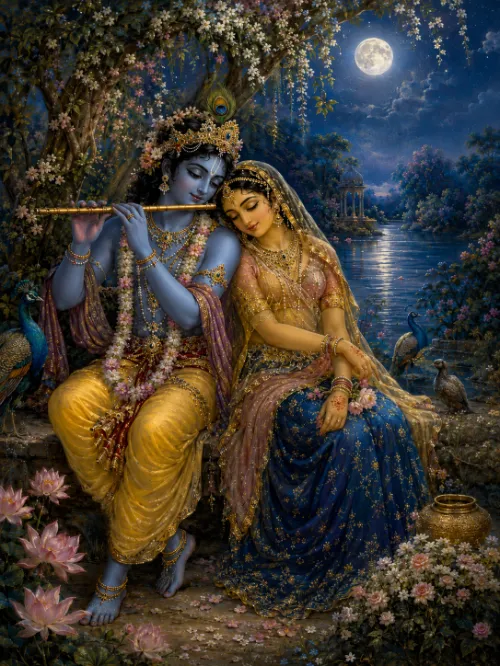
1
मेघैर्मेदुरमम्बरं वनभुवः श्यामास्तमालद्रुमैः
नक्तं भीरुरयं त्वमेव तदिमं राधे गृहं प्रापय ।
इत्थं नन्दनिदेशतश्चलितयोः प्रत्यध्वकुञ्जद्रुमं
राधामाधवयोर्जयन्ति यमुनाकूले रहःकेलयः ॥ १ ॥
meghair meduram ambaraṁ vana-bhuvaḥ śyāmās tamāla-drumair
naktaṁ bhīrur ayaṁ tvam eva tad imaṁ rādhe gṛhaṁ prāpaya |
itthaṁ nanda-nideśataś calitayoḥ praty-adhva-kuñja-drumaṁ
rādhā-mādhavayor jayanti yamunā-kūle rahaḥ-kelayaḥ || 1 ||
“The sky is dense with clouds, and the forest lands are darkened by tamāla trees. Night has fallen, and this boy is timid. Therefore, Rādhā, You alone should take Him home.”
Thus instructed by Nanda, Rādhā and Mādhava set out together. Victorious are Their secret pastimes beneath the bowers and trees along the path on the bank of the Yamunā.
Commentary
This extraordinary opening contains the entire Gīta-govinda in miniature. Nanda apparently regards Kṛṣṇa as an innocent boy afraid of the dark and entrusts Him to Rādhā. But Jayadeva immediately reveals the hidden reality: instead of simply returning home, Rādhā and Kṛṣṇa enjoy rahaḥ-kelayaḥ, confidential amorous pastimes, along the Yamunā.
The darkness itself assists Them: dark clouds cover the sky; tamāla trees make the forest still darker; night conceals the lovers; and secluded kuñjas provide places of intimacy.
The verse therefore begins simultaneously on two levels. In Nanda’s perception, a young girl escorts a frightened boy home. In the poet’s perception, the eternal lovers have been given the perfect opportunity for secret union.
A widespread reading has nanda-nideśitaś, “thus instructed by Nanda,” whereas several important editions read the grammatically very natural nanda-nideśataḥ, “at Nanda’s instruction.”
The final phrase is crucial — rādhā-mādhavayor jayanti … rahaḥ-kelayaḥ, “victorious are the confidential pastimes of Rādhā and Mādhava.” It is effectively Jayadeva’s declaration of the subject of his poem.
2
वाग्देवताचरितचित्रितचित्तसद्मा
पद्मावतीचरणचारणचक्रवर्ती ।
श्रीवासुदेवरतिकेलिकथासमेतम्
एतं करोति जयदेवकविः प्रबन्धम् ॥ २ ॥
vāg-devatā-carita-citrita-citta-sadmā
padmāvatī-caraṇa-cāraṇa-cakravartī |
śrī-vāsudeva-rati-keli-kathā-sametam
etaṁ karoti jayadeva-kaviḥ prabandham || 2 ||
The poet Jayadeva—whose heart is a dwelling ornamented by the movements of the goddess of speech, and who is supreme in directing the movements of Padmāvatī’s feet—composes this work filled with accounts of the amorous pastimes of glorious Vāsudeva.
Commentary
Jayadeva introduces himself through two arts: poetry and dance. His heart is the residence of Vāgdevatā, Sarasvatī, the goddess of speech.
The expression padmāvatī-caraṇa-cāraṇa-cakravartī is deliberately brilliant. Jayadeva presents himself as the “emperor” in causing the feet of Padmāvatī—traditionally identified as his wife and dancer—to move.
Thus the Gīta-govinda is not simply a text to be silently read. From the beginning it belongs simultaneously to poetry, music, dance and devotion. And Jayadeva explicitly states his subject: śrī-vāsudeva-rati-keli-kathā, “the accounts of the love-play of Śrī Vāsudeva.”
3
यदि हरिस्मरणे सरसं मनो
यदि विलासकलासु कुतूहलम् ।
मधुरकोमलकान्तपदावलीं
शृणु तदा जयदेवसरस्वतीम् ॥ ३ ॥
yadi hari-smaraṇe sarasaṁ mano
yadi vilāsa-kalāsu kutūhalam |
madhura-komala-kānta-padāvalīṁ
śṛṇu tadā jayadeva-sarasvatīm || 3 ||
If your mind finds delight in remembering Hari, and if you are curious about the arts of His amorous play, then listen to Jayadeva’s speech—its succession of words sweet, tender and beautiful.
Commentary
This is perhaps Jayadeva’s clearest statement of how he expects his poem to be received. Two qualifications are given: hari-smaraṇa, remembrance of Hari, and vilāsa-kalā-kutūhala, sensitivity to the arts of divine amorous play. The erotic poetry that follows is therefore explicitly placed within Hari-smaraṇa.
Jayadeva describes his own language with three carefully chosen adjectives: madhura, sweet; komala, tender and delicate; kānta, beautiful and enchanting. This is almost a manifesto for the literary style of the entire work.
4
वाचः पल्लवयत्युमापतिधरः सन्दर्भशुद्धिं गिरां
जानीते जयदेव एव शरणः श्लाघ्यो दुरूहद्रुतेः ।
शृङ्गारोत्तरसत्प्रमेयरचनैराचार्यगोवर्धन-
स्पर्धी कोऽपि न विश्रुतः श्रुतिधरो धोयी कविक्ष्मापतिः ॥ ४ ॥
vācaḥ pallavayaty umāpatidharaḥ sandarbha-śuddhiṁ girāṁ
jānīte jayadeva eva śaraṇaḥ ślāghyo durūha-druteḥ |
śṛṅgārottara-sat-prameya-racanair ācārya-govardhana-
spardhī ko ’pi na viśrutaḥ śrutidharo dhoyī kavi-kṣmāpatiḥ || 4 ||
Umāpatidhara can make words blossom; Jayadeva alone understands purity of verbal composition. Śaraṇa is celebrated for swiftly composing difficult poetry. No one is known who can rival Ācārya Govardhana in compositions whose noble subject is dominated by erotic sentiment; and Dhoyī, possessed of extraordinary learning, is a king among poets.
Commentary
This unusual verse is historically valuable because Jayadeva names several celebrated poets—Umāpatidhara, Śaraṇa, Govardhana and Dhoyī—simultaneously praising them and situating himself among them.
It is textually difficult, and manuscripts vary at several points, especially around durūha-druteḥ / durūhādbhuteḥ.
The essential point remains clear: Jayadeva is consciously entering an elite Sanskrit literary world, but the subject he is about to treat—the intimate love of Rādhā and Kṛṣṇa—is uniquely his own poetic domain.
Song 1
Pralaya-payodhi-jale (Daśāvatāra) — mālava-gauḍa rāga — rūpaka tāla
Commentary
The famous Daśāvatāra hymn now interrupts the romantic opening. That is deliberate: before Jayadeva shows us Kṛṣṇa dancing with the young women of Vraja, he establishes exactly who Kṛṣṇa is.
S1.1
प्रलयपयोधिजले धृतवानसि वेदम् ।
विहितवहित्रचरित्रमखेदम् ॥
केशव धृतमीनशरीर जय जगदीश हरे ॥
pralaya-payodhi-jale dhṛtavān asi vedam
vihita-vahitra-caritram akhedam |
keśava dhṛta-mīna-śarīra
jaya jagadīśa hare ||
In the waters of the cosmic deluge You upheld the Veda, effortlessly performing the function of a saving vessel.
O Keśava, who assumed the body of the Fish—victory to You, O Lord of the universe, Hari!
Commentary
Kṛṣṇa is praised as Matsya, the fish avatāra who preserves sacred knowledge through the cosmic flood.
S1.2
क्षितिरतिविपुलतरे तव तिष्ठति पृष्ठे ।
धरणिधरणकिणचक्रगरिष्ठे ॥
केशव धृतकच्छपरूप जय जगदीश हरे ॥
kṣitir ati-vipulatare tava tiṣṭhati pṛṣṭhe
dharaṇī-dharaṇa-kiṇa-cakra-gariṣṭhe |
keśava dhṛta-kacchapa-rūpa
jaya jagadīśa hare ||
The earth rests upon Your immensely broad back, made massive with the circular mark produced by bearing its weight.
O Keśava, who assumed the form of the Tortoise—victory to You, O Lord of the universe, Hari!
Commentary
This is Kūrma, the cosmic tortoise. Jayadeva deliberately uses massive physical imagery: the divine back bears an enormous burden so long that it seems marked by the pressure.
S1.3
वसति दशनशिखरे धरणी तव लग्ना ।
शशिनि कलङ्ककलेव निमग्ना ॥
केशव धृतसूकररूप जय जगदीश हरे ॥
vasati daśana-śikhare dharaṇī tava lagnā
śaśini kalaṅka-kaleva nimagnā |
keśava dhṛta-sūkara-rūpa
jaya jagadīśa hare ||
The earth clings to the tip of Your tusk, like the dark mark embedded upon the Moon.
O Keśava, who assumed the form of the Boar—victory to You, O Lord of the universe, Hari!
Commentary
The earth raised upon Varāha’s white tusk is compared to the dark lunar marking appearing upon the shining Moon. It is one of Jayadeva’s most compact visual images.
S1.4
तव करकमलवरे नखमद्भुतशृङ्गम् ।
दलितहिरण्यकशिपुतनुभृङ्गम् ॥
केशव धृतनरहरिरूप जय जगदीश हरे ॥
tava kara-kamala-vare nakham adbhuta-śṛṅgam
dalita-hiraṇyakaśipu-tanu-bhṛṅgam |
keśava dhṛta-nara-hari-rūpa
jaya jagadīśa hare ||
Upon Your excellent lotus-hand are nails like astonishing horns, which tear apart the bee-like body of Hiraṇyakaśipu.
O Keśava, who assumed the form of the Man-Lion—victory to You, O Lord of the universe, Hari!
Commentary
Hiraṇyakaśipu’s dark body becomes a bee, while Narasiṁha’s hand is a lotus. But this lotus possesses terrible “horns”—His nails. Jayadeva thus combines beauty and violence in a single metaphor.
S1.5
छलयसि विक्रमणे बलिमद्भुतवामन ।
पदनखनीरजनितजनपावन ॥
केशव धृतवामनरूप जय जगदीश हरे ॥
chalayasi vikramaṇe balim adbhuta-vāmana
pada-nakha-nīra-janita-jana-pāvana |
keśava dhṛta-vāmana-rūpa
jaya jagadīśa hare ||
O wondrous Vāmana, in taking Your mighty steps You deceive Bali; the water arising from Your toenail becomes the purifier of all people.
O Keśava, who assumed the form of Vāmana—victory to You, O Lord of the universe, Hari!
Commentary
The tiny dwarf becomes Trivikrama, whose foot pierces the cosmic coverings. The water associated with His foot becomes the sacred Gaṅgā.
S1.6
क्षत्रियरुधिरमये जगदपगतपापम् ।
स्नपयसि पयसि शमितभवतापम् ॥
केशव धृतभृगुपतिरूप जय जगदीश हरे ॥
kṣatriya-rudhira-maye jagad apagata-pāpam
snapayasi payasi śamita-bhava-tāpam |
keśava dhṛta-bhṛgu-pati-rūpa
jaya jagadīśa hare ||
You bathe the world, its sins removed, in a flood made of the blood of the warrior class, thereby quelling the burning affliction of worldly existence.
O Keśava, who assumed the form of the lord of Bhṛgu’s lineage—victory to You, O Lord of the universe, Hari!
Commentary
This is Paraśurāma, the Bhārgava avatāra. Jayadeva transforms Paraśurāma’s terrible destruction of the kṣatriyas into the paradoxical image of a purificatory bath.
S1.7
वितरसि दिक्षु रणे दिक्पतिकमनीयम् ।
दशमुखमौलिबलिं रमणीयम् ॥
केशव धृतरामशरीर जय जगदीश हरे ॥
vitarasi dikṣu raṇe dik-pati-kamanīyam
daśa-mukha-mauli-baliṁ ramaṇīyam |
keśava dhṛta-rāma-śarīra
jaya jagadīśa hare ||
In battle You distribute through the directions the delightful sacrificial offering of the crowned heads of ten-headed Rāvaṇa, pleasing the guardians of the quarters.
O Keśava, who assumed the body of Rāma—victory to You, O Lord of the universe, Hari!
Commentary
Rāvaṇa’s ten heads become a ritual bali, an offering distributed to the ten directions. Some recensions instead read raghupati-rūpa, “the form of the Lord of the Raghus.”
S1.8
वहसि वपुषि विशदे वसनं जलदाभम् ।
हलहतिभीतिमिलितयमुनाभम् ॥
केशव धृतहलधररूप जय जगदीश हरे ॥
vahasi vapuṣi viśade vasanaṁ jaladābham
hala-hati-bhīti-milita-yamunābham |
keśava dhṛta-hala-dhara-rūpa
jaya jagadīśa hare ||
Upon Your radiant body You wear a garment dark like a rain cloud, resembling the Yamunā when she approached You in fear of the blow of Your plough.
O Keśava, who assumed the form of Haladhara, the Bearer of the Plough—victory to You, O Lord of the universe, Hari!
Commentary
Jayadeva gives the eighth place to Balarāma. The reference is to the famous episode in which Balarāma commands the Yamunā to approach Him and threatens her with His plough when she initially refuses.
This is theologically important: Kṛṣṇa Himself is not one member of Jayadeva’s ten avatāras. Keśava, Kṛṣṇa, is the Lord who assumes the ten forms.
S1.9
निन्दसि यज्ञविधेरहह श्रुतिजातम् ।
सदयहृदयदर्शितपशुघातम् ॥
केशव धृतबुद्धशरीर जय जगदीश हरे ॥
nindasi yajña-vidher ahaha śruti-jātam
sadaya-hṛdaya darśita-paśu-ghātam |
keśava dhṛta-buddha-śarīra
jaya jagadīśa hare ||
Ah! With Your compassionate heart You condemn those Vedic statements concerning sacrificial ritual when You see the slaughter of animals.
O Keśava, who assumed the body of Buddha—victory to You, O Lord of the universe, Hari!
Commentary
Jayadeva emphasizes compassion as Buddha’s defining quality. The target is specifically sacrificial killing justified through scriptural ritualism.
S1.10
म्लेच्छनिवहनिधने कलयसि करवालम् ।
धूमकेतुमिव किमपि करालम् ॥
केशव धृतकल्किशरीर जय जगदीश हरे ॥
mleccha-nivaha-nidhane kalayasi karavālam
dhūma-ketum iva kim api karālam |
keśava dhṛta-kalki-śarīra
jaya jagadīśa hare ||
For the destruction of hosts of impious men You wield a terrifying sword, dreadful like a comet.
O Keśava, who assumes the body of Kalki—victory to You, O Lord of the universe, Hari!
Commentary
The avatāra cycle ends in eschatological violence. Kalki’s sword is compared to a dhūmaketu, a comet—traditionally an ominous celestial sign.
S1.11
श्रीजयदेवकवेरिदमुदितमुदारम् ।
शृणु सुखदं शुभदं भवसारम् ॥
केशव धृतदशविधरूप जय जगदीश हरे ॥
śrī-jayadeva-kaver idam uditam udāram
śṛṇu sukhadaṁ śubhadaṁ bhava-sāram |
keśava dhṛta-daśa-vidha-rūpa
jaya jagadīśa hare ||
Listen to this noble song uttered by the poet Śrī Jayadeva. It bestows happiness and auspiciousness and reveals the essence of existence.
O Keśava, who assumes these ten different forms—victory to You, O Lord of the universe, Hari!
5
वेदानुद्धरते जगन्ति वहते भूगोलमुद्बिभ्रते
दैत्यं दारयते बलिं छलयते क्षत्रक्षयं कुर्वते ।
पौलस्त्यं जयते हलं कलयते कारुण्यमातन्वते
म्लेच्छान्मूर्च्छयते दशाकृतिकृते कृष्णाय तुभ्यं नमः ॥ ५ ॥
vedān uddharate jaganti vahate bhūgolam udbibhrate
daityaṁ dārayate baliṁ chalayate kṣatra-kṣayaṁ kurvate |
paulastyaṁ jayate halaṁ kalayate kāruṇyam ātanvate
mlecchān mūrcchayate daśākṛti-kṛte kṛṣṇāya tubhyaṁ namaḥ || 5 ||
Obeisance to You, Kṛṣṇa, who assume ten forms: You rescue the Vedas; You support the worlds; You lift the globe of the earth; You tear apart the demon; You deceive Bali; You destroy the warrior class; You conquer the descendant of Pulastya; You wield the plough; You extend compassion; and You overwhelm the impious.
Commentary
This verse supplies the theological key to the preceding song: daśākṛti-kṛte kṛṣṇāya tubhyaṁ namaḥ, “obeisance to You, Kṛṣṇa, who assume ten forms.”
Jayadeva therefore places Kṛṣṇa behind and above the Daśāvatāra sequence. The same Kṛṣṇa who is about to dance among the gopīs is the source of the forms that save the universe. That juxtaposition is essential to the poem.
Song 2
Śrita-kamalā-kuca-maṇḍala — gurjarī rāga — niḥsāra tāla
Commentary
The cosmic avatāra hymn now gives way to direct praise of Hari.
S2.1
श्रितकमलाकुचमण्डल धृतकुण्डल ए ।
कलितललितवनमाल जय जय देव हरे ॥
śrita-kamalā-kuca-maṇḍala dhṛta-kuṇḍala e
kalita-lalita-vana-māla jaya jaya deva hare ||
O You who rest upon the bosom of Kamalā, who wear shining earrings and a graceful forest garland—victory, victory to You, divine Hari!
S2.2
दिनमणिमण्डलमण्डन भवखण्डन ए ।
मुनिजनमानसहंस जय जय देव हरे ॥
dina-maṇi-maṇḍala-maṇḍana bhava-khaṇḍana e
muni-jana-mānasa-haṁsa jaya jaya deva hare ||
O ornament of the solar orb, destroyer of worldly bondage, swan dwelling in the lake of the sages’ minds—victory, victory to You, divine Hari!
Commentary
The haṁsa, swan, is a traditional symbol of spiritual discrimination and purity. Hari moves within the minds of sages as a swan moves upon a clear lake.
S2.3
कालियविषधरगञ्जन जनरञ्जन ए ।
यदुकुलनलिनदिनेश जय जय देव हरे ॥
kāliya-viṣa-dhara-gañjana jana-rañjana e
yadu-kula-nalina-dineśa jaya jaya deva hare ||
O crusher of the venomous serpent Kāliya, delighter of the people, Sun causing the lotus of the Yadu dynasty to blossom—victory, victory to You, divine Hari!
S2.4
मधुमुरनरकविनाशन गरुडासन ए ।
सुरकुलकेलिनिदान जय जय देव हरे ॥
madhu-mura-naraka-vināśana garuḍāsana e
sura-kula-keli-nidāna jaya jaya deva hare ||
O destroyer of Madhu, Mura and Naraka, rider upon Garuḍa, source of the gods’ delight—victory, victory to You, divine Hari!
S2.5
अमलकमलदललोचन भवमोचन ए ।
त्रिभुवनभवननिधान जय जय देव हरे ॥
amala-kamala-dala-locana bhava-mocana e
tribhuvana-bhuvana-nidhāna jaya jaya deva hare ||
O You whose eyes resemble spotless lotus petals, liberator from worldly existence, foundation and treasure of the three worlds—victory, victory to You, divine Hari!
S2.6
जनकसुताकृतभूषण जितदूषण ए ।
समरशमितदशकण्ठ जय जय देव हरे ॥
janaka-sutā-kṛta-bhūṣaṇa jita-dūṣaṇa e
samara-śamita-daśa-kaṇṭha jaya jaya deva hare ||
O You who were adorned by Janaka’s daughter, who conquered Dūṣaṇa and brought the ten-necked Rāvaṇa to an end in battle—victory, victory to You, divine Hari!
Commentary
Hari is again praised in His identity as Rāma. Jayadeva effortlessly moves among avatāra identities because all are manifestations of the same Lord.
S2.7
अभिनवजलधरसुन्दर धृतमन्दर ए ।
श्रीमुखचन्द्रचकोर जय जय देव हरे ॥
abhinava-jala-dhara-sundara dhṛta-mandara e
śrī-mukha-candra-cakora jaya jaya deva hare ||
O beautiful Lord resembling a fresh rain cloud, bearer of Mount Mandara, cakora bird drinking the moonlight of Śrī’s face—victory, victory to You, divine Hari!
Commentary
The cakora is poetically imagined as living upon moonbeams. Hari is therefore the cakora gazing upon the moon-like face of Śrī, Lakṣmī.
S2.8
तव चरणे प्रणता वयमिति भावय ए ।
कुरु कुशलं प्रणतेषु जय जय देव हरे ॥
tava caraṇe praṇatā vayam iti bhāvaya e
kuru kuśalaṁ praṇateṣu jaya jaya deva hare ||
Remember that we have bowed at Your feet. Bestow welfare upon those who surrender to You. Victory, victory to You, divine Hari!
Commentary
This stanza occurs in important textual traditions, and in the text followed here, but is absent from some printed versions of the song.
S2.9
श्रीजयदेवकवेरिदं कुरुते मुदम् ए ।
मङ्गलमुज्ज्वलगीतं जय जय देव हरे ॥
śrī-jayadeva-kaver idaṁ kurute mudam e
maṅgalam ujjvala-gītaṁ jaya jaya deva hare ||
May this brilliant and auspicious song of the poet Śrī Jayadeva produce joy. Victory, victory to You, divine Hari!
6
पद्मापयोधरतटीपरिरम्भलग्न-
काश्मीरमुद्रितमुरो मधुसूदनस्य ।
व्यक्तानुरागमिव खेलदनङ्गखेद-
स्वेदाम्बुपूरमनुपूरयतु प्रियं वः ॥ ६ ॥
padmā-payodhara-taṭī-parirambha-lagna-
kāśmīra-mudritam uro madhusūdanasya |
vyaktānurāgam iva khelad-anaṅga-kheda-
svedāmbu-pūram anupūrayatu priyaṁ vaḥ || 6 ||
May the chest of Madhusūdana bring you delight—marked red with saffron transferred through the embrace of Padmā’s breasts, as though visibly displaying His passion, and freshly covered with drops of perspiration born from the exertion of Love’s play.
Commentary
The tone changes dramatically. Only moments earlier Kṛṣṇa was the cosmic Lord destroying demons. Now His chest bears saffron from His beloved’s body, the marks of embrace, and perspiration from love-play.
Jayadeva intentionally refuses to separate Bhagavān from the intimate lover.
7
वसन्ते वासन्तीकुसुमसुकुमारैरवयवै-
र्भ्रमन्तीं कान्तारे बहुविहितकृष्णानुसरणाम् ।
अमन्दं कन्दर्पज्वरजनितचिन्ताकुलतया
वलद्बाधां राधां सरसमिदमुचे सहचरी ॥ ७ ॥
vasante vāsantī-kusuma-sukumārair avayavair
bhramantīṁ kāntāre bahu-vihita-kṛṣṇānusaraṇām |
amandaṁ kandarpa-jvara-janita-cintākulatayā
valad-bādhāṁ rādhāṁ sarasam idam ūce sahacarī || 7 ||
In springtime, Rādhā—Her limbs tender as spring flowers—wandered through the forest, searching everywhere for Kṛṣṇa. Greatly afflicted and agitated by anxiety arising from the fever of Love, She was addressed affectionately by Her companion.
Commentary
The actual dramatic narrative now begins, and three characters become central: Rādhā, Kṛṣṇa and the sakhī. The sakhī is indispensable throughout the Gīta-govinda — she observes, interprets, persuades, carries messages and ultimately facilitates union.
Rādhā is already in viraha, separation. And spring, ordinarily pleasurable, becomes painful because everything in nature stimulates remembrance of Kṛṣṇa.
Song 3
Lalita-lavaṅga-latā — vasanta rāga — yati tāla
विहरति हरिरिह सरसवसन्ते ।
नृत्यति युवतिजनेन समं सखि विरहिजनस्य दुरन्ते ॥
viharati harir iha sarasa-vasante
nṛtyati yuvati-janena samaṁ sakhi virahi-janasya durante ||
Hari is sporting here in the delightful spring. He dances together with the young women, O sakhī—while for those suffering separation this season is unbearable.
Commentary
This entire song is spoken by Rādhā’s sakhī, and the refrain above returns after every stanza. Its central idea is a single contrast: for Kṛṣṇa spring is pleasure; for Rādhā the same spring is intensified separation.
S3.1
ललितलवङ्गलतापरिशीलनकोमलमलयसमीरे ।
मधुकरनिकरकरम्बितकोकिलकूजितकुञ्जकुटीरे ॥
lalita-lavaṅga-latā-pariśīlana-komala-malaya-samīre
madhukara-nikara-karambita-kokila-kūjita-kuñja-kuṭīre ||
The gentle Malaya breeze caresses the graceful lavaṅga creepers; forest bowers resound with cuckoos and are crowded with swarms of bees. Here, in this intoxicating spring, Hari sports and dances with the young women.
Commentary
The sensory world is immediately activated: touch in the soft breeze, smell in the flowering creepers, sound in the cuckoos and bees, sight in the secluded kuñjas. Nature becomes an uddīpana, a stimulus intensifying erotic love.
S3.2
उन्मदमदनमनोरथपथिकवधूजनजनितविलापे ।
अलिकुलसङ्कुलकुसुमसमूहनिराकुलबकुलकलापे ॥
unmada-madana-manoratha-pathika-vadhū-jana-janita-vilāpe
ali-kula-saṅkula-kusuma-samūha-nirākula-bakula-kalāpe ||
Wives of travellers lament as maddening Love awakens their desires, while branches of bakula blossoms remain luxuriant amid masses of flowers crowded with swarms of bees.
Commentary
Jayadeva widens Rādhā’s experience into a universal condition. Anyone separated from a beloved suffers in spring; thus viraha is written into nature itself.
S3.3
मृगमदसौरभरभसवशंवदनवदलमालतमाले ।
युवजनहृदयविदारणमनसिजनखरुचिकिंशुकजाले ॥
mṛga-mada-saurabha-rabhasa-vaśaṁvada-nava-dala-māla-tamāle
yuva-jana-hṛdaya-vidāraṇa-manasija-nakha-ruci-kiṁśuka-jāle ||
The fresh leaves of the tamāla trees seem surrendered to the intense fragrance of musk, while clusters of crimson kiṁśuka flowers shine like the fingernails of the Love-god, tearing open the hearts of the young.
Commentary
The red kiṁśuka or palāśa blossom becomes Kāmadeva’s fingernail. Spring is no longer passive scenery; it physically attacks the lover.
S3.4
मदनमहीपतिकनकदण्डरुचिकेशरकुसुमविकासे ।
मिलितशिलीमुखपाटलिपटलकृतस्मरतूणविलासे ॥
madana-mahīpati-kanaka-daṇḍa-ruci-keśara-kusuma-vikāse
milita-śilī-mukha-pāṭali-paṭala-kṛta-smara-tūṇa-vilāse ||
The blossoming nāga-keśara flowers shine like the golden staff of King Madana, while clusters of pāṭali flowers surrounded by bees resemble the quiver of the Love-god.
Commentary
The forest has become Kāmadeva’s armoury: flowers are his weapons and bees become arrows. The landscape of Vṛndāvana is transformed into the military domain of Love.
S3.5
विगलितलज्जितजगदवलोकनतरुणकरुणकृतहासे ।
विरहिनिकृन्तनकुन्तमुखाकृतिकेतकदन्तुरिताशे ॥
vigalita-lajjita-jagad-avalokana-taruṇa-karuṇa-kṛta-hāse
virahi-nikṛntana-kunta-mukhākṛti-ketaka-danturitāśe ||
Young karuṇa trees burst into blossom as though laughing upon seeing the whole world stripped of modesty, while every direction bristles with pointed ketakī flowers shaped like spears for cutting down those suffering separation.
Commentary
The spring world has become almost cruel. The flowers laugh at lovers who have lost their composure, while the pointed ketakī blossoms become spears aimed at the hearts of the separated. For someone happily united this is beautiful nature; for Rādhā it is torment.
S3.6
माधविकापरिमलललिते नवमालिकयातिसुगन्धौ ।
मुनिमनसामपि मोहनकारिणि तरुणाकारणबन्धौ ॥
mādhavikā-parimala-lalite nava-mālikayāti-sugandhau
muni-manasām api mohana-kāriṇi taruṇākāraṇa-bandhau ||
The atmosphere is charming with the fragrance of mādhavikā flowers and intensely perfumed with fresh jasmine. This spring bewilders even the minds of sages and becomes the natural ally of the young.
Commentary
This is an important poetic exaggeration: even munis, whose minds are disciplined through austerity, may be disturbed by spring. How much stronger, then, must spring’s effect be upon lovers?
The transmitted text varies considerably here, particularly around nava-mālikā and taruṇākāraṇa-bandhau. The basic sense is stable: spring is the intimate ally of youthful love.
S3.7
स्फुरदतिमुक्तलतापरिरम्भणमुकुलितपुलकितचूते ।
वृन्दावनविपिने परिसरपरिगतयमुनाजलपूते ॥
sphurad-atimukta-latā-parirambhaṇa-mukulita-pulakita-cūte
vṛndāvana-vipine parisara-parigata-yamunā-jala-pūte ||
The mango trees burst into buds as though thrilled with horripilation by the embrace of trembling flowering creepers; all this unfolds in the forest of Vṛndāvana, purified by the waters of the Yamunā flowing nearby.
Commentary
Trees and vines become lovers. The vine embraces the tree; the tree responds with pulaka, goosebumps, represented by newly emerging buds. Jayadeva projects human erotic emotion into the entire natural world.
S3.8
श्रीजयदेवभणितमिदमुदयति हरिचरणस्मृतिसारम् ।
सरसवसन्तसमयवनवर्णनमनुगतमदनविकारम् ॥
śrī-jayadeva-bhaṇitam idam udayati hari-caraṇa-smṛti-sāram
sarasa-vasanta-samaya-vana-varṇanam anugata-madana-vikāram ||
May this description spoken by Śrī Jayadeva—of the forest in delightful springtime, pervaded by the transformations produced by Love—arise as the very essence of remembrance of Hari’s feet.
Commentary
This verse is extremely important for understanding Jayadeva. After an intensely erotic description of spring he explicitly states its purpose: hari-caraṇa-smṛti, remembrance of Hari’s feet.
Sensual imagery and devotional remembrance are therefore not two separate layers arbitrarily combined by later commentators. Jayadeva himself joins them.
8
दरविदलितमल्लीवल्लिचञ्चत्पराग-
प्रकटितपटवासैर्वासयन् काननानि ।
इह हि दहति चेतः केतकीगन्धबन्धुः
प्रसरदसमबाणप्राणवद्गन्धवाहः ॥ ८ ॥
dara-vidalita-mallī-valli-cañcat-parāga-
prakaṭita-paṭa-vāsair vāsayan kānanāni |
iha hi dahati cetaḥ ketakī-gandha-bandhuḥ
prasarad-asama-bāṇa-prāṇavad gandhavāhaḥ || 8 ||
The wind perfumes the forests with pollen shaken from slightly opened jasmine creepers, spreading fragrance like scented powder. Yet that same breeze, intimate with the fragrance of ketakī, burns the heart as though it were the very life-breath of Love’s irresistible arrows.
Commentary
What should cool the lover—the breeze—instead burns. This paradox is characteristic of viraha: cool things become hot, pleasant fragrances become painful, beautiful flowers become weapons. Rādhā’s inner condition changes the experienced nature of the external world.
9
उन्मीलन्मधुगन्धलुब्धमधुपव्याधूतचूताङ्कुर-
क्रीडत्कोकिलकाकलीकलकलैरुद्गीर्णकर्णज्वराः ।
नीयन्ते पथिकैः कथंकथमपि ध्यानावधानक्षण-
प्राप्तप्राणसमागमरसोल्लासैरमी वासराः ॥ ९ ॥
unmīlan-madhu-gandha-lubdha-madhupa-vyādhūta-cūtāṅkura-
krīḍat-kokila-kākalī-kalakalair udgīrṇa-karṇa-jvarāḥ |
nīyante pathikaiḥ kathaṁ katham api dhyānāvadhāna-kṣaṇa-
prāpta-prāṇa-samāgama-rasollāsair amī vāsarāḥ || 9 ||
The ears of travellers burn with fever from the sweet cries of cuckoos playing among mango shoots shaken by bees greedy for the fragrance of opening blossoms. Somehow they endure these days only by concentrating their minds upon imagined moments of joyous reunion with those dearer than life.
Commentary
Again Jayadeva universalizes Rādhā’s condition. The absent traveller survives separation through one thing: smaraṇa of reunion. Memory and imagination become temporary substitutes for physical presence.
10
अनेकनारीपरिरम्भसम्भ्रम-
स्फुरन्मनोहारिविलासलालसम् ।
मुरारिमारादुपदर्शयन्त्यसौ
सखी समक्षं पुनराह राधिकाम् ॥ १० ॥
aneka-nārī-parirambha-sambhrama-
sphuran-manohāri-vilāsa-lālasam |
murārim ārād upadarśayanty asau
sakhī samakṣaṁ punar āha rādhikām || 10 ||
Pointing out Murāri nearby—eager for enchanting amorous play and excited by the embraces of many women—the sakhī again spoke directly to Rādhikā.
Commentary
Rādhā has been searching for Kṛṣṇa. Now She finds Him, but the discovery is painful: Kṛṣṇa is not alone. He is surrounded by other young women.
This revelation generates the emotional crisis from which much of the Gīta-govinda develops: love, then jealousy, then wounded pride, then separation, longing and reconciliation.
Song 4
Candana-carcita-nīla-kalevara — rāmakarī rāga — yati tāla
हरिरिह मुग्धवधूनिकरे
विलासिनि विलसति केलिपरे ॥
harir iha mugdha-vadhū-nikare
vilāsini vilasati keli-pare ||
Here Hari sports among a company of enchanting young women, O graceful one, completely absorbed in amorous play.
Commentary
The sakhī now describes exactly what Rādhā sees. This refrain returns after every stanza of the song.
S4.1
चन्दनचर्चितनीलकलेवरपीतवसनवनमाली ।
केलिचलन्मणिकुण्डलमण्डितगण्डयुगस्मितशाली ॥
candana-carcita-nīla-kalevara-pīta-vasana-vana-mālī
keli-calan-maṇi-kuṇḍala-maṇḍita-gaṇḍa-yuga-smita-śālī ||
His dark body is anointed with sandal paste. He wears yellow garments and a forest garland. Jewelled earrings dance as He plays, decorating His two cheeks, radiant with smiles.
Commentary
Jayadeva gives us the iconic Vraja Kṛṣṇa: dark body, yellow cloth, forest garland, jewelled earrings, smiling face. But every ornament is dynamic — the earrings are moving because Kṛṣṇa Himself is dancing.
S4.2
पीनपयोधरभारभरेण हरिं परिरभ्य सरागम् ।
गोपवधूरनुगायति काचिदुदञ्चितपञ्चमरागम् ॥
pīna-payodhara-bhāra-bhareṇa hariṁ parirabhya sarāgam
gopa-vadhūr anugāyati kācid udañcita-pañcama-rāgam ||
One cowherd maiden passionately embraces Hari with the full weight of her breasts and sings along with Him, raising the melody to the fifth note.
Commentary
Jayadeva unites music and physical intimacy. The technical reference to the pañcama, the fifth note, reminds us again that the Gīta-govinda was conceived as sung poetry.
S4.3
कापि विलासविलोलविलोचनखेलनजनितमनोजम् ।
ध्यायति मुग्धवधूरधिकं मधुसूदनवदनसरोजम् ॥
kāpi vilāsa-vilola-vilocana-khelana-janita-manojam
dhyāyati mugdha-vadhūr adhikaṁ madhusūdana-vadana-sarojam ||
Another charming maiden, her restless eyes moving playfully and awakening desire, gazes in absorbed contemplation upon the lotus of Madhusūdana’s face.
Commentary
The verb is striking: dhyāyati, “she meditates.” The language normally associated with yogic contemplation is applied to a gopī gazing upon Kṛṣṇa’s face. The object of her meditation is not an abstract Brahman but Madhusūdana’s face-lotus.
S4.4
कापि कपोलतले मिलिता लपितुं किमपि श्रुतिमूले ।
चारु चुचुम्ब नितम्बवती दयितं पुलकैरनुकूले ॥
kāpi kapola-tale militā lapituṁ kim api śruti-mūle
cāru cucumba nitambavatī dayitaṁ pulakair anukūle ||
Another shapely maiden approached His cheek as though intending to whisper something into His ear, but instead sweetly kissed her beloved, her body thrilled with horripilation.
Commentary
The supposed whisper is merely a pretext. Jayadeva repeatedly uses vyāja, an apparent excuse concealing an intimate intention.
S4.5
केलिकलाकुतुकेन च काचिदमुं यमुनाजलकूले ।
मञ्जुलवञ्जुलकुञ्जगतं विचकर्ष करेण दुकूले ॥
keli-kalā-kutukena ca kācid amuṁ yamunā-jala-kūle
mañjula-vañjula-kuñja-gataṁ vicakarṣa kareṇa dukūle ||
Another, eager for the arts of love-play, caught hold of His garment with her hand and pulled Him toward a charming vañjula bower on the bank of the Yamunā.
Commentary
The secluded kuñja is one of the central physical spaces of Vraja poetry. The gopī does not wait passively for Kṛṣṇa; she seizes His garment and takes the initiative.
S4.6
करतलतालतरलवलयावलिकलितकलस्वनवंशे ।
रासरसे सहनृत्यपरा हरिणा युवतिः प्रशशंसे ॥
kara-tala-tāla-tarala-valayāvali-kalita-kala-svana-vaṁśe
rāsa-rase saha-nṛtya-parā hariṇā yuvatiḥ praśaśaṁse ||
As her hands beat the rhythm and her moving bracelets produced sweet sounds accompanying the flute, one young woman became absorbed in dancing with Hari in the rāsa and was praised by Him.
Commentary
Here Jayadeva presents a complete musical ensemble: flute, hand rhythm, bracelets, dance and song. Rāsa is not merely movement; it is coordinated music, rhythm and intimate exchange.
S4.7
श्लिष्यति कामपि चुम्बति कामपि कामपि रमयति रामाम् ।
पश्यति सस्मितचारुतरामपरामनुगच्छति वामाम् ॥
śliṣyati kām api cumbati kām api kām api ramayati rāmām
paśyati sa-smita-cāru-tarām aparām anugacchati vāmām ||
He embraces one woman, kisses another, makes love with another beautiful girl; He gazes smilingly at yet another, while following one more who coyly resists Him.
Commentary
This is the verse that makes Rādhā’s predicament unmistakable. Kṛṣṇa appears to give Himself freely to everyone: He embraces one, kisses another, delights another, looks at another, follows another.
For Rādhā, whose love demands an absolutely unique relationship with Him, this is intolerable. The emotional world of māna, jealous loving pride, is about to unfold.
S4.8
श्रीजयदेवभणितमिदमद्भुतकेशवकेलिरहस्यम् ।
वृन्दावनविपिने ललितं वितनोतु शुभानि यशस्यम् ॥
śrī-jayadeva-bhaṇitam idam adbhuta-keśava-keli-rahasyam
vṛndāvana-vipine lalitaṁ vitanotu śubhāni yaśasyam ||
May this graceful song spoken by Śrī Jayadeva, revealing the wondrous secret pastimes of Keśava in the forest of Vṛndāvana, spread auspiciousness and glory.
Commentary
Jayadeva calls what he has described keśava-keli-rahasyam, “the secret of Keśava’s play.” The intimacy is not incidental to the theology; it is itself a rahasya, a mystery of Kṛṣṇa.
11
विश्वेषामनुरञ्जनेन जनयन्नानन्दमिन्दीवर-
श्रेणीश्यामलकोमलैरुपनयन्नङ्गैरनङ्गोत्सवम् ।
स्वच्छन्दं व्रजसुन्दरीभिरभितः प्रत्यङ्गमालिङ्गितः
शृङ्गारः सखि मूर्तिमानिव मधौ मुग्धो हरिः क्रीडति ॥ ११ ॥
viśveṣām anurañjanena janayann ānandam indīvara-
śreṇī-śyāmala-komalair upanayann aṅgair anaṅgotsavam |
svacchandaṁ vraja-sundarībhir abhitaḥ praty-aṅgam āliṅgitaḥ
śṛṅgāraḥ sakhi mūrtimān iva madhau mugdho hariḥ krīḍati || 11 ||
O sakhī, charming Hari sports in the spring as though Śṛṅgāra itself had taken bodily form. By enchanting everyone He produces bliss; with limbs soft and dark like rows of blue lotuses He creates a festival for bodiless Kāma, while the beautiful women of Vraja freely embrace every part of His body from all sides.
Commentary
This is one of the key aesthetic statements of the canto: śṛṅgāraḥ … mūrtimān iva, “He is as though erotic rasa itself embodied.”
Kṛṣṇa does not simply experience śṛṅgāra-rasa; Jayadeva imagines Him as śṛṅgāra incarnate. His dark-blue softness is compared to rows of blue lotuses. Spring, Kṛṣṇa and rasa become almost indistinguishable.
12
निजोत्सङ्गवसद्भुजङ्गकवलक्लेशादिवेशाचलं
प्रालेयप्लवनेच्छयानुसरति श्रीखण्डशैलानिलः ।
किं च स्निग्धरसालमौलिमुकुलान्यालोक्य हर्षोदयाद्
उन्मीलन्ति कुहूः कुहूरिति कलोत्तालाः पिकानां गिरः ॥ १२ ॥
nijotsaṅga-vasad-bhujaṅga-kavala-kleśād iveśācalaṁ
prāleya-plavanecchayānusarati śrī-khaṇḍa-śailānilaḥ |
kiṁ ca snigdha-rasāla-mauli-mukulāny ālokya harṣodayād
unmīlanti kuhūḥ kuhūr iti kalottālāḥ pikānāṁ giraḥ || 12 ||
The breeze from the sandalwood mountain seems to pursue the Himalayan mountain, longing to plunge into its snow, as though tormented by the serpents dwelling in the hollows of the sandal trees. And seeing the tender buds crowning the mango trees, the cuckoos joyfully release their rising melodious cries: “kuhū! kuhū!”
Commentary
This is one of the textually most unstable verses in the canto. Readings include forms resembling nijotsaṅga-, adyotsaṅga- and nityotsaṅga-. The basic poetic image is nevertheless intelligible.
Sandalwood trees proverbially harbour snakes. The breeze blowing through them is poetically imagined as suffering from contact with these serpents and therefore fleeing toward the cold Himalaya to bathe in snow. Meanwhile the cuckoos see the fresh mango buds and erupt in ecstatic song. Again, nature behaves like living lovers.
13
रासोल्लासभरेण विभ्रमभृतामाभीरवामभ्रुवाम्
अभ्यर्णं परिरभ्य निर्भरमुरः प्रेमान्धया राधया ।
साधु त्वद्वदनं सुधामयमिति व्याहृत्य गीतस्तुति-
व्याजादुद्भटचुम्बितः स्मितमनोहारी हरिः पातु वः ॥ १३ ॥
rāsollāsa-bhareṇa vibhrama-bhṛtām ābhīra-vāma-bhruvām
abhyarṇaṁ parirabhya nirbharam uraḥ premāndhayā rādhayā |
sādhu tvad-vadanaṁ sudhā-mayam iti vyāhṛtya gīta-stuti-
vyājād udbhaṭa-cumbitaḥ smita-manohārī hariḥ pātu vaḥ || 13 ||
Amid the charming cowherd maidens, filled with the playful exhilaration of the rāsa, Rādhā—blinded by love—pressed Kṛṣṇa’s chest tightly to Hers.
Saying, “Excellent! Your face is filled with nectar,” as though merely praising His singing, She suddenly kissed Him intensely. May Hari, enchanting in His smile after receiving that kiss, protect you.
Commentary
The canto ends where its opening promised it would lead: Rādhā and Kṛṣṇa in intimate union. But the manner is characteristically subtle. Rādhā uses praise of Kṛṣṇa’s song as a pretext, saying “Your face is nectar” — which on the surface could mean only “Your singing is beautiful.” She then verifies the statement directly, by tasting His lips. Thus gīta-stuti-vyāja, “under the pretext of praising His song.”
The concluding blessing is remarkable because the protective deity Jayadeva invokes is not Viṣṇu enthroned in majesty. It is Kṛṣṇa smiling after being passionately kissed by Rādhā. That is the theological world of the Gīta-govinda.
Colophon
इति श्रीगीतगोविन्दे सामोददामोदरो नाम प्रथमः सर्गः ॥ १ ॥
iti śrī-gīta-govinde sāmoda-dāmodaro nāma prathamaḥ sargaḥ || 1 ||
Thus ends the first sarga, named Sāmoda-Dāmodara, of the illustrious Gīta-govinda.
Full synopsis
Sāmoda-Dāmodara
Chapter 1
Author, theme and title
The Gīta-govinda was composed by Śrī Jayadeva, the twelfth-century Sanskrit poet of Bengal. Its first canto is named Sāmoda-Dāmodara. Dāmodara is Kṛṣṇa; sa-āmoda carries the senses of delighted, joyful, fragrant and filled with pleasurable excitement. The title may therefore be rendered “Dāmodara Filled with Delight,” or more freely “the Joyous and Love-intoxicated Dāmodara.”
The title summarises the canto exactly. Here Kṛṣṇa is not yet suffering separation. He is the exuberant centre of springtime Vṛndāvana, dancing and sporting among the gopīs. It is Rādhā who will now experience jealousy, longing and separation.
How the canto is built
The progression is extraordinarily deliberate. It opens with the hidden Rādhā–Kṛṣṇa world, as Nanda sends the two home together and their secret Yamunā-bank pastimes are announced. Jayadeva then declares his method: Hari-smaraṇa joined to vilāsa-kalā — divine remembrance through the aesthetics of love.
Only then does he establish Kṛṣṇa’s cosmic identity, through Matsya, Kūrma, Varāha, Narasiṁha, Vāmana, Paraśurāma, Rāma, Balarāma, Buddha and Kalki — all of them forms assumed by Kṛṣṇa. That cosmic Bhagavān immediately becomes the Vraja lover: the Lord who rescues the Vedas, supports the earth, kills demons and restores dharma is shown with sandalwood on His body, yellow garments, a forest garland, moving earrings, a flute, and gopīs embracing Him.
Spring then awakens śṛṅgāra. Vṛndāvana comes alive with lavaṅga, mādhavī, mālatī, bakula, tamāla, kiṁśuka, nāga-keśara, pāṭali and ketakī, with mango blossoms, bees, cuckoos, Malaya breezes and the Yamunā — every element of nature becoming a stimulus of love. Rādhā wanders the forest in Kṛṣṇa-anusaraṇa, her state named kandarpa-jvara, the fever of Love. Finally comes the painful discovery: the sakhī shows her Kṛṣṇa, and He is surrounded by gopīs, embracing one, kissing another, delighting another, smiling at another, following another. The seeds of Rādhā’s jealousy and māna have been planted, and the emotional drama of the following cantos begins there.
Why begin with the Daśāvatāra?
This is one of the most brilliant structural decisions in the poem. Jayadeva first settles the question of who Kṛṣṇa is: the Lord who assumes all the great avatāras. Then he asks us to contemplate something more astonishing still — that this same Supreme Being is Himself overcome by prema.
The one who kills Hiraṇyakaśipu becomes captivated by Rādhā. The one who deceives Bali finds Himself outwitted by the gopīs. The one who carries the worlds dances in a forest bower. The one whom sages meditate upon becomes the object of a gopī’s dhyāna. The Lord of the cosmos enters a world in which love, not majesty, governs Him.
The central theological idea
The canto moves between two apparently opposite images. In aiśvarya, Kṛṣṇa is Jagadīśa, Lord of the universe, who assumes the avatāras and governs cosmic history. In mādhurya, the same Kṛṣṇa wears flowers, plays the flute, dances with the gopīs, allows Himself to be embraced, and is kissed by Rādhā.
Jayadeva does not regard the second image as a reduction of the first. It is the opposite. The intimate Kṛṣṇa of Vṛndāvana reveals a dimension of divinity inaccessible through majesty alone: Bhagavān becomes subject to love. That is the doorway through which the Gīta-govinda begins.
Textual note
The Gīta-govinda exists in a large manuscript and performance tradition, so minor readings vary. The text presented here is normalised principally according to well-attested Sanskrit editions, and particularly important variants are noted in the commentary where they affect meaning. Among them: nanda-nideśataḥ / nanda-nideśitaḥ in śloka 1; several readings in the difficult poet-list of śloka 4; rāma-śarīra / raghupati-rūpa in the Daśāvatāra song; the presence or omission of one stanza in the second song; valad-bādhām / calad-bādhām in śloka 7; variants in Song 3.6; and nijotsaṅga / adyotsaṅga / nityotsaṅga in śloka 12.
The traditional musical directions also vary between performing traditions. One important tradition assigns Song 1 to Mālava-Gauḍa rāga in Rūpaka tāla, Song 2 to Gurjarī rāga in Niḥsāra tāla, Song 3 to Vasanta rāga in Yati tāla, and Song 4 to Rāmakarī rāga in Yati tāla.