Chapter 3
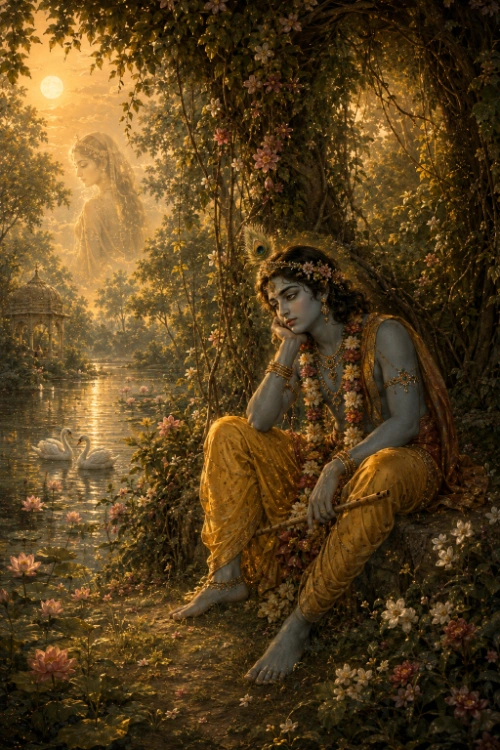
Kṛṣṇa sitting alone and dejected in a flowering bower beside the moonlit Yamunā, his chin resting on his hand and his flute held idle across his lap, while a translucent apparition of Rādhā hovers in the mist among the trees behind him; swans and lotuses float on the water.

Śrī Gīta-govinda, Sarga III — Mugdha-Madhusūdana: Madhusūdana Bewildered by Love

Synopsis

The third canto, and the first great reversal of the Gīta-govinda. Until now the longing has appeared to run one way: Rādhā yearns for Kṛṣṇa. Here Jayadeva reveals the other half of the truth. The moment she disappears, the women around him lose all attraction; he abandons them, searches the forest for her, fails, and collapses in a bower beside the Yamunā. We then hear his thoughts directly — he admits the offence, imagines her before him, begs forgiveness of a woman who is not there, argues with Kāma, and finds that her remembered eyebrow, glance and lips have become Love’s entire arsenal against him. Two ślokas, one song and six closing verses, with Devanāgarī, IAST and commentary.

Chapter 3 Mugdha-Madhusūdana

18

कंसारिरपि संसारवासनाबन्धशृङ्खलाम् ।
राधामाधाय हृदये तत्याज व्रजसुन्दरीः ॥ १८ ॥

kaṁsārir api saṁsāra-vāsanā-bandha-śṛṅkhalām |
rādhām ādhāya hṛdaye tatyāja vraja-sundarīḥ || 18 ||

Even the enemy of Kaṁsa, placing Rādhā within his heart — the chain binding him to the desire of worldly existence — abandoned the beautiful women of Vraja.

Even Kṛṣṇa, the destroyer of Kaṁsa, placed Rādhā deep within his heart. Bound to her as though by an unbreakable chain, he turned away from all the other beauties of Vraja.

Commentary

The opening api, “even he,” is important. Rādhā’s longing has already been described; Jayadeva now says in effect that she was not alone in it. Kṛṣṇa too was bound.

The extraordinary expression is saṁsāra-vāsanā-bandha-śṛṅkhalām, literally “the chain for binding the desire or latent inclination toward saṁsāra.” Traditional commentators recognise the deliberately striking image: Rādhā is the chain that binds Kṛṣṇa’s consciousness. This is not bondage in the usual negative sense — within Jayadeva’s erotic theology the language of bondage is reversed, and the supreme Lord willingly becomes bound by love.

The verse also establishes Rādhā’s position among the gopīs. Their beauty is not denied; precisely because Jayadeva calls them sundarīḥ, the statement becomes stronger. They are beautiful — but they are not Rādhā.

19

इतस्ततस्तामनुसृत्य राधिकाम्
अनङ्गबाणव्रणखिन्नमानसः ।
कृतानुतापः स कलिन्दनन्दिनी-
तटान्तकुञ्जे विषसाद माधवः ॥ १९ ॥

itas tatas tām anusṛtya rādhikām
anaṅga-bāṇa-vraṇa-khinna-mānasaḥ |
kṛtānutāpaḥ sa kalinda-nandinī-
taṭānta-kuñje viṣasāda mādhavaḥ || 19 ||

Following Rādhikā here and there, his mind distressed by the wounds of the arrows of bodiless Love, Mādhava became filled with remorse. Unable to find her, he sank into dejection in a bower at the edge of the bank of the daughter of Mount Kalinda — the Yamunā.

Through the forest Mādhava searched for Rādhā — here, there, everywhere. Kāma’s invisible arrows had wounded his heart, and remorse now consumed him. At last, beside the Yamunā, within a lonely bower on her bank, Kṛṣṇa sank down in despair.

Commentary

Anaṅga, “the Bodiless One,” is Kāma, whose body was burned by Śiva. The phrase anaṅga-bāṇa-vraṇa, “the wound made by Kāma’s arrow,” becomes important later in the canto, when Kṛṣṇa begins to address the love-god directly as though he were physically under attack. Kalinda-nandinī, “daughter of Kalinda,” is the Yamunā, whose traditional source lies on that mountain.

Most significant psychologically is kṛtānutāpaḥ, “filled with remorse.” Kṛṣṇa now recognises his own responsibility. Rādhā did not simply disappear; he hurt her.

Song 7

Mām iyaṁ calitā vilokya — gurjarī rāga — yati tāla

हरि हरि हतादरतया
गता सा कुपितेव ॥

hari hari hatādaratayā
gatā sā kupiteva ||

“Alas! Alas! Because I failed to show her proper regard, she has gone away in anger.”

Commentary

Kṛṣṇa’s Lament

For the first time in the poem we enter directly into Kṛṣṇa’s anguish, and the refrain is devastating. The repeated hari hari functions here not as the divine name but as an exclamation of grief — “alas, alas” — and the conclusion Kṛṣṇa keeps returning to is that she left because he failed to honour her.

S7.1

मामियं चलिता विलोक्य वृतं वधूनिचयेन ।
सापराधतया मयापि न वारितातिभयेन ॥

mām iyaṁ calitā vilokya vṛtaṁ vadhū-nicayena |
sāparādhatayā mayāpi na vāritāti-bhayena ||

She went away after seeing me surrounded by a multitude of young women. And because I knew myself to be guilty, I was so afraid that I did not even stop her.

Commentary

Kṛṣṇa does not excuse himself. The crucial word is sāparādhatayā — “because I was guilty,” because I had committed an offence. This is a major transition from the Kṛṣṇa of the first canto, who freely enjoyed the company of many gopīs; he now interprets that same behaviour as an aparādha against Rādhā.

S7.2

किं करिष्यति किं वदिष्यति सा चिरं विरहेण ।
किं धनेन जनेन किं मम जीवितेन गृहेण ॥

kiṁ kariṣyati kiṁ vadiṣyati sā ciraṁ viraheṇa |
kiṁ dhanena janena kiṁ mama jīvitena gṛheṇa ||

What will she do? What will she say if this separation continues? What use have I for wealth? What use are people to me? What use is my life? What use is my home?

Commentary

The repetitions of kim, “what use?”, progressively strip Kṛṣṇa’s world of value: without Rādhā, wealth, companions, home and even life itself mean nothing. The reversal from the first canto is now complete. Previously Kṛṣṇa was surrounded by abundance; now, without one person, abundance means nothing.

S7.3

चिन्तयामि तदाननं कुटिलभ्रु कोपभरेण ।
शोणपद्ममिवोपरि भ्रमताकुलं भ्रमरेण ॥

cintayāmi tad-ānanaṁ kuṭila-bhru kopa-bhareṇa |
śoṇa-padmam ivopari bhramatākulaṁ bhramareṇa ||

I remember her face, her brows curved by the fullness of anger — like a red lotus disturbed by a black bee circling above it.

Commentary

Kṛṣṇa is now doing precisely what Rādhā did in the previous canto: he remembers. Her angry face itself becomes beautiful to him — the red lotus is her face, and the dark curved brows suggest bees moving above it. Even her anger has become an object of longing.

S7.4

तामहं हृदि सङ्गतामनिशं भृशं रमयामि ।
किं वनेऽनुसरामि तामिह किं वृथा विलपामि ॥

tām ahaṁ hṛdi saṅgatām aniśaṁ bhṛśaṁ ramayāmi |
kiṁ vane ‘nusarāmi tām iha kiṁ vṛthā vilapāmi ||

I unite with her intensely and without interruption within my heart. Why then do I pursue her through the forest? Why do I lament here in vain?

She is already within my heart. There I meet her endlessly; there I embrace her again and again. Why, then, do I wander through this forest searching? Why do I sit here lamenting?

Commentary

This begins a profound motif that returns near the end of the canto: physical absence produces intensified mental presence. Kṛṣṇa cannot see Rādhā externally, but inwardly she becomes almost overwhelmingly real, and his search oscillates between “where is she?” and “she is already completely within me.”

S7.5

तन्वि खिन्नमसूयया हृदयं तवाकलयामि ।
तन्न वेद्मि कुतो गतासि न तेन तेऽनुनयामि ॥

tanvi khinnam asūyayā hṛdayaṁ tavākalayāmi |
tan na vedmi kuto gatāsi na tena te ‘nunayāmi ||

O slender Rādhā, I understand that your heart has been wounded by jealousy. But I do not know where you have gone, and because I cannot find you I cannot come before you and appease you.

Commentary

Kṛṣṇa has now begun speaking directly to the absent Rādhā, and the lament is becoming a visionary dialogue. Asūyā here denotes jealous resentment — the pain caused by seeing the beloved intimate with a rival. Kṛṣṇa finally understands the emotional state that drove her away.

S7.6

दृश्यसे पुरतो गतागतमेव मे विदधासि ।
किं पुरेव ससम्भ्रमं परिरम्भणं न ददासि ॥

dṛśyase purato gatāgatam eva me vidadhāsi |
kiṁ pureva sa-sambhramaṁ parirambhaṇaṁ na dadāsi ||

I seem to see you before me, moving back and forth before my eyes. Why do you not, as before, eagerly give me your embrace?

Commentary

Kṛṣṇa’s meditation has become so intense that Rādhā appears before him — but the apparition will not embrace him. This is one of Jayadeva’s most psychologically acute representations of separation: memory can reproduce the beloved’s appearance, but not her touch.

A widespread reading has dṛśyate, “it appears,” while important commentarial witnesses read dṛśyase, “you are seen” or “you appear.” The latter fits Kṛṣṇa’s direct address to Rādhā especially naturally and is followed here.

S7.7

क्षम्यतामपरं कदापि तवेदृशं न करोमि ।
देहि सुन्दरि दर्शनं मम मन्मथेन दुनोमि ॥

kṣamyatām aparaṁ kadāpi tavedṛśaṁ na karomi |
dehi sundari darśanaṁ mama manmathena dunomi ||

Forgive my offence. Never again will I do anything like this to you. Beautiful one, grant me your sight. I am being tormented by Manmatha, the god of love.

Commentary

An extraordinary moment in the poem. Kṛṣṇa promises her kadāpi tavedṛśaṁ na karomi, “never again will I do such a thing to you.” The divine lover is no longer merely longing. He is apologising.

S7.8

वर्णितं जयदेवकेन हरेरिदं प्रवणेन ।
किन्दुबिल्वसमुद्रसम्भवरोहिणीरमणेन ॥

varṇitaṁ jayadevakena harer idaṁ pravaṇena |
kindubilva-samudra-sambhava-rohiṇī-ramaṇena ||

Thus has this condition of Hari been described by Jayadeva, wholly devoted to him — Jayadeva, who is like the moon, lover of Rohiṇī, rising from the ocean of Kindubilva.

Commentary

This unusually elaborate signature contains autobiographical geography. Kindubilva — also transmitted as Kendubilva, Tindubilva and Bindubilva — is traditionally understood by commentators as Jayadeva’s native village. He compares himself to the moon rising from the ocean, the moon being poetically called rohiṇī-ramaṇa, “the lover of Rohiṇī.” The image therefore means roughly: Jayadeva is the moon arisen from the ocean-like village of Kindubilva.

The signature word is transmitted in two forms: pravaṇena, “wholly devoted,” the reading followed here and printed by Miller and by the Gauḍīya edition, and praṇatena, “bowed down,” which the Kāvyamālā text carries.

20

हृदि बिसलताहारो नायं भुजङ्गमनायकः
कुवलयदलश्रेणी कण्ठे न सा गरलद्युतिः ।
मलयजरजो नेदं भस्म प्रियारहिते मयि
प्रहर न हरभ्रान्त्यानङ्ग क्रुधा किमु धावसि ॥ २० ॥

hṛdi bisa-latā-hāro nāyaṁ bhujaṅgama-nāyakaḥ
kuvalaya-dala-śreṇī kaṇṭhe na sā garala-dyutiḥ |
malayaja-rajo nedaṁ bhasma priyā-rahite mayi
prahara na hara-bhrāntyānaṅga krudhā kimu dhāvasi || 20 ||

This upon my chest is a garland of lotus fibres; it is not the lord of serpents. This row around my throat is made of blue-lotus petals; it is not the dark radiance of poison. This is the powder of sandalwood from Malaya; it is not ash. O bodiless Love, do not strike me, bereft of my beloved. Have you mistaken me for Hara, Śiva? Why do you rush upon me in anger?

Kāma — stop! Do not mistake me for Śiva. What lies across my chest is only a garland of pale lotus fibres, not Vāsuki, king of serpents. The darkness around my throat is merely a wreath of blue-lotus petals, not Śiva’s poison-darkened neck. This powder upon my body is sandalwood, not funeral ash. I have already lost my beloved. Why attack me too? O bodiless god of Love, have you mistaken me for the one who burned you?

Commentary

The verse depends on the myth of Śiva and Kāma: when Kāma attempted to disturb Śiva’s meditation, Śiva opened his third eye and burned him to ashes, and Kāma thereafter became Anaṅga, the bodiless one. Kṛṣṇa imagines that Kāma is now attacking him because he has been mistaken for Śiva, and Jayadeva builds the conceit from three visual resemblances — the lotus-fibre garland for the serpent, the blue lotus petals at the throat for Śiva’s poison-darkened neck, and sandalwood powder for sacred ash.

Beneath the wit lies genuine suffering, and Kṛṣṇa’s final argument is simply that he is already without Rādhā: why inflict another wound? The comparison is also deliberately ironic. Śiva defeated Kāma. Kṛṣṇa cannot.

21

पाणौ मा कुरु चूतसायकममुं मा चापमारोपय
क्रीडानिर्जितविश्व मूर्च्छितजनाघातेन किं पौरुषम् ।
तस्या एव मृगीदृशो मनसिजप्रेङ्खत्कटाक्षाशुग-
श्रेणीजर्जरितं मनागपि मनो नाद्यापि सन्धुक्षते ॥ २१ ॥

pāṇau mā kuru cūta-sāyakam amuṁ mā cāpam āropaya
krīḍā-nirjita-viśva mūrcchita-janāghātena kiṁ pauruṣam |
tasyā eva mṛgī-dṛśo manasija-preṅkhat-kaṭākṣāśuga-
śreṇī-jarjaritaṁ manāg api mano nādyāpi sandhukṣate || 21 ||

Do not take that mango-blossom arrow into your hand. Do not string your bow. O Love, you who have conquered the whole world merely in play — what heroism is there in striking one who is already fainting? My heart has already been torn apart by the rushing arrows of the sidelong glances of that doe-eyed woman, and even now it has scarcely recovered.

Commentary

Kāma’s traditional weapons are a flower-bow and flower-arrows, and Jayadeva specifies the mango blossom, one of spring’s great erotic stimulants. Kṛṣṇa protests: mūrcchita-janāghātena kiṁ pauruṣam — “what heroism is there in striking someone already unconscious?”

Then comes the revelation. Kāma is not Kṛṣṇa’s first attacker; Rādhā has already shot him, and her weapon is the kaṭākṣa, the sidelong glance. The boundary between Rādhā and Kāma begins to collapse: Kāma may hold the bow, but Rādhā has the more powerful arrows.

22

भ्रूचापे निहितः कटाक्षविशिखो निर्मातु मर्मव्यथां
श्यामात्मा कुटिलः करोतु कबरीभारोऽपि मारोद्यमम् ।
मोहं तावदयं च तन्वि तनुतां बिम्बाधरो रागवान्
सद्वृत्तस्तनमण्डलस्तव कथं प्राणैर्मम क्रीडति ॥ २२ ॥

bhrū-cāpe nihitaḥ kaṭākṣa-viśikho nirmātu marma-vyathāṁ
śyāmātmā kuṭilaḥ karotu kabarī-bhāro ‘pi mārodyamam |
mohaṁ tāvad ayaṁ ca tanvi tanutāṁ bimbādharo rāgavān
sad-vṛttaḥ stana-maṇḍalas tava kathaṁ prāṇair mama krīḍati || 22 ||

Let the arrow of your sidelong glance, placed upon the bow of your eyebrow, create pain in my vital places. Let your mass of dark, curling hair undertake its murderous work. O slender one, let your red bimba-like lip produce bewilderment in me. But how can your perfectly rounded breasts, which are sad-vṛtta — “well-rounded” and “of good conduct” — play with my very life?

Rādhā — let the arrow of your glance, set upon the bow of your eyebrow, pierce my heart. Let your dark and curling hair conspire in Love’s assault. Let your red bimba-fruit lips drive me into delirium. All that I can understand. But tell me this: your breasts are so perfectly formed, so well-behaved, so sad-vṛtta — how can something so virtuous play so mercilessly with my life?

Commentary

The verse is built on deliberate double meanings. Śyāmātmā, “dark in nature,” describes Rādhā’s hair but can also suggest moral darkness; kuṭila, “curved,” describes the curls but also means “crooked” in character; rāgavān makes her lip red, while rāga is also passion.

Most ingenious is sad-vṛtta, which means both “beautifully rounded” and “of good conduct.” Kṛṣṇa therefore jokes: if they are truly of such excellent character, why are they trying to kill me? Even in agony, Jayadeva’s Kṛṣṇa remains verbally playful.

23

तानि स्पर्शसुखानि ते च तरलाः स्निग्धा दृशोर्विभ्रमास्
तद्वक्त्राम्बुजसौरभं स च सुधास्यन्दी गिरां वक्रिमा ।
सा बिम्बाधरमाधुरीति विषयासङ्गेऽपि चेन्मानसं
तस्यां लग्नसमाधि हन्त विरहव्याधिः कथं वर्धते ॥ २३ ॥

tāni sparśa-sukhāni te ca taralāḥ snigdhā dṛśor vibhramās
tad-vaktrāmbuja-saurabhaṁ sa ca sudhā-syandī girāṁ vakrimā |
sā bimbādhara-mādhurīti viṣayāsaṅge ‘pi cen mānasaṁ
tasyāṁ lagna-samādhi hanta viraha-vyādhiḥ kathaṁ vardhate || 23 ||

Those pleasures of her touch are still here. Those restless, affectionate movements of her eyes are still here. The fragrance of her lotus face is still here. The charming crookedness of her speech, dripping nectar, is still here. The sweetness of her bimba-red lips is still here. If my mind, absorbed in samādhi upon her, remains attached to all these objects of sense — alas! — how can the disease of separation continue to grow?

Commentary

One of the most sophisticated verses of the canto. Traditional commentators note that Jayadeva systematically evokes all five sensory fields: touch, in the pleasure of her touch; sight, in the movements of her loving eyes; smell, in the fragrance of her lotus face; hearing, in her nectar-filled speech; and taste, in the sweetness of her lips. Rādhā is physically absent, yet every sense behaves as though she were present.

Kṛṣṇa’s mind has entered tasyāṁ lagna-samādhi, total concentration upon her. The word samādhi is extraordinary here: a term for profound contemplative absorption is transferred into erotic separation, and Kṛṣṇa’s meditation object is Rādhā. Yet the paradox remains — if he experiences her so completely within himself, why does separation hurt more and more? That paradox is the essence of vipralambha-śṛṅgāra: absence does not diminish the beloved, it intensifies her presence.

24

भ्रूपल्लवं धनुरपाङ्गतरङ्गितानि
बाणा गुणः श्रवणपालिरिति स्मरेण ।
तस्यामनङ्गजयजङ्गमदेवतायाम्
अस्त्राणि निर्जितजगन्ति किमर्पितानि ॥ २४ ॥

bhrū-pallavaṁ dhanur apāṅga-taraṅgitāni
bāṇā guṇaḥ śravaṇa-pālir iti smareṇa |
tasyām anaṅga-jaya-jaṅgama-devatāyām
astrāṇi nirjita-jaganti kim arpitāni || 24 ||

Her tender eyebrow is the bow. The movements of her sidelong glance are the arrows. The line reaching toward her ear is the bowstring. Has Kāma placed in her — all-conquering, moving deity of Love — the very weapons by which he subdued the worlds?

Commentary

Jayadeva now makes explicit what the preceding verses implied: Rādhā herself is Kāma embodied, and her features become an arsenal — bhrū-pallava, the tender eyebrow, as bow; apāṅga-taraṅgita, the moving sidelong glance, as arrows; śravaṇa-pāli, the line reaching toward the ear, as bowstring. Most striking is anaṅga-jaya-jaṅgama-devatā: Rādhā imagined as a living, moving deity through whom Love achieves victory. Kṛṣṇa, destroyer of demons and ruler of worlds, is defenceless before something as small as the movement of her eyebrow.

Editions differ over the order of the three ślokas on Rādhā’s bodily weapons. The sequence printed here follows Miller’s critical edition; the Kāvyamālā text (and with it GRETIL) and the Gauḍīya edition place this verse before bhrū-cāpe nihitaḥ. The transmitted material itself is stable — only the rhetorical sequence varies. Read conceptually the development is clear in any arrangement: Kāma attacks Kṛṣṇa; Kṛṣṇa protests that Rādhā’s glances have already wounded him; her features themselves become the weapons of Love; and he remembers her through all five senses. What matters is the cumulative effect — Kṛṣṇa can no longer separate Kāma’s power from Rādhā herself.

25

तिर्यक्कण्ठविलोलमौलितरलोत्तंसस्य वंशोच्चरद्-
दीप्तिस्थानकृतावधानललनालक्षैर्न संलक्षिताः ।
संमुग्धे मधुसूदनस्य मधुरे राधामुखेन्दौ सुधा-
सारे कन्दलिताश्चिरं दधतु वः क्षेमं कटाक्षोर्मयः ॥ २५ ॥

tiryak-kaṇṭha-vilola-mauli-taralottaṁsasya vaṁśoccarad-
dīpti-sthāna-kṛtāvadhāna-lalanā-lakṣair na saṁlakṣitāḥ |
saṁmugdhe madhusūdanasya madhure rādhā-mukhendau sudhā-
sāre kandalitāś ciraṁ dadhatu vaḥ kṣemaṁ kaṭākṣormayaḥ || 25 ||

As Madhusūdana plays his flute, his neck inclined, his crown trembling and his earrings swaying, countless women remain absorbed in the brilliant heights of its melody. Unnoticed by them, waves of his sidelong glances continually arise toward the sweet moon of Rādhā’s face, the very essence of nectar. May those waves of Kṛṣṇa’s glances grant you lasting blessedness.

Commentary

The benediction brings the canto back to a public scene. Many women may be listening to Kṛṣṇa’s flute — but his eyes are on Rādhā, and the distinction is the whole point: his music can belong to everyone, his deepest attention does not. The phrase rādhā-mukhendau, “the moon of Rādhā’s face,” becomes the point toward which his hidden glances continually rise.

This final benedictory stanza is absent from some shorter recensions and survives with several small textual variations in the manuscripts and the commentarial tradition. Miller gives it in her apparatus rather than in the critical text, as a stanza of the Lakṣmaṇa-Rāṇaka witnesses, and the reading kept here, dīpti-sthāna — the “brilliant registers” of the flute’s music — is that of the Nirṇaya Sāgara text, where the Kāvyamālā and Gauḍīya editions read gīti-sthāna, “the pitches of the song.” Its function nevertheless suits the canto exactly: it returns from Kṛṣṇa’s private delirium to the visible sign of his preference.

Colophon

इति श्रीगीतगोविन्दे मुग्धमधुसूदनो नाम तृतीयः सर्गः ॥ ३ ॥

iti śrī-gīta-govinde mugdha-madhusūdano nāma tṛtīyaḥ sargaḥ || 3 ||

Thus ends the third sarga, named Mugdha-Madhusūdana, of the illustrious Gīta-govinda.

Commentary

The title

Madhusūdana, “slayer of the demon Madhu,” is one of Kṛṣṇa’s martial epithets; mugdha means bewildered, dazed, infatuated, and in poetics it is the standing description of the ingénue heroine, the mugdhā nāyikā. Jayadeva yokes the two words together, and the whole canto is contained in that yoking: the destroyer of demons is reduced to the condition normally attributed to an inexperienced girl in love.

The shape of the canto

Sarga III is the shortest in the poem: two narrative ślokas, the seventh song — Mām iyaṁ calitā vilokya, sung in gurjarī rāga and yati tāla, eight couplets carrying the refrain hari hari hatādaratayā — and then a closing group of ślokas. Editions differ over that closing group: six stand here, as in the Kāvyamālā, Nirṇaya Sāgara and Gauḍīya texts, while Miller’s critical edition ends the canto with the fifth and relegates the benediction to her apparatus. The three ślokas on Rādhā’s bodily weapons also stand in different orders in different editions.

From Sarga III to Sarga IV

The canto leaves Kṛṣṇa alone in the bower on the Yamunā, speaking to a Rādhā who is not there. Nothing is resolved: he has confessed the offence, promised never to repeat it, and discovered that her absence only makes her more present to him. Sarga IV, Snigdha-Madhusūdana, breaks that solitude by bringing in the sakhī, who has come from Rādhā and can tell him what his neglect has done to her. The two lovers still do not meet; they begin instead to be described to one another.

Full synopsis

Mugdha-Madhusūdana

Chapter 3

The title and its paradox

The third canto is named Mugdha-Madhusūdana. Mugdha has a rich range of meanings — charming, innocent, bewildered, fascinated, enchanted, infatuated — and here it is deliberately paradoxical. Madhusūdana is “the slayer of the demon Madhu,” the powerful divine hero. Yet that conqueror has now himself been conquered: not by an asura, not by a weapon, but by Rādhā.

The reversal

Until this point the emotional movement of the poem has appeared to run in one direction. Rādhā longs for Kṛṣṇa; she sees him surrounded by other gopīs, withdraws in jealousy, remembers their former intimacy, and confesses that she cannot stop loving him. Sarga III reveals the other half of the truth: Kṛṣṇa has not remained untouched.

The moment Rādhā disappears, the multitude of beautiful women around him loses its attraction. He abandons them, searches desperately through the forest, fails to find her, and finally collapses in a bower beside the Yamunā. There Jayadeva allows us to hear his thoughts directly. He regrets his offence. He imagines Rādhā before him. He begs forgiveness of a woman who is not physically present. He challenges Kāma, the god of love, and becomes so disordered by separation that he compares himself with Śiva. And eventually Rādhā’s body, remembered feature by feature, becomes Kāma’s entire arsenal against him.

Absence reveals supremacy

This is perhaps the most important insight of the canto. While Rādhā was physically present among the other gopīs, her unique position could appear uncertain. Only when she leaves does the truth become visible — Kṛṣṇa immediately abandons everyone else. Her departure therefore does not diminish her position; it reveals it, and her absence becomes more powerful than the presence of all the other women combined. That is why Jayadeva opens the canto with rādhām ādhāya hṛdaye tatyāja vraja-sundarīḥ, “placing Rādhā in his heart, he abandoned the beauties of Vraja.” The single verse contains the essential movement of the whole canto.

The conqueror conquered

Jayadeva deliberately surrounds the suffering Kṛṣṇa with heroic divine names — Kaṁsāri, enemy of Kaṁsa; Mādhava; Madhusūdana, slayer of Madhu; Hari. Yet none of those victories helps him. He conquered Kaṁsa and Madhu; he enchants the gopīs; Kāma conquers the world. But Rādhā conquers Kṛṣṇa. Her eyebrow becomes a bow, her glance an arrow, the line toward her ear a bowstring; her lips induce bewilderment; her touch, fragrance, voice and taste occupy all five senses; and finally her form becomes the object of his samādhi. That is the meaning of the title: Madhusūdana, the mighty conqueror, has himself become captivated.

Toward Sarga IV

But Rādhā does not yet know any of this, and that is the tension on which the canto ends. She believes herself abandoned; Kṛṣṇa believes she has abandoned him; both are suffering intensely, and neither yet knows the suffering of the other. A mediator therefore becomes necessary — and that is exactly what follows in Sarga IV, Snigdha-Mādhava, where Rādhā’s sakhī finds Kṛṣṇa in the bower beside the Yamunā and tells him what has happened to her. For the first time he will hear in detail how separation has transformed her body and mind. The structure moves from Rādhā’s longing, to Kṛṣṇa’s longing, and now to the sakhī carrying knowledge of that longing from one lover to the other. The path toward reunion has begun.