The title and its irony
The second canto is named Akleśa-Keśava. The compound may be understood literally as “Keśava without affliction,” or as “Keśava who removes distress.” The title acquires its full force at the close of the canto, where the poet invokes the ever-fresh Keśava to remove the kleśa, the suffering, of the hearer.
There is also a dramatic irony in it. At this point it is Rādhā who suffers, while Kṛṣṇa appears outwardly carefree among the gopīs. The next canto will reverse the perspective entirely and reveal Kṛṣṇa himself tormented by separation from her.
Where the canto stands
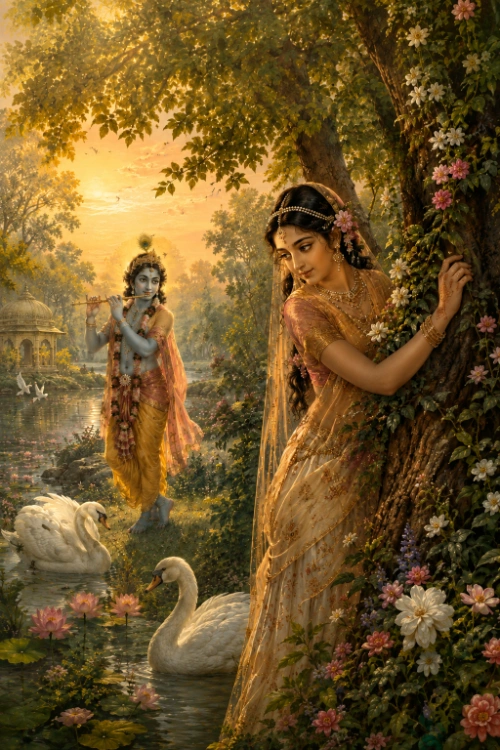
Sarga II begins immediately after Rādhā has seen Kṛṣṇa enjoying the springtime rāsa with the other cowherd maidens, and the mood changes decisively. In the first canto Kṛṣṇa stood at the centre of an exuberant world of music, flowers, dancing, bees, moonlight and amorous play. Now Jayadeva enters Rādhā’s consciousness. She cannot bear to see Kṛṣṇa distributing his affection among others; overcome by jealousy, wounded pride and longing, she withdraws into a secluded vine-bower and confides in a single intimate friend.
Yet her anger produces a paradox: the more she tries to condemn him, the more vividly she remembers him. Sarga II is therefore fundamentally a canto of smaraṇa, remembrance. Rādhā recalls Kṛṣṇa’s beauty, his flute, his glances, their previous secret meetings and the most intimate details of their union. The Kṛṣṇa who appears externally to belong to everyone remains inwardly impossible for her to abandon.
What happens to Rādhā
The paradox becomes explicit as the canto proceeds. She withdrew because Kṛṣṇa was intimate with other women; yet when she attempts to speak of his betrayal she remembers his flute, his eyes, his peacock feathers, his smile, his earrings, his yellow garments, his embraces — and finally their own private meetings. Her jealousy does not destroy love. It makes memory more intense.
The sixth song is decisive here. Rādhā’s anguish is not the abstract jealousy of someone who merely wishes to possess Kṛṣṇa: it is intensified by the memory of intimacy actually experienced. She remembers that he waited for her in secret, reassured her shyness, spoke tenderly, lay with her on a bed of leaves, embraced and kissed her, and that their encounter ended in complete mutual surrender. She is comparing the public Kṛṣṇa she has just seen with the private Kṛṣṇa whom she remembers as hers — and she asks the sakhī, now acting as mediator, to bring them together again.
The turn at the end
After pouring out these memories Rādhā sees Kṛṣṇa once more among the Vraja maidens — and something remarkable happens. Kṛṣṇa sees her, and his body immediately betrays him: the flute slips from his hand, a hurried sidelong glance seems to dismiss the other girls, sweat moistens his cheeks, and an almost guilty smile breaks across his face. Rādhā, who has every reason to grieve, instead rejoices. The reaction reveals that she is not one woman among many.
The canto nevertheless ends in separation, and so the very springtime beauty that should bring pleasure becomes unbearable: the aśoka in bloom, the breeze from the lake garden, the mango buds loud with bees. In Sarga I that same landscape was uddīpana, a stimulant of erotic love. Now it intensifies vipralambha, love-in-separation. Nature has not changed; Rādhā has.
The dramatic meaning
Sarga II accomplishes something subtler than showing a jealous Rādhā. At first the apparent situation is that Kṛṣṇa possesses many women and Rādhā has lost her special position. By the close, Jayadeva has begun to overturn that appearance — and the emotional trajectory of the poem is set: Kṛṣṇa revels among the gopīs in Sarga I; Rādhā becomes jealous, withdraws and remembers him in Sarga II; his bodily reaction at the end of this canto reveals the power she holds over him; and in Sarga III, Mugdha-Madhusūdana, Kṛṣṇa abandons the other Vraja beauties and is himself consumed by thoughts of her.
The apparent centre of gravity of the poem is therefore beginning to shift. The Gīta-govinda started with Kṛṣṇa surrounded by women. It is gradually becoming the story of Kṛṣṇa conquered by Rādhā.