Chapter 6
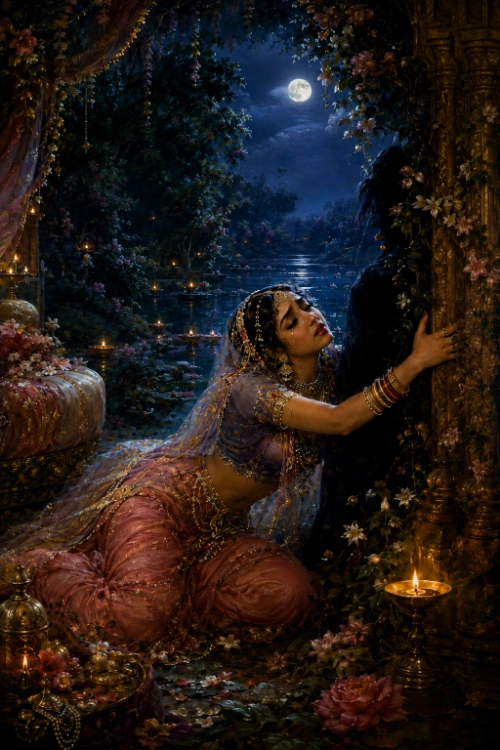
Rādhā sinks against a dark pillar in a moonlit bower, her arms reaching around it and her face pressed to the shadow as though embracing a body. She wears rose silk and gold, her veil slipping, and she has fallen to her knees among cushions and scattered petals. A single oil lamp burns beside her, lamps float on the river behind, and the full moon stands above the trees.

Śrī Gīta-govinda, Sarga VI — Kuṇṭha-Vaikuṇṭha: Vaikuṇṭha Hindered by Love

Synopsis

The sixth canto begins with a failure. Everything was ready at the end of the fifth — Kṛṣṇa waiting in the bower, the bed of leaves prepared, the sakhī urging Rādhā to go. She tries. She cannot. Her longing has weakened her so completely that after a few steps she falls, and the sakhī has to abandon the plan and return to Kṛṣṇa with the opposite message: Rādhā cannot come to you. The single Aṣṭapadī describes her condition to him directly — she adorns herself, fashions bracelets, watches the path, mistakes the dense darkness for a rain-cloud-coloured Kṛṣṇa and embraces it, and at last imagines herself to be him. The title is a deliberate paradox: Vaikuṇṭha is the Lord whom nothing obstructs, and here he is kuṇṭha, checked.

Chapter 6

38

अथ तां गन्तुमशक्तां चिरमनुरक्तां लतागृहे दृष्ट्वा ।
तच्चरितं गोविन्दे मनसिजमन्दे सखी प्राह ॥ ३८ ॥

atha tāṁ gantum aśaktāṁ ciram anuraktāṁ latā-gṛhe dṛṣṭvā |
tac-caritaṁ govinde manasija-mande sakhī prāha || 38 ||

Then, seeing Rādhā—long deeply attached to him—unable to go any farther and remaining in the vine-bower, the sakhī spoke of her condition to Govinda, who himself had been made languid by the god of Love.

The sakhī saw what had happened. Rādhā had tried to go— but could not. Overwhelmed by longing, she remained helpless in the vine-bower. So the messenger returned once more to Govinda, who himself had been weakened by Love, and told him what Rādhā had become.

Commentary

The phrase गन्तुमशक्ताम् — gantum aśaktām is decisive: “unable to go.” Rādhā’s failure to reach Kṛṣṇa does not arise from lack of desire. It arises from too much desire. Love has produced such physical weakness that the very force urging her toward Kṛṣṇa prevents her body from carrying her there. That paradox governs the whole canto.

Song 12

Paśyati diśi diśi rahasi bhavantam — guṇakarī rāga — rūpaka tāla

नाथ हरे जगन्नाथ हरे
सीदति राधा वासगृहे

nātha hare jagannātha hare
sīdati rādhā vāsa-gṛhe

Refrain: “O Lord Hari, O Lord of the world — Rādhā is languishing in the chamber prepared for love.”

Commentary

Rādhā Is Languishing in the Chamber Prepared for Love

The sakhī now describes Rādhā directly to Kṛṣṇa, and the refrain is relentless: the chamber has been made ready and the woman who prepared it is failing in it.

The rāga

No song in the poem is worse attested for its mode. The Kāvyamālā text prescribes गुणकरीरागेण रूपकतालेन गीयते — guṇakarī-rāgena rūpaka-tālena gīyate; the Nirṇaya Sāgara edition of 1910 prints goṇḍakarī but records guṇakarī in its footnote as a variant, and its Rasamañjarī commentary states outright that the rāga of this song is guṇakarī; Miller prints nāṭa; the Gauḍīya edition allows “nāṭa or guṇakarī”; and the manuscripts add dhanāśī and gauḍa-karṇāṭa. Only the tāla is unanimous: rūpaka. Guṇakarī is printed here as the reading with the widest support.

A Note on the Refrain

The refrain varies slightly among recensions. Some texts give simply: नाथ हरे सीदति राधा वासगृहे while others expand it to: नाथ हरे जगन्नाथ हरे सीदति राधा वासगृहे and still others repeat hare. The essential refrain, however, is stable: सीदति राधा वासगृहे sīdati rādhā vāsa-gṛhe “Rādhā languishes in the chamber of love.” The short form is that of the Kāvyamālā text, of Nirṇaya Sāgara 1910 and of the Gauḍīya edition; the expanded form printed here is the one current in the sung tradition.

S12.1

पश्यति दिशि दिशि रहसि भवन्तम् ।
तदधरमधुरमधूनि पिबन्तम् ॥

paśyati diśi diśi rahasi bhavantam |
tad-adhara-madhura-madhūni pibantam ||

In solitude she sees you in every direction, drinking the sweet honey of her lips. O Lord Hari, O Lord of the world, Rādhā languishes in the chamber of love.

Everywhere she looks— she sees you. In every direction, in the loneliness of the bower, she imagines you before her, drinking the sweet honey of her lips. O Hari— Rādhā is wasting away in the chamber where she expected to meet you.

Commentary

Kṛṣṇa is physically absent. Yet for Rādhā the entire environment has become Kṛṣṇa-filled. The old commentators make precisely this point: in separation, every direction becomes permeated by the beloved. The distinction between memory and perception is beginning to collapse.

S12.2

त्वदभिसरणरभसेन वलन्ती ।
पतति पदानि कियन्ति चलन्ती ॥

tvad-abhisaraṇa-rabhasena valantī |
patati padāni kiyanti calantī ||

Driven by the impetuous eagerness to go to you, she sets out— but after walking only a few steps, she falls. O Lord Hari, Rādhā languishes in the chamber of love.

She tried to come to you, Kṛṣṇa. Love drove her forward. She rose. She began to walk. One step. Another. Only a few— and Rādhā collapsed.

Commentary

This stanza supplies the physical explanation for the entire Sarga. The sakhī’s argument is now unavoidable: Rādhā has already attempted the abhisāra. She did not refuse Kṛṣṇa. Her body failed her. Kṛṣṇa can therefore no longer simply remain in his bower waiting.

S12.3

विहितविशदबिसकिसलयवलया ।
जीवति परमिह तव रतिकलया ॥

vihita-viśada-bisa-kisalaya-valayā |
jīvati param iha tava rati-kalayā ||

She has fashioned bracelets from pale lotus fibres and tender shoots. Here she continues to live only through the recollection and imagining of your arts of love. O Lord Hari, Rādhā languishes in the chamber of love.

Commentary

Lotus fibres are cooling and delicate. Rādhā therefore turns the forest itself into ornament. But the more important expression is: तव रतिकलया — tava rati-kalayā literally, “through your art of love.” The commentators understand this as Rādhā sustaining herself through the mental recollection of intimacy previously experienced with Kṛṣṇa. She lives because she can still remember him.

S12.4

मुहुरवलोकितमण्डनलीला ।
मधुरिपुरहमिति भावनशीला ॥

muhur avalokita-maṇḍana-līlā |
madhu-ripur aham iti bhāvana-śīlā ||

Again and again she examines the play of her ornaments. Absorbed in imagination, she thinks: “I am Madhuripu—the enemy of Madhu.” O Lord Hari, Rādhā languishes in the chamber of love.

Again she arranges herself. Again she looks at her ornaments. Again she enters the world of imagination— until Rādhā no longer thinks herself to be Rādhā. She thinks: “I am Kṛṣṇa.”

Commentary

A Remarkable Psychological Moment

This is one of the most extraordinary lines in the canto: मधुरिपुरहमिति भावनशीला madhu-ripur aham iti bhāvana-śīlā “She habitually imagines: ‘I am Madhuripu.’” The commentarial tradition interprets Rādhā as imitating Kṛṣṇa’s ornaments and appearance. In extreme separation, the beloved becomes so completely internalized that Rādhā begins to assume Kṛṣṇa’s identity. She cannot reach him outwardly. Therefore inwardly: she becomes him. This is much more than ordinary recollection. The distinction between lover and beloved begins to dissolve within meditation.

S12.5

त्वरितमुपैति न कथमभिसारम् ।
हरिरिति वदति सखीमनुवारम् ॥

tvaritam upaiti na katham abhisāram |
harir iti vadati sakhīm anuvāram ||

Again and again she asks her friend: “Why does Hari not quickly come to the rendezvous?” O Lord Hari, Rādhā languishes in the chamber of love.

Commentary

A subtle change has occurred. Previously the sakhī told Rādhā: “Go to Kṛṣṇa.” Rādhā tried. She failed. Now Rādhā asks: “Then why does Kṛṣṇa not come to me?” The responsibility for movement has shifted.

S12.6

श्लिष्यति चुम्बति जलधरकल्पम् ।
हरिरुपगत इति तिमिरमनल्पम् ॥

śliṣyati cumbati jaladhara-kalpam |
harir upagata iti timiram analpam ||

Thinking, “Hari has arrived,” she embraces and kisses the dense darkness, dark like a rain cloud. O Lord Hari, Rādhā languishes in the chamber of love.

Then something dark appears at the entrance to the bower. Rādhā’s heart leaps. Kṛṣṇa! She rushes forward. She embraces it. She kisses it. But it is only the thick darkness of night— dark like Kṛṣṇa’s rain-cloud body.

Commentary

This is perhaps the most visually unforgettable image of Sarga VI. Kṛṣṇa’s complexion is conventionally compared to a dark rain cloud. The night is therefore capable of deceiving Rādhā. Her longing transforms darkness into Kṛṣṇa. She does not merely think about the absent beloved. She physically responds to the world as though he were present. The commentators identify this as poetic bhrānti, mistaken perception. But psychologically the scene is deeper: Rādhā’s internal image of Kṛṣṇa has become more powerful than external reality.

S12.7

भवति विलम्बिनि विगलितलज्जा ।
विलपति रोदिति वासकसज्जा ॥

bhavati vilambini vigalita-lajjā |
vilapati roditi vāsaka-sajjā ||

As you continue to delay, her modesty falls away. Prepared for her lover, the vāsaka-sajjā heroine laments and weeps. O Lord Hari, Rādhā languishes in the chamber of love.

Commentary

Vāsaka-sajjā

Here Jayadeva explicitly identifies Rādhā with one of the classical aṣṭa-nāyikās, the eight types of heroine: वासकसज्जा — vāsaka-sajjā She is the woman who: expects her beloved, ornaments herself, decorates the chamber, prepares the bed, and waits eagerly for his arrival. Normally the category suggests joyful expectation. Jayadeva pushes it toward tragedy. Everything is prepared— except Kṛṣṇa is not there. The chamber designed for union becomes the chamber of separation.

S12.8

श्रीजयदेवकवेरिदमुदितम् ।
रसिकजनं तनुतामतिमुदितम् ॥

śrī-jayadeva-kaver idam uditam |
rasika-janaṁ tanutām ati-muditam ||

May these words uttered by the poet Śrī Jayadeva bring supreme delight to those who know how to relish rasa.

39

विपुलपुलकपालिः स्फीतसीत्कारमन्त-
र्जनितजडिमकाकुव्याकुलं व्याहरन्ती ।
तव कितव विधायामन्दकन्दर्पचिन्तां
रसजलधिनिमग्ना ध्यानलग्ना मृगाक्षी ॥ ३९ ॥

vipula-pulaka-pāliḥ sphīta-sītkāram antar-
janita-jaḍima-kāku-vyākulaṁ vyāharantī |
tava kitava vidhāyāmanda-kandarpa-cintāṁ
rasa-jaladhi-nimagnā dhyāna-lagnā mṛgākṣī || 39 ||

O deceiver! The doe-eyed Rādhā, covered with great waves of horripilation, breathing deep sighs and speaking with a voice disturbed by inward stupor and emotional modulation, has conceived an overwhelming passion for you. Immersed in the ocean of rasa, she remains fixed in meditation.

O Kṛṣṇa—you rogue. Rādhā’s whole body is covered in horripilation. Deep gasps escape her. Her voice breaks and changes beneath emotions she can no longer control. Thought of you has awakened an immense force of Love within her. She has sunk into an ocean of rasa. Her mind is fixed entirely upon you.

Commentary

Rādhā Has Entered an Ocean of Rasa

After the song, the sakhī makes the description still more intimate.

The sakhī now calls Kṛṣṇa: कितव — kitava “cheat,” “rogue,” “deceiver.” This is affectionate but accusatory. He must understand that Rādhā’s condition is partly the consequence of his delay.

Kāku

kāku refers to meaningful modulation of the voice—the alteration of tone caused by grief, fear, love or emotional pressure. Thus Rādhā’s speech no longer communicates only through words. Her voice itself reveals her condition.

Dhyāna

Once again Jayadeva uses contemplative language: ध्यानलग्ना — dhyāna-lagnā “fixed in meditation.” In earlier Sargas: Kṛṣṇa meditated on Rādhā; Rādhā meditated on Kṛṣṇa. Here meditation has reached the point where she sees him, embraces darkness as him, and imagines herself to be him.

The third pāda is printed here as तव कितव विधायामन्दकन्दर्पचिन्तां — tava kitava vidhāyāmanda-kandarpa-cintāṁ, that is vidhāya + amanda-kandarpa-cintām, “having roused no slight longing of Love”; the word-division vidhāyām anda- found in some transcripts yields no Sanskrit word. Kāvyamālā, Nirṇaya Sāgara 1910 and the Gauḍīya edition agree in the reading, and equally in रसजलधिनिमग्ना — rasa-jaladhi-nimagnā of the fourth pāda, where the GRETIL e-text gives the equivalent rasa-jala-nidhi-magnā.

40

अङ्गेष्वाभरणं करोति बहुशः पत्रेऽपि सञ्चारिणि
प्राप्तं त्वां परिशङ्कते वितनुते शय्यां चिरं ध्यायति ।
इत्याकल्पविकल्पतल्परचनासङ्कल्पलीलाशत-
व्यासक्तापि विना त्वया वरतनुर्नैषा निशां नेष्यति ॥ ४० ॥

aṅgeṣv ābharaṇaṁ karoti bahuśaḥ patre ‘pi sañcāriṇi
prāptaṁ tvāṁ pariśaṅkate vitanute śayyāṁ ciraṁ dhyāyati |
ity ākalpa-vikalpa-talpa-racanā-saṅkalpa-līlā-śata-
vyāsaktāpi vinā tvayā vara-tanur naiṣā niśāṁ neṣyati || 40 ||

Again and again she places ornaments upon her limbs. Whenever even a leaf moves, she suspects that you have arrived. She spreads the bed. She meditates upon you for a long time. Although this beautiful woman occupies herself with hundreds of acts of adornment, imagining, arranging the couch and forming mental visions, without you she will not make it through the night.

Again she puts on an ornament. Again she removes it. A leaf moves— “Kṛṣṇa?” She looks toward the entrance. Nothing. Again she arranges the bed. Again she imagines your arrival. Again she closes her eyes and constructs you within her mind. Adornment. Expectation. Bed-making. Imagination. Again and again and again. But Kṛṣṇa— without you, she will not survive this night.

Commentary

Waiting Has Become an Endless Ritual

Jayadeva’s Fourfold Psychology of Waiting

The verse contains an extraordinarily compressed sequence: आकल्प-विकल्प-तल्परचना-सङ्कल्प ākalpa-vikalpa-talpa-racanā-saṅkalpa

Ākalpa — adornment. Rādhā prepares herself for Kṛṣṇa.

Vikalpa — doubt and imagining. Every sound may mean that Kṛṣṇa has arrived.

Talpa-racanā — preparing the bed. She repeatedly arranges the place where union should occur.

Saṅkalpa — mental construction. When the external Kṛṣṇa fails to appear, she creates him inwardly through imagination.

This sequence captures the psychology of waiting almost perfectly. The body prepares. The senses become hyper-alert. The environment is organized. Then, when nothing happens, the mind supplies what reality withholds.

The Final Warning

The sakhī’s conclusion is uncompromising: विना त्वया वरतनुर्नैषा निशां नेष्यति vinā tvayā vara-tanur naiṣā niśāṁ neṣyati “Without you, this beautiful woman will not pass the night.” This can mean more than: “she will find the night difficult.” Within the emotional logic of the canto, it carries the darker possibility: Rādhā may not survive until morning. The sakhī has therefore converted Kṛṣṇa’s desire into an obligation. He must go.

41

किं विश्राम्यसि कृष्णभोगिभवने भाण्डीरभूमीरुहि
भ्रातर्यासि न दृष्टिगोचरमितः सानन्दनन्दास्पदम् ।
राधाया वचनं तदध्वगमुखान्नन्दान्तिके गोपतो
गोविन्दस्य जयन्ति सायमतिथिप्राशस्त्यगर्भा गिरः ॥ ४१ ॥

kiṁ viśrāmyasi kṛṣṇa-bhogi-bhavane bhāṇḍīra-bhūmī-ruhi
bhrātar yāsi na dṛṣṭi-gocaram itaḥ sānanda-nandāspadam |
rādhāyā vacanaṁ tad adhvaga-mukhān nandāntike gopato
govindasya jayanti sāyam-atithi-prāśastya-garbhā giraḥ || 41 ||

“Brother traveller, why are you resting beneath the Bhāṇḍīra tree, the dwelling of a black serpent? Will you not go from here to the delightful dwelling of Nanda, there within sight?” Glorious are Govinda’s words spoken near Nanda, outwardly containing praise of hospitality toward an evening guest, while secretly concealing Rādhā’s message that had come through the traveller.

Commentary

The Cryptic Closing Verse: A Secret Message Hidden in Hospitality

A fuller tradition preserves one further verse whose wit is easy to miss without the old commentaries. The Kāvyamālā text, Nirṇaya Sāgara 1910 and the Gauḍīya edition all carry it as the closing verse of the canto; Miller omits it, ending Sarga VI at the previous verse.

What Is Happening Here?

The verse depends upon a sophisticated double meaning. A traveller has apparently reached the vicinity of the Bhāṇḍīra tree, traditionally associated with the Vraja landscape. On the surface Kṛṣṇa says: “Do not remain beneath that tree. A black snake may live there. Go instead to Nanda’s house, where an evening guest will be welcomed.” Perfectly respectable. But the commentarial tradition detects another meaning.

कृष्णभोगिभवन — Kṛṣṇa-bhogi-bhavana

This expression can be understood in two ways. Surface meaning kṛṣṇa-bhogi a black serpent. Thus: “the dwelling of a black snake.” Hidden meaning Kṛṣṇa + bhogin Kṛṣṇa as the enjoyer, lover, erotic hero. Thus the Bhāṇḍīra tree becomes: “the dwelling/place of amorous Kṛṣṇa.” In other words: this is a lovers’ rendezvous place. The traveller should not remain there.

The Secret Beneath the Polite Words

Kṛṣṇa is near Nanda. He cannot openly speak about Rādhā. So the language of guest hospitality conceals the language of secret love. Outwardly: “Brother, go to Nanda’s house. You will be welcomed.” Inwardly: “Do not remain at our secret meeting place.” The poet therefore praises: गोविन्दस्य … गिरः govindasya … giraḥ “the words of Govinda.” Their brilliance lies in saying one thing publicly while communicating another privately. This is an elegant final reminder that the Rādhā-Kṛṣṇa relationship exists inside a world of: secrecy, signals, messengers, coded speech, concealed meeting places, and social danger.

The second pāda is printed here as भ्रातर्यासि — bhrātar yāsi, with the Kāvyamālā text, Nirṇaya Sāgara 1910 and the Gauḍīya edition. The yāhi of some printings is Kumbha’s own gloss in the Rasikapriyā, which explains the present tense yāsi as standing for an imperative; that imperative force is what the translation above keeps.

Colophon

इति श्रीगीतगोविन्दे वासकसज्जावर्णने कुण्ठवैकुण्ठो नाम षष्ठः सर्गः ॥ ६ ॥

iti śrī-gīta-govinde vāsaka-sajjā-varṇane kuṇṭha-vaikuṇṭho nāma ṣaṣṭhaḥ sargaḥ || 6 ||

Thus ends the sixth sarga, named Kuṇṭha-Vaikuṇṭha, in the description of the vāsaka-sajjā heroine, of the illustrious Gīta-govinda.

Commentary

Why Sarga VI Is Called a Vāsaka-sajjā Description

The colophon identifies the canto as: वासकसज्जावर्णन — vāsaka-sajjā-varṇana “the description of the heroine prepared for her lover.” This is crucial. Rādhā is not merely sitting somewhere and longing. She has performed every action that should precede union. She has: adorned herself; fashioned bracelets; prepared the chamber; arranged the bed; watched the path; listened for movement; imagined Kṛṣṇa’s arrival; attempted to walk toward him; and finally waited for him to come. The tragedy is therefore not absence of preparation. It is: preparation without fulfilment.

The colophon wording वासकसज्जावर्णने — vāsaka-sajjā-varṇane is that of Nirṇaya Sāgara 1910 and of the Gauḍīya edition; the GRETIL e-text carries over abhisārikā-varṇane from the preceding canto. The name of the canto is the least stable in the poem: kuṇṭha-vaikuṇṭha is printed here, Nirṇaya Sāgara and the Gauḍīya edition read dhṛṣṭa-vaikuṇṭha, the Kāvyamālā heading gives sotkaṇṭha-vaikuṇṭha with dhanya-vaikuṇṭha noted beside it, and the prabandha itself is named dhanya-vaikuṇṭha-kuṅkuma. Every one of them names the same blocked and baffled Lord.

The Deepest Transformation: “I Am Kṛṣṇa”

Perhaps the most remarkable psychological moment of Sarga VI is not Rādhā falling. It is: मधुरिपुरहमिति भावनशीला madhu-ripur aham iti bhāvana-śīlā “She imagines: ‘I am Madhuripu—I am Kṛṣṇa.’” This develops a theme already present throughout the preceding cantos. In separation, the absent beloved becomes increasingly internalized. First Rādhā remembers Kṛṣṇa. Then she sees him mentally. Then she sees him everywhere. Then she mistakes darkness for him. Finally: she experiences herself as him. The beloved is no longer merely an object outside consciousness. He has invaded the structure of consciousness itself.

Darkness Becomes Kṛṣṇa

The most powerful visual symbol of the canto is therefore: हरिरुपगत इति तिमिरमनल्पम् श्लिष्यति चुम्बति जलधरकल्पम् harir upagata iti timiram analpam śliṣyati cumbati jaladhara-kalpam Thinking “Hari has come,” Rādhā embraces and kisses the dense darkness because it resembles a rain cloud. This image condenses the entire experience of vipralambha. She desires Kṛṣṇa so intensely that: darkness becomes body, absence becomes presence, imagination becomes perception. And yet the embrace gives no relief— because darkness cannot embrace her back.

The Parallel with Kṛṣṇa in Sarga V

There is also a beautiful symmetry between Sargas V and VI. Kṛṣṇa in Sarga V A bird moves. A leaf shakes. He thinks: “Rādhā is coming.” Rādhā in Sarga VI Darkness gathers. A cloudlike form appears. She thinks: “Kṛṣṇa has come.” Both lovers now misread the external world because expectation has become overwhelming. Kṛṣṇa transforms sound and movement into Rādhā. Rādhā transforms darkness into Kṛṣṇa. Their bodies remain apart— but their worlds have become saturated with one another.

Why Kuṇṭha-Vaikuṇṭha?

The title now acquires greater meaning. Vaikuṇṭha is the Lord whom nothing should obstruct. Yet everything here is obstructed: Rādhā cannot reach Kṛṣṇa. Kṛṣṇa does not yet reach Rādhā. The sakhī travels repeatedly between them. The body fails. Night advances. Social secrecy complicates movement. Every sign is misread. The bed is prepared but empty. The lovers see one another everywhere— except where they physically are. Thus: Kuṇṭha-Vaikuṇṭha is not merely “frustrated Kṛṣṇa.” It describes an entire universe in which the supreme Lord himself has become dependent upon the fragile mechanics of human love: a messenger, a path, a body strong enough to walk, a secluded grove, the right hour, and the willingness of one beloved to cross the distance toward another.

From Sarga VI to Sarga VII

Sarga VI ends with the lovers still separated. Rādhā has prepared herself. She has waited. She has attempted to go. She has collapsed. She has imagined Kṛṣṇa’s arrival. But Kṛṣṇa still has not appeared before her. Then the moon rises. And time becomes the enemy. This leads into: Sarga VII — Nāgara-Nārāyaṇa Nārāyaṇa, the Gallant Lover There Rādhā waits beyond the appointed hour. Her expectation turns into suspicion. Her suspicion becomes jealousy. And she begins to imagine the most painful explanation possible: Kṛṣṇa must be with another woman. The emotional progression is therefore: Sarga V “Kṛṣṇa waits for Rādhā.” ↓ Sarga VI “Rādhā tries to reach him but cannot; now she waits for Kṛṣṇa.” ↓ Sarga VII “Kṛṣṇa still does not appear—and Rādhā imagines him enjoying another lover.” Expectation will therefore become something much more dangerous: betrayal imagined in exquisite detail.

Full synopsis

Chapter 6

Why the canto is called a vāsaka-sajjā description

The colophon identifies this canto as vāsaka-sajjā-varṇana, the description of the heroine who has made herself and her chamber ready for her lover. That matters. Rādhā is not simply sitting somewhere longing. She has performed every action that should precede union — adorned herself, fashioned bracelets, prepared the chamber, arranged the bed, watched the path, listened for movement, imagined his arrival, attempted the journey, and finally waited for him to come instead. The tragedy of the canto is not a lack of preparation. It is preparation without fulfilment.

Darkness becomes Kṛṣṇa

The strongest image in the canto is harir upagata iti timiram analpam / śliṣyati cumbati jaladhara-kalpam — thinking “Hari has come,” Rādhā embraces and kisses the thick darkness because it has the colour of a rain cloud. The whole experience of vipralambha is condensed there: she wants him so intensely that darkness becomes a body, absence becomes presence, and imagination becomes perception. And the embrace gives no relief, because darkness cannot embrace her back.

“I am Kṛṣṇa”

The most remarkable psychological moment is not Rādhā falling but madhu-ripur aham iti bhāvana-śīlā — she comes to imagine that she herself is Madhuripu. It completes a movement running through the preceding cantos: first she remembers him, then she sees him mentally, then everywhere, then she mistakes the darkness for him, and finally she experiences herself as him. The beloved has stopped being an object outside consciousness and has entered the structure of consciousness itself.

The symmetry with the fifth canto

Jayadeva builds an exact mirror. In the fifth canto a bird moves, a leaf shakes, and Kṛṣṇa thinks “Rādhā is coming.” In the sixth, darkness gathers into a cloudlike shape and Rādhā thinks “Kṛṣṇa has come.” Both lovers now misread the world because expectation has overwhelmed them; he turns sound and movement into her, she turns darkness into him. Their bodies stay apart while their worlds saturate with one another.

Why Kuṇṭha-Vaikuṇṭha

Vaikuṇṭha is the Lord whom nothing should obstruct, and in this canto everything is obstructed. Rādhā cannot reach Kṛṣṇa; Kṛṣṇa does not reach Rādhā; the sakhī travels back and forth; the body fails; night advances; secrecy complicates every movement; every sign is misread; the bed is prepared and empty. The title therefore means more than “frustrated Kṛṣṇa.” It describes a world in which the supreme Lord has become dependent on the fragile mechanics of human love — a messenger, a path, a body strong enough to walk, a grove, the right hour, and the willingness of one person to cross the distance to another.

A note on the title itself

The canto-title varies in the manuscripts. Many modern Sanskrit texts read Kuṇṭha-Vaikuṇṭha, but the 1899 Nirṇaya-Sāgara edition carrying the Rasikapriyā and Rasamañjarī commentaries gives Dhṛṣṭa-Vaikuṇṭha, “bold Vaikuṇṭha,” and one commentarial colophon preserves Dhanya-Vaikuṇṭha, “blessed Vaikuṇṭha.” The commonly transmitted form is kept here for continuity with the twelve-canto sequence, but the variants are worth remembering.

Toward the seventh canto

The canto ends with the lovers still apart. Rādhā has prepared herself, waited, tried to go, collapsed and imagined his arrival, and Kṛṣṇa still has not appeared. Then the moon rises, and time turns into the enemy. In Sarga VII — Nāgara-Nārāyaṇa she waits past the appointed hour, expectation curdles into suspicion, suspicion into jealousy, and she begins to imagine the most painful explanation available: that he is with another woman.