32
अहमिह निवसामि याहि राधाम्
अनुनय मद्वचनेन चानयेथाः ।
इति मधुरिपुणा सखी नियुक्ता
स्वयमिदमेत्य पुनर्जगाद राधाम् ॥ ३२ ॥
aham iha nivasāmi yāhi rādhām
anunaya mad-vacanena cānayethāḥ |
iti madhu-ripuṇā sakhī niyuktā
svayam idam etya punar jagāda rādhām || 32 ||
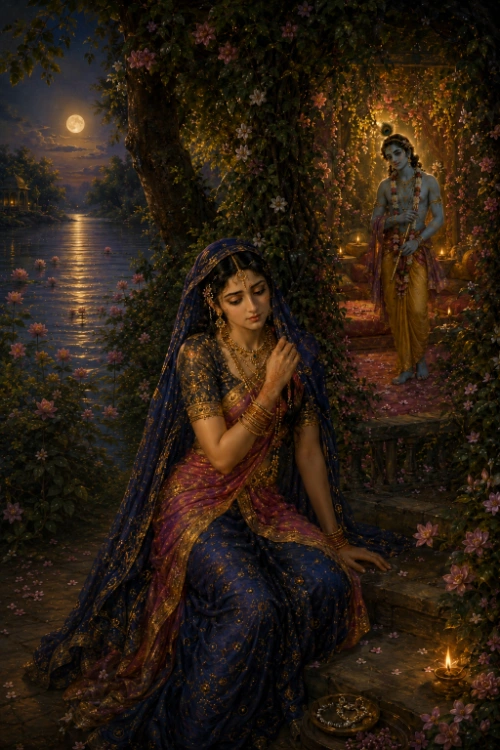
“I shall remain here. Go to Rādhā. Appease her with my words and bring her here.” Thus commissioned by the enemy of Madhu, the sakhī herself returned and again spoke to Rādhā.
Commentary
Freely rendered
“I will wait here. Go to Rādhā. Speak to her for me. Soothe her anger. And bring her to me.” So commanded by Kṛṣṇa, the enemy of Madhu, the faithful sakhī returned once more to Rādhā. And she began to speak.
Kṛṣṇa does not leave the rendezvous place. That becomes crucial throughout the canto. The sakhī can therefore tell Rādhā with certainty: He is there. He is waiting specifically for you. The entire canto depends upon this fixed point: Kṛṣṇa waits in the forest bower; Rādhā must decide whether to go to him.
Song 10
Vahati malaya-samīre — deśī-varāḍī rāga — rūpaka tāla
तव विरहे वनमाली सखि सीदति ॥
tava virahe vanamālī sakhi sīdati ||
“Friend, in separation from you, Vanamālī is languishing.”
Commentary
In Separation from You, the Garlanded One Is Fading
This line is the dhruva, the refrain that returns at the close of every stanza of the song.
The sakhī’s first strategy is the simplest one available to her: she tells Rādhā that Kṛṣṇa is suffering exactly as Rādhā has suffered. Every image of the season that tormented Rādhā in the fourth canto is now turned around and applied to him — the Malaya breeze, the opening flowers, the moonlight. Vanamālī, “the wearer of the forest garland,” is Kṛṣṇa, and the name is chosen for its sweetness rather than its majesty.
S10.1
वहति मलयसमीरे मदनमुपनिधाय ।
स्फुटति कुसुमनिकरे विरहिहृदयदलनाय ॥
vahati malaya-samīre madanam upanidhāya |
sphuṭati kusuma-nikare virahi-hṛdaya-dalanāya ||
The Malaya breeze blows as though carrying the god of Love with it. Masses of flowers burst open as though to tear apart the hearts of separated lovers. Friend, in separation from you, Vanamālī languishes.
Commentary
Freely rendered
The sandal-scented wind from Malaya moves through the forest, carrying Kāma invisibly upon it. Every cluster of flowers bursts into bloom as though sharpened specifically to wound those separated from the beloved. And there among them— Kṛṣṇa is wasting away for you, Rādhā.
The same spring landscape that tortured Rādhā now tortures Kṛṣṇa. Jayadeva is deliberately creating symmetry. In the early cantos, spring intensified Rādhā’s longing. Now: the Malaya wind, flowers, moon, bees and birds attack Kṛṣṇa as well.
S10.2
दहति शिशिरमयूखे मरणमनुकरोति ।
पतति मदनविशिखे विलपति विकलतरोऽति ॥
dahati śiśira-mayūkhe maraṇam anukaroti |
patati madana-viśikhe vilapati vikalataro ‘ti ||
The cooling moonbeams burn him. He seems almost to imitate death itself. When the arrows of Madana strike him, utterly distraught he laments. Friend, in separation from you, Vanamālī languishes.
Commentary
The inversion previously associated with Rādhā now applies to Kṛṣṇa: cool moonlight burns. The lovers’ experiences are becoming virtually interchangeable.
S10.3
ध्वनति मधुपसमूहे श्रवणमपिदधाति ।
मनसि कलितविरहे निशि निशि रुजमुपयाति ॥
dhvanati madhupa-samūhe śravaṇam apidadhāti |
manasi kalita-virahe niśi niśi rujam upayāti ||
When swarms of bees begin to hum, he covers his ears. As the thought of separation stirs within his mind, night after night he falls into pain. Friend, in separation from you, Vanamālī languishes.
Commentary
Why should the bees hurt him? Because their humming belongs to the soundscape of spring, flowers and amorous union. For someone in separation, even the buzzing of bees becomes a reminder of what is absent.
The published calita-virahe is corrected here to kalita-virahe, the reading of Nirṇaya Sāgara (1910), whose commentary glosses kalita-virahe sati; the Kāvyamālā text agrees, while the Gauḍīya edition reads valita-virahe.
S10.4
वसति विपिनविताने त्यजति ललितधाम ।
लुठति धरणिशयने बहु विलपति तव नाम ॥
vasati vipina-vitāne tyajati lalita-dhāma |
luṭhati dharaṇi-śayane bahu vilapati tava nāma ||
He has abandoned his beautiful dwelling and remains beneath the canopy of the forest. He rolls upon the earth as upon a bed and repeatedly cries out your name. Friend, in separation from you, Vanamālī languishes.
Commentary
The sakhī now gives Rādhā the strongest possible evidence. Kṛṣṇa is not simply “thinking about her.” He has: abandoned comfort, withdrawn into the forest, fallen upon the ground, and begun calling Rādhā’s name. The supposedly carefree Kṛṣṇa of Sarga I is gone.
S10.5
रणति पिकसमवाये प्रतिदिशमनुयाति ।
हसति मनुजनिचये विरहमपलपति नेति ॥
raṇati pika-samavāye prati-diśam anuyāti |
hasati manuja-nicaye viraham apalapati neti ||
Whenever the cuckoos call together, he rushes from direction to direction. When people laugh at his behaviour, he tries to deny his suffering: “No—it is nothing.” Friend, in separation from you, Vanamālī languishes.
Commentary
Kṛṣṇa’s suffering now becomes socially visible. He hears a sound— perhaps imagining that it signals Rādhā’s approach— and immediately turns toward it. Others notice. Others laugh. Kṛṣṇa attempts to conceal the reason. But the sakhī sees through him.
S10.6
स्फुरति कलरवरावे स्मरति मणितमेव ।
तवरतिसुखविभवे गणयति सुगुणमतीव ॥
sphurati kalarava-rāve smarati maṇitam eva |
tava rati-sukha-vibhave gaṇayati suguṇam atīva ||
Whenever sweet, indistinct calls resound, he remembers only your intimate murmurs. He considers the bliss of love with you to possess unsurpassed excellence. Friend, in separation from you, Vanamālī languishes.
Commentary
maṇita belongs to the vocabulary of amorous sound: murmuring or indistinct vocal expression during intimacy. Thus ordinary sounds in nature trigger memories of Rādhā. The world has become a network of reminders.
S10.7
त्वदभिधशुभदमासं वदति नरि शृणोति ।
तमपि जपति सरसं युवतिषु न रतिमुपैति ॥
tvad-abhidha-śubhada-māsaṁ vadati nari śṛṇoti |
tam api japati sarasaṁ yuvatiṣu na ratim upaiti ||
If someone happens to utter an auspicious name associated with yours, he listens intently. He repeats even that name with feeling. He finds no delight in other young women. Friend, in separation from you, Vanamālī languishes.
Commentary
Textual and Interpretive Note
This is one of the more difficult verses of the song. Traditional interpretation connects the expression tvad-abhidha—“bearing your designation/name”—with a calendrical name associated with Rādhā, while the transmitted wording itself varies slightly between editions. The essential dramatic point, however, is clear: anything that sounds like Rādhā’s name captures Kṛṣṇa’s attention. And the stanza ends with the much less ambiguous declaration: युवतिषु न रतिमुपैति yuvatiṣu na ratim upaiti “He takes no delight in other young women.” This is precisely what Rādhā most needs to hear.
Stanzas 5–7 of this song are absent from the Kāvyamālā text (GRETIL), from Nirṇaya Sāgara (1910) and from the Gauḍīya edition, all three of which give Aṣṭapadī 10 in five stanzas; they are retained here from the fuller recension.
S10.8
भणति कविजयदेवे विरहविलसितेन ।
मनसि रभसविभवे हरिरुदयतु सुकृतेन ॥
bhaṇati kavi-jayadeve viraha-vilasitena |
manasi rabhasa-vibhave harir udayatu sukṛtena ||
As the poet Jayadeva sings of these manifestations of separation, may Hari arise in the heart endowed with the blessed abundance of passionate devotion.
Commentary
A Note on the Transmission of Aṣṭapadī 10
Aṣṭapadī 10 is preserved in the fuller traditional text and in commentarial editions of the Gīta-govinda. Some regional and later witnesses, however, transmit a shorter form of Sarga V, and particular stanzas of this song have sometimes been regarded as secondary. For a complete reading of the received poetic tradition, it is valuable to retain the song while marking the textual issue. More importantly, its dramatic role is perfectly intelligible: Sarga IV told Kṛṣṇa how Rādhā suffers. Aṣṭapadī 10 tells Rādhā how Kṛṣṇa suffers. The symmetry is too important to miss.
33
पूर्वं यत्र समं त्वया रतिपतेरासादिताः सिद्धय-
स्तस्मिन्नेव निकुञ्जमन्मथमहातीर्थे पुनर्माधवः ।
ध्यायंस्त्वामनिशं जपन्नपि तवैवालापमन्त्रावलीं
भूयस्त्वत्कुचकुम्भनिर्भरपरीरम्भामृतं वाञ्छति ॥ ३३ ॥
pūrvaṁ yatra samaṁ tvayā ratipater āsāditāḥ siddhayas
tasminn eva nikuñja-manmatha-mahā-tīrthe punar mādhavaḥ |
dhyāyaṁs tvām aniśaṁ japann api tavaivālāpa-mantrāvalīṁ
bhūyas tvat-kuca-kumbha-nirbhara-parīrambhāmṛtaṁ vāñchati || 33 ||
In that very bower where formerly, together with you, the lord of Love attained his perfections, Mādhava has returned to that great sacred place of Manmatha. He meditates upon you without cease. He repeats the garland of your words as though they were mantras. And he longs once again for the nectar of tightly embracing your full breasts.
Commentary
Kṛṣṇa Has Turned the Bower into a Sacred Place of Love
Rādhā— he has returned to that same bower. The place where you once met. The place where Love himself seemed to attain perfection. For Mādhava it has now become a sacred pilgrimage place of desire. There he sits, meditating only upon you. Your former words have become his mantra. Your embrace has become the nectar for which he longs.
The Sacred-Erotic Metaphor
This verse is one of Jayadeva’s most daring transformations of religious language. The secret bower becomes: मन्मथमहातीर्थ — manmatha-mahā-tīrtha “the great sacred tīrtha of Love.” Kṛṣṇa becomes almost an ascetic or worshipper: dhyāyan — meditating; japan — repeating sacredly; mantrāvalī — a garland of mantras; amṛta — nectar of immortality. But the deity upon whom Kṛṣṇa meditates is Rādhā. Her speech is his mantra. Her embrace is his amṛta. The theology implicit in Sarga III has therefore become even more explicit: Rādhā is the object of Kṛṣṇa’s meditation.
The published āsāditaḥ is corrected to āsāditāḥ, in agreement with siddhayaḥ, on the authority of Nirṇaya Sāgara (1910) and the Kāvyamālā text (GRETIL).
Song 11
Rati-sukha-sāre gatam abhisāre — gurjarī rāga — ekatālī tāla
धीरसमीरे यमुनातीरे वसति वने वनमाली ।
गोपीपीनपयोधरमर्दनचञ्चलकरयुगशाली ॥
dhīra-samīre yamunā-tīre vasati vane vanamālī |
gopī-pīna-payodhara-mardana-cañcala-kara-yuga-śālī ||
In the gentle breeze, on the bank of the Yamunā, Vanamālī waits in the forest, he whose pair of restless hands delights in the breasts of the cowherd maidens.
Commentary
In the Gentle Breeze, on the Bank of the Yamunā, Vanamālī Waits
This couplet is the dhruva, the refrain that returns at the close of every stanza of the song.
Having established that Kṛṣṇa loves her, the sakhī changes strategy: she stops describing and starts instructing. The refrain is among the most famous lines in the Gīta-govinda, and everything in it points toward movement — a named place, a waiting person, and an implied journey. This is the song that turns Rādhā into an abhisārikā.
S11.1
रतिसुखसारे गतमभिसारे मदनमनोहरवेशम् ।
न कुरु नितम्बिनि गमनविलम्बनमनुसर तं हृदयेशम् ॥
rati-sukha-sāre gatam abhisāre madana-manohara-veśam |
na kuru nitambini gamana-vilambanam anusara taṁ hṛdayeśam ||
He has gone to the appointed rendezvous, the very essence of the happiness of love, dressed in a form enchanting even to Love himself. O beautiful-hipped Rādhā, do not delay your departure. Follow the lord of your heart. In the gentle breeze, on the bank of the Yamunā, Vanamālī waits in the forest, he whose pair of restless hands delights in the breasts of the cowherd maidens.
Commentary
Freely rendered
He has gone to the secret meeting place, dressed with such beauty that even Kāma might be enchanted. Rādhā— do not delay. Go to the lord of your heart. There, where the breeze moves softly along the bank of the Yamunā, Vanamālī waits beneath the trees.
Note: Abhisāra
abhisāra is not simply “going somewhere.” In Sanskrit erotic poetics it is the movement toward a secret amorous rendezvous. The woman who ventures forth to meet her lover is the: अभिसारिका — abhisārikā Sarga V is therefore traditionally characterized as an abhisārikā-varṇana, a portrayal of the heroine preparing to make that dangerous and exciting journey.
S11.2
नामसमेतं कृतसंकेतं वादयते मृदुवेणुम् ।
बहु मनुते ननु ते तनुसंगतपवनचलितमपि रेणुम् ॥
nāma-sametaṁ kṛta-saṅketaṁ vādayate mṛdu-veṇum |
bahu manute nanu te tanu-saṅgata-pavana-calitam api reṇum ||
He softly plays his flute, filling it with the signal of your name. Even a particle of dust carried toward him by the breeze after touching your body he treasures greatly. In the gentle breeze, on the bank of the Yamunā, Vanamālī waits in the forest.
Commentary
Kṛṣṇa’s flute now has a specific function. It is not the universal flute of the rāsa. It is a signal meant for Rādhā. कृतसंकेत — kṛta-saṅketa The word saṅketa can mean a sign, signal, or appointed meeting place. Thus the flute almost says: “Rādhā—here I am.” Even dust that may have touched her body becomes precious to him.
S11.3
पतति पतत्रे विचलति पत्रे शङ्कितभवदुपयानम् ।
रचयति शयनं सचकितनयनं पश्यति तव पन्थानम् ॥
patati patatre vicalati patre śaṅkita-bhavad-upayānam |
racayati śayanaṁ sa-cakita-nayanaṁ paśyati tava panthānam ||
Whenever a bird’s wing flutters, whenever a leaf moves, he imagines that you are approaching. He prepares the bed. With startled, expectant eyes he looks again and again toward the path by which you must come. In the gentle breeze, on the bank of the Yamunā, Vanamālī waits in the forest.
Commentary
Freely rendered
A wing beats— Kṛṣṇa looks up. A leaf trembles— he thinks it is you. Again he arranges the bed of leaves. Again he turns toward the path. Again he listens. Again he waits.
This may be the purest image of ākāṅkṣā—expectation in the whole canto. It also explains the title Sākāṅkṣa-Puṇḍarīkākṣa more vividly than any abstract definition could. Kṛṣṇa is reduced to one repeated thought: “Is that Rādhā?”
S11.4
मुखरमधीरं त्यज मञ्जीरं रिपुमिव केलिषु लोलम् ।
चल सखि कुञ्जं सतिमिरपुञ्जं शीलय नीलनिचोलम् ॥
mukharam adhīraṁ tyaja mañjīraṁ ripum iva keliṣu lolam |
cala sakhi kuñjaṁ sa-timira-puñjaṁ śīlaya nīla-nicolam ||
Cast aside your restless, noisy anklets as though they were enemies during secret love-play. Go, friend, toward the bower filled with masses of darkness. Wrap yourself in a dark-blue covering. In the gentle breeze, on the bank of the Yamunā, Vanamālī waits in the forest.
Commentary
The scene has become intensely practical. The sakhī is now preparing Rādhā for a clandestine journey. Her anklets must be removed because they betray her through sound. Her clothing should blend with the darkness. This is the classical iconography of the abhisārikā: love becomes powerful enough to overcome modesty, social danger and the fear of night.
Editions differ here: keliṣu lolam, the reading printed above, is that of the Gauḍīya edition, while Nirṇaya Sāgara (1910) and the Kāvyamālā text read keli-sulolam.
S11.5
उरसि मुरारेरुपहितहारे घन इव तरलबलाके ।
तडिदिव पीते रतिविपरीते राजसि सुकृतविपाके ॥
urasi murārer upahita-hāre ghana iva tarala-balāke |
taḍid iva pīte rati-viparīte rājasi sukṛta-vipāke ||
When your necklace rests upon Murāri’s dark chest, its moving pearls will appear like a flight of white cranes against a rain cloud. And you, golden one, will shine upon that cloud like lightning when the fruit of your good fortune ripens in love. In the gentle breeze, on the bank of the Yamunā, Vanamālī waits in the forest.
Commentary
The Cloud–Crane–Lightning Image
This is one of the great visual images of Sarga V: Kṛṣṇa → dark rain cloud Rādhā’s pearl necklace → white cranes Rādhā herself → golden lightning Jayadeva transforms their future embrace into a monsoon landscape. Rādhā’s golden radiance does not disappear against Kṛṣṇa’s darkness. It becomes more brilliant because of it.
The published taṭid iva is corrected to taḍid iva, “like lightning,” the reading of Nirṇaya Sāgara (1910), whose commentary glosses taḍid iva vidyud iva, and of the Kāvyamālā text.
S11.6
विगलितवसनं परिहृतरसनं घटय जघनमपिधानम् ।
किसलयशयने पङ्कजनयने निधिमिव हर्षनिदानम् ॥
vigalita-vasanaṁ parihṛta-rasanaṁ ghaṭaya jaghanam apidhānam |
kisalaya-śayane paṅkaja-nayane nidhim iva harṣa-nidānam ||
O lotus-eyed Rādhā, when clothing and girdle have fallen away, place upon the bed of tender leaves that treasure which is the source of delight. In the gentle breeze, on the bank of the Yamunā, Vanamālī waits in the forest.
Commentary
Jayadeva’s imagery is explicitly erotic, as is characteristic of the Gīta-govinda. But the key metaphor is nidhi—“treasure.” The lovers’ bodily union is not presented as incidental sensuality. Throughout the poem it functions as the culminating physical manifestation of an inward, mutually overwhelming attachment.
S11.7
हरिरभिमानी रजनिरिदानीमियमपि याति विरामम् ।
कुरु मम वचनं सत्वररचनं पूरय मधुरिपुकामम् ॥
harir abhimānī rajanir idānīm iyam api yāti virāmam |
kuru mama vacanaṁ satvara-racanaṁ pūraya madhu-ripu-kāmam ||
Hari possesses his own pride, and even this night is now moving toward its end. Therefore act quickly upon my words. Fulfil the longing of the enemy of Madhu. In the gentle breeze, on the bank of the Yamunā, Vanamālī waits in the forest.
Commentary
The sakhī adds urgency. Two things may disappear: Kṛṣṇa’s patience and the night itself. The opportunity is temporary. The word abhimānī indicates that Kṛṣṇa also possesses pride or self-respect. If Rādhā refuses indefinitely, he cannot be expected to wait without end. Thus: love now has a deadline.
S11.8
श्रीजयदेवे कृतहरिसेवे भणति परमरमणीयम् ।
प्रमुदितहृदयं हरिमतिसदयं नमत सुकृतकमनीयम् ॥
śrī-jayadeve kṛta-hari-seve bhaṇati parama-ramaṇīyam |
pramudita-hṛdayaṁ harim ati-sadayaṁ namata sukṛta-kamanīyam ||
As Śrī Jayadeva, devoted to the service of Hari, sings this supremely beautiful song, bow down to that exceedingly compassionate Hari, joyful at heart and attainable through blessed merit.
34
विकिरति मुहुः श्वासानाशाः पुरो मुहुरीक्षते
प्रविशति मुहुः कुञ्जं गुञ्जन्मुहुर्बहु ताम्यति ।
रचयति मुहुः शय्यां पर्याकुलं मुहुरीक्षते
मदनकदनक्लान्तः कान्ते प्रियस्तव वर्तते ॥ ३४ ॥
vikirati muhuḥ śvāsān āśāḥ puro muhur īkṣate
praviśati muhuḥ kuñjaṁ guñjan muhur bahu tāmyati |
racayati muhuḥ śayyāṁ paryākulaṁ muhur īkṣate
madana-kadana-klāntaḥ kānte priyas tava vartate || 34 ||
Again and again he releases deep sighs. Again and again he looks into every direction before him. Again he enters the bower, humming. Again he burns with longing. Again he prepares the bed. Again, bewildered, he looks about. O beautiful one, this is how your beloved behaves, exhausted by Love’s assault.
Commentary
Kṛṣṇa Cannot Remain Still
The song is followed by a magnificent portrait of waiting.
The Repetition of muhuḥ
Jayadeva repeats: मुहुः — muhuḥ “again and again.” This is psychologically exact. Waiting creates repetitive action. Kṛṣṇa does not progress. He cycles: sigh → look → enter → suffer → arrange → look again. Nothing can complete the sequence because the missing element is always the same: Rādhā has not arrived.
The published diśaḥ is corrected to āśāḥ, the reading of Nirṇaya Sāgara (1910), the Kāvyamālā text and the Gauḍīya edition alike; the sense (“the quarters before him”) is unchanged.
35
त्वद्वाम्येन समं समग्रमधुना तिग्मांशुरस्तं गतो
गोविन्दस्य मनोरथेन च समं प्राप्तं तमः सान्द्रताम् ।
कोकानां करुणस्वनेन सदृशी दीर्घा मदभ्यर्थना
तन्मुग्धे विफलं विलम्बनमसौ रम्योऽभिसारक्षणः ॥ ३५ ॥
tvad-vāmyena samaṁ samagram adhunā tigmāṁśur astaṁ gato
govindasya manorathena ca samaṁ prāptaṁ tamaḥ sāndratām |
kokānāṁ karuṇa-svanena sadṛśī dīrghā mad-abhyarthanā
tan mugdhe viphalaṁ vilambanam asau ramyo ‘bhisāra-kṣaṇaḥ || 35 ||
Now the fierce-rayed sun has completely set, as though together with your resistance. Darkness has become dense in proportion to Govinda’s desire. My entreaty has become long like the sorrowful calls of the cakravāka birds. Therefore, innocent one, further delay is useless. This is the beautiful moment for the rendezvous.
Commentary
Sunset, Darkness and the Perfect Moment for Abhisāra
Rādhā— the sun has finally gone down. Let your resistance set with it. As Govinda’s desire deepens, the darkness itself grows deeper. Even the separated cakravāka birds cry through the dusk, and I have pleaded with you just as long. Enough delay. This is the hour. This is the beautiful moment for the secret journey.
Jayadeva aligns the entire cosmos with the lovers: Rādhā’s resistance → sunset Kṛṣṇa’s desire → deepening darkness sakhī’s entreaty → cries of separated birds The landscape is no longer merely decorative. It is a clock. Night has opened the possibility of reunion.
36
आश्लेषादनु चुम्बनादनु नखोल्लेखादनु स्वान्तज-
प्रोद्बोधादनु सम्भ्रमादनु रतारम्भादनु प्रीतयोः ।
अन्यार्थं गतयोर्भ्रमान्मिलितयोः सम्भाषणैर्जानतो-
र्दम्पत्योरिह को न को न तमसि व्रीडाविमिश्रो रसः ॥ ३६ ॥
āśleṣād anu cumbanād anu nakhollekhād anu svāntaja-
prodbodhād anu sambhramād anu ratārambhād anu prītayoḥ |
anyārthaṁ gatayor bhramān militayoḥ sambhāṣaṇair jānator
dampatyor iha ko na ko na tamasi vrīḍā-vimiśro rasaḥ || 36 ||
In darkness, when two lovers meet unexpectedly, what flavour of love does not arise? First an embrace, then a kiss, then the marks of nails, then the awakening of desire within the heart, then excitement, then the beginning of love-play, then delight— until conversation reveals whom they have encountered, and pleasure becomes mingled with bashfulness.
Commentary
The Darkness Itself Creates Erotic Possibility
This is one of Jayadeva’s most explicitly aesthetic verses. The subject is broader than Rādhā and Kṛṣṇa themselves: the poet briefly reflects upon what darkness does to erotic rasa. Darkness removes certainty. It permits: misrecognition, surprise, touch before sight, desire before identification, and finally vrīḍā, bashfulness. Thus night is not simply concealment. It actively creates new varieties of rasa.
37
सभयचकितं विन्यस्यन्तीं दृशौ तिमिरे पथि
प्रतितरु मुहुः स्थित्वा मन्दं पदानि वितन्वतीम् ।
कथमपि रहः प्राप्तामङ्गैरनङ्गतरङ्गिभिः
सुमुखि सुभगः पश्यन्स त्वामुपैतु कृतार्थताम् ॥ ३७ ॥
sa-bhaya-cakitaṁ vinyasyantīṁ dṛśau timire pathi
prati-taru muhuḥ sthitvā mandaṁ padāni vitanvatīm |
katham api rahaḥ prāptām aṅgair anaṅga-taraṅgibhiḥ
sumukhi subhagaḥ paśyan sa tvām upaitu kṛtārthatām || 37 ||
O beautiful-faced one, may that fortunate lover attain fulfilment when he sees you— casting frightened, cautious glances along the dark road; pausing again and again at every tree; placing your steps slowly; somehow finally reaching the secret place; your limbs surging with waves of bodiless Love.
Commentary
The Sakhī Imagines Rādhā’s Journey
I can already see you, Rādhā. The path is dark. You cast nervous glances around you. At every tree you stop— listening, watching, wondering whether someone has seen you. Slowly you move forward. Love rises in waves through every limb. And somehow— at last— you reach the hidden bower. May Kṛṣṇa see you there and know that his waiting was not in vain.
Here Rādhā is fully imagined as the abhisārikā. The erotic heroine is not fearless. Her courage consists precisely in moving forward despite fear. The journey includes: darkness, uncertainty, social risk, hesitation, secrecy, bodily desire. Abhisāra therefore gives physical movement to inward longing. Until now Rādhā’s love has largely been experienced in memory and suffering. Now it must become: a path walked through the night.
Editions differ here: dṛśau, “the two eyes,” is retained as published, while Nirṇaya Sāgara (1910), the Kāvyamālā text and the Gauḍīya edition read the singular dṛśam.
Benediction
राधामुग्धमुखारविन्दमधुपस्त्रैलोक्यमौलिस्थली-
नेपथ्योचितनीलरत्नमवनीभारावतारान्तकः ।
स्वच्छन्दं व्रजसुन्दरीजनमनस्तोषप्रदोषोदयः
कंसध्वंसनधूमकेतुरवतु त्वां देवकीनन्दनः ॥
rādhā-mugdha-mukhāravinda-madhupas trailokya-mauli-sthalī-
nepathyocita-nīla-ratnam avanī-bhārāvatārāntakaḥ |
svacchandaṁ vraja-sundarī-jana-manas-toṣa-pradoṣodayaḥ
kaṁsa-dhvaṁsana-dhūmaketur avatu tvāṁ devakī-nandanaḥ ||
May Devakī’s son protect you— the honeybee drinking from the lovely lotus of Rādhā’s face; the blue jewel fit to adorn the crowns of the three worlds; the destroyer of those incarnations that burden the earth; the evening moon that freely rises to delight the hearts of the beautiful women of Vraja; the blazing comet of destruction for Kaṁsa.
Commentary
Closing Benediction — A Recensional Verse
A fuller textual tradition preserves an additional benedictory stanza.
The opening image is particularly important: राधामुग्धमुखारविन्दमधुपः rādhā-mugdha-mukhāravinda-madhupaḥ Kṛṣṇa is the bee. Rādhā’s face is the lotus. Despite the cosmic epithets that follow, Jayadeva begins by defining Kṛṣṇa through his attraction to Rādhā. Only afterward does he become: the jewel of the three worlds, the remover of the earth’s burden, the delight of the women of Vraja, the destroyer of Kaṁsa. The order matters. The cosmic Kṛṣṇa is introduced first as: the bee at Rādhā’s lotus-face.
Though sometimes described as a recensional addition, this stanza in fact closes Sarga V in Nirṇaya Sāgara (1910) and in the Kāvyamālā text (GRETIL) alike.
Colophon
इति श्रीगीतगोविन्देऽभिसारिकावर्णने साकाङ्क्षपुण्डरीकाक्षो नाम पञ्चमः सर्गः ॥ ५ ॥
iti śrī-gīta-govinde ‘bhisārikā-varṇane sākāṅkṣa-puṇḍarīkākṣo nāma pañcamaḥ sargaḥ || 5 ||
Thus ends the fifth sarga, named Sākāṅkṣa-Puṇḍarīkākṣa, in the description of the abhisārikā, of the illustrious Gīta-govinda.
The question the canto turns on
Sarga V is about one thing: will Rādhā go? The emotional problem has already been settled. There is no longer any serious doubt that the lovers want each other — the second canto established Rādhā’s longing, the third established Kṛṣṇa’s, the fourth told Kṛṣṇa how devastated she is, and this canto tells Rādhā how devastated he is. What remains is not a failure of love but a failure of movement. Someone has to cross the distance.
The sakhī as the engineer of reunion
Her method is patient and unusually intelligent. She never simply says “go to Kṛṣṇa.” Instead she dismantles, one at a time, every reason Rādhā might have for staying where she is. He is suffering for you. He has no interest in other women. He has gone back to the place where you were together. He is meditating on you. He is calling you with the flute. He takes every sound for your arrival. He has prepared the bed. Night has fallen. Your anklets can be silenced. Dark clothing will hide you. The night is passing. There is no longer any reason to wait.
That is not persuasion so much as a controlled transformation: māna, Rādhā’s wounded pride, is being converted into abhisāra, active movement toward the beloved.
Every leaf makes him think she has come
The emotional centre of the canto may be its plainest line — patati patatre vicalati patre śaṅkita-bhavad-upayānam. A feather falls. A leaf stirs. And Kṛṣṇa thinks: Rādhā. It says more about his condition than any amount of praise could, because it describes the particular psychology of expectation in which every sensory event is read as the beloved. A sound has stopped being a sound. It has become the possibility of her.
Why Sākāṅkṣa-Puṇḍarīkākṣa
Puṇḍarīkākṣa, the lotus-eyed, is a majestic name and traditionally belongs to Viṣṇu. Jayadeva sets beside it sākāṅkṣa — waiting, wanting, expectant — and the whole point of the canto is in that pairing. The Lord whom devotees wait to see is himself waiting. The one the world seeks is watching a forest path for a single woman. The object of meditation is meditating; the receiver of mantra performs japa with her remembered words; the giver of liberation wants the nectar of her embrace. The inversion is deliberate and it is central to Jayadeva: Kṛṣṇa’s greatness is not suspended when he longs for Rādhā. His willingness to be conquered by love is part of it.
Rādhā as abhisārikā
The canto also begins a change in Rādhā’s poetic identity. Until now she has been the offended heroine and the woman suffering in separation. The sakhī summons a different Rādhā: the abhisārikā, who does not wait at home. Night does not stop her, nor the forest, nor fear, nor convention. Her anklets are silenced, her bright clothes darkened, her path kept secret, and her desire made stronger than her hesitation. This is why the canto’s own colophon calls itself the description of the abhisārikā — it is not simply about Kṛṣṇa waiting, but about the making of the Rādhā who will go to him.
And still the reunion does not occur
Everything is ready. Kṛṣṇa waits, the bower is prepared, the sun has set, the darkness will hide her, the sakhī has argued the case, and the journey has already been described in imagination. Surely she goes. She does not — or more precisely, she cannot yet complete the journey, and Jayadeva withholds the reunion on purpose. The sixth canto, Kuṇṭha-Vaikuṇṭha, explains why: her longing has grown so intense that her body can no longer carry her. She rises, prepares herself, imagines him, mistakes the darkness itself for his form, and collapses. The sakhī will have to return to Kṛṣṇa with a stranger message than the one she brought — that Rādhā wants to come and cannot.