

Smaller Than the Small, Greater Than the Great
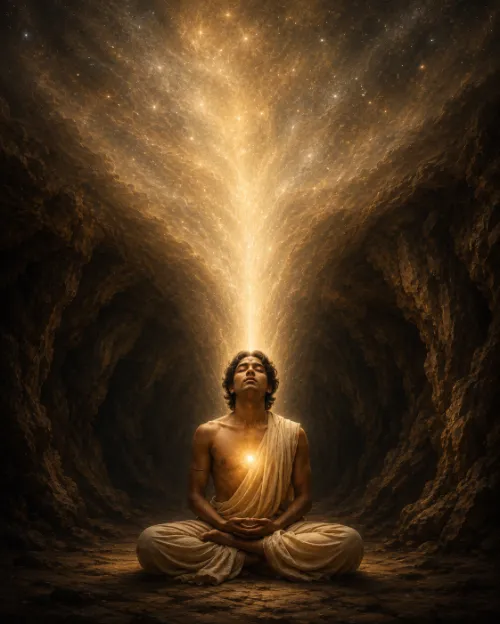
The Self Hidden in the Cave of the Heart
How can the Self be smaller than the smallest and at the same time greater than the greatest? How can something hidden in the deepest interior of a living being also transcend every ordinary measure of greatness?
And why does the Kaṭha Upaniṣad say that this Self becomes visible only when desire subsides and sorrow is overcome? These questions are compressed into one of the Upaniṣads’ most striking mantras:
अणोरणीयान् महतो महीयान्
आत्मास्य जन्तोर्निहितो गुहायाम् ।
तमक्रतुः पश्यति वीतशोको
धातुप्रसादान्महिमानमात्मनः ॥
aṇor aṇīyān mahato mahīyān
ātmāsya jantor nihito guhāyām
tam akratuḥ paśyati vīta-śoko
dhātu-prasādān mahimānam ātmanaḥ
“Smaller than the small and greater than the great, the Self is hidden in the cave of the heart of this living being. One who is free from selfish desire, and thus free from sorrow, beholds the greatness of the Self through the serenity and purification of the inner faculties.”
Kaṭha Upaniṣad 1.2.20
The verse sounds paradoxical because it is deliberately pushing thought beyond ordinary physical categories. The Self is not simply another object in the universe. It cannot be placed next to a stone, a planet, or an atom and measured on the same scale.
It is “smaller than the small,” yet “greater than the great.” It is hidden within, yet its greatness transcends the limits of the body in which it is realized. The mantra is therefore not primarily giving us a measurement.
It is teaching us how badly ordinary measurements fail when applied to spiritual reality.
The Setting: Naciketas Has Asked the Question of Death
The Kaṭha Upaniṣad is built around an extraordinary dialogue between the young seeker Naciketas and Yama, the lord of death. Naciketas does not ask merely how to live comfortably or how to gain heaven. He asks what happens to the conscious person when the body dies.
Some say the person continues. Others say there is nothing. He asks Yama to reveal the truth. Yama initially tries to divert him with wealth, long life, descendants, beautiful companions, music, chariots, and every imaginable worldly pleasure.
Naciketas refuses. He recognizes that all such things are temporary. That rejection becomes the foundation of the entire teaching. Yama therefore distinguishes between two paths:
अन्यच्छ्रेयोऽन्यदुतैव प्रेयस्
ते उभे नानार्थे पुरुषं सिनीतः ।
तयोः श्रेय आददानस्य साधु
भवति हीयतेऽर्थाद्य उ प्रेयो वृणीते ॥
anyac chreyo ’nyad utaiva preyas
te ubhe nānārthe puruṣaṁ sinītaḥ
tayoḥ śreya ādadānasya sādhu
bhavati hīyate ’rthād ya u preyo vṛṇīte
“The truly good is one thing and the merely pleasant another. These two lead a person toward different ends. It goes well with one who chooses the higher good; one who chooses merely the pleasant falls away from the true goal.”
Kaṭha Upaniṣad 1.2.1
That distinction is essential for understanding 1.2.20. The Self is not discovered by chasing every attractive experience. The seeker must become capable of choosing what is true over what merely gratifies desire.
The Self Is Difficult to Know
Yama warns that this knowledge is subtle:
श्रवणायापि बहुभिर्यो न लभ्यः
शृण्वन्तोऽपि बहवो यं न विद्युः ।
आश्चर्यो वक्ता कुशलोऽस्य लब्धा
आश्चर्यो ज्ञाता कुशलानुशिष्टः ॥
śravaṇāyāpi bahubhir yo na labhyaḥ
śṛṇvanto ’pi bahavo yaṁ na vidyuḥ
āścaryo vaktā kuśalo ’sya labdhā
āścaryo jñātā kuśalānuśiṣṭaḥ
“Many do not even obtain the opportunity to hear of this Self, and many who hear of it still do not understand. Wonderful is the teacher who can speak of it; rare and skillful is the one who realizes it when properly instructed.”
Kaṭha Upaniṣad 1.2.7
The Self is subtle not because it is deliberately hidden behind obscurity, but because our attention is normally directed outward. We are trained to notice: objects, sounds, people, possessions, success, failure, pleasure, and pain.
The consciousness by which all these are known is rarely examined. That is why the Upaniṣad calls this teaching: aṇīyān subtler than the subtle.
“Smaller Than the Small”
The mantra opens:
अणोरणीयान्
aṇor aṇīyān
“smaller than the small,”
“subtler than the subtle.”
The word aṇu can mean minute, tiny, subtle, or atomic. But this should not be confused with a modern physical atom. The Upaniṣad is not proposing that the Self is a microscopic particle waiting to be discovered by sufficiently advanced instruments.
A physical object, however small, still has: location, dimension, material composition, and measurable extension. The Self is not being presented as one more physical thing.
Its minuteness points instead toward its radical subtlety. It is not accessible to the ordinary senses. You cannot see consciousness with the eye in the same way you see a color.
You cannot hear the Self as you hear a sound. You cannot touch it as you touch an object. Yet without consciousness: seeing, hearing, touching, thinking, and knowing would not occur at all.
The Self is therefore subtler than the objects it knows.
Yet the Same Self Is “Greater Than the Great”
The verse immediately reverses direction:
महतो महीयान्
mahato mahīyān
“greater than the great.”
This prevents us from imagining that the Self is simply very tiny. Something extraordinary is being said. The same ātman is described as: smaller than the small, and: greater than the great.
Śaṅkarācārya explains that all names, forms, and activities ultimately depend upon the Self. It therefore cannot be reduced to the dimensions of any object appearing within experience.
The verse is deliberately paradoxical because spiritual reality cannot be exhausted by spatial language. “Small” and “great” work only as pointers. The Self is subtler than anything we can objectify, yet its reality is more fundamental than the vast things we normally call great.
The Next Two Verses Confirm That Ordinary Spatial Categories Are Inadequate
Immediately after 1.2.20, Yama says:
आसीनो दूरं व्रजति
शयानो याति सर्वतः ।
कस्तं मदामदं देवं
मदन्यो ज्ञातुमर्हति ॥
āsīno dūraṁ vrajati
śayāno yāti sarvataḥ
kas taṁ madāmadaṁ devaṁ
mad anyo jñātum arhati
“Sitting, He travels far; lying down, He goes everywhere. Who can truly know that luminous Reality beyond ordinary states of exhilaration and dejection?”
Kaṭha Upaniṣad 1.2.21
Then:
अशरीरं शरीरेष्व्
अनवस्थेष्ववस्थितम् ।
महान्तं विभुमात्मानं
मत्वा धीरो न शोचति ॥
aśarīraṁ śarīreṣv
anavastheṣv avasthitam
mahāntaṁ vibhum ātmānaṁ
matvā dhīro na śocati
“Knowing the bodiless Self dwelling among unstable bodies, great and all-pervading, the discerning person does not grieve.”
Kaṭha Upaniṣad 1.2.22
The word:
विभु
vibhu
means: great, mighty, pervasive, all-pervading. So the immediate sequence does not encourage us to think of the Self merely as a tiny object hidden somewhere in the chest.
The Upaniṣad is describing a reality that is inwardly present yet not confined by bodily dimensions.
Hidden in the Cave of the Heart
The mantra continues:
आत्मास्य जन्तोर्निहितो गुहायाम्
ātmāsya jantor nihito guhāyām
“The Self of this living being is hidden in the cave.”
The crucial word is:
गुहा
guhā
cave, hidden place, secret interior.
Traditional Vedānta understands this “cave” as the: heart —not merely the anatomical organ pumping blood, but the inward center of consciousness, intelligence, and spiritual realization.
Śaṅkara glosses the cave simply as:
हृदय
hṛdaya
“the heart.”
The image is powerful. The truth we seek is described as hidden, but not because it is necessarily far away. It is hidden because it lies deeper than the level at which we ordinarily look.
Human beings search outward: for more experience, more possessions, more relationships, more stimulation, more information. The Upaniṣad redirects the search inward. The deepest reality is not reached by traveling farther through external objects.
It is discovered in the “cave” where consciousness itself becomes the object of inquiry.
Hidden Does Not Mean Absent
The word:
निहित
nihita
means: placed, lodged, deposited, hidden. This is important. The Self does not have to be manufactured through spiritual practice. Meditation does not create the Self. Austerity does not create the Self.
Scripture does not create the Self. The Self is already: nihitaḥ present, lodged, hidden within. The problem is not absence. The problem is obscured perception. This becomes crucial in the second half of the mantra.
Akratuḥ: The One Who No Longer Lives Under the Rule of Craving
Who sees this hidden Self? The mantra says:
तमक्रतुः पश्यति
tam akratuḥ paśyati
“The one who is akratu sees it.”
The word: akratu is difficult to capture in one English word. Its opposite, kratu, can involve: intention, desire, resolve, mental projection, purpose, or sacrificial action.
Śaṅkara interprets: akratuḥ as: akāmaḥ “desireless.” But “desireless” needs explanation. The Upaniṣad is not describing someone who has become inert or incapable of willing anything.
The meaning is closer to: a person no longer dominated by selfish craving for external objects. Such a person no longer assumes: “If I acquire enough things outside myself, I will finally become complete.”
This connects directly with Naciketas’ earlier rejection of Yama’s temptations. Yama offered him: wealth, longevity, pleasure, status, and sensual enjoyment. Naciketas declined.
He understood that temporary objects cannot answer the question of the eternal Self. That is akratu in practice.
Desire Shapes What We See
This point is psychologically profound. We often imagine perception as neutral: “I simply see reality as it is.” But desire filters attention. If I intensely want something, I notice information supporting my desire.
If I fear something, I notice threats. If I crave approval, I interpret events through status and reputation. If I want possession, people and objects appear primarily according to their usefulness to me.
The mind colored by craving does not see reality cleanly. That is why the Upaniṣad links self-realization with: akratuḥ —freedom from compulsive self-centered desire. The Self is not absent.
The mind is noisy.
Vīta-śokaḥ: Freedom From Sorrow
The seeker is then described as:
वीतशोकः
vīta-śokaḥ
“free from sorrow.”
This phrase appears repeatedly in the Upaniṣadic world. śoka is not merely momentary sadness. It includes: grief, existential sorrow, the pain produced by ignorance and identification with what is unstable.
vīta means: gone beyond, freed from, having passed beyond. The Upaniṣad therefore links knowledge of the Self with a profound freedom from sorrow. This does not necessarily mean that a realized person never experiences ordinary human emotion.
It means that the deepest foundation of identity is no longer destroyed whenever something temporary changes. If I believe: “I am nothing more than this body,” then bodily death threatens absolute annihilation.
If I believe: “I am nothing more than my possessions,” their loss becomes loss of self. If I believe: “I am nothing more than social approval,” criticism becomes existential collapse.
The Upaniṣad attacks sorrow at its root by asking: What are you, really?
Knowledge and Freedom From Sorrow Are Repeatedly Joined
Earlier in the same section, Yama says:
तं दुर्दर्शं गूढमनुप्रविष्टं
गुहाहितं गह्वरेष्ठं पुराणम् ।
अध्यात्मयोगाधिगमेन देवं
मत्वा धीरो हर्षशोकौ जहाति ॥
taṁ durdarśaṁ gūḍham anupraviṣṭaṁ
guhāhitaṁ gahvareṣṭhaṁ purāṇam
adhyātma-yogādhigamena devaṁ
matvā dhīro harṣa-śokau jahāti
“Knowing through the yoga of inner realization that ancient luminous Reality, difficult to see, deeply hidden and established in the cave, the discerning person gives up both elation and sorrow.”
Kaṭha Upaniṣad 1.2.12
Again: the Self is hidden in the cave, and realization transforms emotional bondage. The pattern is consistent. Self-knowledge is not merely intellectual information. It changes the center from which life is experienced.
What Is Dhātu-prasāda?
The final part of the mantra contains one of its most difficult expressions:
धातुप्रसादान्महिमानमात्मनः
dhātu-prasādān mahimānam ātmanaḥ
A natural translation is: “through the serenity or purification of the inner faculties, one beholds the greatness of the Self.” The phrase: dhātu-prasāda has received more than one traditional explanation.
In Śaṅkara’s commentary, the dhātus are the faculties that sustain embodied life, especially the: mind, intelligence, and senses. When craving for external objects subsides, these faculties become: clear, quiet, serene, and transparent.
Then the Self becomes recognizable. The principle is simple: A disturbed instrument produces distorted perception. A purified instrument reveals more clearly what is already present.
The Mirror Analogy
Imagine a mirror covered with dirt. The face is present. The mirror is present. But the reflection is distorted. Cleaning the mirror does not create the face. It allows the mirror to reveal it.
Or imagine muddy water. The sun may be shining brilliantly above it, but the reflection is broken and unclear. When the water becomes: clear and: still, the same sun appears distinctly.
The Upaniṣadic teaching works in the same way. The Self is already: nihitaḥ present and hidden within. Spiritual discipline purifies the instrument through which it is known.
The goal is not to manufacture spiritual identity. It is to remove what obstructs clear realization.
Prasāda Means Clarity as Well as Grace
The Sanskrit word: prasāda can mean: clarity, serenity, tranquility, favor, or grace. This gives the phrase dhātu-prasāda an especially beautiful richness. One traditional line of interpretation emphasizes: the serenity of the faculties.
Another theistic reading hears: the grace of the Ordainer or Creator. These two ideas do not have to be enemies. Spiritual traditions regularly hold together: human preparation, and: divine revelation.
The mind must become ready. But ultimate reality is not an object we conquer by intellectual force. This becomes explicit only a few verses later.
The Self Cannot Be Captured by Intellectual Power Alone
The Kaṭha Upaniṣad says:
नायमात्मा प्रवचनेन लभ्यो
न मेधया न बहुना श्रुतेन ।
यमेवैष वृणुते तेन लभ्यस्
तस्यैष आत्मा विवृणुते तनूं स्वाम् ॥
nāyam ātmā pravacanena labhyo
na medhayā na bahunā śrutena
yam evaiṣa vṛṇute tena labhyas
tasyaiṣa ātmā vivṛṇute tanūṁ svām
“This Self is not attained merely by eloquent teaching, nor by intellect, nor by much hearing. It is attained by the one whom the Self chooses; to such a person the Self reveals its own nature.”
Kaṭha Upaniṣad 1.2.23
This is one of the most striking corrections to spiritual intellectualism in all of Vedānta. One may possess:
- excellent memory
- vast scriptural knowledge
- philosophical sophistication
- and impressive eloquence
- yet still lack direct realization.
Knowledge is necessary. But information alone cannot force the Self to become an object of possession. The Upaniṣad says: vivṛṇute tanūṁ svām “the Self reveals its own nature.”
Realization contains the character of revelation.
Yet Grace Does Not Remove the Need for Purification
The next verse immediately prevents us from turning grace into passivity:
नाविरतो दुश्चरितान्नाशान्तो नासमाहितः ।
नाशान्तमानसो वापि प्रज्ञानेनैनमाप्नुयात् ॥
nāvirato duścaritān nāśānto nāsamāhitaḥ
nāśānta-mānaso vāpi prajñānenainam āpnuyāt
“One who has not turned away from wrongful conduct, whose senses are not peaceful, who lacks concentration, and whose mind is not tranquil cannot attain this Self merely through knowledge.”
Kaṭha Upaniṣad 1.2.24
This creates a beautiful balance. The Self is not captured by intellectual brilliance. But neither is realization given as an excuse for moral disorder. The seeker must cultivate: ethical restraint, inner peace, attention, and purification.
Then realization can dawn. So the Upaniṣadic equation is neither: effort alone nor: grace without transformation. It is: purification that becomes receptive to revelation.
“Smaller Than the Small” Does Not Mean the Same Thing in Every Vedānta School
A serious treatment should acknowledge that the great Vedānta traditions do not interpret every term in exactly the same way. Advaita Vedānta, following Śaṅkara, emphasizes that the ultimate Self cannot literally be confined to a spatially minute entity. Aṇīyān points to extreme subtlety, while mahīyān and vibhu reveal the Self as limitless.
Vaiṣṇava Vedānta accepts the reality of an eternal individual jīva and also distinguishes that jīva from the unlimited Supreme Self. Within those traditions, scriptural statements describing the jīva as aṇu become important for the doctrine of the soul’s real spiritual minuteness.
The important point is not to force every later doctrinal distinction into this one mantra. The mantra itself speaks majestically of: ātman as smaller than the small, greater than the great, and hidden in the heart.
The surrounding Upaniṣadic corpus then develops different dimensions of the relationship between the individual self and the Supreme.
A Vaiṣṇava Reading: The Minute Jīva and the Unlimited Lord
Vaiṣṇava traditions place this verse alongside other śruti passages that distinguish the finite individual self from the unlimited Lord. The Śvetāśvatara Upaniṣad, for example, gives its famous image of the minute jīva:
बालाग्रशतभागस्य
शतधा कल्पितस्य च ।
भागो जीवः स विज्ञेयः
स चानन्त्याय कल्पते ॥
bālāgra-śata-bhāgasya
śatadhā kalpitasya ca
bhāgo jīvaḥ sa vijñeyaḥ
sa cānantyāya kalpate
“The jīva should be understood as comparable to one hundredth part of the tip of a hair divided again one hundredfold; yet it is fitted for spiritual infinitude.”
Śvetāśvatara Upaniṣad 5.9
The comparison expresses unimaginable subtlety. It is not intended as a physical measurement. The jīva is not a microscopic material particle. It is a conscious spiritual individual.
The Same Kaṭha Mantra Appears in the Śvetāśvatara Upaniṣad
An especially interesting textual fact is that a close version of this mantra appears again in Śvetāśvatara Upaniṣad 3.20:
अणोरणीयान्महतो महीयान्
आत्मा गुहायां निहितोऽस्य जन्तोः ।
तमक्रतुं पश्यति वीतशोको
धातुः प्रसादान्महिमानमीशम् ॥
aṇor aṇīyān mahato mahīyān
ātmā guhāyāṁ nihito ’sya jantoḥ
tam akratuṁ paśyati vīta-śoko
dhātuḥ prasādān mahimānam īśam
“Smaller than the small and greater than the great, the Self is hidden in the cave of the heart of this living being. One becomes free from sorrow upon beholding that desireless and majestic Lord through the grace or serenity granted by the Ordainer.”
The significant variant is the ending:
ईशम्
īśam
“the Lord.”
This gives the verse an unmistakably theistic coloring in the Śvetāśvatara recension. It shows how naturally the mantra could be received within later theistic Vedānta.
The Heart as the Meeting Place of the Finite and the Infinite
This is perhaps one of the most beautiful ways to understand the mantra. The verse directs us inward: guhāyām into the cave of the heart. Yet what is discovered there is not merely something private and psychologically small.
It is: mahato mahīyān greater than the great. The inward journey therefore does not end in self-absorption. Properly understood, it opens toward transcendence. The deepest center of consciousness becomes the place where the finite living being encounters a reality greater than itself.
The Two Birds Give a Related Upaniṣadic Image
A different Upaniṣadic passage expresses this relationship through the famous image of two birds. The Muṇḍaka Upaniṣad says:
द्वा सुपर्णा सयुजा सखाया
समानं वृक्षं परिषस्वजाते ।
तयोरन्यः पिप्पलं स्वाद्वत्त्य्
अनश्नन्नन्यो अभिचाकशीति ॥
dvā suparṇā sayujā sakhāyā
samānaṁ vṛkṣaṁ pariṣasvajāte
tayor anyaḥ pippalaṁ svādv atty
anaśnann anyo ’bhicākaśīti
“Two beautiful birds, inseparable companions, perch upon the same tree. One eats the sweet fruit; the other, not eating, simply watches.”
Muṇḍaka Upaniṣad 3.1.1
The next mantra says:
समाने वृक्षे पुरुषो निमग्नोऽनीशया
शोचति मुह्यमानः ।
जुष्टं यदा पश्यत्यन्यमीशमस्य
महिमानमिति वीतशोकः ॥
samāne vṛkṣe puruṣo nimagno ’nīśayā
śocati muhyamānaḥ
juṣṭaṁ yadā paśyaty anyam īśam asya
mahimānam iti vīta-śokaḥ
“On the same tree the individual person, submerged and powerless, grieves in bewilderment. But when he sees the other—the Lord—and beholds His greatness, he becomes free from sorrow.”
Muṇḍaka Upaniṣad 3.1.2
This is not the literal imagery of Kaṭha Upaniṣad 1.2.20. But the spiritual movement is strikingly similar. In both cases the seeker moves from: desire, bewilderment, and sorrow toward: vision, realization, and freedom from sorrow.
The phrase: vīta-śoka appears in both worlds. The Upaniṣads repeatedly associate liberation with seeing clearly what was always present.
The Problem Is Not That the Self Is Far Away
One of the most practical insights of the mantra is that spiritual ignorance is not primarily a problem of geographical distance. The Self is: nihitaḥ guhāyām hidden in the cave of the heart.
We do not fail to know it because we have not traveled far enough. We fail because our attention is absorbed elsewhere. This is why the Kaṭha Upaniṣad later says:
पराञ्चि खानि व्यतृणत्स्वयम्भूः
तस्मात्पराङ्पश्यति नान्तरात्मन् ।
कश्चिद्धीरः प्रत्यगात्मानमैक्षद्
आवृत्तचक्षुरमृतत्वमिच्छन् ॥
parāñci khāni vyatṛṇat svayambhūḥ
tasmāt parāṅ paśyati nāntarātman
kaścid dhīraḥ pratyag-ātmānam aikṣad
āvṛtta-cakṣur amṛtatvam icchan
“The Self-born Creator made the senses turn outward; therefore one looks outward and not toward the inner Self. But a rare discerning person, desiring immortality, turns the gaze inward and beholds the inner Self.”
Kaṭha Upaniṣad 2.1.1
This is almost a commentary on the “cave of the heart.” The Self is hidden because consciousness is habitually facing outward.
Spiritual Life Is Therefore a Reversal of Attention
Ordinary life asks: “What else can I acquire?” The Upaniṣad asks: “Who is the one trying to acquire?” Ordinary life asks: “What experience will finally satisfy me?” The Upaniṣad asks: “Who is the experiencer?”
Ordinary life seeks completion through objects. The Upaniṣad turns attention toward the subject. This inward turn does not require hatred of the world. It requires refusing to expect impermanent objects to supply an eternal identity.
That is exactly why Naciketas had to reject Yama’s temptations before receiving this teaching.
Why Desire and Sorrow Are Connected
The mantra’s sequence: akratuḥ and: vīta-śokaḥ is not accidental. Craving ties identity to outcomes. “I must obtain this.” “I must preserve this.” “This must not change.” “This person must never leave.”
“This body must remain young.” “My status must remain intact.” But everything conditioned changes. Therefore craving aimed at impermanent objects eventually produces: fear, frustration, and grief.
The Upaniṣad does not solve this merely by telling us: “Stop caring.” It offers a deeper foundation for identity. When consciousness discovers what is not destroyed by every passing condition, sorrow loses its absolute power.
Freedom From Sorrow Does Not Mean Emotional Numbness
This point must be handled carefully. Vīta-śoka does not require becoming incapable of human feeling. The Upaniṣadic sage is not necessarily someone who never feels sadness at a death or pain during loss.
Freedom from sorrow means something deeper: grief no longer rests upon a false understanding of the Self. One can experience separation without believing that the entire reality of the person has vanished.
One can experience bodily decline without believing that the body is the whole Self. One can lose possessions without losing one’s deepest identity. The emotion may be present.
The metaphysical panic is gone.
A Gauḍīya Echo: The Self Is Ultimately Relational
Later Gauḍīya Vaiṣṇava theology develops the positive identity of the individual jīva in explicitly relational terms. Śrī Caitanya’s teaching is summarized:
জীবের ‘স্বরূপ’ হয় — কৃষ্ণের ‘নিত্যদাস’ ।
কৃষ্ণের ‘তটস্থা-শক্তি’, ‘ভেদাভেদ-প্রকাশ’ ॥
jīvera ‘svarūpa’ haya — kṛṣṇera ‘nitya-dāsa’
kṛṣṇera ‘taṭasthā-śakti’, ‘bhedābheda-prakāśa’
“The constitutional nature of the living being is to be Kṛṣṇa’s eternal servant. The jīva is Kṛṣṇa’s marginal potency, a manifestation simultaneously distinct from and non-distinct from Him.”
Caitanya-caritāmṛta, Madhya 20.108
This is a later Gauḍīya theological development, not the literal meaning of Kaṭha Upaniṣad 1.2.20. But it illustrates how Vaiṣṇava tradition answers the next question. If self-realization reveals: “I am not merely this body,”
what is the positive identity that remains? The Gauḍīya answer is: the self is an eternal conscious being whose deepest identity is relational—existing in dependence upon and service to Kṛṣṇa.
Thus the inward journey does not terminate in isolated self-contemplation. It culminates in relationship with the Supreme.
The Verse Is Not About Physical Size
A common misunderstanding should therefore be avoided. The expressions: aṇor aṇīyān and: mahato mahīyān cannot be translated into modern units of measurement. The Upaniṣad is not saying: “The soul is exactly this many nanometers wide.”
Nor is “greater than the great” a statement about physical volume. The language is metaphysical. The Self is beyond ordinary objectification. In Vaiṣṇava theology, the jīva’s minuteness is real but spiritual rather than material, while the Supreme Lord is unlimited.
But the Kaṭha mantra itself is deliberately paradoxical. Its first purpose is to shatter our assumption that spiritual reality can be measured using the categories applied to material things.
The Verse Is Also Not Telling Us to Worship the Ego
Another danger is to hear: “The Self is greater than the greatest” and conclude: “My individual personality is therefore the greatest thing in existence.” That would reverse the teaching.
The person who sees the Self is: akratuḥ free from selfish craving. Self-realization reduces egocentric grasping. It does not inflate it. The more clearly the deeper Self is known, the less need there is to construct identity through: possession, status, comparison, and domination.
True inwardness therefore produces less selfishness, not more.
What Does It Mean to “See” the Self?
The mantra says:
पश्यति
paśyati
“he sees.”
This should not be taken to mean ordinary visual perception. The Self is not seen as a physical object floating somewhere in the chest. “Seeing” in the Upaniṣads often means: direct realization, immediate knowledge, recognition.
It is the difference between: knowing a proposition about the Self and: knowing the Self as reality. A person may memorize: “I am not the body.” That does not mean the truth has transformed consciousness.
Realization occurs when the statement ceases to be merely philosophical vocabulary and becomes the basis of identity.
Information Is Not Yet Realization
This is why 1.2.23 says: na medhayā “not merely through intellectual power,” and: na bahunā śrutena “not merely through much hearing.” The Upaniṣad is not anti-intellectual.
It is anti-reductionist. Scriptural study matters. Reason matters. Teachers matter. But the purpose of all of them is to take the seeker toward: direct recognition. The map matters because there is somewhere to arrive.
The Deep Practical Lesson
What does Kaṭha Upaniṣad 1.2.20 ask of an ordinary reader? First, it asks us to reconsider what we mean by “self.” Are we only: the body, our memories, our profession, our reputation, our desires, and our present emotional condition?
All of those change. The Upaniṣad points toward a deeper center. Second, it asks us to notice how desire colors perception. A mind constantly reaching outward is a poor instrument for inward knowledge.
Third, it says that inner clarity matters. Spiritual knowledge is not merely accumulated. The mind and senses themselves must become: quieter, cleaner, less compulsive. Fourth, it connects realization with freedom from sorrow.
The purpose is not abstract metaphysical sophistication. It is liberation from mistaken identity. And finally, it reminds us that spiritual reality exceeds the categories by which material things are measured.
The Self is: aṇor aṇīyān smaller than the small, and: mahato mahīyān greater than the great.
A Clean Translation for Publication
For a source-conscious article, the mantra can be rendered:
अणोरणीयान् महतो महीयान्
आत्मास्य जन्तोर्निहितो गुहायाम् ।
तमक्रतुः पश्यति वीतशोको
धातुप्रसादान्महिमानमात्मनः ॥
aṇor aṇīyān mahato mahīyān
ātmāsya jantor nihito guhāyām
tam akratuḥ paśyati vīta-śoko
dhātu-prasādān mahimānam ātmanaḥ
“Smaller than the small and greater than the great, the Self is hidden in the cave of the heart of this living being. One who is free from selfish desire, and thus free from sorrow, beholds the greatness of the Self through the serenity and purification of the inner faculties.”
A slightly more theistic rendering of the final line is also possible: “…through divine grace, the desireless one beholds the greatness of the Self and becomes free from sorrow.”
The first reflects Śaṅkara’s interpretation of dhātu-prasāda as serenity of the faculties. The second reflects a devotional understanding of prasāda as grace. Both preserve an important truth: self-realization cannot be reduced to external acquisition. Something within consciousness must become clear.
Conclusion: The Self Is Hidden Because We Are Looking Elsewhere
Kaṭha Upaniṣad 1.2.20 compresses an extraordinary spiritual vision into four lines. The Self is:
अणोरणीयान्
aṇor aṇīyān
“smaller than the small,”
because it escapes ordinary sensory measurement. It is:
महतो महीयान्
mahato mahīyān
“greater than the great,”
because spiritual reality cannot be confined by the limits that define material objects. It is:
निहितो गुहायाम्
nihito guhāyām
“hidden in the cave of the heart.”
It is not far away. It is hidden at the very center from which experience itself is known. But it is not discovered while consciousness remains wholly dominated by craving.
Therefore the seer is:
अक्रतुः
akratuḥ
free from selfish desire.
And realization culminates in:
वीतशोकः
vīta-śokaḥ
freedom from sorrow.
The final lesson is simple but demanding. We spend much of life trying to become whole by rearranging what lies outside us. We seek: another possession, another relationship, another achievement, another experience.
The Upaniṣad turns the inquiry around. It asks: Who is the one seeking all these things? And it says that when desire becomes quiet enough, when the inner instrument becomes clear enough, the seeker discovers that the deepest reality was never absent.
It was: nihitaḥ hidden, already present, in the cave of the heart. Perhaps that is the central meaning of the mantra: The Self does not need to be created.
It needs to be seen.
And once it is seen clearly, the Upaniṣad says, sorrow no longer has the final word.
Primary Texts Cited
Digital Texts and Reference Sites Consulted
For formal academic publication, the mantra and commentarial passages should additionally be checked against identified critical or printed editions of the Kaṭha Upaniṣad and Śaṅkara’s bhāṣya.