

The Twelve Mahājanas
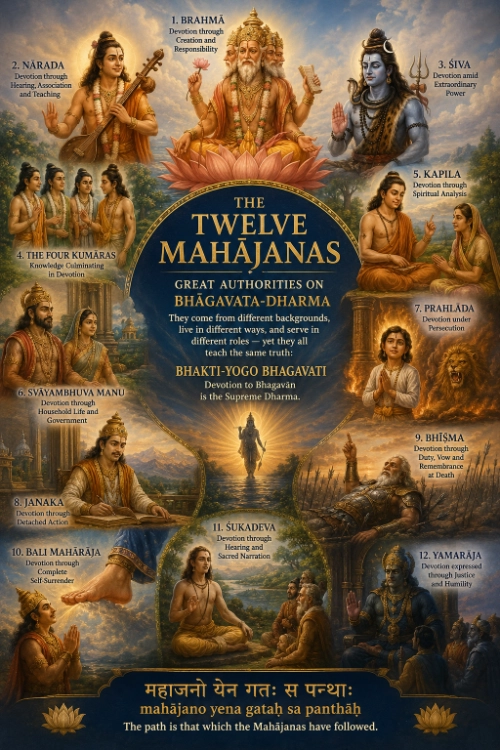
The Great Authorities on Bhāgavata-dharma
The twelve Mahājanas are a celebrated group of spiritual authorities named by Yamarāja in the Śrīmad-Bhāgavatam. They are not simply twelve famous saints or important figures of Hindu sacred history. In the immediate context of the passage, they are identified as those who truly understand bhāgavata-dharma—the pure and subtle religious principle centered upon devotion to Bhagavān.
The list appears in Śrīmad-Bhāgavatam 6.3.20–21, during Yamarāja’s instructions to the Yamadūtas after they had been prevented by the Viṣṇudūtas from taking Ajāmila.
Yamarāja first establishes an important principle:
dharmaṁ tu sākṣād bhagavat-praṇītaṁ
na vai vidur ṛṣayo nāpi devāḥ
na siddha-mukhyā asurā manuṣyāḥ
kuto nu vidyādhara-cāraṇādayaḥ
“Dharma is directly established by Bhagavān. It is not fully known even by the great sages or the gods, nor by the foremost Siddhas, Asuras, or human beings—what then of the Vidyādharas, Cāraṇas, and others?”
Śrīmad-Bhāgavatam 6.3.19
He then names the exceptional authorities who do understand it:
svayambhūr nāradaḥ śambhuḥ
kumāraḥ kapilo manuḥ
prahlādo janako bhīṣmo
balir vaiyāsakir vayam
dvādaśaite vijānīmo
dharmaṁ bhāgavataṁ bhaṭāḥ
guhyaṁ viśuddhaṁ durbodhaṁ
yaṁ jñātvāmṛtam aśnute
“Svayambhū [Brahmā], Nārada, Śambhu [Śiva], the Kumāras, Kapila, Manu, Prahlāda, Janaka, Bhīṣma, Bali, Vaiyāsaki [Śukadeva, the son of Vyāsa], and we ourselves—these twelve know bhāgavata-dharma, which is confidential, completely pure, and difficult to understand. By knowing it, one attains immortality.”
Śrīmad-Bhāgavatam 6.3.20–21
The twelve are therefore:
- Brahmā
- Nārada
- Śiva
- The Four Kumāras
- Kapila
- Svāyambhuva Manu
- Prahlāda
- Janaka
- Bhīṣma
- Bali Mahārāja
- Śukadeva
- Yamarāja
The term vaiyāsakiḥ, “the son of Vyāsa,” refers to Śukadeva, while vayam, literally “we,” is Yamarāja’s own self-reference.
Although there are four Kumāras—Sanaka, Sanandana, Sanātana, and Sanat-kumāra—they constitute a single collective entry in Yamarāja’s twelvefold list.
What Is a Mahājana?
The Sanskrit word mahājana combines mahā, “great,” and jana, “person.” In ordinary usage it can simply mean a great or eminent person, but in this theological context it carries a much stronger sense: a great spiritual authority whose realization, conduct, and teaching reveal the path of true dharma.
This principle is expressed in the famous saying attributed to Yudhiṣṭhira in the Mahābhārata:
tarko ’pratiṣṭhaḥ śrutayo vibhinnā
nāsāv ṛṣir yasya mataṁ na bhinnam
dharmasya tattvaṁ nihitaṁ guhāyāṁ
mahājano yena gataḥ sa panthāḥ
“Reasoning has no final foundation; the revealed scriptures appear diverse; there is hardly a sage whose opinion does not differ from another. The truth of dharma is hidden in a profound place. Therefore the path is that which the mahājanas have followed.”
Mahābhārata, Vana-parva 313.117
The point is not that reason or scripture is useless, but that dharma can be extremely subtle. Scripture must ultimately be understood through realized exemplars who embody its conclusion.
This is precisely the setting of Yamarāja’s list.
The following verse makes his meaning even more explicit:
etāvān eva loke ’smin
puṁsāṁ dharmaḥ paraḥ smṛtaḥ
bhakti-yogo bhagavati
tan-nāma-grahaṇādibhiḥ
“The supreme dharma for living beings in this world is bhakti-yoga directed toward Bhagavān, beginning with the taking of His holy name.”
Śrīmad-Bhāgavatam 6.3.22
Thus the twelve Mahājanas are above all authorities on bhakti.
The term mahājana is used more broadly elsewhere in Sanskrit religious literature, so Yamarāja’s verse should not necessarily be understood as claiming that only twelve great spiritual authorities have ever existed. Rather, these are the twelve paradigmatic authorities specifically identified here as knowers of bhāgavata-dharma.
1. Brahmā — Devotion Through Creation and Responsibility
Brahmā is called Svayambhū in Yamarāja’s verse, “the self-born.” According to the Bhāgavata Purāṇa, he appears upon the lotus arising from the navel of Garbhodakaśāyī Viṣṇu and becomes the great secondary creator and organizer of the universe.
Brahmā occupies an extraordinary position. He possesses immense knowledge, longevity, creative power, and authority, yet his own awakening begins with the realization that he is not the ultimate source of his power.
This makes Brahmā an important model of spiritual leadership. Authority does not imply independence from Bhagavān. On the contrary, the greater one’s responsibility, the greater the need to recognize its source and purpose.
Brahmā therefore represents intelligence and creative power offered in divine service.
His life teaches that the spiritual problem is not necessarily possession of power, knowledge, or responsibility. The decisive question is whether they are regarded as one’s own property or as instruments entrusted by the Supreme.
2. Nārada Muni — Devotion Through Hearing, Association, and Teaching
Nārada is one of the most active spiritual teachers in Purāṇic literature. He moves freely throughout the worlds, meeting kings, sages, gods, children, householders, and even persons born in demonic families, repeatedly awakening devotion in them.
His own biography demonstrates the transformative power of sādhu-saṅga, association with saintly persons.
In his previous life, Nārada was the son of a maidservant. During the rainy season he served traveling sages, listened to their discussions of Bhagavān, and accepted the remnants of their food.
He remembers:
ucchiṣṭa-lepān anumodito dvijaiḥ
sakṛt sma bhuñje tad-apāsta-kilbiṣaḥ
evaṁ pravṛttasya viśuddha-cetasas
tad-dharma evātma-ruciḥ prajāyate
“Once, with the permission of those brāhmaṇas, I partook of the remnants of their food. Through that my impurities were removed. As I continued in such service and my consciousness became purified, attraction for their dharma arose naturally within me.”
Śrīmad-Bhāgavatam 1.5.25
Nārada’s biography therefore makes an important statement about spiritual eligibility: bhakti is not dependent upon prestigious birth, wealth, social position, or academic qualification.
It can awaken through service, hearing, saintly association, and receptivity.
Nārada consequently represents not only devotion through hearing, but also devotion through transmission. Having received divine knowledge, he spends his existence carrying it to others.
3. Lord Śiva — Devotion Amid Extraordinary Power
Śiva appears in Yamarāja’s list under the name Śambhu.
His inclusion is especially significant because Śiva occupies an extraordinary theological position. He is one of the great lords of the cosmos, associated with destruction, transformation, asceticism, yoga, and profound metaphysical mysteries. Yet the Bhāgavatam simultaneously presents him as an exemplary devotee.
A famous verse declares:
nimna-gānāṁ yathā gaṅgā
devānām acyuto yathā
vaiṣṇavānāṁ yathā śambhuḥ
purāṇānām idam tathā
“As the Gaṅgā is foremost among rivers, as Acyuta is foremost among divine beings, and as Śambhu is foremost among Vaiṣṇavas, so this Purāṇa is foremost among the Purāṇas.”
Śrīmad-Bhāgavatam 12.13.16
The expression vaiṣṇavānāṁ yathā śambhuḥ—“as Śambhu among the Vaiṣṇavas”—is especially important.
Śiva is therefore a Mahājana not simply because of his cosmic power. He is an authority because immense power has not obscured his orientation toward the Supreme.
He exemplifies devotion without possessiveness toward power.
4. The Four Kumāras — Knowledge Culminating in Devotion
The four Kumāras are the ancient mind-born sons of Brahmā:
- Sanaka
- Sanandana
- Sanātana
- Sanat-kumāra
Although four individual sages, they are represented collectively by the singular kumāraḥ in the list of twelve Mahājanas.
They are famous for their perpetual celibacy, extraordinary knowledge, detachment, and eternally youthful appearance.
One of their most important episodes occurs when they enter Vaikuṇṭha. Although deeply established in realization of the imperishable Brahman, their consciousness undergoes a new transformation when they encounter the fragrance of tulasī associated with the lotus feet of the Lord:
tasyāravinda-nayanasya padāravinda-
kiñjalka-miśra-tulasī-makaranda-vāyuḥ
antar-gataḥ sva-vivareṇa cakāra teṣāṁ
saṅkṣobham akṣara-juṣām api citta-tanvoḥ
“The breeze carrying the fragrance of tulasī mingled with the lotus feet of the lotus-eyed Lord entered through their nostrils and produced a transformation in their minds and bodies, although they had been devoted to realization of the imperishable Brahman.”
Śrīmad-Bhāgavatam 3.15.43
Their importance lies precisely here.
The Kumāras demonstrate that spiritual knowledge does not reach its highest expression merely in abstraction or liberation. Knowledge reaches another dimension when the Absolute becomes personally lovable.
They therefore represent jñāna perfected in bhakti.
5. Lord Kapila — Devotion Through Spiritual Analysis
The Kapila named among the Mahājanas is Kapila, son of Kardama Muni and Devahūti, whom the Śrīmad-Bhāgavatam presents as Bhagavān.
After Kardama retires to the forest, Kapila remains with his mother in order to instruct her:
pitari prasthite ’raṇyaṁ
mātuḥ priya-cikīrṣayā
tasmin bindusare ’vātsīd
bhagavān kapilaḥ kila
“When his father had departed for the forest, Bhagavān Kapila remained at Bindu-sarovara, desiring to benefit his mother.”
Śrīmad-Bhāgavatam 3.25.5
Kapila teaches Devahūti about consciousness, material nature, bondage, liberation, meditation, association with sādhus, and devotion.
His teaching demonstrates that philosophical analysis is not an end in itself. The discrimination between spirit and matter should ultimately free consciousness for devotion to Bhagavān.
In Vaiṣṇava interpretation, this divine Kapila is distinguished from the Kapila associated with the classical non-theistic Sāṅkhya philosophical tradition.
Kapila therefore represents analytical knowledge transformed into liberating devotion.
6. Svāyambhuva Manu — Devotion Through Household Life and Government
Svāyambhuva Manu is the first Manu of the present day of Brahmā and one of the primordial rulers of humanity.
His wife is Śatarūpā, and their children include Priyavrata, Uttānapāda, Ākūti, Devahūti, and Prasūti.
Manu is particularly important because his spirituality is not expressed primarily through renunciation. He is a king, husband, father, administrator, and protector of social order.
His place among the Mahājanas demonstrates that bhāgavata-dharma does not require abandonment of worldly responsibility.
Government, family life, law, protection, and social duty can themselves become modes of service when performed under a higher conception of dharma.
Manu thus represents devotion through responsible stewardship of human society.
7. Prahlāda Mahārāja — Devotion Under Persecution
Prahlāda is one of the clearest demonstrations that bhakti transcends birth and environment.
He was born as the son of the powerful Daitya king Hiraṇyakaśipu, who was violently opposed to Viṣṇu. Yet Prahlāda became one of Viṣṇu’s greatest devotees.
According to the Bhāgavatam, Prahlāda received Nārada’s teaching while still in his mother’s womb. Later, despite threats, torture, and repeated attempts on his life, he remained peaceful and absorbed in remembrance of the Lord.
When asked what he considered the highest knowledge, Prahlāda famously described nine principal expressions of bhakti:
śravaṇaṁ kīrtanaṁ viṣṇoḥ
smaraṇaṁ pāda-sevanam
arcanaṁ vandanaṁ dāsyaṁ
sakhyam ātma-nivedanam
iti puṁsārpitā viṣṇau
bhaktiś cen nava-lakṣaṇā
kriyeta bhagavaty addhā
tan manye ’dhītam uttamam
“Hearing about Viṣṇu, glorifying Him, remembering Him, serving His feet, worshipping Him, offering prayers, becoming His servant, becoming His friend, and surrendering oneself completely—if these nine forms of devotion are directly offered to Viṣṇu, I consider that the highest learning.”
Śrīmad-Bhāgavatam 7.5.23–24
The appearance of Nṛsiṁhadeva from the pillar vindicates Prahlāda’s unwavering faith and destroys Hiraṇyakaśipu.
Prahlāda therefore represents devotion that cannot be destroyed by external circumstances.
His example also makes an important theological statement: no family, social class, or inherited identity possesses a monopoly on devotion.
8. Janaka Mahārāja — Devotion Through Detached Action
Janaka is traditionally identified with the celebrated king of Mithilā, remembered as an enlightened ruler and an exemplar of detachment while remaining fully engaged in royal responsibility.
“Janaka” was also a dynastic title associated with the rulers of Mithilā, so the name has a broader historical-literary background. In the devotional tradition, however, the Mahājana Janaka is understood as the paradigmatic saintly king associated with Mithilā.
The Bhagavad-gītā explicitly invokes Janaka as an example of perfection achieved through action:
karmaṇaiva hi saṁsiddhim
āsthitā janakādayaḥ
loka-saṅgraham evāpi
sampaśyan kartum arhasi
“Indeed, Janaka and others attained perfection through action alone. You should also act while considering the maintenance and welfare of the world.”
Bhagavad-gītā 3.20
Janaka therefore represents a profoundly important principle: renunciation is not identical with inactivity.
A realized person may continue to rule, administer, decide, protect, and work—not because of personal attachment to the results, but because responsible action benefits others.
Janaka exemplifies detachment within action rather than detachment from action.
9. Bhīṣmadeva — Devotion Through Duty, Vow, and Remembrance at Death
Bhīṣma is one of the towering personalities of the Mahābhārata.
His extraordinary vow of celibacy and renunciation of the throne earned him the name Bhīṣma, “the terrible” or “awesome one,” referring to the fearsome magnitude of his vow.
He becomes the grandsire of the Kuru dynasty, a warrior of extraordinary ability, and one of the great authorities on kingship, ethics, social duty, and dharma.
Following the Battle of Kurukṣetra, Bhīṣma lies upon a bed of arrows and gives extensive instructions to Yudhiṣṭhira.
Because of a boon allowing him to choose the time of his death, he remains alive until the auspicious moment and then fixes his consciousness upon Kṛṣṇa.
His prayer includes:
vijaya-ratha-kuṭumba ātta-totre
dhṛta-haya-raśmini tac-chriyekṣaṇīye
bhagavati ratir astu me mumurṣor
yam iha nirīkṣya hatā gatāḥ sva-rūpam
“As I am about to die, may my loving consciousness rest upon Bhagavān as He appeared as the charioteer of Vijaya [Arjuna], holding the whip and the reins of the horses, beautiful to behold.”
Śrīmad-Bhāgavatam 1.9.39
Bhīṣma therefore represents steadfastness, fidelity to vows, disciplined duty, and above all remembrance of Bhagavān at the moment of death.
His life also demonstrates the complexity of dharma: a person may find himself caught between competing loyalties and responsibilities, yet the ultimate refuge remains devotion to the Lord.
10. Bali Mahārāja — Devotion Through Complete Self-Surrender
Bali Mahārāja is the grandson of Prahlāda and one of the greatest rulers of the Daityas.
After conquering enormous cosmic power, Bali encounters Viṣṇu in the form of Vāmana, a dwarf brāhmaṇa who asks only for three steps of land.
Bali agrees.
Vāmana then reveals His cosmic form as Trivikrama and encompasses the worlds with two steps. Nothing remains for the promised third step.
At that moment Bali does something that defines his position as a Mahājana.
He offers himself:
yady uttamaśloka bhavān mameritaṁ
vaco vyalīkaṁ sura-varya manyate
karomy ṛtaṁ tan na bhavet pralambhanaṁ
padaṁ tṛtīyaṁ kuru śīrṣṇi me nijam
“O Uttamaśloka, if You consider the promise I made to be false, then I shall make it true so that there may be no deception. Place Your third step upon my head.”
Śrīmad-Bhāgavatam 8.22.2
Bali has already surrendered his wealth, kingdom, prestige, and freedom. Finally he offers himself.
His greatness therefore does not lie principally in what he gave when giving was easy. It lies in his refusal to abandon surrender when obedience seemed to cost him everything.
The Lord ultimately grants Bali residence in Sutala and becomes his personal protector.
Bali represents ātma-nivedana—complete self-surrender.
11. Śukadeva — Devotion Through Hearing and Narration
Śukadeva, the son of Vyāsadeva, is referred to in Yamarāja’s verse as Vaiyāsaki, “the son of Vyāsa.”
He is portrayed as extraordinarily detached from bodily identity, possessions, social conventions, and ordinary worldly ambition.
Yet his detachment does not culminate in silence.
When King Parīkṣit learns that he has only seven days to live, Śukadeva arrives at the bank of the Gaṅgā and responds to the king’s ultimate question: what should a human being hear, remember, and do when death is approaching?
Śukadeva states:
tasmād bhārata sarvātmā
bhagavān īśvaro hariḥ
śrotavyaḥ kīrtitavyaś ca
smartavyaś cecchatābhayam
“Therefore, O descendant of Bharata, one who desires fearlessness should hear about, glorify, and remember Hari, Bhagavān, the Lord and Self of all.”
Śrīmad-Bhāgavatam 2.1.5
For seven days Śukadeva narrates the teachings that form the Śrīmad-Bhāgavatam.
He therefore represents an important synthesis: extreme personal detachment combined with extreme compassion for others.
He has little interest in material society for his own sake, yet he speaks because another person needs transcendental knowledge.
Śukadeva thus represents devotion through hearing, remembrance, and the transmission of sacred narrative.
12. Yamarāja — Devotion Expressed Through Justice and Humility
The final Mahājana is Yamarāja himself, also known as Dharmarāja.
Yamarāja presides over the judgment of sinful actions and the consequences of karma. Yet the context in which he names the twelve Mahājanas reveals that even the cosmic judge recognizes an authority higher than himself.
The entire discussion follows the deliverance of Ajāmila.
The Yamadūtas had come to take Ajāmila, but the Viṣṇudūtas prevented them. Bewildered, Yamarāja’s servants returned to their master and asked how such a contradiction could occur.
Yamarāja explains that he is not the supreme authority.
Dharma itself originates with Bhagavān:
dharmaṁ tu sākṣād bhagavat-praṇītam
“Dharma is directly established by Bhagavān.”
Śrīmad-Bhāgavatam 6.3.19
And he concludes:
etāvān eva loke ’smin
puṁsāṁ dharmaḥ paraḥ smṛtaḥ
bhakti-yogo bhagavati
tan-nāma-grahaṇādibhiḥ
“The supreme dharma for living beings in this world is bhakti-yoga directed toward Bhagavān, beginning with the taking of His holy name.”
Śrīmad-Bhāgavatam 6.3.22
Yamarāja’s authority is therefore inseparable from his humility.
The judge recognizes that he himself exists beneath a higher law.
The Ajāmila narrative consequently makes Yamarāja an especially powerful Mahājana: he teaches that karmic justice is real, but it does not constitute the highest level of divine reality. Above ordinary karmic adjudication stands bhakti and the grace of Bhagavān.
Yamarāja represents justice subordinated to divine truth.
The Twelve Mahājanas and Their Different Paths
One of the most remarkable features of the list is its diversity.
The Mahājanas do not share a single external lifestyle.
Brahmā serves through creation and cosmic responsibility.
Nārada through hearing, traveling, and teaching.
Śiva through devotion despite possessing tremendous divine power.
The Kumāras through knowledge perfected in personal devotion.
Kapila through philosophical discrimination and spiritual instruction.
Manu through household responsibility and government.
Prahlāda through remembrance under persecution.
Janaka through detached action and kingship.
Bhīṣma through vows, duty, and remembrance at death.
Bali through radical self-surrender.
Śukadeva through hearing and sacred narration.
Yamarāja through justice governed by recognition of a higher divine authority.
The twelve therefore encompass remarkably different forms of existence:
- creator and cosmic ruler,
- wandering sage,
- great god,
- contemplative sages,
- divine philosopher,
- lawgiver and householder,
- child devotee,
- king,
- warrior,
- Daitya emperor,
- renunciant narrator,
- and judge of the dead.
They even cross conventional cosmic categories: deva, ṛṣi, Manu, human king, Daitya, renunciant, and cosmic administrator all appear in the same list.
This diversity is itself theological.
It demonstrates that bhāgavata-dharma is not confined to one birth, occupation, social order, temperament, or external mode of life.
What Unites the Twelve Mahājanas?
Their external circumstances differ radically, but several fundamental principles unite them.
They recognize that Bhagavān is ultimately supreme.
They do not regard their knowledge, power, kingdom, purity, austerity, office, or social position as independent of Him.
Their lives repeatedly demonstrate the transformation of ordinary categories:
- knowledge becomes devotion in the Kumāras;
- power becomes service in Brahmā and Śiva;
- politics becomes responsibility in Manu and Janaka;
- suffering becomes remembrance in Prahlāda;
- duty culminates in contemplation of the Lord in Bhīṣma;
- ownership becomes surrender in Bali;
- renunciation becomes compassionate narration in Śukadeva;
- justice becomes humility before divine grace in Yamarāja.
This is why a Mahājana should not merely be admired.
A Mahājana is a path-maker.
The famous statement,
mahājano yena gataḥ sa panthāḥ
means that the true importance of these figures lies in the way they walked.
Their lives are interpretive keys to dharma.
The Central Idea of the Twelve Mahājanas
The twelve Mahājanas demonstrate that bhāgavata-dharma cannot be reduced to a single external form.
It does not belong exclusively to:
- renunciants rather than householders,
- sages rather than kings,
- gods rather than humans,
- socially privileged persons rather than those born in hostile circumstances,
- philosophers rather than warriors,
- or peaceful circumstances rather than crisis.
Prahlāda can practice it in the palace of an enemy of Viṣṇu.
Bali can practice it while losing an empire.
Bhīṣma can perfect it while lying upon arrows.
Janaka can practice it while governing a kingdom.
Śukadeva can practice it as a wandering renunciant.
Yamarāja can practice it while administering cosmic justice.
Brahmā can practice it while creating worlds.
What defines the Mahājanas is therefore not uniformity of circumstance but orientation of consciousness.
They recognize a reality higher than ego, status, intellectual pride, power, wealth, and even conventional calculations of success and failure.
Their biographies collectively express the conclusion of Yamarāja’s teaching:
bhakti-yogo bhagavati
“Bhakti-yoga directed toward Bhagavān.”
The twelve Mahājanas are thus not merely revered personalities from sacred history. They are twelve authoritative demonstrations of what devotion looks like when lived under radically different conditions.
And this explains why the ancient maxim remains so important:
महाजनो येन गतः स पन्थाः
mahājano yena gataḥ sa panthāḥ
“The path is that which the Mahājanas have followed.”