

Ṭera-kadamba
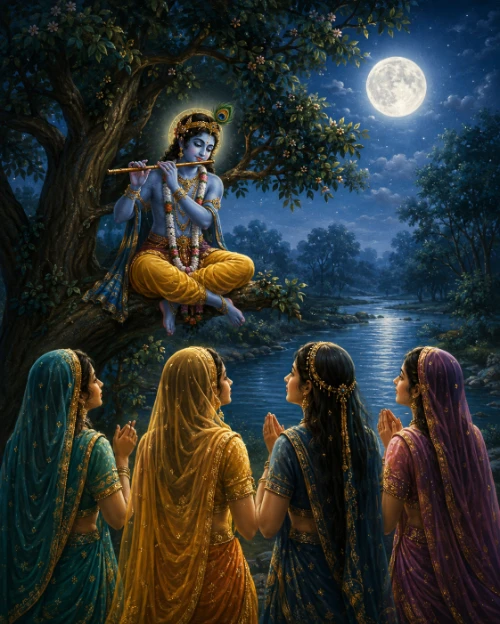
Ṭera-kadamba: Kṛṣṇa’s Sacred Place of Calling
Among the many sacred groves of Vraja, Ṭera-kadamba occupies a distinctive place in devotional memory. It is revered as the place where Śrī Kṛṣṇa called His cows, where He is also remembered as calling the gopīs with His flute, and where Gauḍīya Vaiṣṇavas honour a bhajana-sthalī of Śrī Rūpa Gosvāmī. In this one place, three devotional worlds meet: cowherding līlā, rāsa-līlā, and the meditative remembrance of the Gosvāmīs.
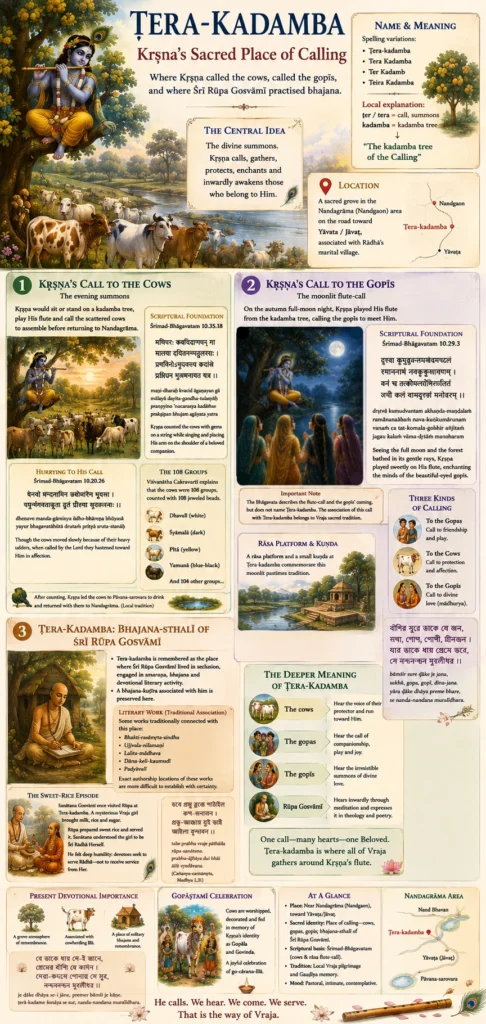
The name and its meaning, the location near Nandagrāma, Kṛṣṇa’s call to the cows and to the gopīs with their scriptural foundations, Rūpa Gosvāmī’s bhajana-sthalī and the fourfold meaning of the calling.
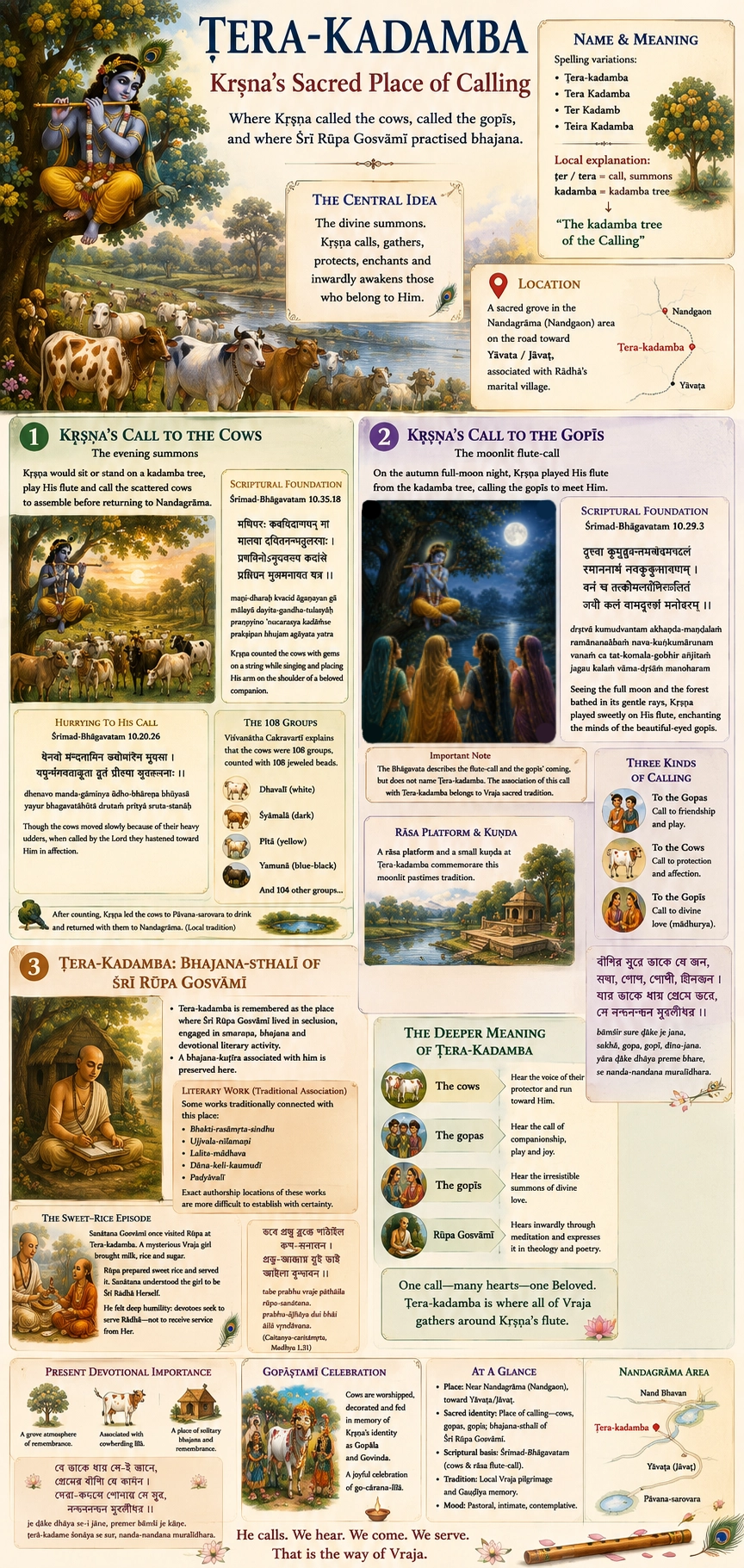
The site is therefore not important merely as a picturesque grove, but as a place expressing one of the deepest motifs in Kṛṣṇa-bhakti: the divine summons. At Ṭera-kadamba, Kṛṣṇa is remembered as the one who calls, gathers, protects, enchants and inwardly awakens those who belong to Him.
Name, Spelling and Location
The place-name appears in several spellings: Ṭera-kadamba, Tera Kadamba, Ter Kadamb and Teira Kadamba. It is traditionally identified as a sacred grove in the Nandagrāma (modern Nandgaon) area of Vraja, on the rural route toward Yāvaṭa or Jāvaṭ, the village associated in Gauḍīya and Braj tradition with Rādhā’s married life.
The most common local explanation of the name is devotional rather than philological:
Thus Ṭera-kadamba is understood as “the kadamba tree of the calling” or “the kadamba from which Kṛṣṇa called.” Some local explanations also connect the name with Kṛṣṇa sitting at the end or tip of a kadamba branch, but the dominant devotional understanding in Vraja emphasises calling or summoning.
Kṛṣṇa’s Call to the Cows
The best-known tradition of Ṭera-kadamba is connected with Kṛṣṇa’s cowherding pastimes. According to Vraja pilgrimage tradition, Kṛṣṇa would bring the cows to graze in the surrounding region during the day. Toward evening He would sit or stand on a kadamba tree, play His flute, and call the cows from different pasturing places so that they might gather before returning to Nandagrāma.
After the cows assembled, He is said to have counted them with a jewelled counting garland or string of beads — often called a go-mālā in later devotional explanation — so that not one would be left behind. This central image is not a mere local invention. It has a strong scriptural basis in the Śrīmad-Bhāgavatam.
Kṛṣṇa Counting the Cows
मणिधरः क्वचिदागणयन् गा
मालया दयितगन्धतुलस्याः ।
प्रणयिनोऽनुचरस्य कदांसे
प्रक्षिपन् भुजमगायत यत्र ॥
maṇi-dharaḥ kvacid āgaṇayan gā
mālayā dayita-gandha-tulasyāḥ
praṇayino ’nucarasya kadāṁse
prakṣipan bhujam agāyata yatra
“At one place Kṛṣṇa counted the cows with gems on a string, while singing and placing His arm upon the shoulder of a beloved companion.” — Śrīmad-Bhāgavatam 10.35.18
This verse is extremely important. It directly contains the motif of Kṛṣṇa with the herd, counting the cows, jewelled beads, song, and the relaxed intimacy of Vraja.
The Bhāgavata itself, however, does not name Ṭera-kadamba as the location. The site identification belongs to the sacred-geographical tradition of Vraja.
The Cows Hurrying to Kṛṣṇa’s Call
Another Bhāgavata verse deepens the image:
धेनवो मन्दगामिन्य ऊधोभारेण भूयसा ।
ययुर्भगवताहूता द्रुतं प्रीत्या स्रुतस्तनाः ॥
dhenavo manda-gāminya
ūdho-bhāreṇa bhūyasā
yayur bhagavatāhūtā
drutaṁ prītyā sruta-stanāḥ
“Though the cows moved slowly because of the weight of their full udders, when called by the Lord they hastened to Him in affection, their milk flowing.” — Śrīmad-Bhāgavatam 10.20.26
This verse beautifully expresses the emotional logic of Ṭera-kadamba. The cows do not merely obey a signal. They run in affection toward their protector.
The 108 Groups of Cows
Later Gauḍīya commentary, especially that of Viśvanātha Cakravartī Ṭhākura, expands the Bhāgavata image in a way that became extremely influential in devotional tradition. According to this explanation, Kṛṣṇa grouped the cows into 108 divisions, distinguished by colour, shape and markings, and counted them with 108 jewelled beads. The commentary preserves traditional cow-names such as Dhavalī, Haṁsī, Candanī, Gaṅgā, Muktā, Śyāmalā, Yamunā, Pītā and Piṅgalā, among others.
This expanded commentary does not alter the scriptural core; rather, it gives detailed devotional texture to the scene already present in the Bhāgavata. The most precise statement is therefore a layered one:
The Go-mālā and the Return to Nandagrāma
The later devotional term go-mālā — the counting garland of the cows — belongs especially to pilgrimage and oral explanation rather than to the exact wording of the Bhāgavata verse itself. But the idea is entirely harmonious with the text and its traditional commentary.
After assembling and counting the herd, local Nandagrāma tradition says that Kṛṣṇa took the cows toward Pāvana-sarovara for water and then led them back to the cowsheds of Nanda Mahārāja.
This specific itinerary belongs to living Vraja sacred tradition, not to a verse that explicitly names the route. The distinction is worth keeping visible: the līlā motif is scriptural, while the precise Vraja location is traditional and devotional.
Kṛṣṇa’s Call to the Gopīs
Ṭera-kadamba is also associated with another, more intimate form of divine calling: Kṛṣṇa summoning the gopīs with His flute. Local Vraja tradition says that on moonlit nights Kṛṣṇa would play His flute from the kadamba tree, calling Śrī Rādhā and the gopīs to meet Him. A rāsa platform and a small kuṇḍa at the site preserve this memory in present-day devotion.
Here too the relationship between scripture and local sacred geography must be carefully stated. The scriptural foundation is beyond doubt. The Śrīmad-Bhāgavatam describes the beginning of the rāsa episode in these words:
दृष्ट्वा कुमुद्वन्तमखण्डमण्डलं
रमाननाभं नवकुङ्कुमारुणम् ।
वनं च तत्कोमलगोभिरञ्जितं
जगौ कलं वामदृशां मनोहरम् ॥
dṛṣṭvā kumudvantam akhaṇḍa-maṇḍalaṁ
ramānanābhaṁ nava-kuṅkumāruṇam
vanaṁ ca tat-komala-gobhir añjitaṁ
jagau kalaṁ vāma-dṛśāṁ manoharam
“Seeing the full moon, reddish like fresh kuṅkuma, and the forest made beautiful by its gentle rays, Kṛṣṇa played sweetly on His flute, enchanting the minds of the beautiful-eyed gopīs.” — Śrīmad-Bhāgavatam 10.29.3
This is the scriptural flute-call. The Bhāgavata then narrates how the gopīs, hearing that sound, abandoned their various household tasks and ran toward Kṛṣṇa.
Rādhā in the Gauḍīya Understanding
A small source-critical point must be noted here. In Bhāgavatam 10.29.3 the text says the gopīs; it does not explicitly mention Śrī Rādhā by name in that verse. In Gauḍīya Vaiṣṇava theology, however, Rādhā is understood as the supreme heroine of the rāsa-līlā, the crest-jewel among the gopīs and the ultimate focus of Kṛṣṇa’s intimate love.
The most accurate formulation is therefore this: the Bhāgavata explicitly describes Kṛṣṇa’s flute summoning the gopīs; Gauḍīya tradition understands Śrī Rādhā as the highest among them; and local Vraja sacred geography identifies Ṭera-kadamba as a place associated with that summons. This preserves both devotional truth and textual precision.
Not a Generalised Monthly Event
It is best not to describe Ṭera-kadamba too loosely as the place where Kṛṣṇa called the gopīs “on full-moon nights” in a repeated, general sense. The scriptural narrative is more precise: it speaks of the autumn moonlit rāsa setting, especially the celebrated flute-call that begins the rāsa narrative. The careful expression is that the moonlit flute-call of the rāsa-līlā is scriptural, while its association with Ṭera-kadamba belongs to later Vraja pilgrimage tradition.
Three Kinds of “Calling”
A particularly beautiful interpretive tradition associated with Ṭera-kadamba speaks of three forms of Kṛṣṇa’s call:
Whether or not this threefold scheme belongs to very ancient strata of tradition, it expresses the theological richness of the place beautifully. The same flute is heard differently according to the relationship of the hearer: the gopas hear friendship, the cows hear protection and affection, and the gopīs hear the summons of love. Ṭera-kadamba thus becomes not merely a physical grove but a symbol of how Kṛṣṇa gathers all of Vraja around Himself.
Ṭera-kadamba as the Bhajana-sthalī of Śrī Rūpa Gosvāmī
Ṭera-kadamba is also deeply important in Gauḍīya Vaiṣṇava history because it is honoured as a bhajana-sthalī of Śrī Rūpa Gosvāmī. Later Gauḍīya tradition remembers Rūpa Gosvāmī residing there in seclusion, engaged in smaraṇa (meditative remembrance), bhajana, contemplation of Rādhā-Kṛṣṇa’s līlā, and devotional literary activity. A bhajana-kuṭīra associated with him is traditionally preserved at the site.
A Bengali line from the Gauḍīya tradition provides context for Rūpa’s importance in Vraja:
তবে প্রভু ব্রজে পাঠাইল রূপ-সনাতন ।
প্রভু-আজ্ঞায় দুই ভাই আইলা বৃন্দাবন ॥
tabe prabhu vraje pāṭhāila rūpa-sanātana
prabhu-ājñāya dui bhāi āilā vṛndāvana
“Then the Lord sent Rūpa and Sanātana to Vraja; by the Lord’s order the two brothers came to Vṛndāvana.” — Caitanya-caritāmṛta, Madhya 1.31
This verse is not about Ṭera-kadamba specifically, but it illuminates why a site of Rūpa Gosvāmī’s bhajana in Vraja is so revered: it belongs to the larger Gauḍīya rediscovery and theological articulation of Vṛndāvana.
Literary Activity at the Site
Many modern devotional accounts connect Ṭera-kadamba with Rūpa Gosvāmī’s literary work and sometimes name specific texts:
- Bhakti-rasāmṛta-sindhu
- Ujjvala-nīlamaṇi
- Lalita-mādhava
- Dāna-keli-kaumudī
- Padyāvalī
It is safest to say only that Ṭera-kadamba is traditionally associated with Rūpa Gosvāmī’s bhajana and literary activity; the exact authorship location of particular texts is more difficult to establish with certainty. That is the most historically careful formulation.
The Sweet-Rice Episode: Rādhā’s Hidden Grace
One of the most beloved Gauḍīya stories associated with Ṭera-kadamba concerns Rūpa Gosvāmī and Sanātana Gosvāmī. According to later hagiographical tradition, Sanātana once came to visit Rūpa at Ṭera-kadamba. Rūpa desired to honour his elder brother with sweet rice, but he had no ingredients.
At that moment a mysterious young Vraja girl appeared and brought milk, rice, sugar and the other necessities. Rūpa prepared the sweet rice and served it to Sanātana. When Sanātana tasted it, he was astonished by its extraordinary sweetness and spiritual potency. On hearing how the ingredients had arrived, he understood that the girl had been none other than Śrī Rādhā Herself.
The story takes an unexpected devotional turn. Rather than rejoicing in having received miraculous favour, Sanātana became troubled: the aim of the devotee is to serve Rādhā, not to become one for whom Rādhā must personally render service. The theological beauty of the story lies in this inversion. It expresses the humility of the Gosvāmīs and their ideal of devotion — never to claim privilege, but only to seek service.
Present Devotional Importance
Ṭera-kadamba is not remembered primarily as a monumental temple complex or an urban pilgrimage centre. Its importance lies in its grove atmosphere, its association with cowherding līlā, its connection with the flute-call of rāsa, and its status as a solitary bhajana place of Rūpa Gosvāmī. This gives the place a distinctive devotional mood: quiet, pastoral, intimate and contemplative.
One important modern observance is Gopāṣṭamī, the festival celebrating Kṛṣṇa’s cowherding identity as Gopāla and Govinda. At Ṭera-kadamba this festival is especially meaningful. Cows are decorated, worshipped and fed, and the site’s ancient identity as a go-cāraṇa-līlā sthala, a place of Kṛṣṇa’s cowherding pastimes, is brought vividly to life.
The Theological Meaning of Ṭera-kadamba
The deepest significance of Ṭera-kadamba lies in its unifying symbolism. The same call is heard in four different registers:
Ṭera-kadamba may therefore be understood through a fourfold progression:
go-cāraṇa  →  the pastoral call to the cows
sakhya     →  the call to friendship
mādhurya   →  the call to the gopīs
smaraṇa    →  the inwardly heard call of contemplative devotion
This makes Ṭera-kadamba one of the most suggestive places in all of Vraja. It is not only a remembered location of past events; it is a theological symbol of Kṛṣṇa as the one who calls all beings according to their relationship with Him.
Ṭera-kadamba stands at the intersection of scripture, sacred geography and devotional memory. The Śrīmad-Bhāgavatam supplies the core motifs — Kṛṣṇa calling and counting His cows, and Kṛṣṇa enchanting the gopīs with His flute on the moonlit night of rāsa. The local Vraja pilgrimage tradition identifies Ṭera-kadamba as one of the places where these moods are remembered and commemorated.
The Gauḍīya tradition adds yet another layer by honouring the site as a bhajana-sthalī of Śrī Rūpa Gosvāmī, where the eternal call of Kṛṣṇa was received in contemplative devotion and transformed into theology, poetry and sacred remembrance. For this reason Ṭera-kadamba is more than a grove near Nandagrāma. It is a place where the whole of Vraja gathers around Kṛṣṇa’s call — cows, gopas, gopīs and saints alike.