

You Are Not This Body
Why “I Am Not the Body” Is Only the Beginning
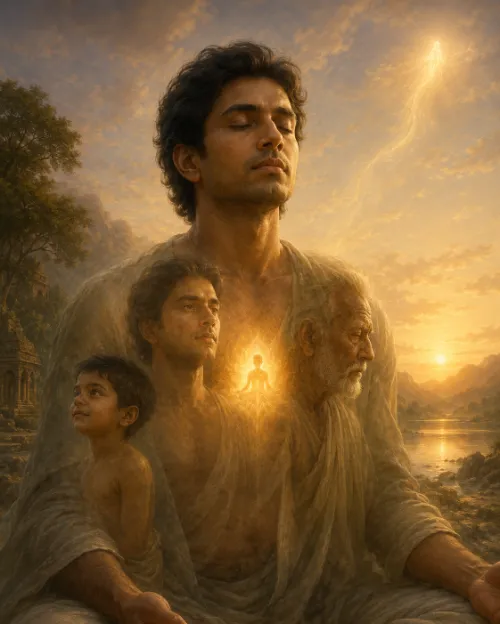
You once had the body of a small child.
That body has changed almost beyond recognition. Your size, appearance, strength, voice, knowledge, desires, and responsibilities are no longer what they were. Yet when you look at an old photograph, you still say:
“That was me.”
Who is that continuing “me”?
That deceptively simple question lies at the heart of one of the most famous verses of the Bhagavad-gītā:
देहिनोऽस्मिन्यथा देहे
कौमारं यौवनं जरा ।
तथा देहान्तरप्राप्तिर्
धीरस्तत्र न मुह्यति ॥
dehino ’smin yathā dehe
kaumāraṁ yauvanaṁ jarā
tathā dehāntara-prāptir
dhīras tatra na muhyati
“Just as childhood, youth, and old age come to the embodied self in this present body, so too comes the attainment of another body. A steady and discerning person is not bewildered by this.”
Bhagavad-gītā 2.13
Śrīla A. C. Bhaktivedanta Swami Prabhupāda gives the familiar Gauḍīya Vaiṣṇava rendering:
“As the embodied soul continuously passes, in this body, from boyhood to youth to old age, the soul similarly passes into another body at death. A sober person is not bewildered by such a change.”
Bhagavad-gītā 2.13
This verse certainly teaches rebirth, but it begins with a more immediate question: What is the difference between the changing body and the conscious person who experiences those changes?
The following discussion approaches that question primarily through the Gauḍīya Vaiṣṇava tradition while also noting how several major Vedānta commentators understand the verse.
Deha and Dehin: The Body and the Embodied One
The first words already establish a distinction:
The Sanskrit word deha means “body.” The related word dehin means “one who has a body,” “the embodied one,” or, interpretively, “the one inhabiting the body.”
This distinction can easily disappear in translation. In ordinary speech we say “my hand,” “my face,” “my brain,” and “my body.” That language contains two ideas: the body and the “I” to whom it belongs. It does not by itself prove what that “I” ultimately is, but it opens the philosophical question that the Gītā proceeds to answer.
Interestingly, Bhagavad-gītā 2.13 uses neither ātman nor jīva. It begins with the less abstract word dehin: the embodied one. Kṛṣṇa starts not with a technical definition but with an experience Arjuna already understands—the passage from childhood through youth to old age.
One Life, Many Bodily Conditions
Kṛṣṇa names three stages:
These are not merely superficial changes. A child and an elderly person can differ profoundly in size, strength, appearance, hormones, abilities, needs, and social roles. Nevertheless, the adult does not normally say, “That child was an unrelated being who disappeared before I came into existence.” The adult says, “I grew up.”
The bodily condition changed, yet the person claims continuity through that change.
Śrīdhara Svāmī expresses this recognition with the words:
sa evāham — “I am that very same one.”
When an adult looks at a childhood photograph, the face may scarcely resemble the present face, but the recognition remains: “I was there.” Śrīdhara argues that childhood, youth, and old age belong to the body rather than to the self in its own nature.
This observation should be stated carefully. Personal continuity through one life is not a laboratory proof of an immaterial self or rebirth. A materialist may explain continuity in terms of an organism, a brain, or an evolving psychological process. The Gītā places the observation within a wider metaphysical teaching: bodily states change, while the conscious dehin who experiences them is not reducible to those states.
“Just As… So Also”: The Step From Aging to Rebirth
The logical structure of the verse is carried by two words:
yathā… tathā — “just as… so also.”
Just as the embodied being passes through childhood, youth, and old age, so also there is:
dehāntara-prāptiḥ — “attainment of another body.”
The compound can be unpacked as:
The verse therefore says more than “consciousness somehow survives.” It speaks specifically of another embodiment. Death is presented not as an unrelated mystery but as a further transition in the history of the embodied being.
Prabhupāda’s translation includes “continuously” and “at death.” Neither expression corresponds to a separate word in 2.13. They are explanatory additions that make the intended movement clear. The Sanskrit itself says that childhood, youth, and old age occur in this body and that, similarly, another body is attained. The surrounding verses make the transition at death explicit.
The Argument in Its Immediate Context
Bhagavad-gītā 2.13 should not be isolated from the verses around it. Kṛṣṇa has just declared the continuing existence of Himself, Arjuna, and the assembled kings:
न त्वेवाहं जातु नासं
न त्वं नेमे जनाधिपाः ।
न चैव न भविष्यामः
सर्वे वयमतः परम् ॥
na tv evāhaṁ jātu nāsaṁ
na tvaṁ neme janādhipāḥ
na caiva na bhaviṣyāmaḥ
sarve vayam ataḥ param
“Never was there a time when I did not exist, nor you, nor these rulers of men; nor in the future shall any of us cease to exist.”
Bhagavad-gītā 2.12
Then 2.13 distinguishes the changing bodily stages from the embodied person. A few verses later, Kṛṣṇa states the principle directly:
न जायते म्रियते वा कदाचिन्
नायं भूत्वा भविता वा न भूयः ।
अजो नित्यः शाश्वतोऽयं पुराणो
न हन्यते हन्यमाने शरीरे ॥
na jāyate mriyate vā kadācin
nāyaṁ bhūtvā bhavitā vā na bhūyaḥ
ajo nityaḥ śāśvato ’yaṁ purāṇo
na hanyate hanyamāne śarīre
“The self is never born and never dies. It has not come into being, nor will it ever cease to be. It is unborn, eternal, everlasting, and ancient; it is not slain when the body is slain.”
Bhagavad-gītā 2.20
The final line is decisive: the destruction of the body is not the destruction of the self.
Kṛṣṇa then gives the famous clothing analogy:
वासांसि जीर्णानि यथा विहाय नवानि गृह्णाति नरोऽपराणि ।
तथा शरीराणि विहाय जीर्णान्यन्यानि संयाति नवानि देही ॥
vāsāṁsi jīrṇāni yathā vihāya navāni gṛhṇāti naro ’parāṇi
tathā śarīrāṇi vihāya jīrṇāny anyāni saṁyāti navāni dehī
“Just as a person gives up worn-out garments and takes other new ones, so the embodied self gives up worn-out bodies and goes to other new bodies.”
Bhagavad-gītā 2.22
The analogy is powerful, but it should not be pushed too far. Changing bodies is not as casual as selecting a new shirt. According to the Gītā, future embodiment is connected with karma, desire, the guṇas, habitual consciousness, and the subtle condition of the living being. The body is compared to clothing because it is not the wearer’s ultimate identity—not because bodies are worthless or chosen arbitrarily.
What Continues From One Body to Another?
The gross body that is buried or cremated is not transferred intact. Bhagavad-gītā 15.8 describes a subtler continuity:
शरीरं यदवाप्नोति
यच्चाप्युत्क्रामतीश्वरः ।
गृहीत्वैतानि संयाति
वायुर्गन्धानिवाशयात् ॥
śarīraṁ yad avāpnoti
yac cāpy utkrāmatīśvaraḥ
gṛhītvaitāni saṁyāti
vāyur gandhān ivāśayāt
“When the lord of the body obtains a body and when he departs from it, he goes taking these faculties with him, just as the wind carries fragrances from their source.”
Bhagavad-gītā 15.8
The next verse identifies those faculties as the senses and mind through which the embodied being encounters the world. Later Vedāntic analysis therefore distinguishes three levels:
- the gross physical body;
- the subtle psychophysical apparatus, including mind, senses, and accumulated impressions;
- the conscious self who experiences through them.
Śrīdhara Svāmī explicitly explains dehāntara-prāpti in connection with the liṅga-deha, the subtle body. The subtle apparatus carries karmic impressions and tendencies, while the conscious jīva remains the experiencer. Rebirth is therefore more complex than the popular idea that an unchanged social personality simply wakes up inside a new physical body.
Bhagavad-gītā 2.13 establishes that another body is attained. The wider Gītā explains why a particular embodiment follows. Rāmānuja, commenting on this passage, connects embodiment with beginningless karma and with bodies suited to the living being’s karmic condition.
Upaniṣadic Background: The Self Is Not Slain With the Body
The language of Bhagavad-gītā 2.20 closely parallels the Kaṭha Upaniṣad:
न जायते म्रियते वा विपश्चिन्
नायं कुतश्चिन्न बभूव कश्चित् ।
अजो नित्यः शाश्वतोऽयं पुराणो
न हन्यते हन्यमाने शरीरे ॥
na jāyate mriyate vā vipaścin
nāyaṁ kutaścin na babhūva kaścit
ajo nityaḥ śāśvato ’yaṁ purāṇo
na hanyate hanyamāne śarīre
“The knowing self is not born and does not die. It did not arise from anything, nor did anything arise from it. It is unborn, eternal, everlasting, and ancient; it is not slain when the body is slain.”
Kaṭha Upaniṣad 1.2.18
Bhagavad-gītā 2.13 therefore belongs to a much broader Upaniṣadic inquiry into the nature of the conscious self.
The Bṛhadāraṇyaka Upaniṣad uses two memorable analogies. The first is traditionally understood as a leech moving from one blade of grass to another, although some modern translations call it a caterpillar:
तद्यथा तृणजलायुका तृणस्यान्तं गत्वान्यमाक्रममाक्रम्यात्मानमुपसंहरति, एवमेवायमात्मेदं शरीरं निहत्य, अविद्यां गमयित्वा, अन्यमाक्रममाक्रम्यात्मानमुपसंहरति ॥
tad yathā tṛṇa-jalāyukā tṛṇasyāntaṁ gatvānyam ākramam ākramyātmānam upasaṁharati, evam evāyam ātmā idaṁ śarīraṁ nihatya, avidyāṁ gamayitvā, anyam ākramam ākramyātmānam upasaṁharati
“Just as a leech on a blade of grass, having reached its end, takes hold of another support and draws itself toward it, so this self, having laid aside this body and made it insensible, takes hold of another support and draws itself toward it.”
Bṛhadāraṇyaka Upaniṣad 4.4.3
The next passage compares the formation of another embodiment to the work of a goldsmith:
तद्यथा पेशस्कारी पेशसो मात्रामपादायान्यन्नवतरं कल्याणतरं रूपं तनुते, एवमेवायमात्मेदं शरीरं निहत्य, अविद्यां गमयित्वा, अन्यन्नवतरं कल्याणतरं रूपं कुरुते—पित्र्यं वा, गान्धर्वं वा दैवं वा, प्राजापत्यं वा, ब्राह्मं वा, अन्येषां वा भूतानाम् ॥
tad yathā peśaskārī peśaso mātrām apādāyānyan navataraṁ kalyāṇataraṁ rūpaṁ tanute, evam evāyam ātmā idaṁ śarīraṁ nihatya, avidyāṁ gamayitvā, anyan navataraṁ kalyāṇataraṁ rūpaṁ kurute—pitryaṁ vā, gāndharvaṁ vā daivaṁ vā, prājāpatyaṁ vā, brāhmaṁ vā, anyeṣāṁ vā bhūtānām
“Just as a goldsmith, taking a small quantity of gold, fashions another, newer and finer form, so this self, having laid aside this body and made it insensible, fashions another, newer and finer form—one suited to the ancestors, the Gandharvas, the gods, Prajāpati, Brahmā, or other beings.”
Bṛhadāraṇyaka Upaniṣad 4.4.4
In both images the form changes while the principle of continuity remains. The new embodiment is not arbitrary; the surrounding passage connects a person’s future condition with desire, conduct, and knowledge.
What the Vedānta Commentators Agree—and Disagree—About
Major Vedānta commentators agree that Bhagavad-gītā 2.13 distinguishes the conscious self from the changing states of the body. They do not, however, describe the self’s ultimate metaphysical status in precisely the same way.
Śaṅkarācārya presents 2.13 as an illustration of the self’s eternality. In his explanation of 2.20, he describes the self as avikriya—not subject to the transformations that affect produced material things. In Advaita Vedānta, the highest realization concerns the nondual reality of Brahman, and individual plurality is ultimately interpreted differently than it is in Vaiṣṇava Vedānta.
Rāmānujācārya affirms the enduring reality of individual conscious selves. The same self remains through childhood, youth, old age, and another embodiment. The self’s association with particular bodies is conditioned by beginningless karma. On the persistence of individual identity, this agrees more closely with the Gauḍīya reading than Śaṅkara’s Advaita interpretation does, although Rāmānuja and the Gauḍīya ācāryas explain the self’s relation to the Supreme in different ways.
Śrīdhara Svāmī stresses the recognition “I am that same one” and explains further embodiment through the subtle body. Viśvanātha Cakravartī Ṭhākura draws out the emotional force of the analogy: the destruction of an old bodily condition should not be confused with the annihilation of the person. Baladeva Vidyābhūṣaṇa describes the dhīra as one who understands the nature of the body, the jīva, and the fruition of karma.
The Gauḍīya Conclusion: “I Am Not the Body” Is Only the Beginning
Gauḍīya Vaiṣṇavism accepts the body–self distinction but does not stop with the negative statement “I am not this body.” That would leave the self without a positive identity.
Śrī Caitanya Mahāprabhu’s teaching to Sanātana Gosvāmī supplies that positive identity:
জীবের ‘স্বরূপ’ হয় — কৃষ্ণের ‘নিত্যদাস’ ।
কৃষ্ণের ‘তটস্থা-শক্তি’, ‘ভেদাভেদ-প্রকাশ’ ॥
সূর্যাংশ-কিরণ, যৈছে অগ্নিজ্বালাচয় ।
স্বাভাবিক কৃষ্ণের তিনপ্রকার ‘শক্তি’ হয় ॥
jīvera ‘svarūpa’ haya — kṛṣṇera ‘nitya-dāsa’
kṛṣṇera ‘taṭasthā-śakti’, ‘bhedābheda-prakāśa’
sūryāṁśa-kiraṇa, yaiche agni-jvālā-caya
svābhāvika kṛṣṇera tina-prakāra ‘śakti’ haya
“The essential identity of the jīva is to be Kṛṣṇa’s eternal servant. The jīva is Kṛṣṇa’s marginal potency, a manifestation simultaneously distinct from and non-distinct from Him, like a ray belonging to the sun or sparks belonging to a fire. Kṛṣṇa naturally possesses three kinds of potencies.”
Caitanya-caritāmṛta, Madhya 20.108–109
The Gauḍīya conclusion is therefore relational. The jīva is conscious and eternal but not independently absolute. It is one with Kṛṣṇa in spiritual quality while remaining distinct as a dependent individual. Gauḍīya theology calls this relationship acintya-bhedābheda—inconceivable simultaneous distinction and non-distinction.
Self-realization consequently has two movements:
- I am not reducible to this changing body.
- My enduring identity exists in relationship with Kṛṣṇa.
The first removes false identification. The second supplies positive spiritual identity.
Dhīra: Wisdom in the Presence of Change
The verse ends:
dhīras tatra na muhyati — “the steady and discerning person is not bewildered by this.”
The word dhīra can mean steady, wise, calm, self-possessed, or discerning. A dhīra is not merely someone who can repeat a doctrine about reincarnation. The real test comes when beauty fades, strength weakens, illness appears, someone dies, or one’s own mortality becomes impossible to ignore.
The phrase na muhyati, “is not bewildered,” does not require emotional numbness. A spiritually wise person may feel pain, separation, and grief. What knowledge removes is the misconception that the conscious person has ceased to exist merely because the present body has ceased to function.
This is important for understanding Arjuna. His crisis includes affection for Bhīṣma and Droṇa, fear of sinful consequences, concern for his family, social disorder, and confusion about duty. Kṛṣṇa does not condemn love itself. He treats Arjuna’s grief as rooted partly in a failure to distinguish the perishable body from the enduring self. Before telling Arjuna how to act, He begins by teaching him what a person is.
The Body Is Temporary, Not Worthless
The teaching that the self survives bodily death must never be turned into an excuse for violence or neglect:
“The soul does not die; therefore bodily harm does not matter.”
That conclusion is foreign to the Gītā’s broader concern with dharma, responsibility, karma, self-control, motivation, and right action. Kṛṣṇa does not say that bodies are worthless. He says that the body is not the totality of the person.
Something can be temporary and still matter greatly. The body is the field through which one acts, learns, serves, protects others, worships, hears sacred teaching, and practices sādhana. Later Kṛṣṇa calls it a kṣetra, a field:
इदं शरीरं कौन्तेय
क्षेत्रमित्यभिधीयते ।
एतद्यो वेत्ति तं प्राहुः
क्षेत्रज्ञ इति तद्विदः ॥
idaṁ śarīraṁ kaunteya
kṣetram ity abhidhīyate
etad yo vetti taṁ prāhuḥ
kṣetra-jña iti tad-vidaḥ
“This body, O son of Kuntī, is called the field, and those who understand these matters call the one who knows this field the knower of the field.”
Bhagavad-gītā 13.2
The body matters precisely because it is a field of action and experience. Yet the knower of the field is not identical with the field.
The Immediate Practical Teaching: Learn to Endure Change
The verse immediately following 2.13 shows what Kṛṣṇa expects Arjuna to do with this knowledge:
मात्रास्पर्शास्तु कौन्तेय
शीतोष्णसुखदुःखदाः ।
आगमापायिनोऽनित्याः
तांस्तितिक्षस्व भारत ॥
mātrā-sparśās tu kaunteya
śītoṣṇa-sukha-duḥkha-dāḥ
āgamāpāyino ’nityās
tāṁs titikṣasva bhārata
“O son of Kuntī, contact between the senses and their objects produces cold and heat, pleasure and pain. These experiences come and go and are impermanent. Endure them, O descendant of Bharata.”
Bhagavad-gītā 2.14
The practical word is titikṣasva: endure, tolerate, or forbear. Kṛṣṇa’s movement is therefore:
Understand what is changing, and then learn how to live steadily through change.
This has direct consequences for ordinary life.
Aging: Loss of youth is not loss of personhood. Instead of thinking, “I am becoming less of a person,” one can recognize, “My embodiment is changing.” This does not remove the hardships of aging, but it protects dignity.
Appearance: If physical attractiveness becomes the foundation of identity, its decline feels like the disappearance of the self. The Gītā allows beauty to be appreciated without allowing it to define the whole person.
Illness and disability: Disease can alter mobility, speech, memory, appearance, energy, and independence. Those losses are real, but they do not make the person less real. The distinction between deha and dehin should deepen respect for the elderly, disabled, chronically ill, and dying.
Death and grief: Death ends a relationship in its familiar embodied form, and that separation can be painful. The Gītā does not trivialize it. It rejects the further conclusion that the conscious being has fallen into absolute nonexistence.
Memory, Rebirth, and the Limits of the Argument
A common objection is: “If I lived before, why do I not remember?”
Personal continuity is not identical with complete autobiographical memory. Most people remember little or nothing from infancy, forget countless days of childhood, and retain only fragments of dreams and conversations. Forgetting an experience does not prove that the person did not exist when it occurred.
Within Vedānta, memory belongs to the subtle mental apparatus rather than defining the existence of the self. Death involves a radical change of embodiment and mental conditions, so the absence of ordinary access to previous-life memories is not considered surprising.
Nevertheless, Bhagavad-gītā 2.13 should not be advertised as a modern scientific demonstration of reincarnation. It is a metaphysical teaching that begins with experienced continuity through bodily change and interprets that continuity within the Gītā’s wider account of the eternal self, karma, and rebirth. A reader may accept that account or challenge it philosophically, but it should be represented for what it is.
For the same reason, there is no need to repeat the popular claim that every cell in the human body is replaced every seven years. Different cells and tissues turn over at very different rates, and some remain for extremely long periods. The Gītā’s point does not depend upon that myth. The transformation from infancy to old age is profound enough to raise the question: What accounts for the continuity of the person through all these changes?
Conclusion: The Experiencer Is Not the Stage
Bhagavad-gītā 2.13 begins with something ordinary: every human body moves through changing stages. Childhood gives way to youth, youth to maturity, and maturity to old age. Yet through those transformations the person continues to say, “I experienced them.”
Kṛṣṇa then extends the principle:
tathā dehāntara-prāptiḥ — “similarly, another body is attained.”
The Gītā therefore interprets death not as the destruction of the conscious person but as a change in embodiment. The dhīra understands what is changing and what is not. Such a person need not pretend that aging is easy, that illness is unreal, or that death causes no grief. Wisdom means seeing those experiences without reducing the person to the condition of the body.
Gauḍīya Vaiṣṇavism then carries the inquiry one step further. The final answer to “Who am I?” is not merely “I am not the body.” It is:
I am an eternal conscious jīva whose deepest identity exists in relationship with Kṛṣṇa.
The body has a beginning, development, old age, and an end. The conscious self moves through that history without being identical with any single stage of it.
You have known many versions of your embodied life. Through all of them, you have continued to say “I.” Bhagavad-gītā 2.13 asks you to investigate that “I”—and once that investigation begins, aging, identity, grief, and death no longer look quite the same.