

The Limits of Independent Reasoning
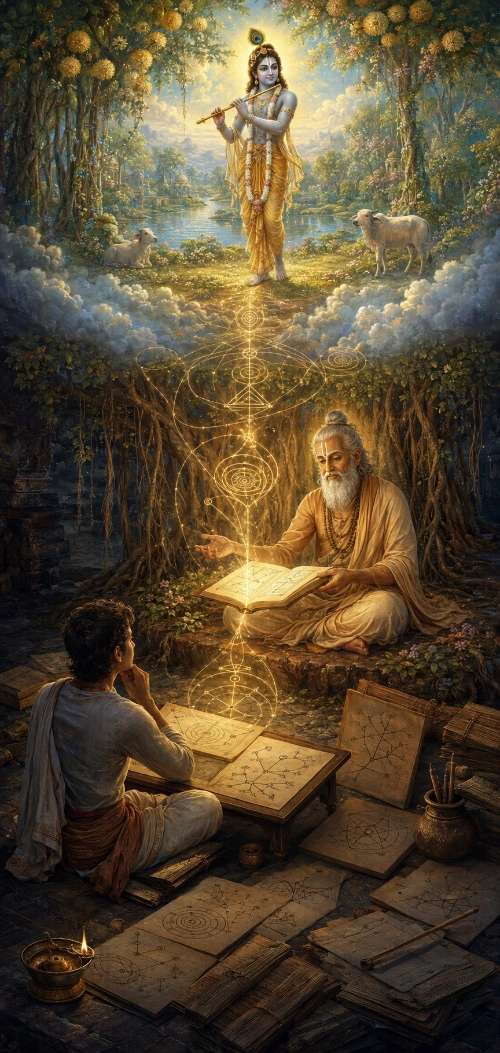
Does Vedānta Really Reject Logic?
One line of the Vedānta-sūtra is habitually quoted, in translation, as “Transcendental topics cannot be understood by argument or logic.” The rendering is not so much wrong as too large. Read at face value it suggests that Vedānta has no use for careful thought, philosophical analysis or logical argument — which would be a strange position for a text that argues on every page. The sūtra says something narrower and considerably more interesting: that reasoning, cut loose from a reliable source of knowledge, has nowhere to come to rest.
तर्काप्रतिष्ठानादप्यन्यथानुमेयमिति चेदेवमप्यनिर्मोक्षप्रसङ्गः ॥ २.१.११ ॥
tarkāpratiṣṭhānād apy anyathānumeyam iti ced evam apy anirmokṣa-prasaṅgaḥ
“Moreover, because reasoning has no final foundation. If it is said that the matter may be inferred differently, then even so there follows the consequence of there being no release from this defect.” — Vedānta-sūtra 2.1.11
Reading the Sūtra
That is the close, almost uncomfortably literal rendering. Set more smoothly, the sūtra says:
“Unaided reasoning cannot provide a final and unassailable conclusion concerning Brahman. If one argues that a better inference can be constructed, that inference too may be replaced by another; thus the instability remains.”
The popular translation catches one implication of this and then overshoots it. Vedānta does not reject careful thought. The Vedānta-sūtra is itself one of the most concentrated works of philosophical reasoning in Sanskrit, and its commentators are relentless logicians. What the sūtra denies is that reasoning, standing on its own feet, can settle the question of Brahman.
The Words
The line is built from eight elements, and almost the whole argument is carried by the first.
The compound tarkāpratiṣṭhānāt is best understood as because reasoning has no final, universally secure foundation. Apratiṣṭhā does not mean that every act of reasoning is meaningless. It means that speculative reasoning, once made independent of a reliable source of knowledge, does not arrive at an uncontestable conclusion.
One thinker constructs an inference. Another identifies a weakness in it and constructs a different inference. A third replaces both. There is no necessary endpoint to the series, and no position within it from which one could recognise the endpoint if it arrived.
The Objection and the Reply
The sūtra contains both an objection and a reply, compressed into a single line. The objection runs, in effect: even if one particular system of reasoning is defective, why not simply reason differently and construct a better inference? Bādarāyaṇa Vyāsa answers in four words.
एवमप्यनिर्मोक्षप्रसङ्गः
evam apy anirmokṣa-prasaṅgaḥ
“Even then, there is no escape from the difficulty.”
The new inference is still the product of an individual intellect, and it can be overturned by another individual intellect. Substituting one philosophical construction for another does not remove the instability; it only relocates it. The defect is not in any particular argument but in the standing of argument as such when it is asked to be its own authority.
So the sūtra is not saying never reason. It is saying that reason alone cannot serve as the ultimate foundation for knowledge of Brahman.
Where the Sūtra Stands
The second chapter of the Vedānta-sūtra is traditionally called the Avirodha-adhyāya, the chapter demonstrating the non-contradiction — the philosophical defensibility — of Vedānta. The immediate discussion concerns rival accounts of the origin and nature of the universe, and the Vedāntin is defending the Upaniṣadic teaching that Brahman is the cause of the world against systems built primarily out of inference.
The direct subject, then, is not “transcendental topics” in general. The question is methodological, and quite specific: can an independently constructed philosophical inference overturn the Upaniṣadic revelation concerning Brahman and the cause of the universe? The answer is no — because speculative conclusions are unstable, and another thinker can always construct a different model.
What the sūtra establishes is therefore a hierarchy rather than a prohibition.
Why Brahman Is Not Reached by Inference Alone
Inference depends on previously observed relations. The textbook example runs:
- wherever there is smoke, there is fire;
- there is smoke on the mountain;
- therefore there is fire on the mountain.
This works because smoke and fire have repeatedly been observed together. The inference is not conjuring the fire; it is riding on a relation already established by perception.
Brahman is not an ordinary object within the observable world. One cannot collect multiple sensory instances of worlds being produced from Brahman and then establish a universal relation between Brahman and cosmic manifestation. The material for the inference is missing, and no amount of ingenuity supplies it.
Reason may show that a revealed doctrine is coherent. It may refute contradictions and remove misunderstandings. What it cannot do is independently manufacture direct knowledge of a reality lying outside its experiential field.
The principle is stated much earlier in the same work, in a single compound:
शास्त्रयोनित्वात् ॥ १.१.३ ॥
śāstra-yonitvāt
“Because scripture is the source of knowledge of Brahman.” — Vedānta-sūtra 1.1.3
The precise construal of this compact sūtra differs among the Vedānta schools, but all of them recognise the indispensable role of Upaniṣadic revelation in the knowledge of Brahman. Later, Bādarāyaṇa says the same thing from the other side:
श्रुतेस्तु शब्दमूलत्वात् ॥ २.१.२७ ॥
śrutes tu śabda-mūlatvāt
“But this is established by revelation, because it has scripture as its foundation.” — Vedānta-sūtra 2.1.27
Together these establish that supersensible Brahman is known principally through śabda, authoritative verbal testimony, rather than by perception and inference operating on their own.
The Kaṭha Upaniṣad: Not by Reasoning
The clearest Upaniṣadic parallel comes in Yama’s instruction to Naciketas.
नैषा तर्केण मतिरापनेया
प्रोक्तान्येनैव सुज्ञानाय प्रेष्ठ ।
यां त्वमापः सत्यधृतिर्बतासि
त्वादृङ् नो भूयान्नचिकेतः प्रष्टा ॥
naiṣā tarkeṇa matir āpaneyā
proktānyenaiva sujñānāya preṣṭha
yāṃ tvam āpaḥ satya-dhṛtir batāsi
tvādṛṅ no bhūyān naciketaḥ praṣṭā
“This understanding cannot be attained through reasoning alone. When taught by one who is not separate from that reality, it becomes truly understood, dear one. You have attained this understanding and are steadfast in truth. May we have another questioner like you, O Naciketas.” — Kaṭha Upaniṣad 1.2.9
The verse is numbered 2.9 where the Kaṭha is counted as six vallīs. The form 1.2.9 counts adhyāya, vallī and mantra; it is Śaṅkarācārya’s own scheme and the one the Gauḍīya commentators follow.
The preceding verse explains why a qualified teacher is needed at all. Its latter half reads:
अनन्यप्रोक्ते गतिरत्र नास्ति
अणीयान् ह्यतर्क्यमणुप्रमाणात् ॥
ananya-prokte gatir atra nāsti
aṇīyān hy atarkyam aṇu-pramāṇāt
“When taught by one who has realised non-difference from it, no uncertainty remains concerning it; for it is subtler than the subtle and beyond mere reasoning.” — Kaṭha Upaniṣad 1.2.8
Śaṅkarācārya comments on this that if the Self is approached through intellectual conjecture alone, one thinker declares it subtle and the next imagines something subtler still. His conclusion is a single line:
न हि तर्कस्य निष्ठा क्वचिद् विद्यते ।
na hi tarkasya niṣṭhā kvacid vidyate
“Reasoning has no final resting point anywhere.” — Śaṅkarācārya, commentary on Kaṭha Upaniṣad 1.2.8
That line is very nearly an explanatory gloss on tarkāpratiṣṭhānāt itself — written by a commentator of a quite different school. The agreement is worth registering: the limit placed on independent reasoning is not a sectarian position but a shared Vedāntic one.
The sentence is the closing clause of Śaṅkarācārya’s comment on 1.2.8, the end of an argument by regress: whatever degree of subtlety one reasoner posits for the Self, another posits something subtler, and a third subtler still. He makes the same point in different words in his Brahma-sūtra commentary on 2.1.11 — that the fixity of reasonings cannot be relied upon, because human intellects differ in kind — but the sentence quoted here belongs to the Kaṭha commentary.
The Mahābhārata: Reasoning Has No Foundation
The same difficulty is put more memorably in the Mahābhārata, in the Yakṣa’s questioning of Yudhiṣṭhira at the lake. Asked what the path is, Yudhiṣṭhira replies:
तर्कोऽप्रतिष्ठः श्रुतयो विभिन्ना
नासावृषिर्यस्य मतं न भिन्नम् ।
धर्मस्य तत्त्वं निहितं गुहायां
महाजनो येन गतः स पन्थाः ॥
tarko ’pratiṣṭhaḥ śrutayo vibhinnā
nāsāv ṛṣir yasya mataṃ na bhinnam
dharmasya tattvaṃ nihitaṃ guhāyāṃ
mahājano yena gataḥ sa panthāḥ
“Reasoning has no final foundation; the revealed texts appear diverse. There is no sage whose opinion does not differ from that of another. The truth of dharma is hidden in a profound place. Therefore the path is that which the great authorities have followed.” — Mahābhārata, Vana-parvan 313.117
This is the received vulgate numbering, the one Jīva Gosvāmī uses when he quotes the verse at Bhakti-sandarbha 180; the Gītā Press edition numbers the same verse 316.117, the śloka number staying constant while the chapter number shifts. In the critical edition the verse belongs not to the constituted text but to the long insertion catalogued as Appendix I.32, after 3.297.61, and there the second line reads naiko ṛṣir yasya mataṃ pramāṇam, “there is no single sage whose opinion is authoritative,” rather than the Gauḍīya nāsāv ṛṣir yasya mataṃ na bhinnam given above.
The verse does not recommend blind imitation. Its conclusion is that when individual reasoning and competing interpretations produce uncertainty, one looks to the path embodied by trustworthy mahājanas — realised authorities in whom teaching, conduct and scriptural understanding agree. The test is convergence: not one authority’s opinion, but the road that the great ones have in fact walked.
The Inconceivable Is Not the Irrational
A second Mahābhārata passage is cited almost as often:
अचिन्त्याः खलु ये भावा
न तांस्तर्केण योजयेत् ।
प्रकृतिभ्यः परं यच्च
तदचिन्त्यस्य लक्षणम् ॥
acintyāḥ khalu ye bhāvā
na tāṃs tarkeṇa yojayet
prakṛtibhyaḥ paraṃ yac ca
tad acintyasya lakṣaṇam
“Realities that are truly inconceivable should not be subjected to reasoning. That which lies beyond material nature is the very mark of the inconceivable.” — Mahābhārata 6.6.11 in the Poona critical edition; Bhīṣma-parvan 5.12 in the Gītā Press vulgate
On the text and its reference. The verse is spoken by Sañjaya to Dhṛtarāṣṭra, and it does stand in the constituted text of the critical edition, where it reads na tāṃs tarkeṇa sādhayet and prakṛtibhyaḥ paraṃ yat tu. The Gauḍīya authors quote it with yojayet and yac ca, and that is the reading given above. The citation “Bhīṣma-parvan 5.22,” usual in Gauḍīya works, cannot be confirmed: that chapter has eighteen verses in the vulgate, where the verse is 5.12. Jīva Gosvāmī, quoting it in his Digdarśinī on Brahma-saṁhitā 5.34, ascribes it to the Skanda Purāṇa and the Bhārata together — which is probably why its location is so often reported as uncertain.
The important point is that acintya does not mean irrational, absurd or internally contradictory. It means that the reality in question cannot be exhaustively enclosed within categories drawn from material experience. The word marks the limits of a set of categories, not a licence to abandon coherence.
A divine nature may transcend ordinary experience without violating reason. Trans-rational is not the same as irrational — and acintya is the term Sanskrit uses to hold precisely that distinction open.
Jīva Gosvāmī and the Gauḍīya Reading
The principle carries particular weight in Jīva Gosvāmī’s Tattva-sandarbha, specifically its eleventh anuccheda, where he is establishing the means by which ultimate reality is known at all. Building the case, Jīva — one of the Six Gosvāmīs of Vṛndāvana — assembles five of the passages gathered above:
- tarkāpratiṣṭhānāt;
- the statement on inconceivable realities;
- śāstra-yonitvāt;
- śrutes tu śabda-mūlatvāt;
- Śrīmad-Bhāgavatam 11.20.4.
Kaṭha Upaniṣad 1.2.9 is not among them. It enters the discussion through Baladeva Vidyābhūṣaṇa, who supplies it in his gloss on the same anuccheda — and it is there, commenting directly on tarkāpratiṣṭhānāt, that Baladeva names the mechanism:
परमार्थनिर्णयस्तर्केण न भवति
पुरुषबुद्धिवैविध्येन तस्य नष्टप्रतिष्ठत्वात् ।
paramārtha-nirṇayas tarkeṇa na bhavati
puruṣa-buddhi-vaividhyena tasya naṣṭa-pratiṣṭhatvāt
“The ascertainment of ultimate reality does not arise from reasoning alone, because reasoning loses any final foundation owing to the diversity of human intellects.” — Baladeva Vidyābhūṣaṇa, Ṭippaṇī on Tattva-sandarbha, anuccheda 11
This is the valuable part of the Gauḍīya explanation, because it says why. Reasoning is not unstable in the abstract. It is unstable because it is carried out by particular people, and different minds begin from different assumptions, experiences, capacities and inclinations. Purely speculative metaphysics therefore produces mutually incompatible conclusions with great reliability — which is an observation about the history of philosophy as much as a doctrinal claim.
Baladeva is glossing the sūtra itself, not merely the topic: he writes that tarka is a fragment of the Brahma-sūtra, “the meaning of which is …,” gives the line quoted above, and then adduces the Kaṭha verse immediately after it. The Sanskrit stands in the Ṣaṭ-sandarbha with his Ṭippaṇī, at Tattva-sandarbha 11.
Does Vedānta Reject Logic?
No — and the question is worth putting directly, because the sūtra is so often quoted as though it did. The Vedānta-sūtra is an extraordinarily concentrated work of philosophical reasoning, and its commentators employ the whole apparatus:
- grammar;
- inference;
- comparison;
- contextual interpretation;
- objection and reply;
- examination of contradictions;
- analysis of competing doctrines.
Jīva Gosvāmī’s own discussion goes further and recognises the technical utility of tarka as an aid to inference. The objection is not to disciplined reasoning but to kevala-tarka — reasoning that claims complete independence from revealed testimony.
Several distinct uses of reason have to be separated before the sūtra can be read correctly.
The traditional formula is accordingly śruty-anugṛhīta-tarka or śruty-anukūla-tarka: reasoning assisted by, or consistent with, revealed knowledge. Faith is not being substituted for thought. Each means of valid knowledge is being used within its proper field.
Rejecting śāstra because it cannot be independently recreated by empirical inference would be like rejecting sound because it cannot be seen.
Revelation Does Not Eliminate Inquiry
The need for revealed testimony does not oblige a student to accept every religious assertion indiscriminately, and it does not forbid questioning. The Bhagavad-gītā builds inquiry into the process of receiving spiritual knowledge:
तद्विद्धि प्रणिपातेन
परिप्रश्नेन सेवया ।
उपदेक्ष्यन्ति ते ज्ञानं
ज्ञानिनस्तत्त्वदर्शिनः ॥
tad viddhi praṇipātena
paripraśnena sevayā
upadekṣyanti te jñānaṃ
jñāninas tattva-darśinaḥ
“Understand that knowledge through sincere approach, thorough inquiry, and service. Those who possess knowledge and directly perceive the truth will instruct you in it.” — Bhagavad-gītā 4.34
Paripraśna means careful, thorough, relevant inquiry; the prefix pari- carries the sense of going all the way round a thing. The ideal student is neither rebelliously argumentative nor intellectually passive, but listens, questions, examines, practises and realises.
Śāstra as an Eye
The Bhāgavata gives the point its sharpest image:
पितृदेवमनुष्याणां वेदश्चक्षुस्तवेश्वर ।
श्रेयस्त्वनुपलब्धेऽर्थे साध्यसाधनयोरपि ॥
pitṛ-deva-manuṣyāṇāṃ vedaś cakṣus taveśvara
śreyas tv anupalabdhe ’rthe sādhya-sādhanayor api
“O Lord, the Veda is the eye of the ancestors, the gods and human beings concerning the highest good — concerning realities, goals and means that cannot otherwise be directly perceived.” — Śrīmad-Bhāgavatam 11.20.4
Calling the Veda an eye is doing real work. Śāstra is not being presented as a collection of commands to be obeyed, but as a pramāṇa — a means of valid knowledge — for realities that unaided perception cannot reach. An eye is not an authority one submits to. It is an instrument through which something becomes visible.
The Deeper Implication
The sūtra finally concerns not only the weakness of the instrument but the nature of what is being known.
Brahman, or Bhagavān, is not a passive object that can be set before the intellect, dissected and mastered. The finite intellect does not comprehend the infinite in the way it comprehends an ordinary object, and the disproportion is not a matter of effort or ingenuity. It is structural.
In the devotional Vedānta traditions the reality known must also disclose itself. Knowledge accordingly draws on more than one faculty:
- śravaṇa — hearing revelation;
- manana — thoughtful reflection;
- nididhyāsana or smaraṇa — sustained contemplation and remembrance;
- purification of consciousness;
- instruction from a realised teacher;
- divine grace;
- direct realisation.
Reason participates at every stage of this. It does not dominate it, and it cannot replace it.
What the Sūtra Actually Claims
Tarkāpratiṣṭhānāt means, compactly, because reasoning lacks a final and stable foundation. It does not condemn logic or thoughtful inquiry. It teaches that unaided human speculation cannot independently establish the nature of Brahman, because one philosophical inference can always be challenged by another.
Vedānta therefore places reasoning in the service of revelation. Śāstra supplies knowledge of supersensible reality; reason interprets that revelation, tests the coherence of the interpretation, answers objections and guards against misunderstanding. Reason is indispensable as an instrument and insufficient as a final source.
The popular rendering — transcendental topics cannot be understood by argument or logic — is acceptable with one word added: alone.
Transcendental reality cannot be established by unaided speculative reasoning. It is revealed through śāstra and understood through disciplined inquiry, realised instruction, spiritual practice and divine grace. Tarka is an instrument of that understanding rather than its foundation, and what the sūtra denies to reasoning is not its use but its independence.