

Gokula, Mathurā and Dvārakā
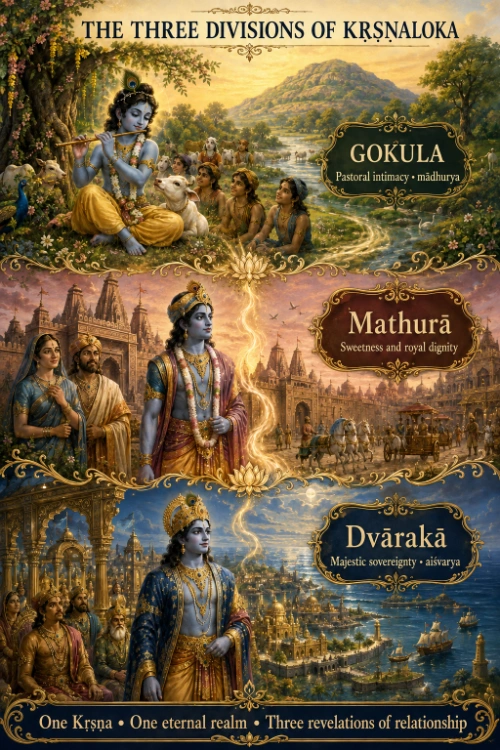
One Kṛṣṇaloka in Three Manifestations: Gokula, Mathurā and Dvārakā
Kṛṣṇadāsa Kavirāja states in a single line of verse that the realm of Kṛṣṇa is one and yet threefold — Gokula, Mathurā, Dvārakā. The line is short enough to look like a piece of celestial geography, and it is routinely read that way: one planet, three districts. It is something considerably more interesting than that. It is a statement about how the same person is differently available to different kinds of love, and the three names are the names of three ways of being related to him.
এক ‘কৃষ্ণলোক’ হয় ত্রিবিধপ্রকার ।
গোকুলাখ্য, মথুরাখ্য, দ্বারকাখ্য আর ॥ ২১৪ ॥
eka ‘kṛṣṇaloka’ haya trividha-prakāra
gokulākhya, mathurākhya, dvārakākhya āra
“The one Kṛṣṇaloka is of three kinds: that called Gokula, that called Mathurā, and that called Dvārakā.” — Śrī Caitanya-caritāmṛta, Madhya-līlā 20.214
Reading the Verse
The words are unusually transparent, and it is worth taking them one at a time, because two of them are habitually over-translated.
The standard BBT rendering reads: “The planet of Kṛṣṇaloka is divided into three sections — Gokula, Mathurā and Dvārakā.” Nothing in it is doctrinally false, and every Gauḍīya reader will recognise the intent. But two English words do more work than the Bengali gives them. Loka becomes “planet,” which in a modern ear means a body of rock in astronomical space; and trividha-prakāra becomes “divided into three sections,” which suggests a partitioned territory. The Bengali says neither. A closer rendering keeps the emphasis where the verse puts it:
“The one eternal realm of Kṛṣṇa is manifested in three principal forms: Gokula, Mathurā, and Dvārakā.”
This is not a quarrel about accuracy so much as about emphasis. The three are not three unrelated heavens belonging to three different gods, nor three provinces on one map. They are three revelations of one Kṛṣṇa and one internal spiritual potency, distinguished by his identity, his associates, his pastimes, and above all by the mode of loving relationship each sustains. Read as geography, the verse is a curiosity. Read as a taxonomy of intimacy, it is the hinge of Gauḍīya theology.
Kṛṣṇadāsa gives the same teaching earlier, in the Ādi-līlā, in almost the same words — evidence that the threefold formula is a settled doctrinal unit for him rather than a passing remark:
তাহার উপরিভাগে ‘কৃষ্ণলোক’-খ্যাতি ।
দ্বারকা-মথুরা-গোকুল — ত্রিবিধত্বে স্থিতি ॥ ১৬ ॥
tāhāra upari-bhāge ‘kṛṣṇa-loka’-khyāti
dvārakā-mathurā-gokula — tri-vidhatve sthiti
“In the region above that is what is known as Kṛṣṇaloka. It abides in a threefold state — Dvārakā, Mathurā and Gokula.” — Caitanya-caritāmṛta, Ādi-līlā 5.16
Note the order. The Ādi-līlā verse ascends — Dvārakā, Mathurā, Gokula — while the Madhya-līlā verse descends — Gokula, Mathurā, Dvārakā. Neither sequence is accidental, and the two together already imply that the list is graded rather than merely enumerated.
Where Kṛṣṇaloka Stands
The verse under discussion does not stand alone. The line immediately preceding it locates Kṛṣṇaloka in relation to the Vaikuṇṭha worlds:
পরব্যোম-মধ্যে নারায়ণের নিত্য-স্থিতি ।
পরব্যোম-উপরি কৃষ্ণলোকের বিভূতি ॥ ২১৩ ॥
paravyoma-madhye nārāyaṇera nitya-sthiti
paravyoma-upari kṛṣṇalokera vibhūti
“Within the spiritual sky is the eternal residence of Nārāyaṇa; above the spiritual sky is manifested the opulence of Kṛṣṇaloka.” — Caitanya-caritāmṛta, Madhya-līlā 20.213
Here paravyoma, the “supreme sky,” is the non-material expanse containing the Vaikuṇṭha realms of Nārāyaṇa and his Viṣṇu forms. The Sanskrit foundation for placing Kṛṣṇa’s own abode beyond it is the Brahma-saṁhitā:
गोलोकनाम्नि निजधाम्नि तले च तस्य
देवीमहेशहरिधामसु तेषु तेषु ।
ते ते प्रभावनिचया विहिताश्च येन
गोविन्दमादिपुरुषं तमहं भजामि ॥
goloka-nāmni nija-dhāmni tale ca tasya
devī-maheśa-hari-dhāmasu teṣu teṣu
te te prabhāva-nicayā vihitāś ca yena
govindam ādi-puruṣaṁ tam ahaṁ bhajāmi
“Below his own abode named Goloka are situated the several realms of Devī, Maheśa and Hari, each endowed with its own array of powers, ordained by him. I worship Govinda, the primeval Person.” — Brahma-saṁhitā 5.43
“Above” here should not be read only as altitude. In theological cosmography, spatial language routinely carries non-spatial freight: greater intimacy, fuller manifestation, deeper rasa, more complete disclosure of the divine personality. Kṛṣṇaloka is “above” Vaikuṇṭha in the sense that what is manifested there is more of Kṛṣṇa himself, not merely further from the ground. Nor is this a hierarchy of divine power in which Nārāyaṇa comes off short. Nārāyaṇa lacks nothing that belongs to Godhead. What increases as one ascends is the revelation of personal sweetness and the range of relationships it makes possible.
One Kṛṣṇa, Three Relational Identities
Before taking the three in turn, it is worth stating what does and does not vary between them.
These identities are not costumes worn over an impersonal Absolute, nor masks adopted for pedagogical convenience. They are eternal personal manifestations. Neither are they simply three chapters of a biography. The earthly narrative does move from Vraja to Mathurā to Dvārakā, but the corresponding realms and the relationships they sustain exist eternally, and the residents of each are eternally what they are.
Gokula: The Names of the Highest Realm
In this context Gokula is not the village near modern Mathurā to which Vasudeva carried the infant Kṛṣṇa. It is eternal Vraja, and Kṛṣṇadāsa gives its several names in a single verse:
সর্বোপরি শ্রীগোকুল—ব্রজলোক-ধাম ।
শ্রীগোলোক, শ্বেতদ্বীপ, বৃন্দাবন নাম ॥ ১৭ ॥
sarvopari śrī-gokula — vraja-loka-dhāma
śrī-goloka, śvetadvīpa, vṛndāvana nāma
“Above all is Śrī Gokula, the abode of Vraja; its names are Śrī Goloka, Śvetadvīpa and Vṛndāvana.” — Caitanya-caritāmṛta, Ādi-līlā 5.17
The terms are not simply synonyms. Each foregrounds a different dimension of one reality:
These words are not interchangeable in every Sanskrit text. Within this Gauḍīya frame, however, they designate closely related aspects of the same eternal Vraja, and the question sometimes raised — whether Gokula and Goloka are two different destinations — is answered by the verse itself. They are not. Goloka emphasises the eternal transcendent realm; Gokula emphasises that same realm as Kṛṣṇa’s pastoral home; and the earthly Gokula-Vṛndāvana is its manifested counterpart, a point taken up below.
The Landscape of Eternal Gokula
Eternal Gokula contains the originals of everything the pilgrim finds in terrestrial Vraja: the twelve forests of Vṛndāvana; the Yamunā; Govardhana; Rādhā-kuṇḍa and Śyāma-kuṇḍa; Nanda-grāma; Varṣāṇā; Yāvaṭa; Saṅketa; and innumerable groves, pastures, pathways, ponds and meeting-places, together with Kṛṣṇa’s cows, his cowherd friends, his parents and the gopīs.
The Brahma-saṁhitā describes this world not as an expanse of undifferentiated spiritual light but as an environment that is personal through and through — where the elements of the landscape are themselves participants:
श्रियः कान्ताः कान्तः परमपुरुषः कल्पतरवो
द्रुमा भूमिश्चिन्तामणिगणमयी तोयममृतम् ।
कथा गानं नाट्यं गमनमपि वंशी प्रियसखी
चिदानन्दं ज्योतिः परमपि तदास्वाद्यमपि च ॥
स यत्र क्षीराब्धिः स्रवति सुरभीभ्यश्च सुमहान्
निमेषार्धाख्यो वा व्रजति न हि यत्रापि समयः ।
भजे श्वेतद्वीपं तमहमिह गोलोकमिति यं
विदन्तस्ते सन्तः क्षितिविरलचाराः कतिपये ॥
śriyaḥ kāntāḥ kāntaḥ parama-puruṣaḥ kalpa-taravo
drumā bhūmiś cintāmaṇi-gaṇa-mayī toyam amṛtam
kathā gānaṁ nāṭyaṁ gamanam api vaṁśī priya-sakhī
cid-ānandaṁ jyotiḥ param api tad āsvādyam api ca
sa yatra kṣīrābdhiḥ sravati surabhībhyaś ca su-mahān
nimeṣārdhākhyo vā vrajati na hi yatrāpi samayaḥ
bhaje śvetadvīpaṁ tam ahaṁ iha golokam iti yaṁ
vidantas te santaḥ kṣiti-virala-cārāḥ katipaye
“I worship that Śvetadvīpa which is known here as Goloka — where the goddesses of fortune are the beloveds and the Supreme Person the beloved; where the trees are wish-fulfilling trees, the ground is made of touchstone gems and the water is nectar; where speech is song and movement is dance, and the flute is the dearest companion; where the effulgence is conscious bliss and all is there to be relished; where a vast ocean of milk flows from the surabhi cows, and where time does not pass, not even for half an instant. Only a few rare saints in this world know that realm.” — Brahma-saṁhitā 5.56
This is poetic theology, not surveying. Its force is that nothing in the realm is inert scenery: the trees give what is wanted, the ground is jewel, speech has already become song. Every feature participates consciously in the līlā. To ask where such a place is on a chart is to ask the wrong question of the verse — which is why the same stanza ends by saying that hardly anyone here knows it.
Kṛṣṇa’s Identity in Gokula
In Gokula, Kṛṣṇa is the son of Nanda and Yaśodā; the younger brother of Balarāma; the friend of Śrīdāma, Subala, Madhumaṅgala and the cowherd boys; the beloved of the gopīs; the life of the cows, calves, birds, trees, rivers and forests; and, above all, the beloved of Śrī Rādhā. He dresses as a cowherd, tends the herds, plays the flute, steals butter, wrestles with his friends, and meets the gopīs in the forest bowers.
The remarkable feature of the realm is not the pastoral setting but the fact that its residents do not ordinarily relate to him through awareness that he is God. Yaśodā does not think, “I am privileged to care for the Supreme Lord.” She thinks that this beautiful and troublesome child is hers, and that unless she feeds and protects him something may happen to him. The cowherd boys do not stand at a reverential distance: they wrestle with him, climb on his shoulders, share half-eaten food with him, joke at his expense, and sometimes beat him at games. The gopīs have not been persuaded by theological argument that he is worth loving; their love is immediate, total and self-forgetful, and it does not consult his credentials.
Why Divine Majesty Is Concealed There
It is not that power is absent from Vraja. Kṛṣṇa kills Pūtanā, uproots the twin arjuna trees, subdues Kāliya, lifts Govardhana, destroys a series of demons, and shows the universe inside his mouth. What is striking is that none of these displays permanently converts Vraja’s intimacy into formal reverence. Yaśodā sees the universe in her son’s mouth and, moments later, is again a mother worrying about a child. The power of her parental love reasserts the relationship over the evidence.
This is what mādhurya means in its widest sense: not the absence of divinity, but divinity so completely integrated into humanlike beauty that majesty never obstructs love. It is the difference between a king who conceals his rank and a king whose subjects love him so thoroughly that his rank stops governing how they speak to him.
The Relationships of Vraja
Gokula manifests the intimate devotional relationships in their fullest form:
Two senses of one word. Mādhurya denotes both the general sweetness and humanlike accessibility of Kṛṣṇa’s personality — the quality contrasted with aiśvarya — and, more narrowly, the specific amorous rasa. The senses are deeply connected but not identical, and sliding between them silently is the commonest source of confusion in English discussions of Vraja.
Pūrṇatama: Why Gokula Is Called the Fullest Manifestation
The claim that Gokula stands highest is not an expression of sentiment. Rūpa Gosvāmī gives it a technical form, distinguishing three degrees in which Kṛṣṇa’s qualities become manifest, and Kṛṣṇadāsa Kavirāja quotes all three verses in the Madhya-līlā, prefacing them with his own summary:
ব্রজে কৃষ্ণ — সর্বৈশ্বর্যপ্রকাশে ‘পূর্ণতম’ ।
পুরীদ্বয়ে, পরব্যোমে — ‘পূর্ণতর,’ ‘পূর্ণ’ ॥ ৩৯৮ ॥
vraje kṛṣṇa — sarvaiśvarya-prakāśe ‘pūrṇatama’
purī-dvaye, paravyome — ‘pūrṇatara’, ‘pūrṇa’
“In Vraja Kṛṣṇa is pūrṇatama, most complete, by the manifestation of all opulences; in the two cities he is pūrṇatara, more complete, and in the spiritual sky pūrṇa, complete.” — Caitanya-caritāmṛta, Madhya-līlā 20.398
हरिः पूर्णतमः पूर्णतरः पूर्ण इति त्रिधा ।
श्रेष्ठमध्यादिभिः शब्दैर्नाट्ये यः परिपठ्यते ॥
प्रकाशिताखिलगुणः स्मृतः पूर्णतमो बुधैः ।
असर्वव्यञ्जकः पूर्णतरः पूर्णोऽल्पदर्शकः ॥
कृष्णस्य पूर्णतमता व्यक्ताभूद् गोकुलान्तरे ।
पूर्णता पूर्णतरता द्वारकामथुरादिषु ॥
hariḥ pūrṇatamaḥ pūrṇataraḥ pūrṇa iti tridhā
śreṣṭha-madhyādibhiḥ śabdair nāṭye yaḥ paripaṭhyate
prakāśitākhila-guṇaḥ smṛtaḥ pūrṇatamo budhaiḥ
asarva-vyañjakaḥ pūrṇataraḥ pūrṇo ’lpa-darśakaḥ
kṛṣṇasya pūrṇatamatā vyaktābhūd gokulāntare
pūrṇatā pūrṇataratā dvārakā-mathurādiṣu
“Hari is threefold — most complete, more complete, and complete — corresponding to the terms ‘highest,’ ‘intermediate’ and so on used in dramaturgy. When all his qualities are manifested, the wise call him most complete; when he does not display them all, more complete; and when he shows fewer, complete. Kṛṣṇa’s most complete state became manifest within Gokula, while completeness and greater completeness are manifest in Dvārakā, Mathurā and the rest.” — Rūpa Gosvāmī, Bhakti-rasāmṛta-sindhu 2.1.221–223, quoted at Caitanya-caritāmṛta, Madhya-līlā 20.399–401
The teaching needs careful handling, because it is easy to misread in two opposite directions.
It does not mean that the Kṛṣṇa of Dvārakā is a fraction of God, a diminished or partial deity. Kṛṣṇa is always fully Bhagavān, in every realm, without remainder. The gradation concerns the extent to which his relational and personal qualities are manifested within a given līlā — what is displayed, not what is possessed. The three Sanskrit terms are degrees of disclosure, not percentages of divinity, and treating them as arithmetic is the surest way to get the doctrine wrong.
Nor is the assignment of the lower two terms as tidy as popular summaries suggest. It is often said that Gokula is pūrṇatama, Mathurā pūrṇatara, and Dvārakā pūrṇa, distributing the three words neatly across the three names of the verse under discussion. That distribution has some warrant in the word order of Bhakti-rasāmṛta-sindhu 2.1.223, which names Dvārakā before Mathurā after having named pūrṇatā before pūrṇataratā. But Kṛṣṇadāsa Kavirāja’s own gloss at Madhya 20.398 does not distribute them that way. He takes the two cities together as pūrṇatara and reserves pūrṇa for the paravyoma — reading Rūpa Gosvāmī’s “and the rest” (ādiṣu) as reaching down to Vaikuṇṭha. On his reading the scale is not Gokula–Mathurā–Dvārakā but Vraja–the two cities–Vaikuṇṭha, and the threefold Kṛṣṇaloka of Madhya 20.214 is graded internally in two steps rather than three.
Both readings are current in the tradition and neither is a corruption of the other; they answer different questions. The BRS verse ranks manifestations of Kṛṣṇa wherever they occur, including in Vaikuṇṭha; the Madhya 20.214 verse enumerates the divisions of Kṛṣṇaloka alone, which does not include Vaikuṇṭha. A summary that assigns pūrṇa to Dvārakā is therefore serviceable but should be offered as one construal, with Kṛṣṇadāsa’s alternative noted — particularly since he is the author of the verse being explained.
What is not in dispute is the reason Vraja stands at the top. In Gokula alone, and simultaneously, Kṛṣṇa displays childhood, boyhood and fresh youth; dependence upon his parents; equality with his friends; pastoral simplicity; the flute; the herding of cows; unrestricted romantic sweetness; and the mahābhāva of Śrī Rādhā. No other līlā holds all of these at once. That simultaneity, not the pastoral scenery, is what pūrṇatama names.
Mathurā: Kṛṣṇa as Prince and Son of Vasudeva
Mathurā is the eternal city in which Kṛṣṇa appears as the son of Vasudeva and Devakī and becomes publicly attached to the Yadu dynasty. The verse immediately following the threefold Kṛṣṇaloka guards against reducing it to a stage in a story:
মথুরাতে কেশবের নিত্য সন্নিধান ।
নীলাচলে পুরুষোত্তম — ‘জগন্নাথ’ নাম ॥ ২১৫ ॥
mathurāte keśavera nitya sannidhāna
nīlācale puruṣottama — ‘jagannātha’ nāma
“Keśava is eternally present at Mathurā; at Nīlācala, Puruṣottama is known by the name Jagannātha.” — Caitanya-caritāmṛta, Madhya-līlā 20.215
The word nitya, eternally, is what prevents Mathurā from being read as a temporary historical episode that Kṛṣṇa passed through and left behind.
Mathurā is associated with Kṛṣṇa’s birth from Devakī and Vasudeva; his transfer to Gokula on the night of his appearance; his later return; the defeat of the wrestlers Cāṇūra and Muṣṭika; the killing of Kaṁsa; the liberation of his imprisoned parents; his education under Sāndīpani Muni; his recognition as a Yadu prince; his meeting with Kubjā; and his dealings with the citizens of the city. It is therefore doubly significant: it is his janma-sthāna, the place of his manifested birth, and it is where his royal and dynastic identity emerges into public view.
The Atmosphere of Mathurā
Mathurā stands between Vraja’s pastoral intimacy and Dvārakā’s developed royal world. There, Kṛṣṇa is no longer outwardly a village cowherd; he is recognised as an extraordinary hero and a prince; his connection with Vasudeva, Devakī, Ugrasena and the Yadus becomes prominent; public awareness of his power increases; and the unrestricted intimacy of Vraja is no longer the dominant external register.
It would be a mistake, though, to describe Mathurā as merely half sweet and half majestic — a transitional corridor with no character of its own. It has its own eternal completeness and its own sacred identity, and its devotees are not people who failed to reach somewhere better. A more accurate summary of the three registers runs:
Mathurā Above Vaikuṇṭha
Rūpa Gosvāmī’s best-known statement of graded holiness begins from Mathurā and ascends within Vraja itself:
वैकुण्ठाज्जनितो वरा मधुपुरी तत्रापि रासोत्सवाद्
वृन्दारण्यमुदारपाणिरमणात्तत्रापि गोवर्धनः ।
राधाकुण्डमिहापि गोकुलपतेः प्रेमामृताप्लावनात्
कुर्यादस्य विराजतो गिरितटे सेवां विवेकी न कः ॥
vaikuṇṭhāj janito varā madhu-purī tatrāpi rāsotsavād
vṛndāraṇyam udāra-pāṇi-ramaṇāt tatrāpi govardhanaḥ
rādhā-kuṇḍam ihāpi gokula-pateḥ premāmṛtāplāvanāt
kuryād asya virājato giri-taṭe sevāṁ vivekī na kaḥ
“Mathurā is superior to Vaikuṇṭha because he was born there; superior to it is the forest of Vṛndāvana, because of the festival of the rāsa dance; superior to that is Govardhana, because of the sport of his generous hand; and superior even to that is Rādhā-kuṇḍa, flooded with the nectar of love for the Lord of Gokula. What discerning person would not serve it, there at the foot of the hill?” — Rūpa Gosvāmī, Upadeśāmṛta 9
A terminological caution. In this verse madhu-purī can carry the wider sense of Mathurā-maṇḍala, the whole sacred region, of which Vṛndāvana, Govardhana and Rādhā-kuṇḍa are then named as progressively more intimate parts. The verse is not comparing four unrelated pilgrimage towns; it is descending into one region and finding its centre. And the ladder is built entirely from intensity of manifested love — a birth, a dance, a lifted hill, a lake made of Rādhā’s prema — with no reference whatever to size, wealth or political importance.
Dvārakā: The Royal and Household Realm
Dvārakā is Kṛṣṇa’s eternal maritime capital, and there he is prince and leader of the Yādavas; protector of his people; husband of his queens; father and grandfather; statesman, diplomat and warrior; friend of the Pāṇḍavas; and sovereign amid palaces, assembly halls, armies, ministers and sages. Here his aiśvarya — majesty, lordship, magnificence — is displayed with a fullness found nowhere else.
His principal queens are Rukmiṇī, Satyabhāmā, Jāmbavatī, Kālindī, Mitravindā, Satyā (Nāgnajitī), Bhadrā and Lakṣmaṇā, and beyond them the great company of princesses freed from Bhaumāsura, each of whom resides with Kṛṣṇa in her own palace. By his inconceivable potency he is simultaneously and personally present with every one of them.
On the number. The figure 16,108 is standard in Gauḍīya usage, but it is a composite and no single Bhāgavata verse states it. Śrīmad-Bhāgavatam 10.59.33 gives ayuta plus ṣaṭ-sahasra — sixteen thousand — princesses recovered from Bhauma; Śrīdhara Svāmī, commenting there, cites the Viṣṇu Purāṇa’s figure of 16,100; the eight principal queens are named at 10.83.6–7, where Draupadī addresses nine speakers, the eight together with Rohiṇī, who speaks on behalf of the rest. The total of 16,108 is arrived at by adding the eight to the commentarial 16,100, and is given in that form in the purport to 10.61.1. It is a sound traditional figure, but it should be presented as the tradition’s reckoning rather than as a verse quotation.
The queens’ love should not be reduced to protocol. Rukmiṇī, Satyabhāmā and the rest possess deep conjugal intimacy, playfulness, jealousy, longing and thoroughly personal familiarity with their husband. The difference from Vraja lies not in the absence of sweetness but in the structure that surrounds it. Love in Dvārakā is svakīya — established within publicly recognised marriage; it is royal, socially ordered, accompanied by awareness of Kṛṣṇa’s position, and framed by palace life, queenship, dynasty and sovereignty. The gopīs’ love, by contrast, disregards convention, personal security and even religious reputation when these stand between them and Kṛṣṇa.
Dvārakā also reveals aspects of Kṛṣṇa scarcely visible in Vraja at all: kingly responsibility; the protection of a great dynasty; dealings with rulers and sages; political intelligence; the maintenance of innumerable households; simultaneous presence in thousands of palaces; his role in the world of the Mahābhārata; and the sheer magnificence of his royal wealth. It is not spiritually inferior in the sense of being impure or incomplete. It is an eternal and perfect revelation of his sovereign personality, and it is given precedence below Gokula only under the Gauḍīya principle of rasa-vicāra — evaluation by the intimacy and comprehensiveness of loving relationship.
Mādhurya and Aiśvarya
The whole threefold scheme can be held in view through two terms.
These are not two gods, nor two mutually exclusive substances. They are two dimensions of one person, and every realm has both. What varies is which one organises the relationship.
Two things should not be said. Not that Gokula has “no aiśvarya” — Kṛṣṇa lifts Govardhana there and shows the universe in his mouth; rather, awareness of his aiśvarya does not govern the devotees’ dealings with him. And not that Dvārakā has “no mādhurya” — his dealings with his queens, children, friends and kinsmen are genuinely intimate; majesty simply remains in view.
The Three Realms and the Forms of Love
Set out relationship by relationship, the same gradation appears in each register.
Gokula.
Mathurā.
Dvārakā.
“Kṛṣṇa Is Ours”: Three Relational Worlds
The cleanest way to feel the difference is to ask what the residents of each realm would say about him.
Why Love May Appear to Subordinate God
Vraja-bhakti contains a genuine theological reversal. Ordinarily the devotee is subordinate to God. In Vraja, pure love makes Kṛṣṇa willingly subordinate to his devotees: Yaśodā binds him; his friends defeat him and make him carry them on their shoulders; the gopīs rebuke him; and Rādhā’s love exercises the greatest power over him of all. The Bhāgavatam registers the astonishment of this directly:
नेमं विरिञ्चो न भवो
न श्रीरप्यङ्गसंश्रया ।
प्रसादं लेभिरे गोपी
यत्तत्प्राप विमुक्तिदात् ॥ २० ॥
nemaṁ viriñco na bhavo
na śrīr apy aṅga-saṁśrayā
prasādaṁ lebhire gopī
yat tat prāpa vimuktidāt
“Neither Brahmā, nor Śiva, nor even Śrī who rests upon his chest, obtained such mercy from the giver of liberation as the cowherd woman obtained.” — Śrīmad-Bhāgavatam 10.9.20
The sting is in vimukti-dāt, “from the giver of liberation.” The point is not that Yaśodā received a large blessing. It is that the one who grants liberation to the universe permitted himself to be tied to a grinding mortar by his mother — and that this, and not liberation, is the greater gift. That is the distinctive glory of Gokula, stated by the Bhāgavatam itself rather than inferred by later commentators.
Śrī Rādhā and the Supremacy of Gokula
The deepest reason for Gokula’s precedence is not the cows, the forests, the childhood or the flute. It is the presence of Śrī Rādhā, and the manifestation there of her mahābhāva — understood as the highest concentration of Kṛṣṇa’s own pleasure potency, the hlādinī-śakti.
হ্লাদিনীর সার ‘প্রেম’, প্রেমসার ‘ভাব’ ।
ভাবের পরমকাষ্ঠা, নাম—‘মহাভাব’ ॥ ৬৮ ॥
মহাভাবস্বরূপা শ্রীরাধা-ঠাকুরাণী ।
সর্বগুণখনি কৃষ্ণকান্তাশিরোমণি ॥ ৬৯ ॥
hlādinīra sāra ‘prema’, prema-sāra ‘bhāva’
bhāvera parama-kāṣṭhā, nāma—‘mahā-bhāva’
mahābhāva-svarūpā śrī-rādhā-ṭhākurāṇī
sarva-guṇa-khani kṛṣṇa-kāntā-śiromaṇi
“The essence of the hlādinī potency is prema; the essence of prema is bhāva; and the highest reach of bhāva is called mahābhāva. Śrī Rādhā Ṭhākurāṇī is mahābhāva embodied, the mine of all good qualities, the crown jewel among Kṛṣṇa’s beloveds.” — Caitanya-caritāmṛta, Ādi-līlā 4.68–69
Since Rādhā’s love is most completely manifested in Vraja, the fullest tasting of Kṛṣṇa’s own sweetness also occurs there — and by the logic of pūrṇatama, that is precisely what makes Vraja the fullest manifestation. The hierarchy of realms and the hierarchy of loves are not two rankings; they are one.
Eternal Realms and Earthly Manifestations
A major Gauḍīya principle is that Kṛṣṇa never descends alone. His abode, associates, names, forms and pastimes descend with him. Kṛṣṇadāsa states the identity of the manifested and the original dhāma without qualification:
ব্রহ্মাণ্ডে প্রকাশ তার কৃষ্ণের ইচ্ছায় ।
একই স্বরূপ তার, নাহি দুই কায় ॥ ১৯ ॥
brahmāṇḍe prakāśa tāra kṛṣṇera icchāya
eka-i svarūpa tāra, nāhi dui kāya
“That abode is manifested within the material universe by Kṛṣṇa’s will. Its intrinsic nature is one and the same; there are not two bodies.” — Caitanya-caritāmṛta, Ādi-līlā 5.19
The two verses that follow supply the epistemology that this doctrine requires — for if the manifested dhāma really is the original, the obvious objection is that it does not look like it:
cintāmaṇi-bhūmi, kalpa-vṛkṣa-maya vana
carma-cakṣe dekhe tāre prapañcera sama
prema-netre dekhe tāra svarūpa-prakāśa
gopa-gopī-saṅge yāṅhā kṛṣṇera vilāsa
“The ground there is touchstone and the forests are made of desire trees; the eye of flesh sees it as an ordinary place. The eye of love sees its own nature disclosed — where Kṛṣṇa sports in the company of the cowherd boys and girls.” — Caitanya-caritāmṛta, Ādi-līlā 5.20–21
So each eternal division has its terrestrial counterpart, and the counterpart is not a replica:
The visible holy place may lie within material geography and may be veiled from ordinary perception, but its intrinsic identity — its dhāma-svarūpa — is held to be transcendental. They are revelations of the eternal originals within terrestrial space, not symbolic imitations of higher worlds.
This teaching should not be used carelessly. Modern buildings, roads, administrative boundaries, pollution and every kind of historical alteration are plainly temporal, and no one is obliged to regard them as eternal. The claim concerns the dhāma-svarūpa, the spiritual identity of the sacred realm — not each passing physical condition that appears there. A doctrine about identity is being misused when it is turned into a prohibition on observation.
Why Kṛṣṇa Appears to Leave Vṛndāvana
In the earthly narrative Kṛṣṇa leaves Vraja for Mathurā and afterwards reigns at Dvārakā. Yet Gauḍīya theologians insist that the original Vraja Kṛṣṇa never leaves Vṛndāvana at all. The canonical statement is Rūpa Gosvāmī’s, quoted by Kṛṣṇadāsa in the Antya-līlā:
कृष्णोऽन्यो यदुसम्भूतो यः पूर्णः सोऽस्त्यतः परः ।
वृन्दावनं परित्यज्य स क्वचिन्नैव गच्छति ॥
kṛṣṇo ’nyo yadu-sambhūto yaḥ pūrṇaḥ so ’sty ataḥ paraḥ
vṛndāvanaṁ parityajya sa kvacin naiva gacchati
“The Kṛṣṇa born among the Yadus, who is pūrṇa, is other than this one; the one beyond him never at any time goes anywhere, abandoning Vṛndāvana.” — Rūpa Gosvāmī, Laghu-bhāgavatāmṛta 1.5.461, quoted at Caitanya-caritāmṛta, Antya-līlā 1.67
On a widely quoted line. The aphorism vṛndāvanaṁ parityajya padam ekaṁ na gacchati — “abandoning Vṛndāvana he does not go a single step” — circulates constantly in Gauḍīya preaching and is often introduced as Purāṇic, with the Ādi Purāṇa, the Nārada-pañcarātra or the Bṛhad-vāmana Purāṇa variously named. The attribution cannot be secured in critical editions, and the padam ekaṁ wording does not correspond to the verse above, which reads sa kvacin naiva gacchati. It is best cited as a traditional saying, without a Purāṇa attached, while the verse quoted here carries the doctrine with a locatable source. (A first-person form, na gacchāmi, sometimes met with in English retellings, has no textual basis at all.)
The sounder formulation is that Kṛṣṇa’s manifest līlā moves outward while his eternal Vraja presence remains uninterrupted. Gauḍīya authors accordingly distinguish prakaṭa-līlā, the pastimes visibly manifested within a material universe, from aprakaṭa-līlā, the same eternal pastimes unmanifest to material vision. The departure for Mathurā belongs to the dramatic sequence of the prakaṭa-līlā; it produces the profound experience of viraha, separation, which intensifies the Vraja devotees’ love beyond what union alone could reach. It does not empty eternal Gokula.
The Turning of the Wheel
The same logic governs the relation of the manifest pastimes to time. The Caitanya-caritāmṛta describes them as circulating endlessly through innumerable universes:
অলাতচক্রপ্রায় সেই লীলাচক্র ফিরে ।
সব লীলা সব ব্রহ্মাণ্ডে ক্রমে উদয় করে ॥ ৩৯৩ ॥
alāta-cakra-prāya sei līlā-cakra phire
saba līlā saba brahmāṇḍe krame udaya kare
“That wheel of pastimes turns like a whirling firebrand; all the pastimes arise in turn in all the universes.” — Caitanya-caritāmṛta, Madhya-līlā 20.393
Because some pastime is therefore always occurring in one universe or another, the Āgamas and Purāṇas call the līlā nitya, eternal (Madhya 20.395). The image is exact: a firebrand swung in a circle is a single point of light that appears as an unbroken ring. The same intuition is often put more simply — as the sun is always rising somewhere and setting somewhere else, so Kṛṣṇa’s birth, childhood, Vraja pastimes, Mathurā pastimes and Dvārakā pastimes are always occurring in one universe or another. And Kṛṣṇadāsa is careful to state which of the two is the original:
অতএব গোলোকস্থানে নিত্য বিহার ।
ব্রহ্মাণ্ডগণে ক্রমে প্রাকট্য তাহার ॥ ৩৯৭ ॥
ataeva goloka-sthāne nitya vihāra
brahmāṇḍa-gaṇe krame prākaṭya tāhāra
“Therefore the sporting is eternal in the place called Goloka; its becoming manifest occurs by turns among the universes.” — Caitanya-caritāmṛta, Madhya-līlā 20.397
The pastimes are eternal not because one earthly scene is frozen forever, but because the whole cycle never ceases, and because the manifested cycle is the appearing of something that was never interrupted.
Are the Three Realms Spatially Connected?
Gauḍīya texts use both geographical and non-geographical language, and they use them together without embarrassment. They speak of Goloka above Vaikuṇṭha; of Mathurā, Dvārakā and Gokula as divisions; of Vṛndāvana as the highest portion; of lotus-shaped structures and concentric regions; and of spiritual rivers, forests, cities and paths. These descriptions should be flattened neither into ordinary cartography nor into mere psychological symbolism. The dhāmas are held to be real, objective spiritual environments — but spiritual space is not bound by material geometry. Kṛṣṇadāsa says of Gokula precisely this:
সর্বগ, অনন্ত, বিভু, কৃষ্ণতনুসম ।
উপর্যধো ব্যাপিয়াছে, নাহিক নিয়ম ॥ ১৮ ॥
sarvaga, ananta, vibhu, kṛṣṇa-tanu-sama
upary-adho vyāpiyāche, nāhika niyama
“All-pervading, endless, all-encompassing, like Kṛṣṇa’s own body — it extends above and below, and there is no restriction.” — Caitanya-caritāmṛta, Ādi-līlā 5.18
The comparison is the argument. Because Kṛṣṇa’s own form is not divided by the limits of space and time, neither is his abode. Gokula can therefore be a distinct region, the highest manifestation of Kṛṣṇaloka, eternally beyond Vaikuṇṭha, and simultaneously present within earthly Vraja, without contradiction. Spiritual geography here is relational and qualitative as much as it is spatial — which is also why the “above” of Madhya 20.213 was never a measurement.
Is Gokula “Better” Than Mathurā and Dvārakā?
Gauḍīya Vaiṣṇavism answers yes — but the qualifications are not decorative. All three are eternal; all three are spiritual; all three are free from material suffering; all three are manifestations of Kṛṣṇa’s internal potency; all three are inhabited by perfected devotees; all three are filled with divine love; and all three are expressions of the same Kṛṣṇa. Gokula is called supreme according to rasa, because the greatest number and intensity of intimate relationships become manifest there.
The gradation is therefore not
pure realm → less pure realm → impure realm
but
complete revelation  →  more complete revelation  →  most complete revelation
                        of personal intimacy
A devotee of Rukmiṇī does not experience Dvārakā as deficient, and it would be a strange theology that told her so. Every devotee’s own eternal relationship with Kṛṣṇa is perfect and lacks nothing. The hierarchy has a narrower and more technical use: it becomes relevant when Gauḍīya theologians compare the objective range of qualities and rasas manifested in each realm — which is a question about the līlā, not a report on anyone’s satisfaction.
Why Dvārakā’s Opulence Does Not Make It Highest
By any ordinary religious measure Dvārakā should win. It has more wealth, more palaces, greater military power, public recognition of Kṛṣṇa’s divinity, royal marriages, vast dynastic influence, and explicit displays of omniscience and omnipresence. Gauḍīya theology reverses the measure.
God’s supreme glory, on this account, is not that he possesses everything. It is that he can enter relationships so intimate that his devotees forget his supremacy — and that he takes greater pleasure in their love than in formal glorification. Hence the formula that best compresses the whole discussion:
A Concise Comparison
The three Sanskrit designations in the ninth row are degrees in the manifestation of qualities, not fractions of Kṛṣṇa’s essence. They describe how much is shown, never how much there is.
The Movement in Outline
                    ONE ETERNAL KṚṢṆALOKA
                             │
         ┌───────────────────┼───────────────────┐
      GOKULA              MATHURĀ             DVĀRAKĀ
         │                   │                   │
  pastoral intimacy   princely dignity    royal sovereignty
  mādhurya            sweetness and       aiśvarya
  predominant         majesty together    predominant
The diagram is a taxonomy, not an itinerary. It is not a chronological path every soul must travel, nor a ladder on which one realm is abandoned for the next. Each division corresponds to particular eternal relationships and particular devotional identities, and a soul belongs where its relationship belongs.
Kṛṣṇaloka is the supreme personal realm of Kṛṣṇa, beyond the material world and, in Gauḍīya cosmography, above the Vaikuṇṭha realms of Nārāyaṇa. It is one spiritual reality that manifests three principal environments according to Kṛṣṇa’s identity, his associates and the loving relationships they sustain. In Gokula — also Goloka, Vraja, Vṛndāvana — he lives as the cowherd son of Nanda and Yaśodā, his majesty present but concealed beneath pastoral sweetness, his parents protecting him, his friends treating him as an equal, the gopīs loving him as their beloved, and all of it culminating in Śrī Rādhā’s mahābhāva; because the fullest range of his personal qualities and relationships appears there, Rūpa Gosvāmī calls that manifestation pūrṇatama. In Mathurā he is the son of Vasudeva and Devakī and a prince of the Yadus, his sweetness undiminished but his heroic power, exalted birth and royal identity now openly visible. In Dvārakā he is sovereign, protector, husband, father and leader of the Yādavas, living in royal palaces with his queens and displaying extraordinary majesty, his relationships still personal and loving but framed by kingship, marriage, dynasty and full awareness of his position. These are not separate heavens belonging to different deities, and neither Mathurā nor Dvārakā is imperfect or material; all three are eternal manifestations of the same Kṛṣṇa and the same internal potency. What is graded is the intensity and range of relational intimacy — royal sovereignty in Dvārakā, princely sweetness joined with majesty in Mathurā, and in Gokula the fullest concealment of divinity beneath love. That is the meaning of eka kṛṣṇaloka: one Kṛṣṇa, one eternal realm, three great revelations of his personal life.
Principal Scriptural Sources
On translations and numbering. Bengali and Sanskrit are given here in the received Gauḍīya vulgate as printed in the Bhaktivedanta editions, with verse numbers following them; the English renderings are my own and are deliberately closer to the syntax than the standard translations, which is why they differ from familiar wordings in several places — most visibly at Madhya 20.214, where “planet” and “divided into three sections” have been set aside for reasons given at the head of this article. Two further cautions have been flagged in place rather than silently smoothed over: the composite character of the figure 16,108, and the insecure provenance of the popular line vṛndāvanaṁ parityajya padam ekaṁ na gacchati. Where the tradition itself reads a verse in more than one way — as it does with the assignment of pūrṇa and pūrṇatara — both readings are given rather than one being presented as settled.