

Gāṇḍīva, the Bow of Arjuna
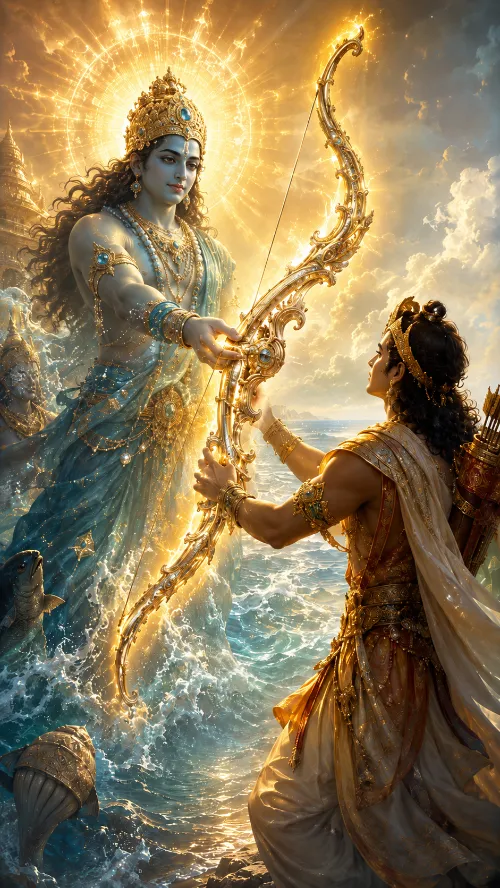
Gāṇḍīva: The Divine Bow of Arjuna
Gāṇḍīva (गाण्डीव) is the celestial bow of Arjuna — so closely identified with him that the Mahābhārata repeatedly calls him Gāṇḍīvadhanvan, “the wielder of Gāṇḍīva.” Yet the bow is far older than Arjuna. Its history begins among the gods, passes through a succession of divine custodians, enters the human world for a specific purpose, accompanies Arjuna through the defining events of his life, and returns to the divine realm once that purpose is complete. The result is almost a weapon’s biography — and the epic uses it to make a point: Gāṇḍīva never makes Arjuna independently omnipotent. His power, the bow’s effectiveness, Kṛṣṇa’s presence and the proper movement of Kāla, Time, all belong together.
Gāṇḍīva Was Created by Brahmā
The Karṇa-parvan connects the origin of the bow directly with Brahmā:
ब्रह्मणा च प्रजाः सृष्टा गाण्डीवं च महाद्भुतम् ।
brahmaṇā ca prajāḥ sṛṣṭā
gāṇḍīvaṁ ca mahādbhutam
“By Brahmā were the creatures created — and also the exceedingly wondrous Gāṇḍīva.” — Mahābhārata, Karṇa-parvan 8.50.56
Gāṇḍīva is therefore not merely a very fine human bow. The epic traces its origin to Brahmā’s creative activity itself.
This also clears up a small problem in some older English translations of the Virāṭa-parvan. The Sanskrit reads brahmā pūrvam adhārayat (ब्रह्मा पूर्वमधारयत्), “Brahmā formerly held it.” Some English versions print “Śiva” here, but Brahmā is the reading of the Sanskrit text.
The Ancient Succession of Gāṇḍīva
In the Virāṭa-parvan, during Arjuna’s revelation of the Pāṇḍavas’ weapons to Prince Uttara, the ancient history of the bow is given:
देवदानवगन्धर्वैः पूजितं शाश्वतीः समाः ।
एतद्वर्षसहस्रं तु ब्रह्मा पूर्वमधारयत् ॥
ततोऽनन्तरमेवाथ प्रजापतिरधारयत् ।
त्रीणि पञ्चशतं चैव शक्रोऽशीति च पञ्च च ॥
सोमः पञ्चशतं राजा तथैव वरुणः शतम् ।
पार्थः पञ्च च षष्टिं च वर्षाणि श्वेतवाहनः ॥
devadānava-gandharvaiḥ pūjitaṁ śāśvatīḥ samāḥ
etad varṣa-sahasraṁ tu brahmā pūrvam adhārayat
tato ’nantaram evātha prajāpatir adhārayat
trīṇi pañcaśataṁ caiva śakro ’śīti ca pañca ca
somaḥ pañcaśataṁ rājā tathaiva varuṇaḥ śatam
pārthaḥ pañca ca ṣaṣṭiṁ ca varṣāṇi śvetavāhanaḥ
— Virāṭa-parvan 4.38
The reading of 503 years for Prajāpati is correct: grammatically trīṇi pañcaśatam gives “five hundred and three.” But the last number needs a qualification.
Arjuna Did Not Possess Gāṇḍīva for Only 65 Years
The statement occurs during the Virāṭa episode, before the Kurukṣetra war. So pārthaḥ pañca ca ṣaṣṭiṁ ca varṣāṇi means that Arjuna had possessed Gāṇḍīva for sixty-five years by that point in the narrative. He continues to hold it throughout Kurukṣetra, throughout the reign of Yudhiṣṭhira, after Kṛṣṇa’s departure, and into the beginning of the Mahāprasthāna.
“65 years” should therefore not be presented as the total span of Arjuna’s ownership.
What Was Gāṇḍīva Like?
The Khāṇḍava episode gives one of the richest descriptions of the bow. It is called adbhutaṁ mahāvīryam (अद्भुतं महावीर्यं), “wondrous and immensely powerful,” and also:
सर्वशस्त्रैरनाधृष्यं सर्वशस्त्रप्रमाथि च
sarva-śastrair anādhṛṣyaṁ
sarva-śastra-pramāthi ca
“Unassailable by weapons, and overpowering other weapons.”
The surrounding description calls it a dhanu-ratna, a “jewel among bows,” says that it was richly variegated in colour, smooth and flawless, and that it had been honoured by devas, Dānavas and Gandharvas for ages.
ekaṁ śata-sahasreṇa saṁmitam
rāṣṭra-vardhanam
Why Arjuna Needed Such a Bow
Gāṇḍīva enters Arjuna’s life during the Khāṇḍava-dāha, the burning of the Khāṇḍava forest. Agni wished to consume the forest, but Indra repeatedly frustrated him by pouring down rain, so Agni sought the help of Kṛṣṇa and Arjuna.
Arjuna did not tell Agni that he lacked martial skill. Quite the opposite: he said that he possessed celestial weapons and could face formidable opponents. His problem was that his existing equipment could not match his physical and martial capacity. He required a bow capable of enduring the force of his arms, inexhaustible arrows because of the extraordinary speed with which he shot, suitable celestial horses, and a chariot capable of sustaining the battle.
This detail matters. Gāṇḍīva does not create Arjuna’s archery. Arjuna’s existing power requires a weapon capable of expressing it.
Varuṇa, Soma and Agni
When Arjuna states what he needs, Agni summons Varuṇa and says:
सोमेन राज्ञा यद्दत्तं धनुश्चैवेषुधी च ते ।
somena rājñā yad dattaṁ
dhanuś caiveṣudhī ca te
“That bow and those quivers which King Soma gave to you…”
He asks Varuṇa to supply them for Arjuna’s task. This agrees exactly with the succession given in the Virāṭa-parvan — Soma, then Varuṇa, then Arjuna — with Agni as the agent who arranges the transfer.
The precise formulation is therefore not “Varuṇa → Agni → Arjuna,” as though Agni had himself held Gāṇḍīva for a period. It is Varuṇa → Arjuna, at Agni’s request. This is confirmed at the end of Arjuna’s life, when Agni himself says that he had obtained the bow from Varuṇa for Pārtha’s sake.
The Complete Divine Equipment
Varuṇa provides not only Gāṇḍīva. Arjuna receives the bow, two inexhaustible quivers (akṣayyau maheṣudhī), and a magnificent celestial chariot drawn by extraordinary white horses. The chariot is described as kapi-pravara-ketanam (कपिप्रवरकेतनम्), “bearing the foremost monkey as its banner.” Its Gandharva horses are white like clouds, adorned with golden garlands, and swift as mind and wind.
A nuance is required here. The Khāṇḍava text already describes the chariot as monkey-bannered. Later tradition and the Bhagavad-gītā famously associate that banner with Hanumān, giving Arjuna the epithet kapi-dhvajaḥ (कपिध्वजः), “he whose banner bears the monkey.” One should distinguish the text’s early monkey-emblem chariot from the later explicit identification of Hanumān’s presence upon the banner.
Arjuna Strings Gāṇḍīva
Upon receiving the bow, Arjuna pays respect to Agni and strings it. The epic describes the reaction to the sound:
मौर्व्यां तु युज्यमानायां बलिना पाण्डवेन ह ।
येऽशृण्वन् कूजितं तत्र तेषां वै व्यथितं मनः ॥
maurvyāṁ tu yujyamānāyāṁ balinā pāṇḍavena ha
ye ’śṛṇvan kūjitaṁ tatra teṣāṁ vai vyathitaṁ manaḥ
When powerful Arjuna fitted the bowstring, the sound of the bow disturbed the minds of those who heard it.
From this point onward the sound of Gāṇḍīva becomes one of Arjuna’s signatures.
The Terrible Sound of Gāṇḍīva
In the Virāṭa-parvan, when Arjuna finally reveals himself and prepares to fight the Kaurava army:
तस्य शङ्खस्य शब्देन रथनेमिस्वनेन च ।
गाण्डीवस्य च घोषेण पृथिवी समकम्पत ॥
tasya śaṅkhasya śabdena
ratha-nemi-svanena ca
gāṇḍīvasya ca ghoṣeṇa
pṛthivī samakampata
“At the sound of his conch, the noise of his chariot wheels and the resonance of Gāṇḍīva, the earth trembled.” — Virāṭa-parvan
In the Droṇa-parvan, Gāṇḍīva’s roar rises above the conches, kettledrums and other instruments and is said to reach the sky. The bow is not merely visually identifiable: its sound announces Arjuna’s presence on the battlefield, and the Kaurava warriors can sometimes identify him without seeing him, simply by hearing it.
Gāṇḍīva Becomes Part of Arjuna’s Identity
The association becomes so strong that the epic repeatedly calls Arjuna Gāṇḍīvadhanvan (गाण्डीवधन्वन्), “he whose bow is Gāṇḍīva,” and the Sanskrit lexicons likewise preserve Gāṇḍīvin as an epithet of him. The relationship between warrior and weapon is much deeper than simple ownership: Gāṇḍīva becomes almost an extension of Arjuna’s kṣatriya identity. This becomes dramatically apparent during the Kurukṣetra war.
“Gāṇḍīva Is Slipping from My Hand”
At the beginning of the Bhagavad-gītā, Arjuna has already raised his bow and asked Kṛṣṇa to position the chariot between the armies. Then he sees his teachers, relatives and friends, and his warrior identity collapses:
गाण्डीवं स्रंसते हस्तात् त्वक् चैव परिदह्यते ।
न च शक्नोम्यवस्थातुं भ्रमतीव च मे मनः ॥
gāṇḍīvaṁ sraṁsate hastāt
tvak caiva paridahyate
na ca śaknomy avasthātuṁ
bhramatīva ca me manaḥ
“Gāṇḍīva slips from my hand; my skin burns. I cannot remain standing, and my mind seems to reel.” — Bhagavad-gītā 1.30
The choice of the word Gāṇḍīva rather than simply dhanus, “my bow,” is significant. This is the divine weapon he could wield against gods and armies — and now it slips from his hand. The crisis is not physical weakness. It is the collapse of certainty concerning dharma.
Possessing the greatest bow does not answer the question should I shoot? That question requires the Bhagavad-gītā.
Arjuna’s Vow Concerning Gāṇḍīva
The depth of Arjuna’s attachment becomes clearer in the Karṇa-parvan. He had secretly vowed that if anyone said to him “give Gāṇḍīva to somebody else,” he would kill that person. When the frustrated Yudhiṣṭhira effectively tells Arjuna that someone else should wield the bow if he cannot defeat Karṇa, Arjuna reaches for his sword and explains to Kṛṣṇa:
दद गाण्डीवमन्यस्मा इति मां योऽभिचोदयेत् ।
छिन्द्यामहं शिरस्तस्य इत्युपांशुव्रतं मम ॥
dada gāṇḍīvam anyasmā iti māṁ yo ’bhicodayet
chindyām ahaṁ śiras tasya ity upāṁśu-vrataṁ mama
“My private vow is that I will cut off the head of anyone who tells me, ‘Give Gāṇḍīva to another.’” — Karṇa-parvan 8.49.9
Kṛṣṇa must intervene to prevent Arjuna from killing Yudhiṣṭhira. The episode shows how completely the bow has become tied to Arjuna’s honour, competence, warrior identity and personal vow — which makes his eventual voluntary surrender of it all the more significant.
Gāṇḍīva in the Kurukṣetra War
Throughout the eighteen days, Gāṇḍīva is Arjuna’s principal bow. With it he confronts the greatest military powers of the Kaurava coalition, including the forces led by Bhīṣma and Droṇa, Bhagadatta, Jayadratha and ultimately Karṇa. An assessment in the Udyoga-parvan describes his battle equipment as an almost unparalleled combination:
वासुदेवश्च संयन्ता योधा चैव धनंजयः ।
गाण्डीवं च धनुर्दिव्यं ते चाश्वा वातरंहसः ॥
vāsudevaś ca saṁyantā
yodhā caiva dhanañjayaḥ
gāṇḍīvaṁ ca dhanur divyaṁ
te cāśvā vāta-raṁhasaḥ
“Vāsudeva is the charioteer, Dhanañjaya the warrior, Gāṇḍīva the divine bow, and the horses are swift as the wind.” — Udyoga-parvan
The same description continues with Arjuna’s divine armour, inexhaustible quivers and celestial astras. The epic thus presents his battlefield power as a system rather than as a single weapon: Kṛṣṇa, Arjuna, Gāṇḍīva, the celestial horses, the inexhaustible arrows and the divine astras together.
At the End of Kurukṣetra: Remove Gāṇḍīva First
Immediately after the war another revealing episode follows. Kṛṣṇa tells Arjuna:
अवरोपय गाण्डीवमक्षय्यौ च महेषुधी ।
अथाहमवरोक्ष्यामि पश्चाद्भरतसत्तम ॥
avaropaya gāṇḍīvam akṣayyau ca maheṣudhī
athāham avarokṣyāmi paścād bharata-sattama
“Take down Gāṇḍīva and the two inexhaustible quivers. Then I shall descend afterward.” — Śalya-parvan 9.61.9
Arjuna obeys, and only after Kṛṣṇa descends does the chariot burst into flames. The text explains that it had already been struck by powerful celestial weapons during the war and had survived until then through Kṛṣṇa’s presence. The chariot’s mission is finished — but Gāṇḍīva’s is not yet, and Arjuna carries it away.
After Kṛṣṇa’s Departure: the Bow No Longer Obeys
The deepest episode in Gāṇḍīva’s history occurs much later, in the Mausala-parvan. Kṛṣṇa has departed and Dvārakā has fallen. Arjuna escorts the surviving women, children and dependents of the Yādavas away from the ruined kingdom, and bands of Ābhīra raiders attack them. He naturally reaches for the weapon with which he had destroyed armies — but something astonishing happens:
ततोऽर्जुनो धनुर्दिव्यं गाण्डीवमजरं महत् ।
आरोपयितुमारेभे यत्नादिव कथंचन ॥
tato ’rjuno dhanur divyaṁ
gāṇḍīvam ajaraṁ mahat
āropayitum ārebhe
yatnād iva kathaṁcana
Arjuna began to string the great, divine, undecaying Gāṇḍīva — but now he could do so only with great difficulty.
The next verse says that he could no longer remember his celestial weapons. Then something even more extraordinary occurs: the arrows from the quivers that had formerly been akṣayya, “inexhaustible,” are exhausted.
अक्षया हि पुरा भूत्वा क्षीणाः
akṣayā hi purā bhūtvā kṣīṇāḥ
“Though formerly inexhaustible, they were exhausted.”
Arjuna eventually resorts to striking the raiders with the end of the bow itself.
This scene changes how the whole story should be read. The bow has not become an inferior object. The age for which Arjuna and his divine weapons were empowered has ended.
Arjuna Realizes Who the Real Power Was
Arjuna goes to Vyāsa and tells him what happened. He says that in former battles a mysterious, immeasurable four-armed being bearing conch, discus and mace used to advance before his chariot, and he identifies Him with Kṛṣṇa:
येन पूर्वं प्रदग्धानि शत्रुसैन्यानि तेजसा ।
शरैर्गाण्डीवनिर्मुक्तैरहं पश्चाद्व्यनाशयम् ॥
yena pūrvaṁ pradagdhāni
śatru-sainyāni tejasā
śarair gāṇḍīva-nirmuktair
ahaṁ paścād vyanāśayam
“He first burned the enemy armies by His power; afterward I destroyed them with arrows released from Gāṇḍīva.” — Mausala-parvan 16.9.21
This is perhaps the most important passage for understanding the bow. Arjuna himself recognizes that Gāṇḍīva was never the ultimate source of his victory — and neither was his own arm. Warrior and weapon operated within a greater divine arrangement.
Vyāsa Explains the Disappearance of Arjuna’s Power
Vyāsa then gives the theological interpretation:
बलं बुद्धिश्च तेजश्च प्रतिपत्तिश्च भारत ।
भवन्ति भवकालेषु विपद्यन्ते विपर्यये ॥
balaṁ buddhiś ca tejaś ca
pratipattiś ca bhārata
bhavanti bhava-kāleṣu
vipadyante viparyaye
“Strength, intelligence, splendour and capacity arise when their proper time has come, O Bhārata; when that time has passed, they disappear.”
Then comes the central statement:
कालमूलमिदं सर्वं जगद्बीजं धनञ्जय ।
काल एव समादत्ते पुनरेव यदृच्छया ॥
kāla-mūlam idaṁ sarvaṁ
jagad-bījaṁ dhanañjaya
kāla eva samādatte
punar eva yadṛcchayā
“All this is rooted in Time, O Dhanañjaya; Time is the seed of the world. Time takes things away again according to its course.”
And then Vyāsa explains the celestial weapons specifically:
कृतकृत्यानि चास्त्राणि गतान्यद्य यथागतम् ।
पुनरेष्यन्ति ते हस्तं यदा कालो भविष्यति ॥
kṛta-kṛtyāni cāstrāṇi
gatāny adya yathāgatam
punar eṣyanti te hastaṁ
yadā kālo bhaviṣyati
“The weapons have accomplished what they had to accomplish and have now departed as they came. They will return to your hand when the proper time comes again.” — Mausala-parvan 16.9.32–35
This is far more powerful than merely saying that Arjuna had grown old. The epic interprets the event cosmically: the mission was complete.
The Final Return of Gāṇḍīva
After Kṛṣṇa’s departure and Vyāsa’s teaching, the Pāṇḍavas renounce their kingdom and begin the Mahāprasthāna, their Great Departure. Yet Arjuna still carries Gāṇḍīva and the two inexhaustible quivers; the epic notes that he has not yet been able to relinquish these precious divine objects. Then Agni appears before them — the same god whose need had led to Arjuna receiving the bow at Khāṇḍava:
अयं वः फल्गुनो भ्राता गाण्डीवं परमायुधम् ।
परित्यज्य वनं यातु नानेनार्थोऽस्ति कश्चन ॥
ayaṁ vaḥ phālguno bhrātā
gāṇḍīvaṁ paramāyudham
parityajya vanaṁ yātu
nānenārtho ’sti kaścana
“Let your brother Phālguna abandon the supreme weapon Gāṇḍīva and proceed onward. He has no further need of it.”
Agni then explains:
वरुणादाहृतं पूर्वं मयैतत्पार्थकारणात् ।
गाण्डीवं कार्मुकश्रेष्ठं वरुणायैव दीयताम् ॥
varuṇād āhṛtaṁ pūrvaṁ
mayaitat pārtha-kāraṇāt
gāṇḍīvaṁ kārmuka-śreṣṭhaṁ
varuṇāyaiva dīyatām
“Formerly I obtained this supreme bow Gāṇḍīva from Varuṇa for Pārtha’s sake. Let it now be given back to Varuṇa.” — Mahāprasthānika-parvan 17.1
Arjuna obeys. He throws Gāṇḍīva and the two inexhaustible quivers into the waters. The circle is complete.
The Full Journey of Gāṇḍīva
The Deeper Meaning of Gāṇḍīva
It is tempting to read Gāṇḍīva simply as a symbol of power. The Mahābhārata says something subtler. At the beginning of Arjuna’s heroic career he is already extraordinarily powerful, but lacks an instrument proportionate to his ability; Gāṇḍīva arrives when the time for his great deeds has come. At Kurukṣetra it becomes almost inseparable from his identity — he values it so greatly that he has vowed to kill anyone who tells him to surrender it.
At the opening of the Bhagavad-gītā, however, Gāṇḍīva falls from his hand, because even supreme martial ability cannot solve a crisis of dharma. Then, after Kṛṣṇa departs, the reverse happens: Arjuna still has the bow, but the bow is no longer enough. His divine weapons disappear, the inexhaustible arrows become exhausted, and Gāṇḍīva itself becomes difficult to string.
The lesson is remarkably clear: the instrument of power remains, but the divine moment in which that power functioned has passed. Vyāsa therefore does not tell Arjuna to train harder or to obtain another weapon. He tells him kāla-mūlam idaṁ sarvam (कालमूलमिदं सर्वम्), “everything is rooted in Time.”
Finally, the very man who once vowed to kill anyone who asked him to surrender Gāṇḍīva willingly casts it into the sea. That is one of the most profound transformations in Arjuna’s story. The warrior who could not imagine himself without the bow comes to understand that even Gāṇḍīva was entrusted to him only for a time. Its greatness did not lie in being possessed. It lay in fulfilling its appointed dharma, and then being relinquished when that dharma was complete.
Gāṇḍīva and Arjuna
The arc is almost perfect. Gāṇḍīva enters Arjuna’s hands when his divine heroic mission begins, and leaves them when that mission is over. Between those two moments stands Kṛṣṇa.
Gāṇḍīva is more than the weapon of the greatest archer of the Mahābhārata. It is a symbol of power entrusted for a purpose, power governed by dharma, power dependent upon divine arrangement — and ultimately power that must be relinquished when its time has passed.