

Caitanya’s Tree
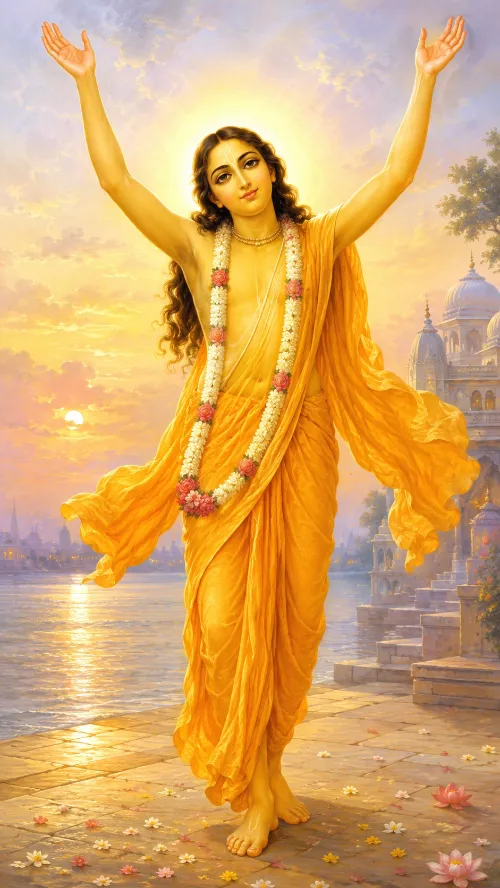
Caitanya’s Tree: Who Is Who in the World of Śrī Caitanya Mahāprabhu
The long lists of names in the Caitanya-caritāmṛta can initially look almost impenetrable. Śrīvāsa, Nityānanda, Advaita, Haridāsa, Rūpa, Sanātana, Svarūpa Dāmodara, Rāmānanda Rāya, Śivānanda Sena, Raghunātha Dāsa, Vṛndāvana Dāsa, Kavi Karṇapūra and scores of others appear in rapid succession. Some are brothers, some are sons, some are gurus or disciples, some are intimate companions, some are regional leaders, some are poets, and some belong to several devotional circles at once.
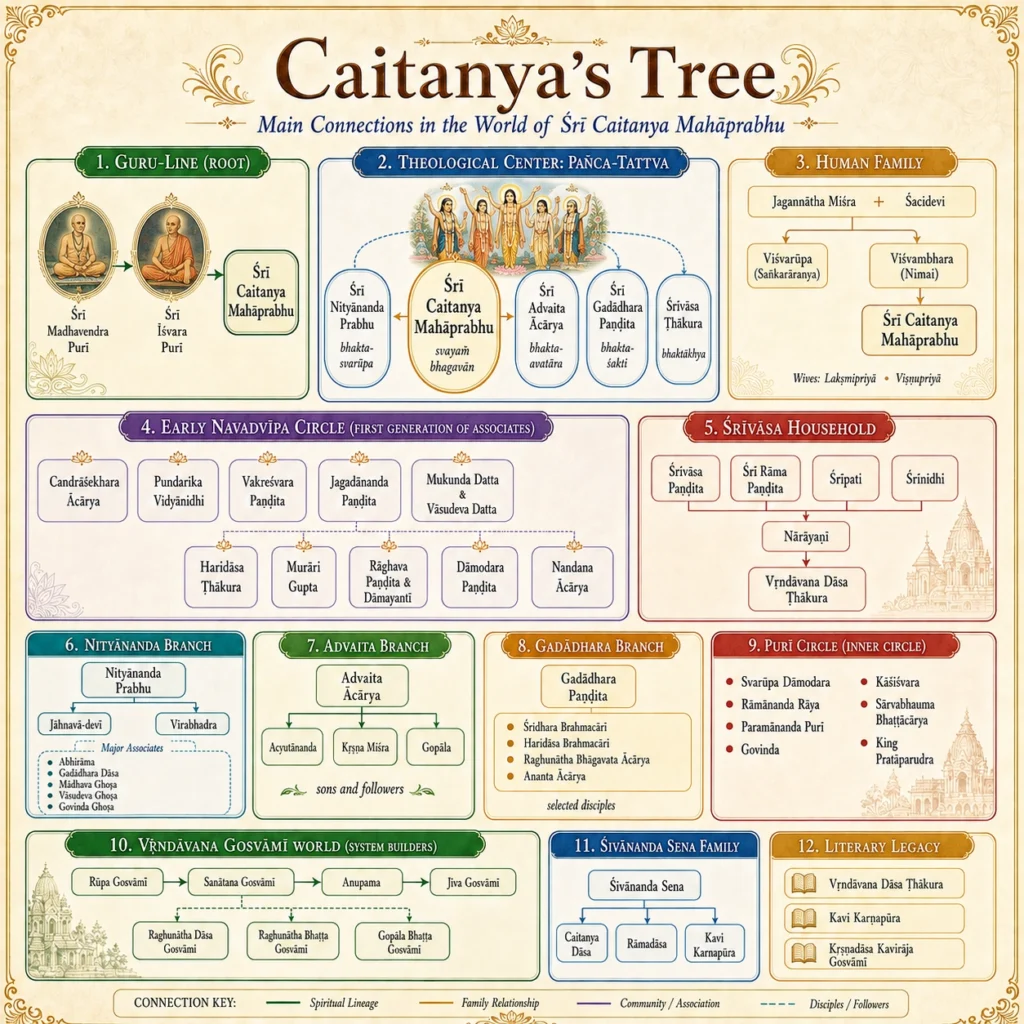
Twelve panels: the guru-line, the Pañca-tattva, Caitanya’s family, the Navadvīpa circle, the Śrīvāsa household, the Nityānanda, Advaita and Gadādhara branches, the Purī circle, the Vṛndāvana Gosvāmīs, Śivānanda Sena’s family and the literary legacy.
The key to understanding this world is therefore not to read Caitanya’s “tree” as an ordinary family tree.
Kṛṣṇadāsa Kavirāja uses the image of a living devotional organism: roots, trunks, branches, subbranches, fruits and flowers. Biological descent is only one of several relationships represented by the metaphor. A person may be connected to Caitanya through family, initiation, friendship, theological identity, personal service, geographical community, literary transmission — or several of these at once.
Kṛṣṇadāsa himself warns against turning the tree into a simple hierarchy. In a Bengali verse of Caitanya-caritāmṛta, Ādi 10.4, he writes:
caitanya-gosāñira yata pāriṣada-caya
guru-laghu-bhāva tāṅra nā haya niścaya
“The associates of Śrī Caitanya are many; among them a conception of greater and lesser cannot be definitively established.”
Thus “most important” in what follows means most structurally important for understanding the tradition, not spiritually superior to the others.
The clearest way to enter this world is to recognise several overlapping structures: the guru-line that precedes Caitanya; the Pañca-tattva theological centre; Caitanya’s human family; the original Navadvīpa community; the Nityānanda, Advaita and Gadādhara branches; the regional communities of Bengal; the intimate Purī circle; the Vṛndāvana Gosvāmīs; and finally the writers who preserved and systematised the entire tradition.
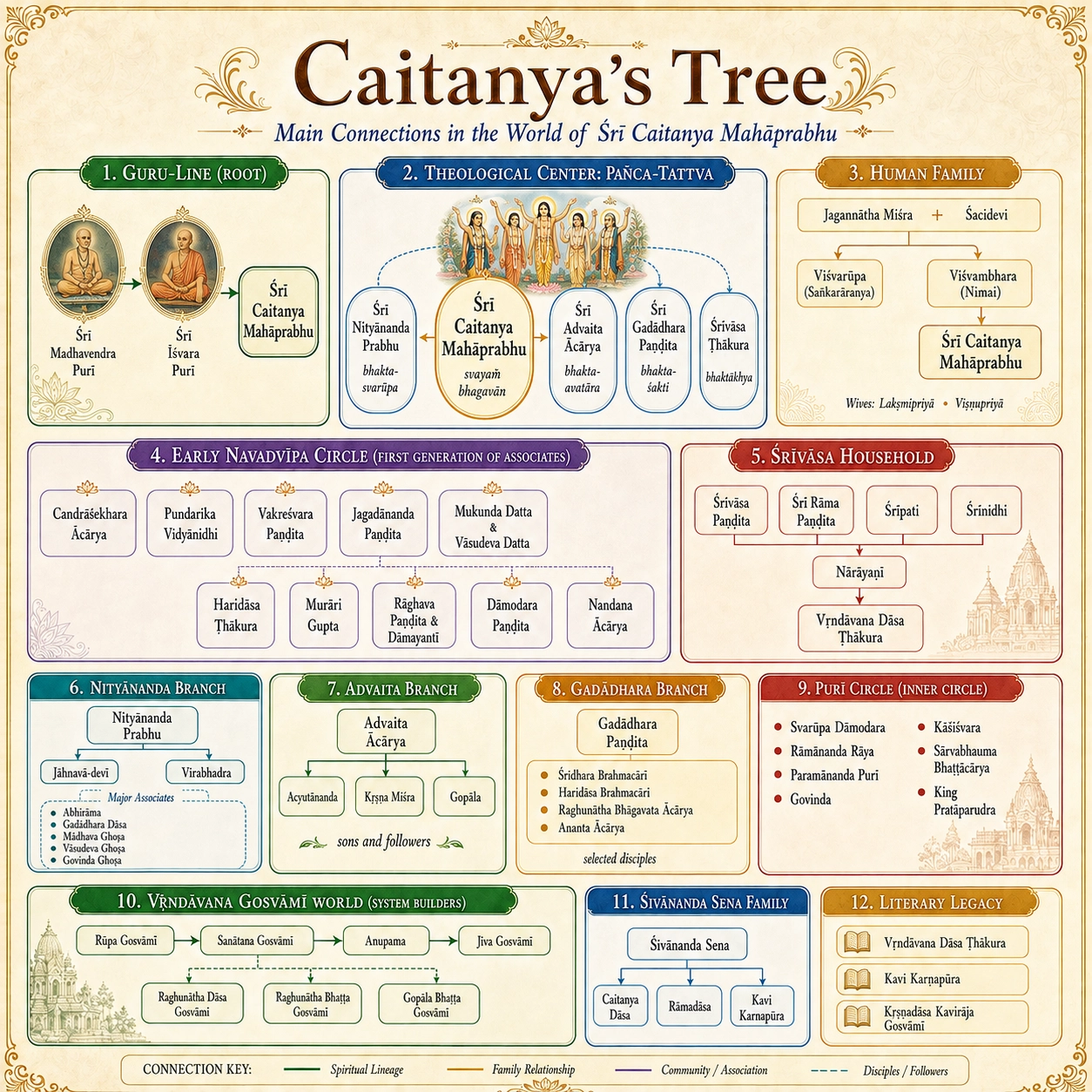
A second chart maps the same world in far greater detail — every household, branch, regional network and circle on one sheet, with a legend distinguishing guru-lines, family ties, theological identities and community links. It is too dense to read inline: open the full “Who is Who” wall chart in a new tab ↗
The Tree Before Caitanya: Mādhavendra Purī and Īśvara Purī
The Caitanya-caritāmṛta does not begin the devotional tree with Caitanya’s birth. It traces the emergence of its particular current of kṛṣṇa-prema back to Mādhavendra Purī. In Ādi 9.10 Kṛṣṇadāsa writes:
jaya śrī mādhavapurī kṛṣṇa-prema-pūra
bhakti-kalpatarura teṅho prathama aṅkura
“All glories to Śrī Mādhavendra Purī, the reservoir of love for Kṛṣṇa. He is the first sprout of the wish-fulfilling tree of devotion.”
The metaphor continues immediately:
śrī-īśvarapurī-rūpe aṅkura puṣṭa haila
āpane caitanya-mālī skandha upajila
“In the form of Śrī Īśvara Purī that sprout became nourished, and then Caitanya Himself, the gardener, arose as the trunk.”
This gives the first essential spiritual genealogy:
Mādhavendra Purī → Īśvara Purī → Śrī Caitanya Mahāprabhu
Īśvara Purī was Mādhavendra Purī’s deeply devoted disciple and served him personally during his final illness. Caitanya later accepted Īśvara Purī as His initiating spiritual master.
This relationship is fundamental because Caitanya’s movement does not portray itself as appearing without antecedents. Its distinctive theology of intense Kṛṣṇa-prema emerges from a devotional inheritance that becomes fully manifest in Caitanya.
Around this guru-root stand several senior renunciants, especially Paramānanda Purī. The Caitanya-caritāmṛta actually uses the tree metaphor for these elder sannyāsīs as well, describing nine such personalities as roots strengthening the trunk. Paramānanda Purī is especially important because he belonged to Mādhavendra Purī’s circle and was treated by Caitanya with extraordinary affection and reverence. He later became one of Caitanya’s closest resident companions in Purī.
Two further names belong directly to the Īśvara Purī line: Kāśīśvara Brahmacārī and Govinda. Both were disciples of Īśvara Purī. Therefore, strictly speaking, they were Godbrothers of Caitanya, not disciples of Caitanya. Yet before his departure, Īśvara Purī instructed them to serve Caitanya personally. Govinda became Caitanya’s intimate bodily servant, while Kāśīśvara accompanied Him to the Jagannātha temple and cleared a path through the crowds.
This illustrates a principle that recurs throughout the entire network: formal guru-disciple status and functional service are not always the same thing.
The Theological Centre: The Pañca-tattva
The whole Caitanya world is best understood as radiating from the Pañca-tattva. The foundational Sanskrit verse is Caitanya-caritāmṛta, Ādi 7.6:
pañca-tattvātmakaṁ kṛṣṇaṁ
bhakta-rūpa-svarūpakam
bhaktāvatāraṁ bhaktākhyaṁ
namāmi bhakta-śaktikam
“I bow to Kṛṣṇa manifested in five aspects: the form of a devotee, the expansion of a devotee, the avatāra as a devotee, the devotee, and the devotional potency.”
These are not merely five senior historical followers. In Gauḍīya theology they represent five dimensions of the divine devotional mystery itself.
Śrī Caitanya Mahāprabhu — Kṛṣṇa in the Mood of Rādhā
At the centre stands Śrī Kṛṣṇa Caitanya, born Viśvambhara Miśra and familiarly called Nimāi. The most important theological verse describing His identity is Caitanya-caritāmṛta, Ādi 4.55:
rādhā kṛṣṇa-praṇaya-vikṛtir hlādinī śaktir asmād
ekātmānāv api bhuvi purā deha-bhedaṁ gatau tau
caitanyākhyaṁ prakaṭam adhunā tad-dvayaṁ caikyam āptaṁ
rādhā-bhāva-dyuti-suvalitaṁ naumi kṛṣṇa-svarūpam
“Rādhā is the transformation of Kṛṣṇa’s love, His hlādinī-śakti. Although They are one in identity, They eternally manifested in separate forms. Now those two have become one and appeared as Caitanya. I bow to that form of Kṛṣṇa adorned with Rādhā’s mood and radiance.”
This is the theological key to the entire Gauḍīya understanding of Caitanya. He is not simply a saint teaching devotion to Kṛṣṇa. Within the tradition He is Kṛṣṇa entering the position of His supreme devotee in order to taste and distribute the love embodied by Rādhā.
Nityānanda Prabhu — Balarāma and the Expansive Power of Grace
Nityānanda is Caitanya’s closest divine counterpart. Caitanya-caritāmṛta, Ādi 5.6 states directly:
sei kṛṣṇa — navadvīpe śrī-caitanya-candra
sei balarāma — saṅge śrī-nityānanda
“That original Kṛṣṇa appeared in Navadvīpa as Śrī Caitanya, and that Balarāma appeared with Him as Śrī Nityānanda.”
Nityānanda’s role in the historical movement strongly reflects Balarāma’s theological role as the principle of expansion and service. Caitanya increasingly turns toward the intense interior devotional life of Purī, while Nityānanda becomes the great expansive force carrying Caitanya’s mercy throughout Bengal.
Advaita Ācārya — The Elder Who Calls Caitanya into the World
Advaita Ācārya belongs to an older generation than Caitanya and occupies a unique position: elder, teacher, divine manifestation and servant simultaneously. The Caitanya-caritāmṛta explains His name: because He is nondifferent from Hari, He is Advaita; because He teaches devotion, He is Ācārya. It also explicitly identifies Him with Mahā-Viṣṇu.
His devotional appeal — worshipping Kṛṣṇa with Gaṅgā water and tulasī while crying out for divine intervention — is presented as one cause of Caitanya’s descent. Thus Advaita represents a paradox essential to Gaura-līlā: one who is Himself divine longs for the appearance of the Lord and then delights in becoming His servant.
Gadādhara Paṇḍita — Bhakta-śakti
Gadādhara Paṇḍita should not be reduced merely to “another close associate.” Within the Pañca-tattva he is bhakta-śakti, the devotional potency. Ādi 10 describes him as connected with Kṛṣṇa’s pleasure potency and immediately adds that his disciples and granddisciples form their own subbranches.
Later Gauḍīya literature develops more specific identifications with Rādhā and Vraja personalities, but for organising the Caitanya-caritāmṛta itself, the safest structural designation is Gadādhara as bhakta-śakti, the hlādinī-related devotional potency.
Śrīvāsa Ṭhākura — The Devotee Community Embodied
Śrīvāsa represents bhaktākhya, the pure devotee. His importance is practical as well as theological: his house, Śrīvāsa-aṅgana, becomes the sacred centre of Caitanya’s earliest nocturnal saṅkīrtana. Śrīvāsa therefore represents more than an individual. He stands for the devotional community gathered around the Holy Name. This leads directly to the first major biological-devotional family in the tree.
Caitanya’s Human Family
Alongside the divine structure stands Caitanya’s ordinary human genealogy. At its simplest:
Jagannātha Miśra + Śacīdevī
    ├── Viśvarūpa
    └── Viśvambhara / Nimāi — Śrī Caitanya
Viśvarūpa, Caitanya’s elder brother, left household life and accepted renunciation. The name Śaṅkarāraṇya is traditionally identified with Viśvarūpa’s sannyāsa identity. The Caitanya-caritāmṛta lists Śaṅkarāraṇya as a branch, while its traditional commentary explicitly states that Śaṅkarāraṇya was the sannyāsa name of Śrīla Viśvarūpa, elder brother of Viśvambhara. Therefore Śaṅkarāraṇya corresponds to Viśvarūpa in the received Gauḍīya tradition, rather than being an unrelated devotee who happens to share the list.
Before taking sannyāsa, Caitanya married twice: first Lakṣmīpriyā, and after her death Viṣṇupriyā. They are absent from the Ādi 10 branch list, but any genuinely comprehensive “Who is Who” map should include them, because they belong to Caitanya’s actual household biography.
The Śrīvāsa Household: The First Saṅkīrtana Family
The list begins with four brothers — Śrīvāsa Paṇḍita, Śrī Rāma (Rāmāi) Paṇḍita, Śrīpati and Śrīnidhi. The Caitanya-caritāmṛta explicitly groups them together:
śrīpati, śrīnidhi — tāṅra dui sahodara
cāri bhāira dāsa-dāsī, gṛha-parikara
“Their two brothers were Śrīpati and Śrīnidhi. The four brothers together with their servants and household members were considered one great branch.”
This is a perfect example of what the tree metaphor means: an entire household can function as one branch. Caitanya’s nightly saṅkīrtana took place at Śrīvāsa’s home, making this family the domestic centre of the earliest movement. Śrīvāsa’s wife Mālinīdevī belongs in any proper reconstruction.
Another important member of the extended household was the young Nārāyaṇī. Through her, this family connects to one of the great literary lineages:
Śrīvāsa household → Nārāyaṇī → Vṛndāvana Dāsa Ṭhākura
Vṛndāvana Dāsa became the author of the Caitanya-bhāgavata. Kṛṣṇadāsa Kavirāja gives him the extraordinary title of the Vyāsa of Caitanya’s pastimes. Yet Vṛndāvana Dāsa also belongs to the Nityānanda branch. This single example demonstrates why a conventional tree is inadequate: he is simultaneously connected by family, by devotional affiliation and by literary transmission.
The Original Navadvīpa Circle
Around Śrīvāsa’s household was a remarkable constellation of devotees who formed Caitanya’s earliest community. They should be understood as a first-generation Navadvīpa circle, not as one hundred independent names.
Candraśekhara Ācārya / Ācāryaratna
These are two names for the same person: Ācāryaratna is Śrī Candraśekhara Ācārya, and the Caitanya-caritāmṛta explicitly says so. His house became the setting for dramatic devotional performances in which Caitanya Himself took roles.
Do not confuse him with Candraśekhara Vaidya, a different person appearing elsewhere in the lists.
Puṇḍarīka Vidyānidhi
Puṇḍarīka Vidyānidhi belongs among the major early devotees, not among marginal names. The Caitanya-caritāmṛta says that Caitanya loved him so deeply that He would sometimes cry in his absence. His importance is also tied to Gadādhara Paṇḍita, and to the theme that profound devotion can be concealed beneath unexpected external appearances.
Vakreśvara Paṇḍita
Vakreśvara embodies ecstatic dance. The text says he could dance continuously for seventy-two hours, with Caitanya Himself singing while he danced. Caitanya tells him affectionately:
“I have only one wing like you; if I had another, I could fly through the sky.”
Vakreśvara therefore represents the embodied ecstatic dimension of saṅkīrtana.
Jagadānanda Paṇḍita
Jagadānanda is one of Caitanya’s most intimate and psychologically fascinating servants. His love is intense, possessive and sometimes quarrelsome. He tries to provide comfort for Caitanya, while Caitanya’s strict sannyāsa discipline repeatedly frustrates him. The text directly associates Jagadānanda with Satyabhāmā, Kṛṣṇa’s passionate queen. Their apparently trivial disagreements are therefore not signs of ordinary conflict but expressions of deep intimacy in the devotional language of the text.
Rāghava Paṇḍita and Damayantī
These two must remain together.
Rāghava Paṇḍita
    └── sister: Damayantī
Damayantī prepared extraordinary preserved foods throughout the year for Caitanya in Purī. Rāghava carried them in the famous rāghavera jhāli, “Rāghava’s bags.” Their service represents domestic devotion transformed into an art of care: cooking, preservation, transport and remembrance of Caitanya across great distance.
Dāmodara Paṇḍita and Śaṅkara Paṇḍita
Another actual brother-pair:
Dāmodara Paṇḍita
    └── younger brother: Śaṅkara Paṇḍita
Dāmodara is famous because his love for Caitanya was so fearless that he could rebuke Caitanya Himself when he feared that social appearances might damage the Lord’s reputation. Caitanya did not reject him for this. Instead, the episode becomes evidence of his uncompromising affection. Śaṅkara, the younger brother, is poetically described as the Lord’s “shoes” — an image of intimate, constant service.
Sadāśiva Paṇḍita
Sadāśiva is important particularly because Nityānanda stayed at his house when He came to Navadvīpa. This places him at the intersection of Caitanya’s and Nityānanda’s earliest circles.
Pradyumna Brahmacārī = Nṛsiṁhānanda Brahmacārī
This is one of the most important corrections to the traditional list. They are not two people. The Bengali verse says:
śrī-nṛsiṁha-upāsaka pradyumna brahmacārī
prabhu tāṅra nāma kailā nṛsiṁhānanda kari’
“Pradyumna Brahmacārī was a worshiper of Śrī Nṛsiṁha. The Lord therefore gave him the name Nṛsiṁhānanda.”
He should appear only once in any structured list, with the second name recorded as an alias.
Nakula Brahmacārī
Nakula Brahmacārī is a different person. He is important because Kṛṣṇadāsa uses him to explain āveśa, a special manifestation or empowerment through which Caitanya’s presence became perceptible in another devotee. Nakula Brahmacārī is therefore not Nṛsiṁhānanda Brahmacārī — and neither of them was a son of Śivānanda Sena.
Nandana Ācārya
Nandana Ācārya’s house is associated with the two Prabhus, Caitanya and Nityānanda, and therefore belongs to the geography of their early meeting and hidden pastimes. He is a good example of a person whose importance is primarily locational and relational, rather than through a large disciple lineage.
Mukunda Datta and Vāsudeva Datta
These two should be presented as a connected pair. Mukunda Datta was a celebrated singer; the text says simply that Caitanya danced while Mukunda sang. Vāsudeva Datta, meanwhile, represents one of the most radical expressions of compassion in Caitanya literature. He prayed that the sins and karmic suffering of all living beings might fall upon him so that everyone else could be delivered.
They are traditionally described as brothers, with Vāsudeva the elder.
Haridāsa Ṭhākura: The Archetype of Nāma-bhakti
Haridāsa Ṭhākura deserves his own major node. The Caitanya-caritāmṛta says that he chanted the name of Kṛṣṇa three hundred thousand times every day. He becomes the paradigmatic devotee of the Holy Name and, in later Gauḍīya usage, is celebrated as Nāma-ācārya. His background also makes him a powerful demonstration that access to Caitanya’s devotional world is not dependent upon conventional social birth. Advaita Ācārya honoured him extraordinarily, and Caitanya personally celebrated him even at his death.
But the lists contain several Haridāsas, and they must remain distinct:
- Haridāsa Ṭhākura — the famous devotee of the Holy Name;
- Baḍa Haridāsa — a Purī devotee and singer;
- Choṭa Haridāsa — another Purī singer with a separate narrative;
- Dvija Haridāsa — another individual;
- Haridāsa Brahmacārī — a branch in Gadādhara’s lineage.
A list that merges them would generate serious errors.
Murāri Gupta: Rāma-bhakti Inside the Caitanya Movement
Murāri Gupta is one of the most revealing figures in the entire network. He was a physician and early companion of Caitanya, but his deepest devotional attachment was to Lord Rāmacandra. When Caitanya tested him by suggesting that he worship Kṛṣṇa instead, Murāri found himself unable to abandon Rāma. He preferred death to spiritual infidelity. Caitanya praised rather than condemned him, and eventually told him:
“You are indeed Hanumān, the eternal servant of Lord Rāmacandra.”
Thus Murāri represents a crucial principle: Caitanya’s devotional world is centred on Kṛṣṇa but is not spiritually flattened into one emotional uniformity. Murāri’s steadfastness to Rāma becomes itself an exemplary form of niṣṭhā, devotional fidelity.
Śivānanda Sena: The Organiser of the Movement
Śivānanda Sena is one of the most important non-renunciant organisational figures. Every year Bengali devotees travelled to Jagannātha Purī to meet Caitanya. Śivānanda organised these enormous pilgrimages: routes, lodging, tolls, food and care for the travellers. He should be understood as the movement’s great logistical organiser and community coordinator, not merely another devotional name. The Caitanya-caritāmṛta describes him as an “extremely confidential servant” under whose guidance the pilgrims travelled to Purī.
His genuine family tree is:
Śivānanda Sena
    ├── Caitanya Dāsa
    ├── Rāmadāsa
    └── Paramānanda Sena / Kavi Karṇapūra
caitanya-dāsa, rāmadāsa, āra karṇapūra
tina putra śivānandera prabhura bhakta-śūra
“Caitanya Dāsa, Rāmadāsa and Karṇapūra — the three sons of Śivānanda — were heroic devotees of the Lord.”
Karṇapūra was also known as Paramānanda. He became one of the most important Sanskrit authors of the next generation, producing works such as the Gaura-gaṇoddeśa-dīpikā, Caitanya-candrodaya, Ānanda-vṛndāvana-campū and Alaṅkāra-kaustubha.
This corrects a major error found in circulating lists. Nakula Brahmacārī, Pradyumna Brahmacārī and Nṛsiṁhānanda Brahmacārī were not Śivānanda Sena’s three sons:
- Nakula was unrelated;
- Pradyumna and Nṛsiṁhānanda were the same person;
- Śivānanda’s three sons were Caitanya Dāsa, Rāmadāsa and Paramānanda / Kavi Karṇapūra.
The Śrīkhaṇḍa Community
Another cluster should be organised geographically rather than individually. The Caitanya-caritāmṛta names Śrīkhaṇḍavāsī Mukunda and his son Raghunandana, along with Narahari, Cirañjīva and Sulocana, and describes them collectively as great branches distributing love of God everywhere. These names form the Śrīkhaṇḍa devotional centre. The particularly important biological relationship is Mukunda → Raghunandana. Narahari belongs to the same regional devotional milieu and becomes an important figure in the development of Bengali Gaura devotion.
Kulīna-grāma: A Regional Devotional Network
Another set of seemingly disconnected names is actually a village community. The Caitanya-caritāmṛta explicitly groups Satyarāja, Rāmānanda, Yadunātha, Puruṣottama, Śaṅkara and Vidyānanda as inhabitants of Kulīna-grāma. It then mentions the community headed by Vāṇīnātha Vasu. So this is not primarily a family genealogy; it is a regional devotional network. Satyarāja Khān, also called Satyarāja Vasu, is particularly associated with the mercy of Haridāsa Ṭhākura.
Nityānanda’s Great Bengal Branch
The Caitanya-caritāmṛta gives Nityānanda an entire independent chapter because His network became enormous. Kṛṣṇadāsa writes that Nityānanda is a great branch of the Caitanya tree whose innumerable subbranches spread everywhere. After Nityānanda, the text names Vīrabhadra Gosāñi as the greatest branch.
Later Gauḍīya genealogical tradition organises Nityānanda’s household around His consorts Vasudhā and Jāhnavā-devī and identifies Vīrabhadra as the son of Vasudhā. Later traditions also preserve Gaṅgā as a daughter of this household. Jāhnavā is especially important because she eventually emerges not merely as Nityānanda’s consort but as a major spiritual authority, teacher and organiser of the post-Caitanya community.
This later institutional development deserves a separate layer from what Ādi 11 itself explicitly states.
The Overlapping Caitanya–Nityānanda Circle
The Caitanya-caritāmṛta itself gives an important warning against forcing every person into only one category. It says of Rāmadāsa and Gadādhara Dāsa that Caitanya sent them with Nityānanda to preach in Bengal; therefore they are counted in both groups. The same is true of Mādhava Ghoṣa and Vāsudeva Ghoṣa:
ataeva dui-gaṇe duṅhāra gaṇana
mādhava-vāsudeva ghoṣerao ei vivaraṇa
“Therefore they are counted in both groups; the same applies to Mādhava and Vāsudeva Ghoṣa.”
This is one of the most important structural verses for the whole reconstruction. Duplicate appearance does not always mean a duplicate person or a scribal error. Sometimes the text deliberately places one person in several circles.
Major Nityānanda associates include Rāmadāsa / Abhirāma, Gadādhara Dāsa, Mādhava Ghoṣa, Vāsudeva Ghoṣa, Sundarānanda, Kamalākara Pippalāi, Gaurīdāsa Paṇḍita, Parameśvara Dāsa, Jagadīśa Paṇḍita, Dhanañjaya Paṇḍita, Maheśa Paṇḍita, Puruṣottama Paṇḍita, Kālā Kṛṣṇadāsa, Uddhāraṇa Datta and Mīnaketana Rāmadāsa, among many others. A remarkable theological feature of the chapter is that many of Nityānanda’s principal associates are interpreted as counterparts of the cowherd boys of Vraja.
The Ghoṣa Brothers: The Great Kīrtana Family
Three names should always be shown together: Govinda Ghoṣa, Mādhava Ghoṣa and Vāsudeva Ghoṣa. They were brothers and celebrated kīrtana performers, and Caitanya and Nityānanda danced when they sang. Mādhava in particular is celebrated for extraordinary musical ability, while Mādhava and Vāsudeva also belong explicitly to Nityānanda’s preaching branch.
Do not confuse Govinda Ghoṣa with Govinda Datta, another singer, or with Govinda, the disciple of Īśvara Purī who became Caitanya’s personal servant. These are three separate Govindas.
Advaita Ācārya’s Biological and Disciplic Tree
Advaita’s network must also be separated into sons and followers. The Caitanya-caritāmṛta explicitly identifies six sons:
Advaita Ācārya
    ├── Acyutānanda
    ├── Kṛṣṇa Miśra
    ├── Gopāla
    ├── Balarāma
    ├── Svarūpa
    └── Jagadīśa
Acyutānanda receives especially strong attention. Even as a child he is portrayed as intensely devoted to Caitanya. Kṛṣṇa Miśra and Gopāla are also described individually, while the other three are named together.
But Advaita’s tree was much larger than His biological family. His prominent followers include Kamalākānta Viśvāsa, Yadunandana Ācārya, Bhāgavata Ācārya, Viṣṇudāsa Ācārya, Cakrapāṇi Ācārya, Ananta Ācārya and many others. Any diagram should therefore use two different connectors — biological descent, and disciple or follower relationship — or the structure becomes misleading.
Gadādhara Paṇḍita’s Disciple Branch
Caitanya-caritāmṛta Ādi 12.79 introduces Gadādhara as a major branch and then enumerates his subbranches. Among the principal disciples are Dhruvānanda, Śrīdhara Brahmacārī, Haridāsa Brahmacārī and Raghunātha Bhāgavata Ācārya, followed by further personalities such as Ananta Ācārya, Kavi Datta, Nayana Miśra, Bhūgarbha Gosāñi, Bhāgavata Dāsa, Vāṇīnātha Brahmacārī and Vallabha Caitanya Dāsa. This is primarily a guru-disciple transmission line, not a blood genealogy.
The Purī World: Caitanya’s Mature Inner Circle
After Caitanya accepted sannyāsa, Jagannātha Purī became the centre of His mature life. This creates another network entirely. The Caitanya-caritāmṛta says that among the devotees living with Him there, Paramānanda Purī and Svarūpa Dāmodara were His heart and soul. Other permanent or especially close Purī companions included Gadādhara, Jagadānanda, Śaṅkara, Vakreśvara, Dāmodara Paṇḍita, Haridāsa Ṭhākura, Raghunātha Vaidya and Raghunātha Dāsa.
Svarūpa Dāmodara and Rāmānanda Rāya
Within this broad circle, two men become especially important for understanding Caitanya’s final years. They form the innermost spiritual companionship of the Gambhīrā period. One remarkable line states that when Caitanya suffered the most intense separation from Kṛṣṇa, Rāmānanda Rāya’s discussions of Kṛṣṇa and Svarūpa Dāmodara’s songs kept Him alive.
Together they function almost as two complementary forms of spiritual nourishment for Caitanya’s deepest internal state.
Raghunātha Dāsa: The Bridge from Purī to Vṛndāvana
Raghunātha Dāsa Gosvāmī belongs to several worlds simultaneously. He came from a wealthy Bengali family but abandoned extraordinary material privilege in order to join Caitanya in Purī. Caitanya personally entrusted him to Svarūpa Dāmodara:
“My dear Svarūpa, I entrust this Raghunātha to you. Accept him as your son or servant.”
For this reason he became known as Svarūpera Raghu, “Svarūpa’s Raghunātha.” He served in the confidential Purī circle for many years. After Caitanya and Svarūpa disappeared, Raghunātha went to Vṛndāvana, where Rūpa and Sanātana accepted him as their third brother. He therefore becomes one of the crucial transmission bridges:
Caitanya → Svarūpa Dāmodara → Raghunātha Dāsa → Rūpa / Sanātana / Vṛndāvana
Much of what the Vṛndāvana community knew about Caitanya’s most intimate later experiences was preserved through Raghunātha’s memory.
Bhavānanda Rāya’s Family
Circulating lists contain both Bhavānanda Rāya and Rāya Bhavānanda. They are the same person. His five sons are explicitly named:
Bhavānanda Rāya
    ├── Rāmānanda Rāya
    ├── Gopīnātha Paṭṭanāyaka
    ├── Kalānidhi
    ├── Sudhānidhi
    └── Vāṇīnātha Nāyaka
Caitanya tells Bhavānanda that all five are dear to Him and gives Rāmānanda a uniquely intimate status. This family should therefore appear as one genuine biological branch of the Purī network.
The Purī Institutional Circle
Several important personalities belong neither to Caitanya’s family nor to a simple guru-line. They belong to the political, scholarly and temple environment of Jagannātha Purī.
The Purī world should therefore be pictured as a court-temple-devotional network, not a genealogy.
Jagāi and Mādhāi: Exemplars of Mercy
Jagāi and Mādhāi belong in the Caitanya world, but not in the same category as Rūpa Gosvāmī or Svarūpa Dāmodara. Their importance is paradigmatic: they become the supreme example of Caitanya and Nityānanda’s power to transform the morally fallen. They belong in a category such as recipients and exemplars of transformative mercy, and they help explain the title patita-pāvana, “deliverer of the fallen.”
Similarly, Devānanda Paṇḍita is best understood as a figure whose understanding was transformed through contact with Caitanya’s devotees, particularly Vakreśvara. The Caitanya-caritāmṛta says that through Vakreśvara’s mercy he came to understand the devotional meaning of the Bhāgavata.
The Vṛndāvana Gosvāmī World
If Navadvīpa is the birthplace of public saṅkīrtana and Purī is the centre of Caitanya’s mature inner devotional life, Vṛndāvana becomes the great theological, literary and institutional laboratory of the movement. This is where Caitanya’s devotional vision becomes systematised into theology, the aesthetics of rasa, ritual, sacred geography, temple culture, Vaiṣṇava conduct and scriptural argument. At the centre are Rūpa and Sanātana Gosvāmī.
Rūpa, Sanātana, Anupama and Jīva: An Actual Family
This is a genuine biological lineage:
Sanātana Gosvāmī — Rūpa Gosvāmī — Anupama (Vallabha)
                                       └── Jīva Gosvāmī
Jīva is the son of Anupama and the nephew of Rūpa and Sanātana. The Caitanya-caritāmṛta calls Rūpa and Sanātana principal branches and explicitly places Anupama and Jīva among their subbranches.
Rūpa and Sanātana were given a great Vṛndāvana mission: recover forgotten sacred sites, establish deity worship, write texts and articulate the devotional system. The text says that in accordance with the śāstras they excavated the lost places of pilgrimage and inaugurated Deity worship in Vṛndāvana. Their importance is therefore not merely biographical. They become architects of Gauḍīya Vaiṣṇavism as a coherent intellectual and religious tradition.
The Six Gosvāmīs Are Not One Family
The famous Six Gosvāmīs of Vṛndāvana are Rūpa Gosvāmī, Sanātana Gosvāmī, Jīva Gosvāmī, Raghunātha Dāsa Gosvāmī, Raghunātha Bhaṭṭa Gosvāmī and Gopāla Bhaṭṭa Gosvāmī. But they are not six relatives. They are a functional spiritual and intellectual brotherhood assembled from several different lineages.
This is precisely the sort of distinction a “Caitanya tree” needs to make visually.
Raghunātha Bhaṭṭa belongs to the line Tapana Miśra → Raghunātha Bhaṭṭa. He encountered Caitanya through his family, served Him in Purī and later entered the Vṛndāvana environment. He must not be confused with Raghunātha Dāsa Gosvāmī; the two Raghunāthas are entirely different men.
Gopāla Bhaṭṭa arose from the South Indian devotional world associated with Śrīraṅgam and Veṅkaṭa Bhaṭṭa. He later became a major Vṛndāvana Gosvāmī and associated closely with Rūpa and Sanātana. Again, his position is spiritual and institutional, not genealogical with Rūpa’s family.
The Literary Transmission: Who Preserved the Caitanya World?
The lists become far more meaningful when one adds a final dimension: who wrote the history and theology that allowed later generations to know this world at all? Several figures are indispensable.
Murāri Gupta
An early participant whose records and recollections belong to the oldest layer of Caitanya memory.
Vṛndāvana Dāsa Ṭhākura
Connected biologically with Nārāyaṇī and therefore the Śrīvāsa household, while also belonging to Nityānanda’s branch. He composed the work later known as the Caitanya-bhāgavata. Kṛṣṇadāsa writes that the Vyāsa of Caitanya’s pastimes was Vṛndāvana Dāsa — an extraordinary acknowledgment of his authority.
Kavi Karṇapūra
Son of Śivānanda Sena. He belongs to the next generation and becomes one of the great Sanskrit literary and theological voices of Gauḍīya Vaiṣṇavism. His Gaura-gaṇoddeśa-dīpikā became particularly influential for identifying Caitanya’s associates with personalities of Kṛṣṇa-līlā.
The Six Gosvāmīs
They transform the movement’s devotional experience into systematic theological literature.
Kṛṣṇadāsa Kavirāja Gosvāmī
Curiously, he is absent from the giant circulating lists, although he is obviously indispensable: he is the author of the Caitanya-caritāmṛta itself. At the close of the Nityānanda chapter he states:
śrī-rūpa-raghunātha-pade yāra āśa
caitanya-caritāmṛta kahe kṛṣṇadāsa
“Aspiring for the feet of Śrī Rūpa and Raghunātha, Kṛṣṇadāsa narrates the Caitanya-caritāmṛta.”
This tells us exactly where Kṛṣṇadāsa locates himself: in the interpretive lineage of Rūpa Gosvāmī and Raghunātha Dāsa Gosvāmī.
How the Major Streams Fit Together
The whole movement can now be seen more clearly. At the guru-root stand Mādhavendra Purī → Īśvara Purī → Caitanya. At the theological centre stand Caitanya, Nityānanda, Advaita, Gadādhara and Śrīvāsa.
From Śrīvāsa’s Navadvīpa household comes the first saṅkīrtana community and, through Nārāyaṇī, eventually Vṛndāvana Dāsa. Nityānanda generates the great Bengal preaching network. Advaita develops a large family-and-disciple branch. Gadādhara develops another disciple lineage. Śivānanda Sena provides the organisational infrastructure linking Bengal and Purī, and produces Kavi Karṇapūra. The Śrīkhaṇḍa and Kulīna-grāma communities form important regional devotional centres.
Purī becomes Caitanya’s mature inner world, especially through Svarūpa Dāmodara and Rāmānanda Rāya. Raghunātha Dāsa then carries the memory of this confidential Purī world to Vṛndāvana. Rūpa, Sanātana and Jīva create the great theological and institutional Vṛndāvana tradition. Finally, Vṛndāvana Dāsa, Kavi Karṇapūra and Kṛṣṇadāsa Kavirāja preserve the movement’s memory in literature.
This is why the Caitanya tradition should be imagined not as one vertical succession but as an interconnected spiritual civilisation.
The Most Important Names to Understand First
Before trying to memorise every person in Ādi 10–12, it is far more useful to understand several layers.
- The Pañca-tattva — Caitanya, Nityānanda, Advaita, Gadādhara and Śrīvāsa.
- The guru roots — Mādhavendra Purī and Īśvara Purī.
- The great early Navadvīpa figures — Haridāsa Ṭhākura, Mukunda Datta, Vāsudeva Datta, Murāri Gupta, Candraśekhara Ācārya, Puṇḍarīka Vidyānidhi, Jagadānanda and Vakreśvara.
- The Purī inner world — Svarūpa Dāmodara, Rāmānanda Rāya, Paramānanda Purī, Sārvabhauma Bhaṭṭācārya and Govinda.
- The Vṛndāvana system-builders — Rūpa, Sanātana, Jīva, Raghunātha Dāsa, Raghunātha Bhaṭṭa and Gopāla Bhaṭṭa.
- The Bengal expansion — Śivānanda Sena, Vīrabhadra, Jāhnavā, Abhirāma Rāmadāsa, Gadādhara Dāsa, the Ghoṣa brothers, Narahari and Raghunandana.
- The principal preservers of memory — Vṛndāvana Dāsa, Kavi Karṇapūra and Kṛṣṇadāsa Kavirāja.
Once those anchors are clear, the remaining names cease to feel random. They become members of recognisable households, regions and subbranches.
Essential Corrections to the Circulating Lists
Several names need to be treated carefully.
A Better Model Than a Single Family Tree
Drawn visually, the best model would look something like this:
                        MĀDHAVENDRA PURĪ
                               │
                          ĪŚVARA PURĪ
                               │
                  ŚRĪ CAITANYA MAHĀPRABHU
                               │
    ┌───────────────┬──────────┼───────────┬──────────────┐
    │               │          │           │              │
NITYĀNANDA       ADVAITA   GADĀDHARA    ŚRĪVĀSA      PURĪ CIRCLE
    │               │          │           │              │
Bengal network   sons +     disciple   household   Svarūpa Dāmodara
Vīrabhadra       disciples  lineage        │        Rāmānanda Rāya
Jāhnavā                                Nārāyaṇī     Paramānanda Purī
Abhirāma                                   │
Ghoṣa brothers                      Vṛndāvana Dāsa
    │
    └──────────── broader Bengal network ─────────────┐
                                                      │
                   ŚIVĀNANDA SENA                     │
                          │                           │
       Caitanya Dāsa — Rāmadāsa — Kavi Karṇapūra      │
                                                      │
                  VṚNDĀVANA MISSION ◄─────────────────┘
                          │
                 Rūpa ─── Sanātana
                        /
                    Anupama
                       │
                     Jīva
                       │
              Raghunātha Dāsa
              Raghunātha Bhaṭṭa
              Gopāla Bhaṭṭa
                       │
                LITERARY LEGACY
                       │
    Vṛndāvana Dāsa — Karṇapūra — Kṛṣṇadāsa Kavirāja
Even this remains only a simplification, because the real network is multidirectional.
The Deeper Meaning of Caitanya’s Tree
The metaphor is ultimately theological. The movement is not structured around one human founder handing an institution to one successor. Caitanya becomes simultaneously the gardener, the tree, the trunk and the distributor of the fruit.
The text says that the branches become so numerous that no one can count them. It also says that the tree is unusual because every part is spiritually conscious and can perform the work of the other parts. Most importantly, the fruit is kṛṣṇa-prema, love of Kṛṣṇa. Caitanya does not distribute it according to ordinary calculations of qualification: the Caitanya-caritāmṛta describes Him as giving the fruit freely, without considering who asked for it and who did not, or who appeared qualified and who did not.
That explains the extraordinary diversity of the tree.
- A Muslim-born nāma-bhakta such as Haridāsa stands beside Sanskrit intellectuals.
- A physician such as Murāri Gupta stands beside renunciants.
- Royal administrators such as Rāmānanda Rāya stand beside ecstatic dancers such as Vakreśvara.
- Householders such as Śivānanda Sena become essential to the functioning of the movement.
- Women such as Damayantī, Mālinī, Mādhavī and later Jāhnavā occupy distinctive devotional and institutional roles.
- The Vṛndāvana Gosvāmīs become theologians and textual architects.
- Kīrtanīyas become transmitters of emotion.
- Poets become preservers of history.
- Pilgrimage organisers become indispensable connectors between whole devotional communities.
The tree is therefore not a hierarchy of religious offices. It is a map of different forms of service converging upon a common centre.
That is probably the most useful way to understand the enormous lists of names in Caitanya-caritāmṛta Ādi 10–12: not as a catalogue of obscure saints, but as the anatomy of an emerging devotional world.
Navadvīpa gives it its original saṅkīrtana heart. Nityānanda gives it expansion. Advaita gives it an elder theological and household lineage. Gadādhara gives it another stream of devotional transmission. Purī preserves Caitanya’s deepest personal experience. Vṛndāvana gives that experience intellectual, textual and institutional form. And Vṛndāvana Dāsa, Kavi Karṇapūra and Kṛṣṇadāsa Kavirāja ensure that the whole network can still be entered centuries later.
That is the real meaning of Caitanya’s Tree.
Principal Textual Passages
The foundation for this reconstruction is principally the Śrī Caitanya-caritāmṛta:
Later Gauḍīya biographical traditions, such as the Bhakti-ratnākara, are particularly relevant when extending the structure beyond what Ādi 10–12 themselves explicitly state — for example, the later leadership role of Jāhnavā-devī and the details of the Nityānanda household. These should be kept conceptually distinct from direct statements of the Caitanya-caritāmṛta.