

Birth After Birth, Let Me Serve
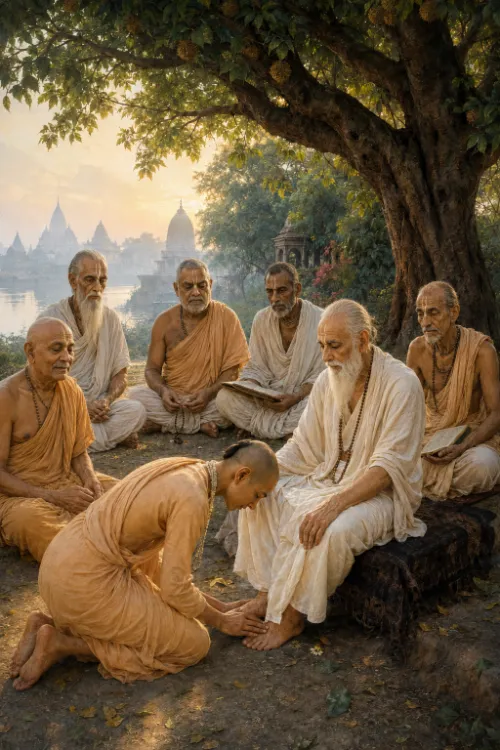
Narottama dāsa Ṭhākura on the Six Gosvāmīs, the Association of Devotees, and Devotion Beyond Liberation
Two lines of Bengali, simple enough to sing, that decline the one thing most spiritual practice is aimed at. Narottama dāsa Ṭhākura does not ask to escape rebirth. He asks that if birth comes again, service should come with it.
তাঁদের চরণ সেবি ভক্ত-সনে বাস ।
জনমে জনমে হয় এই অভিলাষ ॥
tāṅdera caraṇa sevi bhakta-sane vāsa
janame janame haya ei abhilāṣa
Nāma-saṅkīrtana 7
“Their lotus feet” points to the Six Gosvāmīs of Vṛndāvana, named immediately before this verse. “Living with devotees” names the need for genuine spiritual association. And janame janame, birth after birth, reveals that Narottama is not treating devotion as an instrument for securing something else — not even liberation. The treasure he wants is devotion itself: service to the previous ācāryas, lived in the company of Vaiṣṇavas. Three dimensions of Gauḍīya life in a couplet — fidelity to lineage, the transforming power of association, and devotion that depends on neither material success nor release from birth.
Two Ways of Reading the First Line
The compact syntax of Bengali devotional poetry allows the opening line to be rendered two closely related ways. A widely published translation associated with Śrīla A. C. Bhaktivedanta Swami Prabhupāda reads:
“This is my desire, that birth after birth I may live with those devotees who serve the lotus feet of these Six Gosvāmīs.”
In many of his purports and lectures, however, he explains the line as containing two coordinated practices — tāṅdera caraṇa sevi, serving the lotus feet, instructions and mission of the Gosvāmīs; and bhakta-sane vāsa, living in the association of devotees. Which gives a closer explanatory rendering:
“May I serve the lotus feet of the Six Gosvāmīs and live in the association of devotees. Birth after birth, this is my aspiration.”
These should not be forced into opposition. On the first, Narottama desires the company of devotees whose lives are dedicated to the Gosvāmīs; on the second, he desires both service to the Gosvāmīs and residence among devotees. Both carry the same structure: the Gosvāmīs supply the inherited direction of Gauḍīya bhakti, the Vaiṣṇavas supply the living association in which that direction is practiced.
Whose Feet — the Song Answers Its Own Question
The word tāṅdera, “their,” only becomes clear when the couplet is read inside the song. Narottama has just named the Six Gosvāmīs:
শ্রী-রূপ শ্রী-সনাতন ভট্ট-রঘুনাথ ।
শ্রী-জীব গোপাল-ভট্ট দাস-রঘুনাথ ॥
śrī-rūpa śrī-sanātana bhaṭṭa-raghunātha
śrī-jīva gopāla-bhaṭṭa dāsa-raghunātha
and bowed to them:
এই ছয় গোসাই করি চরণ বন্দন ।
যাহা হৈতে বিঘ্ন-নাশ অভীষ্ট-পূরণ ॥
ei chaya gosāi kari caraṇa vandana
yāhā haite vighna-nāśa abhīṣṭa-pūraṇa
and then described his relationship not with them directly but with those who follow them:
এই ছয় গোসাই যার, মুই তার দাস ।
তা-সবার পদ-রেণু মোর পঞ্চ-গ্রাস ॥
ei chaya gosāi yāra, mui tāra dāsa
tā-sabāra pada-reṇu mora pañca-grāsa
Pañca-grāsa literally evokes five mouthfuls of food — the modest daily portion by which life is kept going. So Narottama is not saying merely that he admires the Gosvāmīs’ followers. He is calling the dust of their feet the food that sustains him. Only then does the central couplet arrive:
তাঁদের চরণ সেবি ভক্ত-সনে বাস ।
জনমে জনমে হয় এই অভিলাষ ॥
tāṅdera caraṇa sevi bhakta-sane vāsa
janame janame haya ei abhilāṣa
and finally the reason the Six Gosvāmīs occupy so decisive a place:
এই ছয় গোসাই যবে ব্রজে কৈলা বাস ।
রাধা-কৃষ্ণ-নিত্য-লীলা করিলা প্রকাশ ॥
ei chaya gosāi jabe vraje kailā vāsa
rādhā-kṛṣṇa-nitya-līlā karilā prakāśa
The progression is deliberate — named, honored, followed through their servants, and praised as the revealers of Rādhā and Kṛṣṇa’s eternal Vraja-līlā. The aspiration does not arise from general admiration for religious teachers. It arises from the particular role these six played in preserving and unfolding the inner meaning of Śrī Caitanya Mahāprabhu’s gift.
Why These Six
They were not simply six respected ascetics who happened to live in Vṛndāvana. Through their writing and practice they gave the Gauḍīya tradition its enduring theological, literary, ritual and geographical form after Caitanya — establishing the scriptural foundations of the doctrine, explaining the nature and stages of bhakti, analyzing devotional relationship and sacred emotion, articulating the significance of Rādhā, Kṛṣṇa, Vraja and Caitanya, setting standards of practice, identifying and restoring the holy places connected with Kṛṣṇa’s pastimes, and inspiring the temple traditions that made Vṛndāvana a visible center of Gauḍīya devotional culture. Their individual contributions differ considerably:
To approach the Gosvāmīs, for Narottama, is therefore to approach the theological heart of Caitanya’s movement. Their feet mark the path by which later generations enter that inheritance.
Caraṇa-sevā: What “Serving the Feet” Means
In Vaiṣṇava language, serving the feet expresses humility, shelter, discipleship and practical obedience. It can certainly include embodied acts of reverence toward a living guru or sādhu, but it is not limited to physically touching, washing or worshiping anyone’s feet. When the ācāryas are no longer physically present, one serves them by hearing their teachings, understanding their conclusions, following the path they established, and helping their service continue.
Which is why Prabhupāda so often glossed tāṅdera caraṇa sevi as following the instructions and mission of the Gosvāmīs. Their feet stand for the path they walked as much as for the persons themselves; to follow in their footsteps is to let one’s understanding be formed by what they received and realized, rather than treating private inspiration as self-authenticating. The principle continues the Gītā’s own account of paramparā:
एवं परम्पराप्राप्तमिमं राजर्षयो विदुः ।
स कालेनेह महता योगो नष्टः परन्तप ॥
evaṁ paramparā-prāptam
imaṁ rājarṣayo viduḥ
sa kāleneha mahatā
yogo naṣṭaḥ paran-tapa
Bhagavad-gītā 4.2
Paramparā is sometimes pictured as a bare chain of information, one person handing propositions to the next. Narottama’s language exposes its relational dimension: transmission involves hearing, trust, service, realization and faithful continuation. Teaching is not preserved by copying words. It is preserved when the words are understood and lived inside a relationship of service — which is why the Bhāgavatam describes approaching a genuine teacher as an act of taking shelter:
तस्माद् गुरुं प्रपद्येत जिज्ञासुः श्रेय उत्तमम् ।
शाब्दे परे च निष्णातं ब्रह्मण्युपशमाश्रयम् ॥
tasmād guruṁ prapadyeta
jijñāsuḥ śreya uttamam
śābde pare ca niṣṇātaṁ
brahmaṇy upaśamāśrayam
Śrīmad-Bhāgavatam 11.3.21
A genuine teacher does not claim to invent a new ultimate truth. But fidelity is not lifeless repetition either — the Gosvāmīs were extraordinarily creative writers and thinkers, and their originality served revelation and Caitanya’s purpose. The distinction that matters is between illuminating an inherited truth and replacing it with a self-created path.
The Dust of the Devotees’ Feet
Narottama’s image of foot-dust sharpens the same point. Dust sits in the lowest position, beneath everyone’s feet; to want it is to give up the ego’s demand to be spiritually independent or prominent. Prahlāda Mahārāja uses the identical image:
नैषां मतिस्तावदुरुक्रमाङ्घ्रिं
स्पृशत्यनर्थापगमो यदर्थः ।
महीयसां पादरजोऽभिषेकं
निष्किञ्चनानां न वृणीत यावत् ॥
naiṣāṁ matis tāvad urukramāṅghriṁ
spṛśaty anarthāpagamo yad-arthaḥ
mahīyasāṁ pāda-rajo-’bhiṣekaṁ
niṣkiñcanānāṁ na vṛṇīta yāvat
Śrīmad-Bhāgavatam 7.5.32
The image does not glorify ignorance or passive dependence — the Six Gosvāmīs were among the most learned figures in Vaiṣṇava history. It places learning within humility. Scholarship becomes spiritually fruitful when it is joined to receptivity, purification of motive, and a willingness to be corrected by realized devotion.
And Narottama declines even the position of direct importance. He calls himself the servant of those who belong to the Gosvāmīs — dāsānudāsa-bhāva, the aspiration to be the servant of the servant. Service offered through the devotees does not put distance between him and Kṛṣṇa. In Gauḍīya understanding it is the natural way of approaching Him without the ego demanding the center.
Bhakta-sane Vāsa: Association as a Dwelling, Not a Visit
He is not praying to meet devotees occasionally. Vāsa means dwelling, residence. The aspiration is to make devotee association his habitat — the environment in which his values, habits, speech, service and remembrance are formed. Which is psychologically realistic as much as spiritually so: people absorb the standards of the company they keep. Surroundings dominated by competition, acquisition, sensuality and resentment gradually make those values feel normal; surroundings shaped by hearing, chanting, service, remembrance and honest correction make devotional consciousness easier to sustain. Ṛṣabhadeva puts it as a choice between two doors:
महत्सेवां द्वारमाहुर्विमुक्ते-
स्तमोद्वारं योषितां सङ्गिसङ्गम् ।
महान्तस्ते समचित्ताः प्रशान्ता
विमन्यवः सुहृदः साधवो ये ॥
mahat-sevāṁ dvāram āhur vimuktes
tamo-dvāraṁ yoṣitāṁ saṅgi-saṅgam
mahāntas te sama-cittāḥ praśāntā
vimanyavaḥ suhṛdaḥ sādhavo ye
Śrīmad-Bhāgavatam 5.5.2
That verse does more than command respect for religious personalities — it supplies the marks by which a mahātmā can actually be recognized: peacefulness, freedom from anger, equal vision, goodwill, saintly conduct. Association helps because the character and consciousness of such people are already oriented toward the Supreme. Kapiladeva describes what then happens inside it:
सतां प्रसङ्गान्मम वीर्यसंविदो
भवन्ति हृत्कर्णरसायनाः कथाः ।
तज्जोषणादाश्वपवर्गवर्त्मनि
श्रद्धा रतिर्भक्तिरनुक्रमिष्यति ॥
satāṁ prasaṅgān mama vīrya-saṁvido
bhavanti hṛt-karṇa-rasāyanāḥ kathāḥ
taj-joṣaṇād āśv apavarga-vartmani
śraddhā ratir bhaktir anukramiṣyati
Śrīmad-Bhāgavatam 3.25.25
Sādhu-saṅga changes the quality of hearing. Kṛṣṇa-kathā stops being religious information and becomes nourishment; through repeated hearing and service, faith becomes attraction, and attraction matures into devotion. Kṛṣṇadāsa Kavirāja compresses the whole claim into a line:
‘সাধুসঙ্গ’, ‘সাধুসঙ্গ’ — সর্বশাস্ত্রে কয় ।
লবমাত্র সাধুসঙ্গে সর্বসিদ্ধি হয় ॥
‘sādhu-saṅga,’ ‘sādhu-saṅga’ — sarva-śāstre kaya
lava-mātra sādhu-saṅge sarva-siddhi haya
Śrī Caitanya-caritāmṛta, Madhya-līlā 22.54
Proximity by itself is not sādhu-saṅga. One can live among devotees while relating to them mainly through gossip, institutional politics, business, conflict or mundane familiarity. The association happens through what makes a sādhu a sādhu — hearing, service, discussion of śāstra, chanting, remembrance, the reception of correction, the cultivation of character. Nor does it mean surrendering judgment to social pressure: a Vaiṣṇava community carries spiritual authority only so far as it stays accountable to guru, sādhu and śāstra. The community is not the goal. It is the environment in which its members help one another remember and serve Kṛṣṇa.
Janame Janame: The Radical Words
The most startling thing in the prayer is janame janame. Rebirth is normally the condition spiritual practice is supposed to deliver the soul from. Narottama does not deny the suffering of conditioned existence, and he is not asking to stay bound by ignorance. He is making a subtler declaration: whether liberation comes now or later, devotion must never be lost.
Śrī Caitanya says the same thing in the fourth verse of the Śikṣāṣṭaka:
न धनं न जनं न सुन्दरीं
कवितां वा जगदीश कामये ।
मम जन्मनि जन्मनीश्वरे
भवताद् भक्तिरहैतुकी त्वयि ॥
na dhanaṁ na janaṁ na sundarīṁ
kavitāṁ vā jagad-īśa kāmaye
mama janmani janmanīśvare
bhavatād bhaktir ahaitukī tvayi
Śikṣāṣṭaka 4; Caitanya-caritāmṛta, Antya-līlā 20.29
The parallel between janmani janmani and janame janame is unmistakable. Both prayers withdraw the demand that devotion purchase release from birth; the devotee leaves liberation in the Lord’s hands and asks only that service continue uninterrupted. Vṛtrāsura states the hierarchy outright:
न नाकपृष्ठं न च पारमेष्ठ्यं
न सार्वभौमं न रसाधिपत्यम् ।
न योगसिद्धीरपुनर्भवं वा
समञ्जस त्वा विरहय्य काङ्क्षे ॥
na nāka-pṛṣṭhaṁ na ca pārameṣṭhyaṁ
na sārva-bhaumaṁ na rasādhipatyam
na yoga-siddhīr apunar-bhavaṁ vā
samañjasa tvā virahayya kāṅkṣe
Śrīmad-Bhāgavatam 6.11.25
Apunar-bhavam means freedom from further birth — and Vṛtrāsura refuses even that, if it would mean separation from the Lord. Prabhupāda cites Narottama’s couplet in his purport to this very verse, because both prayers place devotional relationship above liberation pursued as an achievement in its own right.
None of which depreciates liberation. Gauḍīya theology does not celebrate bondage or suffering; it refuses to rank liberation above prema and sevā. Freedom is complete not when the soul becomes independent of every relationship, but when its relationship of loving service is fully awakened.
Why the Couplet Needs Both Halves
Narottama holds together two things that distort as soon as they are separated:
So the two halves protect each other. Service to the Gosvāmīs gives devotional community its direction; devotee association gives the Gosvāmīs’ teaching a lived, relational form. That balance also sets a limit on spiritual authority in both directions: no contemporary teacher becomes absolute by detaching himself from the lineage, since a genuine guru represents the previous ācāryas and stays accountable to what he received — and equally, fidelity to tradition is no excuse for coldness or isolation. The inherited path is meant to produce living communities of hearing, service, humility and care.
The couplet is not a prayer for congenial religious surroundings. It describes the shape desire takes once bhakti has purified it. Material desire asks what may I possess; Narottama asks whom may I serve. The ego seeks independence and prominence; he seeks the dust of the devotees’ feet. Conventional spirituality can treat devotion as the price paid for liberation; he wants devotion even if birth comes again. The Six Gosvāmīs connect the practitioner to the theological and devotional inheritance of Śrī Caitanya, and the association of devotees supplies the living environment in which that inheritance turns into conduct, character, remembrance and service. And janame janame removes every remaining condition — devotion is not postponed until circumstances improve, and not discarded once it has delivered some higher reward.
May I remain beneath the feet of the ācāryas, among the devotees, in the service of Kṛṣṇa—birth after birth.
That is why Prabhupāda returned to these two lines so often. They compress an entire Gauḍīya way of life into a couplet: received through the lineage, sustained through devotee association, and fulfilled in a service that is itself the goal.