

When Prema Becomes Difficult to Read
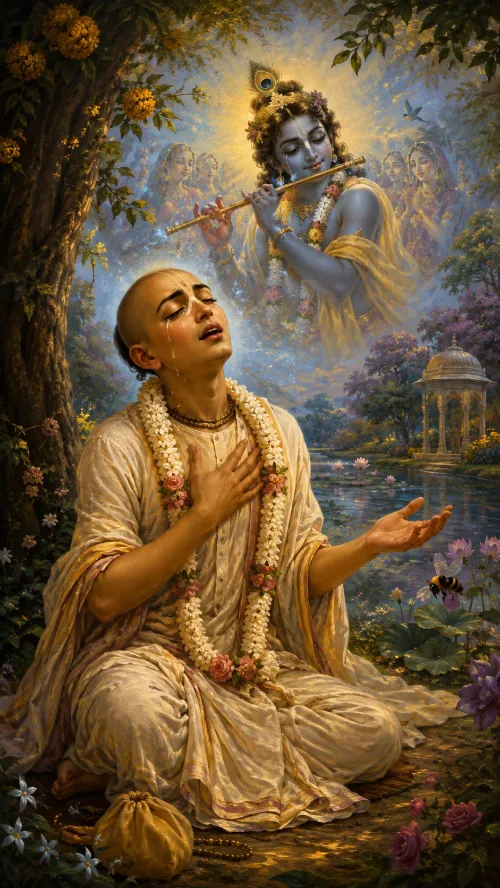
Why Even a Scholar Can Misread a Devotee’s Tears
One of the most intriguing statements in the Caitanya-caritāmṛta appears when Śrī Caitanya Mahāprabhu teaches Sanātana Gosvāmī about the development of devotion from bhāva into prema. Mahāprabhu says:
যাঁর চিত্তে কৃষ্ণপ্রেমা করয়ে উদয় ।
তাঁর বাক্য, ক্রিয়া, মুদ্রা বিজ্ঞেহ না বুঝয় ॥
yāṅra citte kṛṣṇa-premā karaye udaya
tāṅra vākya, kriyā, mudrā vijñeha nā bujhaya
“When kṛṣṇa-prema awakens in someone’s heart, even a learned and discerning person cannot fully comprehend that devotee’s speech, actions, and characteristic expressions.”
Śrī Caitanya-caritāmṛta, Madhya 23.39
The traditional English translation reads:
“Even the most learned man cannot understand the words, activities and symptoms of a person situated in love of Godhead.”
That is essentially correct, yet the Bengali is more evocative. Mahāprabhu does not merely say that someone occupies a spiritual status called “love of Godhead.” He says kṛṣṇa-premā karaye udaya — Kṛṣṇa-prema rises within the heart — and as it rises it leaves its imprint on three things.
The remarkable claim is that even a vijña — a learned and discerning person — may fail to penetrate their full meaning. Not because prema destroys meaning. Not because spiritual love makes a person irrational. The principle is subtler: prema may possess an interior relational coherence that is not transparent to an external observer. The speech is meaningful, the action is meaningful, the expression is meaningful — but the meaning may arise from a relationship with Kṛṣṇa that the observer does not inhabit.
The Context: From Bhāva to Prema
The location of the verse is essential. Immediately before it Mahāprabhu tells Sanātana:
কৃষ্ণে ‘রতির’ চিহ্ন এই কৈলুঁ বিবরণ ।
‘কৃষ্ণপ্রেমের’ চিহ্ন এবে শুন সনাতন ॥
kṛṣṇe ratira cihna ei kailuṅ vivaraṇa
kṛṣṇa-premera cihna ebe śuna sanātana
“I have described the characteristics of rati toward Kṛṣṇa. Now, Sanātana, hear the characteristics of kṛṣṇa-prema.”
Madhya 23.38
He has been describing the whole development — śraddhā → sādhu-saṅga → bhajana-kriyā → anartha-nivṛtti → niṣṭhā → ruci → āsakti → bhāva → prema — and the discussion has now crossed from bhāva into prema. One of the first things He says about prema is almost paradoxical: its outward manifestations cannot always be fully interpreted from outside.
What Is Bhāva?
Rūpa Gosvāmī gives the foundational definition:
शुद्धसत्त्वविशेषात्मा प्रेमसूर्यांशुसाम्यभाक् ।
रुचिभिश्चित्तमासृण्यकृदसौ भाव उच्यते ॥
śuddha-sattva-viśeṣātmā
prema-sūryāṁśu-sāmya-bhāk
rucibhiś citta-masṛṇya-kṛd asau bhāva ucyate
“Bhāva is a special manifestation of śuddha-sattva. It resembles a ray of the sun of prema and softens the heart through spiritual taste.”
Bhakti-rasāmṛta-sindhu 1.3.1
The central image is prema-sūryāṁśu, “a ray of the sun of prema.” If prema is the sun, bhāva is its first visible ray. Bhāva is therefore not merely intense religious emotion; it is the dawning of the reality that will mature into prema. One of its effects is citta-masṛṇya-kṛt — it makes the heart soft.
What Does “Softening the Heart” Mean?
In ordinary speech, “soft-hearted” may suggest sentimentality. Rūpa’s idea is deeper. Conditioned consciousness is ordinarily organized around the self — what do I gain, what do I lose, what gives me pleasure, what threatens me, how am I perceived, what confirms my importance? Bhakti gradually changes that center of gravity, and the heart becomes increasingly responsive to Kṛṣṇa rather than principally to itself.
The “softening” of bhāva is therefore not merely increased emotional sensitivity. It is the beginning of a consciousness no longer completely hardened around self-interest. In prema this transformation becomes far more profound.
Rūpa Gosvāmī’s Definition of Prema
Rūpa writes:
सम्यङ्मसृणितस्वान्तो ममत्वातिशयाङ्कितः ।
भावः स एव सान्द्रात्मा बुधैः प्रेमा निगद्यते ॥
samyaṅ-masṛṇita-svānto
mamatvātiśayāṅkitaḥ
bhāvaḥ sa eva sāndrātmā
budhaiḥ premā nigadyate
“When that same bhāva thoroughly softens the heart, becomes deeply condensed, and is marked by extraordinary mamatā, the learned call it prema.”
Bhakti-rasāmṛta-sindhu 1.4.1
Three expressions in that definition carry the weight.
“Kṛṣṇa Is Mine”
This is not material possessiveness. Material possessiveness says “this exists for my use.” Spiritual mamatā says “my existence belongs within this relationship” — and it takes a different form in each Vraja relationship.
The majesty of Bhagavān has not ceased to exist. But the devotee’s consciousness is no longer structured primarily by abstract awareness of divine sovereignty. Relationship becomes dominant — and that is one reason prema cannot always be interpreted through ordinary psychological assumptions.
Bhāva Has Recognizable Signs
At first the verse may seem puzzling. If prema becomes difficult to understand, why does the tradition give recognizable characteristics of spiritual advancement? Rūpa himself lists the signs that accompany awakened bhāva:
क्षान्तिरव्यर्थकालत्वं विरक्तिर्मानशून्यता ।
आशाबन्धः समुत्कण्ठा नामगाने सदा रुचिः ॥
आसक्तिस्तद्गुणाख्याने प्रीतिस्तद्वसतिस्थले ।
इत्यादयोऽनुभावाः स्युर्जातभावाङ्कुरे जने ॥
kṣāntir avyartha-kālatvaṁ
viraktir māna-śūnyatā
āśā-bandhaḥ samutkaṇṭhā
nāma-gāne sadā ruciḥ
āsaktis tad-guṇākhyāne
prītis tad-vasati-sthale
ity-ādayo ’nubhāvāḥ syur
jāta-bhāvāṅkure jane
“When the sprout of bhāva has arisen in a person, such manifestations appear: forbearance, unwillingness to waste time, detachment, absence of pride, strong hope, intense longing, constant taste for singing the holy name, attachment to describing Kṛṣṇa’s qualities, and affection for the places of His residence.”
Bhakti-rasāmṛta-sindhu 1.3.25–26
quoted in Caitanya-caritāmṛta, Madhya 23.18–19
These are not theatrical symptoms. They describe a restructuring of life. The devotee becomes:
- more tolerant, and less attracted to distraction;
- less proud;
- more hopeful in Kṛṣṇa’s mercy, and more eager for Him;
- more attracted to nāma and more absorbed in Kṛṣṇa-kathā;
- and more affectionate toward the places connected with Him.
So how can Mahāprabhu say that the devotee in prema may be difficult to understand?
The Sign Is Visible; Its Inner Meaning May Not Be
That distinction solves the problem. One may recognize that a person possesses extraordinary taste for Kṛṣṇa’s name, yet not know what the name is awakening within that person’s relationship with Him. One may see a tear — but the tear might arise from:
- separation, or gratitude;
- humility, or remembrance;
- fear of losing service;
- unexpected mercy;
- joy at Kṛṣṇa’s happiness;
- or several of these currents at once.
The manifestation is visible. Its complete interior meaning may not be. This is where the word mudrā becomes especially important.
What Does Mudrā Mean?
Modern readers often associate mudrā primarily with ritual hand gestures. That meaning exists, but the wider Sanskrit semantic field includes seal, stamp, mark, impression, sign, characteristic indication — and that is remarkably apt here. A mudrā can be understood as the outward impression left by an inward reality. Prema exists within consciousness; its seal appears outside.
A glance, a change of voice, a silence, a smile, an unusual sentence, a posture, a withdrawal, a cry, or an apparently contradictory response may all carry the imprint of the inner devotional relationship. “Symptoms” is not a wrong translation, but characteristic expression, outward imprint or distinctive manifestation preserve more of the original image. An interpretive rendering could therefore read:
“When love of Kṛṣṇa rises within the heart, even a scholar may be unable to decipher the words, behavior, and outward imprint of that love.”
Rūpa’s Sanskrit Foundation
Mahāprabhu immediately supports the statement by quoting Rūpa Gosvāmī:
धन्यस्यायं नवः प्रेमा यस्योन्मीलति चेतसि ।
अन्तर्वाणीभिरप्यस्य मुद्रा सुष्ठु सुदुर्गमा ॥
dhanyasyāyaṁ navaḥ premā
yasyonmīlati cetasi
antar-vāṇibhir apy asya
mudrā suṣṭhu su-durgamā
“Blessed is that person in whose heart this fresh prema opens. Even for those deeply learned in sacred knowledge, that person’s mudrā is exceedingly difficult to penetrate.”
Bhakti-rasāmṛta-sindhu 1.4.17
quoted in Caitanya-caritāmṛta, Madhya 23.40
This is effectively the Sanskrit foundation of the Bengali verse. Kṛṣṇadāsa Kavirāja first states vākya, kriyā, mudrā vijñeha nā bujhaya, and then Mahāprabhu cites Rūpa’s mudrā suṣṭhu su-durgamā.
Rūpa says navaḥ premā, “fresh” or newly manifested prema, and then unmīlati cetasi, “it opens in consciousness.” The verb evokes something unfolding — eyes opening, a flower opening, something concealed becoming manifest. Prema is not depicted as a static spiritual label. It is alive, it unfolds, and as it unfolds the whole person begins to bear its imprint.
His conclusion is emphatic. Suṣṭhu means exceedingly, thoroughly; su-durgamā means extremely difficult to reach, penetrate or comprehend. There is a genuine gap between seeing an expression of prema and fully inhabiting the consciousness from which it arises, and extensive scriptural learning does not automatically erase it.
The Map Is Not the Country
There is a beautiful paradox here. Rūpa Gosvāmī is one of the most systematic analysts of devotional emotion in Indian theological literature: the Bhakti-rasāmṛta-sindhu carefully distinguishes bhāva, prema, vibhāva, anubhāva, sāttvika-bhāva, vyabhicāri-bhāva, sthāyi-bhāva and rasa. He is not anti-analysis; he creates an extraordinarily sophisticated theology of devotional experience.
Yet the same author says mudrā suṣṭhu su-durgamā. Rūpa therefore recognizes the limit of his own classification. The map can be precise. The map is not the country. A treatise can describe prema; that does not mean the description reproduces the experience from within.
Several Inner Currents Can Produce One Outer Expression
Gauḍīya rasa theory helps explain why outward behavior may become difficult to interpret: inner devotional states appear through overlapping forms of expression.
The eight sāttvika transformations are:
ते स्तम्भस्वेदरोमाञ्चाः स्वरभेदोऽथ वेपथुः ।
वैवर्ण्यमश्रु प्रलय इत्यष्टौ सात्त्विकाः स्मृताः ॥
te stambha-sveda-romāñcāḥ
svara-bhedo ’tha vepathuḥ
vaivarṇyam aśru pralaya
ity aṣṭau sāttvikāḥ smṛtāḥ
“The eight sāttvika transformations are becoming stunned, perspiration, horripilation, alteration of the voice, trembling, change of bodily color, tears, and loss of ordinary bodily activity or consciousness.”
Bhakti-rasāmṛta-sindhu 2.3.16
A single outward manifestation may therefore carry several emotional currents at once. That is why one cannot reliably infer the inner bhāva from the external sign alone.
“Like One Who Is Mad”
The next verse Mahāprabhu quotes shows what such expression may look like:
एवंव्रतः स्वप्रियनामकीर्त्या
जातानुरागो द्रुतचित्त उच्चैः ।
हसत्यथो रोदिति रौति गाय-
त्युन्मादवन्नृत्यति लोकबाह्यः ॥
evaṁ-vrataḥ sva-priya-nāma-kīrtyā
jātānurāgo druta-citta uccaiḥ
hasaty atho roditi rauti gāyaty
unmāda-van nṛtyati loka-bāhyaḥ
“Having developed anurāga through chanting the name of his beloved Lord, his heart melts. He loudly laughs, cries, calls out and sings; he dances like one who is mad, beyond concern for ordinary worldly convention.”
Śrīmad-Bhāgavatam 11.2.40
quoted in Caitanya-caritāmṛta, Madhya 23.41
The sequence of the three verses is deliberate.
The comparison is theological and aesthetic, not a medical diagnosis, and the Bhāgavata itself gives the cause: jātānurāgaḥ, deep loving attachment has arisen, and druta-cittaḥ, the heart has melted. The apparent madness is described as an outward consequence of a consciousness radically centered upon the beloved Lord.
Strange Behavior Is Not Proof of Prema
This distinction is essential. The text does not teach that psychological disorientation is itself spiritual realization, nor that irrational behavior should automatically be revered. Tears can have many causes; so can trembling. One can imitate crying, shout, dance, or cultivate dramatic devotional language, and none of these alone establishes prema.
Rūpa’s deeper criteria concern enduring transformation: humility, detachment, hope in Kṛṣṇa, longing, taste for nāma, attachment to Kṛṣṇa-kathā, and a heart increasingly centered upon Him. Prema may sometimes produce extraordinary behavior, but outward strangeness by itself proves nothing.
Rādhā and the Bumblebee
The Bhramara-gītā of the Śrīmad-Bhāgavatam gives one of the clearest examples of why devotional speech can be difficult to interpret. Later in the Caitanya-caritāmṛta, Kṛṣṇadāsa Kavirāja points to Śrī Rādhā’s speech there as scriptural precedent for Mahāprabhu’s own ecstatic utterances:
ইহার সত্যত্বে প্রমাণ শ্রীভাগবতে ।
শ্রীরাধার প্রেম-প্রলাপ ‘ভ্রমর-গীতা’তে ॥
ihāra satyatve pramāṇa śrī-bhāgavate
śrī-rādhāra prema-pralāpa bhramara-gītāte
“The evidence for the truth of these utterances is found in the Śrīmad-Bhāgavatam, in Śrī Rādhā’s prema-pralāpa in the Bhramara-gītā.”
Caitanya-caritāmṛta, Antya 19.107
In the Bhramara-gītā, Rādhā addresses a bumblebee as though it were connected with Kṛṣṇa. She says:
मधुप कितवबन्धो मा स्पृशाङ्घ्रिं सपत्न्याः …
madhupa kitava-bandho mā spṛśāṅghriṁ sapatnyāḥ …
“O bumblebee, friend of a cheater, do not touch My feet…”
Śrīmad-Bhāgavatam 10.47.12
On the surface this sounds like rejection — and yet Rādhā cannot stop speaking about Him. A few verses later she declares tad alam asita-sakhyair, “Enough of friendship with that dark one!” and immediately adds dustyajas tat-kathārthaḥ, “yet the subject of His stories is impossible to give up” (Śrīmad-Bhāgavatam 10.47.17).
This is an almost perfect illustration. Rādhā says “enough of Him” while simultaneously demonstrating “I cannot cease speaking of Him.” The contradiction is not a failure of logic. It reveals love in separation.
Surface Meaning and Rasa Meaning
Suppose someone extracted only the sentence “enough of friendship with Kṛṣṇa.” The conclusion might be that Rādhā no longer loves Him — the exact opposite of the emotional reality of the passage. The rejection itself is saturated with attachment: the beloved occupies consciousness so completely that even denunciation becomes another way of remaining absorbed in Him.
Rasa therefore requires attention not only to what is said but to the relationship and emotional situation from which it is said. That is one dimension of vākya … vijñeha nā bujhaya: even a learned person may fail to understand the speech.
Action Can Be Equally Ambiguous
Mahāprabhu’s second word is kriyā, action or behavior — and the same action can arise from very different inner states.
The outward action alone does not transparently reveal its inner cause.
Prema Is Not Irrational — Its Center Has Changed
Most ordinary psychology begins with a familiar question: what does this person want for himself? Comfort, status, security, pleasure, recognition, the avoidance of pain. Prema alters the premise, and the devotee’s consciousness increasingly asks instead: what concerns Kṛṣṇa? what serves Him? what brings happiness to the beloved?
If the observer keeps interpreting every action through ordinary self-interest, the behavior may appear irrational. But the problem may not be an absence of coherence — the observer may be using the wrong center of gravity. A beginner watching an expert chess player may see a move that looks disastrous; the move is not necessarily irrational, and the beginner may simply not see enough of the game. Expressions of prema may likewise possess a relational coherence that is not immediately visible from outside.
Alaukika: Beyond Ordinary Worldly Categories
Kṛṣṇadāsa Kavirāja later says of divine līlā:
অলৌকিক কৃষ্ণলীলা, দিব্যশক্তি তার ।
তর্কের গোচর নহে চরিত্র যাহার ॥
alaukika kṛṣṇa-līlā, divya-śakti tāra
tarkera gocara nahe caritra yāhāra
“Kṛṣṇa-līlā is alaukika and possesses divine potency; its character does not fall completely within the reach of ordinary argument.”
Caitanya-caritāmṛta, Antya 19.103
Alaukika means extraordinary, beyond ordinary worldly categories. It does not mean “logically contradictory, therefore true,” and it does not mean “immune from all examination.” The point is that transcendental rasa cannot be exhaustively explained by inference beginning only from ordinary worldly psychology. Gauḍīya theologians themselves reason rigorously; what they reject is the assumption that mundane experience provides an exhaustive model for transcendental relationship.
A Necessary Safeguard
This verse can be seriously misused. Someone might argue: “if an advanced devotee cannot be understood, then whatever a supposedly advanced person does must be transcendental and should never be questioned.” That is not what the chapter teaches — Mahāprabhu has already supplied observable characteristics of genuine spiritual development.
The verse does not say “never question a saint.” It does not say “suspend moral judgment,” or “scripture no longer applies,” or “spiritual leaders cannot be held accountable.” And it certainly does not say that any inexplicable behavior is transcendental. The principle is one of epistemic humility, not institutional immunity: it warns us not to assume that external observation gives exhaustive access to the inner meaning of genuine prema. That is very different from abandoning discernment.
Knowledge About Prema and Knowledge Through Prema
Here the argument reaches its deeper distinction. One can possess knowledge about prema — its definitions, stages, symptoms, technical Sanskrit terminology and rasa-theology. That knowledge is genuine and valuable. But the devotee in prema possesses something additional: knowledge from within the relationship itself.
The difference resembles knowing the chemistry of sweetness and tasting honey. The chemical explanation may be exact, but it does not contain the taste. Rūpa’s theology values both; it simply refuses to confuse them. The observer sees the tear; the devotee experiences the rasa. The observer possesses the manifestation; the devotee possesses the experience from within. That gap is what Rūpa calls mudrā suṣṭhu su-durgamā.
Prema Makes Expression Meaning-Dense
When an observer cannot immediately understand a devotee’s expression, the conclusion need not be that the behavior has no meaning. Another possibility is that the expression contains more relational meaning than the observer can presently decode.
A short glance between intimate friends may communicate more than an outsider can understand. Likewise, in rasa, a single word or gesture may carry layers of memory, longing, jealousy, humor, separation, hope, fear and affection at once. Prema does not necessarily make expression meaningless. It can make expression meaning-dense.
Prema Is Personal Before It Is Spectacular
This is one of the most important safeguards in the whole theology. Readers can easily become fascinated by dramatic expressions of bhakti — crying, trembling, fainting, singing, dancing, apparent madness. But Rūpa’s definition of prema begins somewhere else entirely: not with tears, not with trembling, not with collapse, but with samyaṅ-masṛṇita-svāntaḥ, the heart thoroughly softened, and mamatvātiśayāṅkitaḥ, extraordinary loving belonging toward Kṛṣṇa.
The spectacle is secondary. The relationship is primary.
Mahāprabhu as the Living Demonstration
Madhya 23 teaches the principle; the Antya-līlā demonstrates it. As Mahāprabhu’s separation from Kṛṣṇa becomes increasingly intense, His words and bodily states become extraordinary, and Kṛṣṇadāsa returns to Rūpa’s verse — dhanyasyāyaṁ navaḥ premā … mudrā suṣṭhu su-durgamā. The framework built to explain prema in a treatise is now used to interpret a person. And when His speech appears incomprehensible by ordinary psychology, Kṛṣṇadāsa points to Śrī Rādhā’s Bhramara-gītā.
That creates a single coherent line: Rādhā’s prema in the Bhāgavata → Rūpa Gosvāmī’s analysis of prema → Mahāprabhu’s ecstatic manifestations → Kṛṣṇadāsa Kavirāja’s interpretation of them. The verse belongs inside that larger structure.
What the Verse Does Not Mean
It should never be reduced to any of the following.
The actual claim is more precise: external knowledge does not automatically provide exhaustive access to another person’s internal rasa.
What the Verse Does Teach
The verse is not teaching that genuine devotion is irrational. It teaches that the interior relational coherence of prema cannot always be reconstructed from outward behavior alone. Rūpa calls bhāva a ray of the sun of prema; when that bhāva becomes thoroughly softened, deeply concentrated and filled with extraordinary mamatā toward Kṛṣṇa, it becomes prema. Prema then impresses itself upon the whole person — speech, action, gesture, silence, eyes, voice, body, memory, longing, joy and grief. That outward impression is its mudrā, its seal.
But seeing the seal is not the same as knowing everything it seals. That is why Rūpa says mudrā suṣṭhu su-durgamā, and why Kṛṣṇadāsa Kavirāja says:
tāṅra vākya, kriyā, mudrā vijñeha nā bujhaya
“Even the learned cannot fully understand such a devotee’s speech, actions and expressions.”
The point is not that prema has no coherence. The point is that its center has changed. Ordinary consciousness asks “what does this mean for me?” Prema increasingly asks “what does this mean for Kṛṣṇa?” To the outsider that transformation may sometimes look contradictory; within rasa, those contradictions may reveal a deeper consistency, in which everything has become an expression of relationship with Kṛṣṇa.
Principal Scriptural Sources
The passages drawn on above, gathered by text. Each is quoted in full — in its own script, with transliteration and translation — at the point where it is discussed.
Śrī Caitanya-caritāmṛta
Rūpa Gosvāmī — Bhakti-rasāmṛta-sindhu
Śrīmad-Bhāgavatam
The wider semantic field of mudrā — seal, stamp, mark, impression, sign — is worth checking in a Sanskrit lexicon; it is what makes the word so apt here, and it is largely lost when the term is rendered simply as “symptoms.” The Sanskrit of the Bhakti-rasāmṛta-sindhu also circulates in several printed and electronic recensions whose readings differ in small particulars; the verses above are reproduced as supplied.