

When Stillness Is Not Spiritual
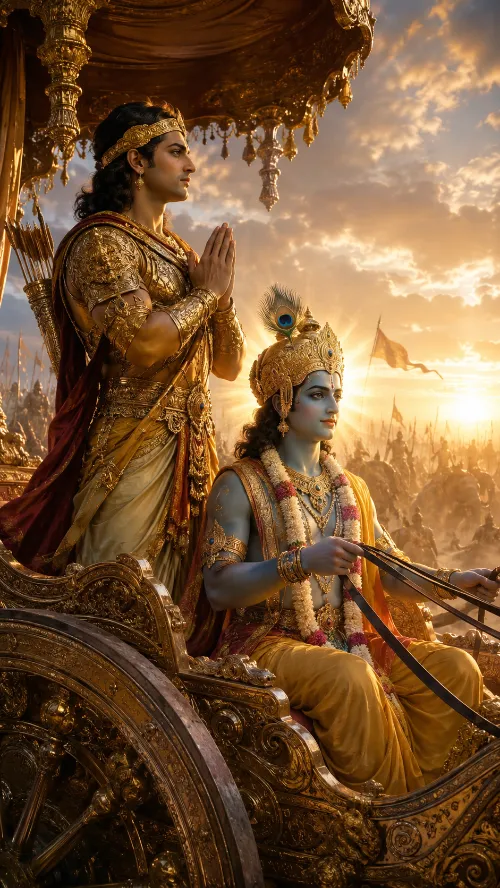
Action Without Bondage: Karma, Akarma, and the Paradox at the Heart of the Gītā
A busy person may be inwardly free. Someone who looks thoroughly renounced may be entangled to the hilt. That is the uncomfortable claim behind one of the most deliberately paradoxical verses in the Bhagavad-gītā — and it dismantles an assumption most people never think to question: that movement means action and stillness means inaction.
कर्मण्यकर्म यः पश्येद्
अकर्मणि च कर्म यः ।
स बुद्धिमान् मनुष्येषु
स युक्तः कृत्स्नकर्मकृत् ॥
“One who sees non-action within action and action within non-action is intelligent among human beings. Such a person is established in yoga and has accomplished the whole of action.”
Bhagavad-gītā 4.18
The closing compound, kṛtsna-karma-kṛt, literally suggests “one who has accomplished the whole of action” — someone who has grasped and fulfilled what action is ultimately for.
So the real question is not whether the body is moving. It is why the action is being performed, who claims to be its independent doer, who claims its fruit, whether it accords with dharma, what desire drives it, and what it is finally aimed at. Which is why Kṛṣṇa warns, in the verse just before:
गहना कर्मणो गतिः
gahanā karmaṇo gatiḥ
“The course of action is profound and difficult to understand.”
Even the Wise Get This Wrong
The paradox is not dropped without preparation. Kṛṣṇa first concedes how difficult the subject is:
किं कर्म किमकर्मेति
कवयोऽप्यत्र मोहिताः ।
तत्ते कर्म प्रवक्ष्यामि
यज्ज्ञात्वा मोक्ष्यसेऽशुभात् ॥
“What is action, and what is inaction? Even the wise are bewildered about this. I shall explain action to you, knowing which you will become freed from misfortune.”
Bhagavad-gītā 4.16
and then supplies three categories that must not be run together:
कर्मणो ह्यपि बोद्धव्यं
बोद्धव्यं च विकर्मणः ।
अकर्मणश्च बोद्धव्यं
गहना कर्मणो गतिः ॥
“Action must be understood; prohibited or improper action must also be understood; and inaction must be understood. The course of action is profound.”
Bhagavad-gītā 4.17
विकर्म
vikarma
अकर्म
akarma
“non-action.”
Depending on the Vedānta one reads it through, akarma may indicate the absence of binding karmic effect, the actionlessness of the spiritual self, knowledge present within properly performed action, or action so transformed that it no longer functions as bondage. All of which is how Kṛṣṇa can speak of akarma within karma at all.
Inaction Within Action
कर्मण्यकर्म यः पश्येत्
karmaṇy akarma yaḥ paśyet
“One who sees non-action within action.”
At the practical level this means outward activity need not produce spiritual bondage. The body moves, the senses operate, duties are performed, work gets done — and the action may still cease to bind, once it is freed from egoistic appropriation and redirected toward a sacred purpose. Kṛṣṇa makes the paradox sharper two verses later:
त्यक्त्वा कर्मफलासङ्गं
नित्यतृप्तो निराश्रयः ।
कर्मण्यभिप्रवृत्तोऽपि
नैव किञ्चित्करोति सः ॥
“Having abandoned attachment to the fruit of action, always satisfied and dependent on nothing, although fully engaged in action, he does nothing at all.”
Bhagavad-gītā 4.20
The Sanskrit keeps the contradiction deliberately intact: he is karmaṇy abhipravṛttaḥ, fully engaged in action, and yet naiva kiñcit karoti, does nothing at all. Which cannot mean no physical activity occurs. It means the activity is no longer attributed to the self in the ordinary, binding way.
Action and Bondage Are Not the Same Thing
People commonly assume liberation means stop acting. The Gītā rejects that repeatedly. The problem was never activity; it is the consciousness that structures activity — attachment, self-centered desire, egoistic doership, possessiveness, appropriation of the result. Kṛṣṇa had already said so:
यज्ञार्थात्कर्मणोऽन्यत्र
लोकोऽयं कर्मबन्धनः ।
तदर्थं कर्म कौन्तेय
मुक्तसङ्गः समाचर ॥
“Action performed for anything other than yajña causes bondage in this world. Therefore, O Kaunteya, perform action for that purpose, free from attachment.”
Bhagavad-gītā 3.9
The outer movement may be identical. The spiritual structure is entirely different — and the practical formula for the shift is given plainly:
मयि सर्वाणि कर्माणि
सन्न्यस्याध्यात्मचेतसा ।
निराशीर्निर्ममो भूत्वा
युध्यस्व विगतज्वरः ॥
“Surrendering all actions unto Me with spiritual consciousness, free from expectation and possessiveness, fight without inner fever.”
Bhagavad-gītā 3.30
Externally, yudhyasva: fight. Internally, mayi sarvāṇi karmāṇi sannyasya: surrender all actions to Me. Then nirāśīḥ, without expectation, and nirmamaḥ, without possessiveness. Intense action and profound renunciation turn out to be perfectly compatible, because the renunciation happens inside.
Three Claims That Make Action Bind
Read across the Gītā’s wider teaching, freedom from binding action involves letting go of three interlocking claims:
These three are not dictionary meanings of akarma. They are a synthesis of the Gītā’s wider teaching on non-attachment, doership, sacrifice and surrender, and worth labeling as such rather than presenting as lexical fact.
From Action to Worship
Śrīdhara Svāmī supplies the reading that matters most for Vaiṣṇava interpretation. He speaks of action performed as:
परमेश्वराराधनलक्षणे कर्मणि
parameśvarārādhana-lakṣaṇe karmaṇi
“action characterized by worship of the Supreme Lord.”
Such activity looks externally like ordinary karma. But because it is oriented toward the Supreme and its result is purification rather than bondage, akarma can be perceived within it — which is precisely the bridge from karma-yoga toward bhakti, where action becomes ārādhana, worship, and in the Gauḍīya form, sevā.
Consider two people cooking the same meal. One is thinking I want to enjoy this; I want recognition; this is mine. The other prepares it as an offering to Bhagavān and as service to others. From outside, the movements are nearly identical. One is cultivating mamatā, mine-ness; the other arpaṇa, offering. The Gītā’s demand is that we look beneath appearance, because the spiritual meaning of an action often cannot be read off the body at all.
Action Within Inaction
अकर्मणि च कर्म यः
akarmaṇi ca karma yaḥ
“and one who sees action within non-action.”
The second half of the paradox is subtler, and there are several distinct ways it happens. The first is simply that the body can be still while the mind is not:
कर्मेन्द्रियाणि संयम्य
य आस्ते मनसा स्मरन् ।
इन्द्रियार्थान्विमूढात्मा
मिथ्याचारः स उच्यते ॥
“One who restrains the organs of action but sits mentally dwelling upon the objects of the senses is deluded and is called a hypocrite.”
Bhagavad-gītā 3.6
Outwardly, stillness. Inwardly: desire, fantasy, envy, resentment, planning, appropriation. Physical inactivity is not spiritual inactivity, because the mind can go on producing exactly the orientation that bondage depends on.
The second is that complete inaction is not actually available:
न हि कश्चित्क्षणमपि
जातु तिष्ठत्यकर्मकृत् ।
कार्यते ह्यवशः कर्म
सर्वः प्रकृतिजैर्गुणैः ॥
“No one can remain without action even for a moment. Everyone is compelled to act by the guṇas born of prakṛti.”
Bhagavad-gītā 3.5
Even apparent stillness includes breathing, thinking, remembering, desiring and perceiving. So bodily motion cannot define karma, and bodily stillness cannot define akarma.
And the third is the one most easily overlooked: sometimes there is a genuine responsibility to act, and failing to perform an obligatory duty carries consequence of its own. Śrīdhara Svāmī raises this through pratyavāya, the negative result arising from omission — which is directly Arjuna’s situation. He begins by assuming that withdrawing from battle would automatically be the more spiritual course, and Kṛṣṇa refuses the shortcut, examining his duty, his motives, his attachments, the circumstances, and the consequences of refusing. Not acting is not automatically renunciation. Avoidance can be its own form of attachment.
None of which glorifies passivity, irresponsibility, neglect or laziness. The goal is not “stop doing.” It is “stop being bound by doing” — and those are entirely different projects.
The Ego Underneath
अहङ्कार
ahaṅkāra
— the egoic sense of independent authorship, which talks like this: I alone am the doer; I am the independent cause; my success proves my power; my failure destroys my identity. The Gītā dismantles the absolute version of that claim:
नैव किञ्चित्करोमीति
युक्तो मन्येत तत्त्ववित् ।
पश्यञ्शृण्वन्स्पृशञ्जिघ्रन्
अश्नन्गच्छन्स्वपन्श्वसन् ॥
प्रलपन्विसृजन्गृह्णन्
उन्मिषन्निमिषन्नपि ।
इन्द्रियाणीन्द्रियार्थेषु
वर्तन्त इति धारयन् ॥
“One established in yoga who knows reality understands, ‘I do nothing at all,’ even while seeing, hearing, touching, smelling, eating, walking, sleeping, breathing, speaking, releasing, receiving, opening and closing the eyes, knowing that the senses are interacting with their objects.”
Bhagavad-gītā 5.8–9
There is intense activity in that passage — seeing, hearing, touching, eating, moving, sleeping, breathing, speaking, grasping, opening and closing the eyes. What the wise person does not claim is to be the absolute independent doer. The teaching removes arrogance. It does not remove responsibility.
And the Motive
Immediately after the paradox, Kṛṣṇa describes the wise actor in terms not of metaphysics but of desire:
यस्य सर्वे समारम्भाः
कामसङ्कल्पवर्जिताः ।
ज्ञानाग्निदग्धकर्माणं
तमाहुः पण्डितं बुधाः ॥
“The wise call that person learned whose undertakings are free from desire-driven intentions and whose karma has been burned by the fire of knowledge.”
Bhagavad-gītā 4.19
whose key phrase is:
कामसङ्कल्पवर्जिताः
kāma-saṅkalpa-varjitāḥ
“free from desire-driven intention.”
and whose result is:
ज्ञानाग्निदग्धकर्माणम्
jñānāgni-dagdha-karmāṇam
“one whose karma has been burned by the fire of knowledge.”
The imagery is precise. The action may continue; what is destroyed is its power to bind in the former way. The activity stays visible. The bondage is burned off. Three verses later the argument closes with something close to a formula:
गतसङ्गस्य मुक्तस्य
ज्ञानावस्थितचेतसः ।
यज्ञायाचरतः कर्म
समग्रं प्रविलीयते ॥
“For one who is free from attachment, liberated, whose consciousness is established in knowledge, and who acts for yajña, karma dissolves completely.”
Bhagavad-gītā 4.23
So 4.16–23 is one continuous argument rather than a piece of isolated mystical poetry: even the wise are confused about action; karma, vikarma and akarma must be distinguished; outward appearance cannot settle the question; self-centered desire is removed; attachment to the fruit is relinquished; action becomes yajña; and karma dissolves. The verses after the paradox are what explain it.
Four Vedānta Readings
The Sanskrit is broad enough to invite genuinely different philosophical emphases, and the major commentators take it in distinct directions.
They disagree substantially about metaphysics. They converge on one lesson: outward behavior alone cannot disclose the spiritual meaning of an action. To read an action one has to consider knowledge, doership, motive, attachment, dharma and orientation — which is exactly why Kṛṣṇa says the course of action is gahanā, profound and hard to fathom.
The Gauḍīya Turn: From Karma to Sevā
Within Gauḍīya Vaiṣṇavism the principle becomes personal rather than merely structural. The devotee may be extremely busy — cooking, teaching, writing, cleaning, earning, organizing, raising children, traveling, serving guests, building, caring for others. The physical act need not disappear. What changes is the center.
This is not the only philosophical reading of akarma. It is the specifically Gauḍīya devotional transformation of it — and Kṛṣṇadāsa Kavirāja states the underlying diagnosis plainly:
কৃষ্ণভক্ত — নিষ্কাম, অতএব ‘শান্ত’ ।
ভুক্তি-মুক্তি-সিদ্ধি-কামী — সকলি ‘অশান্ত’ ॥
“The Kṛṣṇa-bhakta is free from ulterior desire and therefore peaceful, whereas those who desire material enjoyment, liberation, or mystic perfection are all restless.”
Caitanya-caritāmṛta, Madhya-līlā 19.149
As the demand for independent acquisition diminishes, action can increasingly become sevā. Which does not mean it becomes passive. Rūpa Gosvāmī’s definition is emphatic on the point:
अन्याभिलाषिताशून्यं
ज्ञानकर्माद्यनावृतम् ।
आनुकूल्येन कृष्णानुशीलनं
भक्तिरुत्तमा ॥
“The highest bhakti is favorable cultivation directed toward Kṛṣṇa, free from ulterior desires and not covered by jñāna, karma, or other independent pursuits.”
Bhakti-rasāmṛta-sindhu 1.1.11, quoted at Caitanya-caritāmṛta, Madhya 19.167
The word anuśīlanam means cultivation, practice, engagement. Pure bhakti is not inactivity. The ideal is not “stop acting” but “act positively for Kṛṣṇa without independent selfish motive” — which is how a paradox about karma turns out to be directly about devotion.
A serious caution belongs here, because this teaching is unusually easy to abuse. One cannot simply claim I am serving Kṛṣṇa, therefore anything I do is reactionless. The Gītā explicitly distinguishes karma from vikarma, and an unethical or exploitative act does not become transcendental because spiritual language has been attached to it. Action driven by greed, deception, exploitation, cruelty or uncontrolled desire does not become akarma because the actor calls it service. Religious rhetoric cannot cancel moral responsibility; the Gītā’s standard is transformation of consciousness, not verbal exemption from accountability.
A Critique of Spiritual Appearances
The teaching also blocks a set of divisions people find very comfortable: temple activity is spiritual, employment is material; monastic life is spiritual, family life is material. But someone may perform outwardly religious activity driven by ego, status, competition, prestige and possessiveness, and remain thoroughly bound. Someone else may do ordinary practical work with responsibility, non-attachment, offering and devotion, and be doing yoga. External form does not settle spiritual quality.
And the reverse holds just as firmly. One may withdraw, keep silent, avoid responsibility or sit in meditation while inwardly consumed by desire, fear, resentment, ego or ambition. So akarmaṇi karma is partly a warning about how spiritual life looks from outside:
Which is what makes the teaching livable. Spiritual life does not require abandoning practical responsibility: one can work, manage a household, care for children, teach, write, farm, create, build or serve society while practicing yoga. Cooking becomes offering, knowledge becomes service, money becomes entrusted responsibility, speech becomes benefit to others, work becomes duty rather than identity, relationships become fields of care rather than objects of possession. The outer life stays recognizably human; its orientation changes.
Arjuna Does Not End by Escaping
This is the practical test of the whole teaching, and the Gītā applies it to itself. Arjuna’s crisis is precisely about action — should he fight, should he renounce, would action bind him, would withdrawal be superior? After hearing everything, his conclusion is not “I shall cease acting”:
करिष्ये वचनं तव
kariṣye vacanaṁ tava
“I shall act according to Your word.”
Bhagavad-gītā 18.73
The fruit of understanding is not paralysis. It is rightly oriented action.
Which is what Kṛṣṇa’s closing compound is pointing at:
कृत्स्नकर्मकृत्
kṛtsna-karma-kṛt
“one who has accomplished the whole of action.”
— not “someone who is very busy,” but someone who has understood what action is ultimately for. Action is not merely a machine for producing wealth, pleasure, status, recognition or heavenly reward; it can become a means of purification, knowledge, yajña, yoga, and finally sevā. And He calls such a person:
युक्तः
yuktaḥ
from the root √yuj, to join — the root of yoga. So the wise actor is not merely detached; he is integrated. Knowledge, action, motive and spiritual purpose have stopped pulling in different directions, which is what allows him to act strongly without being inwardly divided.
One phrase from 3.30 catches the whole thing:
युध्यस्व विगतज्वरः
yudhyasva vigata-jvaraḥ
“Fight without fever.”
The activity stays intense; the fever goes. And the fever is the recognizable part — egoistic ownership, anxiety, obsession with results, fear of failure, pride in success, self-centered agitation. The Gītā does not necessarily remove the action. It removes what makes the action possess the actor.
The Movement in One Sequence
The body does not necessarily stop. What stops is appropriation.
A close translation of the verse runs: “One who sees non-action within action and action within non-action is intelligent among human beings; such a person is established in yoga and has accomplished the whole of action.” A Gauḍīya explanatory rendering would go further — but that is commentary rather than translation, and the distinction is worth keeping visible:
“One who understands that activity performed without selfish attachment and in service to Bhagavān need not produce binding karma, while mere outward inactivity may still conceal desire, ego, or neglected duty, truly understands the mystery of action. Such a person is established in yoga and has grasped the spiritual purpose of karma.”
Activity is not identical with bondage, and inactivity is not identical with liberation. The questions that actually decide it are who is acting, with what understanding, why, for whose satisfaction, with what sense of ownership, with what attachment to the fruit, and toward what goal. For the Gauḍīya Vaiṣṇava the paradox resolves most personally when action becomes Kṛṣṇa-sevā: the ego says I am the doer and bhakti says I am the servant; the ego says the fruit is mine and bhakti says let it belong to Kṛṣṇa. The same hands keep moving, the same responsibilities remain, the outer world looks almost unchanged — and the center has shifted. Action stops being something the ego owns, and becomes an offering.