

The Appearance of Śrīmatī Rādhārāṇī
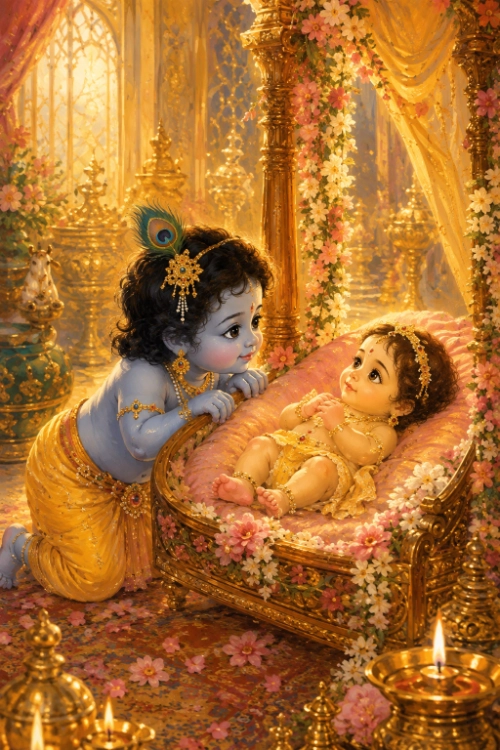
The Appearance of Śrīmatī Rādhārāṇī: Hlādinī-śakti and the Traditions of Her Descent
Śrīmatī Rādhārāṇī is the eternal beloved of Śrī Kṛṣṇa and, in Gauḍīya Vaiṣṇava theology, far more than an exceptionally exalted devotee or an incarnation of the goddess Lakṣmī. She is understood as Kṛṣṇa’s own internal pleasure potency, the hlādinī-śakti — the divine potency through which Kṛṣṇa experiences and exchanges transcendental love.
The Caitanya-caritāmṛta states this identity in one of its most important theological verses:
राधा कृष्णप्रणयविकृतिर्ह्लादिनी शक्तिरस्माद्
एकात्मानावपि भुवि पुरा देहभेदं गतौ तौ ।
चैतन्याख्यं प्रकटमधुना तद्द्वयं चैक्यमाप्तं
राधाभावद्युतिसुवलितं नौमि कृष्णस्वरूपम् ॥
rādhā kṛṣṇa-praṇaya-vikṛtir hlādinī śaktir asmād
ekātmānāv api bhuvi purā deha-bhedaṁ gatau tau
caitanyākhyaṁ prakaṭam adhunā tad-dvayaṁ caikyam āptaṁ
rādhā-bhāva-dyuti-suvalitaṁ naumi kṛṣṇa-svarūpam
“Rādhā is the transformation of Kṛṣṇa’s love, His hlādinī-śakti. Although Rādhā and Kṛṣṇa are one in identity, They eternally manifest in two forms.”
Caitanya-caritāmṛta, Ādi-līlā 1.5
The same work puts it more simply:
राधिका हयेन कृष्णेर प्रणय-विकार ।
स्वरूप-शक्ति—‘ह्लादिनी’ नाम याँहार ॥
rādhikā hayena kṛṣṇera praṇaya-vikāra
svarūpa-śakti—‘hlādinī’ nāma yāṅhāra
“Śrīmatī Rādhikā is the transformation of Kṛṣṇa’s love. She is His internal potency called hlādinī.”
Caitanya-caritāmṛta, Ādi-līlā 4.59
This is also why, from the Gauḍīya perspective, it is inadequate to describe Rādhā merely as a manifestation of Lakṣmī. The Bṛhad-gautamīya-tantra, quoted in the Caitanya-caritāmṛta, calls her sarva-lakṣmī-mayī — the one in whom all the Lakṣmīs have their source:
देवी कृष्णमयी प्रोक्ता राधिका परदेवता ।
सर्वलक्ष्मीमयी सर्वकान्तिः सम्मोहिनी परा ॥
devī kṛṣṇa-mayī proktā rādhikā para-devatā
sarva-lakṣmī-mayī sarva-kāntiḥ sammohinī parā
“Rādhikā is the supreme goddess, completely filled with Kṛṣṇa. She is the source and embodiment of all the goddesses of fortune, the repository of all beauty, and she enchants even Kṛṣṇa Himself.”
Bṛhad-gautamīya-tantra, cited in Caitanya-caritāmṛta, Ādi-līlā 4.83
Rādhā therefore does not descend into Vraja as an ordinary soul who later develops extraordinary devotion to Kṛṣṇa. She descends with Kṛṣṇa, as His eternal śakti, so that their eternal Vraja-līlā may become manifest within this world.
Why Are There Different Accounts of Her Appearance?
Vaiṣṇava literature preserves several accounts of Śrī Rādhā’s earthly manifestation, and it is important not to combine every detail into a single chronological narrative.
The Śrīmad-Bhāgavatam does not narrate Rādhā’s birth and does not explicitly introduce her by name. Yet the Gauḍīya ācāryas identify her presence in verses such as this one:
अनयाराधितो नूनं भगवान् हरिरीश्वरः ।
यन्नो विहाय गोविन्दः प्रीतो यामनयद् रहः ॥
anayārādhito nūnaṁ bhagavān harir īśvaraḥ
yan no vihāya govindaḥ prīto yām anayad rahaḥ
“Surely this particular gopī has perfectly worshipped Bhagavān Hari, for Govinda was so pleased with her that He left all of us and took her alone to a secluded place.”
Śrīmad-Bhāgavatam 10.30.28
Śrī Viśvanātha Cakravartī Ṭhākura explains that the word ārādhitaḥ here reveals Rādhā: she is the one whose worship and love have completely captivated Govinda.
More explicit accounts of her appearance are preserved in the Garga-saṁhitā, in Rūpa Gosvāmī’s Lalita-mādhava, and in the living sacred traditions of Vraja — particularly those associated with Rāvala, the place traditionally revered as Rādhā’s appearance site.
These accounts are not identical. Rather than forcing them into one continuous sequence, it is better to hear each according to its own theological and literary setting.
Her Descent in the Garga-saṁhitā
The Garga-saṁhitā contains an entire chapter entitled Śrī-Rādhikā-janma-varṇana, “The Description of Śrī Rādhikā’s Birth.” It describes Rādhā as consciously descending into the household of Vṛṣabhānu beside the Yamunā:
अथैव राधा वृषभानु-पत्न्याम्
आवेश्य रूपं महसः पराख्यम् ।
कलिन्दजा-कुल-निकुञ्ज-देशे
सु-मन्दिरे सावततार राजन् ॥
athaiva rādhā vṛṣabhānu-patnyām
āveśya rūpaṁ mahasaḥ parākhyam
kalindajā-kula-nikuñja-deśe
su-mandire sāvatatāra rājan
“Then Śrī Rādhā, placing her glorious transcendental form within the wife of Vṛṣabhānu, descended into a beautiful residence in a grove on the bank of the Yamunā.”
Garga-saṁhitā 1.8.6
This verse matters especially because the Garga-saṁhitā itself describes a descent through Vṛṣabhānu’s wife — not the golden-lotus episode found in another stream of Vraja tradition.
The following verse gives the sacred time of her appearance:
घनावृते व्योम्नि दिनस्य मध्ये
भाद्रे सिते नाग-तिथौ च सोमे ।
अवाकिरन् देव-गणाः स्फुरद्भिस्
तन्-मन्दिरे नन्दनजैः प्रसूनैः ॥
ghanāvṛte vyomni dinasya madhye
bhādre site nāga-tithau ca some
avākiran deva-gaṇāḥ sphuradbhis
tan-mandire nandanajaiḥ prasūnaiḥ
“At midday, when the sky was covered with clouds, on the eighth day of the bright fortnight of Bhādra, on a Monday, the devas showered her residence with blossoming flowers from the celestial Nandana garden.”
Garga-saṁhitā 1.8.7
This Bhādra śukla aṣṭamī is celebrated as Rādhāṣṭamī. Her descent transforms the atmosphere of the world itself:
राधावतारेण तदा बभूवुर्
नद्योऽमलाम्भश् च दिशः प्रसेदुः ।
ववुश् च वाता अरविन्द-रागैः
सु-शीतलाः सुन्दर-मन्द-यानाः ॥
rādhāvatāreṇa tadā babhūvur
nadyo ’malāmbhaś ca diśaḥ praseduḥ
vavuś ca vātā aravinda-rāgaiḥ
su-śītalāḥ sundara-manda-yānāḥ
“With Rādhā’s descent the rivers became pure and clear, the directions became auspicious, and gentle cooling breezes carried the pollen of lotus flowers.”
Garga-saṁhitā 1.8.8
The next verse describes Kīrti, Rādhā’s mother, gazing upon a daughter beautiful as hundreds of autumn moons and joyfully giving immense charity to the brāhmaṇas.
Some sources call Rādhā’s mother Kīrti and others Kīrtidā, while the Garga-saṁhitā elsewhere connects Vṛṣabhānu’s wife with Kalāvatī. These names should not automatically be treated as references to entirely different women.
The Vindhya Account in Lalita-mādhava
Rūpa Gosvāmī preserves another, much more elaborate revelation in his Sanskrit drama Lalita-mādhava. In the first act, Paurṇamāsī explains the confidential history of Rādhā and Candrāvalī to Gārgī, the daughter of Garga Muni.
The story begins with the personified Mount Vindhya. Vindhya had become envious of Himālaya, whose daughter Gaurī — Pārvatī — had obtained the extraordinarily powerful Lord Śiva as her husband. Vindhya therefore desired daughters whose husbands would be capable of defeating even Śiva. Brahmā granted the wish, declaring that he would receive two extraordinary daughters whose future husband would triumph even over Lord Śiva.
Those two girls are revealed as Rādhā and Candrāvalī.
But Rūpa Gosvāmī adds a remarkable detail that keeps this account from contradicting Rādhā’s eternal identity as Vṛṣabhānu’s daughter. Paurṇamāsī explains that, at Brahmā’s request, Hari’s Yogamāyā drew the two girls from the wombs of Vṛṣabhānu’s and Candrabhānu’s wives and placed them in the womb of Vindhya’s wife.
So the Vindhya narrative does not ultimately deny Rādhā’s relationship with Vṛṣabhānu. Yogamāyā temporarily rearranges the circumstances of her manifestation for the unfolding of Kṛṣṇa’s līlā. This also explains the traditional names by which she is known:
Pūtanā abducts the divine girls
The Lalita-mādhava account then introduces Pūtanā. After the divine daughter of Devakī had warned Kaṁsa that the one destined to destroy him had already appeared, she also foretold the manifestation of extraordinary divine śaktis. Kaṁsa therefore ordered Pūtanā to:
- destroy extraordinary male infants, and
- abduct extraordinary female infants.
Pūtanā consequently seized Rādhā and Candrāvalī. When Vindhya’s chief priest recited a rakṣoghna-mantra, a mantra destructive to hostile beings, Pūtanā became terrified and fled.
While she was flying above Vidarbha, the first of the two girls fell from her grasp into the current of a river, and King Bhīṣmaka later found that girl. Within the larger theological structure of Lalita-mādhava, this becomes part of Rūpa Gosvāmī’s profound identification and reconciliation of the Vraja gopīs with Kṛṣṇa’s queens in Dvārakā.
Rādhā’s course was different. Paurṇamāsī later explains that when Pūtanā was killed, she recovered Rādhā together with five other girls connected with Kṛṣṇa’s Vraja-līlā. She secretly distributed these girls among Vraja families and entrusted Rādhā to Mukhara, telling her that the child was the daughter of her son-in-law Vṛṣabhānu.
This is the authentic Pūtanā narrative in Lalita-mādhava. The popular story in which Pūtanā drops both Rādhā and Candrāvalī directly onto two lotuses in the Yamunā should not be presented as Rūpa Gosvāmī’s account.
The Golden Lotus of Rāvala
Alongside these textual accounts, Vraja preserves another deeply cherished tradition, associated especially with Rāvala, a village on the Yamunā near Gokula that is traditionally revered as Śrī Rādhā’s appearance place.
According to this tradition, Vṛṣabhānu Mahārāja went to the Yamunā and saw an extraordinary lotus upon the water, radiating a supernatural golden brilliance. When he approached it he discovered within the flower a beautiful infant girl shining with divine effulgence. Overcome with wonder and affection, Vṛṣabhānu accepted the child as divine mercy and brought her home to Kīrtidā.
So Rādhā — eternal, and unborn in any ordinary material sense — entered the parental affection of Vṛṣabhānu and Kīrtidā, and allowed them to experience themselves simply as the mother and father of their precious daughter.
This lotus narrative should be understood as a distinct Vraja appearance tradition, not as the next episode after the Pūtanā story of Lalita-mādhava. Rāvala is particularly associated with Rādhā’s infancy, while Varṣāṇā becomes the great sacred landscape of her childhood and youthful pastimes.
The Child Who Would Not Open Her Eyes
A particularly beloved part of the Vraja tradition tells that although Rādhā was extraordinarily beautiful, she did not open her eyes. Vṛṣabhānu and Kīrtidā naturally feared that their daughter had been born blind.
Some later devotional retellings expand the parents’ anxiety and describe her as unusually silent and still, but the essential tradition concerns her closed eyes.
Vaiṣṇava teachers explain the mystery very differently from the parents. Rādhā was not incapable of seeing. She would not see.
Before entering the manifest earthly līlā she desired that when she first opened her eyes, the first form she beheld would be Śrī Kṛṣṇa. Her apparent blindness is therefore an expression of her deepest identity: for Rādhā, sight itself has meaning only because there is Kṛṣṇa to behold. This corresponds exactly to the description kṛṣṇa-mayī — one whose inner and outer existence is entirely filled with Kṛṣṇa.
Nārada Muni Recognises Her
Gauḍīya devotional narrations also preserve the visit of Nārada Muni to Vṛṣabhānu’s home. When Nārada asked to see the child, the parents hesitated, because they believed she was blind. But when the sage finally received her darśana he recognised at once that this was no ordinary child: he understood her as Kṛṣṇa’s own internal pleasure potency.
Rather than embellishing the episode with an elaborate inventory of jewels and ritual objects, its essential significance is more profound. Nārada — the great devarṣi, the devotee of Nārāyaṇa — is overwhelmed on encountering the one who is the very embodiment of the highest love of Kṛṣṇa.
Traditional Gauḍīya retellings say that after leaving the parents, Nārada went to a secluded place and prayed to see Rādhā not merely in her infant form but in her eternal kiśorī-rūpa — the blossoming adolescent form in which she eternally performs her intimate Vraja-līlā with Kṛṣṇa. By her mercy Śrī Rādhā granted him that darśana, accompanied in some narrations by Lalitā-sakhī and other intimate companions.
Nārada thus understood that the apparently helpless infant in Vṛṣabhānu’s home was in truth the eternal queen of Vraja.
Rādhā Opens Her Eyes for Kṛṣṇa
The culmination of the infancy narrative comes when Nanda Mahārāja and Mother Yaśodā visit Vṛṣabhānu and Kīrtidā with little Kṛṣṇa.
The precise details differ among traditional retellings. In some Kṛṣṇa crawls towards Rādhā; in others he is carried close to her. Some emphasise his touch, while others say Rādhā first recognises the transcendental fragrance of his body.
But all preserve the same essential moment. Kṛṣṇa comes face to face with the infant Rādhā — and Rādhā opens her eyes. The first form she beholds in this manifest world is Śrī Kṛṣṇa.
Her parents rejoice, believing their daughter’s blindness has miraculously gone. But from the theological perspective of the tradition nothing has been cured. Rādhā had simply been waiting. She had entered the world for Kṛṣṇa, and so she would first look upon Kṛṣṇa.
This childhood episode expresses in narrative form what Gauḍīya theology teaches philosophically: Rādhā exists wholly for Kṛṣṇa, and Kṛṣṇa is completely conquered by Rādhā’s love. As the Caitanya-caritāmṛta says:
सेइ गोपीगण-मध्ये उत्तमा राधिका ।
रूपे, गुणे, सौभाग्ये, प्रेमे सर्वाधिका ॥
sei gopī-gaṇa-madhye uttamā rādhikā
rūpe, guṇe, saubhāgye, preme sarvādhikā
“Among all the gopīs, Śrīmatī Rādhikā is the foremost. She surpasses all in beauty, qualities, good fortune, and above all, in love.”
Caitanya-caritāmṛta, Ādi-līlā 4.214
The various narratives differ in external detail, but their theological centre is remarkably consistent. Rādhā does not begin to exist at Rāvala, at Varṣāṇā, in Vṛṣabhānu’s household, in the womb of Vindhya’s wife, or upon a lotus in the Yamunā. She is nitya — eternal. Her “birth” is therefore better understood as avatāra or prakaṭya: descent, manifestation.
She appears because Kṛṣṇa appears. She enters childhood because Kṛṣṇa performs childhood pastimes. She enters Vraja because Vraja is the field in which their eternal love becomes visible to the world.
And although the Śrīmad-Bhāgavatam seems at first to conceal her name, Gauḍīya commentators see it shining through the words anayārādhito nūnam — “surely she has worshipped Him more perfectly than anyone else.” The one who perfectly ārādhayati, who worships and satisfies Kṛṣṇa completely, is Rādhā.
Her appearance is therefore not simply the birth of another divine personality. It is the earthly manifestation of Kṛṣṇa-prema itself — the supreme love by which even the all-attractive Kṛṣṇa becomes attracted, controlled and conquered.