

The Moment Arjuna Became Teachable
The Spiritual Power of Saying “I Do Not Know”
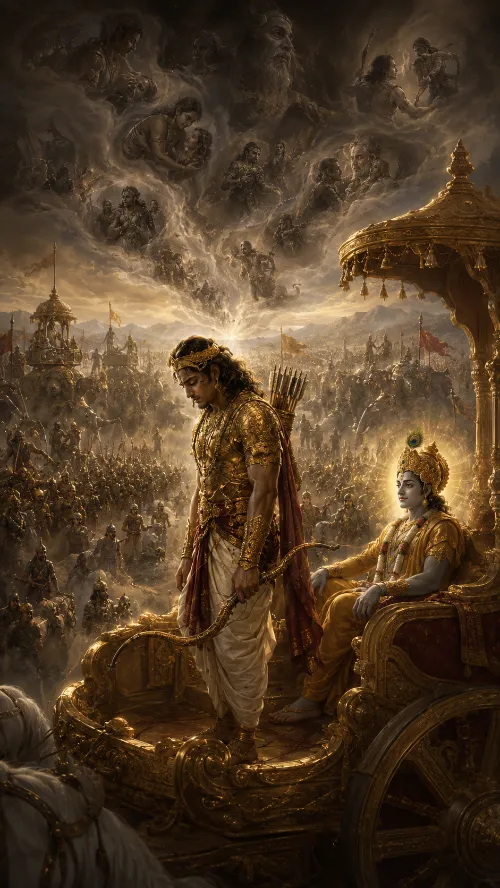
There is a point in the Bhagavad-gītā when Arjuna stops trying to persuade Kṛṣṇa and finally allows Kṛṣṇa to teach him.
That moment is Bhagavad-gītā 2.7.
Until then, Arjuna argues. He has explained why fighting seems wrong: he will have to kill relatives and teachers, family traditions may collapse, sin may follow, and no kingdom can compensate for the deaths of those he loves. These are not foolish objections. Some are compassionate; others are morally sophisticated.
But they have not solved his problem. Eventually Arjuna recognizes something more disturbing than the battlefield itself: he no longer trusts his own ability to determine what is right.
Then he says:
कार्पण्यदोषोपहतस्वभावः
पृच्छामि त्वां धर्मसम्मूढचेताः ।
यच्छ्रेयः स्यान्निश्चितं ब्रूहि तन्मे
शिष्यस्तेऽहं शाधि मां त्वां प्रपन्नम् ॥
kārpaṇya-doṣopahata-svabhāvaḥ
pṛcchāmi tvāṁ dharma-sammūḍha-cetāḥ
yac chreyaḥ syān niścitaṁ brūhi tan me
śiṣyas te ’haṁ śādhi māṁ tvāṁ prapannam
“My nature has been overcome by the fault of weakness, and my consciousness is bewildered regarding dharma. I ask You: tell me decisively what would truly lead to my highest good. I am Your disciple; instruct me, for I have taken refuge in You.”
Bhagavad-gītā 2.7
Śrīla A. C. Bhaktivedanta Swami Prabhupāda renders the central movement of the verse in familiar language: “Now I am confused about my duty… Now I am Your disciple, and a soul surrendered unto You. Please instruct me.”
This is the formal turning point. A conversation between intimate friends becomes a guru–śiṣya dialogue. Yet the deeper change is internal: Arjuna stops asking Kṛṣṇa to confirm his conclusion and becomes willing to have that conclusion corrected. Only then can Kṛṣṇa’s systematic teaching begin.
A Crisis of Competing Duties
Arjuna’s problem is not that he has no arguments. He has too many arguments pointing in different directions.
He asks Kṛṣṇa:
कथं भीष्ममहं सङ्ख्ये
द्रोणं च मधुसूदन ।
इषुभिः प्रतियोत्स्यामि
पूजार्हावरिसूदन ॥
kathaṁ bhīṣmam ahaṁ saṅkhye
droṇaṁ ca madhusūdana
iṣubhiḥ pratiyotsyāmi
pūjārhāv ari-sūdana
“How can I fight with arrows against Bhīṣma and Droṇa in battle, O Madhusūdana? O destroyer of enemies, they are worthy of my worship.”
Bhagavad-gītā 2.4
He then says that begging would be preferable to killing his teachers:
गुरूनहत्वा हि महानुभावान्
श्रेयो भोक्तुं भैक्ष्यमपीह लोके ।
हत्वार्थकामांस्तु गुरूनिहैव
भुञ्जीय भोगान् रुधिरप्रदिग्धान् ॥
gurūn ahatvā hi mahānubhāvān
śreyo bhoktuṁ bhaikṣyam apīha loke
hatvārtha-kāmāṁs tu gurūn ihaiva
bhuñjīya bhogān rudhira-pradigdhān
“It would be better in this world to live by begging than to kill these great teachers. If I killed them, although they desire material gain, whatever pleasures I enjoyed here would be stained with their blood.”
Bhagavad-gītā 2.5
Arjuna is not stupid, shallow, or simply afraid of dying. He sees several genuine duties colliding. He owes reverence to Bhīṣma and Droṇa, yet he also has obligations as a kṣatriya. He wishes to avoid violence and sin, yet refusing to resist injustice also has consequences. Compassion, justice, family loyalty, public responsibility, and fear of wrongdoing pull him in different directions.
That is why his crisis remains recognizable. The hardest decisions are rarely presented as obvious good versus obvious evil. More often, one responsibility says “stay” while another says “leave.” Loyalty conflicts with truth. Duty to one person appears to injure another. Acting carries a cost, but avoiding action also carries a cost.
In such moments, having sincere motives does not guarantee clear judgment. Arjuna finally sees that his moral reasoning has become entangled with grief, attachment, and fear.
What Arjuna Admits About His Own Condition
Arjuna begins with the difficult compound:
कार्पण्यदोषोपहतस्वभावः
kārpaṇya-doṣopahata-svabhāvaḥ
It means that his svabhāva—his natural disposition or characteristic strength—has been impaired by kārpaṇya-doṣa.
Prabhupāda translates kārpaṇya-doṣa as “miserly weakness.” Other translations use “faint-heartedness,” “dejection,” “weak pity,” or “the defect of weakness.” The underlying word kṛpaṇa can describe someone pitiable, impoverished, narrow, or miserly.
The Bṛhadāraṇyaka Upaniṣad gives the word a deeper spiritual force:
यो वा एतदक्षरं गार्ग्यविदित्वास्माल्लोकात्प्रैति स कृपणः ।
yo vā etad akṣaraṁ gārgy aviditvāsmāl lokāt praiti sa kṛpaṇaḥ
“O Gārgī, whoever departs from this world without knowing this Imperishable is a kṛpaṇa—a pitiable or miserly person.”
Bṛhadāraṇyaka Upaniṣad 3.8.10
Madhusūdana Sarasvatī explicitly cites this Upaniṣadic statement in his commentary on Bhagavad-gītā 2.7. A miser possesses something valuable but fails to use it properly. Similarly, a human being possesses the rare opportunity for self-knowledge but may waste it without realizing the Imperishable.
Arjuna possesses intelligence, training, courage, knowledge of dharma, and direct access to Kṛṣṇa. Yet his distress has narrowed his vision so severely that he cannot use those gifts properly. Kārpaṇya therefore suggests more than sadness. It is a constricted state in which a person can no longer see or act from his full capacity.
The rest of the compound, upahata-svabhāvaḥ, means that his nature has been struck, overpowered, or impaired. Classical commentators connect this with Arjuna’s normal kṣatriya qualities: courage, steadiness, decisiveness, and readiness to bear responsibility. He is effectively saying, “I am no longer functioning like myself.”
Kṛṣṇa had already called this condition:
हृदयदौर्बल्यम्
hṛdaya-daurbalyam
“weakness of heart”
Bhagavad-gītā 2.3
Arjuna now admits that something has indeed overwhelmed him. This admission is essential. Confused judgment cannot be corrected until we accept that our judgment may be confused.
Arjuna then names the actual problem:
धर्मसम्मूढचेताः
dharma-sammūḍha-cetāḥ
“My consciousness is thoroughly bewildered regarding dharma.”
He is not saying, “I do not know which religion I belong to.” He is saying, “I cannot determine what the right action is.” Śrīdhara Svāmī explains the dilemma concretely: is abandoning the battle and living by begging proper for a kṣatriya, or is refusing the battle itself adharma?
Strong emotion may contain important information, but it can also distort perception. Arjuna has become wise enough to ask not only, “How strongly do I feel this?” but also, “How reliable is my judgment while I feel it?”
From Defending an Answer to Asking a Real Question
Arjuna then says:
पृच्छामि त्वाम्
pṛcchāmi tvām
“I ask You.”
Before this, Arjuna mainly explains. Now he asks. There is a profound difference between “Tell me why my conclusion is correct” and “Tell me what is actually correct.”
A person can seek advice while remaining unwilling to be advised. We may ask several people until one confirms what we already want, or read only the arguments that support our present position. We call it guidance, but what we really seek is validation.
Arjuna’s question becomes genuine because the answer is now allowed to overturn his answer.
What does he ask for? Not immediate relief, but śreyas:
यच्छ्रेयः स्यात्
yac chreyaḥ syāt
“what would truly be for the higher good.”
The Kaṭha Upaniṣad distinguishes śreyas, what is truly beneficial, from preyas, what is immediately pleasant:
अन्यच्छ्रेयोऽन्यदुतैव प्रेयस्
ते उभे नानार्थे पुरुषं सिनीतः ।
तयोः श्रेय आददानस्य साधु
भवति हीयतेऽर्थाद्य उ प्रेयो वृणीते ॥
anyac chreyo ’nyad utaiva preyas
te ubhe nānārthe puruṣaṁ sinītaḥ
tayoḥ śreya ādadānasya sādhu
bhavati hīyate ’rthād ya u preyo vṛṇīte
“The truly good is one thing and the immediately pleasant another. These two lead a person toward different ends. It goes well with one who chooses śreyas, the higher good; one who chooses merely what is pleasant falls away from the true goal.”
Kaṭha Upaniṣad 1.2.1
Arjuna is no longer asking which choice will end his discomfort fastest or make him appear compassionate. He asks what is genuinely best, even if the answer is painful.
This distinction enters ordinary life whenever apologizing is painful but right, abandoning a destructive habit is difficult but necessary, or telling the truth is harder than remaining silent. Emotional relief and genuine welfare are not always the same.
Finally Arjuna adds:
निश्चितं ब्रूहि
niścitaṁ brūhi
“Tell me decisively.”
His mind is already full of competing possibilities. What he lacks is not information but the ability to integrate that information into a reliable conclusion. He therefore asks Kṛṣṇa to determine what truly serves his highest good.
“I Am Your Disciple”
The relationship changes with three expressions:
शिष्यस्तेऽहम्
śiṣyas te ’ham
“I am Your disciple.”
शाधि माम्
śādhi mām
“Instruct me.”
त्वां प्रपन्नम्
tvāṁ prapannam
“I have taken refuge in You.”
The word śiṣya means a disciple or student—one who accepts instruction and discipline. Śrīdhara Svāmī glosses it:
शिष्यः शासनार्हः ।
śiṣyaḥ śāsanārhaḥ
“A disciple is one who is fit to receive instruction.”
He explains śādhi with śikṣaya—“teach me”—and prapanna with śaraṇāgata—“one who has taken refuge.” Arjuna is not asking for an interesting perspective. He is authorizing Kṛṣṇa to correct him.
The classical commentators recognize the formality of the transition. Rāmānuja understands Arjuna as approaching Kṛṣṇa for a definite judgment concerning his true welfare. Madhusūdana Sarasvatī begins his explanation with:
गुरूपसदनमिदानीं प्रतिपाद्यते ।
gurūpasadanam idānīṁ pratipādyate
“Now the approaching of a guru is being taught.”
This echoes the Upaniṣadic model:
तद्विज्ञानार्थं स गुरुमेवाभिगच्छेत्
समित्पाणिः श्रोत्रियं ब्रह्मनिष्ठम् ॥
tad-vijñānārthaṁ sa gurum evābhigacchet
samit-pāṇiḥ śrotriyaṁ brahma-niṣṭham
“For the realization of That, one should indeed approach a guru, carrying sacrificial fuel in hand—one who is learned in revelation and firmly established in Brahman.”
Muṇḍaka Upaniṣad 1.2.12
The Upaniṣad does not recommend surrender to any confident authority figure. It describes a qualified teacher: śrotriya, grounded in revealed knowledge, and brahma-niṣṭha, firmly established in spiritual realization.
Arjuna does not physically arrive carrying firewood. Spiritually, however, the pattern is recognizable. He has reached the limit of his independent conclusion, accepts Kṛṣṇa as qualified to teach him, asks a real question, and becomes willing to receive correction. This is not intellectual defeat. It is the beginning of deeper intelligence.
Surrender Begins Before Agreement
One detail prevents us from reducing discipleship to instant, artificial agreement.
After saying “I am Your disciple” and “I have taken refuge in You,” Arjuna does not immediately change his opinion. In verse 2.8 he says that even unrivalled sovereignty on earth—or lordship among the devas—could not remove the grief drying up his senses. External success cannot answer the moral and spiritual problem.
Then Sañjaya reports:
सञ्जय उवाच ।
एवमुक्त्वा हृषीकेशं
गुडाकेशः परन्तप ।
न योत्स्य इति गोविन्दम्
उक्त्वा तूष्णीं बभूव ह ॥
sañjaya uvāca
evam uktvā hṛṣīkeśaṁ
guḍākeśaḥ parantapa
na yotsya iti govindam
uktvā tūṣṇīṁ babhūva ha
“Sañjaya said: Having spoken thus to Hṛṣīkeśa, Arjuna, the conqueror of sleep and chastiser of enemies, said to Govinda, ‘I shall not fight,’ and became silent.”
Bhagavad-gītā 2.9
Arjuna has surrendered as a disciple, but his present conclusion remains: na yotsye—“I will not fight.” Therefore surrender in 2.7 does not mean, “I already agree.” It means, “I no longer trust my present conclusion enough to make it final. Teach me.”
That is intellectual humility without dishonesty. Arjuna neither pretends to understand nor claims certainty he no longer possesses. Real discipleship begins before agreement because instruction is what makes informed agreement possible.
Then he becomes silent. Until now he has filled the conversation with reasons; now he creates space to hear. A person who spends every answer preparing the next objection may hear words without learning anything.
Kṛṣṇa begins by correcting him:
अशोच्यानन्वशोचस्त्वं
प्रज्ञावादांश्च भाषसे ।
गतासूनगतासूंश्च
नानुशोचन्ति पण्डिताः ॥
aśocyān anvaśocas tvaṁ
prajñā-vādāṁś ca bhāṣase
gatāsūn agatāsūṁś ca
nānuśocanti paṇḍitāḥ
“You grieve for those who should not be grieved for, yet you speak words that sound wise. Those who truly know do not grieve in this way for either the living or the dead.”
Bhagavad-gītā 2.11
Kṛṣṇa does not begin by validating Arjuna. He tells him that his learned-sounding arguments rest upon incomplete understanding. That is exactly the correction Arjuna has requested.
Humility Does Not Mean Switching Off the Mind
The Gītā later explains how spiritual knowledge should be received:
तद्विद्धि प्रणिपातेन
परिप्रश्नेन सेवया ।
उपदेक्ष्यन्ति ते ज्ञानं
ज्ञानिनस्तत्त्वदर्शिनः ॥
tad viddhi praṇipātena
paripraśnena sevayā
upadekṣyanti te jñānaṁ
jñāninas tattva-darśinaḥ
“Learn that truth through humble approach, thorough inquiry, and service. Those who possess knowledge and have seen reality will instruct you in that knowledge.”
Bhagavad-gītā 4.34
Three principles appear together: praṇipāta, humble approach; paripraśna, serious and thorough inquiry; and sevā, service. The verse teaches neither submission without questions nor questioning without humility.
Kṛṣṇadāsa Kavirāja preserves the same balance in his description of foundational bhakti practice:
গুরুপাদাশ্রয়, দীক্ষা, গুরুর সেবন ।
সদ্ধর্মশিক্ষা-পৃচ্ছা, সাধুমার্গানুগমন ॥
guru-pādāśraya, dīkṣā, gurura sevana
sad-dharma-śikṣā-pṛcchā, sādhu-mārgānugamana
“One takes shelter at the feet of the guru, receives initiation, serves the guru, inquires in order to learn true dharma, and follows the path of the sādhus.”
Caitanya-caritāmṛta, Madhya 22.115
Shelter, service, and inquiry belong together. The Gauḍīya guru–disciple relationship does not erase intelligent questioning; proper inquiry is part of discipleship.
This becomes unmistakable near the end of the Bhagavad-gītā. After teaching Arjuna, Kṛṣṇa says:
इति ते ज्ञानमाख्यातं
गुह्याद्गुह्यतरं मया ।
विमृश्यैतदशेषेण
यथेच्छसि तथा कुरु ॥
iti te jñānam ākhyātaṁ
guhyād guhya-taraṁ mayā
vimṛśyaitad aśeṣeṇa
yathecchasi tathā kuru
“Thus I have explained to you knowledge more confidential than the confidential. Deliberate upon it fully, and then act as you wish.”
Bhagavad-gītā 18.63
The key word is vimṛśya: having reflected or deliberated carefully. Kṛṣṇa does not say, “You are My disciple, therefore thinking is forbidden.” He tells Arjuna to consider the teaching fully and then choose how to act.
Arjuna has not surrendered intelligence, moral responsibility, or the right to ask questions. He has surrendered the insistence that his present perception must be correct simply because it is his. That is disciplined humility, not blind obedience.
From “I Do Not Know” to “I Will Act”
The language of refuge in 2.7 later reaches its theological climax:
सर्वधर्मान्परित्यज्य
मामेकं शरणं व्रज ।
अहं त्वां सर्वपापेभ्यो
मोक्षयिष्यामि मा शुचः ॥
sarva-dharmān parityajya
mām ekaṁ śaraṇaṁ vraja
ahaṁ tvāṁ sarva-pāpebhyo
mokṣayiṣyāmi mā śucaḥ
“Abandoning all other dharmas, take refuge in Me alone. I shall free you from all sinful reactions. Do not grieve.”
Bhagavad-gītā 18.66
At 2.7 Arjuna says, tvāṁ prapannam—“I have taken refuge in You.” At 18.66 Kṛṣṇa gives the complete instruction: mām ekaṁ śaraṇaṁ vraja—“Take refuge in Me alone.” The seed introduced in Chapter Two is unfolded through the entire Gītā.
The result appears when Arjuna finally replies:
नष्टो मोहः स्मृतिर्लब्धा
त्वत्प्रसादान्मयाच्युत ।
स्थितोऽस्मि गतसन्देहः
करिष्ये वचनं तव ॥
naṣṭo mohaḥ smṛtir labdhā
tvat-prasādān mayācyuta
sthito ’smi gata-sandehaḥ
kariṣye vacanaṁ tava
“My delusion has been destroyed, and my memory—my clear understanding—has been restored by Your grace, O Acyuta. I stand firm, free from doubt. I shall act according to Your word.”
Bhagavad-gītā 18.73
This is the answer to 2.7.
At the beginning Arjuna says dharma-sammūḍha-cetāḥ—“I am bewildered concerning dharma.” At the end he says gata-sandehaḥ—“my doubt is gone.” At the beginning he asks to be taught; at the end his clear understanding has been restored. At the beginning he accepts discipleship; at the end he freely says, kariṣye vacanaṁ tava—“I shall act according to Your word.”
Notice the sequence. Arjuna does not move directly from confusion to obedience. His delusion is destroyed, understanding restored, steadiness regained, and doubt resolved; only then does he act.
The Gītā therefore shows two stages of surrender. The first is the humility of a teachable person: “I recognize that I do not know. Teach me.” The second is mature, willing action: “I have understood. My doubt is gone. I will act.” Almost the entire teaching of the Bhagavad-gītā stands between those two statements.
What Bhagavad-gītā 2.7 Means for the Reader
Arjuna’s admission offers a practical method for difficult decisions.
Diagnose your condition before defending your conclusion
Ask whether fear, anger, grief, attachment, pride, personal gain, or family loyalty may be narrowing your vision. Strong emotion does not automatically make a conclusion false, but neither does sincerity make it reliable.
Separate śreyas from preyas
Are you seeking what is truly beneficial, or what provides the quickest relief? The pleasant choice and the right choice sometimes coincide, but not always.
Seek qualified guidance
Do not ask only those who will agree with you. Look for guidance grounded in śāstra, authentic tradition, realization, sound character, and freedom from personal interest in your decision.
Ask a question that permits correction
“What do you think?” is not a real question if every unwelcome answer will be rejected. Teachable inquiry begins when the answer is allowed to challenge the assumptions behind the question.
Listen and deliberate
Arjuna becomes silent, receives extensive instruction, asks further questions, and reflects. Humility is not passivity. The Gītā explicitly requires paripraśna, thorough inquiry, and vimṛśya, careful deliberation.
Act from clarified responsibility
Guidance is not complete while it remains an interesting idea. Arjuna’s education culminates in action freely accepted after his doubt has been resolved.
Bhagavad-gītā 2.7 does not teach that we should never trust our judgment, obey any authority figure, stop thinking, or pretend to agree. It teaches something more demanding: recognize when your own mind is no longer a reliable judge of its conclusions; then seek qualified guidance, ask honestly, listen carefully, think deeply, and accept the responsibility to act.
Conclusion: The Strength to Become Teachable
People often associate certainty with strength. But certainty is valuable only when connected with truth; false certainty merely makes correction harder.
Arjuna is one of the greatest warriors of his age. Yet one of his strongest moments occurs while he is overwhelmed and admits, “I cannot see clearly.” That admission is not the end of his strength. It is how his strength becomes usable again.
Before Bhagavad-gītā 2.7, Arjuna wants a solution to the battlefield. After 2.7, he permits Kṛṣṇa to transform the person who is looking at the battlefield. The Gītā does not remove Kurukṣetra. It removes moha—delusion.
Arjuna has not yet changed his conclusion. He has changed something more fundamental: his relationship with his own certainty. He can finally say:
धर्मसम्मूढचेताः
dharma-sammūḍha-cetāḥ
“I am bewildered concerning what is right.”
पृच्छामि त्वाम्
pṛcchāmi tvām
“I ask You.”
शिष्यस्तेऽहम्
śiṣyas te ’ham
“I am Your disciple.”
शाधि माम्
śādhi mām
“Teach me.”
That is what makes instruction possible. By the end, the result is visible:
नष्टो मोहः
naṣṭo mohaḥ
“My delusion is destroyed.”
गतसन्देहः
gata-sandehaḥ
“My doubt is gone.”
करिष्ये वचनं तव
kariṣye vacanaṁ tava
“I shall act according to Your word.”
The movement is not confusion followed by mindless obedience. It is:
confusion → humility → inquiry → teaching → reflection → understanding → freely accepted action.
Real learning begins when we stop asking only, “How can I prove that I am right?” and become capable of asking, “What if I am not seeing this clearly?”
Arjuna becomes teachable at precisely that moment. And once he becomes teachable, the Bhagavad-gītā can teach him.
Primary Texts and Sources
Translations in this article are the author’s unless another translator is identified.