

The Sun and Moon That Rise Inside the Heart
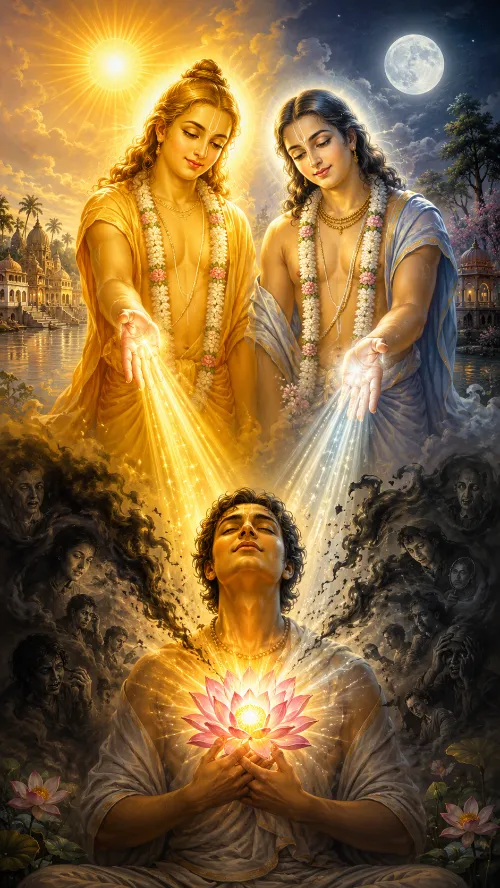
The Sun and Moon That Rise Inside the Heart: Caitanya, Nityānanda, and the Five Forms of Ignorance Behind Human Bondage
The ordinary sun can illuminate a city. It can reveal a road, a house, a tree, a face. The moon can illuminate the night. But neither can answer: Who am I? Neither can remove the fear of death.
Neither can explain why pleasure repeatedly turns into dissatisfaction. Neither can reveal whether the world exists independently or as the energy of a deeper Absolute Reality.
For that reason, Kṛṣṇadāsa Kavirāja describes Śrī Caitanya Mahāprabhu and Śrī Nityānanda Prabhu as an extraordinary sun and moon. He writes:
এই চন্দ্র সূর্য দুই পরম সদয় ।
জগতের ভাগ্যে গৌড়ে করিলা উদয় ॥
ei candra sūrya dui parama sadaya
jagatera bhāgye gauḍe karilā udaya
“These two—the sun and moon—are exceedingly merciful. For the good fortune of the whole world, They have risen on the horizon of Gauḍa.”
Śrī Caitanya-caritāmṛta, Ādi 1.102
“These two” are Caitanya and Nityānanda. A. C. Bhaktivedanta Swami Prabhupāda explains in his purport that They remove five kinds of ignorance from conditioned souls:
- accepting the body as the self;
- making material sense enjoyment the standard of happiness;
- anxiety arising from material identification;
- lamentation;
- believing that reality exists independently of the Absolute Truth.
He connects this fivefold analysis with the Sanatsujātīya section of the Mahābhārata, Udyoga-parva. But the idea becomes much richer when we read the surrounding Caitanya-caritāmṛta verses and compare them with the Sanskrit teachings of the Mahābhārata, Śrīmad-Bhāgavatam, Viṣṇu Purāṇa, and other Vaiṣṇava sources.
The result is not simply a catalog of five mistakes. It is a remarkably coherent psychology of bondage. And it explains why Caitanya and Nityānanda are called: the sun and moon that illuminate the heart.
Ordinary Light Reveals Objects; Spiritual Light Reveals the Observer
Immediately before Ādi 1.102, Kṛṣṇadāsa Kavirāja explains his metaphor.
সূর্য চন্দ্র বাহিরের তমঃ সে বিনাশে ।
বহির্বস্তু ঘট-পট-আদি সে প্রকাশে ॥
sūrya candra bāhirera tamaḥ se vināśe
bahir-vastu ghaṭa-paṭa-ādi se prakāśe
“The sun and moon destroy the darkness of the external world and reveal external objects such as pots and plates.”
Caitanya-caritāmṛta, Ādi 1.97
This is ordinary illumination. Before sunrise, a pot may be present but unseen. When light comes, nothing new needs to be created. Light simply lets us recognize what was already there.
Then Kṛṣṇadāsa draws the contrast:
দুই ভাই হৃদয়ের ক্ষালি’ অন্ধকার ।
দুই ভাগবত-সঙ্গে করান সাক্ষাৎকার ॥
dui bhāi hṛdayera kṣāli’ andhakāra
dui bhāgavata-saṅge karāna sākṣātkāra
“But these two brothers cleanse the darkness within the heart and bring one into contact with the two Bhāgavatas.”
Caitanya-caritāmṛta, Ādi 1.98
The difference is profound. Ordinary light reveals: what is outside me. Caitanya and Nityānanda reveal: what I am, what binds me, and what my relationship with the Absolute actually is.
The Two Bhāgavatas: Scripture and the Living Devotee
What are the “two Bhāgavatas”? Kṛṣṇadāsa immediately answers:
এক ভাগবত বড়—ভাগবত-শাস্ত্র ।
আর ভাগবত—ভক্ত ভক্তি-রস-পাত্র ॥
eka bhāgavata baḍa — bhāgavata-śāstra
āra bhāgavata — bhakta bhakti-rasa-pātra
“One Bhāgavata is the great scripture Śrīmad-Bhāgavatam; the other is the devotee who is the vessel of bhakti-rasa.”
Caitanya-caritāmṛta, Ādi 1.99
This tells us something essential about how ignorance is removed. Not by information alone. Not merely by reading philosophy in isolation. One receives illumination through: bhāgavata-śāstra — revealed scripture; and: bhakta-bhāgavata — the living devotee in whom the teaching has become embodied.
The text gives doctrine. The devotee demonstrates what the doctrine looks like when it becomes consciousness.
What Happens When the Two Bhāgavatas Enter the Heart?
The next verse says:
দুই ভাগবত দ্বারা দিয়া ভক্তিরস ।
তাঁহার হৃদয়ে তাঁর প্রেমে হয় বশ ॥
dui bhāgavata dvārā diyā bhakti-rasa
tāṅhāra hṛdaye tāṅra preme haya vaśa
“Through these two Bhāgavatas, bhakti-rasa enters the heart, and the Lord becomes conquered by the devotee’s love.”
Caitanya-caritāmṛta, Ādi 1.100
This is important. Ignorance is not removed merely by subtraction. Caitanya’s teaching is not simply: “This identity is false.” “This pleasure is temporary.” “This attachment is ignorant.”
The empty space is filled with something positive: bhakti-rasa. Spiritual identity replaces false identity. Material attachment is replaced by attachment to Kṛṣṇa. Fear is replaced by shelter.
Lamentation is transformed through knowledge of the eternal self. And the apparently independent world is rediscovered as Kṛṣṇa’s energy.
The Second Miracle: Darkness Inside the Citta-guhā
Kṛṣṇadāsa then says:
এক অদ্ভুত—সমকালে দোঁহার প্রকাশ ।
আর অদ্ভুত—চিত্তগুহার তমঃ করে নাশ ॥
eka adbhuta — sama-kāle doṅhāra prakāśa
āra adbhuta — citta-guhāra tamaḥ kare nāśa
“One wonder is that both appear simultaneously; the other wonder is that They destroy the darkness in the innermost chamber of the heart.”
Caitanya-caritāmṛta, Ādi 1.101
The beautiful expression is:
চিত্তগুহা
citta-guhā
“the cave of consciousness,”
“the inner chamber of the heart.” A physical cave can remain dark even when the sun shines outside. Likewise, a person can live in a technologically illuminated civilization while the inner world remains confused.
We may know how stars form and still not know who is observing them. We may understand brain chemistry and still not understand consciousness. We may know how to extend biological life while remaining terrified by death.
The problem is not lack of external light. It is darkness in the citta-guhā.
Prabhupāda’s Five Kinds of Ignorance
In the purport to Ādi 1.102, Prabhupāda summarizes five kinds of ignorance:
- Accepting the body as the self
- Treating sense gratification as the standard of happiness
- Anxiety arising from material identification
- Lamentation
- Thinking that anything exists independently of the Absolute Truth
He attributes these to the Mahābhārata, Udyoga-parva, chapter 43. A source-critical qualification is useful here. The Sanatsujātīya section of the Mahābhārata indeed develops these themes, but surviving Sanskrit editions do not necessarily present Prabhupāda’s five English points as one consecutive numbered Sanskrit list.
The ideas occur throughout the discourse, and chapter divisions vary among recensions. For example, material found around chapters 42–43 in one edition may be arranged somewhat differently in another.
Thus Prabhupāda’s list should best be understood as a theological summary of the Sanatsujātīya analysis of ignorance. The underlying ideas, however, are unmistakably present.
First Ignorance: “I Am This Body”
The first and foundational mistake is bodily identification. The Sanatsujātīya says:
योऽन्यथा सन्तमात्मानम्
अन्यथा प्रतिपद्यते ।
किं तेन न कृतं पापं
चोरेणात्मापहारिणा ॥
yo ’nyathā santam ātmānam
anyathā pratipadyate
kiṁ tena na kṛtaṁ pāpaṁ
coreṇātmāpahāriṇā
“One who apprehends the self, which exists in one way, as though it were something else—what wrong has that thief not committed, having stolen away his own self?”
Mahābhārata, Udyoga-parva, Sanatsujātīya; numbering varies by recension
The image is extraordinary: ātmāpahārin one who has “stolen away his own self.” Nobody has literally stolen the ātman. Rather, true identity has disappeared beneath false identification.
The person says: “I am this body.” “I am fat.” “I am thin.” “I am old.” “I am young.” “I am this social role.” “I am this nationality.” “I am this status.” The bodily conditions may be factually present.
The error comes when they become the ultimate definition of the person.
Bodily Identification Is the Root From Which the Other Ignorances Grow
If I believe: “I am this body,” then the next conclusion follows naturally: “The pleasure of this body is my pleasure.”
Then:
- what gratifies the senses appears good;
- what frustrates the senses appears bad;
- what protects the body appears absolutely valuable;
- what threatens it appears existentially terrifying.
Thus the first ignorance produces the second. And the second naturally produces the third and fourth. The five categories are therefore not unrelated. They form a chain.
Second Ignorance: Sense Gratification Becomes the Definition of Happiness
Sanat-sujāta says:
तद्वै महामोहनमिन्द्रियाणां
मिथ्यार्थयोगस्य गतिर्हि नित्या ।
मिथ्यार्थयोगाभिहतान्तरात्मा
स्मरन्नुपास्ते विषयान्समन्तात् ॥
tad vai mahā-mohanam indriyāṇāṁ
mithyārtha-yogasya gatir hi nityā
mithyārtha-yogābhihatāntarātmā
smarann upāste viṣayān samantāt
“This is indeed the great bewilderment of the senses: their continual movement toward falsely valued objects. The inner self, struck by attachment to such objects, continually remembers and attends upon the objects of the senses.”
Mahābhārata, Udyoga-parva 5.42.10 in one Southern recension
The crucial expression is:
महामोहनम्
mahā-mohanam
“great bewilderment.” The senses do not merely encounter objects. The mind projects onto them: “This will complete me.” Food promises completion. Sex promises completion.
Wealth promises completion. Prestige promises completion. Possession promises completion. Yet even when obtained, none remains permanently satisfying. The conditioned mind therefore repeats the pursuit.
The Problem Is Not Pleasure Itself
This teaching should not be reduced to: “Pleasure is evil.” That would be crude. The question is: What kind of happiness has become the standard by which I measure existence?
Food may be pleasant. Beauty may be pleasant. Music may be pleasant. Human affection may be deeply meaningful. The error begins when temporary sensory experience becomes: the definition of fulfillment itself.
Then every temporary object is asked to perform an impossible task: give eternal satisfaction to the eternal self.
Desire Reproduces the Bondage It Promises to Solve
The Sanatsujātīya says:
कामानुसारी पुरुषः
कामाननु विनश्यति ।
कामान् व्युदस्य धुनुते
यत्किञ्चित्पुरुषो रजः ॥
kāmānusārī puruṣaḥ
kāmān anu vinaśyati
kāmān vyudasya dhunute
yat kiñcit puruṣo rajaḥ
“The person who follows desires perishes along with those desires; one who casts off such desires shakes away the impurity connected with them.”
Mahābhārata, Udyoga-parva 5.42.13 in one recension
Desire says: “Follow me and the restlessness will end.” But attachment usually creates: more dependency, more fear of loss, more comparison, more frustration. The promised cure reproduces the disease.
Third Ignorance: Anxiety Arising From Material Identification
If my identity depends upon temporary things, anxiety is unavoidable. If: I am my body, then aging threatens me. If: I am my wealth, then financial loss threatens me. If: I am my status, then criticism threatens me.
If: I am my relationship, then separation destroys me. If: I am my reputation, then another person’s opinion begins governing my inner life. The Sanatsujātīya connects inner bondage with:
क्रोध
krodha — anger,
लोभ
lobha — greed,
मोह
moha — delusion,
and:
भय
bhaya — fear.
It says:
क्रोधाल्लोभान्मोहभयान्तरात्मा
स वै मृत्युस्त्वच्छरीरे य एषः ।
krodhāl lobhān moha-bhayāntarātmā
sa vai mṛtyus tvac-charīre ya eṣaḥ
“The inner person overcome by anger, greed, delusion, and fear—this indeed is death operating within the embodied condition.”
Mahābhārata, Udyoga-parva 5.42.16 in one recension
That is striking language. Fear is not treated merely as a passing emotion. It belongs to a structure of consciousness rooted in false identity.
The Bhāgavatam Gives the Psychology of Fear in One Verse
The Śrīmad-Bhāgavatam says:
भयं द्वितीयाभिनिवेशतः स्या-
दीशादपेतस्य विपर्ययोऽस्मृतिः ।
तन्माययातो बुध आभजेत्तं
भक्त्यैकयेशं गुरुदेवतात्मा ॥
bhayaṁ dvitīyābhiniveśataḥ syād
īśād apetasya viparyayo ’smṛtiḥ
tan-māyayāto budha ābhajet taṁ
bhaktyaikayeśaṁ guru-devatātmā
“Fear arises through absorption in what is perceived as separate from the Lord. When the living being turns away from Him, inversion of identity and forgetfulness arise through māyā. Therefore the wise should worship the Lord with exclusive bhakti, taking shelter of guru.”
Śrīmad-Bhāgavatam 11.2.37
The sequence is extremely close to Prabhupāda’s five-point analysis:
- forgetfulness of God
- false identity
- absorption in separate material objects
- fear
This is not merely theology. It is psychology.
Why Material Identity Must Produce Anxiety
Temporary identities require constant maintenance. The body must remain healthy. Status must be defended. Wealth must be protected. Beauty must be preserved. Relationships must behave according to expectation.
The social self must be continuously validated. But everything material changes. Therefore a consciousness built from changing objects must live under the constant possibility of collapse.
The anxiety is not accidental. It is built into the structure.
Fourth Ignorance: Lamentation
When the temporary arrangement finally changes, anxiety becomes grief. The Sanskrit term is:
शोक
śoka
lamentation, grief, sorrow. The Sanatsujātīya includes śoka among the disturbances that bind consciousness. Yet Vaiṣṇava philosophy does not claim that spiritually mature people become emotionless.
Kuntī grieves. Arjuna grieves. The residents of Vraja experience extraordinarily intense separation from Kṛṣṇa. The question is: What kind of grief is being discussed? The ignorance is lamentation rooted in the conviction: “The destruction of this temporary object has destroyed my actual self or ultimate good.”
That grief is inseparable from false possession.
“Mine” Is the Companion of “I Am the Body”
Once the body becomes: “I,” its extensions become: “mine.” My house. My family. My position. My reputation. My nation. My possessions. My achievements. My control. Then loss becomes not merely: “something changed.”
It becomes: “part of me has been destroyed.” The deeper the false identification, the deeper the existential shock. Thus lamentation follows naturally from bodily consciousness.
Spiritual Knowledge Does Not Remove Love
This distinction is essential. Freedom from ignorant lamentation does not mean: “Do not care about anyone.” The Vaiṣṇava conclusion is almost the opposite. When the other person is no longer understood merely as: “my possession,”
he can be loved as a conscious being related to Kṛṣṇa. Attachment based on ownership can transform into service. Spiritual knowledge does not require less care. It can make care less possessive.
Fifth Ignorance: Believing Reality Exists Independently of the Absolute
This is the deepest and most subtle category. Prabhupāda phrases it as: “thinking that there is anything beyond the Absolute Truth.” That can easily be misunderstood. Does it mean: “Nothing except Kṛṣṇa exists”?
Are jīvas unreal? Is the material world unreal? Are differences imaginary? That is not the Gauḍīya conclusion. The point is: nothing possesses independent existence separate from the Supreme source.
Everything depends upon Kṛṣṇa and His energies.
Everything Is Kṛṣṇa’s Energy
A famous verse from the Viṣṇu Purāṇa, quoted by Caitanya Mahāprabhu’s tradition, says:
एकदेशस्थितस्याग्नेर्
ज्योत्स्ना विस्तारिणी यथा ।
परस्य ब्रह्मणः शक्तिस्
तथेदमखिलं जगत् ॥
eka-deśa-sthitasyāgner
jyotsnā vistāriṇī yathā
parasya brahmaṇaḥ śaktis
tathedam akhilaṁ jagat
“Just as the illumination of a fire situated in one place spreads outward, so this entire universe is the energy of the Supreme Brahman.”
Viṣṇu Purāṇa 1.22.53, quoted in Caitanya-caritāmṛta, Madhya 20.110
This is one of the best explanations of Prabhupāda’s statement: “Everything is a manifestation of Kṛṣṇa.” The world is not independent. It is: śakti energy. Kṛṣṇa is: śaktimān the possessor and source of the energy.
Energy Is Not Independent of the Energetic
Consider fire and heat. Heat cannot exist independently of an energetic source. Sunshine cannot exist without the sun. Yet the sunshine is not identical in every respect with the solar globe.
Similarly, Gauḍīya theology says:
- the world is Kṛṣṇa’s energy;
- the jīva is Kṛṣṇa’s energy;
- the spiritual realm exists through Kṛṣṇa’s energy.
Everything is dependent upon Him. But not everything is Kṛṣṇa in precisely the same personal sense. This produces the characteristic Gauḍīya principle: bhedābheda simultaneous difference and non-difference.
The Fifth Ignorance Is Therefore the Illusion of Independence
The problem is not recognizing distinctions. It is imagining independent existence. The jīva exists. But not independently. Matter exists. But not independently. Its powers exist.
But not independently. Thus the false vision says: “Here is a world unrelated to God, available for my independent exploitation.” Spiritual vision says: “This is Kṛṣṇa’s energy.”
The same object is then seen differently.
The World Changes When Its Relationship to Kṛṣṇa Is Recognized
Food is no longer merely something I consume. It can become: prasāda. Sound is no longer merely vibration for my stimulation. It can become: kīrtana. Intelligence can become: śāstra-vicāra — inquiry into truth.
Money can become: seva. Work can become service. Relationships can become opportunities for spiritual responsibility. The material world does not need to disappear before spiritual consciousness begins.
Its meaning changes.
This Is Not World-Denial
A crude interpretation says: “The world is material, therefore reject it.” A more specifically Gauḍīya understanding says: “See the world in relation to Kṛṣṇa.” The problem is not necessarily the object.
It is false appropriation. The object is seen as: “mine for independent enjoyment.” Bhakti transforms that vision into: “Kṛṣṇa’s energy, to be used in relation to Him.” This is why Vaiṣṇava renunciation can be very different from simple rejection.
The Bhāgavatam Also Has an Explicit Fivefold Scheme of Ignorance
There is another important parallel. It should not be confused with Prabhupāda’s specific Mahābhārata citation, but the Śrīmad-Bhāgavatam itself explicitly describes ignorance as fivefold:
ससर्ज च्छाययाविद्यां
पञ्चपर्वाणमग्रतः ।
तामिस्रमन्धतामिस्रं
तमो मोहो महातमः ॥
sasarja cchāyayāvidyāṁ
pañca-parvāṇam agrataḥ
tāmisram andha-tāmisraṁ
tamo moho mahā-tamaḥ
“Brahmā first created from his shadow ignorance in five divisions: tāmisra, andha-tāmisra, tamas, moha, and mahā-moha.”
Śrīmad-Bhāgavatam 3.20.18
This is a genuine Sanskrit fivefold taxonomy of avidyā. It is not exactly identical with the five English points in Ādi 1.102’s purport. But the conceptual overlap is striking.
The Fivefold Avidyā of the Bhāgavatam
Traditional explanation gives approximately:
Andha-tāmisra
deep blindness concerning death and the destruction of bodily identity. Again, the psychology resembles Prabhupāda’s list: false identity; sense attachment; fear and frustration; grief; ignorance of ultimate reality.
Different vocabulary. A closely related map of conditioned consciousness.
Ignorance Is Not Merely Lack of Information
The Sanatsujātīya makes an extraordinarily strong statement:
उभे सत्ये क्षत्रियाद्य प्रवृत्ते
मोहो मृत्युः संमतोऽयं कवीनाम् ।
प्रमादं वै मृत्युमहं ब्रवीमि
तथाऽप्रमादममृतत्वं ब्रवीमि ॥
ubhe satye kṣatriyādya pravṛtte
moho mṛtyuḥ sammato ’yaṁ kavīnām
pramādaṁ vai mṛtyum ahaṁ bravīmi
tathāpramādam amṛtatvaṁ bravīmi
“Both teachings concerning death and deathlessness have long been spoken of. The wise regard delusion as death. I declare spiritual heedlessness to be death, and freedom from such heedlessness to be immortality.”
Mahābhārata, Udyoga-parva 5.42.4 in one recension
This changes the meaning of ignorance. Ignorance is not merely: “I do not know a fact.” It is a mode of existence. One can be biologically alive while spiritually asleep.
Moha Itself Is Called Death
The phrase:
मोहो मृत्युः
moho mṛtyuḥ
means: “delusion is death.” Why? Because delusion cuts consciousness off from awareness of its real nature. If a person spends an entire life defending a false identity, the biological organism may be active while the deepest possibility of human consciousness remains unrealized.
Thus Caitanya and Nityānanda are not merely teachers giving additional religious information. They are described as destroyers of spiritual darkness. Their illumination is life-giving.
The Five Ignorances Form a Single Psychological Chain
Prabhupāda’s five points can now be arranged as one descending movement.
The fifth ignorance is therefore not merely one more item. It is the deepest metaphysical foundation supporting the others.
The Cure Works in the Opposite Direction
Caitanya’s teaching reverses the process.
Everything is Kṛṣṇa’s energy.
- Therefore:
- I do not exist independently.
- I am not merely the temporary body.
- Bodily gratification cannot be my ultimate happiness.
- Material gain and loss do not define the eternal self.
- Fear and lamentation lose their absolute power.
- The positive identity of the jīva becomes visible:
relationship with Kṛṣṇa. That is liberation from ignorance through bhakti.
“I Am Not the Body” Is Still Not the Final Answer
Gauḍīya Vaiṣṇavism does not stop with: “I am not matter.” That is only a negative definition. Caitanya Mahāprabhu gives the positive one:
জীবের ‘স্বরূপ’ হয়—কৃষ্ণের ‘নিত্যদাস’ ।
কৃষ্ণের ‘তটস্থা-শক্তি’, ‘ভেদাভেদ-প্রকাশ’ ॥
jīvera ‘svarūpa’ haya — kṛṣṇera ‘nitya-dāsa’
kṛṣṇera ‘taṭasthā-śakti’, ‘bhedābheda-prakāśa’
“The constitutional nature of the living being is to be Kṛṣṇa’s eternal servant. The jīva is Kṛṣṇa’s marginal potency, a manifestation simultaneously distinct from and connected with Him.”
Caitanya-caritāmṛta, Madhya 20.108
This is why bhakti is necessary. Without positive spiritual identity, negating bodily identity remains incomplete.
The Five Ignorances Are Ultimately Five Ways of Forgetting Relationship
Seen from the positive side:
He can quote Sanskrit on humility while becoming furious when criticized. Therefore the Caitanya-caritāmṛta does not speak only of: bhāgavata-śāstra. It also gives us: bhakta-bhāgavata.
The living devotee demonstrates whether the teaching has descended from the tongue into the heart.
Why the Devotee Alone Is Also Not Enough Without Śāstra
The opposite mistake is equally dangerous. A charismatic spiritual person cannot replace scripture. Without śāstric grounding, emotion can become: sentiment, personality cult, or private invention.
Thus the two Bhāgavatas correct each other. Scripture protects against subjective fabrication. The saint demonstrates how scripture becomes life. Caitanya and Nityānanda bring the conditioned soul into contact with both.
Why the Sun and Moon Image Is So Precise
The metaphor can now be seen in full. The ordinary sun illuminates: objects. The Caitanya-Nityānanda sun and moon illuminate: relationships. Who am I? What is this world?
Who is Kṛṣṇa? What is the connection between us? Material ignorance isolates things. Bhakti reconnects them.
Ordinary Sight Says: “This Exists for Me”
Spiritual sight says: “This exists through Kṛṣṇa’s energy.” Ordinary sight sees a body and says: “That is the person.” Spiritual sight sees: a jīva temporarily embodied. Ordinary sight sees pleasure and says: “This is happiness.”
Spiritual sight asks: “What remains after the sensation ends?” Ordinary sight sees loss and says: “Everything is destroyed.” Spiritual sight sees change within a deeper continuity.
This is what illumination means.
Bhakti Does Not Simply Make the World Disappear
When Caitanya and Nityānanda remove darkness, the world is still there. Bodies remain. Families remain. Responsibilities remain. Food remains. Work remains. Pleasure and pain remain.
But their meaning changes. A conditioned person sees independent objects. A devotee increasingly sees: Kṛṣṇa’s energies and opportunities for relationship with Him. That is a transformation of vision rather than merely a change of location.
The Light Reveals the Same World Differently
This returns us to Kṛṣṇadāsa’s original analogy. A pot remains the same pot before and after sunrise. The sunlight does not create it. It makes recognition possible. Likewise: Caitanya Mahāprabhu does not create the jīva’s spiritual identity.
He reveals it. He does not manufacture Kṛṣṇa’s relationship with the world. He reveals it. He does not invent the fact that everything is dependent on Bhagavān. He illuminates it.
That is why the metaphor of light is so exact.
What the Five Ignorances Do Not Mean
They do not mean that:
- the body is unreal;
- bodily care is unnecessary;
- all sensory pleasure is intrinsically sinful;
- a devotee should never feel ordinary anxiety;
- spiritual realization produces emotional numbness;
- grief itself is always ignorance;
- the material world simply does not exist;
- distinctions between Kṛṣṇa, jīva, and matter are imaginary;
- scripture alone without realization is sufficient;
- or one becomes liberated merely by intellectually agreeing with five doctrines.
Those would be oversimplifications.
What They Do Mean
The five forms of ignorance describe consciousness that:
- mistakes the temporary embodiment for the eternal person;
- tries to obtain permanent satisfaction from temporary sensation;
- builds identity on things that must change;
- therefore lives under anxiety and grief;
- and ultimately perceives itself and the world as independent from the Supreme source.
Caitanya and Nityānanda remove that darkness through:
- knowledge of Kṛṣṇa;
- nāma-saṅkīrtana;
- association with devotees;
- hearing the Bhāgavatam;
- bhakti;
- and direct reorientation of consciousness toward the Absolute.
The Teaching Is Not “Nothing Exists Except God”
A precise Gauḍīya formulation would be: Nothing exists independently of Kṛṣṇa. That preserves the reality of: jīvas, matter, relationships, difference, and divine energies without granting them independent existence.
The jīva is real. But dependent. The world is real. But dependent. Kṛṣṇa is the independent source. That is why: “Everything is a manifestation of Kṛṣṇa” is not crude monism.
It is theology of śakti.
The Final Transformation: From Darkness to Prema
The most important verse in the surrounding sequence may actually be 1.100:
দুই ভাগবত দ্বারা দিয়া ভক্তিরস ।
তাঁহার হৃদয়ে তাঁর প্রেমে হয় বশ ॥
dui bhāgavata dvārā diyā bhakti-rasa
tāṅhāra hṛdaye tāṅra preme haya vaśa
“Through the two Bhāgavatas, bhakti-rasa enters the heart, and the Lord becomes conquered by the devotee’s love.”
The final goal is not merely: “I now possess correct metaphysics.” It is: prema. Ignorance is removed so that relationship can awaken. Knowledge clears the darkness. Bhakti fills the illuminated heart.
Kṛṣṇadāsa Kavirāja calls Caitanya and Nityānanda: sun and moon. But their light is unusual. Ordinary light reveals the body. Their light reveals the person within it. Ordinary light reveals objects.
Their light reveals that those objects are energies of the Supreme. Ordinary light lets us navigate the physical world. Their light teaches us how not to become lost within it.
That is why Prabhupāda’s five ignorances form such a coherent spiritual psychology. First: I mistake the body for myself. Then: I mistake bodily pleasure for happiness. Because the body and its pleasures are temporary: I become anxious.
When they disappear: I lament. And underneath all of these errors lies the deepest mistake: I imagine myself and the world to exist independently of the Absolute source. Caitanya’s teaching reverses the whole structure.
The jīva is Kṛṣṇa’s energy. The world is Kṛṣṇa’s energy. The body is a temporary vehicle, not the eternal self. Material enjoyment is not the ultimate fulfillment of consciousness.
Gain and loss do not define the soul. And Bhagavān is not absent from reality. His energies are everywhere. Thus the solution is not to close our eyes to the world. It is to see the world correctly.
This is why Kṛṣṇadāsa says:
এক অদ্ভুত—সমকালে দোঁহার প্রকাশ ।
আর অদ্ভুত—চিত্তগুহার তমঃ করে নাশ ॥
eka adbhuta — sama-kāle doṅhāra prakāśa
āra adbhuta — citta-guhāra tamaḥ kare nāśa
“One wonder is that both appear simultaneously; the other wonder is that They destroy the darkness within the cave of the heart.”
The ordinary sun rises over the horizon. Caitanya and Nityānanda rise within consciousness. And when that light reaches the citta-guhā, the deepest transformation is not simply: “Now I know more.”
It is: “Now I know who I am, whose I am, and how everything I see is related to Kṛṣṇa.” That is why Their rising over Gauḍa is described not merely as Bengal’s good fortune, but as:
জগতের ভাগ্যে
jagatera bhāgye
“the good fortune of the whole world.”
Primary Texts Cited
Śrī Caitanya-caritāmṛta , Ādi-līlā
Prabhupāda’s Purport to Ādi 1.102
The fivefold summary:
- bodily self-identification;
- sense gratification as the standard of happiness;
- anxiety from material identification;
- lamentation;
- belief in reality independent of the Absolute Truth.
Mahābhārata , Udyoga-parva, Sanatsujātīya
- misapprehension of the self as something other than what it truly is.
- desire as a perpetuating force of bondage.
- fear, greed, anger, and delusion as manifestations of spiritual death.
- the teaching of one underlying Absolute Reality.
Exact chapter and verse numbering varies by recension.
Śrīmad-Bhāgavatam
Viṣṇu Purāṇa
Śrī Caitanya-caritāmṛta , Madhya-līlā
Digital Texts and Reference Sites Consulted
Vedabase.io — verification of Caitanya-caritāmṛta Ādi 1.97–102, including Prabhupāda’s exact fivefold summary in the purport to 1.102. SanskritDocuments.org — Mahābhārata, Southern/Kumbhakonam recension — Sanskrit text of the Sanatsujātīya, including moho mṛtyuḥ, bodily misidentification, sense-object delusion, desire, fear, anger, greed, and related teachings.
Sanskrit Documents / Sanatsujātīya study edition — comparison of Sanskrit wording and interpretive explanations for moha, pramāda, and spiritual death. Vedabase.io — Caitanya-caritāmṛta Madhya 20.110 — verification of the Viṣṇu Purāṇa fire-and-energy analogy and its use in explaining the universe as the energy of the Supreme.
Vedabase.io — Śrīmad-Bhāgavatam 3.20.18 — fivefold avidyā as a parallel Sanskrit taxonomy of ignorance. For formal academic publication, the Sanatsujātīya citations should be keyed to a specified Mahābhārata recension or critical edition, since chapter and verse divisions vary across editions.