

The Sacred Place Is Not Just a Place

The Real Source and Deeper Meaning of the Ten Offenses to the Holy Dhāma
A pilgrimage can fail even when the traveler reaches the correct coordinates. One may enter Vṛndāvana or Navadvīpa physically while continuing to see only roads, buildings, commerce, crowds, and inconveniences. The ten offenses to the holy dhāma are meant to expose that divided vision. They warn against honoring the sacred place ceremonially while treating its guru, residents, pilgrims, worship, scriptures, and very identity as ordinary.
In Gauḍīya Vaiṣṇava theology, a dhāma is not merely a historically important town. It is the Lord’s eternal abode mercifully made accessible within the geography of this world. The visible landscape can therefore be mapped, governed, damaged, restored, and historically studied, yet the divine reality disclosed through it cannot be reduced to acreage, politics, sentiment, or tourism. To offend the dhāma is fundamentally to reduce a living revelation to a usable object.
That single principle unites the entire list. The guru becomes a tour guide; residents become obstacles; worship becomes a business; sacred land becomes real estate; scripture becomes fantasy; pilgrimage becomes consumption. Conversely, when vision is purified, the same journey becomes an education in gratitude, restraint, service, hospitality, theological perception, and grace.
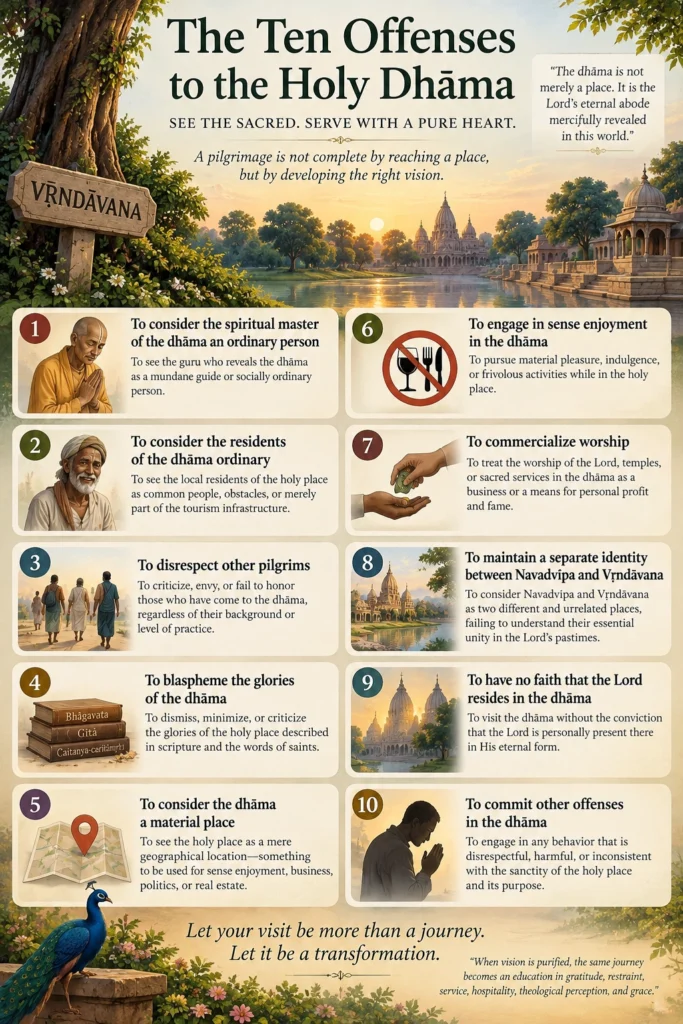
The ten offenses to the holy dhāma, each paired with the positive discipline concealed within the warning.
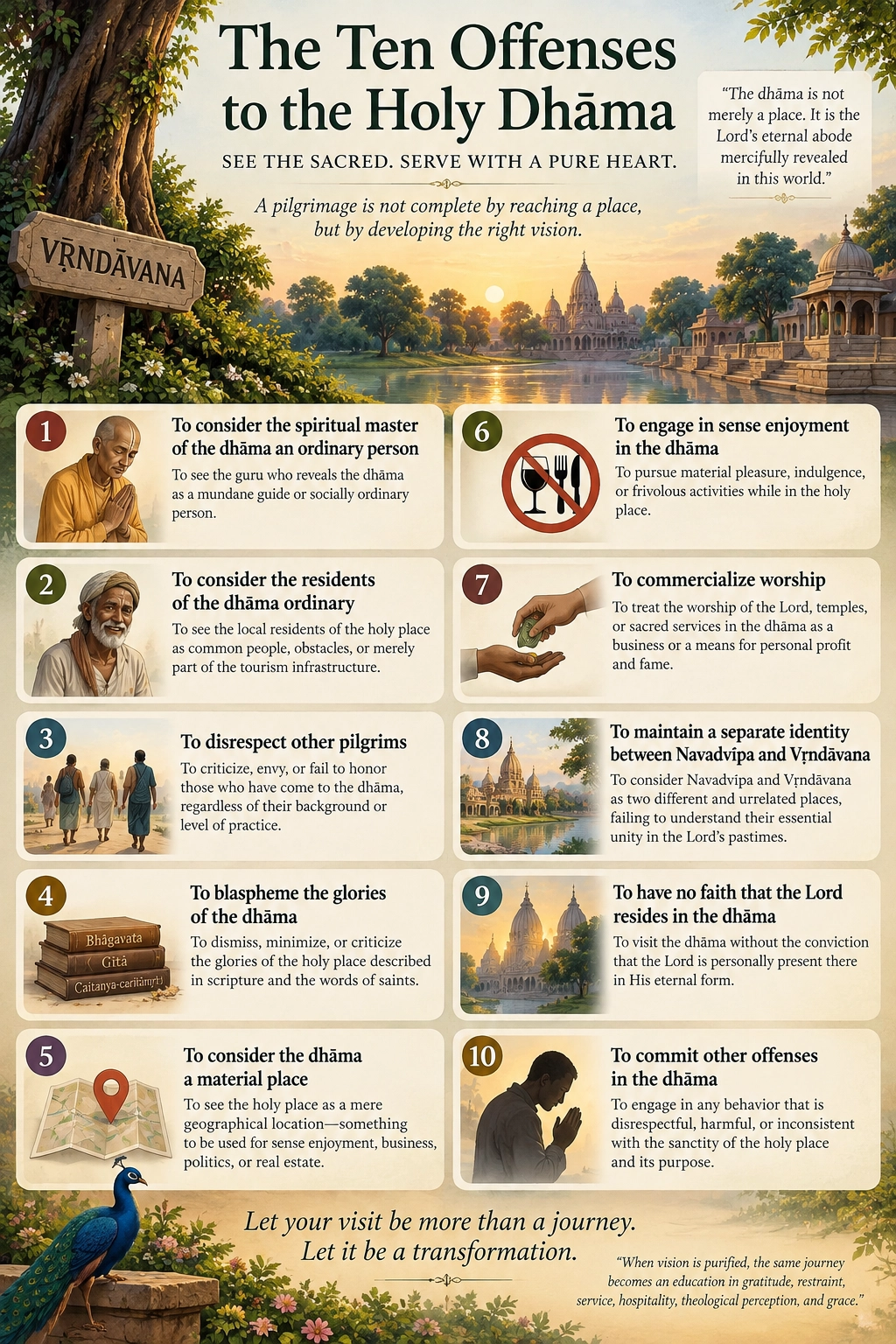
The List of 10 Offenses to the Holy Dhāma The list is genuine as a modern Gauḍīya Vaiṣṇava code of conduct, and the version given is substantially correct. Its exact English wording is securely traceable to The Process of Deity Worship (Arcana-paddhati), published by the Bhaktivedanta Book Trust in 1978. That book identifies itself as the first English translation and revision of an abridged Arcana-paddhati commissioned under Śrīla Bhaktisiddhānta Sarasvatī to regularize temple worship. A. C. Bhaktivedanta Swami Prabhupāda requested the English edited version in 1976.
Three qualifications are essential: The ten items are not presented there as a single ancient Sanskrit passage. No ten-verse Sanskrit archetype for this exact dhāma list has been established.
The ideas are nevertheless deeply rooted in earlier scripture and Gauḍīya theology. The list gathers older teachings about guru, holy places, devotees, sacred conduct, non-commercial devotion, faith, and offense into a practical tenfold form.
The formulation is unmistakably Gauḍīya and post-Caitanya. The eighth item names Navadvīpa and Vṛndāvana together. An ancient Purāṇa could not contain that formulation in its present historical form.
Thus it would be too skeptical to dismiss the list as inauthentic simply because it is a later synthesis. It would be equally inaccurate to place it inside quotation marks and present it as an unidentified ancient Sanskrit revelation. Its authority is traditional and theological; its recoverable literary form is modern.
What “Bhaktivedanta Stotrāvali” tells us—and what it does not
Bhaktivedanta Stotrāvali is a real title used for a Bengali devotional compilation associated in book catalogues with A. C. Bhaktivedanta Swami Prabhupāda. The Bengali form is:
ভক্তিবেদান্ত স্তোত্রাবলী
bhaktivedānta stotrābalī
The Sanskritized spelling is Bhaktivedānta-stotrāvalī. Stotra means a hymn or expression of praise, while āvalī means a row, series, garland, or collection. The title may therefore be rendered “A Bhaktivedanta Garland of Hymns” or “A Bhaktivedanta Collection of Praises.”
The title identifies a compilation, not necessarily the first literary source of every item copied into it. The ten offenses are prose instructions, not themselves a stotra. For this particular list, the more precise recoverable citation is The Process of Deity Worship (Arcana-paddhati), Part Three, “Offenses to Be Avoided.” The heading of an anthology is useful provenance, but it is not a substitute for tracing the item it contains.
Claims sometimes circulate that Bhaktivinoda Ṭhākura himself “listed the ten offenses to the dhāma.” His writings unquestionably teach the theology underlying several items—especially the unity of Navadvīpa and Vṛndāvana—but a primary Bengali passage containing this exact numbered list has not been securely identified. The careful formulation is therefore that the list belongs to the modern Gauḍīya tradition and accords with Bhaktivinoda’s dhāma theology, not that its exact wording has been demonstrated to be his.
What is a dhāma? The Sanskrit noun dhāman can denote a dwelling, domain, station, radiance, glory, or power. In Vaiṣṇava usage, dhāma commonly means the divine abode—the sphere in which the Lord resides and manifests His relationships and līlā. The word therefore holds together two ideas that modern thought often separates: place and presence.
A related term is tīrtha, literally a ford or crossing-place. A tīrtha is where passage across a boundary becomes possible—most importantly, passage from bondage toward spiritual realization. The terms overlap, but their emphases differ: tīrtha stresses crossing and purification; dhāma stresses divine residence, manifestation, and relationship.
The Bhagavad-gītā speaks of the Lord’s supreme abode as beyond material illumination and return:
न तद्भासयते सूर्यो न शशाङ्को न पावकः ।
यद्गत्वा न निवर्तन्ते तद्धाम परमं मम ॥
na tad bhāsayate sūryo na śaśāṅko na pāvakaḥ
yad gatvā na nivartante tad dhāma paramaṁ mama
“Neither sun, moon, nor fire illumines that place. Having gone there, one does not return. That is My supreme abode.”
Bhagavad-gītā 15.6
This is the transcendent dhāma. Gauḍīya theology adds that the eternal abode can become manifest within earthly experience without ceasing to be eternal. Kṛṣṇadāsa Kavirāja describes Gokula in language that prevents its reduction to a finite material location:
সর্বোপরি শ্রীগোকুল—ব্রজলোক-ধাম ।
শ্রীগোলোক, শ্বেতদ্বীপ, বৃন্দাবন নাম ॥
sarvopari śrī-gokula—vrajaloka-dhāma
śrī-goloka, śvetadvīpa, vṛndāvana nāma
“Above all is Śrī Gokula, the abode of Vraja. It is called Śrī Goloka, Śvetadvīpa, and Vṛndāvana.”
Caitanya-caritāmṛta, Ādi 5.17
The following verse is even more explicit:
সর্বগ, অনন্ত, বিভু, কৃষ্ণতনুসম ।
উপর্যধো ব্যাপিয়াছে, নাহিক নিয়ম ॥
sarvaga, ananta, vibhu, kṛṣṇa-tanu-sama
upary-adho vyāpiyāche, nāhika niyama
“Like Kṛṣṇa’s own transcendental body, it is all-pervading, endless, and complete; it expands above and below without material restriction.”
Caitanya-caritāmṛta, Ādi 5.18
It is helpful to distinguish three inseparable dimensions of dhāma: The eternal abode: the Lord’s unconditioned realm and līlā. The manifest sacred geography: Vṛndāvana, Navadvīpa, Purī, and other places through which that abode is approached in this world.
The revealed dhāma: the same place as progressively perceived through grace, scripture, guidance, and purified devotion. These are not three unrelated places. They explain how someone can stand in Vṛndāvana without yet seeing Vṛndāvana. Physical arrival is real, but it does not complete the pilgrimage.
What is aparādha? Aparādha means an offense, fault, transgression, or act that violates a proper relationship. In devotional practice, it is more than a breach of etiquette. It is conduct or vision that obstructs receptivity to grace.
A popular devotional explanation says that aparādha is “that which takes one away from Rādhā.” This is spiritually suggestive wordplay, especially in a Rādhā-centered tradition, but it should not be presented as strict historical etymology. The safer philological sense is offense, wrongdoing, failure, or transgression. The theological point remains powerful: an offense damages the relationship through which sacred reality is known.
The dhāma does not become less holy because someone behaves badly. Rather, the offender’s capacity to receive, recognize, and serve its holiness becomes covered. A dirty lens does not diminish the sun; it diminishes what the observer can see.
Why residence in a holy place is a major practice of bhakti
Śrī Caitanya names residence in Mathurā—understood broadly as the sacred Vraja region—among five especially potent forms of devotional practice:
সাধুসঙ্গ, নামকীর্তন, ভাগবতশ্রবণ ।
মথুরাবাস, শ্রীমূর্তির শ্রদ্ধায় সেবন ॥
sādhu-saṅga, nāma-kīrtana, bhāgavata-śravaṇa
mathurā-vāsa, śrī-mūrtira śraddhāya sevana
“Associate with devotees, chant the holy name, hear the Bhāgavata, reside in Mathurā, and worship the sacred form with faith.”
Caitanya-caritāmṛta, Madhya 22.128
সকলসাধন-শ্রেষ্ঠ এই পঞ্চ অঙ্গ ।
কৃষ্ণপ্রেম জন্মায় এই পাঁচের অল্প সঙ্গ ॥
sakala-sādhana-śreṣṭha ei pañca aṅga
kṛṣṇa-prema janmāya ei pāṅcera alpa saṅga
“These five limbs are the best of all practices. Even slight contact with these five gives rise to love for Kṛṣṇa.”
Caitanya-caritāmṛta, Madhya 22.129
Residence here does not mean merely owning property or accumulating days inside a boundary. Vāsa includes dwelling in remembrance, service, and belonging. One may live physically far away and cultivate mānasa-vāsa, residence in the mind through remembrance; one may also live physically in the dhāma while consciousness remains elsewhere. The ideal joins body, attention, conduct, and aspiration.
The ten offenses: a careful formulation
The received list may be stated clearly as follows:
Showing contempt or disrespect toward the guru who reveals the dhāma
Thinking the holy dhāma is temporary
Harming residents or pilgrims, or dismissing them as merely mundane
Performing mundane, self-centered activities while residing there
Turning Deity worship or the holy name into a business
Reducing the dhāma to a province, equating it indiscriminately with other sites, or imagining it exhausted by measurement
Deliberately committing sin in the dhāma
Treating Vṛndāvana and Navadvīpa as spiritually unrelated
Blaspheming scriptures that glorify the dhāma
Faithlessly dismissing the dhāma’s glories as invention
All ten may be read as forms of one root error: mistaking the spiritually transparent for the materially ordinary.
Disrespecting the guru who reveals the dhāma
A railway timetable can bring a person to Mathurā Junction; it cannot reveal Vraja. The guru “reveals the dhāma” by transmitting the categories of vision through which sacred geography becomes intelligible: the Lord’s līlā, the lives of the saints, the mood of service, proper conduct, and the difference between pilgrimage and consumption.
The Śvetāśvatara Upaniṣad describes revelation as relational:
यस्य देवे परा भक्तिर्यथा देवे तथा गुरौ ।
तस्यैते कथिता ह्यर्थाः प्रकाशन्ते महात्मनः ॥
yasya deve parā bhaktir yathā deve tathā gurau
tasyaite kathitā hy arthāḥ prakāśante mahātmanaḥ
“To the great soul who has supreme devotion to God and, as to God, likewise devotion to the guru, the meanings taught here become revealed.”
Śvetāśvatara Upaniṣad 6.23
The key word is prakāśante—“they become manifest.” Guru is therefore not merely a source of information but an agent of disclosure. This teaching must not be abused. Respect for guru does not mean suspending conscience, evidence, scripture, safeguarding, or accountability. Gauḍīya authority is traditionally triangulated through guru, sādhu, and śāstra. Honest questions are not contempt. Reporting exploitation is not an offense against the dhāma. The offense is proud dismissal of genuine spiritual guidance, not responsible moral discernment.
Its positive form is: approach through gratitude, learn how the tradition sees, and let instruction change conduct.
Thinking the holy dhāma is temporary
At first this seems contradicted by ordinary observation. Temples are rebuilt. River courses shift. Trees die. Municipal boundaries change. Sacred sites suffer erosion, pollution, commercialization, and political conflict. What, then, is eternal?
The claim is not that every wall, road, shop, or administrative boundary is physically indestructible. The eternal object is the dhāma’s spiritual identity as the Lord’s abode and field of līlā. Its manifestation within history can become more or less visible to conditioned perception, without history producing or destroying its underlying reality.
This distinction avoids two extremes: Material reductionism says, “Only the changing landscape is real; therefore the dhāma is temporary.” Naive denial says, “Because the dhāma is eternal, its river, soil, animals, buildings, and people cannot really be harmed.”
The second view is not devotion; it is negligence. Precisely because the sacred landscape bears an eternal identity, its visible ecology deserves extraordinary care. Eternity is not an excuse to pollute the Yamunā or Ganges. It is a reason to serve them.
Harming residents or pilgrims—or seeing them as merely ordinary
The list joins two offenses: actual violence and reductive vision. A sacred place is not honored while the people and creatures who inhabit it are exploited. The Bhāgavata teaches that advanced devotees are themselves living holy places:
भवद्विधा भागवतास्तीर्थभूताः स्वयं विभो ।
तीर्थीकुर्वन्ति तीर्थानि स्वान्तःस्थेन गदाभृता ॥
bhavad-vidhā bhāgavatās tīrtha-bhūtāḥ svayaṁ vibho
tīrthī-kurvanti tīrthāni svāntaḥ-sthena gadābhṛtā
“Devotees such as you are themselves holy places, O master. Because they carry the mace-bearing Lord within their hearts, they make the holy places holy.”
Śrīmad-Bhāgavatam 1.13.10
The verse does not imply that geography is spiritually empty until humans sanctify it. It shows that holy persons and holy places belong to one ecology of presence. A pilgrim encounters the dhāma through sādhus, residents, fellow pilgrims, animals, rivers, trees, dust, stories, and service.
“Violence” should therefore be read broadly but responsibly. It includes assault, intimidation, theft, sexual exploitation, caste or racial contempt, cheating visitors, abusing vulnerable residents, cruelty to animals, reckless traffic, littering, sewage, noise, and treating local poverty as scenery for a spiritual experience.
Yet the warning not to see residents as “ordinary” does not mean that every person living inside a sacred boundary is automatically enlightened, morally impeccable, or above civil law. Residence confers a sacred relationship and deserves respect; it does not erase individual agency or make harmful conduct immune from judgment. Reverence and discrimination must coexist.
Performing mundane activities while living in the dhāma
“Mundane” does not mean material in the simplistic sense of cooking, working, washing clothes, caring for children, repairing a roof, or earning an honest livelihood. Embodied life requires such activities. The real distinction is one of orientation: is an action organized around exploitation and forgetfulness, or related to Kṛṣṇa through responsible service?
The Bhagavad-gītā gives the transformative principle:
यत्करोषि यदश्नासि यज्जुहोषि ददासि यत् ।
यत्तपस्यसि कौन्तेय तत्कुरुष्व मदर्पणम् ॥
yat karoṣi yad aśnāsi yaj juhoṣi dadāsi yat
yat tapasyasi kaunteya tat kuruṣva mad-arpaṇam
“Whatever you do, whatever you eat, whatever you offer or give, and whatever austerity you undertake—do that as an offering to Me.”
Bhagavad-gītā 9.27
Rūpa Gosvāmī calls the mature use of worldly things yukta-vairāgya, appropriate or connected renunciation:
अनासक्तस्य विषयान् यथार्हमुपयुञ्जतः ।
निर्बन्धः कृष्णसम्बन्धे युक्तं वैराग्यमुच्यते ॥
anāsaktasya viṣayān yathārham upayuñjataḥ
nirbandhaḥ kṛṣṇa-sambandhe yuktaṁ vairāgyam ucyate
“When one uses appropriate objects without attachment, firmly relating them to Kṛṣṇa, that is called integrated renunciation.”
Rūpa Gosvāmī, Bhakti-rasāmṛta-sindhu 1.2.255
The fourth offense therefore targets a life in the dhāma dominated by intoxication, predation, gossip, status competition, casual sex, acquisitiveness, entertainment, or indifference to sādhana. In contemporary form, it can also mean treating sacred sites as backdrops for self-promotion, filming worshippers without consent, chasing spectacle, or building a digital identity around “being in the dhāma” while neglecting service.
The remedy is not theatrical renunciation. It is integration: simplify, remember, hear, chant, serve, work honestly, and make necessary activity answerable to the purpose of residence.
Making a business of Deity worship or the holy name
This item does not prohibit all money connected with religious life. Temples have maintenance costs. Priests, cooks, teachers, cleaners, farmers, book workers, drivers, and caregivers may require honest support. Pilgrim lodging, food distribution, publishing, conservation, and festivals require resources. Donations are themselves an ancient devotional practice.
The offense is commodification: treating the Lord, the holy name, access to worship, spiritual authority, or another person’s faith as instruments of private profit and manipulation. It appears wherever grace is packaged as a product, blessings are sold through fear, donors receive staged spiritual privilege, financial opacity protects insiders, or kīrtana is severed from devotion and used only as a marketable brand.
The Bhāgavata places economics under spiritual purpose:
धर्मस्य ह्यापवर्ग्यस्य नार्थोऽर्थायोपकल्पते ।
नार्थस्य धर्मैकान्तस्य कामो लाभाय हि स्मृतः ॥
dharmasya hy āpavargyasya nārtho ’rthāyopakalpate
nārthasya dharmaikāntasya kāmo lābhāya hi smṛtaḥ
“Dharma is meant for ultimate freedom, not merely for material gain; and material gain, when dedicated to dharma, is not meant for the acquisition of sense pleasure.”
Śrīmad-Bhāgavatam 1.2.9
The moral test is not “Did money change hands?” but: What is being served? Are accounts transparent? Is payment proportionate and honest? Are vulnerability and faith being exploited? Does wealth return to worship, care, teaching, residents, and the sacred environment—or accumulate as prestige and control?
Reducing the dhāma to a province, a generic holy site, or a measurable tract
This item contains three related warnings. First, Navadvīpa is physically situated in Bengal, and Vṛndāvana in Uttar Pradesh. Those facts are not denied. The error is the word “merely.” A government can administer land, but it does not create or own the dhāma’s eternal identity. Sacred geography exceeds political sovereignty.
Second, the traditional wording refuses to treat the Lord’s dhāma as interchangeable with every other sacred site. This is an internal Gauḍīya theological hierarchy, grounded in the tradition’s confession of Kṛṣṇa as Svayaṁ Bhagavān and His abodes as uniquely expressive of His intimate līlā. It should be stated without using it as permission to mock Śaivas, Śāktas, other Vaiṣṇavas, or their places of pilgrimage. Fidelity to one’s theology does not require contempt for another’s sacred world.
Third, “attempting to measure the dhāma” cannot reasonably mean that maps, land surveys, property records, conservation studies, archaeology, or pilgrimage routes are sinful. Gauḍīya texts themselves describe the extent and structure of Vraja-maṇḍala and Navadvīpa-maṇḍala. Measurement becomes offensive when one assumes that the measured perimeter exhausts what the dhāma is.
A useful analogy is a person’s body. Height and weight are real and useful; neither tells us the full reality of the person. Likewise, a map may guide the feet but cannot contain the līlā. The map is true within its purpose and false when mistaken for the whole.
Committing sinful acts in the dhāma
The seventh warning overlaps with the fourth but is sharper. Mundane activity can arise from distraction; sinful activity involves violation of dharma. To enter a sacred place while deliberately planning exploitation—and perhaps presuming that the holiness of the place will cancel the consequence—is spiritual bad faith.
A maxim repeated in pilgrimage traditions gives the logic starkly:
अन्यक्षेत्रे कृतं पापं पुण्यक्षेत्रे विनश्यति ।
पुण्यक्षेत्रे कृतं पापं वज्रलेपो भविष्यति ॥
anyakṣetre kṛtaṁ pāpaṁ puṇyakṣetre vinaśyati
puṇyakṣetre kṛtaṁ pāpaṁ vajra-lepo bhaviṣyati
“Sin committed elsewhere is destroyed in a holy place; sin committed in a holy place becomes a diamond-hard coating.”
—A pilgrimage maxim attested in the Skanda Purāṇa, Revā-khaṇḍa
This verse belongs to a broader tīrtha tradition, not to an ancient Sanskrit version of the ten Gauḍīya dhāma offenses. Its image nevertheless explains the principle: greater access to grace entails greater responsibility, not greater license. Deliberate wrongdoing in the place one publicly reveres compounds the act with hypocrisy and presumption.
“Diamond-hard” should not be turned into fatalism. The bhakti tradition does not teach that sincere repentance, confession, restitution, reform, prayer, and divine grace become impossible. The verse deters calculation: one must not make mercy an accomplice to planned sin.
Considering Vṛndāvana and Navadvīpa different
This is the most distinctly Gauḍīya item. It does not claim that the two places occupy the same earthly coordinates or that their manifest līlās have no distinctions. Vṛndāvana is Kṛṣṇa’s Vraja abode; Navadvīpa is the abode of Śrī Caitanya. Their landscapes, histories, narratives, and devotional moods are distinguishable.
The denial concerns ontological separation. Gauḍīya theology identifies Śrī Caitanya with Kṛṣṇa appearing in Rādhā’s mood and radiance. Accordingly, Navadvīpa and Vṛndāvana are one divine reality disclosed in complementary modes. Bhaktivinoda Ṭhākura states this directly:
নবদ্বীপ বৃন্দাবন হয় এক তত্ত্ব ।
পরস্পর কিছু নাহি হীনত্ব মহত্ত্ব ॥
navadvīpa vṛndāvana haya eka tattva
paraspara kichu nāhi hīnatva mahattva
“Navadvīpa and Vṛndāvana are one reality. Between them there is no inferiority or superiority.”
Bhaktivinoda Ṭhākura, Navadvīpa-dhāma-māhātmya 17.13
He immediately explains the complementarity:
সেই বৃন্দাবন-ধাম রসের আধার ।
সে রস না পায় যার নাহি অধিকার ॥
কৃপা করি’ সেই ধাম নবদ্বীপ হয় ।
হেথা রস-অধিকার জীবে উপজয় ॥
sei vṛndāvana-dhāma rasera ādhāra
se rasa nā pāya yāra nāhi adhikāra
kṛpā kari’ sei dhāma navadvīpa haya
hethā rasa-adhikāra jīve upajaya
“That abode of Vṛndāvana is the reservoir of rasa, but one without qualification cannot attain that rasa. Out of mercy, that same abode becomes Navadvīpa; here qualification for rasa arises within the soul.”
Navadvīpa-dhāma-māhātmya 17.14–15
The theological shorthand is mādhurya and audārya: Vṛndāvana prominently manifests the sweetness and intimacy of divine love; Navadvīpa prominently manifests the magnanimous distribution of that love. This is not a rigid division—both qualities exist in both abodes—but it explains the devotional movement from gift to intimacy. Navadvīpa gives access to the treasure of Vṛndāvana.
Thus “not different” means one in spiritual identity and purpose, not indistinguishable in every feature.
Blaspheming scriptures that glorify the dhāma
Dhāma is not recognized by unaided sense perception alone. Scripture, saintly testimony, liturgy, memory, and lived practice disclose dimensions of place that a satellite image cannot show. To ridicule all dhāma-māhātmya literature as fantasy is to reject the tradition’s means of sacred knowledge before hearing its case.
But reverence for scripture is not a ban on scholarship. Manuscripts may differ; quotations may be misattributed; recensions may be late; translations may overinterpret; local legends may grow; historical claims may need correction. Careful philology can serve devotion by preventing a modern summary from being falsely marketed as an ancient Sanskrit verse.
The offense is not asking, “Where does this quotation occur?” It is contemptuous dismissal: “Nothing testified here could disclose reality because only my preferred mode of knowledge is valid.” Honest source criticism and faith are not enemies. False attribution weakens authenticity; accurate attribution deepens it.
Faithlessly regarding the dhāma’s glories as imaginary
The final item concerns aśraddhā, the absence of receptive trust. It closely resembles an offense to the holy name described in the Padma Purāṇa: hearing the name’s greatness while remaining enclosed in possessiveness and without affection for it.
Faith is not the same as intellectual passivity. A newcomer who does not yet know what to believe is not equivalent to someone who has settled into contempt. Questions, uncertainty, cultural distance, and gradual understanding can all coexist with sincerity. The target is hardened reductionism—the prior decision that sacred meaning can only be projection, exaggeration, or fraud.
Nor should “faith” become indiscriminate credulity. A person can affirm dhāma-tattva while rejecting forged citations, financial manipulation, miracle rumors, sectarian boasting, and abuse. Mature faith is neither gullibility nor cynicism. It is trust educated by scripture, reason, character, experience, and good association.
Why this list resembles the ten offenses to the holy name
The tenfold structure is probably not accidental. Several dhāma offenses closely parallel the classical nāmāparādhas, the offenses to the holy name: disrespect for guru, criticism of scripture, treating scriptural praise as exaggeration, committing sin on the strength of sacred power, flattening theological distinctions, and remaining faithless after hearing divine glories.
The Padma Purāṇa’s compact middle sequence reads:
गुरोरवज्ञा श्रुतिशास्त्रनिन्दनं तथार्थवादो हरिनाम्नि कल्पनम् ।
guror avajñā śruti-śāstra-nindanaṁ tathārtha-vādo hari-nāmni kalpanam
“Disrespect for the guru; criticism of revealed scripture; treating praise of the holy name as mere eulogy; and imposing an imaginary interpretation upon the holy name.”
—Padma Purāṇa, Brahma-khaṇḍa 25.16, within the traditional list of offenses to the name
The next warning is particularly close to the seventh dhāma offense:
नाम्नो बलाद्यस्य हि पापबुद्धिर्न विद्यते तस्य यमैर्हि शुद्धिः ।
nāmno balād yasya hi pāpa-buddhir na vidyate tasya yamair hi śuddhiḥ
“For one whose intention is to sin on the strength of the holy name, purification is not achieved merely by disciplinary observances.”
Padma Purāṇa, Brahma-khaṇḍa 25.16
This does not prove that a particular author mechanically adapted one list into the other; the available manual does not explain its editorial history item by item. It does show a common Gauḍīya moral grammar. Name, Deity, devotee, guru, scripture, and dhāma are distinct manifestations of divine relation, and the same reductive habits can offend each of them.
The theology beneath all ten: sacred presence resists possession Each offense turns a relationship into an object of control: Guru becomes an employee of one’s preferences.
Eternity becomes whatever survives material inspection. Residents and pilgrims become categories to exploit or romanticize. Daily life becomes self-centered consumption performed on sacred ground.
Worship and name become merchandise. Dhāma becomes state territory, sectarian property, or measurable real estate. Mercy becomes insurance for deliberate wrongdoing. Navadvīpa and Vṛndāvana become competing brands.
Scripture becomes either disposable fantasy or an untouchable object protected from honest reading. Faith becomes either cynicism or credulity. The list refuses all of these. Its governing claim is simple: the dhāma may be received and served, but it cannot be possessed.
That insight also explains why tourism and pilgrimage can occupy the same road yet move in opposite directions. Tourism ordinarily asks, “What experience can this place give me?” Pilgrimage asks, “How must I change in order to meet this place truthfully?” Tourism is not automatically immoral, and pilgrims also need transport, food, rest, history, and beauty. The difference is the center of gravity: consumption or conversion.
What the list does not authorize
Because sacred warnings can be weaponized, several safeguards should be made explicit: It does not make gurus, institutions, or residents immune from accountability. It does not condemn maps, archaeology, history, ecology, or textual criticism.
It does not teach that every local custom is eternally binding. It does not justify contempt for other Hindu traditions or holy places. It does not prohibit transparent donations, fair wages, or sustainable pilgrim services.
It does not equate honest doubt with malicious blasphemy. It does not license believers to monitor, shame, or humiliate newcomers. It does not make ecological damage unreal because the dhāma is eternal.
The offenses are first a mirror for one’s own consciousness, not a weapon for diagnosing everyone else.
A practical discipline for pilgrimage and residence
The negative list can be converted into a positive rule of life.
Before going
Learn the theological identity and principal līlās of the place. Seek guidance from a trustworthy teacher and reliable texts. Examine one’s purpose: entertainment, prestige, escape, service, prayer, study, or transformation.
Arrange travel and lodging in ways that minimize exploitation and needless ecological harm.
While there
Keep a stable practice of hearing, chanting, remembrance, and service. Ask permission before photographing people or intimate acts of worship. Pay fairly; give transparently; refuse spiritual coercion and predatory commerce.
Treat residents, workers, beggars, animals, rivers, trees, and fellow pilgrims with care. Learn local history without imagining that history exhausts sacred identity. Ask difficult questions respectfully and distinguish evidence from rumor.
Avoid turning the journey into a performance of one’s spirituality.
After returning
Let the dhāma alter ordinary life: consumption, speech, relationships, money, and service. Continue remembrance rather than treating pilgrimage as a completed acquisition.
Support conservation, trustworthy service, and the welfare of residents. Judge the pilgrimage not only by extraordinary feelings but by greater humility, steadiness, truthfulness, and compassion.
Grace is greater than offense—but grace must not be presumed upon Warnings about offense can make spiritual life anxious if detached from the theology of mercy. Bhaktivinoda Ṭhākura celebrates Navadvīpa precisely as an especially merciful manifestation of the dhāma:
নবদ্বীপে শত শত অপরাধ করি’ ।
অনায়াসে নিতাই-কৃপায় যায় তরি’ ॥
navadvīpe śata śata aparādha kari’
anāyāse nitāi-kṛpāya yāya tari’
“Even after committing hundreds of offenses in Navadvīpa, a soul can easily cross over by the mercy of Nitāi.”
Navadvīpa-dhāma-māhātmya 1.57
This verse must be read together with the prohibitions, not against them. Mercy is not permission to be careless. It is the reason despair is unnecessary and reform is possible. Fear of offense should mature into attentiveness, not paralysis; confidence in grace should mature into gratitude, not presumption.
Final assessment
The ten offenses are correctly recognizable and theologically coherent, but their source should be described with precision. The exact English list is best cited to the 1978 Process of Deity Worship (Arcana-paddhati), which transmits an earlier Gauḍīya worship manual prepared under Bhaktisiddhānta Sarasvatī’s direction. It is not presently demonstrable as one ancient Sanskrit list, and the label Bhaktivedanta Stotrāvali identifies a later devotional compilation rather than the primary source of the prose instructions.
Their deeper authenticity lies in the network of older teachings they synthesize. The Gītā speaks of the eternal divine abode and the offering of ordinary action. The Bhāgavata portrays devotees as living tīrthas and subordinates wealth to liberation. Rūpa Gosvāmī teaches the devotional transformation of material things. Kṛṣṇadāsa Kavirāja presents residence in Mathurā as an exceptionally potent limb of bhakti. Bhaktivinoda Ṭhākura explicitly teaches the unity of Navadvīpa and Vṛndāvana.
The heart of the list is not superstition about sacred real estate. It is a discipline of perception. One learns to see place through relationship: guided by guru, answerable to scripture, gentle toward living beings, honest with money, restrained in conduct, open to grace, and unwilling to reduce divine presence to what can be consumed, owned, or measured.
The true opposite of dhāma-aparādha is therefore not nervous rule-keeping. It is seva—intelligent, grateful, embodied service.
Principal texts discussed
The Process of Deity Worship (Arcana-paddhati). Translated by Jayasacinandana dāsa Adhikārī; edited by Jayatīrtha dāsa Adhikārī. Bhaktivedanta Book Trust, 1978. Bhagavad-gītā 9.27 and 15.6.
Śrīmad-Bhāgavatam 1.2.9 and 1.13.10. Śvetāśvatara Upaniṣad 6.23. Rūpa Gosvāmī, Bhakti-rasāmṛta-sindhu 1.2.255. Kṛṣṇadāsa Kavirāja, Caitanya-caritāmṛta, Ādi 5.17–18 and Madhya 22.128–129.
Bhaktivinoda Ṭhākura, Śrī Navadvīpa-dhāma-māhātmya 1.57 and 17.13–15. Padma Purāṇa, Brahma-khaṇḍa 25.15–18, the traditional ten offenses to the holy name. Skanda Purāṇa, Revā-khaṇḍa, for the general pilgrimage maxim concerning wrongdoing in a holy place.