

Lakṣmī Belongs to Nārāyaṇa
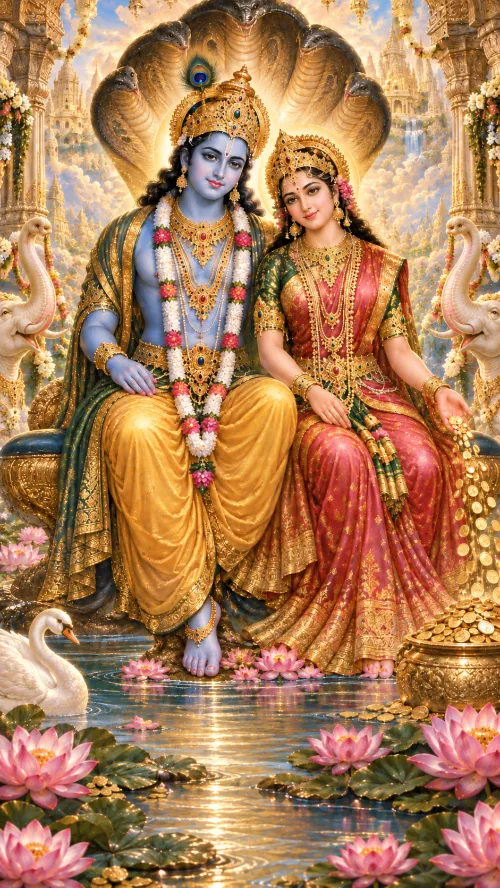
The Vaiṣṇava Theology of Wealth, Ownership, and Yukta-vairāgya
Is money spiritual or material? Vaiṣṇava theology gives a more interesting answer: Money is neither condemned merely because it is material nor sanctified merely because someone possesses it. What matters is its relationship, use, and the consciousness behind that use.
This principle appears vividly in A. C. Bhaktivedanta Swami Prabhupāda’s purport to Śrīmad-Bhāgavatam 1.5.32: “Think always that the money which is accumulated is the wealth of the Lord. Wealth is considered to be the goddess of fortune [Lakṣmī], and the Lord is Nārāyaṇa, or the husband of Lakṣmī. Try to engage Lakṣmī in the service of Lord Nārāyaṇa and be happy.”
This is much more than advice to donate money to religion. It expresses a complete theology of possession. The basic mistake of material consciousness is: “This belongs to me for my independent enjoyment.”
The devotional correction is: “This belongs ultimately to Bhagavān. It has temporarily come into my care. How should it be used?” That shift—from ownership to stewardship, from exploitation to service—is at the heart of yukta-vairāgya, the Vaiṣṇava doctrine of intelligent renunciation.
And it begins with Nārada Muni’s extraordinary claim that the very activity that ordinarily binds a person can become medicine for bondage when offered to Bhagavān.
The Original Verse
एतत्संसूचितं ब्रह्मंस्तापत्रयचिकित्सितम् ।
यदीश्वरे भगवति कर्म ब्रह्मणि भावितम् ॥
etat saṁsūcitaṁ brahmaṁs
tāpa-traya-cikitsitam
yad īśvare bhagavati
karma brahmaṇi bhāvitam
“O brāhmaṇa, it has thus been indicated that the remedy for the threefold miseries is activity dedicated to the Supreme Lord, Bhagavān.”
Śrīmad-Bhāgavatam 1.5.32
Nārada is speaking to Vyāsadeva. The crucial expression is:
कर्म ब्रह्मणि भावितम्
karma brahmaṇi bhāvitam
approximately: “activity placed in, dedicated to, or imbued with relation to the Supreme.” The subject is therefore not merely: money. It is: karma itself. Work. Talent. Property.
Time. Professional activity. Social position. Intelligence. Material resources. The question is: What happens when these are consciously reoriented toward Bhagavān?
The Verse Does Not Say: “Stop Acting”
This is important. Nārada does not tell Vyāsa: “Material activity exists, therefore abandon everything.” He says that activity can become: bhagavat-related. The problem is therefore not activity itself.
The problem is the consciousness in which activity is performed. The same work can be done: for ego, for domination, for consumption, for prestige— or: as duty, service, offering, stewardship.
The external action may sometimes look similar. The spiritual orientation may be completely different.
The Next Verse Gives a Brilliant Medical Analogy
आमयो यश्च भूतानां
जायते येन सुव्रत ।
तदेव ह्यामयं द्रव्यं
न पुनाति चिकित्सितम् ॥
āmayo yaś ca bhūtānāṁ
jāyate yena suvrata
tad eva hy āmayaṁ dravyaṁ
na punāti cikitsitam
“O virtuous one, can not the very substance that causes a disease cure that same disease when properly administered as medicine?”
Śrīmad-Bhāgavatam 1.5.33
The point is subtle. A substance that harms under one condition can heal under another. Likewise, the same material energy that binds consciousness when used for selfish enjoyment can become spiritually beneficial when properly reoriented.
Money illustrates this perfectly. Money can produce: greed, fear, competition, prestige, control, exploitation. But money can also support: food distribution, scripture publication, education, temples, care for dependents, charity, pilgrimage, devotional communities, the preservation and sharing of sacred knowledge.
The currency has not changed. Its sambandha—its relationship—has changed.
Verse 1.5.34 Makes the Principle Explicit
Nārada continues:
एवं नृणां क्रियायोगाः
सर्वे संसृतिहेतवः ।
त एवात्मविनाशाय
कल्पन्ते कल्पिताः परे ॥
evaṁ nṛṇāṁ kriyā-yogāḥ
sarve saṁsṛti-hetavaḥ
ta evātma-vināśāya
kalpante kalpitāḥ pare
“Thus the very activities that ordinarily cause a human being’s bondage in saṁsāra can become capable of destroying that bondage when they are dedicated to the Supreme.”
This is one of the clearest scriptural formulations of a major Vaiṣṇava principle: the world need not simply be rejected; it can be reconnected. That is the foundation of: yukta-vairāgya.
Rūpa Gosvāmī Gives the Principle Its Technical Name
In Bhakti-rasāmṛta-sindhu 1.2.255, Rūpa Gosvāmī writes:
अनासक्तस्य विषयान्
यथार्हमुपयुञ्जतः ।
निर्बन्धः कृष्णसम्बन्धे
युक्तं वैराग्यमुच्यते ॥
anāsaktasya viṣayān
yathārham upayuñjataḥ
nirbandhaḥ kṛṣṇa-sambandhe
yuktaṁ vairāgyam ucyate
“Proper renunciation is said to be the appropriate use of material objects in relation to Kṛṣṇa by one who remains unattached to them.”
This verse contains almost the entire philosophy.
Anāsaktasya : Without Attachment
The first requirement is:
अनासक्तस्य
anāsaktasya
“of one who is unattached.”
This prevents a convenient distortion: “I can indulge in anything I want because I call it service.” No. The point is not to baptize attachment with religious vocabulary.
The user of the object must cultivate: nonpossessiveness. The object may remain. The attachment must change.
Yathārham : Appropriately
The next crucial word is:
यथार्हम्
yathārham
meaning: appropriately, as suitable, to the proper degree. This is extremely practical. Yukta-vairāgya does not mean: maximum consumption with a spiritual excuse. It means: right use.
A householder may legitimately provide: food, housing, education, healthcare, security, support for dependents. Those things are not automatically anti-spiritual. The question is whether use remains: appropriate or becomes: gratification without limit.
Kṛṣṇa-sambandha : The Decisive Transformation
Then comes the heart of the verse:
कृष्णसम्बन्धे
kṛṣṇa-sambandhe
“in relation to Kṛṣṇa.”
This is the real transformation. The mature devotee asks: What is this thing’s relationship with Bhagavān? A building can become: status, or shelter.
A microphone can become: self-advertisement, or hari-kathā. A vehicle can become: luxury, or practical service. A computer can become: distraction, or a tool for publishing sacred teachings.
Money can become: private domination, or responsible service. The thing remains materially similar. The relationship changes.
The Opposite Mistake: Phalgu-vairāgya
Rūpa immediately warns against superficial renunciation:
प्रापञ्चिकतया बुद्ध्या
हरिसम्बन्धिवस्तुनः ।
मुमुक्षुभिः परित्यागो
वैराग्यं फल्गु कथ्यते ॥
prāpañcikatayā buddhyā
hari-sambandhi-vastunaḥ
mumukṣubhiḥ parityāgo
vairāgyaṁ phalgu kathyate
“The rejection of an object related to Hari by those who consider it merely material is called shallow renunciation.”
Bhakti-rasāmṛta-sindhu 1.2.256
The crucial phrase is:
हरिसम्बन्धिवस्तुनः
hari-sambandhi-vastunaḥ
“an object connected with Hari.”
So Vaiṣṇava renunciation has two enemies. One is: attachment. The other is: unnecessary rejection. The middle way is intelligent spiritual use.
Renunciation Does Not Necessarily Mean “Possess Nothing”
A deeper formulation would be: renunciation means “claim nothing independently.” A person can possess almost nothing and still be obsessed with: status, recognition, control.
Another person may manage substantial resources while understanding: “None of this is ultimately mine.” External simplicity can support internal detachment. But external poverty does not automatically create it.
The real issue is: mamatā the sense of: “mine.”
The Īśopaniṣad Begins With Exactly This Principle
The first mantra says:
ईशावास्यमिदं सर्वं
यत्किञ्च जगत्यां जगत् ।
तेन त्यक्तेन भुञ्जीथा
मा गृधः कस्यस्विद्धनम् ॥
īśāvāsyam idaṁ sarvaṁ
yat kiñca jagatyāṁ jagat
tena tyaktena bhuñjīthā
mā gṛdhaḥ kasya svid dhanam
“Everything moving and unmoving within this universe is enveloped and governed by the Lord. Therefore accept what has been allotted to you in a spirit of renunciation, and do not covet another’s wealth—for whose wealth is it really?”
The last phrase is extraordinary:
कस्य स्वित् धनम्
kasya svid dhanam
“Whose wealth is it?”
That question strikes directly at false proprietorship. We say: my house, my money, my land, my business, my body. The Īśopaniṣad asks: Ultimately—whose?
Stewardship, Not Ownership
This produces a useful spiritual shift. Instead of: “I own this absolutely.” the devotee thinks: “This has come temporarily into my care.” That changes both: earning and: spending.
It also makes ethical accountability stronger. If wealth belongs ultimately to Bhagavān, then: fraud, misappropriation, waste, corruption, extravagance disguised as devotion become even more serious.
“Everything belongs to Kṛṣṇa” is therefore not a permission slip. It is a responsibility.
Bhagavad-gītā 5.29: Who Is the Proprietor?
Kṛṣṇa says:
भोक्तारं यज्ञतपसां
सर्वलोकमहेश्वरम् ।
सुहृदं सर्वभूतानां
ज्ञात्वा मां शान्तिमृच्छति ॥
bhoktāraṁ yajña-tapasāṁ
sarva-loka-maheśvaram
suhṛdaṁ sarva-bhūtānāṁ
jñātvā māṁ śāntim ṛcchati
“Knowing Me as the ultimate beneficiary of sacrifice and austerity, the Supreme Lord of all worlds, and the well-wisher of all living beings, one attains peace.”
The phrase:
सर्वलोकमहेश्वरम्
sarva-loka-maheśvaram
means: “the Supreme Lord of all worlds.” The material ego attempts to occupy two positions that belong ultimately to Bhagavān: proprietor and: ultimate enjoyer. Bhakti gives those positions back.
And Kṛṣṇa says: then peace becomes possible.
Bhagavad-gītā 9.27 Gives the Practical Method
Kṛṣṇa says:
यत्करोषि यदश्नासि
यज्जुहोषि ददासि यत् ।
यत्तपस्यसि कौन्तेय
तत्कुरुष्व मदर्पणम् ॥
yat karoṣi yad aśnāsi
yaj juhoṣi dadāsi yat
yat tapasyasi kaunteya
tat kuruṣva mad-arpaṇam
“Whatever you do, whatever you eat, whatever you offer, whatever you give, and whatever austerity you perform—do that as an offering to Me.”
Bhagavad-gītā 9.27
Again, the instruction is not: stop acting. It is: offer action. The center moves from: self to: Bhagavān. That is precisely the movement of ŚB 1.5.32.
Why Is Wealth Called Lakṣmī?
Now we reach Prabhupāda’s striking formulation: “Money is Lakṣmī.” This needs nuance. The Sanskrit words:
श्री
śrī
and:
लक्ष्मी
lakṣmī
can mean: fortune, prosperity, splendor, beauty, abundance, auspiciousness. They also refer to: Śrī Lakṣmī-devī the divine goddess. Thus traditional Vaiṣṇava language naturally moves between: Lakṣmī as divine person and: lakṣmī as fortune.
So “money is Lakṣmī” is not best understood as: every coin is literally Lakṣmī-devī. Rather: wealth belongs to the sphere of fortune and prosperity personified by Lakṣmī, and therefore should not be imagined as an independent possession detached from Bhagavān.
Lakṣmī Is Much More Than Money
This is essential. In Vaiṣṇava theology Lakṣmī is: the eternal divine consort of Viṣṇu/Nārāyaṇa, the embodiment of divine fortune, beauty, grace, auspiciousness. She cannot be reduced to: currency.
Money is only one narrow form of what human beings call: wealth. Lakṣmī encompasses a much richer theological reality.
The Viṣṇu Purāṇa: Śrī Is Never Separated From Viṣṇu
A beautiful verse declares:
नित्यैव सा जगन्माता
विष्णोः श्रीरनपायिनी ।
यथा सर्वगतो विष्णुस्
तथैवेयं द्विजोत्तम ॥
nityaiva sā jagan-mātā
viṣṇoḥ śrīr anapāyinī
yathā sarva-gato viṣṇus
tathaiveyaṁ dvijottama
“Śrī, the mother of the universe, is eternal and inseparable from Viṣṇu. Just as Viṣṇu is all-pervading, so also is she, O best of the brāhmaṇas.”
The crucial word is:
अनपायिनी
anapāyinī
“never departing, inseparable.”
That gives theological depth to Prabhupāda’s phrase: “Lakṣmī belongs to Nārāyaṇa.” This is not merely financial morality. It reflects an eternal divine relationship: Śrī with Nārāyaṇa.
The Bhāgavatam Calls Bhagavān Śriyaḥ Patiḥ
ŚB 2.9.15 describes Brahmā seeing Bhagavān:
ददर्श तत्राखिलसात्वतां पतिं
श्रियः पतिं यज्ञपतिं जगत्पतिम् ।
सुनन्दनन्दप्रबलार्हणादिभिः
स्वपार्षदाग्रैः परिसेवितं विभुम् ॥
dadarśa tatrākhila-sātvatāṁ patiṁ
śriyaḥ patiṁ yajña-patiṁ jagat-patim
sunanda-nanda-prabalārhaṇādibhiḥ
sva-pārṣadāgraiḥ parisevitaṁ vibhum
“There Brahmā saw the Supreme Lord—the Lord of all devotees, the Lord of Śrī, the Lord of sacrifice, and the Lord of the universe—served by His foremost associates.”
The key expression is:
श्रियः पतिम्
śriyaḥ patim
“the Lord or husband of Śrī.”
The same theological pair appears throughout Vaiṣṇava literature: Lakṣmī–Nārāyaṇa. Sītā–Rāma. Rādhā–Kṛṣṇa. The divine energy is understood in relation to: the divine energetic source.
The Rāvaṇa Principle: Trying to Take Lakṣmī Without Nārāyaṇa
Prabhupāda frequently explains the theology through the story of Rāvaṇa. Sītā belongs with Rāma. Rāvaṇa tries to take Sītā away from Rāma for his own enjoyment. That becomes a powerful metaphor.
Rāvaṇa consciousness:
“Lakṣmī is for me.”
Bhakti consciousness:
“Lakṣmī belongs with Nārāyaṇa.” The problem is not: Sītā. The problem is not: Lakṣmī. The problem is: the attempt to possess divine energy independently of Bhagavān.
This Is the Real Meaning of “Reconnect Lakṣmī With Nārāyaṇa”
Nothing has to be physically transported from one cosmic location to another. The “reconnection” takes place in: consciousness and use. Money enters our hands. We can think: “Mine.”
Or: “Entrusted.” Then we decide what to do. That is where theology becomes economics.
Wealth Can Become Bhoga or Sevā
The same wealth can function as:
भोग
bhoga
self-centered enjoyment;
अहङ्कार
ahaṅkāra
status and identity;
बन्धन
bandhana
bondage;
or:
सेवा
sevā
service;
यज्ञ
yajña
offering;
भक्ति
bhakti
devotional engagement.
The number on the bank statement does not reveal which of these is happening. The consciousness behind it does.
Wealth Is Therefore Not Spiritually Neutral in Practice
It would also be too simple to say: “Money is completely neutral.” Money creates possibilities. And those possibilities exert pressure on consciousness. Wealth can magnify: generosity, or greed; responsibility, or control; service, or vanity.
Thus it carries spiritual risk precisely because it carries: power. The greater the resources, the greater the need for: clarity, detachment, accountability.
Wealth Is Not Proof of Divine Favor
Calling prosperity “Lakṣmī” must never be turned into: prosperity theology. The principle is not: “God loves you, therefore you will become rich.” Caitanya Mahāprabhu famously prays:
न धनं न जनं न सुन्दरीं
कवितां वा जगदीश कामये ।
मम जन्मनि जन्मनीश्वरे
भवताद्भक्तिरहैतुकी त्वयि ॥
na dhanaṁ na janaṁ na sundarīṁ
kavitāṁ vā jagad-īśa kāmaye
mama janmani janmanīśvare
bhavatād bhaktir ahaitukī tvayi
“O Lord of the universe, I do not desire wealth, followers, beautiful companions, or worldly prestige. Birth after birth, let me have causeless devotion unto You.”
This is the opposite of: “Worship God so you can become rich.” The devotee does not seek Nārāyaṇa in order to obtain Lakṣmī. Rather: if Lakṣmī comes, she is engaged in Nārāyaṇa’s service.
Poverty Is Not Automatically Spiritual Either
The opposite simplification also fails. Poor does not automatically mean: detached. A poor person may remain completely absorbed in: money, envy, resentment, possession. A wealthy person may use substantial resources with: restraint, generosity, responsibility.
Thus: wealth ≠ materialism and: poverty ≠ renunciation. The real criterion is: attachment and purpose.
The Householder Does Not Have to Destroy the Household
Vaiṣṇava spirituality has never been only a monastic system. Householders have responsibilities. Children require: food, education, healthcare. Families require: shelter, stability.
Society requires: productive work. To abandon legitimate responsibilities and call it “renunciation” can itself become irresponsibility. Rūpa’s word: yathārham —appropriately— is therefore crucial.
One uses what is necessary without constructing life around: unnecessary accumulation.
Bhaktivinoda Ṭhākura Gives a Beautiful Household Formula
A famous Bengali line says:
কৃষ্ণের সংসার কর ছাড়ি’ অনাচার ।
জীবে দয়া, কৃষ্ণনাম—সর্বধর্মসার ॥
kṛṣṇera saṁsāra kara chāḍi’ anācāra
jīve dayā, kṛṣṇa-nāma — sarva-dharma-sāra
“Make your household Kṛṣṇa’s household, abandoning improper conduct; show compassion to living beings and chant Kṛṣṇa’s name—this is the essence of dharma.”
This is an excellent practical counterpart to ŚB 1.5.32. The instruction is not: destroy saṁsāra physically. It is: make it Kṛṣṇa’s. House. Income. Food. Relationships. Work.
Everything becomes reorganized around: sambandha.
Sambandha-jñāna : Knowing What Everything Is Related To
Gauḍīya theology often speaks of:
सम्बन्ध
sambandha
relationship. Spiritual ignorance means not merely lacking information. It means misunderstanding: relationship. I think: “I am the center.” “This is mine.” “This exists for me.”
Sambandha-jñāna restores the structure: I belong to Bhagavān. The world belongs to Bhagavān. My capacities come from Bhagavān. Therefore: how should they be used? That is a far more comprehensive spirituality than simply separating objects into: holy and: unholy.
A Computer Can Become Part of Bhakti
The principle is extraordinarily modern. A computer is not inherently: spiritual or: anti-spiritual. It can be used for: addiction, deception, vanity. Or: editing scripture, translating texts, creating devotional art, teaching, organizing charitable work.
The machine remains materially the same. Its: sambandha changes. Exactly the same applies to: phones, cars, businesses, buildings, capital. This is why yukta-vairāgya remains so practically relevant.
Art, Intelligence, and Talent Are Also Lakṣmī in a Broader Sense
If Lakṣmī means fortune and divine abundance, then wealth cannot be reduced merely to cash. A person may possess: intelligence, beauty, artistic ability, education, influence, time, health, connections, technical skill.
All of these are forms of: capacity. And every capacity raises the same question: What will I do with it? Thus the Lakṣmī principle can be extended beyond money: every gift becomes spiritually meaningful when reconnected with Bhagavān.
This Does Not Mean Every Activity Can Be Sanctified
A limit is necessary. One cannot simply take inherently exploitative or adharmic behavior and say: “I dedicate it to Kṛṣṇa.” Yukta-vairāgya presupposes: dharma, ethical use, appropriate action.
Fraud does not become bhakti because one donates part of the proceeds. Exploitation does not become spiritual because the exploiter funds a temple. The offering cannot erase the unrighteous means by which it was obtained.
Bhakti includes: integrity.
How Wealth Is Earned Matters
This follows logically from the doctrine. If wealth belongs to Bhagavān, then: earning it through deception is already a misuse. Thus there are at least three questions:
- How was it earned?
- How is it held?
- How is it used?
A devotional theology of wealth must consider all three. Otherwise “Lakṣmī for Nārāyaṇa” can become a slogan hiding unethical economics.
“Everything Belongs to God” Demands Better Accounting, Not Worse
This is particularly important for: temples, religious organizations, charities, gurus, community leaders. If donated wealth is considered: Lakṣmī then misuse is especially serious.
Transparency, accountability, responsible budgeting are not spiritually inferior concerns. They protect: Lakṣmī from exploitation. One cannot preach: “Nothing belongs to us”
while treating community wealth as: personal property. That would contradict the doctrine itself.
The Medical Analogy Now Becomes Remarkably Practical
Return to Nārada’s question: Can the substance involved in disease become medicine? Yes. Money can contribute to: material bondage. But rightly used money can also help liberate: the giver, the receiver, the community.
Technology can distract consciousness. The same technology can carry sacred knowledge around the world. Speech can destroy reputations. Speech can glorify Bhagavān. Food can reinforce indulgence.
Food offered to Bhagavān becomes: prasāda. Thus the great Vaiṣṇava question is not always: “Can I eliminate this?” It is often: “Can this be transformed through relationship and service?”
The Threefold Miseries and Their Cure
ŚB 1.5.32 calls the process:
तापत्रयचिकित्सितम्
tāpa-traya-cikitsitam
“the treatment for the threefold miseries.”
The traditional categories are:
Activities performed for independent ego reinforce saṁsāra. The same activities offered to Bhagavān begin to dissolve: the false center.
Material Consciousness Says “Mine”
The theological root problem is beautifully simple. Material consciousness: “I am the proprietor.” Bhakti: “I am the caretaker.” Material consciousness: “How can this serve me?”
Bhakti: “How should this be used responsibly in Bhagavān’s order?” Material consciousness: “Lakṣmī is mine.” Bhakti: “Lakṣmī belongs with Nārāyaṇa.” This is why wealth can become such a sharp spiritual test.
There Is a Paradox at the Heart of Renunciation
The materialist says: “I will be happy when everything becomes mine.” The bhakta discovers: “Peace begins when I stop believing anything is independently mine.” Yet this does not necessarily leave the devotee materially empty.
He may still: work, earn, build, manage, save, feed, create. The transformation occurs at the level of: proprietorship. That is why Vaiṣṇava renunciation can be deeply engaged rather than merely withdrawn.
The Deep Difference Between Ownership and Stewardship
Ownership consciousness asks: “What am I entitled to?” Stewardship asks: “What am I responsible for?” That one change can transform wealth. The same hundred euros can become: ego, waste, service, food, education, charity.
The money is not making the moral decision. The human being is.
What This Teaching Does Not Mean
The doctrine does not mean that:
- money is literally identical with Lakṣmī-devī in every respect;
- wealth automatically becomes spiritual because a religious person possesses it;
- poverty automatically means renunciation;
- wealth automatically means divine favor;
- devotees must give away everything and neglect dependents;
- every luxury can be justified by calling it “service”;
- unethical earnings become pure by donating part of them;
- religious institutions may use funds without accountability because “everything belongs to Kṛṣṇa”;
- or all worldly activity is automatically compatible with bhakti.
Those would be distortions.
What It Does Mean
It means that:
- Bhagavān is the ultimate proprietor;
- Lakṣmī is eternally related to Nārāyaṇa;
- material resources should not be claimed as independent objects of enjoyment;
- work itself can become spiritually transformative when consciously offered;
- resources can be used appropriately without attachment;
- unnecessary rejection of Hari-related objects is shallow renunciation;
- ethical household responsibility can itself be part of bhakti;
- the way wealth is earned matters;
- the way wealth is held matters;
- the way wealth is used matters;
- and true renunciation changes one’s relationship with possessions more deeply than merely changing the amount possessed.
The Whole Philosophy in Four Scriptural Movements
Everything belongs to Bhagavān
ईशावास्यमिदं सर्वम्
īśāvāsyam idaṁ sarvam
“Everything is pervaded and owned by the Lord.”
Offer your activity
तत्कुरुष्व मदर्पणम्
tat kuruṣva mad-arpaṇam
“Do it as an offering to Me.”
Use objects without attachment
निर्बन्धः कृष्णसम्बन्धे
nirbandhaḥ kṛṣṇa-sambandhe
“Establish them in relation to Kṛṣṇa.”
त एवात्मविनाशाय
कल्पन्ते कल्पिताः परे
ta evātma-vināśāya
kalpante kalpitāḥ pare
“Those very activities can destroy bondage when dedicated to the Supreme.”
4. Then what caused bondage can become medicine
This is the full logic behind: “engage Lakṣmī in Nārāyaṇa’s service.”
Prabhupāda’s statement sounds simple: “Lakṣmī belongs to Nārāyaṇa.” But behind it stands a complete Vaiṣṇava philosophy of the world. The world is not independent of Bhagavān.
Our abilities are not independent of Bhagavān. Our resources are not independent of Bhagavān. Our wealth is not independently ours. Nārada therefore does not merely tell Vyāsa to abandon action.
He says: transform action. The thing that binds can become: medicine. Rūpa Gosvāmī later expresses the same principle:
अनासक्तस्य विषयान्
यथार्हमुपयुञ्जतः ।
निर्बन्धः कृष्णसम्बन्धे
युक्तं वैराग्यमुच्यते ॥
anāsaktasya viṣayān
yathārham upayuñjataḥ
nirbandhaḥ kṛṣṇa-sambandhe
yuktaṁ vairāgyam ucyate
“Proper renunciation means using things appropriately, without attachment, in relation to Kṛṣṇa.”
This is not the religion of: “throw everything away.” Nor is it the religion of: “enjoy everything and call it spiritual.” It is something harder: use rightly, possess lightly, and remember the real proprietor.
That is why the theological image of Lakṣmī and Nārāyaṇa is so powerful. Lakṣmī is not meant to be seized. Not by Rāvaṇa. Not by the ego. She belongs with: Nārāyaṇa. And so the essence can be stated in one line: The problem is not that Lakṣmī comes into our hands; the problem begins when we forget Nārāyaṇa and say, “She is mine.”
Or, in the language of Rūpa Gosvāmī: True renunciation is not throwing Kṛṣṇa’s energy away. It is giving up the claim that Kṛṣṇa’s energy exists for our independent enjoyment.