

Mahā-Viṣṇu at the Threshold of Creation
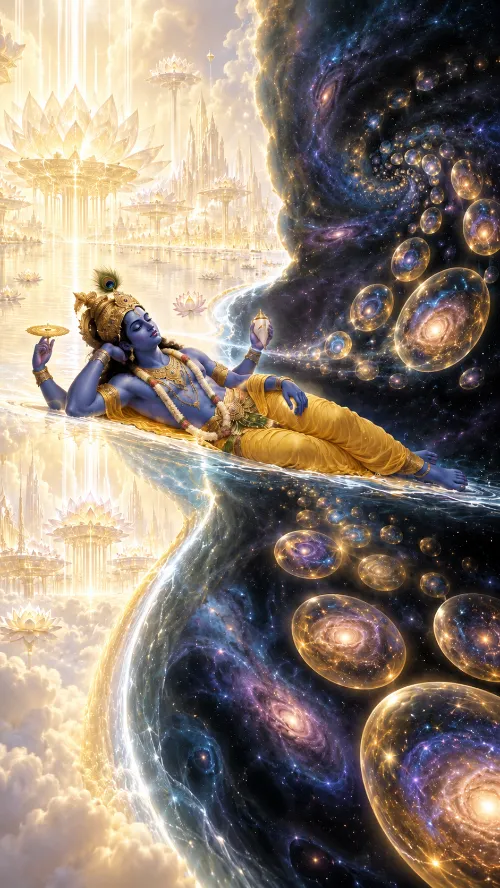
The boundary between the spiritual world and the causal ocean
One of the most striking images in Gauḍīya Vaiṣṇava cosmology is deceptively peaceful: Mahā-Viṣṇu reclines upon an ocean. Yet from that apparent stillness comes the entire material cosmos.
Countless universes appear in relation to His breathing. Material nature becomes activated by His glance. He expands into every universe, then farther into every living being as Paramātmā.
And yet He Himself remains entirely beyond material nature. This theology is condensed into two Bengali lines spoken by Śrī Caitanya Mahāprabhu while instructing Sanātana Gosvāmī.
সেই পুরুষ বিরজাতে করেন শয়ন ।
‘কারণাব্ধিশায়ী’ নাম জগৎকারণ ॥
sei puruṣa virajāte karena śayana
kāraṇābdhiśāyī nāma jagat-kāraṇa
“That Puruṣa reclines in the Virajā. He is called Kāraṇābdhiśāyī and is the cause of the material cosmos.”
Caitanya-caritāmṛta, Madhya 20.268
The standard Bhaktivedanta translation expands the immediate context:
“The original Personality of Godhead, named Saṅkarṣaṇa, first lies down in the River Virajā, which serves as a border between the material and spiritual worlds. As Kāraṇābdhiśāyī Viṣṇu, He is the original cause of the material creation.”
That translation is theologically correct, but several of its details come from the surrounding verses rather than from the literal wording of 20.268 alone. Once those surrounding verses are included, an extraordinarily sophisticated cosmological picture emerges.
What the verse literally says
The two lines are compact.
A very literal rendering is therefore:
“That Puruṣa reclines in the Virajā. His name is Kāraṇābdhiśāyī, the cause of the world.”
The immediate questions are obvious. Who is “that Puruṣa”? What is Virajā? What is the Causal Ocean? How can someone reclining in transcendental waters cause material universes?
And if He is the cause of the cosmos, what does Gauḍīya theology mean when it simultaneously declares Kṛṣṇa to be the ultimate cause of everything? The surrounding text answers each question.
“That Puruṣa” is Śrī Saṅkarṣaṇa manifested for creation
Verse 268 itself does not contain the word Saṅkarṣaṇa. The identification appears a few verses earlier.
সেই মায়া অবলোকিতে শ্রীসঙ্কর্ষণ ।
পুরুষরূপে অবতীর্ণ হইলা প্রথম ॥
sei māyā avalokite śrī-saṅkarṣaṇa
puruṣa-rūpe avatīrṇa ha-ilā prathama
“To cast His glance upon that māyā, Śrī Saṅkarṣaṇa first descended in the form of the Puruṣa.”
Caitanya-caritāmṛta, Madhya 20.265
So the sequence is: Śrī Saṅkarṣaṇa ↓ assumes the Puruṣa form ↓ becomes the first Puruṣa associated with material creation ↓ reclines in the causal waters as: Kāraṇodakaśāyī Viṣṇu / Kāraṇābdhiśāyī Viṣṇu / Mahā-Viṣṇu.
Therefore the expanded translation of 20.268 is drawing upon the text immediately preceding it.
What does “Puruṣa” mean here?
The Sanskrit word puruṣa can mean “person,” “spirit,” “cosmic person,” or the conscious principle distinct from material nature. But in this particular theological context, Puruṣa has a technical meaning.
It refers to the forms of Viṣṇu through whom Bhagavān relates to the material creation. The Caitanya-caritāmṛta quotes the traditional three-Puruṣa doctrine:
विष्णोस्तु त्रीणि रूपाणि
पुरुषाख्यान्यथो विदुः ।
एकं तु महतः स्रष्टृ
द्वितीयं त्वण्डसंस्थितम् ।
तृतीयं सर्वभूतस्थं
तानि ज्ञात्वा विमुच्यते ॥
viṣṇos tu trīṇi rūpāṇi
puruṣākhyāny atho viduḥ
ekaṁ tu mahataḥ sraṣṭṛ
dvitīyaṁ tv aṇḍa-saṁsthitam
tṛtīyaṁ sarva-bhūta-sthaṁ
tāni jñātvā vimucyate
“Viṣṇu is known in three forms called the Puruṣas. The first creates the total material manifestation; the second resides within each universe; the third is situated within all living beings. One who understands these three becomes liberated.”
Caitanya-caritāmṛta, Madhya 20.251
This gives the classical sequence:
The Bhāgavata calls the Puruṣa the first avatāra
Caitanya’s explanation rests directly upon the Śrīmad-Bhāgavatam.
आद्योऽवतारः पुरुषः परस्य
कालः स्वभावः सदसन्मनश्च ।
द्रव्यं विकारो गुण इन्द्रियाणि
विराट् स्वराट् स्थास्नु चरिष्णु भूम्नः ॥
ādyo ’vatāraḥ puruṣaḥ parasya
kālaḥ svabhāvaḥ sad-asan manaś ca
dravyaṁ vikāro guṇa indriyāṇi
virāṭ svarāṭ sthāsnu cariṣṇu bhūmnaḥ
“The Puruṣa is the first avatāra of the Supreme. Time, nature, cause and effect, mind, matter, transformation, the guṇas, the senses, the universal form, and all moving and nonmoving existence depend upon Him.”
Śrīmad-Bhāgavatam 2.6.42
The opening expression is decisive: ādyaḥ avatāraḥ puruṣaḥ parasya
“The Puruṣa is the first avatāra of the Supreme.”
But “first” needs qualification. It means:
the first divine descent specifically in relation to material cosmic manifestation.
It does not mean that Mahā-Viṣṇu is ontologically prior to Kṛṣṇa in Gauḍīya theology.
जगृहे पौरुषं रूपं
भगवान् महदादिभिः ।
सम्भूतं षोडशकलम्
आदौ लोकसिसृक्षया ॥
jagṛhe pauruṣaṁ rūpaṁ
bhagavān mahad-ādibhiḥ
sambhūtaṁ ṣoḍaśa-kalam
ādau loka-sisṛkṣayā
“In the beginning, desiring to manifest the worlds, Bhagavān assumed the Puruṣa form in connection with the principles beginning with the mahat-tattva and the sixteen creative elements.”
Śrīmad-Bhāgavatam 1.3.1 gives the same picture
The important phrase is: loka-sisṛkṣayā
“with the desire to create the worlds.”
The Puruṣa manifestation therefore appears exactly where transcendent Bhagavān begins to relate to material creation.
The first Puruṣa is Mahā-Viṣṇu
This Puruṣa has several names. Mahā-Viṣṇu “the Great Viṣṇu” Kāraṇodakaśāyī Viṣṇu “Viṣṇu who reclines upon the causal waters” Kāraṇābdhiśāyī Viṣṇu “Viṣṇu reclining upon the causal ocean”
Kāraṇārṇavaśāyī Viṣṇu “Viṣṇu reclining in the causal ocean.” The compounds vary, but the theological referent is the same.
What does Kāraṇābdhiśāyī literally mean?
The name itself contains the theology.
Thus: Kāraṇābdhiśāyī means:
“He who reclines upon the Ocean of Cause.”
That “ocean” is the great causal boundary between spiritual existence and manifest material nature.
What is Virajā?
The word Virajā is one of the most important cosmological terms in this passage. It is presented as the boundary between: pradhāna — the unmanifest material domain and paravyoma — the spiritual sky.
A Sanskrit passage quoted in the Caitanya-caritāmṛta states:
प्रधानपरमव्योम्नोर्
अन्तरे विरजा नदी ।
वेदाङ्गस्वेदजनितैस्
तोयैः प्रस्राविता शुभा ॥
pradhāna-parama-vyomnor
antare virajā nadī
vedāṅga-sveda-janitais
toyaiḥ prasrāvitā śubhā
“Between pradhāna and the supreme spiritual sky flows the auspicious river called Virajā.”
Caitanya-caritāmṛta, Madhya 21.50
The cosmological arrangement is therefore: material nature ↓ Virajā ↓ paravyoma, the spiritual sky. Virajā marks the threshold.
Beyond Virajā lies eternal spiritual existence
The next verse states:
तस्याः पारे परव्योम
त्रिपाद्भूतं सनातनम् ।
अमृतं शाश्वतं नित्यम्
अनन्तं परमं पदम् ॥
tasyāḥ pāre para-vyoma
tri-pād-bhūtaṁ sanātanam
amṛtaṁ śāśvataṁ nityam
anantaṁ paramaṁ padam
“Beyond that river lies the spiritual sky, the eternal three-fourths manifestation—immortal, everlasting, eternal, unlimited, and the supreme abode.”
Caitanya-caritāmṛta, Madhya 21.51
This is not simply a location farther away in ordinary physical space. Virajā marks a change of ontological order. On one side lies existence under:
- māyā,
- guṇas,
- material time,
- creation,
- dissolution.
Beyond it lies:
- eternity,
- spiritual existence,
- śuddha-sattva,
- liberated divine life.
Virajā is a border between two modes of reality
This is one of the most profound ideas in the passage. Virajā is not merely geography. It represents the boundary between: conditioned manifestation and transcendental manifestation.
On the material side: sattva, rajas and tamas operate. On the spiritual side: they do not. This is explicitly confirmed by the Bhāgavata verse quoted immediately afterward.
Beyond Virajā there is no miśra-sattva
प्रवर्तते तत्र रजस्तमस्तयोः
सत्त्वं च मिश्रं न च कालविक्रमः ।
न यत्र माया किमुतापरे हरेर्
अनुव्रता यत्र सुरासुरार्चिताः ॥
pravartate tatra rajas tamas tayoḥ
sattvaṁ ca miśraṁ na ca kāla-vikramaḥ
na yatra māyā kim utāpare harer
anuvratā yatra surāsurārcitāḥ
“In that spiritual realm neither rajas nor tamas operate, nor sattva mixed with them; material time has no destructive power there. Māyā does not exist there, what then to speak of her products. There reside the devotees of Hari, worshiped by both gods and demons.”
Śrīmad-Bhāgavatam 2.9.10
This is especially striking when read alongside the Gauḍīya distinction between: miśra-sattva and śuddha-sattva. Beyond Virajā: rajas disappears. tamas disappears. mixed sattva disappears.
māyā disappears. material time disappears. So Virajā is effectively the frontier beyond which the three-guṇa structure ceases.
Is Virajā the same as the Causal Ocean?
The terminology is closely connected, but some caution is useful. The Caitanya-caritāmṛta says:
কারণাব্ধি-পারে মায়ার নিত্য অবস্থিতি ।
বিরজার পারে পরব্যোমে নাহি গতি ॥
kāraṇābdhi-pāre māyāra nitya avasthiti
virajāra pāre paravyome nāhi gati
“Māyā remains situated on one side of the Causal Ocean. Beyond the Virajā she has no entrance into the spiritual sky.”
Madhya 20.269
The text thus places: Kāraṇābdhi and: Virajā in the same liminal cosmological region. Different Gauḍīya texts sometimes emphasize the terms differently. Virajā emphasizes the boundary river.
Kāraṇa-jala / Kāraṇārṇava / Kāraṇābdhi emphasizes the causal waters upon which Mahā-Viṣṇu reclines. It is safest to say:
They belong to the same causal boundary region between spiritual and material manifestation, and in many Gauḍīya presentations they are closely identified.
Trying to draw an overly literal modern map can create distinctions that the theological literature itself does not always rigidly enforce.
These are not ordinary material waters
A particularly important verse appears in the Ādi-līlā.
চিন্ময়-জল সেই পরম কারণ ।
যার এক কণা গঙ্গা পতিতপাবন ॥
cinmaya-jala sei parama kāraṇa
yāra eka kaṇā gaṅgā patita-pāvana
“Those causal waters are spiritual. A single drop of them becomes the Gaṅgā, purifier of the fallen.”
Caitanya-caritāmṛta, Ādi 5.54
The crucial expression is: cinmaya-jala
“conscious/spiritual water.”
This prevents a crude reading. The text is not claiming that somewhere beyond observable galaxies lies an enormous quantity of ordinary terrestrial water. The Causal Ocean belongs to transcendental sacred cosmology.
Mahā-Viṣṇu reclines exactly at the interface
The positioning is theologically perfect. Behind Him: paravyoma the spiritual sky. Before Him: pradhāna unmanifest material nature. At the interface: Mahā-Viṣṇu. He therefore represents the point at which:
the transcendent Lord relates to material nature without Himself becoming material.
This answers one of the great theological problems: How can God cause a material world while remaining transcendental to matter? The Gauḍīya answer is: through śakti.
Material nature cannot create independently
Śrī Caitanya says this directly just before the Virajā passage.
জড় হৈতে সৃষ্টি নহে ঈশ্বরশক্তি বিনে ।
তাহাতেই সঙ্কর্ষণ করে শক্তির আধানে ॥
jaḍa haite sṛṣṭi nahe īśvara-śakti vine
tāhātei saṅkarṣaṇa kare śaktira ādhāne
“Inert matter cannot produce creation without the potency of Īśvara. Saṅkarṣaṇa therefore invests material nature with His potency.”
Caitanya-caritāmṛta, Madhya 20.260
The principle is explicit:
matter is not regarded as an autonomous creative ultimate.
It requires divine activation.
The iron-and-fire analogy
The next verse gives a striking analogy.
ঈশ্বরের শক্ত্যে সৃষ্টি করয়ে প্রকৃতি ।
লৌহ যেন অগ্নিশক্ত্যে পায় দাহশক্তি ॥
īśvarera śaktye sṛṣṭi karaye prakṛti
lauha yena agni-śaktye pāya dāha-śakti
“Prakṛti creates through the potency of the Supreme Lord, just as iron acquires the power to burn through the energy of fire.”
Caitanya-caritāmṛta, Madhya 20.261
Cold iron cannot burn. But place it in fire and it becomes red-hot. The iron remains iron, yet begins functioning with a property received from fire. Likewise: prakṛti remains prakṛti but: its creative activity depends upon divine potency.
Bhagavad-gītā states the same principle
मयाध्यक्षेण प्रकृतिः
सूयते सचराचरम् ।
हेतुनानेन कौन्तेय
जगद्विपरिवर्तते ॥
mayādhyakṣeṇa prakṛtiḥ
sūyate sa-carācaram
hetunānena kaunteya
jagad viparivartate
“Under My supervision, prakṛti produces the moving and nonmoving world. Because of this, O son of Kuntī, the cosmos repeatedly manifests.”
Bhagavad-gītā 9.10
The important phrase is: mayā adhyakṣeṇa
“under My supervision.”
Nature acts. But not independently.
Mahā-Viṣṇu activates māyā through His glance
The Caitanya-caritāmṛta describes the event almost immediately after 20.268.
সেই পুরুষ মায়া-পানে করে অবধান ।
প্রকৃতি ক্ষোভিত করি’ করে বীর্যের আধাণ ॥
sei puruṣa māyā-pāne kare avadhāna
prakṛti kṣobhita kari’ kare vīryera ādhāna
“That Puruṣa directs His attention toward māyā. Agitating prakṛti, He places within her the potency or seed of creation.”
Madhya 20.272
This “glance” is an important theological device. Mahā-Viṣṇu does not need to become materially entangled. He remains beyond māyā. Yet His: attention, will, glance, śakti is sufficient to initiate manifestation.
Why the glance matters
The metaphor protects two doctrines simultaneously.
Mahā-Viṣṇu’s “sleep” is not ordinary unconsciousness
The Sanskrit texts describe Him in: yoga-nidrā divine yogic sleep.
यः कारणार्णवजले भजति स्म योग-
निद्रामनन्तजगदण्डसरोमकूपः ।
आधारशक्तिमवलम्ब्य परां स्वमूर्तिं
गोविन्दमादिपुरुषं तमहं भजामि ॥
yaḥ kāraṇārṇava-jale bhajati sma yoga-
nidrām ananta-jagad-aṇḍa-sa-roma-kūpaḥ
ādhāra-śaktim avalambya parāṁ sva-mūrtiṁ
govindam ādi-puruṣaṁ tam ahaṁ bhajāmi
“I worship Govinda, the original Person, whose great divine expansion reclines in yoga-nidrā upon the Causal Ocean, with innumerable universes associated with the pores of His transcendental body.”
Brahma-saṁhitā 5.47
The image is deliberate: absolute stillness and simultaneously: immense creative potency. His repose is not fatigue. It is sovereign creative stillness.
Countless universes arise with His breathing
The following verse makes the scale almost impossible to imagine.
यस्यैकनिश्वसितकालमथावलम्ब्य
जीवन्ति लोमविलजा जगदण्डनाथाः ।
विष्णुर्महान् स इह यस्य कलाविशेषो
गोविन्दमादिपुरुषं तमहं भजामि ॥
yasyaika-niśvasita-kālam athāvalambya
jīvanti loma-vilajā jagad-aṇḍa-nāthāḥ
viṣṇur mahān sa iha yasya kalā-viśeṣo
govindam ādi-puruṣaṁ tam ahaṁ bhajāmi
“The lords of the universes born from the pores of Mahā-Viṣṇu live only for the duration of one of His breaths. That Mahā-Viṣṇu is a particular plenary expansion of Govinda. I worship that original Govinda.”
Brahma-saṁhitā 5.48
The image is astonishing. A universe vast enough to contain: stars, worlds, cosmic realms, Brahmā, countless living beings exists for merely a fraction of Mahā-Viṣṇu’s cosmic breathing cycle.
And innumerable such universes arise in relation to Him.
Yet Mahā-Viṣṇu is still an expansion of Govinda
The same verse says: viṣṇur mahān sa iha yasya kalā-viśeṣaḥ
“That great Viṣṇu is a particular plenary portion of Govinda.”
This qualification is fundamental. Mahā-Viṣṇu is: jagat-kāraṇa the cause of the material cosmos. But He is not the ultimate source above Kṛṣṇa. The Brahma-saṁhitā begins by stating:
ईश्वरः परमः कृष्णः
सच्चिदानन्दविग्रहः ।
अनादिरादिर्गोविन्दः
सर्वकारणकारणम् ॥
īśvaraḥ paramaḥ kṛṣṇaḥ
sac-cid-ānanda-vigrahaḥ
anādir ādir govindaḥ
sarva-kāraṇa-kāraṇam
“Kṛṣṇa is the Supreme Lord, whose form is eternal existence, consciousness and bliss. He is beginningless yet the beginning of all, Govinda, the cause of all causes.”
Brahma-saṁhitā 5.1
The critical phrase is: sarva-kāraṇa-kāraṇam
“the cause of all causes.”
So the hierarchy is: Kṛṣṇa is the cause of Mahā-Viṣṇu. Mahā-Viṣṇu is the cause of the material universes. That distinction prevents a common misunderstanding of Madhya 20.268.
“Original Personality of Godhead” requires careful wording
Some English translations of 20.268 refer to Saṅkarṣaṇa as “the original Personality of Godhead.” Within Gauḍīya terminology, that wording can be misunderstood if detached from context.
The central Gauḍīya declaration is: kṛṣṇas tu bhagavān svayam “Kṛṣṇa is Bhagavān Himself.” And Kṛṣṇadāsa Kavirāja repeatedly identifies Kṛṣṇa as: svayaṁ bhagavān the original Bhagavān.
So it is clearer to say:
Mahā-Viṣṇu is the original Puruṣa associated with material creation, not the ultimate ontological origin above Kṛṣṇa.
This keeps the hierarchy precise.
The expansion sequence
In simplified Gauḍīya theology, the progression runs: Śrī Kṛṣṇa ↓ Śrī Balarāma ↓ the catur-vyūha expansions ↓ Saṅkarṣaṇa / Mahā-Saṅkarṣaṇa ↓ Kāraṇodakaśāyī Viṣṇu — Mahā-Viṣṇu ↓ Garbhodakaśāyī Viṣṇu ↓ Kṣīrodakaśāyī Viṣṇu.
The exact expansion terminology becomes more detailed in theological works, but this is the basic architecture relevant to Madhya 20.
Nityānanda stands behind the Puruṣa expansions
The Caitanya-caritāmṛta states this beautifully.
सङ्कर्षणः कारणतोयशायी
गर्भोदशायी च पयोऽब्धिशायी ।
शेषश्च यस्यांशकलाः स नित्या-
नन्दाख्यरामः शरणं ममास्तु ॥
saṅkarṣaṇaḥ kāraṇa-toya-śāyī
garbhoda-śāyī ca payo ’bdhi-śāyī
śeṣaś ca yasyāṁśa-kalāḥ sa nityā-
nandākhya-rāmaḥ śaraṇaṁ mamāstu
“May that Rāma known as Nityānanda be my shelter. Saṅkarṣaṇa, Kāraṇodakaśāyī Viṣṇu, Garbhodakaśāyī Viṣṇu, Kṣīrodakaśāyī Viṣṇu and Śeṣa are His plenary portions and portions of plenary portions.”
Ādi 5.7
This gives the specifically Gauḍīya devotional interpretation:
the apparently simple Nityānanda/Balarāma stands behind the entire cosmic Viṣṇu hierarchy.
What happens after Mahā-Viṣṇu generates the universes?
The process does not stop at the Causal Ocean. The first Puruṣa then expands again.
The second Puruṣa: Garbhodakaśāyī Viṣṇu
Mahā-Viṣṇu enters each individual universe as: Garbhodakaśāyī Viṣṇu. He reclines within the cosmic waters of that universe. From His navel emerges the lotus upon which: Brahmā appears.
Brahmā then performs secondary creation—the organization and diversification of cosmic forms and species from the principles already supplied by the Lord. So Mahā-Viṣṇu is not simply “Brahmā on a larger scale.”
Their functions are quite different. Mahā-Viṣṇu initiates the universe. Brahmā organizes within it.
The third Puruṣa: Kṣīrodakaśāyī Viṣṇu
The Lord then enters more deeply still as: Kṣīrodakaśāyī Viṣṇu. He is the: Paramātmā dwelling within every living being. Thus the same divine principle appears at three scales.
Transcendence becomes increasingly intimate
This gives the Puruṣa doctrine an elegant structure. Mahā-Viṣṇu stands beyond the entire material cosmos. Garbhodakaśāyī enters each universe. Kṣīrodakaśāyī enters every jīva.
So the God who seems cosmically remote at the Virajā eventually becomes:
the indwelling witness within the heart.
This is not three unrelated gods. They are three stages of divine expansion and immanence.
Creation begins from divine stillness
The image of Mahā-Viṣṇu reclining is philosophically remarkable. Human creation usually looks like activity. Building. Moving. Manipulating. Working. But the cosmos in this theology begins from: repose.
Mahā-Viṣṇu does not struggle to create. He does not labor. He does not become exhausted. He lies in yoga-nidrā. He glances. He breathes. And universes arise. The theological implication is:
creation is effortless for the Absolute.
His breathing is not meant merely as biological respiration
The imagery is anthropomorphic only if read crudely. Mahā-Viṣṇu is not imagined as a giant organism dependent upon oxygen. His breathing expresses: periodicity, effortlessness, manifestation and withdrawal.
The cosmos expands and contracts with divine rhythm. Creation is not an accident. It participates in a greater order.
Why countless universes?
The Brahma-saṁhitā does not speak of only one material universe. It speaks of: ananta-jagad-aṇḍa “unlimited cosmic eggs/universes.” This is a traditional cosmological picture of innumerable brahmāṇḍas.
Each contains: its own cosmic structure, its own Brahmā, its own worlds, its own living beings. Mahā-Viṣṇu relates to all of them collectively.
The “pores” of Mahā-Viṣṇu
The Sanskrit imagery says universes arise in relation to: roma-kūpa the pores of His body. This should be read as sacred cosmological imagery emphasizing scale. What to us appears unimaginably vast—a universe—is, relative to Mahā-Viṣṇu, almost microscopic.
But again, the text goes further: even this inconceivably enormous Mahā-Viṣṇu is an expansion of Govinda. The scale repeatedly reverses expectation.
Cosmic greatness is not Gauḍīya theology’s highest category
This is one of the most distinctive features of the tradition. One might assume:
“The largest divine form must be the highest.”
But Gauḍīya theology says otherwise. Mahā-Viṣṇu contains or produces innumerable universes. Yet the ultimate source is: Kṛṣṇa of Vṛndāvana. The boy who: plays the flute, herds cows, eats with cowherd friends, runs from Mother Yaśodā, meets Rādhā in the groves stands behind the gigantic cosmic Viṣṇu.
This is the theology of: mādhurya over aiśvarya sweet intimate divinity over manifest cosmic majesty.
The cowherd boy is the cause of the cosmic Lord
This inversion is intentional. Kṛṣṇa’s apparent simplicity does not indicate lesser divinity. Rather, in Gauḍīya theology, His supreme divinity becomes so complete that it no longer needs to display itself constantly as power.
Cosmic grandeur appears through His expansions. He Himself remains absorbed in intimate loving līlā. Thus: Mahā-Viṣṇu displays cosmic greatness. Kṛṣṇa displays divine sweetness.
And the latter is considered the deeper revelation.
Virajā is therefore not only the edge of a universe
It is the edge of māyā itself. Material universes lie on one side. Spiritual reality lies beyond. At the threshold is Mahā-Viṣṇu. This makes Him the perfect theological mediator between: absolute transcendence and: material manifestation.
He is not half spiritual and half material. He remains fully transcendental. But His function faces toward material nature.
This connects directly with śuddha-sattva
The significance becomes especially clear when read together with the Gauḍīya doctrine of pure sattva. Beyond Virajā the Bhāgavata says there is no: rajas no: tamas and no: sattvaṁ miśram mixed material sattva.
Therefore the spiritual domain is: śuddha-sattva. Mahā-Viṣṇu stands at precisely the boundary between: śuddha-sattva existence and: the tri-guṇa material manifestation. This makes Madhya 20.268 a particularly important cosmological companion to discussions of śuddha-sattva.
Efficient cause and material cause
Indian philosophy often distinguishes two kinds of causation.
For example: the clay from which the pot is made. Gauḍīya Vedānta ultimately refuses to posit a second completely independent reality standing beside Bhagavān.
The conscious cause and the material potency both depend upon Him. The Lord acts through His energies.
Śrīmad-Bhāgavatam speaks of seed and womb
A verse quoted in this same section says:
एतौ हि विश्वस्य च बीजयोनी
रामो मुकुन्दः पुरुषः प्रधानम् ।
अन्वीय भूतेषु विलक्षणस्य
ज्ञानस्य चेशात इमौ पुराणौ ॥
etau hi viśvasya ca bīja-yonī
rāmo mukundaḥ puruṣaḥ pradhānam
anvīya bhūteṣu vilakṣaṇasya
jñānasya ceśāta imau purāṇau
“Rāma and Mukunda are the seed and womb of the universe; as Puruṣa and pradhāna they enter the elements and preside over the manifestation of differentiated existence and consciousness.”
The imagery is complementary: seed and: womb. Conscious divine potency initiates. Material energy provides the field of manifestation. But both ultimately depend upon Bhagavān.
Is this creation ex nihilo?
Not in the classical Abrahamic philosophical sense of “creation from absolutely nothing.” Gauḍīya cosmology generally describes periodic: manifestation and: withdrawal of material nature.
Pradhāna exists in an unmanifest condition. It becomes activated. Cosmic elements unfold. Universes appear. Eventually the manifestation is withdrawn again. So the central question is not:
“How did something arise from absolute nothingness?”
but:
“How does the Lord’s material potency move from unmanifest potential into manifest cosmos?”
Mahā-Viṣṇu is the divine agent at that transition.
Why call Him jagat-kāraṇa?
The second line of 20.268 ends: jagat-kāraṇa “cause of the world.” This refers to the material jagat. Mahā-Viṣṇu is therefore the immediate causal Lord of:
- material universes,
- cosmic time,
- mahat-tattva,
- the unfolding material elements,
- the embodied field of conditioned existence.
But the phrase should not be extended to mean:
“Mahā-Viṣṇu is the cause of Goloka and of Kṛṣṇa Himself.”
That would reverse the Gauḍīya theology.
Immediate cause versus ultimate cause
A helpful distinction is:
The second is the ultimate theological statement.
A compact cosmological map
The architecture behind Madhya 20.268 can therefore be represented like this: Goloka / Vaikuṇṭha / Paravyoma, eternal spiritual reality, śuddha-sattva, beyond māyā and material time ↓ Saṅkarṣaṇa / Mahā-Saṅkarṣaṇa ↓ Virajā / Kāraṇa boundary ↓ Mahā-Viṣṇu / Kāraṇodakaśāyī, first Puruṣa, reclines in causal waters ↓ His glance activates: māyā / pradhāna ↓ countless: brahmāṇḍas material universes ↓ into each enters: Garbhodakaśāyī Viṣṇu ↓ from His navel: Brahmā ↓ secondary cosmic organization ↓ within every being: Kṣīrodakaśāyī Viṣṇu ↓ Paramātmā.
Two lines of Bengali therefore contain the gateway to an entire cosmic theology.
Why this cosmology matters philosophically
The passage is not merely asking us to memorize several Viṣṇu names. It addresses several deep philosophical problems.
Three levels of divine presence
The three Puruṣas reveal this beautifully.
Beyond all universes
Mahā-Viṣṇu God as transcendent cosmic source.
Within every universe
Garbhodakaśāyī Viṣṇu God as immanent cosmic Lord.
Within every heart
Kṣīrodakaśāyī Viṣṇu God as intimate witness and guide. The theological movement is: outside everything ↓ inside every universe ↓ inside every living being. The transcendent becomes progressively intimate without ceasing to be transcendent.
Why Mahā-Viṣṇu’s position is unique
Mahā-Viṣṇu stands exactly where two realities meet: spiritual infinity and: material multiplicity. Behind Him: no māyā. Before Him: māyā waiting in unmanifest potential. He looks.
Prakṛti stirs. Universes appear. The imagery turns creation into a relationship between: conscious will and: dependent potency.
Not a cosmic engineer
Mahā-Viṣṇu does not manufacture the universe like a craftsman assembling machinery. His mode of causation is: will glance breath presence śakti. That tells us something about the kind of causality envisioned.
It is not primarily mechanical. It is conscious and ontological.
The deepest paradox: the greatest power appears as rest
Mahā-Viṣṇu reclines. He sleeps. He breathes. Yet worlds emerge. The more carefully one reads the image, the more deliberate the paradox becomes. For conditioned beings: more production generally requires more effort.
For Bhagavān: infinite causal power requires no strain. Creation proceeds from abundance, not need. The Lord does not create because He lacks something. The cosmos manifests through His potency.
And then Gauḍīya theology makes the paradox even larger
Mahā-Viṣṇu seems almost unimaginably supreme. Universes arise from Him. Time depends upon Him. Prakṛti becomes active under His glance. Yet the Brahma-saṁhitā tells us:
He is an expansion of Govinda.
So behind the cosmic recliner is: Kṛṣṇa with a flute. Behind terrifying cosmic magnitude is: Vraja sweetness. That is one of the most distinctively Gauḍīya conclusions of the entire cosmology.
The verse should therefore be understood something like this:
Śrī Saṅkarṣaṇa manifests as the first Puruṣa, Mahā-Viṣṇu. Remaining entirely beyond material contamination, He reclines in the spiritual causal waters at the Virajā, the threshold separating the eternal spiritual sky from the domain of māyā. From this position He directs His glance toward unmanifest material nature and invests it with creative potency. Countless material universes then become manifest in connection with His transcendental breathing. For this reason He is called Kāraṇābdhiśāyī Viṣṇu—the Lord reclining upon the Ocean of Cause—and jagat-kāraṇa, the immediate causal Lord of the material cosmos.
But one final sentence is essential:
Mahā-Viṣṇu is the cause of the material worlds; Govinda/Kṛṣṇa is the cause even of Mahā-Viṣṇu.
Thus the complete hierarchy is: Kṛṣṇa ↓ Saṅkarṣaṇa ↓ Mahā-Viṣṇu ↓ material universes. And the philosophical heart of the verse is:
The Supreme does not become matter in order to create matter. Remaining eternally beyond māyā, He empowers māyā from the boundary of transcendence.
Or, in the language of the verse itself:
সেই পুরুষ বিরজাতে করেন শয়ন ।
sei puruṣa virajāte karena śayana
“That Puruṣa reclines in the Virajā.”
And from that immeasurable stillness:
জগৎকারণ
jagat-kāraṇa
the entire material cosmos begins.
Principal texts
- Caitanya-caritāmṛta, Madhya-līlā 20.251, 20.260–272
- Caitanya-caritāmṛta, Madhya-līlā 21.50–51
- Caitanya-caritāmṛta, Ādi-līlā 5.7 and 5.54
- Śrīmad-Bhāgavatam 1.3.1
- Śrīmad-Bhāgavatam 2.6.42
- Śrīmad-Bhāgavatam 2.9.10
- Bhagavad-gītā 9.10
- Brahma-saṁhitā 5.1, 5.47–48
- The three-Puruṣa verse cited through Gauḍīya sources from the Sātvata-tantra
- Traditional Padma Purāṇa description of Virajā quoted in the Caitanya-caritāmṛta