

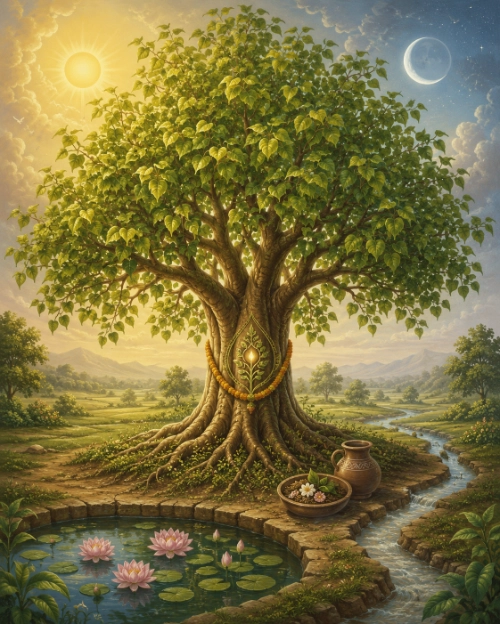
धन्वन्तरिरुवाच
वृक्षायुर्वेदमाख्यास्ये प्लक्षश्चोत्तरतः शुभः ।
प्राग्वटो याम्यतस्त्वाम्रः आप्येऽश्वत्थः क्रमेण तु ॥ १ ॥
दक्षिणां दिशमुत्पन्नाः समीपे कण्टकद्रुमाः ।
उद्यानं गृहवामे स्यात् तिलान् वाप्यथ पुष्पितान् ॥ २ ॥
गृह्णीयाद्रोपयेद्वृक्षान् द्विजं चन्द्रं प्रपूज्य च ।
ध्रुवाणि पञ्च वायव्यं हस्तं प्राजेशवैष्णवम् ॥ ३ ॥
नक्षत्राणि तथा मूलं शस्यन्ते द्रुमरोपणे ।
प्रवेशयेन्नदीवाहान् पुष्करिण्यां तु कारयेत् ॥ ४ ॥
Dhanvantarir uvāca
vṛkṣāyurvedam ākhyāsye plakṣaś cottarataḥ śubhaḥ |
prāg vaṭo yāmyatas tv āmraḥ āpye ’śvatthaḥ krameṇa tu || 1 ||
dakṣiṇāṃ diśam utpannāḥ samīpe kaṇṭaka-drumāḥ |
udyānaṃ gṛha-vāme syāt tilān vāpy atha puṣpitān || 2 ||
gṛhṇīyād ropayed vṛkṣān dvijaṃ candraṃ prapūjya ca |
dhruvāṇi pañca vāyavyaṃ hastaṃ prājeśa-vaiṣṇavam || 3 ||
nakṣatrāṇi tathā mūlaṃ śasyante druma-ropaṇe |
praveśayen nadī-vāhān puṣkariṇyāṃ tu kārayet || 4 ||
Dhanvantari said: I shall now expound the Vṛkṣāyurveda — the Āyurveda of trees. The plakṣa [Ficus lacor, the pakur fig] to the north is auspicious. To the east [stands] the vaṭa [Ficus benghalensis, the banyan]; to the south the āmra [mango, Mangifera indica]; to the water-direction [west] the aśvattha [Ficus religiosa, the peepal] — each in order.
Thorny trees (kaṇṭaka druma) that have grown up [spontaneously] near [the house] in the southern direction [are inauspicious and should be removed]. The garden (udyāna) should be to the left [north or east] of the house. One should sow sesame (tila) or flowering plants in the pond/well (vāpī).
One should take [saplings] and plant trees having worshipped the twice-born [Brāhmaṇas] and the Moon. The five fixed (dhruva) [nakshatras], the lunar mansion of Vāyu [Svāti], Hasta, and those of Prajāpati [Rohiṇī] and Viṣṇu [Śravaṇa] and Mūla — are praised/recommended for the planting of trees. One should bring in flowing water from rivers and construct a lotus pond or reservoir.
Vṛkṣāyurveda — the ancient Indian science of plant life, health, and cultivation; a complete subsidiary branch of Āyurveda dealing with the diagnosis and treatment of plant diseases, auspicious planting, soil science, and the relationship between trees and human habitation. The most complete surviving classical text on this subject is the Vṛkṣāyurveda of Surapāla.
- North (uttara)PlakṣaFicus lacor — auspicious, cooling
- East (prāk)VaṭaFicus benghalensis — the banyan, immortality
- South (yāmya)ĀmraMangifera indica — mango, nourishment
- West (āpya, water-direction)AśvatthaFicus religiosa — the peepal, sacred to Viṣṇu
Thorny trees — their spontaneous growth near the southern direction of a house is considered inauspicious (aśubha) in the Āyurvedic and Vāstuśāstra traditions; the south is the direction of Yama (death), and thorny, aggressive plants amplify its malefic quality in proximity to human habitation.
“The garden to the left of the house” — vāma (left) in the context of a house facing east means the north side; in the context of a south-facing house, it means east. Either way, the garden is placed in an auspicious, life-affirming direction away from the southern quadrant.
“Having worshipped the twice-born and the Moon” — two acts of propitiation before planting: honoring the Brāhmaṇa who will perform the ritual blessing, and worshipping the Moon (Candra) whose nakṣatra governs the auspiciousness of the planting moment. Tree planting in Vṛkṣāyurveda is a sacred act that requires ritual preparation.
The five dhruva (stable, fixed) nakṣatras are considered most auspicious for planting because their stable quality is transferred to the planted tree, ensuring it takes root firmly and grows without disease.
The five dhruva nakṣatras are classically:
- Rohiṇī,
- Uttarāphalgunī,
- Uttarāṣāḍhā,
- Uttarābhādrapadā,
- Revatī.
- The nakṣatra of Vāyu, Svāti — ruled by the wind god; auspicious for planting as Vāyu governs the breath and vital movement of all living things, including plants.
- Hasta nakṣatra — “the hand”; governed by the Sun; associated with skill, craftsmanship, and the bringing of things to fruition — particularly auspicious for agricultural and horticultural acts.
- Rohiṇī nakṣatra, the most fertile and nourishing of all lunar mansions, beloved of the Moon; supreme for planting and sowing.
- Śravaṇa nakṣatra, ruled by Viṣṇu; associated with growth, preservation, and auspicious outcomes.
- Mūla nakṣatra — “the root”; its very name makes it paradigmatically appropriate for planting; governed by Nirṛti (or in some traditions by Ketu), it is associated with foundations, roots, and beginnings — the act of planting a tree’s root in the earth aligns perfectly with the quality of this nakṣatra.