

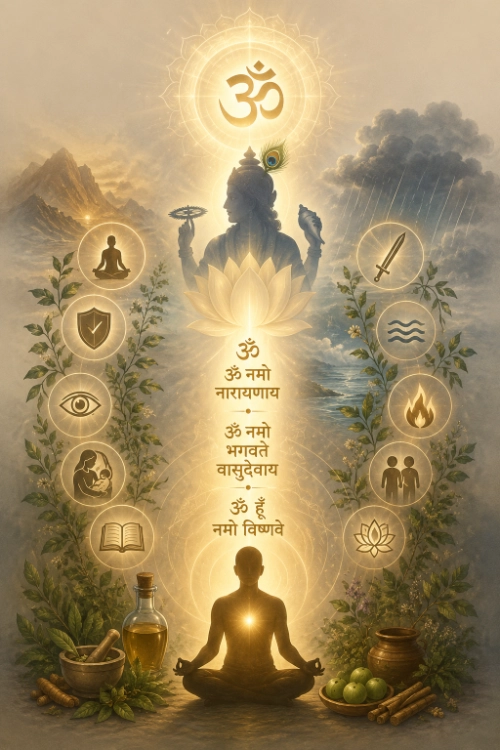
धन्वन्तरिरुवाच
आयुरारोग्यकर्तारः ॐकाराद्याश्च नाकदाः ।
ॐकारः परमो मन्त्रस्तं जप्त्वा चामरो भवेत् ॥ १ ॥
गायत्री परमो मन्त्रस्तां जप्त्वा भुक्तिमुक्तिभाक् ।
ॐ नमो नारायणाय मन्त्रः सर्वार्थसाधकः ॥ २ ॥
ॐ नमो भगवते वासुदेवाय सर्वदः ।
ॐ हूँ नमो विष्णवे मन्त्रोऽयं चौषधं परम् ॥ ३ ॥
Dhanvantarir uvāca
āyur-ārogya-kartāraḥ oṃkārādyāś ca nākadāḥ |
oṃkāraḥ paramo mantras taṃ japtvā cāmaro bhavet || 1 ||
gāyatrī paramo mantras tāṃ japtvā bhukti-mukti-bhāk |
oṃ namo nārāyaṇāya mantraḥ sarvārtha-sādhakaḥ || 2 ||
oṃ namo bhagavate vāsudevāya sarvadaḥ |
oṃ hūṃ namo viṣṇave mantro ’yaṃ cauṣadhaṃ param || 3 ||
Dhanvantari said: Mantras beginning with Oṃkāra are producers of long life and health, and bestowers of heaven. Oṃkāra is the supreme mantra; by reciting it, one becomes immortal.
The Gāyatrī is the supreme mantra; by reciting her, one becomes a recipient of both worldly enjoyment and liberation. The mantra “Oṃ namo Nārāyaṇāya” accomplishes every purpose.
The mantra “Oṃ namo Bhagavate Vāsudevāya” is always bestowing. This mantra, “Oṃ hūṃ namo Viṣṇave,” is also the supreme medicine.
- Dhanvantariḥ — the divine physician. His role here bridges medicine and sacred sound: health is not only herbal or dietary, but also connected with mantra, merit, and divine remembrance.
- āyus — life-span, vitality, duration of life.
- ārogya — health, freedom from disease.
- kartāraḥ — “producers, makers, bringers about.” The mantras are said to actively produce longevity and health.
- nākadāḥ — “bestowers of heaven.” Nāka is heaven or the celestial world; dāḥ means givers.
- Oṃkāraḥ — the syllable Oṃ, regarded as the primordial sound, the seed of Veda, and the supreme sacred utterance.
- amaro bhavet — “one becomes immortal.” This may be understood spiritually — attaining deathlessness through sacred realization — rather than merely physical non-death.
- Gāyatrī — the sacred Vedic mantra-form, often identified with the Vedic metre, the goddess Gāyatrī, and especially the Savitṛ mantra. Here she is treated as a supreme liberating mantra.
- Oṃ namo Nārāyaṇāya — the eight-syllabled aṣṭākṣarī mantra of Nārāyaṇa, highly revered in Vaiṣṇava traditions.
- sarvārtha-sādhakaḥ — “accomplishing all aims.” Artha here means purpose, object, aim, or desired good.
- Oṃ namo Bhagavate Vāsudevāya — the twelve-syllabled dvādaśākṣarī mantra, addressed to Vāsudeva, a supreme form/name of Viṣṇu-Kṛṣṇa.
- Oṃ hūṃ namo Viṣṇave — a Viṣṇu mantra containing the bīja hūṃ, often associated with protection, force, and removal of obstruction.
- auṣadhaṃ param — “the supreme medicine.” The phrase explicitly interprets mantra as a healing agent.
This chapter opens with a striking expansion of medicine beyond herbs, diet, and bodily regimen. Dhanvantari now teaches mantras as medicines. The logic is not merely symbolic: sacred sound is treated as a force that can protect life, restore health, grant heaven, and even lead to liberation. The sequence is meaningful. Oṃ is first praised as the supreme primordial sound; Gāyatrī then appears as the mantra of both worldly and spiritual fulfilment; and the Nārāyaṇa, Vāsudeva, and Viṣṇu mantras are presented as all-accomplishing and medicinal. The chapter thus joins Āyurveda with mantra-śāstra: healing is bodily, mental, karmic, and spiritual at once.