

Nityānanda’s Lotus Feet and Hands: Fifty-Two Auspicious Marks
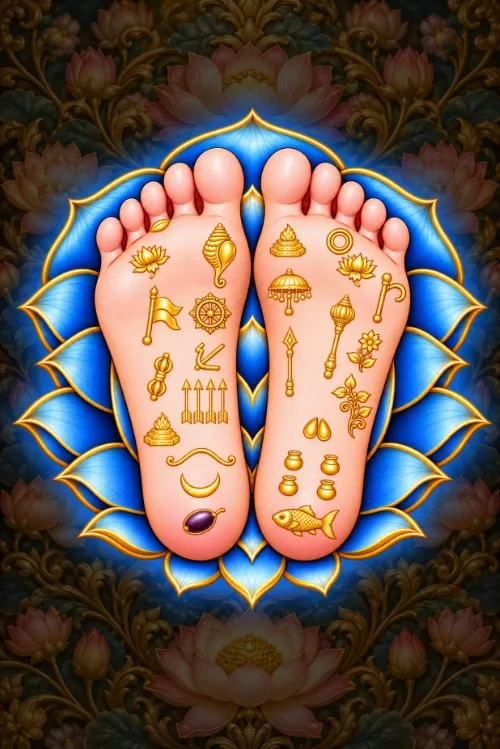
The sacred symbols of Lord Baladeva, the spiritual significance of Nityānanda’s twenty-four foot markings and twenty-eight palm markings, and the extraordinary compassion that opens the way to Rādhā and Kṛṣṇa.
The lotus feet of Lord Nityānanda Prabhu are compared to the cooling radiance of millions of moons. His hands bear the symbols of divine strength, protection, purification, and service, while His feet are adorned with extraordinary auspicious signs. Yet the deepest significance of these markings lies not in their number or appearance, but in the remarkable spiritual identity of the Lord who bears them.
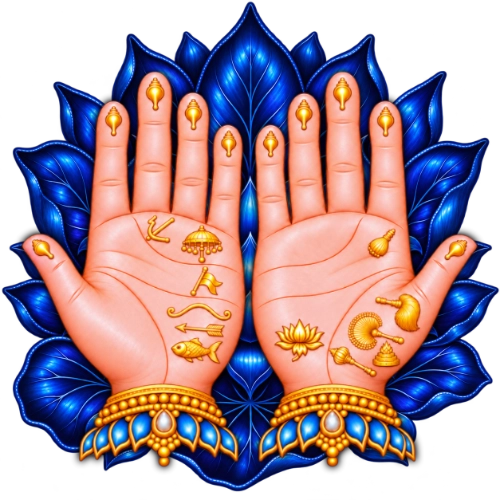
According to a traditional Gauḍīya Vaiṣṇava iconographic system, Lord Nityānanda’s feet possess twenty-four principal auspicious marks, twelve upon each sole, while His hands bear twenty-eight marks, fourteen upon each palm. Together, these form fifty-two counted signs, including sacred emblems, grouped designs, and auspicious palm lines.
Among them are the plough, thunderbolt, conch, lotus, umbrella, fish, flowering creeper, sacrificial altar, bow, and arrows. His hands also display something particularly striking: a broom, a ceremonial fly-whisk, and a fan. These seemingly ordinary implements acquire profound significance when understood in relation to Nityānanda’s divine identity as Lord Baladeva, the embodiment of spiritual service and the compassionate companion of Śrī Caitanya Mahāprabhu.
The great Gauḍīya scriptures firmly establish Nityānanda’s identity, His extraordinary mercy, and the importance of taking shelter of His lotus feet. The exact twenty-four-mark and twenty-eight-mark inventories belong to a more specialized iconographic tradition preserved in transmitted Sanskrit meditation verses and devotional compilations. Their full early manuscript history has not yet been securely established, and that distinction is important for an accurate presentation.
The symbols become most meaningful when viewed through the teachings and pastimes of Nityānanda Himself. His feet offer shelter, His hands extend mercy, and His mission is to awaken love for Kṛṣṇa even in those who have forgotten their spiritual purpose.
1. The Lotus Feet That Cool the World Like Millions of Moons
One of the most celebrated prayers to Lord Nityānanda was composed by Śrīla Narottama Dāsa Ṭhākura, the great Gauḍīya Vaiṣṇava poet and spiritual teacher. His Bengali song Nitāi-pada-kamala, preserved in Prārthanā under the theme of devotion to Nityānanda, begins with an extraordinary comparison.
নিতাই পদ-কমল কোটীচন্দ্র-সুশীতল
nitāi-pada-kamala, koṭi-candra-suśītala
“The lotus feet of Nitāi are more soothing and cooling than millions of moons.”
Narottama Dāsa Ṭhākura, Nitāi-pada-kamala, first stanza.
The full stanza explains that the shade of Nityānanda’s feet brings relief to the world and that His mercy is essential for approaching Rādhā and Kṛṣṇa. It concludes by urging the aspiring devotee to firmly seek their shelter.
The moon is an especially meaningful image in Indian devotional literature. The burning heat of the sun often represents the suffering, anxiety, and agitation of material existence. Cool moonlight expresses peace, compassion, and relief. The moon does not struggle against the darkness; it simply shines, and its cooling rays bring comfort.
Narottama multiplies this image beyond ordinary imagination. Nityānanda’s feet are not compared to one moon, but to millions. The expression koṭi-candra conveys an immeasurable abundance of cooling beauty and compassion.
The comparison becomes even more striking when considered alongside Nityānanda’s role in the spiritual life of a devotee. His mercy does not merely relieve suffering temporarily. It awakens a relationship with the eternal spiritual reality that lies beyond material existence.
In the final stanza of the song, Narottama declares that Nityānanda’s feet are eternally real and that those engaged in their service belong to an eternal spiritual relationship. He then offers a deeply personal prayer, asking Nityānanda to relieve his distress and keep him close to His reddish lotus feet.
The emphasis is not on acquiring extraordinary powers or material prosperity. It is on receiving the mercy of Nityānanda, becoming free from false pride, and attaining the loving service of Rādhā and Kṛṣṇa.
This is the foundation of the entire subject. The auspicious marks on Nityānanda’s feet are sacred because they belong to the Lord whose compassion is compared to the cooling radiance of millions of moons.
2. Who Is Lord Nityānanda? The Identity of Baladeva
In Gauḍīya Vaiṣṇava theology, Lord Nityānanda is identified with Lord Balarāma, also known as Baladeva, the elder brother of Śrī Kṛṣṇa in His earthly pastimes.
Balarāma is not understood merely as an extraordinary divine companion. He is Kṛṣṇa’s first personal expansion and the source of numerous divine manifestations associated with the maintenance of the spiritual and material worlds. Through His expansions, He manifests the principle of divine service in countless forms.
The Śrī Caitanya-caritāmṛta, Ādi-līlā 1.7, establishes His identity in a celebrated Sanskrit verse.
सङ्कर्षणः कारणतोयशायी
गर्भोदशायी च पयोऽब्धिशायी ।
शेषश्च यस्यांशकलाः स नित्या-
नन्दाख्यरामः शरणं ममास्तु ॥
saṅkarṣaṇaḥ kāraṇa-toya-śāyī
garbhoda-śāyī ca payo ‘bdhi-śāyī
śeṣaś ca yasyāṁśa-kalāḥ sa nityā-
nandākhya-rāmaḥ śaraṇaṁ mamāstu
“May Lord Rāma, known as Nityānanda, be my eternal shelter. Saṅkarṣaṇa, the Viṣṇu expansions who recline upon the Causal Ocean, the Garbhodaka Ocean, and the ocean of milk, together with Śeṣa, are His plenary portions and expansions of those portions.”
This verse places Nityānanda within the highest theological structure of Gauḍīya Vaiṣṇavism. He is identified with the divine Baladeva from whom the great sustaining expansions of Godhead proceed.
But His spiritual greatness possesses an unusual characteristic: unlimited power is inseparable from unlimited service.
The Caitanya-caritāmṛta, Ādi-līlā 5.11, expresses this beautifully.
সর্বরূপে আস্বাদয়ে কৃষ্ণ–সেবানন্দ ।
সেই বলরাম—গৌরসঙ্গে নিত্যানন্দ ॥
sarva-rūpe āsvādaye kṛṣṇa-sevānanda
sei balarāma — gaura-saṅge nityānanda
“In all His forms, He relishes the transcendental bliss of serving Kṛṣṇa. That very Balarāma appears as Nityānanda, the companion of Lord Gaurasundara.”
The key expression is kṛṣṇa-sevānanda, the bliss of serving Kṛṣṇa.
Balarāma’s spiritual identity is intimately connected with service. He serves Kṛṣṇa as His elder brother and intimate companion, but He also expands into the many forms through which Kṛṣṇa’s divine pastimes are supported.
He manifests as Ananta Śeṣa, the great serpent who provides a resting place for Lord Viṣṇu. He also assumes innumerable forms of sacred paraphernalia, furnishings, ornaments, and protective implements to facilitate the Lord’s enjoyment.
This provides an essential key to interpreting Nityānanda’s hands and feet. His symbols are not merely signs of royal authority or supernatural strength. They can also be contemplated as expressions of the power to protect, purify, guide, and serve.
3. Why Are His Hands and Feet Adorned With Auspicious Marks?
In Indian sacred iconography, the hands and feet of an extraordinary person may be described as bearing auspicious signs known as śubha-cihna or lakṣaṇa. Such marks appear in different religious traditions, particularly in descriptions of divine manifestations, exalted spiritual personalities, and ideal sovereigns.
The Sanskrit word cihna means a distinguishing sign or mark, while lakṣaṇa refers to a characteristic by which something may be recognized. Another term, rekhā, means a line or marking.
In devotional iconography, these symbols are not generally presented as ordinary ornaments painted upon the skin. They are understood as natural auspicious features of the divine form.
The lotus, conch, disc, flag, and umbrella have long associations with purity, auspiciousness, sovereignty, and spiritual protection. Other symbols, such as the plough, pestle, fan, and fly-whisk, acquire additional significance through their association with the Lord’s particular pastimes and relationships.
The twenty-four-foot-mark tradition of Nityānanda describes twelve principal emblems on each sole. The twenty-eight-hand-mark tradition describes fourteen markings on each palm.
However, the method of counting requires clarification. Four arrows are treated as one grouped emblem on the right foot, and four pitchers are similarly treated as one grouped emblem on the left. The five conch symbols on each palm, by contrast, are counted separately, one on each fingertip. Three major auspicious palm lines are also included in the count of fourteen on each hand.
Consequently, fifty-two does not signify fifty-two unique kinds of symbols. It is the combined numerical inventory of the individual and grouped markings associated with His two feet and two palms.
4. The Sanskrit Evidence for the Twenty-Four Foot Marks
A series of Sanskrit meditation verses preserved in later devotional compilations describes Nityānanda’s foot markings.
The transmitted right-foot verse names the flag, thunderbolt, barleycorn, jambu fruit, lotus, conch, disc, plough, four arrows, sacrificial altar, bow, and crescent moon. The corresponding left-foot verse names the pestle, sky, umbrella, lotus, elephant goad, sacrificial altar, spear, fish, four pitchers, cow’s hoofprint, flower, and flowering creeper.
A representative passage from the right-foot verse reads:
dhvaja-pavi-yava-jambūny ambujaṁ śaṅkha-cakraṁ
hala-viśikha-catuṣkaṁ vedi-cāpārdha-candrān
“The flag, thunderbolt, barleycorn, jambu fruit, lotus, conch, disc, plough, group of four arrows, sacrificial altar, bow, and crescent moon.”
The corresponding passage for the left foot reads:
musala-gagana-chatrābja-aṅkuśaṁ vedi-śakti
jhaṣa-kalaśa-catuṣkaṁ goṣpadaṁ puṣpa-vallīm
“The pestle, sky, umbrella, lotus, elephant goad, sacrificial altar, spear, fish, group of four pitchers, cow’s hoofprint, flower, and flowering creeper.”
These excerpts follow circulated Romanized transcriptions, with normalized diacritics. The accessible versions contain spelling and grammatical irregularities, and their complete manuscript provenance remains uncertain. They should therefore be regarded as transmitted iconographic material rather than critically established verses from a securely identified ancient source.
The accompanying Sanskrit description concludes with the expression:
caturviṁśatiś cihnāni nityānanda-padāmbuje.
“Twenty-four auspicious markings are present upon the lotus feet of Nityānanda.”
This explicit numerical statement is important because it demonstrates that the twenty-four-mark inventory is not merely inferred by counting symbols in a painting.
The meditation verses also refer to prema-rekhāḥ, lines of divine love. Some presentations describe three such lines, although they are not separately included in the standard twelve-mark inventory for each sole.
The conventional count therefore remains twelve principal marks on the right foot and twelve on the left, giving twenty-four auspicious marks in total.
5. The Twelve Auspicious Marks on Nityānanda’s Right Lotus Foot
Nityānanda’s right foot bears the barleycorn, lotus, conch, disc, plough, victory flag, four arrows, thunderbolt, unstrung bow, crescent moon, sacrificial altar, and jambu fruit.
Barleycorn — Yava
Lotus — Padma
Conch — Śaṅkha
Disc — Cakra
Plough — Hala or Lāṅgala
Victory Flag — Dhvaja
Four Arrows — Viśikha-catuṣka
Thunderbolt — Vajra or Pavi
Unstrung Bow
Crescent Moon — Ardha-candra
Sacrificial Altar — Vedi
Jambu Fruit — Jambu-phala
Together, these emblems present an extraordinary combination of spiritual nourishment, protection, strength, and compassionate guidance.
The Barleycorn and Lotus: Nourishment and Purity
The barleycorn, yava, is situated below the middle toe. In traditional Indian symbolism, grain represents nourishment, fertility, prosperity, and the sustaining power of life. Spiritually, it may be contemplated as the nourishment required for devotion to grow and bear fruit.
Just as a seed cannot flourish in barren ground, the spiritual life requires favorable conditions. Hearing sacred teachings, chanting the divine names, associating with devotees, and engaging in service nourish the heart. Nityānanda’s mercy is understood as creating the opportunity for that growth.
The lotus, padma, is situated below the fourth toe. It is one of the most widespread symbols of purity and spiritual beauty in Indian religion. The lotus grows in muddy water yet remains unstained by the mud, making it an especially appropriate image of transcendence.
Upon Nityānanda’s foot, the lotus recalls the purity of divine consciousness and the shelter of the Lord’s own lotus feet. It also reflects the beauty of Vṛndāvana, where the eternal pastimes of Kṛṣṇa and Baladeva unfold.
The Conch and Disc: Awakening and Protection
The conch, śaṅkha, appears at the base of the big toe. The conch is associated with sacred sound, auspicious beginnings, and divine proclamation. Its resonance can be contemplated as a call awakening the soul from spiritual forgetfulness.
Directly below the conch appears the disc, cakra, another powerful emblem of divine protection. The circulated Sanskrit explanation associates this sign with overcoming the six inner enemies: lust, anger, greed, illusion, pride, and envy.
These tendencies are collectively known in many Hindu traditions as the six enemies of the mind, or ṣaḍ-ripu. They obstruct clear spiritual understanding by placing selfish desires at the center of consciousness.
The disc therefore offers an image of the power of divine grace to overcome the obstacles that prevent the development of genuine devotion.
The Plough: Cultivating the Field of the Heart
The plough, hala or lāṅgala, is one of the most significant markings on Nityānanda’s right foot because it directly recalls His identity as Baladeva.
Balarāma is traditionally depicted bearing a plough, and His divine pastimes repeatedly demonstrate its extraordinary power. The plough is not merely an agricultural implement in these narratives. It is also a manifestation of His supernatural strength.
One of the most dramatic examples appears in the Śrīmad-Bhāgavatam, 10.65.26, where Balarāma commands the river Yamunā to approach Him and threatens to draw her toward Himself with His plough when she does not immediately obey.
The plough therefore represents divine authority and irresistible power. But in devotional contemplation, it also provides a remarkably beautiful metaphor for spiritual transformation.
A neglected field cannot produce a fruitful harvest merely because good seed is scattered over its surface. The ground must first be prepared. Weeds must be removed, hardened soil broken, and the field made receptive.
Similarly, the human heart becomes hardened through selfishness, pride, resentment, and attachment. Nityānanda, understood as the original spiritual master, prepares that heart for the seed of devotion.
This metaphor corresponds closely with Caitanya Mahāprabhu’s teaching to Rūpa Gosvāmī in Caitanya-caritāmṛta, Madhya-līlā 19.151.
ব্রহ্মাণ্ড ভ্রমিতে কোন ভাগ্যবান্ জীব ।
গুরু-কৃষ্ণ-প্রসাদে পায় ভক্তিলতা-বীজ ॥
brahmāṇḍa bhramite kona bhāgyavān jīva
guru-kṛṣṇa-prasāde pāya bhakti-latā-bīja
“While wandering throughout the universe, a fortunate soul receives the seed of the creeper of devotional service through the mercy of the spiritual master and Kṛṣṇa.”
The following verse describes how this seed should be cultivated.
মালী হঞা করে সেই বীজ আরোপণ ।
শ্রবণ-কীর্তন-জলে করয়ে সেচন ॥
mālī hañā kare sei bīja āropaṇa
śravaṇa-kīrtana-jale karaye secana
“Becoming a gardener, the devotee plants that seed and waters it with the processes of hearing and chanting.”
The symbolism forms a coherent spiritual sequence. The plough prepares the heart, the mercy of guru and Kṛṣṇa supplies the seed, and hearing and chanting provide the water through which devotion grows.
This is a theological interpretation connecting Nityānanda’s emblem with the broader Gauḍīya teaching. The Bhāgavatam’s account of Balarāma’s plough does not itself explicitly explain the markings on Nityānanda’s soles.
The Victory Flag, Thunderbolt, and Sacrificial Altar
The victory flag, dhvaja, appears below the lotus. A flag ordinarily announces victory, royal authority, and the presence of a sovereign. In devotional interpretation, it represents the triumph of divine love over ignorance and selfishness.
Beneath the flag appears the thunderbolt, vajra or pavi. The thunderbolt is associated with irresistible force. In this context, it may be contemplated as the power of divine grace to destroy deeply rooted spiritual obstacles.
Below the thunderbolt is the sacrificial altar, vedi. The altar represents sacred offering and dedication. It recalls the transformation of ordinary action into worship when everything is offered for the pleasure of the Supreme Lord.
These three marks can be contemplated together. Divine power removes obstacles, loving service transforms the heart, and the victory of devotion is established.
The Four Arrows and Unstrung Bow
The four arrows, viśikha-catuṣka, appear together as one grouped emblem. Above the group stands the plough, while the unstrung bow is located below the arrows.
The Sanskrit expression describing the bow includes jyā-śūnya, meaning without a bowstring. This is a significant detail. An unstrung bow is not necessarily a broken weapon. It can represent power that is present but deliberately restrained.
The four arrows suggest direction, strength, and purposeful action. However, the surviving iconographic description does not clearly assign an independent theological meaning to each arrow. Attempts to identify them individually with four particular principles should therefore be regarded as later symbolic interpretations unless supported by a specific text.
The deeper devotional lesson concerns mastery over power. Nityānanda possesses extraordinary strength, but His principal mission in the age of Kali is the distribution of divine love rather than the conquest of others through violence.
The Crescent Moon and Jambu Fruit
The crescent moon, ardha-candra, appears near the heel, above the jambu fruit. It evokes the cooling and soothing qualities of compassion, recalling Narottama Dāsa Ṭhākura’s comparison of Nityānanda’s feet to millions of moons.
The jambu fruit, jambu-phala, appears at the heel. It refers to the Indian jamun, often called Java plum or Indian blackberry. It should not be confused with the ordinary European blackberry, which is botanically different.
In traditional Indian cosmography, the name Jambūdvīpa is associated with the jambu tree. The mark may therefore invite contemplation of the Lord’s relationship with the world and its inhabitants, although that association is not explicitly developed in the transmitted foot-mark verse.
The right sole thus combines sacred nourishment, purity, awakening, protection, spiritual cultivation, victory, controlled strength, and cooling compassion.
6. The Twelve Auspicious Marks on Nityānanda’s Left Lotus Foot
The left foot bears the sacrificial altar, sky, lotus, elephant goad, pestle-shaped club, umbrella, flower, cow’s hoofprint, spear, flowering creeper, four pitchers, and fish.
Sacrificial Altar — Vedi
Sky — Gagana or Ākāśa
Lotus — Padma
Elephant Goad — Aṅkuśa
Pestle — Musala
Umbrella — Chatra
Flower — Puṣpa
Cow’s Hoofprint — Goṣpada
Spear — Śakti
Flowering Creeper — Vallī
Four Pitchers — Kalaśa-catuṣka
Fish — Matsya or Jhaṣa
Several of these marks repeat symbols found elsewhere in divine-foot iconography, but the combination is particularly meaningful in relation to Nityānanda’s identity and compassionate mission.
The Sacrificial Altar and Umbrella
The sacrificial altar, vedi, appears at the base of the big toe. Immediately below it is the umbrella, chatra, followed by the spear, śakti.
The altar represents dedication to sacred service. The umbrella expresses shelter, royal dignity, and protection. The spear suggests decisive spiritual strength and the ability to overcome opposition.
The umbrella has an especially deep theological association with Baladeva.
In Caitanya-caritāmṛta, Ādi-līlā 5.123, Kṛṣṇadāsa Kavirāja describes the extraordinary forms through which Balarāma serves Kṛṣṇa.
ছত্র, পাদুকা, শয্যা, উপাধান, বসন ।
আরাম, আবাস, যজ্ঞসূত্র, সিংহাসন ॥
chatra, pādukā, śayyā, upādhāna, vasana
ārāma, āvāsa, yajña-sūtra, siṁhāsana
“He serves Kṛṣṇa by assuming the forms of an umbrella, sandals, bed, pillow, garments, resting place, residence, sacred thread, and throne.”
The verse reveals a remarkable feature of Baladeva’s spiritual identity. He does not merely offer service through individual actions. He manifests the very forms required for Kṛṣṇa’s comfort and enjoyment.
Thus the umbrella upon Nityānanda’s foot can be contemplated in two complementary ways. He grants shelter to devotees, and He Himself manifests as a sheltering implement in the service of Kṛṣṇa.
The supreme protector is also the supreme servant.
The Sky: The Symbol of Boundlessness
The sky, gagana or ākāśa, appears beneath the middle toe.
Unlike the conch, lotus, or umbrella, the sky has no universally fixed pictorial shape. Its artistic representation therefore depends upon the particular iconographic tradition.
Spiritually, the sky suggests vastness, openness, and freedom from limitation. It may be contemplated as an image of the transcendental nature of divine existence, beyond the boundaries that govern material life.
However, the transmitted marking verse names the sky without providing an elaborate philosophical explanation. Any particular graphic design or deeper allegorical interpretation should be distinguished from the literal wording of the source.
The Lotus and Pestle: Beauty and Strength
The lotus appears beneath the fourth toe, while a pestle-shaped weapon is located below it.
This weapon is called musala or muṣala in Sanskrit. It is sometimes translated simply as a club, but the more precise meaning is a pestle or heavy pestle-shaped weapon. This distinction is important because the plough and pestle are characteristic weapons of Lord Balarāma.
The Śrīmad-Bhāgavatam, 10.67.16, describes Balarāma taking up both weapons when confronting the destructive ape Dvivida.
तं तस्याविनयं दृष्ट्वा देशांश्च तदुपद्रुतान् ।
क्रुद्धो मुषलमादत्त हलं चारिजिघांसया ॥
taṁ tasyāvinayaṁ dṛṣṭvā
deśāṁś ca tad-upadrutān
kruddho muṣalam ādatta
halaṁ cāri-jighāṁsayā
“Seeing the ape’s insolence and the devastation he had caused in the surrounding lands, Lord Balarāma became angry and took up His pestle-like club and plough to confront His enemy.”
This verse directly establishes the plough and pestle as characteristic weapons of Balarāma.
Their appearance in Nityānanda’s foot markings therefore has a stronger textual connection than many of the purely symbolic interpretations associated with the other emblems.
The plough may be contemplated as preparing the heart for devotion, while the pestle represents the strength to overcome the obstacles that resist transformation.
The Elephant Goad, Flower, and Flowering Creeper
Beneath the little toe appears the elephant goad, aṅkuśa. Below it are the flower, puṣpa, and flowering creeper, vallī.
The elephant goad is used to guide a powerful elephant. Spiritually, it offers a meaningful image of the redirection of the restless mind. The mind possesses extraordinary energy, but without guidance it can be carried away by desires, anxieties, and distractions.
The flower represents tenderness, fragrance, beauty, and the blossoming of devotion. The flowering creeper suggests growth, dependence upon support, and the gradual development of spiritual love.
These three marks form a beautiful devotional progression. The restless mind is guided, devotion begins to blossom, and love grows like a living creeper toward its ultimate object.
The flower and creeper are distinct symbols in the twelve-mark count. Although they are closely related in appearance, they should not be combined into a single emblem when reproducing this particular inventory.
The Four Pitchers, Cow’s Hoofprint, and Fish
Near the heel appears the fish, matsya or jhaṣa. Above it are four pitchers, kalaśa-catuṣka, and above them the cow’s hoofprint, goṣpada.
The pitchers are traditional symbols of auspicious fullness, abundance, nourishment, and sacred offering. Four pitchers are depicted together, but they constitute one grouped mark within the inventory.
The fish suggests complete dependence upon the environment that sustains life. Just as a fish cannot survive without water, the devotional soul finds its true fulfillment in the ocean of divine love.
The cow’s hoofprint possesses an especially powerful scriptural parallel. The Śrīmad-Bhāgavatam, 10.14.58, uses the image of water collected in a calf’s hoofprint to illustrate how divine shelter transforms the otherwise terrifying ocean of material existence.
समाश्रिता ये पदपल्लवप्लवं
महत्पदं पुण्ययशो मुरारेः ।
भवाम्बुधिर्वत्सपदं परं पदं
पदं पदं यद्विपदां न तेषाम् ॥
samāśritā ye pada-pallava-plavaṁ
mahat-padaṁ puṇya-yaśo murāreḥ
bhavāmbudhir vatsa-padaṁ paraṁ padaṁ
padaṁ padaṁ yad vipadāṁ na teṣām
“For those who take shelter of the boat of the Lord’s tender lotus feet, the vast ocean of material existence becomes no greater than water collected in a calf’s hoofprint. Their destination is the supreme spiritual abode, where the dangers of material existence no longer trouble them.”
The image is extraordinary. Material existence is compared to a vast ocean that ordinary effort cannot easily cross. But through divine shelter, that seemingly immeasurable ocean becomes as insignificant as a small puddle in the impression left by a calf’s hoof.
The Bhāgavatam verse refers to the lotus feet of the Supreme Lord and does not specifically describe Nityānanda’s twenty-four-mark inventory. Nevertheless, it supplies a strong scriptural background for contemplating the goṣpada emblem.
Nityānanda’s feet are thus celebrated as the shelter through which the impossible crossing becomes possible.
7. The Fourteen Auspicious Marks on Nityānanda’s Right Palm
The hand markings reveal a somewhat different aspect of Nityānanda’s spiritual identity.
The feet primarily express shelter, surrender, and the path of devotion. The hands suggest activity, service, purification, blessings, and guidance.
According to the transmitted Sanskrit inventory, Nityānanda’s right palm contains five conch symbols, one at the tip of each finger, together with a broom, ceremonial fly-whisk, fan, sacrificial altar, club, lotus, and three auspicious palm lines.
Five Conches — Śaṅkha
Broom — Mārjanī
Ceremonial Fly-Whisk — Cāmara
Fan — Vyajana
Sacrificial Altar — Vedi
Club — Gadā
Lotus — Padma
Three Auspicious Lines — Rekhā
The opening Sanskrit meditation verse includes the expression:
vyajanam api gadābje cāmaraṁ mārjanīṁ ca
guli-mukha-gata-śaṅkhān vedi-saubhāgya-rekhāḥ
“The fan, club, lotus, ceremonial fly-whisk, broom, conch signs upon the fingertips, sacrificial altar, and auspicious palm lines.”
The passage establishes the distinctive character of the right palm: implements of service appear alongside familiar symbols of divine power.
Five Conches Upon the Fingertips
Each of the five fingertips bears a conch: the thumb, index finger, middle finger, ring finger, and little finger.
The arrangement is unusual and visually distinctive. Unlike a single conch placed in the center of a palm, the five conches occupy five separate positions and are individually included in the count of fourteen.
The conch signifies auspiciousness and sacred sound. Its repetition may invite contemplation of the Lord’s blessings being expressed through His actions.
However, the transmitted Sanskrit passage does not assign a separate theological meaning to each individual fingertip. Identifying the five conches with five particular elements, senses, or spiritual principles would therefore be an additional symbolic interpretation rather than a direct explanation from the source.
The Broom: The Purification of the Heart
One of the most remarkable marks on Nityānanda’s right palm is the broom, called mārjanī in Sanskrit. It appears below the index finger.
A broom is an ordinary cleaning implement, but in devotional symbolism it becomes a powerful image of spiritual purification.
The Sanskrit root associated with mārjana conveys cleaning, wiping, or removing impurities. The broom may therefore be contemplated as the removal of the accumulated dust of selfish desires, pride, resentment, envy, and false identification.
These impurities do not necessarily destroy the soul’s spiritual nature, but they obscure its awareness. Just as a mirror covered with dust cannot reflect clearly, consciousness clouded by selfishness cannot fully perceive spiritual reality.
The metaphor of cleansing the heart is well established in Gauḍīya theology. The first verse of Caitanya Mahāprabhu’s Śikṣāṣṭaka begins with ceto-darpaṇa-mārjanam, the cleansing of the mirror of consciousness, through the congregational chanting of Kṛṣṇa’s holy names.
The broom upon Nityānanda’s palm can therefore be contemplated as a symbol of the purification He makes possible through divine mercy.
Together, the broom and plough form a particularly beautiful relationship. The plough prepares the ground of the heart, and the broom removes the impurities that obstruct spiritual growth. Both actions serve the same goal: making consciousness receptive to devotion.
The Fly-Whisk and Fan: Divine Service
The ceremonial fly-whisk, cāmara, appears below the thumb. Beneath it is the fan, vyajana.
These are two distinct objects.
A cāmara is a ceremonial whisk, traditionally made with long, flowing fibers attached to a handle. It is waved before a deity or honored personality as an offering of respectful service.
A vyajana is a fan used to produce a cooling breeze. Its function is comfort, care, and personal attendance.
Both implements carry a particularly intimate significance in relation to Balarāma. The highest form of service is not necessarily spectacular. Sometimes it consists simply of caring for the comfort and pleasure of the beloved Lord.
The presence of the fan and fly-whisk upon Nityānanda’s palm expresses this ideal. His divine power is inseparable from His delight in service.
The Sacrificial Altar, Club, and Lotus
Below the fan appears the sacrificial altar, vedi. Beneath it is the club, gadā, while the lotus is located in the lower central region of the palm, above the wrist.
The altar signifies consecrated action. The club represents strength and the removal of obstacles. The lotus expresses purity, beauty, and spiritual fulfillment.
These symbols can be contemplated as a unified process. Selfish action becomes offering, obstacles are removed through divine grace, and the heart blossoms with devotion.
The devotional interpretation of the club is particularly appropriate to Nityānanda’s merciful nature. His spiritual power is not exercised merely to dominate others. It removes the inner obstacles that prevent them from receiving divine love.
8. The Fourteen Auspicious Marks on Nityānanda’s Left Palm
The left palm contains five conch symbols upon the fingertips, together with the plough, umbrella, long flag, bow, arrow, fish, and three auspicious palm lines.
Five Conches — Śaṅkha
Plough — Hala or Lāṅgala
Umbrella — Chatra
Long Flag — Dhvaja
Bow
Arrow — Viśikha
Fish — Matsya
Three Auspicious Lines — Rekhā
A transmitted Sanskrit passage declares:
vāma-kare caturdaśa cihnāni dharati prabhuḥ.
“The Lord bears fourteen auspicious marks upon His left hand.”
The accompanying description places the plough below the middle finger. The umbrella appears beneath the junction of the ring and little fingers, while the long flag extends toward the wrist. The bow, arrow, and fish occupy the remaining region of the palm.
The Plough: The Power to Awaken Devotion
The plough appears once again, connecting Nityānanda’s left palm with His identity as Baladeva.
Its placement upon the hand gives the symbol an active quality. The plough is not merely an emblem of who Nityānanda is. It can also represent what He does: He cultivates the field of human consciousness, preparing it for the growth of devotional love.
The hand that bears the plough becomes an image of compassionate spiritual action.
The Umbrella and Long Flag
The umbrella signifies protection and divine shelter. The flag expresses victory and the establishment of spiritual truth.
The combination of these two symbols can be understood as the compassionate sovereignty of Nityānanda. He does not simply exercise power over others. He offers them shelter and protection while directing them toward the highest spiritual goal.
The transmitted description emphasizes that the flag is long and extends toward the wrist. This detail is especially relevant when reproducing the markings in sacred art.
The Bow, Arrow, and Fish
The bow and arrow express spiritual power, determination, and purposeful direction. The bow is frequently depicted without a string in traditional diagrams, although the short Sanskrit left-palm inventory itself simply names the bow rather than explicitly repeating the right-foot description of an unstrung weapon.
The arrow may be contemplated as determination directed toward a spiritual purpose. The fish again suggests the complete dependence of life upon its sustaining environment, just as the devotional soul depends upon divine grace.
The symbolic power of these emblems should not obscure the simplicity of the underlying teaching. Nityānanda’s mission is to guide the soul toward spiritual awakening, not to glorify violence or worldly conquest.
9. The Three Auspicious Lines on Each Palm
Both palms contain three principal auspicious lines, traditionally rendered in English as the life line, fate line, and good fortune or enjoyment line.
These are included in the count of fourteen markings on each hand. The five fingertip conches and six central emblems give eleven signs; the three major lines complete the total.
The transmitted Sanskrit descriptive passages use expressions related to long life, good fortune, auspiciousness, and enjoyment, including saubhāgya-rekhā and bhoga-rekhā. The English labels are not always completely consistent, and their interpretation requires caution.
In ordinary palmistry, lines may be associated with predictions concerning lifespan, destiny, wealth, or worldly happiness. Such a framework is not appropriate as a literal explanation of Nityānanda’s transcendental nature.
Gauḍīya theology does not regard the Lord as a conditioned being whose future is determined by karma. The auspicious lines should instead be understood within the devotional symbolism of His eternal spiritual form.
The life line may suggest eternal vitality and the true purpose of life. The fortune line can evoke the supreme good fortune of receiving divine grace. The enjoyment line may be contemplated in relation to spiritual happiness, which is distinct from temporary material pleasure.
These meanings are devotional reflections rather than established predictive definitions supplied by the Sanskrit marking verses.
10. Nityānanda’s Feet Give Shelter, and His Hands Show the Way
One of the most moving episodes in the Caitanya-caritāmṛta brings the symbolism of Nityānanda’s hands and feet into a single narrative.
Kṛṣṇadāsa Kavirāja Gosvāmī, the author of the Caitanya-caritāmṛta, describes how Nityānanda appeared to him in a dream at Jhāmaṭapura, near Naihāṭi.
The Lord appeared in a magnificent form, with extraordinary beauty, powerful limbs, and the radiance of spiritual ecstasy. He was adorned with silk garments, golden ornaments, flower garlands, and sandalwood paste. His movements resembled those of a majestic elephant, and He continually chanted Kṛṣṇa’s holy name.
Overwhelmed by the vision, Kṛṣṇadāsa fell at His feet.
দণ্ডবৎ হৈয়া আমি পড়িনু পায়েতে ।
নিজপাদপদ্ম প্রভু দিলা মোর মাথে ॥
daṇḍavat haiyā āmi paḍinu pāyete
nija-pāda-padma prabhu dilā mora māthe
“I fell at His feet, offering my prostrated respects, and the Lord placed His own lotus feet upon my head.”
Caitanya-caritāmṛta, Ādi 5.182.
This is a deeply significant moment. Nityānanda’s feet are not merely described as possessing auspicious marks. They become the direct means through which His mercy is bestowed.
The Lord then speaks to Kṛṣṇadāsa with extraordinary affection.
আরে আরে কৃষ্ণদাস, না করহ ভয় ।
বৃন্দাবনে যাহ,—তাঁহা সর্ব লভ্য হয় ॥
āre āre kṛṣṇadāsa, nā karaha bhaya
vṛndāvane yāha, tāṅhā sarva labhya haya
“O Kṛṣṇadāsa, do not be afraid. Go to Vṛndāvana, for there everything will become available to you.”
Caitanya-caritāmṛta, Ādi 5.195.
Having spoken these words, Nityānanda directs Kṛṣṇadāsa with a gesture of His hand.
এত বলি’ প্রেরিলা মোরে হাতসানি দিয়া ।
অন্তর্ধান কৈল প্রভু নিজগণ লঞা ॥
eta bali’ prerilā more hātasāni diyā
antardhāna kaila prabhu nija-gaṇa lañā
“Having said this, the Lord directed me with a gesture of His hand. Then He disappeared together with His associates.”
Caitanya-caritāmṛta, Ādi 5.196.
These events express the significance of Nityānanda’s hands and feet more vividly than any abstract symbolic explanation.
His feet bestow mercy, and His hand shows the way.
By Nityānanda’s grace, Kṛṣṇadāsa journeys to Vṛndāvana. There he receives the association of exalted Vaiṣṇavas and ultimately obtains the inspiration and spiritual understanding necessary to compose the Caitanya-caritāmṛta.
His gratitude culminates in an extraordinary declaration.
জয় জয় নিত্যানন্দ–চরণারবিন্দ ।
যাঁহা হৈতে পাইনু শ্রীরাধাগোবিন্দ ॥
jaya jaya nityānanda-caraṇāravinda
yāṅhā haite pāinu śrī-rādhā-govinda
“All glory, all glory to the lotus feet of Lord Nityānanda! By their mercy I have attained Śrī Rādhā-Govinda.”
Caitanya-caritāmṛta, Ādi 5.204.
This verse reveals the ultimate purpose of Nityānanda’s mercy.
His lotus feet are not the final destination in isolation from the divine pastimes of Vraja. They provide the shelter through which the devotee approaches the eternal loving service of Rādhā and Kṛṣṇa.
The gesture of His hand directs the devotee toward that supreme goal.
11. Nityānanda’s Extraordinary Mercy Toward the Fallen
The greatness of Nityānanda’s hands and feet becomes especially apparent in His compassion toward those considered spiritually unqualified.
In the Caitanya-caritāmṛta, Ādi-līlā 5.208, Kṛṣṇadāsa Kavirāja declares:
প্রেমে মত্ত নিত্যানন্দ কৃপা–অবতার ।
উত্তম, অধম, কিছু না করে বিচার ॥
preme matta nityānanda kṛpā-avatāra
uttama, adhama, kichu nā kare vicāra
“Nityānanda is intoxicated with ecstatic divine love and is an incarnation of mercy. He does not discriminate between the virtuous and the fallen.”
The expression kṛpā-avatāra means an incarnation of mercy.
This description is crucial. Nityānanda’s compassion is not limited to those who have already attained spiritual purity or demonstrated exceptional religious qualification. He actively seeks those who have become absorbed in material life and forgotten their relationship with Kṛṣṇa.
One of the most celebrated examples appears in the story of Jagāi and Mādhāi, two brothers notorious for drunkenness, violence, and misconduct.
Nityānanda approaches them with the opportunity to embrace devotion. The encounter becomes violent, and Nityānanda is injured. Nevertheless, He continues to seek their spiritual welfare rather than simply demanding punishment.
Through the intervention of Caitanya Mahāprabhu and Nityānanda’s compassion, the brothers are transformed. Their story becomes a powerful demonstration of the possibility of redemption through divine mercy.
This episode is especially meaningful when contemplated alongside Nityānanda’s symbolic weapons. The plough, pestle, thunderbolt, club, bow, and arrows express divine strength. But in His mission of compassion, the deepest victory is achieved through the transformation of the heart.
The true enemies are not merely external opponents. They are the selfish tendencies, ignorance, and hostility that separate the individual from divine love.
Nityānanda’s mercy does not deny the seriousness of wrongdoing. Rather, it demonstrates that even a deeply fallen person may begin a new spiritual life through repentance, surrender, and devotional transformation.
12. The Mission to Distribute Divine Love Without Restriction
The Caitanya-caritāmṛta, Madhya-līlā 15.42, records an important instruction given by Caitanya Mahāprabhu to Nityānanda.
নিত্যানন্দে আজ্ঞা দিল, — ‘যাহ গৌড়দেশে ।
অনর্গল প্রেমভক্তি করিহ প্রকাশে ॥
nityānande ājñā dila, yāha gauḍa-deśe
anargala prema-bhakti kariha prakāśe
“Śrī Caitanya instructed Nityānanda: Go to Bengal and manifest loving devotional service without restriction.”
The key word is anargala, meaning unrestricted, unhindered, or without obstruction.
Nityānanda’s mission is therefore not merely to preserve spiritual knowledge within a small circle of qualified practitioners. He is instructed to make divine love accessible throughout society.
His compassion becomes an active movement of spiritual awakening.
The symbols upon His palms can be contemplated as expressions of this mission. The broom cleanses, the plough cultivates, the umbrella shelters, the lotus inspires purity, and the flag proclaims the victory of love.
His feet represent the refuge being offered, while His hands represent the action through which that refuge becomes accessible.
The ultimate aim is not simply moral improvement or relief from temporary suffering. It is the awakening of prema-bhakti, pure loving devotion to the Supreme Lord.
This is why Narottama Dāsa Ṭhākura insists that Nityānanda’s mercy opens the path to Rādhā and Kṛṣṇa in Vraja. His compassion is inseparable from the highest goal of Gauḍīya spiritual life.
13. How Authentic Are the Twenty-Four and Twenty-Eight Marks?
A distinction must be maintained between the theological foundations of Nityānanda’s worship and the historical documentation of His particular hand and foot markings.
The Śrīmad-Bhāgavatam firmly establishes the plough and pestle as characteristic weapons of Lord Balarāma. The Caitanya-caritāmṛta identifies Nityānanda with Baladeva, explains His manifestations and spiritual service, and repeatedly celebrates the mercy of His lotus feet.
These are securely identifiable classical textual sources.
The twenty-four-foot-mark and twenty-eight-hand-mark inventories belong to a more specialized tradition. Sanskrit meditation verses describing the symbols, their numbers, and several of their locations are reproduced in devotional compilations and illustrated presentations. However, the accessible texts do not consistently identify an original author or a verifiable early manuscript.
An important printed source is Pāda-sevanam: Meditations on the Lotus Feet and Hands of Their Lordships, compiled by Īśvara Dāsa. The book includes descriptions and illustrations of the sacred markings associated with Kṛṣṇa, Rādhārāṇī, Caitanya, Nityānanda, and Advaita Ācārya. It was already advertised in the devotional magazine Back to Godhead in 2000, demonstrating that this specialized presentation was in circulation before the later online reproductions.
This establishes a modern printed transmission of the material, but it does not by itself demonstrate the date or authorship of every Sanskrit verse reproduced in the compilation.
Several details require particular care.
First, the four arrows and four pitchers are grouped marks. Second, the flower and flowering creeper are distinct emblems. Third, jambu refers to the Indian jamun fruit, and musala denotes a pestle or pestle-shaped weapon. Fourth, the broom, fan, and ceremonial fly-whisk are separate implements, not interchangeable decorations.
Fifth, the three auspicious palm lines should not be treated as literal evidence of predictive palmistry governing Nityānanda’s destiny. Finally, the transmitted verses mention additional lines of divine love, but those lines are not always counted separately among the principal sole emblems.
These distinctions do not diminish the devotional value of the iconography. They allow the tradition to be presented more accurately, without assigning unsupported meanings or inventing scriptural authority.
An authentic illustration should therefore specify which transmitted inventory it follows and preserve its symbolic count, orientations, and distinctive details.
14. The Spiritual Meaning of Nityānanda’s Fifty-Two Auspicious Marks
The twenty-four markings of Nityānanda’s feet and the twenty-eight markings of His hands can be understood as a unified devotional vision.
The plough prepares the heart. The broom removes impurities. The elephant goad guides the restless mind. The disc and thunderbolt represent the strength to overcome obstacles. The sacrificial altar suggests the dedication of one’s actions to the Supreme Lord.
The lotus expresses spiritual purity, while the flower and creeper evoke the awakening and growth of devotion. The umbrella promises shelter, the flag signifies victory, and the crescent moon recalls the cooling compassion compared to millions of moons.
The cow’s hoofprint offers the assurance that the otherwise immense ocean of material existence can become insignificant through divine shelter. The fish symbolizes the soul’s complete dependence upon spiritual nourishment. The fan and fly-whisk reveal the beauty of personal service, while the conch proclaims auspiciousness and spiritual awakening.
These meanings are most properly understood as devotional contemplation informed by the wider Gauḍīya tradition. They are not all individually defined by the surviving Sanskrit marking verses.
The deeper meaning lies in their relationship with Nityānanda’s divine identity.
He is Baladeva, the manifestation of spiritual strength and service. He is the compassionate companion of Śrī Caitanya, distributing the opportunity for pure devotion. He is the Lord whose mercy transformed Jagāi and Mādhāi and whose lotus feet guided Kṛṣṇadāsa Kavirāja toward Vṛndāvana.
The spiritual significance of His hands and feet is therefore not merely a matter of sacred anatomy.
It is the revelation of divine power acting through compassion.
In worldly experience, power is often associated with control, authority, and superiority. In the spiritual world described by the Gauḍīya ācāryas, the highest power is expressed through loving service. The one who possesses extraordinary divine strength takes extraordinary delight in helping others attain Kṛṣṇa.
Nityānanda’s symbols unite these two principles. His weapons reveal strength, while His implements of service reveal tenderness. His feet offer refuge, while His hands actively extend that refuge to others.
Conclusion: The Feet That Offer Shelter and the Hands That Awaken Love
The sacred markings of Lord Nityānanda Prabhu reveal an extraordinary spiritual personality.
His twenty-four foot marks express auspiciousness, protection, cultivation, and divine sovereignty. His twenty-eight palm markings express action, guidance, purification, strength, and loving service. Together they form a symbolic language through which devotees contemplate the mercy and spiritual identity of Baladeva appearing as Nityānanda.
Yet the ultimate significance of these marks is revealed most clearly in the Lord’s own pastimes.
He places His lotus feet upon the head of Kṛṣṇadāsa Kavirāja and directs him toward Vṛndāvana with a gesture of His hand. He approaches those who have fallen into spiritual forgetfulness and offers them the opportunity to change. He carries Caitanya Mahāprabhu’s message of loving devotion beyond the boundaries of worldly qualification.
His mercy does not end with relief from suffering. It opens the path toward the eternal loving service of Śrī Śrī Rādhā and Kṛṣṇa.
Thus the plough, broom, lotus, umbrella, conch, and every other auspicious emblem ultimately point toward a single spiritual truth.
Nityānanda’s lotus feet offer the shelter of divine love, and His lotus hands extend the mercy that brings the soul to that shelter.
The marks are extraordinary, but the compassion they express is greater still. It is this compassion that Narottama Dāsa Ṭhākura compares to the cooling radiance of millions of moons—a mercy capable of soothing the burning distress of material existence and awakening the heart to its eternal spiritual purpose.
Principal Scriptural and Literary Sources
- Śrī Kṛṣṇadāsa Kavirāja Gosvāmī — Śrī Caitanya-caritāmṛta, Ādi-līlā, Chapter 1. Verse 1.7 establishes Nityānanda’s divine identity as Baladeva and His relationship with the Saṅkarṣaṇa and Viṣṇu expansions.
- Śrī Caitanya-caritāmṛta, Ādi-līlā, Chapter 5. Especially verses 11, 123, 180–204, and 208–209. These passages describe Nityānanda’s identity, His forms of service to Kṛṣṇa, the dream of Kṛṣṇadāsa Kavirāja, and His unlimited mercy.
- Śrī Caitanya-caritāmṛta, Madhya-līlā 15.42 and 19.151–152. The unrestricted distribution of loving devotion and the cultivation of the devotional creeper through hearing and chanting.
- Śrīmad-Bhāgavatam, 10.65.26 and 10.67.16. Descriptions of Balarāma’s plough and pestle-like weapon in His divine pastimes.
- Śrīmad-Bhāgavatam, 10.14.58. The sacred analogy of the ocean of material existence becoming as small as water collected in a calf’s hoofprint.
- Narottama Dāsa Ṭhākura — Nitāi-pada-kamala, from Prārthanā. The four-stanza Bengali song celebrating Nityānanda’s feet, His cooling mercy, and the eternal significance of His shelter.
- Śrī Caitanya Mahāprabhu — Śikṣāṣṭaka, verse 1. The cleansing of the mirror of consciousness through the congregational chanting of the holy names.
- Pāda-sevanam: Meditations on the Lotus Feet and Hands of Their Lordships, compiled by Īśvara Dāsa. A printed devotional compilation containing sacred-foot and palm-marking descriptions and illustrations.
- Transmitted Sanskrit foot- and hand-mark meditation verses, reproduced in devotional compilations and online presentations devoted to Nityānanda’s sacred markings. Their complete early textual provenance requires further verification.
Online Editions and Research Resources
- Śrī Caitanya-caritāmṛta, Ādi-līlā, Chapter 5 — VedaBase
- Śrī Caitanya-caritāmṛta, Ādi-līlā 1.7 — Nityānanda’s Identity
- Śrī Caitanya-caritāmṛta, Madhya-līlā 15.42 — Nityānanda’s Mission
- Śrī Caitanya-caritāmṛta, Madhya-līlā 19.151–152 — The Creeper of Devotion
- Śrīmad-Bhāgavatam 10.67.16 — Balarāma’s Plough and Pestle
- Śrīmad-Bhāgavatam 10.14.58 — The Calf’s Hoofprint
- Nitāi-pada-kamala — Original Bengali, Śrī Caitanya Sārasvata Maṭha
- Nitāi-pada-kamala — Transliteration and Translation
- Nityānanda’s Twenty-Four Foot Markings — Sanskrit Descriptions
- Nityānanda’s Twenty-Eight Palm Markings — Sanskrit Descriptions
- Pāda-sevanam — Touchstone Media
- Back to Godhead, Volume 34, Number 3 (2000) — Early Printed Reference to Pāda-sevanam