

Kṛṣṇa and His Second Body
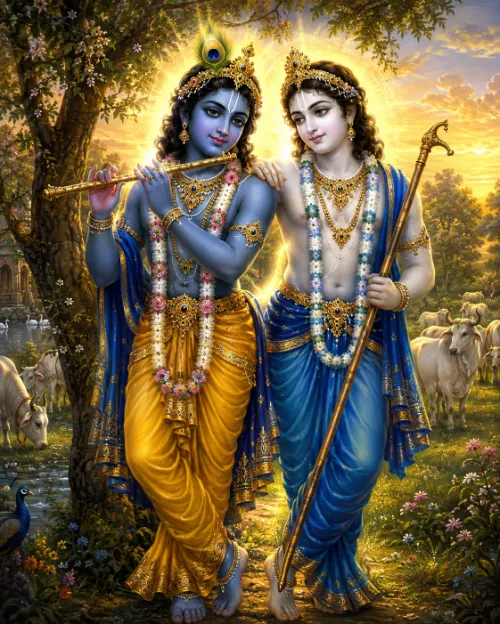
Kṛṣṇa and His “Second Body”: Who Is Balarāma in Gauḍīya Theology?
One of the shortest verses in Śrī Caitanya-caritāmṛta contains an entire theology of Godhead:
সর্ব-অবতারী কৃষ্ণ স্বয়ং ভগবান্ ।
তাঁহার দ্বিতীয় দেহ শ্রীবলরাম ॥
sarva-avatārī kṛṣṇa svayaṁ bhagavān
tāṅhāra dvitīya deha śrī-balarāma
“Kṛṣṇa, the source of all avatāras, is Svayaṁ Bhagavān. Śrī Balarāma is His second body.”
Śrī Caitanya-caritāmṛta, Ādi 5.4
A. C. Bhaktivedanta Swami Prabhupāda renders it: “The Supreme Personality of Godhead, Kṛṣṇa, is the fountainhead of all incarnations. Lord Balarāma is His second body.” At first, the statement seems simple.
Kṛṣṇa is the original Lord. Balarāma comes after Him. But the Sanskrit and Bengali theological vocabulary behind this couplet raises much deeper questions. What does it mean to call Kṛṣṇa: sarva-avatārī—the source of all avatāras?
What exactly does: svayaṁ bhagavān mean? And how can Balarāma be Kṛṣṇa’s: dvitīya deha —His “second body”— without implying that Kṛṣṇa possesses a material body and then somehow acquires another one?
The very next verses answer these questions. And they open into one of the most distinctive ideas in Gauḍīya Vaiṣṇava theology: the one unlimited Bhagavān eternally manifests many complete personal forms without ceasing to be one—and His first expansion is Śrī Balarāma, whose defining function is service to Kṛṣṇa.
Sarva-avatārī : Kṛṣṇa Is Not Merely an Avatāra
The first expression is:
সর্ব-অবতারী
sarva-avatārī
This is stronger than simply: avatāra. An avatāra is a manifestation or descent of Bhagavān. But: avatārī means the source from whom avatāras proceed. Thus Kṛṣṇadāsa Kavirāja is not saying: “Kṛṣṇa is one especially important avatāra among many.”
He is saying: “Kṛṣṇa is the source of them all.” That is why the next words are:
স্বয়ং ভগবান্
svayaṁ bhagavān
“Bhagavān Himself.” This language comes directly from the Śrīmad-Bhāgavatam.
The Foundational Bhāgavata Statement: Kṛṣṇas Tu Bhagavān Svayam
After describing a long series of avatāras, the Bhāgavatam concludes:
एते चांशकलाः पुंसः
कृष्णस्तु भगवान् स्वयम् ।
इन्द्रारिव्याकुलं लोकं
मृडयन्ति युगे युगे ॥
ete cāṁśa-kalāḥ puṁsaḥ
kṛṣṇas tu bhagavān svayam
indrāri-vyākulaṁ lokaṁ
mṛḍayanti yuge yuge
“All these are portions or portions of portions of the Supreme Person, but Kṛṣṇa is Bhagavān Himself. Age after age they appear to protect the worlds when disturbed by the enemies of the gods.”
Śrīmad-Bhāgavatam 1.3.28
The crucial words are:
कृष्णस्तु भगवान् स्वयम्
kṛṣṇas tu bhagavān svayam
The particle:
तु
tu
creates a contrast with the previously listed aṁśas and kalās. And:
स्वयम्
svayam
means: personally, Himself, in His own original identity. Thus Gauḍīya Vaiṣṇavas do not read this verse merely as: “Kṛṣṇa is divine.” They read it as: “Kṛṣṇa is the original personal Bhagavān from whom the other divine manifestations proceed.”
That is precisely what Caitanya-caritāmṛta compresses into: sarva-avatārī kṛṣṇa svayaṁ bhagavān.
Why Jīva Gosvāmī Gives This Verse Exceptional Importance
Śrī Jīva Gosvāmī gives kṛṣṇas tu bhagavān svayam extraordinary interpretive weight in Kṛṣṇa-sandarbha. For Gauḍīya theology, it functions as a controlling principle for understanding passages that might otherwise appear to place Kṛṣṇa beneath some prior or higher divine source.
The theological conclusion is: Kṛṣṇa is not a temporary manifestation produced from a more original divine personality. Rather: Kṛṣṇa Himself is the original Bhagavān. Other forms are real, eternal, and fully divine.
But the relation of source and expansion begins with Kṛṣṇa.
Brahma-saṁhitā Says the Same Thing: Kṛṣṇa Is the Cause of All Causes
The Brahma-saṁhitā opens with one of the clearest formulations:
ईश्वरः परमः कृष्णः
सच्चिदानन्दविग्रहः ।
अनादिरादिर्गोविन्दः
सर्वकारणकारणम् ॥
īśvaraḥ paramaḥ kṛṣṇaḥ
sac-cid-ānanda-vigrahaḥ
anādir ādir govindaḥ
sarva-kāraṇa-kāraṇam
“Kṛṣṇa, Govinda, is the Supreme Lord. His form is eternal, conscious, and blissful. He has no beginning, yet He is the beginning of all, the cause of all causes.”
Brahma-saṁhitā 5.1
Two expressions are especially important.
अनादिरादिः
anādir ādiḥ
“without beginning, yet the beginning.” And:
सर्वकारणकारणम्
sarva-kāraṇa-kāraṇam
“the cause of all causes.” This is essentially the Sanskrit theological equivalent of: sarva-avatārī. Kṛṣṇa has no prior cause. Yet He is the source of the entire hierarchy of divine manifestations.
Then Comes the Surprising Statement: Balarāma Is Kṛṣṇa’s “Second Body”
The second line of Ādi 5.4 says:
তাঁহার দ্বিতীয় দেহ শ্রীবলরাম
tāṅhāra dvitīya deha śrī-balarāma
Literally: “Śrī Balarāma is His second body.” The expression: dvitīya deha must be handled carefully. For ordinary conditioned beings, deha means the material body inhabited by the conscious self.
We receive such bodies through karma. Kṛṣṇa and Balarāma are not being described in that way. The Brahma-saṁhitā has already characterized Kṛṣṇa as:
सच्चिदानन्दविग्रहः
sac-cid-ānanda-vigrahaḥ
“one whose very form is eternity, consciousness, and bliss.” Kṛṣṇa’s body is not an external material shell covering a deeper divine person. His form is spiritual. Therefore: dvitīya deha should be understood as: Kṛṣṇa’s second divine personal form—His first personal expansion.
And Caitanya-caritāmṛta immediately confirms this.
The Next Verse Explains Everything: “One Svarūpa, Different Form”
Kṛṣṇadāsa Kavirāja continues:
একই স্বরূপ দোঁহে, ভিন্নমাত্র কায় ।
আদ্য কায়ব্যূহ, কৃষ্ণলীলার সহায় ॥
eka-i svarūpa doṅhe, bhinna-mātra kāya
ādya kāya-vyūha, kṛṣṇa-līlāra sahāya
“The two are one and the same svarūpa; only Their forms are distinct. Balarāma is the first expansion of the divine form and assists in Kṛṣṇa’s līlā.”
Śrī Caitanya-caritāmṛta, Ādi 5.5
This verse is the key to understanding dvitīya deha.
eka-i svarūpa doṅhe
“The two possess one and the same svarūpa.” Kṛṣṇa and Balarāma are therefore not two unrelated gods. Balarāma is not a created creature. He is not an exalted jīva promoted to divinity.
He belongs to the same divine reality. Yet:
bhinna-mātra kāya
“Their forms alone are distinct.” Their personalities and līlā-roles are genuinely distinct. Their divinity is not.
“First Expansion” and “Second Body” Mean the Same Thing From Two Angles
At first glance, these two expressions may seem contradictory. How can Balarāma be: Kṛṣṇa’s first expansion and also: His second body? The answer is simple. Kṛṣṇa is the original form.
The first expansion from the original becomes the second personal form in the order of manifestation. Thus: 1. Śrī Kṛṣṇa — original form 2. Śrī Balarāma — first expansion, therefore “second body”
There is no contradiction.
Ādya Kāya-vyūha : The First Deployment of Divine Form
Ādi 5.5 calls Balarāma:
আদ্য কায়ব্যূহ
ādya kāya-vyūha
The expression can be understood as: “the original or first expansion/deployment of the divine form.” The Sanskrit term: vyūha can indicate an arrangement, expansion, ordered manifestation, or deployment.
Thus Balarāma stands at the head of an entire structure of divine expansion. The sequence begins: Kṛṣṇa → Balarāma → further Saṅkarṣaṇa and Viṣṇu manifestations. This is not a story about divine beings being manufactured one after another in chronological time.
It is a theological description of eternal relations of source and expansion.
Balarāma Is Not a Weaker Copy of Kṛṣṇa
The word “expansion” can mislead us if we imagine material division. Suppose a loaf of bread is divided. Each portion contains less than the original whole. Gauḍīya theology does not understand divine expansion that way.
Balarāma is a svāṁśa manifestation—Bhagavān’s own personal expansion. The expansion does not diminish the source. Nor does it become something less than divine. To explain this, the tradition uses the image of one lamp lighting another.
The Lamp Analogy: Expansion Without Loss
The Brahma-saṁhitā says:
दीपार्चिरेव हि दशान्तरमभ्युपेत्य
दीपायते विवृतहेतुसमानधर्मा ।
यस्तादृगेव हि च विष्णुतया विभाति
गोविन्दमादिपुरुषं तमहं भजामि ॥
dīpārcir eva hi daśāntaram abhyupetya
dīpāyate vivṛta-hetu-samāna-dharmā
yas tādṛg eva hi ca viṣṇutayā vibhāti
govindam ādi-puruṣaṁ tam ahaṁ bhajāmi
“Just as the flame of one lamp, when transmitted to another lamp, shines separately with the same luminous nature, so Govinda manifests Himself in various Viṣṇu forms while remaining the original Person. I worship that primeval Govinda.”
Brahma-saṁhitā 5.46
This analogy holds together two truths. The second lamp possesses: the same nature of flame. Yet there remains a meaningful relation: source flame → expanded flame. So Gauḍīya theology can say both: Kṛṣṇa and Balarāma are equal in divine nature and: Kṛṣṇa is the original source, Balarāma His first expansion.
Fullness is transmitted without diminution.
Svāṁśa and Vibhinnāṁśa : Balarāma Is Not a Jīva
A crucial theological distinction is made between: svāṁśa and: vibhinnāṁśa.
Svāṁśa
Bhagavān’s own plenary personal expansion.
Vibhinnāṁśa
a separated infinitesimal expansion—the jīva. This distinction prevents the mistake of placing Balarāma in the category of an extraordinarily powerful soul. Balarāma is Viṣṇu-tattva.
The ordinary living being is jīva-tattva. Thus: Balarāma is not a jīva who became God. He is eternally Kṛṣṇa’s first personal divine expansion.
Then Why Does Kṛṣṇa Expand as Balarāma?
This is where the teaching becomes more than ontology. Ādi 5.5 ends:
কৃষ্ণলীলার সহায়
kṛṣṇa-līlāra sahāya
“He assists Kṛṣṇa’s līlā.” That is Balarāma’s defining function. He is fully divine. Yet His joy is centered upon assisting Kṛṣṇa. This introduces one of the deepest themes of Gauḍīya theology: the first expansion of Bhagavān is an expansion for relationship and service.
Divine plurality appears first not as rivalry— but as love.
Kṛṣṇa Is the Served Lord; Balarāma Manifests the Principle of Service
The theological relationship can be expressed as: Kṛṣṇa — sevya the one who is served; Balarāma — sevaka-pradhāna the foremost divine servant and supporter of Kṛṣṇa’s līlā.
This does not mean Balarāma is ontologically inferior like a conditioned servant. He remains Bhagavān. Rather, the divine nature itself contains eternal loving relationship.
This is extremely important. Service is not merely something imposed upon finite souls from outside God. Within Bhagavān’s own eternal līlā, the first expansion of the Supreme joyfully manifests the function of service.
Thus seva belongs to the eternal structure of divine love itself.
Balarāma as Kṛṣṇa’s Elder Brother
In Vraja-līlā, Balarāma appears as Kṛṣṇa’s elder brother. He participates in: cowherding, games, meals, forest excursions, protection of the residents of Vraja, combat with demons, festivals, and family life.
His relationship with Kṛṣṇa is intimate. He can protect Kṛṣṇa. Advise Him. Play with Him. Sometimes even defeat Him in games. Theologically, this is extraordinary. The Supreme expands into another complete divine person so that eternal relationship can become richer.
Balarāma Is Mūla-Saṅkarṣaṇa
Kṛṣṇadāsa Kavirāja then states:
শ্রীবলরাম গোসাঞি মূল-সঙ্কর্ষণ ।
পঞ্চরূপ ধরি’ করেন কৃষ্ণের সেবন ॥
śrī-balarāma gosāñi mūla-saṅkarṣaṇa
pañca-rūpa dhari’ karena kṛṣṇera sevana
“Śrī Balarāma is the original Saṅkarṣaṇa. Assuming five forms, He performs service to Kṛṣṇa.”
Śrī Caitanya-caritāmṛta, Ādi 5.8
Again the key word is:
সেবন
sevana
“service.” The divine expansion hierarchy is therefore not merely a chart of metaphysical entities. It is an architecture of service.
Through Balarāma Come the Further Viṣṇu Expansions
The fifth chapter connects Balarāma with the further manifestations through which divine līlā and cosmic creation are supported. Kṛṣṇadāsa Kavirāja writes:
सङ्कर्षणः कारणतोयशायी
गर्भोदशायी च पयोऽब्धिशायी ।
शेषश्च यस्यांशकलाः स नित्या-
नन्दाख्यरामः शरणं ममास्तु ॥
saṅkarṣaṇaḥ kāraṇa-toya-śāyī
garbhoda-śāyī ca payo ’bdhi-śāyī
śeṣaś ca yasyāṁśa-kalāḥ sa nityā-
nandākhya-rāmaḥ śaraṇaṁ mamāstu
“May that Rāma known as Nityānanda be my shelter. Saṅkarṣaṇa, Kāraṇodakaśāyī Viṣṇu, Garbhodakaśāyī Viṣṇu, Kṣīrodakaśāyī Viṣṇu, and Śeṣa are His plenary portions and portions of His plenary portions.”
Śrī Caitanya-caritāmṛta, Ādi 5.7
This moves Balarāma from the intimate world of Vraja into the entire cosmological architecture of Vaiṣṇava theology.
A Simplified Expansion Sequence
A simplified Gauḍīya map is:
- Śrī Kṛṣṇa — Svayaṁ Bhagavān
- Śrī Balarāma — first expansion / dvitīya-deha
- Mūla-Saṅkarṣaṇa and the catur-vyūha
- Nārāyaṇa
- further catur-vyūha / Mahā-Saṅkarṣaṇa
- Kāraṇodakaśāyī Viṣṇu
- Garbhodakaśāyī Viṣṇu
- Kṣīrodakaśāyī Viṣṇu
This is not meant as a timeline. It is a map of ontological dependence and manifestation. The forms are eternal.
“First” Means Ontologically First, Not Temporally Manufactured First
This distinction is crucial. If Kṛṣṇa is “first” and Balarāma “second,” one might imagine: “At one moment Kṛṣṇa existed alone. Then later He created Balarāma.” That is not the Gauḍīya understanding.
Kṛṣṇa and His eternal expansions are eternally existent. “First” means: Kṛṣṇa is the ontological source. “Second” means: Balarāma is eternally the first expansion from Him.
This is relation in tattva, not chronology.
Anādir Ādiḥ : The Source Who Has No Beginning
This is exactly why Brahma-saṁhitā calls Kṛṣṇa:
अनादिरादिः
anādir ādiḥ
“without beginning, yet the beginning.” He is not “first” because He happened to appear a few moments earlier than someone else. He is ādi because all other divine manifestations are ontologically grounded in Him.
This is what: sarva-avatārī means.
Kṛṣṇa and Balarāma: What Is Different?
If They are one divine svarūpa, what distinguishes Them? The immediate visible distinction is form. Kṛṣṇa is characteristically dark like a fresh rain cloud. Balarāma is fair or white.
Their līlā roles also differ. Kṛṣṇa appears as the younger brother. Balarāma as the elder. Kṛṣṇa occupies the central position as the supreme object of loving service. Balarāma manifests the support and service of Kṛṣṇa’s līlā.
Thus difference is real. But it is relational difference within one divine nature.
Unity Does Not Erase Personality
This is important because Gauḍīya theology does not solve divine unity by making personal distinctions unreal. Kṛṣṇa is genuinely Kṛṣṇa. Balarāma is genuinely Balarāma. Their forms, moods, relationships, and līlās matter.
Yet: eka-i svarūpa doṅhe “the two are one svarūpa.” The theology therefore avoids two extremes.
Not absolute impersonal sameness
where personal distinctions disappear.
Not unrelated polytheism
where Kṛṣṇa and Balarāma become competing independent gods. Instead: real personal plurality exists within one integrated Bhagavān-tattva.
Divine Expansion Is Plurality Without Fragmentation
This is one of the most sophisticated ideas contained in the verse. Material division creates fragments. Divine expansion creates full manifestations. The source remains complete.
The expansion is also complete in divine quality. Thus plurality does not require fragmentation. The candle analogy works because the first flame loses nothing by lighting the second.
The mystery is not: how one becomes broken into many. It is: how the unlimited can eternally manifest many complete personal forms without ceasing to be one unlimited reality.
Balarāma’s Service Extends Into the Structure of Reality
The chapter goes further. Balarāma does not merely personally accompany Kṛṣṇa. Through further manifestations He becomes connected with: Saṅkarṣaṇa, the Puruṣa avatāras, Śeṣa, and the support of the cosmic manifestation.
Ādi 5.9 says:
আপনে করেন কৃষ্ণলীলার সহায় ।
সৃষ্টিলীলা-কার্য করে ধরি’ চারি কায় ॥
āpane karena kṛṣṇa-līlāra sahāya
sṛṣṭi-līlā-kārya kare dhari’ cāri kāya
“Personally He assists Kṛṣṇa’s līlā, while in four other forms He performs functions connected with creation.”
Śrī Caitanya-caritāmṛta, Ādi 5.9
So Balarāma’s service stretches from: the intimate forest pastimes of Vraja to: the cosmic organization of creation.
The Śeṣa Principle: Divine Reality Becomes the Support of Divine Service
One of Balarāma’s manifestations is Ananta Śeṣa. Śeṣa supports the worlds. He becomes Bhagavān’s couch. Throne. Umbrella. Paraphernalia. Environment of service. The symbolism is profound.
The Balarāma principle does not merely serve Kṛṣṇa through one personal action. It becomes the very support upon which divine līlā takes place. This gives new depth to: kṛṣṇa-līlāra sahāya “assistant in Kṛṣṇa’s līlā.”
The First Movement of Divine Plurality Is Service
This may be the deepest conceptual point in the passage. Why does the One become many? In Gauḍīya theology, one answer is: relationship. And the first major relation revealed by Kṛṣṇa’s expansion into Balarāma is: service.
Balarāma does not appear as a competitor for Kṛṣṇa’s supremacy. His fullness is expressed in assisting Kṛṣṇa. That reverses ordinary material hierarchy. In the material world, the second person often wants to become first.
In divine līlā, the first expansion finds perfection in service.
This Is Why Service Is Not Inferiority
Material consciousness often assumes: the person who commands is superior; the person who serves is inferior. Balarāma completely disrupts that assumption. He is fully divine.
Yet service defines His eternal function. Thus service cannot be inherently degrading. In bhakti, service becomes an expression of love. The issue is not: “Who is lower?”
It is: “Who loves whom, and how is that love expressed?” Balarāma shows that even within divinity, love takes the form of service.
This Leads Naturally to Guru-tattva
Because Balarāma’s essential function is to assist Kṛṣṇa and facilitate service to Him, Gauḍīya Vaiṣṇavism associates Baladeva deeply with guru-tattva. The genuine guru does not compete with Kṛṣṇa.
He does not become the disciple’s ultimate destination. He performs the Balarāma function: he helps the jīva approach, understand, and serve Kṛṣṇa. This is why the guru principle is ultimately one of service.
The guru is spiritually powerful precisely because his function is not self-centered. He connects others with Bhagavān.
Balarāma and Spiritual Strength
The name: Bala-rāma contains: bala — strength; rāma — one who delights or gives delight. Gauḍīya teachers often associate Balarāma with the spiritual strength necessary for bhakti.
That interpretation fits His role: elder brother, protector, support, first expansion, and source of further divine service manifestations. The devotee requires strength not merely to control others— but to serve.
Balarāma embodies that strength.
Why This Theology Appears in Caitanya-caritāmṛta
There is another major reason Kṛṣṇadāsa Kavirāja introduces this theology here. The chapter is not only about Balarāma. It is about Nityānanda. Immediately after identifying Kṛṣṇa and Balarāma, Kṛṣṇadāsa writes:
সেই কৃষ্ণ—নবদ্বীপে শ্রীচৈতন্যচন্দ্র ।
সেই বলরাম—সঙ্গে শ্রীনিত্যানন্দ ॥
sei kṛṣṇa — navadvīpe śrī-caitanya-candra
sei balarāma — saṅge śrī-nityānanda
“That same Kṛṣṇa appeared in Navadvīpa as Śrī Caitanya Candra, and that same Balarāma appeared with Him as Śrī Nityānanda.”
Śrī Caitanya-caritāmṛta, Ādi 5.6
Now the purpose of the preceding verses becomes clear. Kṛṣṇadāsa is establishing: Kṛṣṇa : Balarāma as: Caitanya : Nityānanda.
Nityānanda Is Therefore Not Merely Caitanya’s Associate
Within this theology, Nityānanda is not merely: a saint, a preacher, a charismatic companion, or an unusually exalted devotee. He is: Balarāma Himself. Thus the identity sequence is: Svayaṁ Bhagavān Kṛṣṇa → Śrī Caitanya and: first expansion Balarāma → Śrī Nityānanda.
This gives Nityānanda’s role enormous theological significance. His service to Caitanya reflects Balarāma’s eternal service to Kṛṣṇa.
The Same Relationship Reappears in Gaura-līlā
The pattern is remarkably consistent. In Kṛṣṇa-līlā: Kṛṣṇa is the center. Balarāma assists His līlā. In Gaura-līlā: Caitanya is the center. Nityānanda assists His mission.
Thus divine service is not incidental. It persists across līlās. Balarāma’s identity is relational. Nityānanda’s identity continues that same relational movement.
This Also Explains Nityānanda’s Extraordinary Mercy
Gauḍīya tradition repeatedly emphasizes Nityānanda’s eagerness to bring the most fallen persons toward Caitanya and Kṛṣṇa. That fits the Balarāma-guru principle beautifully.
If Balarāma’s function is to facilitate Kṛṣṇa’s service, then Nityānanda’s mission is to bring jīvas into Caitanya’s mercy. The outward form changes. The inner function remains: connect others with the Supreme Lord.
What About Passages Suggesting Kṛṣṇa and Balarāma Come From Another Viṣṇu?
Some Purāṇic and epic passages have historically been interpreted as describing Kṛṣṇa and Balarāma as derivative manifestations of a prior Viṣṇu. One famous example involves imagery of dark and white hairs associated with Kṛṣṇa and Balarāma.
Gauḍīya theologians, especially Jīva Gosvāmī, reject any interpretation that would contradict the explicit Bhāgavata statement: kṛṣṇas tu bhagavān svayam. For them, the controlling principle is clear: Kṛṣṇa is not a small derivative portion of some more original Bhagavān.
He is Svayaṁ Bhagavān. Balarāma is His first expansion. Other texts must be interpreted consistently with that Bhāgavata conclusion.
Sourcehood Does Not Mean Greater Percentage of God
This language can also be misunderstood quantitatively. One should not imagine: Kṛṣṇa = 100% God; Balarāma = 90% God; Saṅkarṣaṇa = 80% God; and so on. That is not the theology.
The Viṣṇu-tattva forms are divine manifestations of Bhagavān. The distinction concerns: source, relationship, mood, form, function, and līlā. Not percentages of divinity.
Why Kṛṣṇa Still Remains Svayaṁ Bhagavān
If Balarāma is fully divine, why preserve Kṛṣṇa’s unique title? Because equality of divine nature does not erase the relation of source. The second lamp is fully flame. Yet it was lit from the first.
Likewise, Balarāma possesses divine fullness. Yet Kṛṣṇa remains: ādi-puruṣa the original Person; sarva-kāraṇa-kāraṇam the cause of all causes; sarva-avatārī the source of avatāras; and: Svayaṁ Bhagavān Bhagavān Himself in His original personal identity.
A Useful Distinction: Essence and Role
A simple way to understand Kṛṣṇa and Balarāma is to distinguish:
Divine essence
one
Personal form
distinct
Relational role
distinct
Divine category
the same Viṣṇu-tattva
Ontological order
Kṛṣṇa as source, Balarāma as first expansion This is essentially what: eka-i svarūpa doṅhe, bhinna-mātra kāya is saying.
What Ādi 5.4 Does Not Mean
The verse does not mean that:
- Kṛṣṇa and Balarāma are two unrelated gods;
- Balarāma is a created being;
- Balarāma is an ordinary jīva;
- Balarāma is less divine because He is an expansion;
- Kṛṣṇa possesses a material body and then produces another material body;
- divine expansions become progressively weaker like pieces cut from an object;
- “first” and “second” describe chronological creation;
- Balarāma’s service indicates material inferiority;
- or Kṛṣṇa is merely one avatar of a higher personal deity.
Those interpretations conflict with the immediate context.
What the Verse Does Mean
Ādi 5.4–5 teaches that:
- Kṛṣṇa is Svayaṁ Bhagavān;
- Kṛṣṇa is sarva-avatārī, the source of all avatāras;
- Balarāma is His first personal expansion;
- this is why Balarāma is called His dvitīya deha, “second body” or second divine form;
- Kṛṣṇa and Balarāma possess the same divine svarūpa;
- Their personal forms and līlā roles are distinct;
- Balarāma is the ādya kāya-vyūha, the first expansion of the divine form;
- His principal function is to assist Kṛṣṇa’s līlā;
- further Saṅkarṣaṇa and Viṣṇu manifestations proceed through this expansion principle;
- Balarāma’s service function underlies the theology of guru-tattva;
- and in Gaura-līlā the same Balarāma appears as Śrī Nityānanda alongside Śrī Caitanya.
The Verse Is Really About How the One Becomes Many
The philosophical problem behind all of this is ancient: How can ultimate reality be one and yet contain genuine plurality? Gauḍīya theology does not answer by making plurality an illusion.
Kṛṣṇa is real. Balarāma is real. Their relationship is real. Nor does it answer by dividing the Absolute into incomplete fragments. Instead: the unlimited can manifest unlimited complete personal forms while remaining unlimited.
The source remains whole. The expansion is genuinely divine. Plurality becomes an expression of fullness rather than deficiency.
And the First Purpose of Plurality Is Love
This is where the theology becomes devotional rather than merely metaphysical. Why should Bhagavān manifest another personal form? For Gauḍīyas, divine plurality allows: relationship, exchange, rasa, and service.
Balarāma’s existence is therefore not a cold metaphysical necessity. It is part of the eternal relational life of Bhagavān. The one becomes many so that divine love can have endlessly expanding forms of expression.
Caitanya-caritāmṛta Ādi 5.4 begins with two deceptively simple statements:
সর্ব-অবতারী কৃষ্ণ স্বয়ং ভগবান্ ।
তাঁহার দ্বিতীয় দেহ শ্রীবলরাম ॥
sarva-avatārī kṛṣṇa svayaṁ bhagavān
tāṅhāra dvitīya deha śrī-balarāma
“Kṛṣṇa, the source of all avatāras, is Svayaṁ Bhagavān. Śrī Balarāma is His second body.”
The first line establishes the source: Kṛṣṇa is Svayaṁ Bhagavān. The second begins the expansion: Balarāma is His first personal manifestation. Then the next verse clarifies:
একই স্বরূপ দোঁহে, ভিন্নমাত্র কায় ।
আদ্য কায়ব্যূহ, কৃষ্ণলীলার সহায় ॥
eka-i svarūpa doṅhe, bhinna-mātra kāya
ādya kāya-vyūha, kṛṣṇa-līlāra sahāya
“The two are one svarūpa; only Their forms are distinct. Balarāma is the first expansion of the divine form and assists Kṛṣṇa’s līlā.”
That sentence contains the key. Balarāma is not another independent Supreme. He is not a created subordinate. He is the same divine reality manifest as a second personal form.
And what does that first expansion do? He serves. That may be the deepest insight in the entire passage. The first movement from divine oneness into divine plurality is not competition.
It is relationship. It is assistance. It is love. It is: kṛṣṇa-līlāra sahāya “assisting Kṛṣṇa’s līlā.” From Balarāma expand the further forms that support divine līlā and cosmic manifestation.
As Śeṣa, the same principle becomes support. As the Viṣṇu expansions, it serves creation and maintenance. As Nityānanda, it brings Caitanya’s mercy to the world. As guru-tattva, it helps the jīva approach Kṛṣṇa.
Thus the phrase: dvitīya deha is far more than a statement of divine genealogy. It begins a theology of love expressed through expansion. Kṛṣṇa is the original object of divine love.
Balarāma is the first complete expansion of that same Godhead in the function of assisting His love and līlā. And this is why Ādi 5.4 ultimately explains not merely: who comes from whom, but: how the unlimited One becomes many without ceasing to be one—and why the first expression of that plurality is service.
Primary Texts Cited
Śrī Caitanya-caritāmṛta , Ādi-līlā
Śrīmad-Bhāgavatam
Brahma-saṁhitā
Jīva Gosvāmī
Digital Texts and Reference Sites Consulted
Vedabase.io — Bengali text, transliteration, translations and purports for Śrī Caitanya-caritāmṛta Ādi 5.4–9; Sanskrit and translations for Śrīmad-Bhāgavatam 1.3.28 and Brahma-saṁhitā 5.1 and 5.46.
Bhakti Tattva / Jīva Gosvāmī textual studies — discussions of Jīva Gosvāmī’s interpretation of kṛṣṇas tu bhagavān svayam and its role in Kṛṣṇa-sandarbha. Wisdomlib / Kṛṣṇa-sandarbha textual resources — Sanskrit and translated material relating to Jīva Gosvāmī’s treatment of apparently competing avatāra statements and Kṛṣṇa’s status as Svayaṁ Bhagavān.
For formal academic publication, exact Sanskrit excerpts from Jīva Gosvāmī’s Kṛṣṇa-sandarbha should additionally be checked against a specified critical or printed Sanskrit edition before quotation.