

The Ladder That Ends in Service
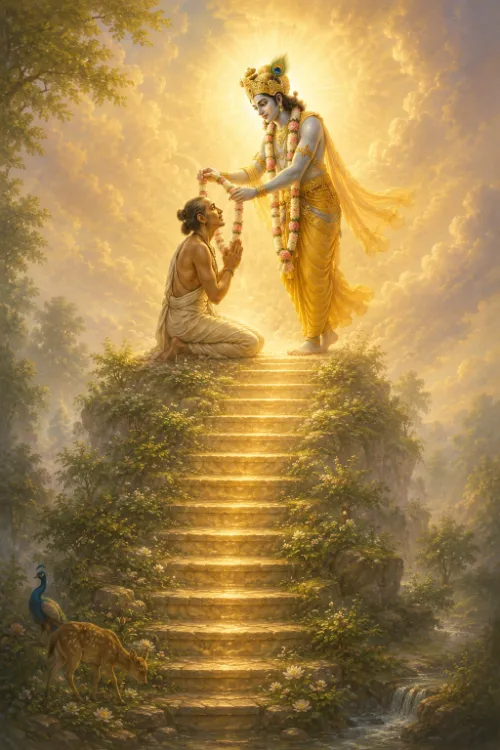
The Ladder That Ends in Service: What the Bhāgavatam Really Says About Life, the Gods, Brāhmaṇas, and Bhagavān
The qualified brāhmaṇa is honored because he preserves sacred knowledge, disciplines his mind and senses, speaks truth, shows mercy, tolerates hardship, realizes the self and the Supreme, and wants nothing but devotional service.
The climax is therefore not caste pride. It is a theology of divine affection: the all-powerful Lord voluntarily honors those who have abandoned self-interest and live to serve Him and others.
The setting: a ruler must learn whom to hear
These verses occur in the instructions of Lord Ṛṣabhadeva to His sons. He is preparing His eldest son, Bharata, to rule and telling the other sons to support him. Immediately before the hierarchy, Ṛṣabhadeva says:
तस्माद्भवन्तो हृदयेन जाताः
सर्वे महीयांसममुं सनाभम् ।
अक्लिष्टबुद्ध्या भरतं भजध्वं
शुश्रूषणं तद्भरणं प्रजानाम् ॥ २० ॥
tasmād bhavanto hṛdayena jātāḥ
sarve mahīyāṁsam amuṁ sanābham
akliṣṭa-buddhyā bharataṁ bhajadhvaṁ
śuśrūṣaṇaṁ tad bharaṇaṁ prajānām
“Therefore, all of you, born from My heart, should serve your exalted brother Bharata with an untroubled and unenvying intelligence. Service to him is also the proper care of the citizens.”
Śrīmad-Bhāgavatam 5.5.20
This political context matters. Ṛṣabhadeva is not offering a detached catalogue of life-forms. He is teaching future leaders how to recognize genuine excellence, accept spiritual guidance, and govern without envy.
The complete passage
भूतेषु वीरुद्भ्य उदुत्तमा ये
सरीसृपास्तेषु सबोधनिष्ठाः ।
ततो मनुष्याः प्रमथास्ततोऽपि
गन्धर्वसिद्धा विबुधानुगा ये ॥ २१ ॥
देवासुरेभ्यो मघवत्प्रधाना
दक्षादयो ब्रह्मसुतास्तु तेषाम् ।
भवः परः सोऽथ विरिञ्चवीर्यः
स मत्परोऽहं द्विजदेवदेवः ॥ २२ ॥
bhūteṣu vīrudbhya uduttamā ye
sarīsṛpās teṣu sabodha-niṣṭhāḥ
tato manuṣyāḥ pramathās tato ’pi
gandharva-siddhā vibudhānugā ye
devāsurebhyo maghavat-pradhānā
dakṣādayo brahma-sutās tu teṣām
bhavaḥ paraḥ so ’tha viriñca-vīryaḥ
sa mat-paro ’haṁ dvija-deva-devaḥ
“Among created beings, those that move are far above the plants; among moving creatures, those established in developed cognition are higher. Above them are human beings; above humans are the Pramathas; above them are the Gandharvas, the Siddhas, and the followers of the gods.
“Above the asuras are the gods headed by Indra. Above them are Dakṣa and the other sons of Brahmā; above them is Bhava, Lord Śiva. Then comes Viriñca, Brahmā, from whose potency Bhava arose. Brahmā has Me as his superior; and I am the Lord—and affectionate honorer—of the gods among the twice-born.”
Śrīmad-Bhāgavatam 5.5.21–22
The last words deliberately create a surprise. The ascent reaches Bhagavān, yet Bhagavān immediately defines Himself through His relationship with the dvija-devas—the “gods among the twice-born,” meaning genuinely qualified brāhmaṇas.
Four corrections that make the reading more precise
Pramathāḥ does not simply mean “ghosts”
The popular translation “ghosts” catches the supernatural character of the beings, but it is broad. Pramathāḥ is the plural of Pramatha, a name for powerful, often fearsome attendants in Lord Śiva’s retinue. “The Pramathas” or “Śiva’s ghostly attendants” is therefore more exact than generic “ghosts.”
The Kinnaras are supplied by commentary
The Sanskrit has vibudhānugāḥ: “those who follow the gods” or “attendants of the gods.” The word Kinnara does not occur in the verse itself. Traditional commentators identify these divine attendants as Kinnaras and related celestial beings. It is sound to include Kinnaras in the explanation, provided we say that this is the commentarial identification.
“The gods, then Indra” is one class with a foremost member
The phrase maghavat-pradhānāḥ means “headed by Maghavan,” Maghavan being a name of Indra. The verse therefore speaks of the devas as a class led by Indra. One may show “devas → Indra” in a diagram, but grammatically the sense is “the gods, foremost among whom is Indra.”
The preceding expression, devāsurebhyaḥ, is compressed. Vīrarāghavācārya explicitly calls its junction an archaic or seer-like sandhi:
देवासुरेभ्य इत्यत्र सन्धिरार्षः ।
devāsurebhya ity atra sandhir ārṣaḥ
“In the expression devāsurebhyaḥ, the sandhi is archaic [or characteristic of the ancient seers].”
His explanation supplies the sequence: after the divine attendants come the asuras; above the asuras are the devas headed by Indra.
Dvija-deva-devaḥ does not overturn the supremacy of Bhagavān
The compound can be rendered most directly as “the Lord of the gods among the twice-born”—that is, the Lord of the brāhmaṇas. A devotional translation may also bring out the contextual sense: “He who honors the brāhmaṇas as worshipable.” The latter is an interpretation of the relationship developed in the next verses, not proof that brāhmaṇas possess a greater divine essence than Bhagavān.
The preceding words prevent that conclusion: sa mat-paraḥ means that Brahmā “has Me as superior,” “has Me as his supreme goal,” or “is subordinate to Me.” The ontological ascent has reached the Supreme. The sentence then changes from who is greater in cosmic order to whom the Supreme freely loves and honors.
Vīrarāghavācārya makes that devotional turn explicit:
स विरिञ्चः मत्परः अहं परो यस्य तथाभूतः । अहं द्विजदेवा ब्राह्मणश्रेष्ठा एव देवा यस्य तथाभूतः । उत्कर्षकाष्ठाभूता द्विजदेवा इति भावः ॥
sa viriñcaḥ mat-paraḥ, ahaṁ paro yasya tathā-bhūtaḥ. ahaṁ dvija-devā brāhmaṇa-śreṣṭhā eva devā yasya tathā-bhūtaḥ. utkarṣa-kāṣṭhā-bhūtā dvija-devā iti bhāvaḥ.
“That Viriñca, Brahmā, is one for whom I am the Supreme. I am one for whom the excellent brāhmaṇas—the gods among the twice-born—are honored as divine. The sense is that these dvija-devas stand at the summit of excellence.”
This is devotional exaltation, not an assertion that God has ceased to be God.
What kind of hierarchy is this?
It is tempting to turn the passage into a single scientific-looking ladder. That is too simple. The criteria change as the verse rises. The root verse begins with bhūteṣu—“among created entities” or “among beings”—and names vegetation as the first explicit embodied class. Prabhupāda’s expanded translation adds the preliminary contrast “inert matter → living vegetation.” That is a theological exposition of the opening phrase, not a separate Sanskrit noun in the metrical list.
The presence of the asuras is revealing. Asuras may possess immense intelligence and power while opposing the devas or the Lord. Therefore every step cannot mean “morally better” or “closer to liberation.” At several points the scale measures embodied capacity, subtle power, longevity, or cosmic office. Only at the climax does it clearly become a scale of spiritual character and selfless devotion.
This is not Darwinian evolution
A. C. Bhaktivedanta Swami Prabhupāda’s purport calls the passage an “evolutionary process.” That expression must be read in its theological context. The verse is not presenting genetics, natural selection, common descent, or a biological chronology. It is describing a graded manifestation of life, cognition, power, responsibility, and finally spiritual qualification within a Purāṇic cosmos.
The passage can be compared with a Bengali summary spoken by Śrī Caitanya Mahāprabhu:
তার মধ্যে ‘স্থাবর’, ‘জঙ্গম’ — দুই ভেদ ।
জঙ্গমে তির্যক্-জল-স্থলচর-বিভেদ ॥ ১৪৪ ॥
tāra madhye ‘sthāvara’, ‘jaṅgama’—dui bheda
jaṅgame tiryak-jala-sthalacara-vibheda
“Among conditioned living beings there are two divisions: the nonmoving and the moving. Among the moving are those that travel through the air, water, and land.”
Caitanya-caritāmṛta, Madhya 19.144
This is a traditional classification of embodied conditions. It should not be enlisted either as a substitute for modern biology or as an easy scriptural proof of it.
The difficult phrase viriñca-vīryaḥ
The third line of verse 22 compresses a transition:
भवः परः सोऽथ विरिञ्चवीर्यः
bhavaḥ paraḥ so ’tha viriñca-vīryaḥ
“Bhava is higher; then [comes] Viriñca, whose potency or causal power [is involved in Bhava’s arising].”
Bhava is Śiva; Viriñca is Brahmā. The compound viriñca-vīryaḥ is not transparent if read in isolation. Vīrarāghavācārya records the related reading viriñca-varyaḥ—“Viriñca is superior”—and explains the received vīrya reading in terms of causal power or source: within the genealogy assumed by this passage, Brahmā is placed after Śiva because Śiva arises from Brahmā’s potency.
The pronoun in the next phrase, sa mat-paraḥ—“he has Me as Supreme”—then refers to Brahmā, not Śiva. The prose hierarchy given above follows this traditional interpretation correctly.
This should also be read locally. Purāṇic literature describes the relationships of Brahmā, Viṣṇu, and Śiva in several theological and narrative frames. Verse 22 is best explained according to its own sequence and its received Vaiṣṇava commentary, rather than being forced into a universal ranking detached from context.
Why does the Lord honor the brāhmaṇa?
Verses 23–25 answer the question. They are indispensable. If verse 22 is quoted without them, the word brāhmaṇa can be emptied of its scriptural qualifications and reduced to a title of birth.
The Lord receives faithful service through the brāhmaṇa
न ब्राह्मणैस्तुलये भूतमन्यत्
पश्यामि विप्राः किमतः परं तु ।
यस्मिन्नृभिः प्रहुतं श्रद्धयाह-
मश्नामि कामं न तथाग्निहोत्रे ॥ २३ ॥
na brāhmaṇais tulaye bhūtam anyat
paśyāmi viprāḥ kim ataḥ paraṁ tu
yasmin nṛbhiḥ prahutaṁ śraddhayāham
aśnāmi kāmaṁ na tathāgni-hotre
“O learned brāhmaṇas, I do not count any other being equal to the brāhmaṇas; how then could I see one as superior? What people offer with faith through a brāhmaṇa, I accept with deep satisfaction—not in the same way as an offering placed in the sacrificial fire.”
Śrīmad-Bhāgavatam 5.5.23
The point is relational and sacramental. A transparent teacher who embodies sacred knowledge becomes a living channel of service. The Lord values the faith, realization, and service carried through such a person.
“Brāhmaṇa” is defined by eight qualities
धृता तनूरुशती मे पुराणी
येनेह सत्त्वं परमं पवित्रम् ।
शमो दमः सत्यमनुग्रहश्च
तपस्तितिक्षानुभवश्च यत्र ॥ २४ ॥
dhṛtā tanūr uśatī me purāṇī
yeneha sattvaṁ paramaṁ pavitram
śamo damaḥ satyam anugrahaś ca
tapas titikṣānubhavaś ca yatra
“Such a person sustains My radiant and ancient embodiment—the Veda. In him abides supremely purified being: control of the mind, control of the senses, truthfulness, mercy, austerity, tolerance, and realized understanding.”
Śrīmad-Bhāgavatam 5.5.24
Vīrarāghavācārya explains the qualities with practical precision:
- sattva — purified clarity and goodness;
- śama — restraint of the inner instrument, especially the mind;
- dama — restraint of the external senses;
- satya — freedom from falsehood and speech directed toward the welfare of beings;
- anugraha — mercy toward living beings;
- tapas — disciplined austerity;
- titikṣā — endurance of life’s opposing conditions;
- anubhava — realized knowledge of the true nature of the self and the Supreme Self.
This list is a test, not ceremonial flattery. A person ruled by greed, uncontrolled senses, dishonesty, cruelty, or hunger for status does not embody the brāhmaṇa praised here, whatever surname, thread, office, or ancestry that person may possess.
The Bhagavad-gītā gives a closely related definition:
शमो दमस्तपः शौचं क्षान्तिरार्जवमेव च ।
ज्ञानं विज्ञानमास्तिक्यं ब्रह्मकर्म स्वभावजम् ॥ ४२ ॥
śamo damas tapaḥ śaucaṁ kṣāntir ārjavam eva ca
jñānaṁ vijñānam āstikyaṁ brahma-karma svabhāva-jam
“Tranquility, self-control, austerity, purity, tolerance, integrity, knowledge, realized wisdom, and faithful affirmation of sacred truth are the work natural to a brāhmaṇa’s character.”
Bhagavad-gītā 18.42
The culminating brāhmaṇa is an akiñcana devotee
मत्तोऽप्यनन्तात्परतः परस्मात्
स्वर्गापवर्गाधिपतेर्न किञ्चित् ।
येषां किमु स्यादितरेण तेषा-
मकिञ्चनानां मयि भक्तिभाजाम् ॥ २५ ॥
matto ’py anantāt parataḥ parasmāt
svargāpavargādhipater na kiñcit
yeṣāṁ kim u syād itareṇa teṣām
akiñcanānāṁ mayi bhakti-bhājām
“Those possessionless devotees who share in devotion to Me ask nothing even from Me—the infinite, highest Lord of heaven and liberation. What could they need from anyone else?”
Śrīmad-Bhāgavatam 5.5.25
The decisive words are akiñcanānām mayi bhakti-bhājām: “of those who claim nothing as their own and are devoted to Me.” The person praised at the summit has no private agenda to advance. He does not use religion to obtain wealth, control, fame, heaven, or even liberation. That freedom from self-interest is precisely why his guidance can be trusted.
The bhakti paradox: the Supreme chooses to be conquered by love
Bhagavān’s honor for His devotee is a recurring theme in the Bhāgavata. When the sage Durvāsā asks the Lord for protection from the consequences of offending King Ambarīṣa, the Lord says:
श्रीभगवानुवाच
अहं भक्तपराधीनो ह्यस्वतन्त्र इव द्विज ।
साधुभिर्ग्रस्तहृदयो भक्तैर्भक्तजनप्रियः ॥ ६३ ॥
śrī-bhagavān uvāca
ahaṁ bhakta-parādhīno hy asvatantra iva dvija
sādhubhir grasta-hṛdayo bhaktair bhakta-jana-priyaḥ
“The Supreme Lord said: O brāhmaṇa, I am dependent upon My devotees—as if I were not independent. Saintly devotees have captured My heart; My devotees and those devoted to them are exceedingly dear to Me.”
Śrīmad-Bhāgavatam 9.4.63
The tiny word iva—“as if”—is crucial. God has not literally lost His sovereignty. The unconquerable Lord freely allows pure love to “conquer” Him. That is the same devotional logic behind dvija-deva-devaḥ. Divine affection is not ontological inferiority.
Does “brāhmaṇa” here mean birth?
Birth can locate a person within a traditional social history, but the texts used to interpret this passage do not permit birth to replace qualities and conduct.
यस्य यल्लक्षणं प्रोक्तं पुंसो वर्णाभिव्यञ्जकम् ।
यदन्यत्रापि दृश्येत तत्तेनैव विनिर्दिशेत् ॥ ३५ ॥
yasya yal lakṣaṇaṁ proktaṁ puṁso varṇābhivyañjakam
yad anyatrāpi dṛśyeta tat tenaiva vinirdiśet
“Whatever characteristics have been described as signs of a person’s social-spiritual function: if those characteristics are seen in someone born elsewhere, that person should be identified by those very characteristics.”
Śrīmad-Bhāgavatam 7.11.35
Śrī Caitanya makes the same principle concrete in Bengali:
কিবা বিপ্র, কিবা ন্যাসী, শূদ্র কেনে নয় ।
যেই কৃষ্ণতত্ত্ববেত্তা, সেই ‘গুরু’ হয় ॥ ১২৮ ॥
kibā vipra, kibā nyāsī, śūdra kene naya
yei kṛṣṇa-tattva-vettā, sei ‘guru’ haya
“Whether one is a brāhmaṇa, a renunciant, or a śūdra—whatever one’s social position—whoever knows the truth of Kṛṣṇa is qualified to be a guru.”
Caitanya-caritāmṛta, Madhya 8.128
The practical rule is blunt: test realization by character, knowledge, conduct, and freedom from selfish motive—not by pedigree alone.
What does “government under the guidance of brāhmaṇas” mean?
Prabhupāda’s purport draws a political conclusion: government should act under the guidance of qualified brāhmaṇas. Read in the immediate context, this is a division between executive power and independent moral-spiritual counsel.
The ruler possesses force, revenue, administration, and the ability to compel. The ideal brāhmaṇa does not wield these as instruments of executive rule or cultivate them as a private power base. His authority rests on truthfulness, learning, restraint, compassion, courage to correct the ruler, and lack of appetite for the ruler’s wealth. Bharata may sit on the throne, but he must not treat the throne as the highest intelligence in society.
This does not automatically translate into rule by hereditary priests, a clerical state, or the transfer of modern public institutions to a caste. Applied responsibly today, the principle is that political power must answer to truth and conscience that it cannot purchase.
A contemporary reader can extract five demanding standards:
- Leaders need independent truth-tellers. An adviser dependent on favors cannot reliably restrain power.
- Expertise without character is dangerous. Knowledge must be joined to self-control, honesty, compassion, and lived realization.
- Spiritual authority is fiduciary. It exists for the welfare of others, not for privilege or immunity.
- The adviser must want less, not more. Verse 25’s akiñcana ideal—freedom from possessiveness—is a direct protection against corruption.
- The test is conduct. A title cannot substitute for the qualities listed in verse 24.
The principle is less “priests should seize the state” than “raw power must submit to disciplined wisdom.”
Hierarchy does not cancel spiritual equality
The passage distinguishes bodies, abilities, offices, and degrees of realized character. It does not say that one soul is disposable and another is intrinsically worthy of cruelty. The Bhagavad-gītā states:
विद्याविनयसम्पन्ने ब्राह्मणे गवि हस्तिनि ।
शुनि चैव श्वपाके च पण्डिताः समदर्शिनः ॥ १८ ॥
vidyā-vinaya-sampanne brāhmaṇe gavi hastini
śuni caiva śva-pāke ca paṇḍitāḥ sama-darśinaḥ
“The wise see with equal vision a learned and humble brāhmaṇa, a cow, an elephant, a dog, and a person treated as an outcaste.”
Bhagavad-gītā 5.18
Equal vision does not pretend that an elephant, a scholar, and a dog have identical bodily capacities or social functions. It sees the spiritual person within each body and the presence of the Supreme with each being. Functional difference and spiritual dignity operate on different axes.
Ṛṣabhadeva Himself supplies the final safeguard just four verses after the hierarchy:
सर्वाणि मद्धिष्ण्यतया भवद्भि-
श्चराणि भूतानि सुता ध्रुवाणि ।
सम्भावितव्यानि पदे पदे वो
विविक्तदृग्भिस्तदु हार्हणं मे ॥ २६ ॥
sarvāṇi mad-dhiṣṇyatayā bhavadbhiś
carāṇi bhūtāni sutā dhruvāṇi
sambhāvitavyāni pade pade vo
vivikta-dṛgbhis tad u hārhaṇaṁ me
“My sons, with clear and discriminating vision you should honor, at every step, all moving and nonmoving beings as My dwelling places. That is truly worship of Me.”
Śrīmad-Bhāgavatam 5.5.26
This verse blocks an arrogant reading of 5.5.21–22. The ladder does not authorize contempt for anyone lower on it. The person who truly understands the hierarchy becomes more respectful toward life, not less.
Four different claims that must not be confused
Once these four claims are separated, the apparent contradiction disappears.
What the passage means for a reader now
The text asks for more than agreement with an ancient cosmology. First, use human intelligence for inquiry and responsibility. To be placed above animals in a sacred hierarchy is not a certificate of superiority. It is a demand to govern appetite, seek truth, and protect beings with less power.
Second, do not confuse visibility with spiritual height. The loudest leader, wealthiest institution, most impressive ritualist, or most prestigious family may fail every test in verse 24.
Third, choose teachers by symptoms. Look for control of mind and senses, truth joined with compassion, endurance without bitterness, knowledge that has become lived realization, and freedom from the need to exploit followers.
Fourth, keep power answerable to wisdom. Whether in a government, temple, company, household, or personal life, executive ability needs principled counsel. Wisdom becomes credible when it is independent of the rewards power can offer.
Fifth, understand devotion as the highest use of freedom. Bhagavān’s greatness is not diminished when He honors His devotee. His freedom is shown in His ability to give Himself in love.
Finally, honor every being. The chapter’s last word on hierarchy is not domination but reverence: plants, animals, strangers, social outsiders, teachers, rulers, and celestial beings all exist in relation to the Supreme. The higher one rises in understanding, the less excuse one has for cruelty or pride.
Śrīmad-Bhāgavatam 5.5.21–22 is correctly identified as a hierarchy, but it is not a one-dimensional ranking of worth. It begins with the manifestation of life, movement, and cognition; rises through human and cosmic capacities; reaches Brahmā’s subordination to Bhagavān; and then culminates in Bhagavān’s love for the qualified brāhmaṇa-devotee.
The seemingly shocking claim that the brāhmaṇa stands “above” the Lord is devotional, not ontological. The Supreme does not become less supreme. He reveals what He values: disciplined consciousness, truth, mercy, realized knowledge, freedom from possessiveness, and unwavering devotion.
And the passage refuses to let that honor harden into caste arrogance. Qualification is measured by qualities. A knower of Kṛṣṇa may teach regardless of social origin. All beings must be respected as places of the Lord’s presence.
The real summit of the ladder is therefore not status. It is character that has become service—and power that willingly bows to love.
Texts and web editions consulted
- Śrīmad-Bhāgavatam 5.5.20–26, including 5.5.21–22 and Bhaktivedanta purports (Vedabase)
- Śrīmad-Bhāgavatam, Canto 5, Chapter 5, with Vīrarāghavācārya’s Sanskrit commentary (Viśvāsa)
- Śrīmad-Bhāgavatam 7.11.35 (Vedabase)
- Śrīmad-Bhāgavatam 9.4.63 (Vedabase)
- Bhagavad-gītā 5.18 (Vedabase)
- Bhagavad-gītā 18.42 (Vedabase)
- Caitanya-caritāmṛta, Madhya 8.128 (Vedabase)
- Caitanya-caritāmṛta, Madhya 19.144 (Vedabase)
- Pramatha, Sanskrit lexical references collected from the Cologne Digital Sanskrit Dictionaries