

The Vedic Library
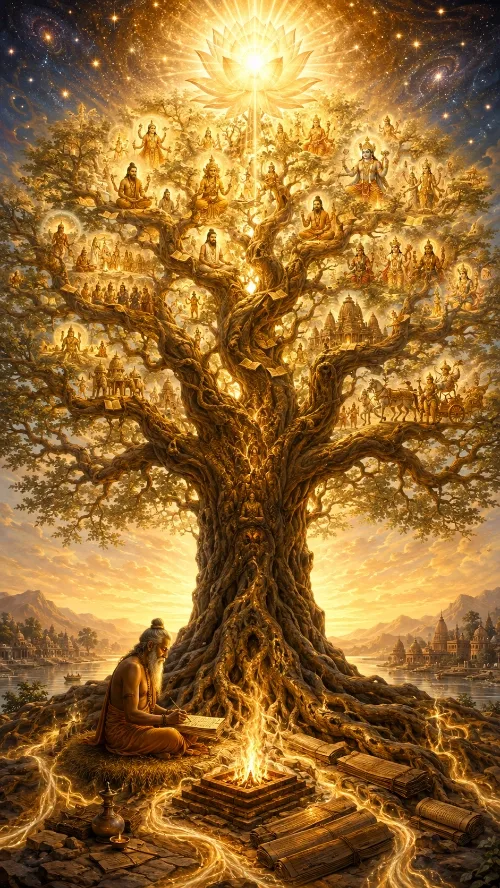
The Vedic Library: Where the Vedas, Upaniṣads, Purāṇas, Itihāsas, and Other Hindu Scriptures Came From
There is no single book called “the Hindu Bible.” Instead, Hindu civilization preserves one of the world’s oldest and largest continuously developing sacred-literary traditions.
It contains hymns more than three thousand years old; ritual manuals; philosophical dialogues; gigantic epics; sacred histories of gods, kings, sages, and cosmic ages; law books; systems of logic and metaphysics; temple scriptures; medical treatises; devotional poetry; and thousands of commentaries upon earlier commentaries.
This raises several obvious questions. What exactly are the Vedas? Are the Upaniṣads separate from the Vedas, or part of them? Who wrote the Mahābhārata? Did Vyāsa actually write all the Purāṇas?
When was the Bhagavad-gītā composed? Were these scriptures originally books at all? And how can a scripture be said to be thousands of years old when the surviving manuscripts may be only a few hundred years old?
To understand the whole picture we must distinguish four things that are often confused: when a tradition says a revelation originated; when historians estimate that its language and contents were composed; when the text became relatively stable; and when it was actually committed to surviving manuscripts.
These dates can be radically different. The Vedas provide the clearest example. Their compositions originated in an overwhelmingly oral civilization. They were memorized and transmitted with extraordinary precision for many centuries before manuscripts became the normal means of preserving them.
So asking simply: “When was the Veda written?” can actually obscure its history. The more accurate question is: When was it composed, when was it orally codified, and when did written copies become common?
Once you make that distinction, the enormous Vedic library begins to make sense.
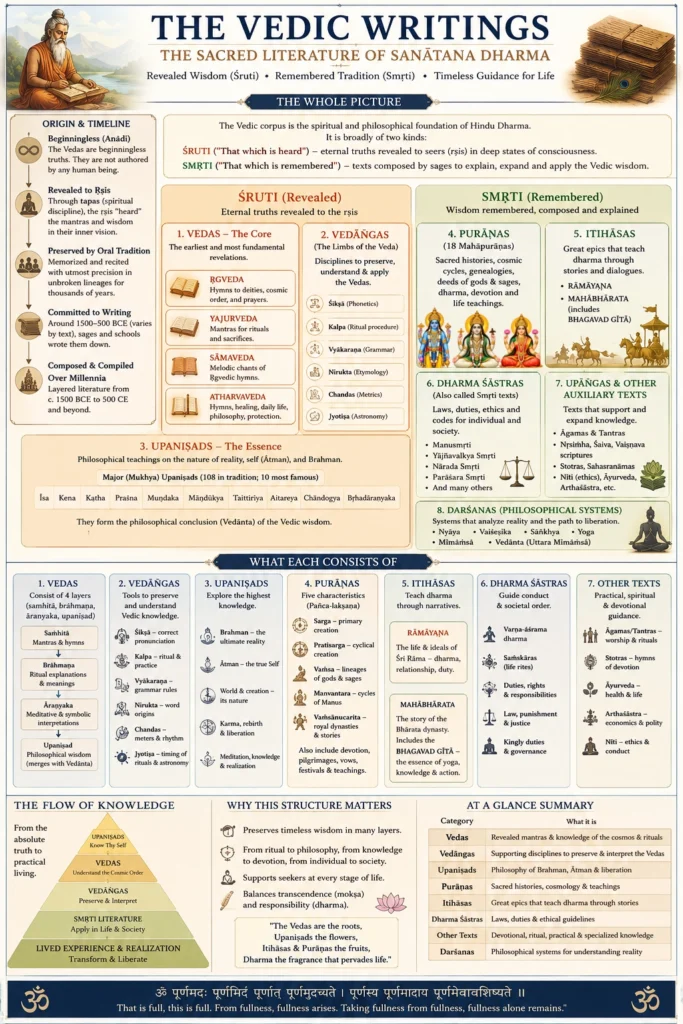
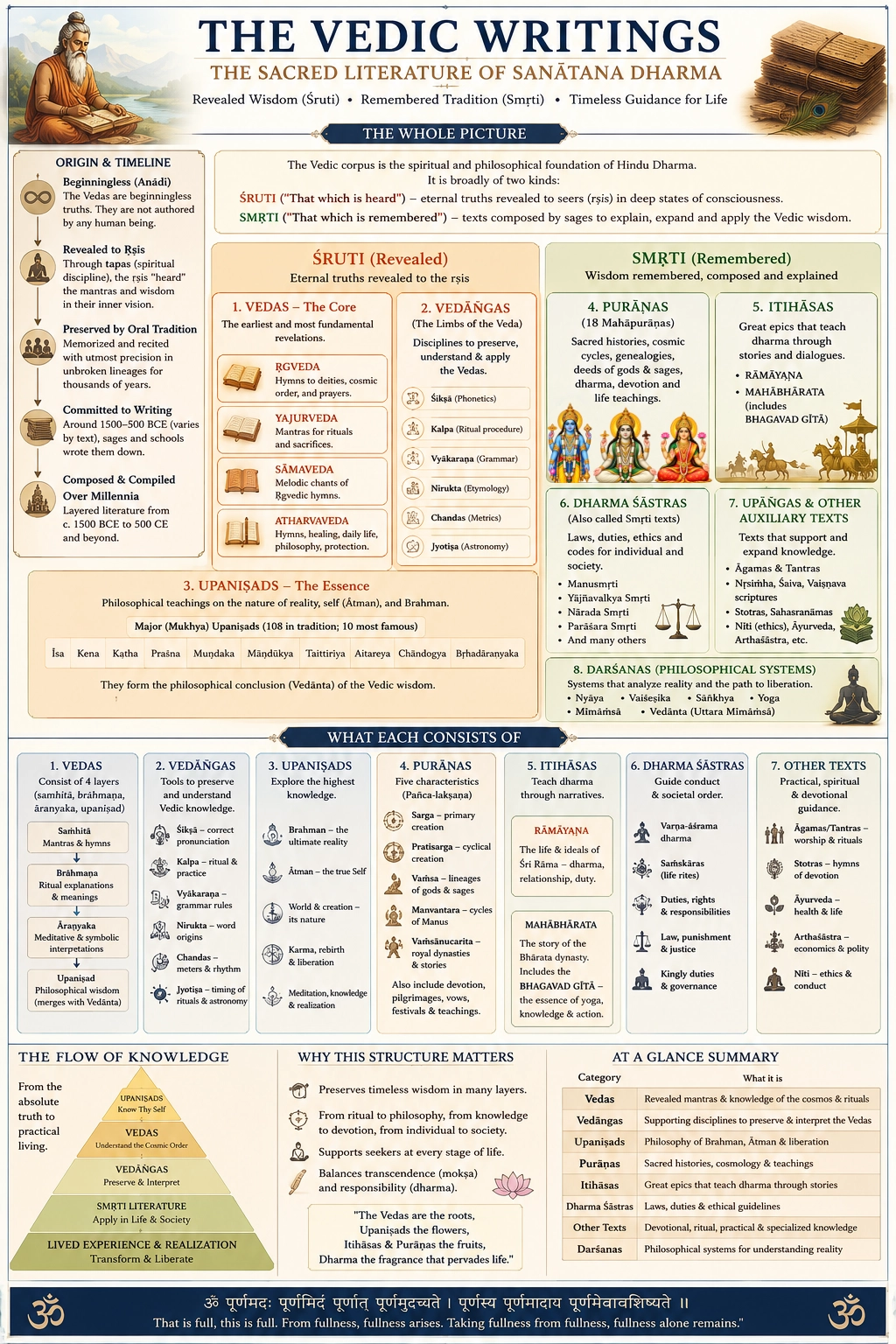
A single sheet laying out the whole corpus — śruti (Vedas, Vedāṅgas, Upaniṣads) beside smṛti (Purāṇas, Itihāsas, Dharma-śāstras, āgamas and darśanas), what each contains, and how they descend from mantra to lived practice.
First, Two Different Meanings of “Vedic Literature”
The expression Vedic literature has both a strict and a broad meaning. In the strict textual sense, the Veda consists of the four great Vedic traditions:
- Ṛgveda
- Sāmaveda
- Yajurveda
- Atharvaveda
together with their associated:
- Saṃhitās
- Brāhmaṇas
- Āraṇyakas
- Upaniṣads.
These constitute Śruti—Vedic revelation proper. But the term “Vedic literature” is also frequently used in a much broader civilizational sense. Then it may include: the Mahābhārata, Rāmāyaṇa, Bhagavad-gītā, Purāṇas, Vedāṅgas, Dharmaśāstras, Vedānta literature, Āgamas, Tantras, Vaiṣṇava and Śaiva theological literature, and later devotional traditions.
These writings belong to the same enormous religious civilization, but they do not all possess the same canonical status or historical age. The first great distinction is therefore between:
Śruti and Smṛti
Śruti: “That Which Is Heard”
Śruti literally means: “that which has been heard.” It is the traditional category of Vedic revelation. Orthodox Hindu traditions generally describe the Veda as:
अपौरुषेय
apauruṣeya
“not of human authorship.” This does not mean that the Vedic hymns appeared as printed books descending from heaven. Rather, the ṛṣis are understood as the seers of mantra.
The traditional expression is: mantra-draṣṭṛ “seer of the mantra.” The ṛṣi therefore does not create Vedic truth in the way that a poet invents a modern poem. He or she perceives it.
A remarkable image occurs in the Bṛhadāraṇyaka Upaniṣad:
अस्य महतो भूतस्य निःश्वसितमेतद् यद् ऋग्वेदो यजुर्वेदः सामवेदोऽथर्वाङ्गिरस इतिहासः पुराणम् …
asya mahato bhūtasya niḥśvasitam etad yad ṛgvedo yajurvedaḥ sāmavedo ’tharvāṅgirasa itihāsaḥ purāṇam …
“This is the breath of that great Being: the Ṛgveda, Yajurveda, Sāmaveda, Atharvāṅgirasa, Itihāsa, Purāṇa …”
Bṛhadāraṇyaka Upaniṣad 2.4.10
The metaphor is profound. Sacred knowledge issues from ultimate reality as naturally as breath. This is one of the foundations of the traditional understanding of Vedic revelation.
Smṛti: “That Which Is Remembered”
The second great category is:
स्मृति
smṛti
“that which is remembered.” In its broad sense Smṛti includes enormous bodies of religious literature transmitted and formulated by sages and teachers rather than belonging directly to Vedic Śruti.
This includes much of:
- Itihāsa
- Purāṇa
- Dharmaśāstra
- ritual literature
- philosophical literature
- later theological literature.
The Mahābhārata is therefore not technically a fifth Vedic Saṃhitā.
Neither is the Bhāgavata Purāṇa. Yet both may possess tremendous religious authority. This distinction is crucial: canonical category and practical religious importance are not the same thing.
A Hindu may almost never encounter a particular Brāhmaṇa text, although technically it belongs to Śruti, while reading the Bhagavad-gītā every day even though the Gītā belongs to Smṛti.
Before Discussing Dates: Ancient India Was Primarily an Oral Textual Civilization
Modern readers instinctively imagine authors producing books by writing them down. That model does not work well for the oldest Indian scriptures. The Vedas were: orally composed, orally organized, orally memorized, orally taught, and orally transmitted.
The earliest securely decipherable large body of Indian inscriptions dates from the reign of Emperor Aśoka in the third century BCE. The Vedic traditions, however, were already many centuries old by then.
This means much of early Indian sacred literature existed without depending upon books. And in the case of the Veda, writing did not immediately replace oral transmission even after scripts became available.
Quite the opposite. The oral form remained the authoritative form.
The Extraordinary Vedic Memory System
Vedic students did not merely memorize the general meaning of a text. They preserved: individual syllables, vowel length, word order, phonetic combination, and even ancient tonal accents.
Different recitation methods provided built-in systems of verification. These included:
and more elaborate permutation systems such as:
- jaṭā-pāṭha
- ghana-pāṭha.
This means the Vedic tradition developed something approaching a human error-correcting system. Because of this, an orally transmitted Vedic text could actually remain more stable than many manuscript traditions in which scribes introduced copying errors.
The astonishing consequence is that: The Veda could be textually fixed before it was fixed in writing. That distinction is fundamental.
So When Were the Vedas Actually Written Down?
The answer is surprisingly late. Writing was certainly known in India by the third century BCE and probably earlier. Attempts to write Vedic material may also have occurred much earlier than our surviving manuscripts.
But the dominant authoritative transmission remained oral. Some scholarly reconstructions suggest that portions of Vedic literature began appearing in written form during the first millennium CE.
For much of the corpus, however, manuscripts appear to have become important only around the early second millennium CE. That means a hymn composed around 1300 BCE might have been faithfully transmitted for roughly two thousand years before the surviving manuscript tradition became central to its preservation.
The oldest surviving Vedic manuscripts are therefore not remotely as old as the texts they contain. For example, one important UNESCO-listed collection of Ṛgvedic manuscripts contains a oldest dated manuscript from 1464 CE.
That does not make the Ṛgveda a fifteenth-century text. It demonstrates precisely the opposite: the text existed independently of that physical manuscript tradition.
The Four Vedas
The four Vedas are:
Atharvaveda
healing, protection, domestic rites, royal rites, speculative hymns, and other material. But each of these represents not simply a book but a Vedic tradition. Their approximate scholarly chronology looks something like this:
These dates are scholarly approximations, not traditional Hindu dates. Different specialists sometimes move particular texts earlier or later.
Who Composed the Ṛgveda?
Traditional Hindu understanding does not speak of a single human author of the Ṛgveda. Individual hymns are associated with particular ṛṣis and ṛṣi families. The famous “family books,” Ṛgveda Maṇḍalas 2–7, are associated principally with lineages such as:
- Gṛtsamada
- Viśvāmitra
- Vāmadeva
- Atri
- Bharadvāja
- Vasiṣṭha.
Other hymns are associated with many additional seers. The tradition also remembers female ṛṣikās, including figures such as:
- Ghoṣā
- Apālā
- Lopāmudrā
- Viśvavārā.
From the traditional perspective these sages saw the mantras.
From the historical-critical perspective, the Ṛgveda preserves the poetry of generations of specialized priest-poets whose compositions were collected and canonized within particular lineages.
Both accounts agree on one point: the Ṛgveda is not the work of one ordinary author.
The Ṛgveda: Approximately 3,200–3,500 Years Old
The Ṛgveda Saṃhitā is generally regarded as the oldest surviving large Sanskrit text. Its principal Śākala recension contains: 1,028 hymns arranged into: ten maṇḍalas. Its world contains: Agni, Indra, Soma, Varuṇa, Uṣas, Sūrya, the Aśvins, Maruts, Rudra, Viṣṇu, and many other deities.
Yet the Ṛgveda also contains remarkable philosophical speculation. Its hymns ask: Where did creation come from? What existed before existence? What is the One underlying the many?
Can even the gods know the ultimate origin of the cosmos? The famous Nāsadīya Sūkta does not merely provide an answer. It questions whether a final answer can even be known.
The principal priest associated with Ṛgvedic recitation is the: hotṛ.
The Sāmaveda: Vedic Poetry Becomes Sacred Music
The Sāmaveda is somewhat later as a compilation than the oldest Ṛgvedic poetry. Much of its verbal material derives directly from Ṛgvedic verses. But its purpose is different.
The verses become: sāman —liturgical song. The specialized priest is the: udgātṛ. Thus the Sāmaveda was not created by one author. It was assembled and transmitted by ritual singing traditions that transformed Vedic verses into highly specialized melodic structures.
Its historical importance for the development of Indian sacred music is immense.
The Yajurveda: The Veda of Ritual Action
The Yajurveda is closely connected with the: adhvaryu —the priest who actually performs many physical actions of sacrifice. Its formulas accompany actions such as: preparing the altar, handling offerings, pouring oblations, measuring ritual space, and manipulating sacrificial implements.
Two broad traditions emerged:
Kṛṣṇa Yajurveda
the “Black Yajurveda,” where mantra and explanatory prose are intermixed; and:
Śukla Yajurveda
the “White Yajurveda,” where the mantra collection is more clearly separated from its Brāhmaṇa. Important Kṛṣṇa Yajurveda traditions include:
- Taittirīya
- Maitrāyaṇī
- Kāṭhaka.
The Śukla Yajurveda produced the monumental: Śatapatha Brāhmaṇa. Again we are dealing with school traditions and generations of ritual specialists, not a single author sitting down to compose “the Yajurveda.”
The Atharvaveda: Healing, Protection, Kingship, and Everyday Life
The Atharvaveda preserves material rather different from the solemn sacrificial atmosphere dominating much of the other Vedas. It contains texts concerned with: healing, disease, long life, marriage, household prosperity, protection from enemies, reconciliation, royal power, hostile magic, counter-magic, cosmology, and philosophical speculation.
The traditions are associated particularly with: Atharvan and Aṅgiras priestly lineages. In the developed four-priest sacrificial system the Atharvaveda became associated with the overseeing: brahman priest.
The classic correspondence is therefore:
A Veda Is Larger Than Its Saṃhitā
This is one of the most important corrections to the popular picture. Each Vedic tradition developed several textual layers:
- Saṃhitā
- Brāhmaṇa
- Āraṇyaka
- Upaniṣad
These should not be imagined as four perfectly uniform historical periods.
They overlap. But they represent an unmistakable intellectual movement.
Saṃhitās: The Collections of Sacred Speech
Saṃhitā means a collection or putting-together. These preserve: hymns, mantras, chants, and sacrificial formulas. The four famous Vedic Saṃhitā traditions are therefore the oldest foundation.
Approximate age
The Saṃhitā period broadly occupies the second millennium BCE into the early first millennium BCE. The Ṛgveda contains the oldest material. The other Saṃhitās generally reflect later stages of Vedic ritual development.
Authorship
No single historical author. They preserve material associated with numerous priestly lineages and Vedic schools.
Written form
Their texts were orally fixed long before surviving manuscripts.
Brāhmaṇas: Explaining Why the Sacrifice Works
The Brāhmaṇas are some of the earliest extensive Sanskrit prose texts. They ask questions such as: Why is this offering performed? Why is a particular mantra spoken? Why does an altar contain a particular number of bricks?
Why is a sacrifice performed at a particular time? How does ritual action correspond with cosmic creation? They combine: ritual instruction, myth, symbolism, theology, etymology, cosmology, and speculation.
Important Brāhmaṇas include:
- Aitareya Brāhmaṇa
- Kauṣītaki Brāhmaṇa
- Taittirīya Brāhmaṇa
- Śatapatha Brāhmaṇa
- Pañcaviṃśa Brāhmaṇa
- Gopatha Brāhmaṇa.
Approximate date
Very broadly: c. 1000–600 BCE depending upon the text and its layers.
Who wrote them?
Again, generally not one author. They are products of individual Vedic schools, preserving teachings transmitted through generations of ritual specialists. Teacher names sometimes appear within the texts, but the works are fundamentally school compositions.
Āraṇyakas: When the Sacrifice Moves Inward
The word:
आरण्यक
āraṇyaka
is related to: araṇya — forest. Hence: “Forest Book.” The distinction between Brāhmaṇa and Āraṇyaka is not always perfectly clean. But something important is happening intellectually.
The ritual becomes increasingly symbolic and internalized. Instead of merely asking: How should this fire altar be constructed? the text may ask: What does this altar correspond to within the cosmos or within the human person?
External ritual develops an inner interpretation.
The Upaniṣads: The Veda Turns Toward Ultimate Reality
The Upaniṣads are not outside the Veda. The oldest Upaniṣads are its culminating layer. Hence their later designation:
वेदान्त
vedānta
veda + anta “the end of the Veda.” They ask: What is Brahman? What is the ātman? What survives death? What causes rebirth? What is karma? What is liberation? What is consciousness?
What is the source of reality? How can ultimate truth actually be known?
How Old Are the Upaniṣads?
Not all Upaniṣads are the same age. The oldest major prose Upaniṣads are generally placed roughly around: 700–500 BCE. These include:
- Bṛhadāraṇyaka
- Chāndogya
- Taittirīya
- Aitareya
- Kauṣītaki.
A later group of important Vedic Upaniṣads is often placed roughly around: 300–100 BCE, with some uncertainty. These include works such as:
- Kena
- Kaṭha
- Īśa
- Śvetāśvatara
- Muṇḍaka
- Praśna
- Māṇḍūkya
- Maitrī.
But Upaniṣadic composition did not stop there. Many later works called Upaniṣads were composed during the first millennium CE and even later. These include: Vaiṣṇava Upaniṣads, Śaiva Upaniṣads, Śākta Upaniṣads, Yoga Upaniṣads, Saṃnyāsa Upaniṣads.
So the statement: “The Upaniṣads say…” is historically insufficient. One must ask: Which Upaniṣad? A Bṛhadāraṇyaka passage and a late medieval sectarian Upaniṣad may be separated by more than a thousand years.
Who Wrote the Upaniṣads?
The ancient Upaniṣads generally do not function like books written by named authors. They preserve teachings connected with teachers such as: Yājñavalkya, Uddālaka Āruṇi, Śvetaketu, Gārgī Vācaknavī, Maitreyi, Prajāpati, Sanatkumāra and many others.
But it would be misleading simply to say: “Yājñavalkya wrote the Bṛhadāraṇyaka Upaniṣad.” He is a teacher inside the tradition preserved in the work. The Upaniṣads are better understood as collections of teachings, debates, dialogues, and meditations transmitted within Vedic schools.
The Upaniṣads Themselves Distinguish Learning From Realization
The Muṇḍaka Upaniṣad makes an extraordinary distinction:
द्वे विद्ये वेदितव्ये इति ह स्म यद्ब्रह्मविदो वदन्ति परा चैवापरा च ॥
dve vidye veditavye iti ha sma yad brahmavido vadanti parā caivāparā ca
“The knowers of Brahman say that two kinds of knowledge are to be known: the higher and the lower.”
It continues:
तत्रापरा ऋग्वेदो यजुर्वेदः सामवेदोऽथर्ववेदः शिक्षा कल्पो व्याकरणं निरुक्तं छन्दो ज्योतिषमिति । अथ परा यया तदक्षरमधिगम्यते ॥
tatrāparā ṛgvedo yajurvedaḥ sāmavedo ’tharvavedaḥ śikṣā kalpo vyākaraṇaṃ niruktaṃ chando jyotiṣam iti; atha parā yayā tad akṣaram adhigamyate
“The lower knowledge consists of the Ṛgveda, Yajurveda, Sāmaveda, Atharvaveda, phonetics, ritual procedure, grammar, etymology, metre, and astronomy. The higher knowledge is that by which the Imperishable is realized.”
Muṇḍaka Upaniṣad 1.1.4–5
This is astonishing. Even mastery of scripture can remain lower knowledge if it does not culminate in realization. The library is not the final goal. It points beyond itself.
Śākhās: The Vedas Were Preserved as Branching Schools
Ancient Vedic tradition was organized into:
शाखा
śākhā
literally: “branch.” A śākhā preserved its own recension of Vedic material. For example, the Taittirīya tradition gives us:
- Taittirīya Saṃhitā
- Taittirīya Brāhmaṇa
- Taittirīya Āraṇyaka
- Taittirīya Upaniṣad.
Many ancient śākhās disappeared. Consequently, the Vedic texts surviving today are only remnants of a much larger forest of oral schools.
The Vedāṅgas: Sciences Created to Preserve the Veda
As Vedic language became increasingly archaic, specialized disciplines became necessary. These are the six:
वेदाङ्ग
vedāṅga
“limbs of the Veda.”
These disciplines emerge largely during the late Vedic and early classical periods, broadly from the first millennium BCE onward. Unlike the Veda proper, these are generally treated as humanly formulated technical literature.
And here we begin to encounter clearer named authors.
Who Wrote the Vedāṅga Literature?
Different branches developed different authorities.
Vyākaraṇa — Grammar
The supreme figure is: Pāṇini author of the: Aṣṭādhyāyī probably composed around the fifth or fourth century BCE, although exact dating remains debated. Pāṇini’s achievement is extraordinary: approximately four thousand compressed grammatical rules describing Sanskrit with almost algorithmic precision.
Kalpa
Here we find names such as: Baudhāyana, Āpastamba, Kātyāyana, Mānava associated with ritual Sūtra traditions. Thus we have entered a literary world in which named teachers and schools are increasingly visible.
marriage,
initiation,
funerary rites.
The Upavedas: Applied Knowledge
Later classification also speaks of:
उपवेद
upaveda
“subsidiary Veda.” Common associations include:
These are categories rather than four universally fixed books. For example, Ayurveda is represented by major works such as: Caraka Saṃhitā and: Suśruta Saṃhitā.
Ayurveda: An Example of Layered Authorship
The Caraka Saṃhitā illustrates how ancient Indian authorship often works. Its teaching is connected traditionally with an older medical lineage passing through: Ātreya / Punarvasu → Agniveśa whose material was later redacted by: Caraka and still later supplemented by: Dṛḍhabala.
Thus saying simply: “Caraka wrote the Caraka Saṃhitā” conceals a long process of transmission and redaction. Likewise, the Suśruta Saṃhitā is traditionally attributed to Suśruta but contains multiple historical layers and later revision.
The major classical Ayurvedic compendia reached forms recognizable to us during the early centuries CE, although their traditions contain older material. This pattern will occur repeatedly: ancient source → oral school → compilation → redaction → commentary → surviving manuscript.
Itihāsa: Sacred History Enters the Picture
Outside Vedic Śruti proper stand India’s two enormous sacred epics: Rāmāyaṇa and: Mahābhārata. These are called:
इतिहास
itihāsa
traditionally understood as: iti ha āsa “thus indeed it was.” Calling them merely “epics” captures their literary form but not their traditional function. They teach: history, genealogy, dharma, theology, politics, ethics, philosophy, devotion, through narrative.
The Rāmāyaṇa: Who Wrote It and How Old Is It?
Tradition attributes the Sanskrit Rāmāyaṇa to: Vālmīki who is therefore called: Ādi-kavi “the first poet.” And the work is called: Ādi-kāvya “the first great poem.” Modern textual scholarship sees a more complicated history.
The central books of the Sanskrit Rāmāyaṇa appear to contain the oldest epic material. The first book, Bāla-kāṇḍa, and especially the seventh, Uttara-kāṇḍa, contain significant later strata.
A reasonable broad scholarly picture places the formation of the epic across roughly: the middle of the first millennium BCE through the first centuries CE. Its oldest substantial layers may go back to approximately the fifth or perhaps sixth century BCE, while the Sanskrit epic in something approaching its received seven-book form was likely substantially established by roughly the second or third century CE.
Was it originally written?
Probably not in the form we possess. It developed from poetic and oral narrative traditions. Once writing became common, written transmission increasingly interacted with oral performance.
No autograph written by “Vālmīki” survives. Indeed, ancient Indian literary history almost never gives us an author’s original physical manuscript.
The Mahābhārata: How Can One Person “Write” 100,000 Verses?
Tradition attributes the Mahābhārata to: Kṛṣṇa Dvaipāyana Vyāsa. Yet the text itself contains multiple layers of narration. Vyāsa teaches the epic. His disciple Vaiśampāyana recites it to King Janamejaya.
Later Ugraśravas Sauti, a professional storyteller, narrates it again to sages at Naimiṣāraṇya. This structure itself reflects a world of: authoritative transmission through recitation.
Modern scholarship generally sees the Mahābhārata as having developed through centuries of accumulation. A very broad conventional range is: c. 400 BCE–400 CE for the development of the monumental work in approximately its surviving form.
Older heroic traditions almost certainly precede this. The final large Brahmanical redaction belongs much later than the original stories underlying the war narrative.
Vyāsa: Author, Compiler, or Something Larger?
This depends upon which kind of historical statement we are making.
Traditional view
Vyāsa is the inspired sage who: organizes the Veda, composes the Mahābhārata, transmits Purāṇic knowledge, and teaches Vedānta.
Historical-critical view
The extant Mahābhārata contains linguistic, theological, and literary strata composed over centuries. These statements do not actually have to be made to cancel each other.
Traditional Indian concepts of authorship include: revelation, arrangement, compilation, transmission, and redaction. The word: vyāsa itself suggests an arranger or compiler.
Thus the traditional claim is larger than the modern concept of a novelist sitting alone and typing every sentence of a book.
The Bhagavad-gītā: A Scripture Inside a Scripture
The Bhagavad-gītā belongs to the: Bhīṣma-parvan of the Mahābhārata. It is therefore technically part of the Mahābhārata rather than a separate Vedic Saṃhitā. Most scholarly estimates place its composition somewhere around the final centuries BCE, although exact proposals vary widely.
A reasonable cautious description is: approximately the second to first century BCE, with scholarly estimates extending somewhat earlier or later. Traditional authorship attributes the entire Mahābhārata, including the Gītā, to Vyāsa.
Historically, the Gītā appears to represent a sophisticated synthesis of: Vedic religion, Upaniṣadic speculation, Sāṃkhya-like analysis, Yoga, renunciation, action, theism, and bhakti.
Its genius lies partly in refusing the simplistic choice between: action or renunciation. It instead teaches transformation of action itself.
When Were the Mahābhārata and Rāmāyaṇa Actually Written Down?
We do not know the date of the first manuscripts. This needs to be stated clearly. Unlike the Vedas, the epics did not maintain the same absolute prohibition against textual variation.
Different recensions developed. Narrators expanded episodes. New theological material was incorporated. Regional textual families diverged. Writing was certainly available during significant phases of their growth.
Thus by the last centuries BCE and early centuries CE, oral and written processes probably interacted. But no ancient “first edition” survives. The Sanskrit manuscripts used by modern critical editors are usually much later than the original composition.
Again: date of surviving manuscript ≠ date of text.
Why Itihāsa and Purāṇa Are Called a “Fifth Veda”
This concept is already very old. The Chāndogya Upaniṣad says:
ऋग्वेदो यजुर्वेदः सामवेद आथर्वणश्चतुर्थ इतिहासपुराणः पञ्चमो वेदानां वेदः
ṛgvedo yajurvedaḥ sāmaveda ātharvaṇaś caturtha itihāsa-purāṇaḥ pañcamo vedānāṃ vedaḥ
“The Ṛgveda, Yajurveda, Sāmaveda, the Atharvaveda as the fourth, and Itihāsa-Purāṇa as the fifth Veda.”
Chāndogya Upaniṣad 7.1.4
This does not mean that the complete Mahābhārata and our eighteen surviving Mahāpurāṇas already existed. It shows that categories of: sacred narrative, genealogy, and ancient tradition already possessed high prestige.
The Mahābhārata later expresses their function beautifully:
इतिहासपुराणाभ्यां वेदं समुपबृंहयेत् ।
बिभेत्यल्पश्रुताद्वेदो मामयं प्रतरिष्यति ॥
itihāsa-purāṇābhyāṃ vedaṃ samupabṛṃhayet
bibhety alpa-śrutād vedo mām ayaṃ pratariṣyati
“One should expand one’s understanding of the Veda through Itihāsa and Purāṇa. The Veda fears a person of little learning, thinking: ‘This person will misunderstand me.’”
Mahābhārata 1.1.204 in a common numbering
This may be the clearest statement of why narrative became so important. The Veda is difficult. The Itihāsa and Purāṇa unpack it.
The Purāṇas: Not Ancient Books Written Once, but Living Textual Traditions
The word:
पुराण
purāṇa
means: ancient account, old tradition. References to purāṇa as a category are extremely old. But this does not mean our surviving Purāṇas existed in their present form in the Vedic age.
Modern scholarship sees the Purāṇas as an extraordinarily long-lived literary genre emerging in recognizable form especially from the early centuries CE onward. Many Purāṇas continued to receive additions and alterations for centuries.
Some effectively remained open textual traditions into the medieval and even early modern periods.
Who Wrote the Purāṇas?
Traditional accounts repeatedly connect Purāṇic revelation with: Vyāsa.
But Purāṇic narrative itself often proceeds through chains of speakers:
- a deity speaks to a sage;
- a sage teaches another sage;
- Sūta recounts what he heard;
- later sages repeat the account.
Modern scholarship therefore describes Purāṇic authorship as largely: anonymous, cumulative, and redactional. A useful term is: composition-in-transmission. The text grows while it is being transmitted.
This explains why asking: “Who wrote the Skanda Purāṇa?” may have no single historical answer. Different strata may have been produced by different religious communities at different times.
The Five Classical Characteristics of a Purāṇa
A famous Sanskrit definition says:
सर्गश्च प्रतिसर्गश्च वंशो मन्वन्तराणि च ।
वंशानुचरितं चैव पुराणं पञ्चलक्षणम् ॥
sargaś ca pratisargaś ca vaṃśo manvantarāṇi ca
vaṃśānucaritaṃ caiva purāṇaṃ pañca-lakṣaṇam
“Creation, secondary creation, genealogies, the periods of the Manus, and the histories of dynasties are the five characteristics of a Purāṇa.”
The five are:
But actual Purāṇas contain vastly more.
They discuss: avatāras, pilgrimage, temples, rituals, holy rivers, cosmology, hells, heavens, kings, sages, yoga, philosophy, vratas, festivals, iconography, and bhakti. They are effectively religious encyclopedias embedded within sacred narrative.
How Old Are the Purāṇas?
No single date can be assigned to “the Purāṇas.” As a recognizable literary genre, extant Purāṇic composition develops especially from approximately the: second to fourth centuries CE onward.
Many major Purāṇas received their characteristic forms between roughly: 300 and 1000 CE while portions of some are considerably later. Examples illustrate the problem. The ancient Markaṇḍeya Purāṇa contains material probably dating to the early centuries CE.
Its celebrated Devī Māhātmya is generally placed around the fifth or sixth century CE. The earliest recension of the Skanda Purāṇa has been connected by scholarship with the late sixth and early seventh centuries CE.
The received Śiva Purāṇa contains substantially later materials, with important strata likely no earlier than around the tenth century and some later still. Thus two texts both called “Purāṇa” may be separated by many centuries.
The Eighteen Mahāpurāṇas
Traditional lists generally contain eighteen Mahāpurāṇas, commonly including:
- Brahma
- Padma
- Viṣṇu
- Śiva or Vāyu
- Bhāgavata
- Nārada
- Mārkaṇḍeya
- Agni
- Bhaviṣya
- Brahmavaivarta
- Liṅga
- Varāha
- Skanda
- Vāmana
- Kūrma
- Matsya
- Garuḍa
- Brahmāṇḍa.
There are additionally numerous: Upapurāṇas. The number eighteen therefore represents a traditional canonical scheme rather than evidence that eighteen books were composed simultaneously.
How Old Is the Śrīmad-Bhāgavatam?
This question is especially important within Vaiṣṇavism. Traditional Vaiṣṇava accounts regard the Bhāgavata as the mature revelation of Vyāsa after his spiritual dissatisfaction with his previous literary work.
Modern scholarship dates the surviving Sanskrit text much later. One influential scholarly position places the Bhāgavata Purāṇa in the ninth or early tenth century CE. Other scholars have argued for important earlier layers or an earlier final form.
Consequently the safest historical statement is: The Bhāgavata is a first-millennium CE Purāṇa whose precise dating remains debated, with the ninth–tenth centuries being an influential modern estimate for its mature form.
Traditional theology makes a completely different claim about its origin through Vyāsa and Śukadeva. These should not be casually collapsed into one another.
Vyāsa and the Bhāgavata
The Bhāgavata itself depicts Vyāsa as an avatāric figure who divides the Vedic tree:
ततः सप्तदशे जातः
सत्यवत्यां पराशरात् ।
चक्रे वेदतरोः शाखा
दृष्ट्वा पुंसोऽल्पमेधसः ॥
tataḥ saptadaśe jātaḥ
satyavatyāṃ parāśarāt
cakre veda-taroḥ śākhā
dṛṣṭvā puṃso ’lpa-medhasaḥ
“Then, appearing as the son of Parāśara and Satyavatī, He divided the tree of the Veda into branches, seeing the diminished capacity of human beings.”
Śrīmad-Bhāgavatam 1.3.21
The metaphor is perfect: Veda is a tree. Vyāsa divides it into: śākhās — branches.
Dharma Literature: From Vedic Order to Human Society
Another enormous branch develops around:
धर्म
dharma.
Dharma may indicate: duty, law, right conduct, religious obligation, social order, ethical order, or the principle sustaining a thing. The earliest systematic texts are the: Dharmasūtras.
Important surviving examples include:
- Āpastamba
- Gautama
- Baudhāyana
- Vasiṣṭha.
Current scholarship generally places the emergence of the surviving Dharmasūtra tradition roughly in the last several centuries BCE, although individual dates remain heavily debated.
Manusmṛti: Who Was Manu?
The famous: Manusmṛti is more properly called: Mānava-Dharmaśāstra “the Dharma Treatise of Manu’s tradition.” It is traditionally presented as the teaching of: Manu the primordial lawgiver.
Within the literary frame, Manu teaches sages and the teaching is transmitted through Bhṛgu. Modern historians do not normally understand this to mean that a single primordial historical Manu personally wrote the surviving Sanskrit manuscript.
The text represents a developed Dharmaśāstra tradition. A reasonable scholarly date for the surviving work is approximately: second century BCE to second or perhaps third century CE.
It was subsequently interpreted through centuries of commentaries.
Yājñavalkya Smṛti
The Yājñavalkya Smṛti is later and more systematically organized. Scholars often date it approximately to: the third to fifth centuries CE. It became enormously influential in medieval Hindu jurisprudence, especially through later commentaries such as the Mitākṣarā.
Again the attribution to the ancient sage Yājñavalkya functions as traditional authority; it does not necessarily identify the historical penman of every surviving verse.
The Six Darśanas: Scripture Becomes Philosophy
Indian thinkers developed sophisticated systematic schools called:
दर्शन
darśana
literally: “seeing,” “view,” or “perspective.” The conventional six Veda-acknowledging systems are:
- Nyāya
- Vaiśeṣika
- Sāṃkhya
- Yoga
- Pūrva-Mīmāṃsā
- Vedānta.
Their systematic literature belongs mostly to the period spanning: the final centuries BCE through the first several centuries CE, although their ideas often have older roots and the texts themselves underwent development.
Who Wrote the Philosophical Sūtras?
Traditional attributions include: Nyāya-sūtra — Gautama or Akṣapāda Vaiśeṣika-sūtra — Kaṇāda Mīmāṃsā-sūtra — Jaimini Yoga-sūtra — Patañjali Brahma-sūtra — Bādarāyaṇa The surviving classical Sāṃkhya tradition is particularly associated with: Īśvarakṛṣṇa’s Sāṃkhya-kārikā probably around the fourth century CE, although Sāṃkhya ideas are far older.
The dates of the Sūtras are notoriously difficult. These are compressed teaching texts that may themselves contain layers.
The Brahma-sūtra: How Old Is Vedānta’s Foundational Text?
The: Brahma-sūtra also called: Vedānta-sūtra is attributed to: Bādarāyaṇa. Many Hindu traditions identify Bādarāyaṇa with Vyāsa. Modern estimates vary considerably. A reasonable broad range is: approximately 200 BCE–200 CE, although some scholars propose later development.
It begins:
अथातो ब्रह्मजिज्ञासा ॥
athāto brahma-jijñāsā
“Now, therefore, inquiry into Brahman.”
The text attempts to organize the diverse Upaniṣadic teachings into a systematic interpretation. Because its aphorisms are extraordinarily compressed, different commentators arrived at radically different conclusions.
This produced the great schools of Vedānta.
The Prasthāna-traya
Vedānta eventually recognizes three principal foundations:
Śruti-prasthāna
the Upaniṣads
Smṛti-prasthāna
the Bhagavad-gītā
Nyāya-prasthāna
the Brahma-sūtra. Thus systematic Vedānta stands upon: revelation + sacred instruction + philosophical systematization. This is why Śaṅkara, Rāmānuja, Madhva, and other great Vedānta teachers write extensively around the same scriptural nucleus while reaching different metaphysical conclusions.
Āgamas and Tantras: A Different Scriptural Stream
The: Āgamas, Tantras, Saṃhitās of Vaiṣṇava, Śaiva, and Śākta traditions constitute another huge sacred world. They are not part of ancient Vedic Śruti in the technical sense.
Yet within their own traditions they may themselves be regarded as divinely revealed scripture. This is an important distinction. Major traditions include: Vaiṣṇava Pāñcarātra Vaikhānasa Śaiva Āgamas Śākta Tantras.
What Do Āgamas and Tantras Teach?
They deal extensively with subjects often only marginally treated in early Vedic literature: temple architecture, mūrti construction, installation of deities, daily worship, mantra initiation, mudrās, yantras, meditation, subtle-body practices, festivals, ritual purification, yoga, and theology.
This explains something that otherwise seems puzzling: Why does a modern Hindu temple look so different from a Ṛgvedic sacrifice? Because historical Hinduism developed through a synthesis of: Vedic + Purāṇic + Āgamic/Tantric + regional + devotional traditions.
How Old Are the Āgamas and Tantras?
Their chronology is complicated. Earlier precedents certainly exist. But the surviving highly developed Tantric and Āgamic textual traditions belong mostly to the: first millennium CE and later.
Important Śaiva Tantric traditions are clearly established by the middle centuries of the first millennium CE. Śākta Tantric systems develop especially from approximately the sixth century CE onward.
Individual texts may be significantly earlier or later. Like the Purāṇas, these are not one corpus produced on one date.
The Pāñcarātra: An Important Vaiṣṇava Example
The Vaiṣṇava: Pāñcarātra tradition has roots extending into the pre-Christian period. Its antecedents appear in traditions of Nārāyaṇa and Vāsudeva worship. A major early textual witness appears in the: Nārāyaṇīya section of the Mahābhārata.
That section in its surviving form belongs approximately to the early centuries CE. The large Pāñcarātra Saṃhitā literature is later. Dating individual Saṃhitās remains difficult and debated; many of the surviving texts belong broadly to the later first millennium and early second millennium CE.
They are typically anonymous. Within the tradition they are presented not as human inventions but as revelations of Viṣṇu/Nārāyaṇa. Thus once again: traditional revealed authorship and: historical textual composition operate on different levels.
Commentary Becomes an Entire Civilization
Indian sacred literature does not stop with primary scriptures. Texts produce commentaries. Commentaries produce subcommentaries. Subcommentaries generate debates. Debates generate philosophical schools.
Important genres include:
Thus saying: “Vedānta teaches…” is insufficient. One must ask: Which Upaniṣad? Which Brahma-sūtra passage? Which commentator? Which school? Which later interpretation? Hindu intellectual history is not one voice.
It is a multi-millennial conversation.
Stotras, Kāvya, Drama, and Devotional Literature
Beyond the formal scriptural categories is another enormous sacred-literary universe. A: stotra is a hymn of praise. A: kāvya is refined literary poetry. A: nāṭaka is drama.
A: campū mixes prose and poetry. A: carita may narrate the life of a sacred personality. A: māhātmya glorifies a deity, scripture, sacred place, or observance. These works may acquire extraordinary religious importance without technically becoming Vedic Śruti.
The Sanskrit Tradition Eventually Blossomed Into Vernacular Scripture
Sacred literature did not remain exclusively Sanskrit. Tamil, Bengali, Braj, Avadhi, Marathi, Kannada, Telugu, Gujarati, Odia, Assamese, and other languages developed enormous religious literatures.
Examples include:
- the Tamil Vaiṣṇava Divya Prabandham,
- Tamil Śaiva devotional poetry,
- Tulsīdāsa’s Rāmacaritamānasa,
- Marathi bhakti poetry,
- Braj Kṛṣṇa poetry,
- and Bengali Gauḍīya Vaiṣṇava literature.
These works are technically much later than the Vedas. But within living religious traditions they may function with tremendous scriptural authority.
The Caitanya-caritāmṛta: A Good Example of a Much Later Sacred Classic
The Śrī Caitanya-caritāmṛta was composed by: Kṛṣṇadāsa Kavirāja Gosvāmī in the early seventeenth century CE. It is therefore separated from the Ṛgveda by roughly three thousand years.
Yet for Gauḍīya Vaiṣṇavas it is one of the most important theological texts ever written. Its language is principally Bengali, richly interwoven with Sanskrit. A famous passage summarizes the Gauḍīya understanding of all scripture:
বেদশাস্ত্র কহে — ‘সম্বন্ধ’, ‘অভিধেয়’, ‘প্রয়োজন’ ।
‘কৃষ্ণ’ — প্রাপ্য সম্বন্ধ, ‘ভক্তি’ — প্রাপ্ত্যের সাধন ॥
veda-śāstra kahe—‘sambandha’, ‘abhidheya’, ‘prayojana’
‘kṛṣṇa’—prāpya sambandha, ‘bhakti’—prāptyera sādhana
“The Vedic scriptures teach relationship, the means of attainment, and the ultimate goal. Kṛṣṇa is the object of the relationship to be attained, and bhakti is the means of attaining Him.”
Caitanya-caritāmṛta, Madhya 20.124
This is not a neutral historian’s description of all Vedic literature. It is a Gauḍīya theological interpretation of its ultimate purpose. That distinction should always be preserved.
Traditional History and Modern Historical Scholarship
We can now see why discussions of Hindu scripture sometimes become unnecessarily confrontational. Two different questions are being asked.
Traditional sacred history asks:
Where does revelation ultimately come from? Who transmitted it? What divine purpose does it serve? What spiritual authority does it possess? From that perspective:
- Veda is eternal.
- Ṛṣis perceive it.
- Vyāsa divides it.
- Teachers transmit it.
- Itihāsa and Purāṇa unfold its meaning.
- Bhakti reveals its ultimate purpose.
Historical-critical scholarship asks:
What form of Sanskrit does this text use? Which earlier works does it quote? Which later works quote it? What social institutions does it assume? What philosophical ideas does it know?
How do manuscripts differ? Which portions appear older or later? From that perspective the picture is:
- Ṛgvedic poetry
- later Saṃhitās
- Brāhmaṇas
- Āraṇyakas
- early Upaniṣads
- Sūtra literature
- epics
- Dharmaśāstra
- classical philosophical systems
- Purāṇas
- Āgamas and Tantras
- medieval theology and commentary
- vernacular devotional literature.
These are not necessarily answers to the same question.
“Who Wrote It?” Has Four Different Meanings in Ancient India
This deserves special emphasis. When modern people ask: “Who wrote this scripture?” they usually mean: “Which individual composed these words and put them on paper?” Ancient Indian texts may instead involve several distinct roles.
This is perhaps the single most important principle for understanding ancient Indian authorship.
“When Was It Written?” Also Has Several Meanings
Likewise, four different dates may exist.
A Chronological Map of the Major Textual Traditions
The following chart gives a useful approximate scholarly overview.
Ṛgveda Saṃhitā
generations of priest-poets; oral canonization
Sāmaveda
liturgical reworking of mostly Ṛgvedic verses
Yajurveda traditions
multiple ritual schools
Atharvaveda
layered priestly compilation
Brāhmaṇas
cumulative ritual prose
Āraṇyakas
symbolic and contemplative development
Earliest Upaniṣads
layered dialogues and teachings
Later Vedic Upaniṣads
continued philosophical compilation
Vedāṅga/Sūtra literature
named technical schools
Rāmāyaṇa
oral epic plus centuries of redaction
Mahābhārata
cumulative epic and Brahmanical redaction
Bhagavad-gītā
philosophical-theological composition incorporated into epic
Dharmasūtras
legal-ritual school traditions
Manusmṛti
developed Dharmaśāstra composition
Brahma-sūtra
systematic synthesis of Upaniṣadic interpretation
Yājñavalkya Smṛti
later Dharmaśāstra
Major Purāṇic literature
anonymous composition-in-transmission
Devī Māhātmya
Śākta theological composition
Early Skanda Purāṇa recension
Pāśupata Śaiva authors/redactors
Bhāgavata Purāṇa
highly sophisticated Vaiṣṇava Purāṇic synthesis
Major Tantric/Āgamic corpora
numerous sectarian schools
Many Pāñcarātra Saṃhitās
anonymous Vaiṣṇava ritual-theological compositions
Caitanya-caritāmṛta
known historical author drawing on eyewitness and earlier Gauḍīya sources
Every date in this table should be read as approximate. Ancient Indian chronology rarely permits the precision expected for modern books.
The Most Important Manuscript Lesson
A surviving manuscript is not the same thing as a text. Suppose a manuscript of a Vedic hymn is dated to 1400 CE. That tells us: this particular physical copy was made around 1400 CE.
It does not tell us: the hymn was composed in 1400 CE. The same principle applies to the epics and Purāṇas. Palm leaf, birch bark, and early paper deteriorate. Texts survived because scribes repeatedly copied them.
An ancient Sanskrit work may therefore exist in a seventeenth-century manuscript while quotations in a fifth-century text prove that the work itself is more than a thousand years older.
Textual historians consequently use far more than manuscripts. They use: language, grammar, metre, quotations, inscriptions, philosophical vocabulary, historical references, cross-references, commentaries, and manuscript relationships.
Dating is therefore historical reconstruction, not merely looking at the oldest copy on a shelf.
The Entire Vedic Library in One Structure
The great textual civilization can now be mapped.
VEDA / ŚRUTI
- Ṛgveda
- Sāmaveda
- Yajurveda
- Atharvaveda
Their textual world includes:
- Saṃhitā
- Brāhmaṇa
- Āraṇyaka
- Upaniṣad
Around the Veda arise:
VEDĀṄGAS
to preserve and interpret sacred language. Then:
KALPA AND SŪTRA LITERATURE
to regulate ritual and practice. Then:
ITIHĀSA
to place dharma inside sacred human history:
- Rāmāyaṇa
- Mahābhārata
- → Bhagavad-gītā
Then:
PURĀṆA
to expand cosmic history, genealogy, mythology, theology, pilgrimage, and bhakti. Then:
DHARMAŚĀSTRA
to organize social, moral, ritual, and juridical life. Then:
DARŚANA
to systematize philosophical reasoning. Then:
ĀGAMA AND TANTRA
to elaborate temple worship, initiation, mantra, deity theology, yoga, and ritual. Then:
COMMENTARY
to explain earlier revelation. Then:
DEVOTIONAL AND REGIONAL LITERATURE
to bring theology into poetry, song, biography, drama, and lived religious culture.
What Each Layer Is Trying to Accomplish
The entire structure can be remembered through a series of questions. The Saṃhitās ask: What sacred words should be spoken? The Brāhmaṇas ask: How and why does the sacrifice work?
The Āraṇyakas ask: What does the sacrifice mean internally? The Upaniṣads ask: What is ultimately real? The Vedāṅgas ask: How can revelation be preserved and interpreted correctly?
The Itihāsas ask: What does dharma look like inside real human conflict? The Purāṇas ask: How do God, cosmos, sacred history, devotion, and human destiny fit together? The Dharmaśāstras ask: How should human life and society be ordered?
The Darśanas ask: Can reality and liberation be philosophically understood and demonstrated? The Āgamas and Tantras ask: How is divine presence ritually encountered and worshipped?
The commentators ask: What precisely did the authoritative text mean? And the great bhakti traditions increasingly ask: How does knowledge become love of Bhagavān?
From Sacred Sound to Realization
Seen historically, the library becomes larger and larger. But seen spiritually, it moves inward. Mantra becomes ritual. Ritual becomes symbolism. Symbolism becomes metaphysics.
Metaphysics becomes philosophy. Philosophy becomes practice. Practice becomes realization. And in bhakti traditions: realization becomes loving relationship with Bhagavān.
That is why the Muṇḍaka Upaniṣad can boldly classify even mastery of the four Vedas as “lower knowledge” compared with realization of the Imperishable. The scriptures themselves refuse to let scholarship become the final goal.
The sacred writings of Hindu civilization cannot be understood as a flat bookshelf. They are a historical, theological, and philosophical ecosystem developing over more than three thousand years.
At its deepest surviving historical root stands the Ṛgveda. Around it developed the other Vedic Saṃhitās. The ritual world produced the Brāhmaṇas. Contemplation transformed ritual into the Āraṇyakas.
Metaphysical inquiry produced the Upaniṣads. The need to preserve revelation produced the Vedāṅgas. Dharma entered human drama through the Rāmāyaṇa and Mahābhārata. The Bhagavad-gītā condensed philosophy, yoga, action, and devotion into one extraordinary dialogue.
The Purāṇas expanded sacred history across cosmic time. The Dharmaśāstras translated sacred order into social life. The Darśanas subjected reality to systematic philosophical investigation.
The Āgamas and Tantras transformed theology into temple, mantra, initiation, meditation, and ritual practice. The commentators built enormous intellectual traditions around these scriptures.
And regional devotional movements translated their conclusions into living languages, songs, poetry, biography, and worship. Traditional Hindu theology sees behind this entire process an eternal revelation transmitted through ṛṣis and great teachers, with Vyāsadeva standing as the supreme organizer of Vedic knowledge.
Modern scholarship sees generations of oral poets, priests, philosophers, storytellers, ritualists, redactors, and commentators working across millennia. These are different perspectives.
But both reveal something extraordinary. The Vedic tradition was never merely a collection of books. It was—and remains—a living machinery for preserving, interpreting, debating, embodying, and ultimately realizing sacred knowledge.
The physical manuscripts are only one stage in that history. Before the manuscript there was memory. Before commentary there was teaching. Before writing there was sacred sound.
And beyond the words, according to the scriptures themselves, lies the purpose toward which the entire library points: realization of ultimate reality.