

When the King Falls, His Favors Fall with Him
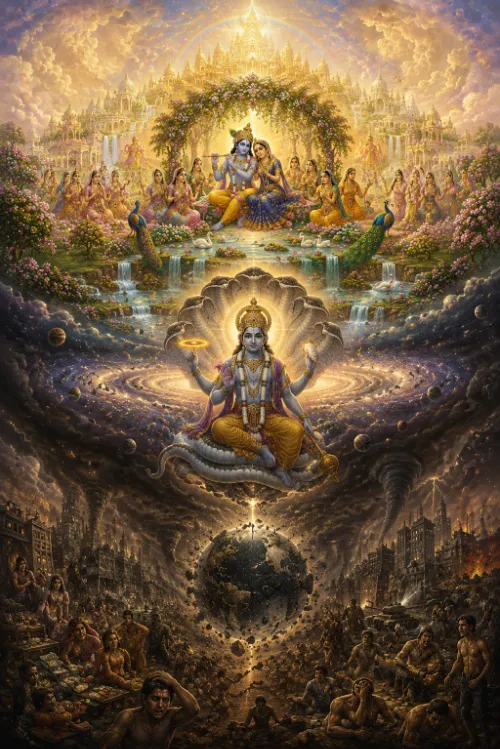
When the King Falls, His Favors Fall with Him: Citraketu’s Warning About Temporary Blessings and the One Refuge That Does Not Perish
Some prayers ask for a gift. Citraketu’s prayer asks a harder question: what happens when the giver of that gift is himself temporary? That is the force of Śrīmad-Bhāgavatam 6.16.38. Standing before Lord Ananta-Saṅkarṣaṇa, Citraketu contrasts the Supreme with the many powers operating within the cosmos. People consumed by thirst for sense enjoyment approach those limited powers for limited favors. But a blessing that depends on a temporary office, body, world, or cosmic order cannot become eternal. When the patron falls, the patronage ends.
Citraketu does not call the devas imaginary or worthless. He calls them vibhūtis: manifestations of the Supreme Lord’s power and glory. His criticism is not directed at respectful recognition of divine servants. It targets transactional worship driven by sensual thirst, in which a dependent power is treated as the ultimate source.
The authentic verse
विषयतृषो नरपशवो
य उपासते विभूतीर्न परं त्वाम् ।
तेषामाशिष ईश
तदनु विनश्यन्ति यथा राजकुलम् ॥ ३८ ॥
viṣaya-tṛṣo nara-paśavo
ya upāsate vibhūtīr na paraṁ tvām
teṣām āśiṣa īśa
tad anu vinaśyanti yathā rāja-kulam
“O Lord, those human animals who thirst for the objects of the senses worship Your manifestations of power rather than You, the Supreme. Their blessings perish along with those powers, just as the fortunes of a royal household perish when the ruling house falls.”
This is Śrīmad-Bhāgavatam 6.16.38. The speaker is King Citraketu, and the person addressed as īśa, “O Lord” or “O supreme controller,” is Ananta-Saṅkarṣaṇa, whom Citraketu has just directly beheld.
The widely circulated A. C. Bhaktivedanta Swami Prabhupāda translation reads:
“O Lord, O Supreme, unintelligent persons who thirst for sense enjoyment and who worship various demigods are no better than animals in the human form of life. Because of their animalistic propensities, they fail to worship Your Lordship, and instead they worship the insignificant demigods, who are but small sparks of Your glory. With the destruction of the entire universe, including the demigods, the benedictions received from the demigods also vanish, just like the nobility when a king is no longer in power.”
That rendering is the object of the analysis below: authentic in source, faithful in theological direction, and more interpretive than a literal translation.
Is Prabhupāda’s translation correct?
Yes, as an explanatory Vaiṣṇava translation—but it is not a word-for-word rendering. Its additions arise from the immediate context and from the same theology expressed elsewhere in the Bhāgavatam and Bhagavad-gītā.
Three expansions deserve special notice. First, “unintelligent” is not a separate adjective in this verse. It paraphrases the severe compound nara-paśavaḥ and is supported by Bhagavad-gītā 7.23, which calls the seekers of temporary fruit alpa-medhasaḥ, “of small understanding.”
Second, “insignificant demigods” and “small sparks of Your glory” expand vibhūtīḥ. The verse does not itself say “insignificant.” An earlier verse in the same passage calls the cosmic creators aṁśāṁśāḥ, “portions of portions,” while the Gītā describes extraordinary powers as arising from a fragment of the Lord’s splendor. The translation is therefore a theological interpretation, not a lexical equivalent.
Third, 6.16.38 does not explicitly name the destruction of the entire universe. It is inferred from verses 35–37, which contrast the changing cosmos and its administrators with the Lord who remains before, during, and after every manifestation. It is also consistent with the Gītā’s teaching that even Brahmā’s world lies within the cycle of return.
The translation is thus doctrinally coherent, but a careful article should distinguish what the Sanskrit says directly from what the commentary legitimately draws out of it.
The prayer is spoken by a man who had already obtained everything
Citraketu’s warning is not the complaint of a person who failed to obtain worldly success. He was a universal emperor whose earth supplied every necessity. He possessed enormous wealth, power, land, and countless beautiful queens. Yet he had no son, and therefore none of his abundance satisfied him:
न तस्य सम्पदः सर्वा
महिष्यो वामलोचनाः ।
सार्वभौमस्य भूश्चेयम्
अभवन् प्रीतिहेतवः ॥
na tasya sampadaḥ sarvā
mahiṣyo vāma-locanāḥ
sārvabhaumasya bhūś ceyam
abhavan prīti-hetavaḥ
“Neither all his opulences, nor his beautiful-eyed queens, nor even the earth belonging to that universal emperor became a cause of happiness for him.”
Śrīmad-Bhāgavatam 6.14.13
The sage Aṅgirā arranged for Citraketu to receive the son he desperately wanted. Before leaving, however, he described the child with a prophetic phrase—not as a personal name, but as the role the boy would play:
अथाह नृपतिं राजन्
भवितैकस्तवात्मजः ।
हर्षशोकप्रदस्तुभ्यमिति
ब्रह्मसुतो ययौ ॥
athāha nṛpatiṁ rājan
bhavitaikas tavātmajaḥ
harṣa-śoka-pradas tubhyam
iti brahma-suto yayau
“Then Brahmā’s son [Aṅgirā] said to the king: ‘O King, you will have one son who will give you both joy and sorrow.’ Having said this, he departed.”
Śrīmad-Bhāgavatam 6.14.29
The compound harṣa-śoka-pradaḥ means “one who gives joy and grief.” It is sometimes loosely retold as though the boy were named Harṣaśoka, but the verse does not record that as his personal name. Its force is prophetic: the same longed-for child would become the occasion first of overwhelming delight and then of devastation. Jealousy drove the king’s neglected co-wives to poison the boy, and the desired blessing became the center of Citraketu’s grief.
This does not mean that the child was evil or that parental love is worthless. It means that possessing a finite object cannot make it immune to time, death, rivalry, fear, or separation. The tighter the king’s happiness was fastened to one fragile condition, the more devastating its loss became.
Nārada and Aṅgirā then called the departed soul back long enough to speak. The soul asked a disarming question: in which of his many lives had these people been his parents? Their present relationship was real as a temporary embodied relationship, but it was not eternal ownership.
Citraketu’s grief was thereby converted into inquiry. Nārada initiated him into worship of the Lord’s fourfold manifestation, culminating in Saṅkarṣaṇa:
ॐ नमस्तुभ्यं भगवते
वासुदेवाय धीमहि ।
प्रद्युम्नायानिरुद्धाय
नमः सङ्कर्षणाय च ॥
oṁ namas tubhyaṁ bhagavate
vāsudevāya dhīmahi
pradyumnāyāniruddhāya
namaḥ saṅkarṣaṇāya ca
“Oṁ. Obeisance to You, the Blessed Lord. We meditate upon Vāsudeva. Obeisance also to Pradyumna, Aniruddha, and Saṅkarṣaṇa.”
Śrīmad-Bhāgavatam 6.16.18
After one week of concentrated practice, Citraketu first received sovereignty over the Vidyādharas as an intermediate result. He did not stop there. His consciousness continued to become illuminated until he attained the presence of Lord Ananta. When he saw the Lord, he wept, his hairs stood erect, and for some time his voice was choked by devotion.
The king who had once wanted one more possession now stood before the source of every power and asked for no possession at all. That transformation gives verse 38 its authority.
The logic of Citraketu’s prayer
Verses 34–38 form a deliberate progression.
The Supreme gives Himself to desireless devotees
Citraketu begins by saying that the unconquerable Lord is conquered by self-controlled devotees who seek no material reward. The Lord is ātma-daḥ: He gives Himself. This is the first contrast between bhakti and a transaction. A commercial worshiper asks, “What will You give me?” The pure devotee asks, “How may I give myself to You?” The Lord responds to that self-giving with His own.
The cosmic rulers possess delegated power
The next verse supplies the ontology behind the word vibhūti:
तव विभवः खलु भगवन्
जगदुदयस्थितिलयादीनि ।
विश्वसृजस्तेऽंशांशास्
तत्र मृषा स्पर्धन्ति पृथगभिमत्या ॥
tava vibhavaḥ khalu bhagavan
jagad-udaya-sthiti-layādīni
viśva-sṛjas te ’ṁśāṁśās
tatra mṛṣā spardhanti pṛthag-abhimatyā
“O Blessed Lord, the creation, maintenance, and dissolution of the universe are truly manifestations of Your power. The creators of the worlds are portions of Your portions; thinking themselves separate, they compete within that sphere in vain.”
Śrīmad-Bhāgavatam 6.16.35
The verse does not deny the cosmic administrators’ actual abilities. It denies their independent ownership of those abilities. A minister may genuinely exercise authority without being the source of the state. A lamp may genuinely shine without being the source of fire itself.
The Lord remains when every created form changes
Verse 36 says that the Lord is present at the beginning, middle, and end of everything, from the smallest atom to the greatest cosmic principle, while He Himself is not bounded by those three phases. Verse 37 then says that countless enormous universes appear like atoms in Ananta.
Only after establishing this scale does Citraketu speak verse 38. The issue is not simply that one deity is stronger than another. The issue is the difference between dependent cosmic offices and the reality that remains when the entire cosmic order is withdrawn.
What does vibhūti mean?
The noun vibhūti can mean power, greatness, glory, prosperity, a mighty manifestation, or an extraordinary expression of divine potency. It is not inherently insulting. The tenth chapter of the Bhagavad-gītā is traditionally called Vibhūti-yoga, “the yoga of divine manifestations.” Kṛṣṇa tells Arjuna:
यद्यद्विभूतिमत्सत्त्वं
श्रीमदूर्जितमेव वा ।
तत्तदेवावगच्छ त्वं
मम तेजोऽंशसम्भवम् ॥
yad yad vibhūtimat sattvaṁ
śrīmad ūrjitam eva vā
tat tad evāvagaccha tvaṁ
mama tejo-’ṁśa-sambhavam
“Whatever being possesses exceptional glory, beauty, prosperity, or power—understand that to have arisen from a portion of My splendor.”
Bhagavad-gītā 10.41
The correct response to a vibhūti is therefore neither contempt nor independent absolutization. It is transparent vision: one honors the extraordinary power while seeing through it to its source.
This is why “demigod” can be a misleading English word. In Prabhupāda’s books it translates deva, a luminous celestial being entrusted with cosmic functions. It does not mean a fictional “half-god” of Greek mythology. Indra, Sūrya, Candra, Vāyu, Agni, Sarasvatī, and other devas are presented as real and venerable beings. But they remain participants within the cosmos, not the unconditioned source of the cosmos.
Citraketu’s hierarchy is not “real God versus fake gods.” It is the Supreme source versus genuine but dependent manifestations of His authority.
Why compare their blessings to a royal household?
The compound rāja-kulam literally means a king’s house, royal family, dynasty, court, or royal establishment. The image assumes a world of patronage. A courtier, official, noble, artist, soldier, or dependent may enjoy status and livelihood because a particular king or dynasty supports him. If that house loses power, everyone whose fortune rested solely upon it falls with it.
Traditional translations bring out different sides of the image:
- Prabhupāda speaks of the nobility losing its position when a king is no longer in power.
- G. V. Tagare speaks of the good fortune of a king’s followers perishing with the fall of the royal house.
- The Gītā Press Hindi rendering explains that when the royal dynasty is destroyed, its dependents’ livelihood also disappears.
The common principle is unmistakable:
A dependent benefit cannot be more permanent than the system on which it depends.
This impermanence operates on several levels.
The blessing may disappear during one lifetime
Health, wealth, fertility, victory, position, beauty, influence, and even family relationships depend on changing conditions. One may obtain the desired object and later lose it. It may also produce anxiety, rivalry, pride, or consequences that were invisible when it was desired. Citraketu’s son is the narrative example: the boon was real, the joy was real, and the loss was also real.
The merit supporting heavenly enjoyment becomes exhausted
The Bhagavad-gītā describes worshipers who attain heaven through meritorious ritual but return when the accumulated merit has been spent:
ते तं भुक्त्वा स्वर्गलोकं विशालं
क्षीणे पुण्ये मर्त्यलोकं विशन्ति ।
एवं त्रयीधर्ममनुप्रपन्ना
गतागतं कामकामा लभन्ते ॥
te taṁ bhuktvā svarga-lokaṁ viśālaṁ
kṣīṇe puṇye martya-lokaṁ viśanti
evaṁ trayī-dharmam anuprapannā
gatāgataṁ kāma-kāmā labhante
“Having enjoyed the vast heavenly world, they enter the mortal world again when their merit is exhausted. Thus those who follow the ritual religion of the three Vedas while desiring objects of desire obtain repeated going and returning.”
Bhagavad-gītā 9.21
The heavenly reward is not dismissed as nonexistent. Its defect is that it expires.
Even the highest material worlds remain inside cosmic time
आब्रह्मभुवनाल्लोकाः
पुनरावर्तिनोऽर्जुन ।
मामुपेत्य तु कौन्तेय
पुनर्जन्म न विद्यते ॥
ā-brahma-bhuvanāl lokāḥ
punar āvartino ’rjuna
mām upetya tu kaunteya
punar janma na vidyate
“From Brahmā’s world downward, all worlds are places of return, O Arjuna. But after attaining Me, O son of Kuntī, there is no further birth.”
Bhagavad-gītā 8.16
This supplies the cosmic dimension made explicit in Prabhupāda’s translation of Citraketu’s prayer. The devas may possess lifespans and powers inconceivably greater than a human being’s, but great duration is not eternity.
The Bhagavad-gītā gives the complete mechanism
Bhagavad-gītā 7.20–23 almost functions as a prose commentary on Citraketu’s verse.
Desire narrows intelligence
कामैस्तैस्तैर्हृतज्ञानाः
प्रपद्यन्तेऽन्यदेवताः ।
तं तं नियममास्थाय
प्रकृत्या नियताः स्वया ॥
kāmais tais tair hṛta-jñānāḥ
prapadyante ’nya-devatāḥ
taṁ taṁ niyamam āsthāya
prakṛtyā niyatāḥ svayā
“Those whose discernment has been carried away by particular desires take shelter of other deities, following the corresponding disciplines, governed by their own disposition.”
Bhagavad-gītā 7.20
The phrase hṛta-jñānāḥ does not necessarily mean that such people lack all intelligence. Desire has “carried away” or commandeered their knowledge. They may be sophisticated about the means while failing to examine the end. They know how to obtain something but have not asked whether it is ultimately worth obtaining.
The Supreme sustains even that worship
यो यो यां यां तनुं भक्तः
श्रद्धयार्चितुमिच्छति ।
तस्य तस्याचलां श्रद्धां
तामेव विदधाम्यहम् ॥
स तया श्रद्धया युक्तस्
तस्याराधनमीहते ।
लभते च ततः कामान्
मयैव विहितान्हि तान् ॥
yo yo yāṁ yāṁ tanuṁ bhaktaḥ
śraddhayārcitum icchati
tasya tasyācalāṁ śraddhāṁ
tām eva vidadhāmy aham
sa tayā śraddhayā yuktas
tasyārādhanam īhate
labhate ca tataḥ kāmān
mayaiva vihitān hi tān
“Whatever form a devotee desires to worship with faith, I make that faith steady. Endowed with that faith, one seeks the worship of that deity and obtains the desired benefits—but those benefits are in fact arranged by Me alone.”
Bhagavad-gītā 7.21–22
This is the theological center of the issue. The deva is not an autonomous competitor operating outside the Supreme. The worshiper’s faith, the deva’s authority, and the resulting boon all exist within a deeper divine government.
The result corresponds to the object—and ends
अन्तवत्तु फलं तेषां
तद्भवत्यल्पमेधसाम् ।
देवान्देवयजो यान्ति
मद्भक्ता यान्ति मामपि ॥
antavat tu phalaṁ teṣāṁ
tad bhavaty alpa-medhasām
devān deva-yajo yānti
mad-bhaktā yānti mām api
“But the fruit obtained by those of small understanding has an end. Worshipers of the devas go to the devas, whereas My devotees come to Me.”
Bhagavad-gītā 7.23
This is almost Citraketu’s entire prayer in one word: antavat—possessing an end.
Does Vedic scripture not prescribe worship of the devas?
It does. The early teaching of the Bhagavad-gītā describes a reciprocal sacrificial order:
देवान्भावयतानेन
ते देवा भावयन्तु वः ।
परस्परं भावयन्तः
श्रेयः परमवाप्स्यथ ॥
devān bhāvayatānena
te devā bhāvayantu vaḥ
parasparaṁ bhāvayantaḥ
śreyaḥ param avāpsyatha
“By this sacrifice nourish the devas, and may those devas nourish you. Nourishing one another, you will attain the highest welfare.”
Bhagavad-gītā 3.11
There is no need to erase this verse. Vedic religion recognizes gratitude, cosmic reciprocity, and duties toward the powers through which rain, sunlight, learning, health, and social order are mediated.
The question is one of level, intention, and final refuge:
- Honoring a deva as a servant or manifestation of the Supreme is not the same as treating that deva as independent.
- Performing a prescribed duty within an integrated life of sacrifice is not the same as shopping for divine favors.
- Receiving a temporal benefit is not the same as attaining the eternal good.
- Respecting the branch is not the same as forgetting the root.
The Gītā later says that even faithful worship offered to other deities ultimately rests upon Kṛṣṇa, but is avidhi-pūrvakam—offered without full understanding of the governing relation. The problem is therefore not that the worship reaches a reality utterly disconnected from God. The problem is incomplete knowledge of the reality being approached.
Root and branches: why direct worship is considered complete
The Bhāgavatam gives the classic analogy:
यथा तरोर्मूलनिषेचनेन
तृप्यन्ति तत्स्कन्धभुजोपशाखाः ।
प्राणोपहाराच्च यथेन्द्रियाणां
तथैव सर्वार्हणमच्युतेज्या ॥
yathā taror mūla-niṣecanena
tṛpyanti tat-skandha-bhujopaśākhāḥ
prāṇopahārāc ca yathendriyāṇāṁ
tathaiva sarvārhaṇam acyutejyā
“As watering the root of a tree satisfies its trunk, large branches, and smaller branches, and as supplying nourishment to the life center satisfies all the senses, so worship of Acyuta constitutes the worship of everyone.”
Śrīmad-Bhāgavatam 4.31.14
The analogy is not “cut off the branches because only the root matters.” Healthy branches are cherished precisely by watering the root. Likewise, exclusive devotion to the Supreme is presented as the deepest way of honoring all beings and cosmic powers in their true relationship.
Kṛṣṇadāsa Kavirāja gives the same principle in Bengali:
‘শ্রদ্ধা’-শব্দে — বিশ্বাস কহে সুদৃঢ় নিশ্চয় ।
কৃষ্ণে ভক্তি কৈলে সর্বকর্ম কৃত হয় ॥
‘śraddhā’-śabde—viśvāsa kahe sudṛḍha niścaya
kṛṣṇe bhakti kaile sarva-karma kṛta haya
“The word ‘faith’ means firm and certain conviction that by rendering devotion to Kṛṣṇa, all subsidiary duties are fulfilled.”
Caitanya-caritāmṛta, Madhya 22.62
This is centralization, not contempt. The devotee does not deny the devas; the devotee refuses to detach them from the source of their life and authority.
Why does Citraketu use the harsh term nara-paśu?
Nara means human being; paśu means animal or domesticated beast. Nara-paśu therefore means “a human animal” or “an animal in human form.” The expression is deliberately severe.
The intended contrast is not that animals are evil. Animals naturally pursue food, reproduction, safety, territory, comfort, and relief from pain. Human beings share those needs, but human life also permits a further question: What am I, what survives death, and what good cannot be taken away by time?
Later in the same chapter, Lord Ananta tells Citraketu:
लब्ध्वेह मानुषीं योनिं
ज्ञानविज्ञानसम्भवाम् ।
आत्मानं यो न बुद्ध्येत
न क्वचित्क्षेममाप्नुयात् ॥
labdhveha mānuṣīṁ yoniṁ
jñāna-vijñāna-sambhavām
ātmānaṁ yo na buddhyeta
na kvacit kṣemam āpnuyāt
“Having attained a human birth in which knowledge and realized understanding are possible, one who does not understand the self cannot attain true welfare anywhere.”
Śrīmad-Bhāgavatam 6.16.58
Thus nara-paśu describes unused human capacity. If intelligence is employed only to refine consumption, extend comfort, or negotiate larger temporary rewards, it has not yet awakened to its distinctively human purpose.
The term must not become a license for cruelty or social contempt. A person repeating “human animal” with pride while lacking compassion has missed the spiritual point. Citraketu is diagnosing a condition of consciousness, not authorizing devotees to dehumanize their neighbors.
The next verse changes the tone completely
If verse 38 were isolated, one might conclude that anyone who approaches God with a material desire is simply condemned. Verse 39 prevents that reading:
कामधियस्त्वयि रचिता
न परम रोहन्ति यथा करम्भबीजानि ।
ज्ञानात्मन्यगुणमये
गुणगणतोऽस्य द्वन्द्वजालानि ॥
kāma-dhiyas tvayi racitā
na parama rohanti yathā karambha-bījāni
jñānātmany aguṇamaye
guṇa-gaṇato ’sya dvandva-jālāni
“O Supreme Lord, desires directed toward You do not continue to sprout, just as roasted seeds do not germinate, because You are the self of knowledge and are beyond the material qualities from which this person’s networks of duality arise.”
Śrīmad-Bhāgavatam 6.16.39
This is the decisive contrast:
- Desire directed toward a finite power seeks fulfillment within the field of desire. It gives a temporary result and ordinarily reinforces the same transactional consciousness.
- Desire brought before the Supreme enters a transforming relationship. Even when the worship begins imperfectly, contact with the transcendent object of bhakti can sterilize the seed of bondage.
The verse does not declare selfish prayer to be the highest devotion. Pure bhakti is without bargaining. It says something more merciful: one does not have to become perfectly desireless before turning toward the Supreme. One turns toward Him so that desire itself can be purified.
That is why the Bhāgavatam elsewhere says:
अकामः सर्वकामो वा
मोक्षकाम उदारधीः ।
तीव्रेण भक्तियोगेन
यजेत पुरुषं परम् ॥
akāmaḥ sarva-kāmo vā
mokṣa-kāma udāra-dhīḥ
tīvreṇa bhakti-yogena
yajeta puruṣaṁ param
“Whether free from material desire, full of every desire, or desiring liberation, a person of broad intelligence should worship the Supreme Person through intense bhakti-yoga.”
Śrīmad-Bhāgavatam 2.3.10
The broad-minded person approaches the root even when the heart is still crowded with requests.
The Supreme may answer a prayer by changing the desire
Gauḍīya theology does not reduce God to a more powerful supplier of the same consumer goods. The difference is not merely that one petitioner uses a local office while another contacts the central office. The Supreme gives something categorically greater: relationship with Himself.
The Caitanya-caritāmṛta expresses this in memorable Bengali:
কৃষ্ণ কহে, — ‘আমা ভজে, মাগে বিষয়-সুখ ।
অমৃত ছাড়ি’ বিষ মাগে, — এই বড় মূর্খ ॥ ৩৮ ॥
আমি — বিজ্ঞ, এই মূর্খে ‘বিষয়’ কেনে দিব ?
স্ব-চরণামৃত দিয়া ‘বিষয়’ ভুলাইব ॥ ৩৯ ॥
kṛṣṇa kahe—‘āmā bhaje, māge viṣaya-sukha
amṛta chāḍi’ viṣa māge—ei baḍa mūrkha
āmi—vijña, ei mūrkhe ‘viṣaya’ kene diba?
sva-caraṇāmṛta diyā ‘viṣaya’ bhulāiba
“Kṛṣṇa says, ‘One worships Me yet asks for happiness from sense objects. Giving up nectar, that great fool asks for poison. Since I am wise, why should I give this fool material enjoyment? I shall give the nectar of My own feet and make that person forget material absorption.’”
Caitanya-caritāmṛta, Madhya 22.38–39
This can take several forms. The Lord may grant the requested object, withhold it, remove it, or redirect the devotee’s heart. The theological claim is not that every loss can be casually interpreted or that suffering should be minimized. It is that divine mercy is measured by the soul’s ultimate good, not merely by compliance with its immediate shopping list.
Citraketu himself is the model. He first wanted a son. Through gaining and losing that son, he eventually gained spiritual knowledge. Through Nārada’s instruction he then attained the Lord. The original request was not simply fulfilled or denied; the person making the request was transformed.
The Lord confirms Citraketu’s insight
After hearing the prayer, Lord Ananta teaches that human life is meant for realized knowledge. He then summarizes the instability of fruitive striving:
स्मृत्वेहायां परिक्लेशं
ततः फलविपर्ययम् ।
अभयं चाप्यनीहायां
सङ्कल्पाद्विरमेत्कविः ॥
smṛtvehāyāṁ parikleśaṁ
tataḥ phala-viparyayam
abhayaṁ cāpy anīhāyāṁ
saṅkalpād viramet kaviḥ
“Remembering the toil involved in fruitive striving, the reversal of its expected result, and the fearlessness found in freedom from such striving, a wise person should withdraw from material schemes.”
Śrīmad-Bhāgavatam 6.16.59
The remarkable term is phala-viparyaya: the result turns contrary to expectation. Wealth attracts fear. Status produces rivalry. A cherished possession intensifies the pain of possible loss. A remedy creates a new dependency. A desired child becomes, in Citraketu’s story, both harṣa and śoka—joy and sorrow.
This does not mean that every undertaking fails or that responsible action should cease. Ananta condemns the fantasy that calculated arrangements can manufacture permanent security. One should act, but not build the soul’s final shelter out of changing results.
What the verse does not mean
It does not say that the devas are unreal
They are called the Lord’s vibhūtis. Their powers and offices are real, but dependent and temporary within the manifested cosmos.
It does not authorize disrespect toward Śiva, Brahmā, or other devas
Vaiṣṇava literature repeatedly honors exalted devas, especially Śiva, as extraordinary servants and devotees. The error criticized here is treating a delegated manifestation as independent of the Supreme, not offering proper reverence.
It does not condemn every prayer made in distress or need
The Gītā explicitly recognizes the distressed and the seeker of material help among the pious people who begin to approach the Lord. Such devotion is not yet desireless, but it can become a doorway to pure devotion.
It does not promise that worship of the Supreme is a superior technique for obtaining everything on demand
Verse 39 says that desires brought to the Supreme are transformed. The Lord may remove the craving rather than supply its object. Bhakti is not cosmic consumerism with a more powerful vendor.
It does not teach neglect of medicine, work, family, government, or practical help
Finite agencies may be used appropriately and gratefully. The teaching concerns ultimate dependence. One may take medicine without worshiping medicine as immortal, serve a family without claiming permanent ownership, and participate in society without mistaking a government for the final protector of the soul.
It is not merely sectarian competition
Citraketu’s argument rests on dependence and duration: Who is the source of the power? Does the result end? What remains when the giver’s office ends? Those are philosophical questions, not merely declarations that one religious team is stronger than another.
A modern reading of the royal-house metaphor
The ancient comparison remains painfully recognizable. A person’s access, status, security, or income may depend on a ruler, employer, institution, market, platform, reputation, body, or relationship. These supports can be useful and sometimes necessary. Yet each carries an expiry condition.
The metaphor does not demand withdrawal from the world. It demands clarity:
- Use temporary means without mistaking them for permanent shelter.
- Honor power without forgetting the source from which the power comes.
- Do not evaluate a blessing only by how pleasant it is when received; ask what it does to consciousness and how long it can last.
- Let need become a doorway to prayer, but let prayer mature from demand into relationship.
- Do not merely ask, “Can this be obtained?” Ask, “Will obtaining it free me, bind me, or deepen my dependence on what must perish?”
Citraketu’s insight can be reduced to a severe but liberating equation:
A finite source can give only a finite shelter.
The solution is not to hate finite things. It is to love them without demanding that they become God.
A fuller and more precise formulation
The original explanation may be expanded as follows:
In Śrīmad-Bhāgavatam 6.16.38, King Citraketu tells Lord Ananta-Saṅkarṣaṇa that people whose intelligence is governed by thirst for sense objects live beneath the distinctive possibility of human life. Instead of seeking the Supreme, they approach His vibhūtis—real but dependent manifestations of divine power—for temporary benefits. Because both the cosmic offices and the karmic conditions supporting those benefits exist within time, their blessings eventually disappear, just as the livelihood and prestige of a royal court collapse when its ruling dynasty falls. The verse does not deny or insult the devas; it denies their independence and their ability to provide an eternal refuge. Its immediate sequel adds a crucial note of mercy: even materially motivated desire, when directed toward the Supreme, can be transformed, like a seed rendered unable to germinate. Thus the passage contrasts not merely two objects of worship, but two structures of religion—transaction with finite power and transforming relationship with the eternal source of all power.
Final conclusion
The quoted verse and attribution are authentic. The published translation is theologically sound but deliberately expansive. Its language about unintelligence, minor devas, sparks of glory, and universal destruction comes from the verse’s surrounding argument rather than from a one-to-one lexical rendering.
The most important correction is also the key to the verse’s depth: vibhūtīḥ does not mean “worthless false gods.” It means the Supreme Lord’s genuine manifestations of power. Citraketu’s mistake would not be to recognize those powers. It would be to stop at them—to seek their gifts while forgetting the source, to honor the office while ignoring the sovereign, and to ask impermanence for what only eternity can give.
No temporary blessing is condemned simply because it is temporary. Food, health, family, learning, protection, and social order all matter. But they become spiritually dangerous when asked to carry the weight of final meaning.
The king falls. The court scatters. The accumulated merit is spent. Even the celestial worlds turn within time. But the Supreme whom Citraketu addresses remains at the beginning, middle, and end—and gives not merely a favor, but Himself.
Principal texts discussed
- Śrīmad-Bhāgavatam 2.3.10; 4.31.14; 6.14.10–15; 6.14.36; 6.15–16, especially 6.16.18, 6.16.34–39, and 6.16.58–60
- Bhagavad-gītā 3.11; 7.20–23; 8.16; 9.20–25; 10.41–42
- Kṛṣṇadāsa Kavirāja Gosvāmī, Śrī Caitanya-caritāmṛta, Madhya 22.38–39 and 22.62
- A. C. Bhaktivedanta Swami Prabhupāda, translation and purport to Śrīmad-Bhāgavatam 6.16.38
- G. V. Tagare, English translation of Bhāgavata Purāṇa, Skandha 6, chapter 16
- Gītā Press, Sanskrit-Hindi edition of Śrīmad-Bhāgavata Mahāpurāṇa, Skandha 6, chapter 16