

When Viṣṇu Touched Dhruva With His Conch
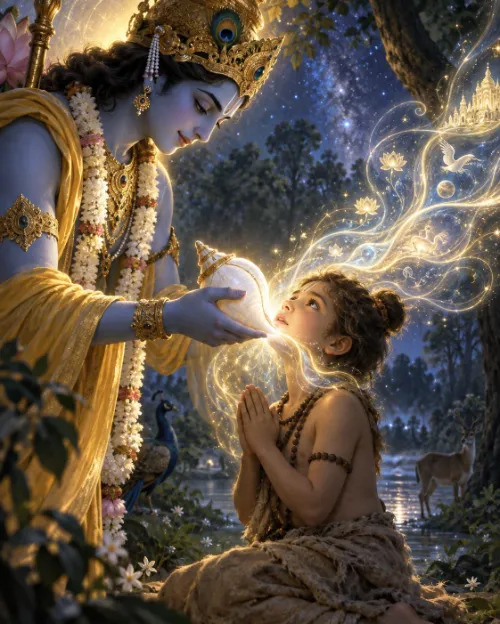
How a five-year-old’s silence became Vedic speech
A five-year-old boy stands face to face with the Supreme Lord. He has endured humiliation, left the palace, accepted Nārada as his spiritual teacher, received Vāsudeva’s mantra, and performed an austerity so intense that the three worlds trembled. He has attained what accomplished yogīs may seek for many lifetimes: direct vision of Bhagavān.
Yet when the Lord appears, Dhruva cannot speak. His devotion is already pouring through his body. He falls like a rod. He gazes at the Lord as though drinking Him with his eyes, kissing Him with his mouth, and embracing Him with his arms. But he cannot formulate a prayer adequate to the encounter.
Then Viṣṇu performs one of the most striking acts of grace in the Bhāgavata Purāṇa: He touches the child’s face with His conch. Dhruva’s speech immediately awakens—not merely as eloquence, but as divine speech accompanied by realization of the Supreme Self and a mature devotional understanding of God, the self, and the cosmos.
The episode contains an entire theology of revelation. It shows how disciplined practice, the guru’s instruction, the devotee’s longing, and God’s freely given grace meet in one transformative moment.
It also requires textual refinements. The Sanskrit says that the conch touched Dhruva on the cheek, not unambiguously on the forehead. The deity manifested is four-armed, Garuḍa-borne Hari or Vāsudeva—Viṣṇu—rather than Kṛṣṇa’s two-armed cowherd form. And verses 4.9.5–6 show that the touch bestows much more than vocabulary: it awakens divine speech, spiritual discernment, and devotion.
The Central Verse
स तं विवक्षन्तमतद्विदं हरिर्
ज्ञात्वास्य सर्वस्य च हृद्यवस्थितः ।
कृताञ्जलिं ब्रह्ममयेन कम्बुना
पस्पर्श बालं कृपया कपोले ॥ ४ ॥
sa taṁ vivakṣantam atad-vidaṁ harir
jñātvāsya sarvasya ca hṛdy avasthitaḥ
kṛtāñjaliṁ brahmamayena kambunā
pasparśa bālaṁ kṛpayā kapole
Hari, knowing that the child wished to speak but did not know how—and being situated within his heart and within the hearts of all—mercifully touched the boy, who stood with folded palms, on the cheek with His conch, which was imbued with sacred Vedic potency.
Śrīmad-Bhāgavatam 4.9.4
The familiar translation in A. C. Bhaktivedanta Swami Prabhupāda’s edition is substantially faithful. It correctly communicates Dhruva’s youth, hesitation, the Lord’s indwelling knowledge, and His merciful touch. But several details deserve closer treatment.
What the Sanskrit Actually Says
Wanting to Speak, but Not Knowing How
The participle vivakṣantam comes from a desiderative formation connected with √vac, “to speak.” It means wanting to speak, intending to say, or attempting to express.
Dhruva is not empty-minded. He urgently wants to praise the Lord. His difficulty is the opposite: his experience is too great for his available language. The compound a-tat-vidam means “not knowing that” or “not acquainted with that.” Here “that” is the act of praising the Lord adequately. Dhruva is not incapable of ordinary speech, nor does he lack all spiritual instruction. Nārada has already taught him a mantra, a form of meditation, and a method of worship.
Dhruva had received instruction about the Lord, but had never before stood directly before the reality to which that instruction pointed. His silence is therefore not mere ignorance. It is also astonishment.
Cheek, Forehead, or Temple?
The last word is kapole, the locative singular of kapola. Its standard meaning is “on the cheek.” It can indicate the cheek or adjoining side of the face, including the temple region, but does not ordinarily mean the center of the forehead.
- kapola — cheek or side of the face;
- kapāla — skull, cranium, sometimes forehead;
- lalāṭa — forehead or brow.
If one quotes Prabhupāda’s published translation, “forehead” should remain part of the quotation. But an exact note should add:
The Sanskrit literally reads kapole, “on the cheek” or “on the side of the face.”
This strengthens the literary image. The Lord brings His conch—the emblem and instrument of sacred sound—to the child’s cheek, beside the mouth through which divine praise will emerge. The Bhāgavatam does not explicitly explain the gesture this way, so it is a literary observation rather than a doctrinal assertion.
Is the Lord Here Kṛṣṇa or Viṣṇu?
The central verse calls Him Hari. The surrounding narrative identifies His manifested form more specifically. Nārada gives Dhruva the twelve-syllable mantra:
ॐ नमो भगवते वासुदेवाय ।
oṁ namo bhagavate vāsudevāya
Oṁ. Obeisance to Bhagavān Vāsudeva.
Śrīmad-Bhāgavatam 4.8.54
Nārada then instructs him to meditate upon a four-armed form:
श्रीवत्साङ्कं घनश्यामं पुरुषं वनमालिनम् ।
शङ्खचक्रगदापद्मैरभिव्यक्तचतुर्भुजम् ॥
śrīvatsāṅkaṁ ghana-śyāmaṁ
puruṣaṁ vana-mālinam
śaṅkha-cakra-gadā-padmair
abhivyakta-catur-bhujam
He should meditate upon the Supreme Person, dark like a rain cloud, marked with Śrīvatsa and wearing a forest garland, whose four arms are manifested by the conch, disc, club, and lotus.
Śrīmad-Bhāgavatam 4.8.47
At the beginning of Chapter Nine the Lord is called Sahasraśīrṣā, “the thousand-headed Lord,” and arrives on Garuḍa:
त एवमुत्सन्नभया उरुक्रमे
कृतावनामाः प्रययुस्त्रिविष्टपम् ।
सहस्रशीर्षापि ततो गरुत्मता
मधोर्वनं भृत्यदिदृक्षया गतः ॥
ta evam utsanna-bhayā urukrame
kṛtāvanāmāḥ prayayus tri-viṣṭapam
sahasraśīrṣāpi tato garutmatā
madhor vanaṁ bhṛtya-didṛkṣayā gataḥ
Their fear removed, the gods bowed to Urukrama and returned to heaven. Then the thousand-headed Lord, borne by Garuḍa, went to Madhuvana because He wished to see His servant.
Śrīmad-Bhāgavatam 4.9.1
The most textually precise statement is therefore:
The four-armed Lord Hari—Viṣṇu or Vāsudeva—touched Dhruva with His conch.
Within Gauḍīya Vaiṣṇava theology, Viṣṇu and Vāsudeva are forms of the same Supreme Bhagavān whose original form is Kṛṣṇa. Thus “Kṛṣṇa touched Dhruva” is theologically intelligible. Narratively and iconographically, however, the visible form is four-armed Viṣṇu, not Kṛṣṇa’s two-armed cowherd form.
The object is called simply kambu, “conch.” The passage does not name it Pāñcajanya. That identification may be a devotional inference, but it is not supplied by this text.
From Humiliation to Theophany
Dhruva is the son of King Uttānapāda and Queen Sunīti. His stepmother Suruci humiliates him when he tries to climb onto his father’s lap. She tells him that if he wants the throne, he must worship the Supreme Lord and be reborn from her womb. Though cruelly intended, her words direct the child toward God.
Dhruva leaves home with a mixture of pain, wounded pride, and extraordinary determination. Nārada initially tries to calm him, but, recognizing that he cannot be turned back, gives him a true spiritual method rather than leaving his ambition unguided.
Dhruva goes to Madhuvana, worships Vāsudeva, progressively reduces his food and breath, and gathers his mind into an astonishing concentration. The text identifies him as five years old in 4.8.65: pañca-varṣaḥ, “five years of age.”
This background prevents a distorted reading. Dhruva’s realization is not the product of a magical touch unrelated to preparation. Before grace fructifies, there have been:
- the shock that breaks his ordinary security;
- sincere determination;
- contact with the guru;
- mantra;
- a revealed form of meditation;
- disciplined worship;
- control of attention and the senses;
- complete absorption in the Lord.
The touch is freely given grace, but it crowns a process founded upon guru, mantra, practice, and surrender.
The Lord Within Becomes Visible Without
Immediately before the touch, the distinction between inner revelation and external appearance collapses:
स वै धिया योगविपाकतीव्रया
हृत्पद्मकोशे स्फुरितं तडित्प्रभम् ।
तिरोहितं सहसैवोपलक्ष्य
बहिःस्थितं तदवस्थं ददर्श ॥
sa vai dhiyā yoga-vipāka-tīvrayā
hṛt-padma-kośe sphuritaṁ taḍit-prabham
tirohitaṁ sahasaivopalakṣya
bahiḥ-sthitaṁ tad-avasthaṁ dadarśa
Through the intense maturity of his yogic meditation, Dhruva saw within the lotus chamber of his heart a form flashing like lightning. Perceiving that it had suddenly disappeared, he saw the very same form standing outside him.
Śrīmad-Bhāgavatam 4.9.2
The Lord whom Dhruva had contemplated inwardly withdraws from his meditation and stands before him in visible form. The phrase tad-avastham, “in that very condition” or “the same as before,” stresses continuity. The indwelling object of meditation and the externally manifested Person are one and the same Lord.
Dhruva responds with his whole body:
तद्दर्शनेनागतसाध्वसः क्षिताव्
अवन्दताङ्गं विनमय्य दण्डवत् ।
दृग्भ्यां प्रपश्यन्प्रपिबन्निवार्भकश्
चुम्बन्निवास्येन भुजैरिवाश्लिषन् ॥
tad-darśanenāgata-sādhvasaḥ kṣitāv
avandatāṅgaṁ vinamayya daṇḍavat
dṛgbhyāṁ prapaśyan prapibann ivārbhakaś
cumbann ivāsyena bhujair ivāśliṣan
Overcome with reverential wonder at seeing Him, the child bowed upon the earth, bending his body like a rod. Gazing upon the Lord, he seemed to drink Him with his eyes, kiss Him with his mouth, and embrace Him with his arms.
Śrīmad-Bhāgavatam 4.9.3
Dhruva’s eyes, mouth, and arms are already worshiping before his voice can do so. The body says what speech cannot yet formulate.
What Does Brahmamayena Kambunā Mean?
This phrase is the theological center of the verse. Kambu is a poetic word for a conch. Brahmamaya combines brahman with the suffix -maya. Depending on context, -maya can mean “made of,” “consisting of,” “filled with,” “pervaded by,” or “characterized by.” Brahman itself can refer not only to the Absolute but also to sacred formulation, Vedic revelation, or spiritual knowledge.
Possible translations therefore include:
- “with the conch consisting of sacred potency”;
- “with the conch pervaded by Brahman”;
- “with the Veda-filled conch”;
- “with the conch embodying Vedic revelation.”
The next verse controls the interpretation: Dhruva obtains giraṁ daivīm, divine speech, and parijñāta-parātma-nirṇayaḥ, realized ascertainment of the Supreme Self. Thus brahmamaya should not be weakened into “an ordinary conch used decoratively.” The shell is a bearer of revelatory power.
The symbolism is precise. A conch exists to sound. Here the Lord does not even need to blow it. His touch alone communicates its potency. The awakening is not produced by air vibrating through a shell; it is produced by the will and compassion of the Lord who wields it.
Mercy Is the Decisive Cause
The verse says kṛpayā, “out of compassion” or “through mercy.” Dhruva’s austerity does not mechanically compel God to appear, and technical skill does not manufacture revelation. His practice makes him wholly receptive, but the Lord remains a free person who comes bhṛtya-didṛkṣayā—because He desires to see His servant.
This is a deeply personal formulation. The story does not merely say that Dhruva wants to see God. It says that God wants to see Dhruva.
The Immediate Result: Divine Speech and Spiritual Discernment
The following verse explains exactly what happens:
स वै तदैव प्रतिपादितां गिरं
दैवीं परिज्ञातपरात्मनिर्णयः ।
तं भक्तिभावोऽभ्यगृणादसत्वरं
परिश्रुतोरुश्रवसं ध्रुवक्षितिः ॥
sa vai tadaiva pratipāditāṁ giraṁ
daivīṁ parijñāta-parātma-nirṇayaḥ
taṁ bhakti-bhāvo ’bhyagṛṇād asatvaraṁ
pariśrutoru-śravasaṁ dhruva-kṣitiḥ
At that very moment Dhruva obtained divine speech and realized the settled truth concerning the Supreme Self. Filled with devotional feeling, he praised the Lord of far-reaching fame deliberately and without haste—Dhruva, who would attain the imperishable station.
Śrīmad-Bhāgavatam 4.9.5
The result has three inseparable dimensions:
- Daivī gir—divine speech. His awakened voice is not ordinary verbal cleverness.
- Parātma-nirṇaya—realized discernment of the Supreme Self. He understands the subject about which he speaks.
- Bhakti-bhāva—the disposition of devotion. His knowledge becomes praise and relationship rather than detached speculation.
The phrase asatvaram, “without haste,” is also important. Dhruva does not pour out confused words under emotional pressure. He speaks deliberately, coherently, and conclusively. His ensuing prayer ranges over theology, cosmology, the nature of consciousness, the insufficiency of material rewards, the bliss of devotion, and the Lord’s compassion.
This is why the conch-touch cannot be reduced to a gift of eloquence. Knowledge, voice, and devotion awaken together.
Dhruva Explains the Miracle Himself
Dhruva’s first words are the most authoritative commentary on the event:
ध्रुव उवाच
योऽन्तः प्रविश्य मम वाचमिमां प्रसुप्तां
सञ्जीवयत्यखिलशक्तिधरः स्वधाम्ना ।
अन्यांश्च हस्तचरणश्रवणत्वगादीन्
प्राणान्नमो भगवते पुरुषाय तुभ्यम् ॥
dhruva uvāca
yo ’ntaḥ praviśya mama vācam imāṁ prasuptāṁ
sañjīvayaty akhila-śakti-dharaḥ sva-dhāmnā
anyāṁś ca hasta-caraṇa-śravaṇa-tvag-ādīn
prāṇān namo bhagavate puruṣāya tubhyam
Dhruva said: “You enter within me and, by Your own potency, bring this sleeping speech of mine to life. You likewise enliven my other faculties—my hands, feet, hearing, skin, life-breath, and the rest. To You, Bhagavān, the Supreme Person and holder of all powers, I offer obeisance.”
Śrīmad-Bhāgavatam 4.9.6
The key words are exceptionally strong:
- antaḥ praviśya — entering within;
- vācam imāṁ prasuptām — this speech of mine, asleep;
- sañjīvayati — causes to live, revives, animates;
- sva-dhāmnā — by His own potency or radiance;
- akhila-śakti-dharaḥ — the possessor of all powers.
Dhruva does not say, “You gave me a memorized composition.” He says, “You brought my sleeping speech to life.” His voice was dormant, not nonexistent. Divine agency does not annihilate his personhood; it enables his faculties to fulfill their deepest purpose.
The external and internal actions correspond:
The touch is therefore simultaneously physical, symbolic, sacramental, cognitive, and devotional.
Not Crude Dictation or Instant Data Transfer
It is tempting to describe the event as a supernatural “download” of Vedic information. That metaphor captures its suddenness but can distort the text. The Bhāgavatam does not present Dhruva as a passive machine into which sentences are inserted. His longing, prior instruction, meditation, character, and newly purified desire all matter. The Lord awakens Dhruva’s sleeping speech. The prayer is simultaneously:
- genuinely Dhruva’s act;
- impossible without Nārada’s instruction;
- empowered by the indwelling Lord;
- consonant with Vedic revelation;
- shaped by devotion rather than self-display.
Revelation here is not the replacement of human consciousness. It is human consciousness made lucid by divine presence.
The Indwelling Lord Gives Understanding
The Lord can answer Dhruva’s unspoken desire because He is already present in the heart. The Bhagavad-gītā presents the same principle: loving service is answered by inwardly given understanding.
तेषां सततयुक्तानां भजतां प्रीतिपूर्वकम् ।
ददामि बुद्धियोगं तं येन मामुपयान्ति ते ॥
teṣāṁ satata-yuktānāṁ bhajatāṁ prīti-pūrvakam
dadāmi buddhi-yogaṁ taṁ yena mām upayānti te
To those who are constantly united with Me and worship Me with love, I give the understanding by which they come to Me.
Bhagavad-gītā 10.10
Dhruva’s enlightenment embodies this promise: devotion is answered with divinely given discernment.
यस्य देवे परा भक्तिर्यथा देवे तथा गुरौ ।
तस्यैते कथिता ह्यर्थाः प्रकाशन्ते महात्मनः ॥
yasya deve parā bhaktir yathā deve tathā gurau
tasyaite kathitā hy arthāḥ prakāśante mahātmanaḥ
To the great soul who has supreme devotion to God and, as to God, so also to the guru, the meanings taught here become manifest.
Śvetāśvatara Upaniṣad 6.23
The crucial verb is prakāśante, “they become manifest” or “shine forth.” Truth is taught, but its inner meaning opens through devotion. This fits Dhruva exactly: Nārada gives the teaching; fidelity to guru and God makes its meaning radiant.
The Bhāgavatam elsewhere describes the same divine stimulation of sacred speech in relation to Brahmā:
प्रचोदिता येन पुरा सरस्वती
वितन्वताजस्य सतीं स्मृतिं हृदि ।
स्वलक्षणा प्रादुरभूत्किलास्यतः
स मे ऋषीणामृषभः प्रसीदताम् ॥
pracoditā yena purā sarasvatī
vitanvatājasya satīṁ smṛtiṁ hṛdi
sva-lakṣaṇā prādurabhūt kilāsyataḥ
sa me ṛṣīṇām ṛṣabhaḥ prasīdatām
May that foremost Lord of the sages be gracious to me—He by whom, in the beginning, Sarasvatī was inspired and appeared from Brahmā’s mouth, unfolding true remembrance within his heart.
Śrīmad-Bhāgavatam 2.4.22
Both episodes join three things: the Lord within the heart, awakened memory or understanding, and sacred speech issuing from the mouth.
What the Awakened Dhruva Now Understands
The depth of the gift is visible in the prayer that follows. Dhruva explains that the one Lord creates through His energy, enters the creation, and appears manifold like one fire burning in different pieces of wood (Bhāgavatam 4.9.7). He distinguishes the eternal Lord from temporary material configurations without denying the Lord’s presence within them.
He then radically reassesses happiness:
या निर्वृतिस्तनुभृतां तव पादपद्म-
ध्यानाद्भवज्जनकथाश्रवणेन वा स्यात् ।
सा ब्रह्मणि स्वमहिमन्यपि नाथ मा भूत्
किं त्वन्तकासिलुलितात्पततां विमानात् ॥
yā nirvṛtis tanu-bhṛtāṁ tava pāda-padma-
dhyānād bhavaj-jana-kathā-śravaṇena vā syāt
sā brahmaṇi sva-mahimany api nātha mā bhūt
kiṁ tv antakāsi-lulitāt patatāṁ vimānāt
O Lord, the bliss embodied beings obtain by meditating upon Your lotus feet or hearing accounts of You from Your devotees is not found even in Brahman resting in its own greatness—what, then, of the pleasure of those who fall from celestial vehicles, struck by the sword of death?
Śrīmad-Bhāgavatam 4.9.10
The child who sought superior status now declares heavenly status temporary. Even impersonal spiritual repose is contrasted with the relational joy of remembering Bhagavān and hearing His glories among devotees.
What does he now desire? Not isolation, but saintly association:
भक्तिं मुहुः प्रवहतां त्वयि मे प्रसङ्गो
भूयादनन्त महताममलाशयानाम् ।
येनाञ्जसोल्बणमुरुव्यसनं भवाब्धिं
नेष्ये भवद्गुणकथामृतपानमत्तः ॥
bhaktiṁ muhuḥ pravahatāṁ tvayi me prasaṅgo
bhūyād ananta mahatām amalāśayānām
yenāñjasolbaṇam uru-vyasanaṁ bhavābdhiṁ
neṣye bhavad-guṇa-kathāmṛta-pāna-mattaḥ
O Infinite Lord, may I have close association with great souls whose stainless hearts constantly pour forth devotion to You. Intoxicated by drinking the nectar of accounts of Your qualities, I shall easily cross the terrible ocean of worldly existence.
Śrīmad-Bhāgavatam 4.9.11
The conch has not made Dhruva proud of possessing special knowledge. It has made him seek devotees, hearing, and service. Authentic revelation produces humility and relationship, not spiritual vanity.
Dhruva’s Later Regret
After the Lord departs, Dhruva reflects painfully on the material desire that originally drove him:
अहो बत ममानात्म्यं मन्दभाग्यस्य पश्यत ।
भवच्छिदः पादमूलं गत्वा याचे यदन्तवत् ॥
aho bata mamānātmyaṁ manda-bhāgyasya paśyata
bhava-cchidaḥ pāda-mūlaṁ gatvā yāce yad antavat
Alas, behold my folly and misfortune! Having reached the feet of Him who severs worldly existence, I asked for something that must come to an end.
Śrīmad-Bhāgavatam 4.9.31
This is the Bhāgavatam’s own expression of Dhruva’s change of heart. The Lord nevertheless grants him Dhruvaloka and royal responsibility. Grace educates desire; it does not pretend the devotee never possessed mixed motives.
The Famous “Glass and Jewel” Verse
A celebrated verse is often quoted as if it were spoken in Bhāgavatam 4.9:
स्थानाभिलाषी तपसि स्थितोऽहं
त्वां प्राप्तवान् देवमुनीन्द्रगुह्यम् ।
काचं विचिन्वन्नपि दिव्यरत्नं
स्वामिन् कृतार्थोऽस्मि वरं न याचे ॥
sthānābhilāṣī tapasi sthito ’haṁ
tvāṁ prāptavān deva-munīndra-guhyam
kācaṁ vicinvann api divya-ratnaṁ
svāmin kṛtārtho ’smi varaṁ na yāce
Desiring an exalted position, I undertook austerity. Yet I have attained You, who are hidden even from the foremost gods and sages. Searching for a piece of glass, I have found a divine jewel. O Lord, I am fulfilled; I ask no boon.
This beautiful verse accurately summarizes Dhruva’s transformation, but it is not part of the received text of the Śrīmad-Bhāgavatam. It comes from the Hari-bhakti-sudhodaya 7.28 and is quoted twice in the Caitanya-caritāmṛta—Madhya 22.42 and 24.219. A publishable article should preserve both its spiritual value and its correct source.
What the Episode Teaches
God Understands the Prayer Before It Is Spoken
Hari knows what Dhruva wants to say because He is hṛdy avasthitaḥ, present in the heart. Prayer is therefore not a report giving an uninformed deity new information. It is the conscious opening of the heart before One who already knows it.
Devotional Speech Is Received and Offered
Dhruva supplies longing, attention, and surrender. The Lord supplies the power by which longing becomes adequate praise. Sacred speech is therefore neither solely human invention nor speech that erases the speaker. The devotee receives the capacity and freely offers it back.
Grace Perfects Discipline
The touch comes after Nārada’s instruction and Dhruva’s practice. Practice cannot force revelation, but grace does not make practice meaningless. Guru, mantra, meditation, austerity, and divine compassion form one organic process.
Revelation Changes Desire
Dhruva begins by seeking status. After seeing Viṣṇu, he values hearing, saintly company, devotion, and the Lord’s feet. The clearest evidence of revelation is not brilliance of speech but transformation of what one loves and seeks.
True Knowledge Becomes Bhakti
Verse 4.9.5 deliberately joins daivī gir, parātma-nirṇaya, and bhakti-bhāva. In this text, revealed theology does not terminate in abstraction. Knowledge of the Supreme Person naturally becomes praise, service, and relationship.
The Lord Awakens Every Faculty
Dhruva mentions not only speech but hands, feet, hearing, skin, and life-breath. Spiritual awakening is not contempt for embodiment. It is the reorientation of the entire living person toward Bhagavān.
A Precise Revised Notebook Entry
Śrīmad-Bhāgavatam 4.9.4 — Viṣṇu awakens Dhruva’s divine speech. The five-year-old Dhruva wished to glorify Hari but did not know how to formulate an adequate prayer. Hari—the indwelling Lord of Dhruva and of every being—mercifully touched the child on the cheek with His brahmamaya conch, a conch imbued with sacred Vedic potency. Verses 4.9.5–6 explain the result: Dhruva obtained divine speech, realized the truth concerning the Supreme Self, and praised the Lord in devotional consciousness. The external touch did not merely confer eloquence; it awakened from within Dhruva’s dormant speech, senses, life-force, and spiritual understanding. The visible deity is specifically the Garuḍa-borne, four-armed Hari or Vāsudeva. Calling Him Kṛṣṇa is theologically acceptable within Gauḍīya Vaiṣṇavism, but “Viṣṇu” is narratively more exact. The Sanskrit kapole normally means “on the cheek” or “on the side of the face,” whereas “forehead” is an interpretive translation.
The wonder of Śrīmad-Bhāgavatam 4.9.4 is not simply that a silent child suddenly becomes an accomplished theologian. Its deeper claim is that all genuine powers of knowing, speaking, sensing, and worshiping already depend upon the indwelling Lord.
Dhruva has done everything demanded of him: he has accepted a guru, repeated the mantra, disciplined his body, fixed his mind, and surrendered himself to meditation. Yet at the decisive moment he discovers that even the power to praise God must come from God.
The conch touches his cheek outside. The Lord enters and awakens his speech inside. Knowledge becomes voice; voice becomes praise; praise becomes devotion; and devotion transforms ambition into relationship.
That is why this small gesture carries such theological weight. Viṣṇu does not merely put words into Dhruva’s mouth. He makes Dhruva fully alive.
Primary Texts and Online Resources
Primary texts cited
- Śrīmad-Bhāgavatam 2.4.22; 4.8.47, 4.8.54, 4.8.65; 4.9.1–11, 4.9.31.
- Bhagavad-gītā 10.10.
- Śvetāśvatara Upaniṣad 6.23.
- Hari-bhakti-sudhodaya 7.28, as quoted in Caitanya-caritāmṛta, Madhya 22.42 and 24.219.