

Śrī Viśākhā-devī
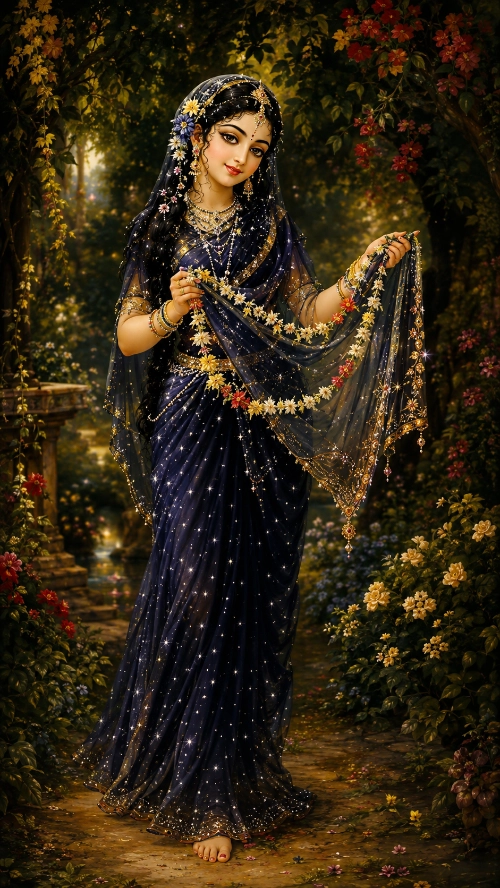
Śrī Viśākhā-devī: Her Character, Service, Appearance and Identity in the Gauḍīya Tradition
Śrī Viśākhā-devī is one of the eight principal companions of Śrī Rādhā and, together with Śrī Lalitā-devī, one of the two sakhīs most closely associated with her. Many descriptions of her circulate in Gauḍīya Vaiṣṇava literature: that she was born at the same moment as Rādhā, that her complexion shines like lightning, that she wears a garment resembling a sky full of stars, that she is extraordinarily intelligent and skilled in speech, that she arranges meetings between Rādhā and Kṛṣṇa, and that she has a particular identity in Śrī Caitanya Mahāprabhu’s pastimes.
Most of these ideas do have roots somewhere in the tradition. The important point is that they do not all come from the same source. Some are stated directly by Śrī Rūpa Gosvāmī; others appear in later meditation manuals; still others develop through the wider līlā literature and through generations of devotional interpretation. It is therefore useful to distinguish three layers.
Keeping these layers distinct does not weaken the traditional picture of Viśākhā. It makes it clearer and, in many ways, more beautiful.
Second Among Śrī Rādhā’s Eight Principal Sakhīs
Śrī Rūpa Gosvāmī names Rādhā’s eight supremely beloved companions — the aṣṭa-sakhīs or parama-preṣṭha-sakhīs — in the Ujjvala-nīlamaṇi.
परमप्रेष्ठसख्यस्तु ललिता सविशाखिका ।
सचित्रा चम्पकलता तुङ्गविद्येन्दुलेखिका ।
रङ्गदेवी सुदेवी चेत्यष्टौ सर्वगणाग्रिमाः ॥
parama-preṣṭha-sakhyas tu lalitā sa-viśākhikā
sa-citrā campakalatā tuṅgavidyendulekhikā
raṅgadevī sudevī cety aṣṭau sarva-gaṇāgrimāḥ
“The dearmost friends are Lalitā together with Viśākhā, Citrā, Campakalatā, Tuṅgavidyā, Indulekhā, Raṅgadevī and Sudevī. These eight are foremost among all the groups.”
Ujjvala-nīlamaṇi 4.54
Viśākhā is regularly named immediately beside Lalitā, and the pairing became deeply embedded in Gauḍīya devotional language. A familiar maṅgalācaraṇa concludes:
श्रीराधाकृष्णपादान्सहगणललिताश्रीविशाखान्वितांश्च ॥
śrī-rādhā-kṛṣṇa-pādān saha-gaṇa-lalitā-śrī-viśākhānvitāṁś ca
“…the feet of Śrī Rādhā and Kṛṣṇa, together with their associates, accompanied by Lalitā and Śrī Viśākhā.”
A small textual caution. This verse is sometimes called an opening verse of the Caitanya-caritāmṛta, but it is not found there. It belongs to the Gauḍīya maṅgalācaraṇa tradition, familiar especially through the Gauḍīya Maṭha and related lineages, and its precise authorship is uncertain.
What Does a Sakhī Actually Do?
The Sanskrit word sakhī simply means “female friend” or “companion.” In the theology of Gauḍīya rasa it means a great deal more. The intimate sakhīs devote themselves to nourishing the love between Rādhā and Kṛṣṇa. They may:
- arrange secret meetings;
- carry messages;
- prepare forest bowers;
- choose garments and ornaments;
- conceal evidence of a meeting;
- distract suspicious elders;
- interpret gestures and unspoken feelings;
- tease Kṛṣṇa;
- protect Rādhā’s dignity;
- strengthen her loving anger, or māna;
- and reconcile the Divine Couple when reconciliation will deepen their love.
Their joy lies primarily in the happiness of Rādhā and Kṛṣṇa, and Viśākhā’s individual qualities should therefore be understood within this world of rasa-sevā — service to divine love.
Rūpa Gosvāmī’s Foundational Description
The Rādhā-kṛṣṇa-gaṇoddeśa-dīpikā gives one of the foundational Gauḍīya portraits of Viśākhā.
विशाखात्र द्वितीया स्याद् एकाचारगुणव्रता ।
प्रियसख्या जनिर् यत्र तत्रैषाभ्युदिता क्षणे ॥
viśākhātra dvitīyā syād ekācāra-guṇa-vratā
priya-sakhyā janir yatra tatraiṣābhyuditā kṣaṇe
“Viśākhā is second among them, one with her dear friend in conduct, qualities and resolve. At the very moment when the dear friend was born, she too appeared.”
Rādhā-kṛṣṇa-gaṇoddeśa-dīpikā, Bṛhad-bhāga 83
The expression carrying the deepest meaning is ekācāra-guṇa-vratā. It means that Viśākhā corresponds closely with Rādhā in three respects.
This is much more significant than simply saying that Viśākhā is the same age as Rādhā. Their simultaneous birth becomes the visible sign of an inward correspondence. Later Gauḍīya literature develops this compact statement into the picture of a sakhī who understands Rādhā with extraordinary immediacy — one who can recognise the affection hidden inside a reproach, the desire hidden inside hesitation, and the longing concealed behind refusal.
That fuller psychological portrait is an interpretation developed through the tradition rather than a literal translation of Rūpa’s verse — but it grows naturally from his striking phrase ekācāra-guṇa-vratā.
Born at the Same Moment as Rādhā
The tradition therefore regards Viśākhā as essentially the same age as Śrī Rādhā, and this is not merely a biographical curiosity. In sacred poetry, simultaneous birth expresses correspondence: Viśākhā enters Rādhā’s world at the same moment because her service is uniquely fitted to Rādhā’s own nature. She is not an attendant who receives instructions from outside Rādhā’s emotional world. She stands extraordinarily close to it — and all of that intimacy is directed toward service.
Her Appearance: The Radiance of Lightning
तारावलिदुकूलेयं विद्युन्निभतनुद्युतिः ।
पितुः पावनतो जाता मुखरायाः स्वसुः सुतात् ॥
tārāvali-dukūleyaṁ vidyun-nibha-tanu-dyutiḥ
pituḥ pāvanato jātā mukharāyāḥ svasuḥ sutāt
“Her fine garment is a cluster of stars; the radiance of her body is like lightning. She was born from her father Pāvana, the son of Mukharā’s sister.”
Rādhā-kṛṣṇa-gaṇoddeśa-dīpikā, Bṛhad-bhāga 84
The key description is vidyun-nibha-tanu-dyutiḥ, “the radiance of her body resembles lightning,” and the wording is important. Modern descriptions sometimes say Viśākhā has a “cream complexion with a reddish tinge.” Such descriptions may belong to later artistic or regional traditions, but that is not what Rūpa says here. His emphasis is on radiance. Lightning can appear pale gold, golden-white, brilliant yellow-white or almost dazzlingly luminous; the comparison is not primarily a precise colour specification but a description of brilliance.
Later meditation literature gives another image pointing in the same direction. A verse quoted in Dhyānacandra Gosvāmī’s Gaura-govindārcana-smaraṇa-paddhati describes her this way:
सच्चम्पकावलिविडम्बितनुं सुशीलां
ताराम्बरां विविधभूषणशोभमानाम् ।
श्रीनन्दनन्दनपुरो वसनादिभूषा-
दाने रतां सुकुतुकां च भजे विशाखाम् ॥
sac-campakāvali-viḍambi-tanuṁ suśīlāṁ
tārāmbarāṁ vividha-bhūṣaṇa-śobhamānām
śrī-nanda-nandana-puro vasanādi-bhūṣā-
dāne ratāṁ sukutukāṁ ca bhaje viśākhām
“I worship Viśākhā, of excellent character, whose body rivals a cluster of campaka blossoms, star-robed and resplendent with many ornaments, eagerly absorbed in offering garments and ornaments before the son of Nanda.”
Bṛhad-gautamīya-tantra, quoted in Gaura-govindārcana-smaraṇa-paddhati 221
Here the image is of campaka blossoms, traditionally golden or yellowish in hue; elsewhere she is called gaurāṅgī, golden-limbed. The textual imagery therefore forms a remarkably consistent family: lightning, campaka blossoms, golden radiance.
Her Garment: A Robe of Stars
Rūpa calls Viśākhā’s clothing tārāvali-dukūla, a fine garment associated with a cluster or row of stars; later meditation literature similarly calls her tārāmbarā, “star-robed.” It is therefore common to picture her wearing a dark garment resembling the evening sky filled with stars. That visualisation is beautiful and entirely natural.
But the distinction between text and visualisation should be remembered: the Sanskrit explicitly gives the stars; it does not explicitly say that the cloth itself is dark blue or black. The night-sky colour is a traditional inference.
The Cloud-Coloured Ānanda Bower
A dark cloud colour does appear in Viśākhā’s meditation tradition — but it describes her bower, not her body.
ईशानदले आनन्दनामकं कुञ्जमस्ति हि ।
मेघवर्णं श्रीविशाखा यत्रास्ते कृष्णवल्लभा ॥
īśāna-dale ānanda-nāmakaṁ kuñjam asti hi
megha-varṇaṁ śrī-viśākhā yatrāste kṛṣṇa-vallabhā
“On the north-eastern petal there is a bower named Ānanda, cloud-coloured, where Śrī Viśākhā, beloved of Kṛṣṇa, resides.”
Gaura-govindārcana-smaraṇa-paddhati 210
The grammar is clear: megha-varṇam, “cloud-coloured,” agrees with kuñjam, “bower.” It means the bower is cloud-coloured. It does not mean that Viśākhā herself has a dark-cloud complexion. Later devotional maps sometimes call this grove Viśākhānanda-kuñja, although Dhyānacandra’s wording itself simply says “the bower named Ānanda.” Taken together, the traditional images produce a striking scene: lightning-like Viśākhā, clothed in stars, within a cloud-coloured bower.
Her Family
जटिलायाः स्वसुः पुत्र्यां दक्षिणायान्तु मातरि ।
भवेद् विवाहकर्तास्या वाहिको नाम बल्लवः ॥
jaṭilāyāḥ svasuḥ putryāṁ dakṣiṇāyāṁ tu mātari
bhaved vivāha-kartāsyā vāhiko nāma ballavaḥ
“Her mother being Dakṣiṇā, the daughter of Jaṭilā’s sister, the cowherd named Vāhika is the one who takes her in marriage.”
Rādhā-kṛṣṇa-gaṇoddeśa-dīpikā, Bṛhad-bhāga 85
Is Viśākhā Jaṭilā’s Niece?
Not exactly. Rūpa says that Viśākhā’s mother Dakṣiṇā is the daughter of Jaṭilā’s sister, which makes Viśākhā one generation further removed than the common shorthand “Jaṭilā’s niece” suggests. In ordinary English genealogical terminology she would be Jaṭilā’s grandniece. This matters because many modern biographies quietly simplify complicated Sanskrit family relationships.
A Small Philological Note on Vāhika
Rūpa does not actually use the ordinary Sanskrit word patiḥ, “husband,” in this verse. He uses vivāha-kartā, literally “the one who effects or performs the marriage.” Within the structure of the passage the traditional interpretation as bridegroom or husband is very natural; other passages treat the relationship in that way, and Dhyānacandra later explicitly uses patiḥ. Still, for textual accuracy it is worth distinguishing Rūpa’s literal expression, vivāha-kartā, from the traditional interpretation, husband or bridegroom.
What Does Adhika-madhyā Mean?
One of the most commonly repeated descriptions of Viśākhā is that she is adhika-madhyā. Unfortunately this technical expression is often translated too loosely as “moderate,” “balanced” or even “marginal.” Rūpa Gosvāmī’s system is more precise: he classifies sakhīs along two separate dimensions. First is their relative standing.
प्रेमसौभाग्यसाद्गुण्याद्याधिक्यादधिका सखी ।
समा तत्साम्यतो ज्ञेया तल्लघुत्वात्तथा लघुः ॥
prema-saubhāgya-sādguṇyādy-ādhikyād adhikā sakhī
samā tat-sāmyato jñeyā tal-laghutvāt tathā laghuḥ
“By superiority in love, good fortune, fine qualities and the like, a sakhī is adhikā; by equality she is samā, and by inferiority she is laghu.”
Then comes the manner of personality.
दुर्लङ्घ्यवाक्यप्रखरा प्रख्याता गौरवोचिता ।
तदूनत्वे भवेन्मृद्वी मध्या तत्साम्यमागता ॥
durlaṅghya-vākya-prakharā prakhyātā gauravocitā
tad-ūnatve bhaven mṛdvī madhyā tat-sāmyam āgatā
“She whose words are difficult to disregard and who commands deference is called prakharā. When that quality is weak she is mṛdvī, and one who stands between them is madhyā.”
Ujjvala-nīlamaṇi 8.3–4
अत्र यूथे विशाखाद्या भवन्त्यधिकमध्यमाः ॥
atra yūthe viśākhādyā bhavanty adhika-madhyamāḥ
“In this group, Viśākhā and the others are adhika-madhyā.”
Ujjvala-nīlamaṇi 8.19
In Viśākhā’s case a useful explanatory translation is therefore “pre-eminent among the sakhīs, while intermediate in firmness.” This does not mean that Viśākhā is superior to Rādhā. The category is relational, and Rūpa explicitly explains that one sakhī may be called adhikā relative to another while all remain subordinate to the group-mistress.
Why Viśākhā Is Not Simply “A Gentler Lalitā”
Lalitā and Viśākhā are extraordinarily close to Rādhā, but their personalities are not identical. Rūpa describes Lalitā and others of her type this way:
यूथेऽत्र वामप्रखरा ललिताद्याः प्रकीर्तिताः ॥
yūthe ’tra vāma-prakharā lalitādyāḥ prakīrtitāḥ
“In this group Lalitā and the others are declared vāma-prakharā.”
Ujjvala-nīlamaṇi 8.37
Lalitā is famous for being strongly vāma — contrary in love — and prakharā — forceful, bold and difficult to contradict. She readily challenges Kṛṣṇa, she strengthens Rādhā’s loving pride, and she is not easily persuaded by his charm, excuses or clever speech. Viśākhā can certainly rebuke Kṛṣṇa as well, but the traditional portrait gives her another kind of mastery. She can confront, negotiate, joke, conceal, redirect, reconcile, improvise, and speak indirectly when indirect speech will accomplish more. In modern explanatory language we might call her diplomatically firm. It is therefore misleading to imagine her merely as a softer Lalitā. She represents a different form of intelligence.
Viśākhā as Messenger and Counsellor
The wider līlā tradition especially celebrates Viśākhā as a messenger, confidante and extraordinarily subtle speaker, and that portrait makes sense placed beside Rūpa’s descriptions. If she corresponds deeply with Rādhā in conduct, qualities and resolve, and if her manner is neither relentlessly forceful nor easily yielding, she is ideally suited to situations requiring delicate judgement.
A messenger in Vraja does not simply repeat sentences. She must understand:
- what Rādhā says;
- what Rādhā really means;
- what Rādhā refuses to say;
- whether her anger should be maintained or softened;
- whether Kṛṣṇa is sincere;
- whether a meeting should happen immediately;
- whether longing should first be intensified;
- how to distract Jaṭilā;
- how to protect Rādhā’s reputation;
- and how to conceal the evidence afterward.
In the world of rasa, speech itself becomes action. A single sentence may simultaneously conceal something from an elder, rebuke Kṛṣṇa, reassure Rādhā, and secretly communicate another message altogether. This helps explain Viśākhā’s traditional fame for wit, double meaning, diplomacy and perfect timing.
These details form a composite portrait from the broader līlā tradition. They should not all be presented as though they appear word-for-word in Rūpa Gosvāmī’s three verses.
Her Special Service: Garments and Ornaments
स्वाधीनभर्तृकाभावमापन्ना हि हरौ सदा ।
वस्त्रालङ्कारसेवाढ्या गौराङ्गी तारकाम्बरा ॥
svādhīna-bhartṛkā-bhāvam āpannā hi harau sadā
vastrālaṅkāra-sevāḍhyā gaurāṅgī tārakāmbarā
“Toward Hari she has attained the mood of the svādhīna-bhartṛkā; she is accomplished in the service of garments and ornaments, golden-limbed and star-robed.”
Gaura-govindārcana-smaraṇa-paddhati 211
The important expression is vastrālaṅkāra-sevāḍhyā, “richly accomplished in the service of garments and ornaments.” This should not be imagined merely as handing Rādhā or Kṛṣṇa a piece of clothing. Within the wider meditation tradition such service may include:
- choosing clothing appropriate to the hour;
- matching colours to mood;
- selecting jewels and flowers;
- arranging garlands;
- preparing the appearance of the Divine Couple before a meeting;
- decorating a bower;
- removing signs that might reveal where they have been;
- and coordinating assistants who gather flowers, ornaments and forest materials.
In Gauḍīya aesthetics, clothing is a language. Colour, fragrance, jewellery, flowers, season, time and place all participate in rasa. Viśākhā’s genius is therefore not merely ornamentation; she makes outward form correspond to inner feeling.
The Arts Are Forms of Service
Descriptions of Viśākhā often list many accomplishments — poetry, conversation, music, gesture, decoration, flowers, clothing, diplomacy and secret messages. From the perspective of rasa they are not really separate talents. A flower can carry a message. A colour can reveal a mood. A garment can conceal evidence. A joke can dissolve anger. A poem can express something ordinary speech cannot. A deliberate delay can intensify longing. A carefully prepared bower can change the entire emotional atmosphere of a meeting. Viśākhā’s deeper gift is therefore fluency in the language of rasa-sevā, and her arts become different instruments serving one purpose.
A Note on Svādhīna-bhartṛkā
The same meditation verse associates Viśākhā with the state called svādhīna-bhartṛkā. Rūpa Gosvāmī defines this type of heroine as one whose beloved remains close and subject to her affection. A distinction is necessary, however. Dhyānacandra is placing different nāyikā conditions into an eight-petalled meditation scheme associated with the principal sakhīs; this is a contemplative arrangement, and it should not be confused with Rūpa’s classification of Viśākhā as adhika-madhyā. They belong to different systems. Both are meaningful within the tradition, but they should not be silently merged into a single technical category.
How Later Meditation Literature Uses Rūpa
Dhyānacandra Gosvāmī’s Gaura-govindārcana-smaraṇa-paddhati is extremely important for understanding how earlier Gauḍīya teachings entered practical meditation. Dhyānacandra belonged to the lineage of Gopāla Guru Gosvāmī of Purī and appears to have written in the generations following Mahāprabhu. His work does not produce a completely independent biography of Viśākhā; it gathers material from earlier sources, and in fact he frequently tells us what he is quoting. Within his Viśākhā section he cites or reproduces material from the Ujjvala-nīlamaṇi, the Rādhā-kṛṣṇa-gaṇoddeśa-dīpikā and the Bṛhad-gautamīya-tantra.
This matters when evaluating evidence. If Dhyānacandra quotes Rūpa’s adhika-madhyā classification, Rūpa and Dhyānacandra are not two independent witnesses to the same fact — Dhyānacandra is transmitting Rūpa. But that transmission is valuable in another way: it shows how Rūpa’s theological classifications were organised for meditation and devotional practice in later generations.
Viśākhā in Gaura-līlā
Here we reach one of the most fascinating questions in Viśākhā’s traditional identity. Modern summaries often say simply that Viśākhā appeared as Rāmānanda Rāya; others say she appeared as Svarūpa Dāmodara. The reason for the disagreement is simple — respected Gauḍīya texts preserve more than one identification. Rather than forcing them into a single answer, it is better to see what each source actually says.
Dhyānacandra: Viśākhā as Rāmānanda Rāya
पतिर्यस्या बाहुकाख्योऽप्यसौ गौररसे पुनः ।
रायरामानन्दतया विख्याताभूत्कलौ युगे ॥
patir yasyā bāhukākhyo ’py asau gaura-rase punaḥ
rāya-rāmānandatayā vikhyātābhūt kalau yuge
“She whose husband is named Bāhuka — she, in the gaura-rasa, became renowned in the age of Kali as Rāya Rāmānanda.”
Gaura-govindārcana-smaraṇa-paddhati 213
The Sanskrit grammar is significant. The subject remains Viśākhā, and the feminine vikhyātā — “she became renowned” — shows that the verse identifies Viśākhā herself with Rāmānanda Rāya.
Kavi Karṇapūra: Viśākhā as Svarūpa Dāmodara
An earlier source, Kavi Karṇapūra’s Gaura-gaṇoddeśa-dīpikā, preserves a different identification. A widely circulated Sanskrit reading of verse 160 is:
कलामशिक्षयद्राधां या विशाखा व्रजे पुरा ।
साद्य स्वरूपगोस्वामी तत्तद्भावविलासवान् ॥
kalām aśikṣayad rādhāṁ yā viśākhā vraje purā
sādya svarūpa-gosvāmī tat-tad-bhāva-vilāsavān
“She who formerly in Vraja taught Rādhā the arts — that Viśākhā — is today Svarūpa Gosvāmī, who revels in those very moods.”
traditionally cited as Gaura-gaṇoddeśa-dīpikā 160
On the received Sanskrit reading the grammatical transition is striking. The relative yā and corresponding sā are feminine because they refer to Viśākhā, while the predicate identifying her with Svarūpa Gosvāmī is masculine.
A textual caution should accompany the quotation. The Sanskrit of this passage was not independently checked here against a reliable printed critical edition or manuscript witness. The verse is well circulated and is supported by the received translation tradition, but its exact textual history deserves further examination. The grammatical observation above therefore applies to the received Sanskrit reading.
What Does Karṇapūra Say About Rāmānanda Rāya?
This question helps explain a widespread confusion. In Gaura-gaṇoddeśa-dīpikā 120–124, Karṇapūra discusses Rāmānanda Rāya, and the identities associated with him there include:
- Arjuna, a cowherd companion in Vraja;
- the Pāṇḍava Arjuna;
- a gopī named Arjunīyā;
- and a tradition connecting him with Lalitā.
Viśākhā is not part of that particular identification. The equation Viśākhā → Rāmānanda Rāya should therefore not be attributed directly to Karṇapūra on the basis of those verses. Its clear textual witness is Dhyānacandra.
Why Modern Accounts Became Confused
A modern purport to Caitanya-caritāmṛta, Ādi 10.134, says in substance that Karṇapūra identifies Rāmānanda with Arjuna and that other opinions identify him with Lalitā or Viśākhā. Read quickly, the whole sentence can sound as though all of these identifications come from Karṇapūra. They do not. The citation to Gaura-gaṇoddeśa-dīpikā 120–124 supports the Arjuna material; the Viśākhā identification is preserved elsewhere, clearly in Dhyānacandra’s paddhati. This is a good example of how traditional statements can become simplified as they pass through later summaries.
Was Svarūpa Dāmodara Lalitā?
Another common statement is that Svarūpa Dāmodara is Lalitā-devī. That identification should not simply be attributed to Kavi Karṇapūra. In the received Gaura-gaṇoddeśa-dīpikā tradition, Lalitā is associated principally with Gadādhara Paṇḍita, with another manifestation also mentioned, whereas the gopī identity explicitly connected with Svarūpa Gosvāmī in verse 160 is Viśākhā. Different Gauḍīya lineages may preserve additional schemes. The important point is not to force every lineage into one chart, but to identify correctly which source says what.
Two Genuine Traditions
These are genuinely different identifications, and there is no need to pretend they are mathematically the same claim. Traditional sacred identity is not always presented by Gauḍīya authors as a single one-to-one system; different texts may emphasise different eternal relationships, devotional functions or meditative perspectives. The safest historical conclusion is simply that two respected Gauḍīya sources preserve different Gaura-līlā identities for Viśākhā.
Why the Rāmānanda Identification Is Theologically Natural
Although Dhyānacandra’s identification must be distinguished from Karṇapūra’s, it is easy to understand why Viśākhā and Rāmānanda Rāya became associated. Rāmānanda occupies an extraordinary position in the Caitanya-caritāmṛta. During the famous Rāmānanda-saṁvāda, Mahāprabhu repeatedly asks him to go deeper into the goal of spiritual life, and the discussion moves through:
- social and religious duty;
- offering one’s actions to Kṛṣṇa;
- pure devotion;
- gradations of divine love;
- the special love of the gopīs;
- the unique position of Śrī Rādhā;
- and finally the deepest mysteries of Rādhā and Kṛṣṇa.
It is one of the Caitanya-caritāmṛta’s most sustained expositions of rasa-tattva, and during this conversation Mahāprabhu gives the famous principle:
কিবা বিপ্র, কিবা ন্যাসী, শূদ্র কেনে নয় ।
যেই কৃষ্ণতত্ত্ববেত্তা, সেই ‘গুরু’ হয় ॥
kibā vipra, kibā nyāsī, śūdra kene naya
yei kṛṣṇa-tattva-vettā, sei ‘guru’ haya
“Whether a brāhmaṇa, whether a renunciant, or why not even a śūdra — whoever knows the truth of Kṛṣṇa is guru.”
Caitanya-caritāmṛta, Madhya 8.128
Rāmānanda is a poet, dramatist, counsellor and speaker of extraordinarily confidential rasa. That profile naturally resembles the later devotional portrait of Viśākhā: intelligent, artistic, subtle in speech and deeply competent in the mysteries of Rādhā-Kṛṣṇa prema. The resemblance helps explain the identification — but theological fitness and textual attribution are different questions, and they should remain distinct.
Svarūpa Dāmodara and Rāmānanda Together
Interestingly, the two personalities identified with Viśākhā in different traditions were themselves extraordinarily close to Mahāprabhu during his final years in Purī.
চণ্ডীদাস, বিদ্যাপতি, রায়ের নাটক-গীতি,
কর্ণামৃত, শ্রীগীতগোবিন্দ ।
স্বরূপ-রামানন্দ-সনে, মহাপ্রভু রাত্রি-দিনে,
গায়, শুনে — পরম আনন্দ ॥
caṇḍīdāsa, vidyāpati, rāyera nāṭaka-gīti,
karṇāmṛta, śrī-gīta-govinda
svarūpa-rāmānanda-sane, mahāprabhu rātri-dine,
gāya, śune — parama ānanda
“Caṇḍīdāsa, Vidyāpati, the dramatic songs of Rāya, the Karṇāmṛta and Śrī Gīta-govinda — in the company of Svarūpa and Rāmānanda, night and day Mahāprabhu sang and listened in supreme joy.”
Caitanya-caritāmṛta, Madhya 2.77
Svarūpa and Rāmānanda understood Mahāprabhu’s rapidly changing inner states and supplied the precise song, verse or dramatic passage suited to his mood. In another key, this resembles the work of Rādhā’s intimate sakhīs, who must know what rasa is present, what should come next, what words will nourish it and what intervention would disturb it. This functional similarity helps explain why different traditions could see the world of Rādhā’s intimate companions reflected in Mahāprabhu’s closest associates.
The Three Layers of Viśākhā’s Portrait
These three layers do not have to compete. The problem begins only when everything in the later portrait is presented as though it were directly stated in Rūpa Gosvāmī’s few foundational verses.
The most important expression in Rūpa Gosvāmī’s description may still be the very first: ekācāra-guṇa-vratā, she corresponds with Śrī Rādhā in conduct, qualities and resolve. From that one idea much of the later portrait becomes intelligible. Because Viśākhā understands Rādhā so intimately, she can carry messages without reducing them to literal words. Because she understands rasa, she knows when to reconcile and when not to. Because she understands mood, she knows what garment, flower, ornament, poem or setting belongs to a particular moment. Because she understands both Rādhā and Kṛṣṇa, she can hear what lies beneath what they say. Her madhyā disposition should therefore not be mistaken for indecision; it gives her range. Where Lalitā may challenge Kṛṣṇa openly, Viśākhā may accomplish the same purpose through a smile, a beautifully ambiguous sentence, a perfectly placed joke, or an arrangement so subtle that Kṛṣṇa discovers only afterward that he has already been outmanoeuvred. Her poetry, diplomacy, wit, garments, flowers, messages and timing are not ultimately separate accomplishments. They are one capacity expressed through different means: to understand the movement of Śrī Rādhā’s love and help it reach its fullest expression. Viśākhā is therefore not simply another companion standing beside Śrī Rādhā. She stands so close to Rādhā’s inner world that she can follow its movements almost as they arise — and she gives that intimacy entirely to the service of Śrī Śrī Rādhā-Kṛṣṇa’s prema.
Principal Sources
A Note on Textual Certainty
Sanskrit and Bengali devotional literature survives through manuscript traditions, printed editions, regional recensions, transliterations and electronic texts. It is therefore important to distinguish two very different claims: “this reading was not found in the witnesses consulted,” and “this reading has never existed in any manuscript or edition.” The first can often be responsibly stated; the second would normally require a much broader manuscript survey.
The same caution applies to verse numbering. Different editions of texts such as the Rādhā-kṛṣṇa-gaṇoddeśa-dīpikā may number passages differently. Where uncertainty remains, it is better to preserve that uncertainty openly than to create a false impression of textual certainty.