

Śrī Rādhā’s Intimate Companions
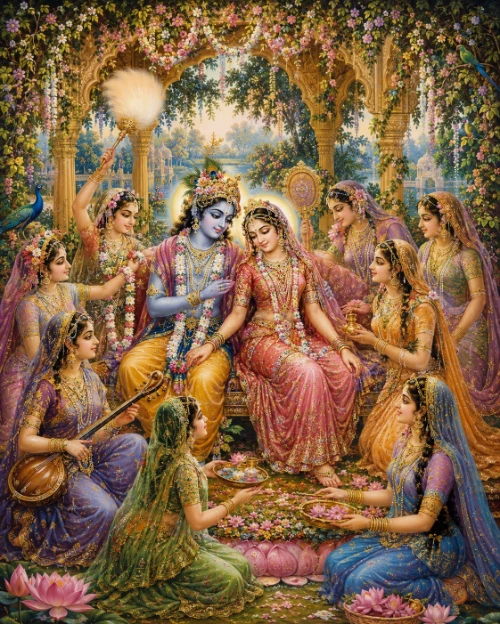
Śrī Rādhā’s Intimate Companions: The Vara-gopīs, Aṣṭa-sakhīs, Mañjarīs, and the Inner Social World of Vraja
The devotional literature of Gauḍīya Vaiṣṇavism presents Śrī Rādhā not as an isolated heroine but as the centre of an extraordinarily intricate community of companions. These gopīs assist Her relationship with Kṛṣṇa, understand Her moods, protect Her interests, arrange meetings, carry messages, decorate the Divine Couple, prepare food and flowers, resolve — or sometimes deliberately intensify — lovers’ quarrels, and transform every circumstance of Vraja into an opportunity for loving service.
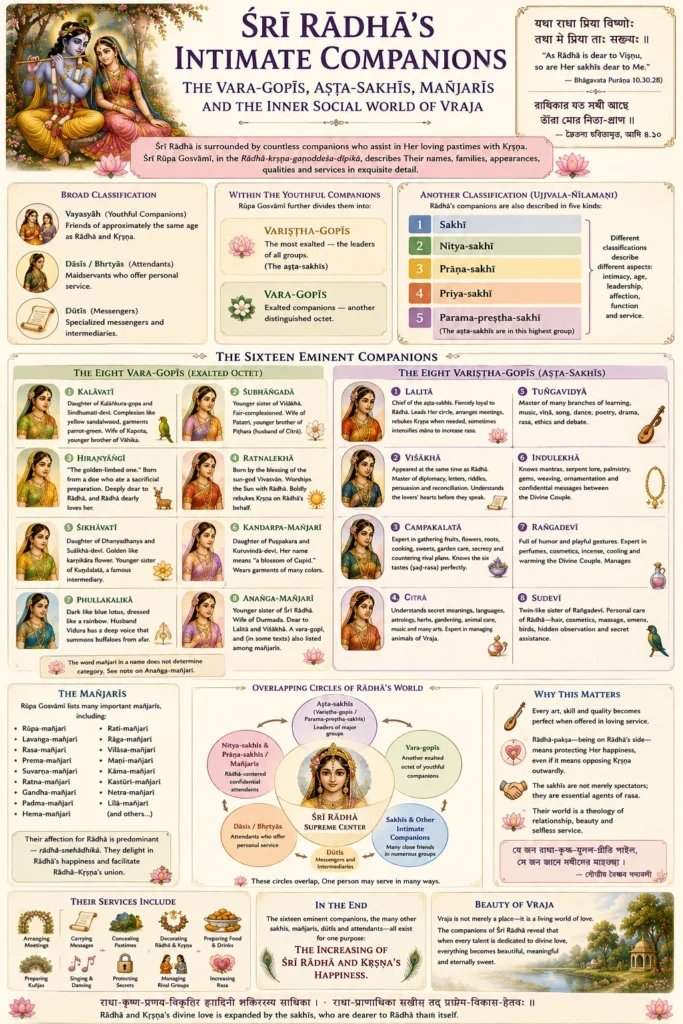
The broad classifications, the eight vara-gopīs and eight variṣṭha-gopīs with their families and specialities, the mañjarī circle, and the overlapping circles of Rādhā’s world.
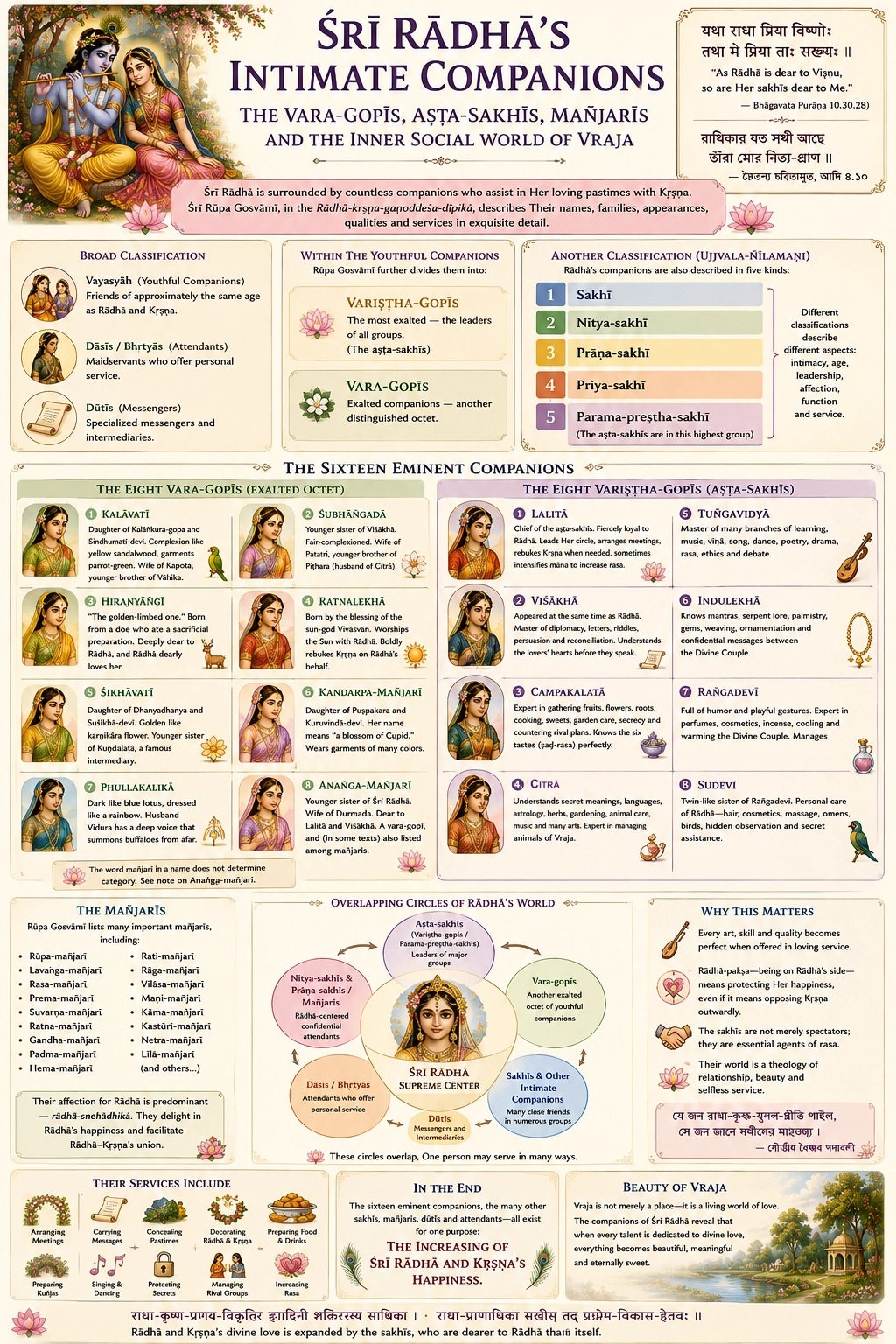
Among the most detailed early Gauḍīya descriptions of this world is Śrī Rūpa Gosvāmī’s Rādhā-kṛṣṇa-gaṇoddeśa-dīpikā, composed as a systematic catalogue of the names, appearances, families, relationships, temperaments and services of Rādhā, Kṛṣṇa and Their associates. Two particularly distinguished groups appear in this work:
These sixteen should not, however, be understood as two simple ranks in a rigid hierarchy. Rūpa Gosvāmī employs several overlapping systems of classification, each describing a different aspect of the gopīs’ relationships: age, intimacy, leadership, emotional allegiance and specialised service. To understand the personalities themselves, one must first understand this social and devotional structure.
Rādhā at the Centre of a Vast Community
The Rādhā-kṛṣṇa-gaṇoddeśa-dīpikā presents Vraja as an enormous network of companions rather than a small group of eight famous gopīs. Rūpa distinguishes broadly between youthful companions, attendants and specialised messengers. Within the circle of youthful companions he further distinguishes those who are vara, “excellent” or “exalted,” from those who are variṣṭha, “the very best” or “most eminent.” The aṣṭa-sakhīs belong to this latter, supreme group.
Yet even these classifications do not exhaust the system. Elsewhere Rūpa describes numerous yūthas, or groups of gopīs, and records different traditions about their organisation. In addition to the eight variṣṭha and eight vara companions, the Gaṇoddeśa-dīpikā names sixty-four further especially important gopīs. The famous sixteen therefore represent only the innermost visible layer of a much larger devotional society.
Another Classification: The Five Kinds of Sakhī
Rūpa Gosvāmī’s Ujjvala-nīlamaṇi analyses Rādhā’s companions from another perspective. Its Sanskrit gives a fivefold classification:
tās tu vṛndāvaneśvaryāḥ sakhyaḥ pañca-vidhā matāḥ |
sakhyaś ca nitya-sakhyaś ca prāṇa-sakhyaś ca kāścana |
priya-sakhyaś ca parama-preṣṭha-sakhyaś ca viśrutāḥ ||
“The companions of Vṛndāvaneśvarī are understood to be of five kinds: sakhīs, nitya-sakhīs, prāṇa-sakhīs, priya-sakhīs and the celebrated parama-preṣṭha-sakhīs.”
The text then identifies the highest group:
parama-preṣṭha-sakhyas tu lalitā sa-viśākhikā |
sa-citrā campakalatā tuṅgavidyendulekhikā |
raṅgadevī sudevī cety aṣṭau sarva-gaṇāgrimāḥ ||
“The parama-preṣṭha-sakhīs are Lalitā, Viśākhā, Citrā, Campakalatā, Tuṅgavidyā, Indulekhā, Raṅgadevī and Sudevī. These eight stand at the head of all the groups.” — Ujjvala-nīlamaṇi, Rādhā-prakaraṇa 50–54
The expression aṣṭau sarva-gaṇāgrimāḥ — “the eight who stand foremost among all the groups” — is particularly important. It helps explain why the aṣṭa-sakhīs are not merely Rādhā’s eight best friends in a modern social sense. They are leaders within the entire organisation of Her intimate Vraja circle.
A later Bengali devotional formulation summarises them beautifully:
śrī rādhikāra sakhī jata tāhā vā kahiba kata
mukhya sakhī kariye gaṇana |
lalitā viśākhā tathā sucitrā campakalatā
raṅgadevī sudevī kathana ||
tuṅgavidyā indulekhā ei aṣṭa-sakhī lekhā
“Who could enumerate all the companions of Śrī Rādhikā? I shall therefore count only the principal sakhīs: Lalitā, Viśākhā, Sucitrā, Campakalatā, Raṅgadevī, Sudevī, Tuṅgavidyā and Indulekhā — these are the eight sakhīs.”
Here Sucitrā is a variant name of Citrā.
Not a Simple Ladder
It is tempting to create a hierarchy such as Rādhā → aṣṭa-sakhīs → vara-sakhīs → mañjarīs → messengers and servants. That may be useful for a very simple diagram, but it is theologically misleading if taken literally, because the categories measure different things.
One individual may also perform functions associated with several categories. The better image is therefore a set of concentric and overlapping circles around Śrī Rādhā, not a military chain of rank.
Yūthas: The Sakhīs as Leaders of Communities
Another essential concept is yūtha — a group, troop or circle — whose female leader is a yūtheśvarī. Rādhā Herself is the supreme centre of Her own vast devotional party, while major sakhīs preside over subsidiary circles. Thus Lalitā does not merely perform Lalitā’s individual services: there is a Lalitā-yūtha. Viśākhā has her own group, as do the other principal companions.
The aṣṭa-sakhīs therefore function almost like eight highly specialised senior leaders, each coordinating many subordinate companions and forms of service. The analogy must not be pressed too literally — their relationships are those of intimate love rather than bureaucracy — but it helps explain the social complexity Rūpa Gosvāmī is describing.
The Eight Vara-gopīs
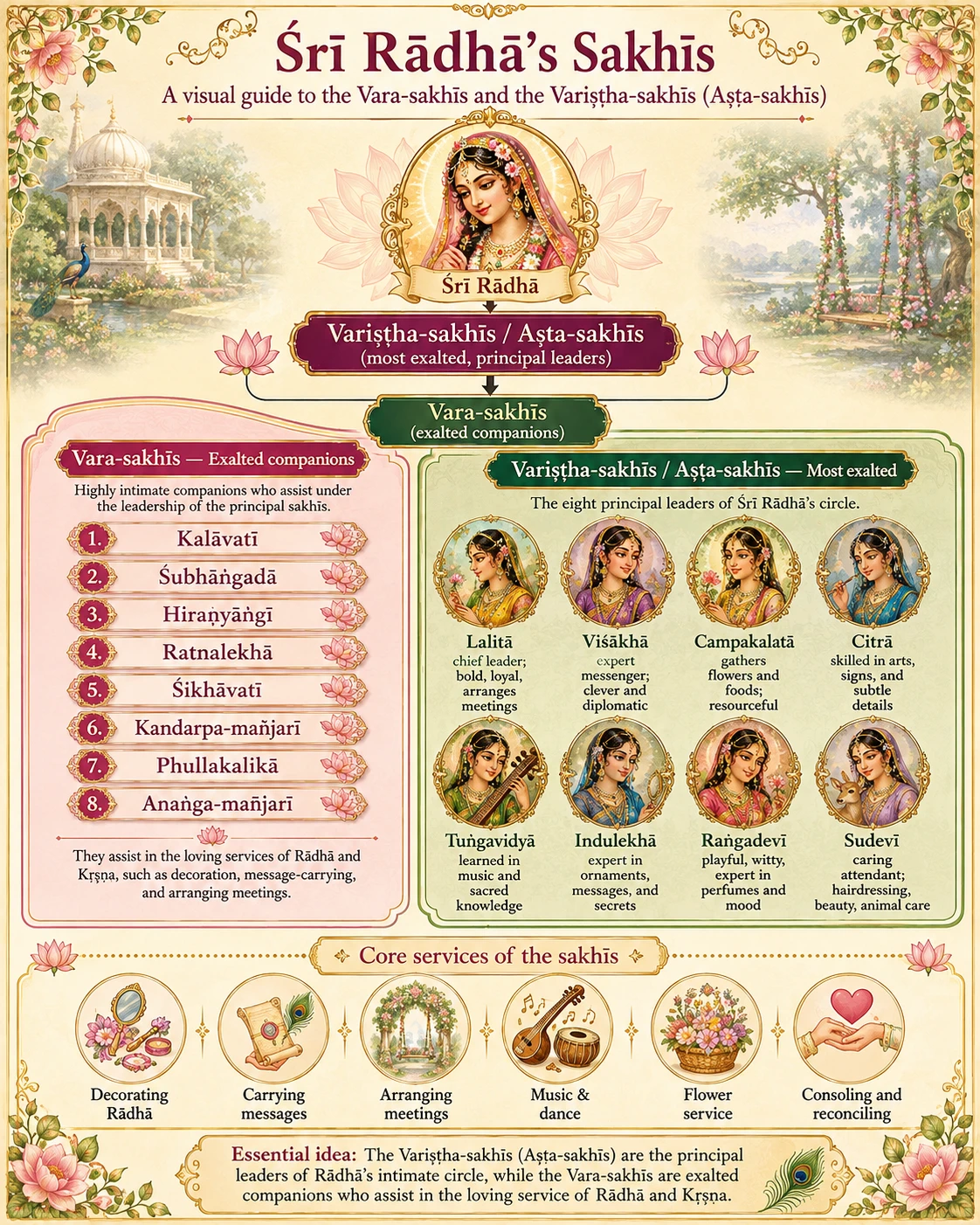
Immediately after the eight variṣṭha companions, Rūpa Gosvāmī describes another distinguished octet — the vara-gopīs: Kalāvatī, Śubhāṅgadā, Hiraṇyāṅgī, Ratnalekhā, Śikhāvatī, Kandarpa-mañjarī, Phullakalikā and Anaṅga-mañjarī. They should not be understood simply as “junior versions” of the aṣṭa-sakhīs. The text deliberately parallels the two octets, recognising the vara-gopīs as an exceptionally eminent group in their own right, and preserves for each of them exactly the sort of family, appearance and service detail characteristic of Rūpa’s Vraja social world.
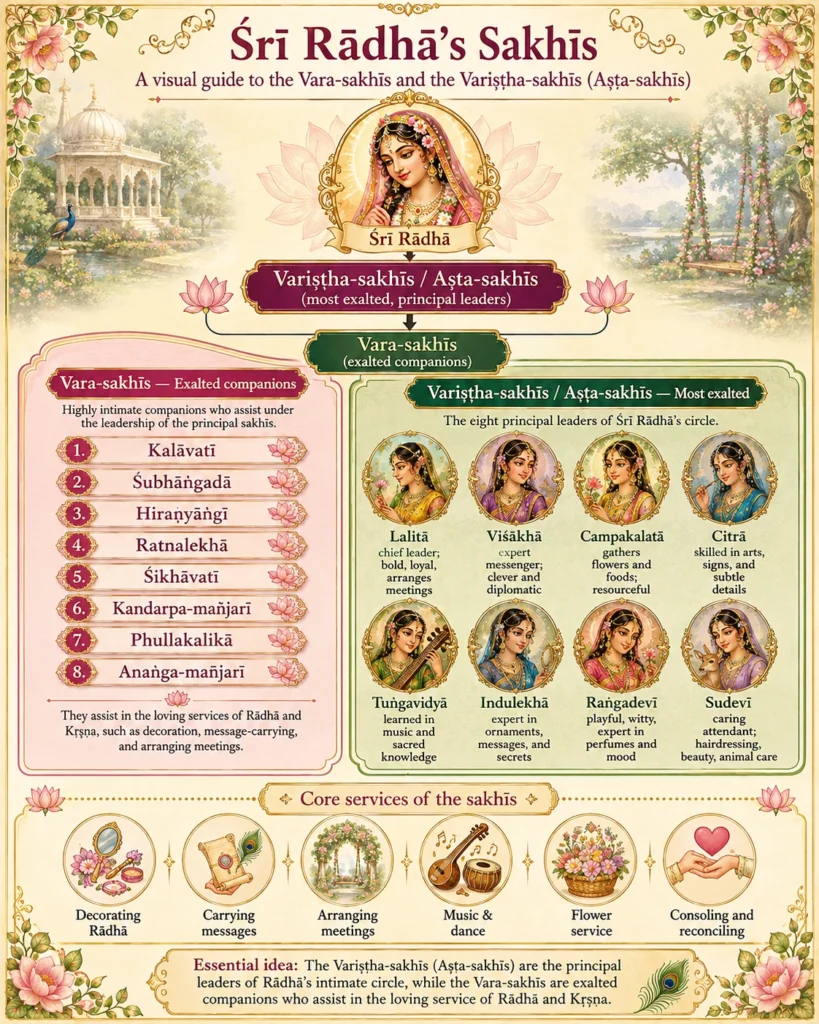
The two octets side by side: the eight vara-sakhīs by name, and the eight variṣṭha-sakhīs with each one’s characteristic service.
1. Kalāvatī
Kalāvatī is the daughter of Kalāṅkura-gopa and Sindhumatī-devī. Her complexion resembles yellow sandalwood, and her clothing is green like the brilliance of a parrot. She is married to Kapota, the younger brother of Vāhika, who is associated with Viśākhā’s marital family. Her biography already demonstrates how Rūpa connects the gopīs through intricate networks of kinship and marriage.
Thus Kalāvatī may be understood as “she who possesses arts or accomplishments.” Her very name reflects a larger principle: the sakhīs are described as masters of refined skills whose talents become forms of service.
2. Śubhāṅgadā
Śubhāṅgadā is especially important genealogically because she is identified as the younger sister of Viśākhā. She is fair-complexioned and married to Patatri, the younger brother of Pīṭhara, Citrā’s husband. Her name may be parsed as śubha, auspicious or fortunate, and aṅga, limb or bodily feature, giving approximately “she whose limbs are auspicious and beautiful.” Her relationship with Viśākhā places her close to one of the most influential leadership circles in Rādhā’s community.
3. Hiraṇyāṅgī
The name Hiraṇyāṅgī means “the golden-limbed one.” Her complexion is accordingly described as golden, and Rūpa’s account depicts her as though beauty itself had found a dwelling place in her form.
Her birth is one of the most unusual stories among the vara-gopīs. Her father desired children and arranged a sacrificial rite. A consecrated preparation produced through the sacrifice was intended for Sucandrā-devī, but a portion fell to the ground and was consumed by a doe. Sucandrā gave birth to Stoka-Kṛṣṇa, while the doe gave birth to Hiraṇyāṅgī. The account is important not simply because it is miraculous: it constructs a ritual and kinship connection between two members of Vraja’s social world. Hiraṇyāṅgī becomes deeply dear to Rādhā, and Rādhā is equally dear to her.
4. Ratnalekhā
Ratnalekhā is born to Payonidhi and Mitrā-devī through the blessing of Vivasvān, the sun-god. Her name combines ratna, jewel, and lekhā, a line, streak or design, and may therefore suggest “a line of jewels” or “a jewelled design.” Her complexion is compared with bright red manaḥśilā, while her dark clothing resembles a swarm of black bees.
Particularly significant is her association with Sūrya-pūjā, worship of the Sun; she accompanies Rādhā in ceremonial solar worship. This connects her with a larger element of later Rādhā-Kṛṣṇa līlā literature, since Rādhā’s socially legitimate worship of the Sun can also provide a reason for leaving Her household, creating circumstances in which confidential encounters with Kṛṣṇa can be arranged. Thus ritual duty and secret divine romance intersect.
Ratnalekhā is firmly on Rādhā’s side. When encountering Kṛṣṇa, she may outwardly exhibit fierce anger and rebuke Him severely — an expression of the bold Rādhā-pakṣa, or allegiance to Rādhā’s party.
5. Śikhāvatī
Śikhāvatī is the daughter of Dhanyadhanya and Suśikhā-devī. Her complexion resembles the golden karṇikāra flower, and she is described as charm and sweetness personified. She is married to Garjara-gopa, also known in the tradition as Garuḍa-gopa.
Most importantly, Śikhāvatī is the younger sister of Kuṇḍalatā. That relationship deserves emphasis, because Kuṇḍalatā is herself a highly important intermediary in Rādhā-Kṛṣṇa’s confidential pastimes, particularly associated with diplomacy, plausible social arrangements and the creation of opportunities for meetings. Śikhāvatī therefore belongs to a family connected with the intermediary and diplomatic infrastructure of Vraja-līlā.
6. Kandarpa-mañjarī
Kandarpa-mañjarī is the daughter of Puṣpakara and Kuruvindā-devī. Her father regarded no ordinary cowherd as an adequate husband for her; in his heart he considered Hari Himself the only worthy match. Her name is highly poetic: Kandarpa, Cupid, the god of love, and mañjarī, a flower cluster or tender blossom — thus “the flower cluster of Cupid,” or in a devotional reading “a blossom of divine amorous beauty.”
An important terminological lesson arises here. A woman having mañjarī as part of her personal name does not automatically determine her technical classification. Kandarpa-mañjarī is explicitly numbered among the vara-gopīs. The word mañjarī can simply form part of a poetic personal name.
7. Phullakalikā
Phullakalikā is the daughter of Śrīmalla and Kamalinī. Her complexion is dark like a blue lotus, while her garments are compared with a rainbow, and yellow tilaka markings are described as naturally appearing on her forehead. Her husband Vidura is a cowherd whose powerful voice can summon buffaloes from a great distance.
Her name creates a beautiful floral paradox: phulla, opened or blooming, and kalikā, bud. It evokes the moment of a flower just emerging from bud into blossom. Such floral names are characteristic of the aesthetic language through which Vraja’s youthful companions are imagined.
8. Anaṅga-mañjarī
Of the eight vara-gopīs, Anaṅga-mañjarī requires the most careful explanation. Her name refers to Anaṅga, “the bodiless one,” a famous epithet of Kāmadeva, and mañjarī, flower cluster or blossom — thus approximately “Cupid’s blossom.” Her complexion is compared with a springtime ketakī flower and her garments with the blue lotus. She is married to Durmada and is especially dear to Lalitā and Viśākhā.
More importantly, elsewhere in the Rādhā-kṛṣṇa-gaṇoddeśa-dīpikā she is explicitly identified as the younger sister of Śrī Rādhā, within the family of Vṛṣabhānu and Kīrtidā. This gives her an exceptional position: she is both an intimate companion and part of Rādhā’s immediate family.
But there is another complication. In some transmitted versions of the later catalogue of Rādhā’s mañjarīs, Anaṅga-mañjarī is also listed among the mañjarī companions, while other textual presentations begin that list instead with Rūpa-mañjarī.
The most careful formulation is therefore this: Anaṅga-mañjarī is explicitly one of Rūpa Gosvāmī’s eight vara-gopīs and Rādhā’s younger sister. Some textual and later Gauḍīya traditions also associate her with the mañjarī circle. Her position should not be reduced to one category merely because her name ends in -mañjarī.
The Eight Variṣṭha-gopīs: The Aṣṭa-sakhīs
Above the vara group in Rūpa Gosvāmī’s specific vara/variṣṭha classification stand the eight variṣṭha-gopīs. In the Ujjvala-nīlamaṇi system they are the parama-preṣṭha-sakhīs, the supremely dear companions: Lalitā, Viśākhā, Campakalatā, Citrā, Tuṅgavidyā, Indulekhā, Raṅgadevī and Sudevī.
The crucial point is not merely that they are “the closest eight.” Each is an independent personality with a recognisable temperament, expertise and circle of assistants. Together their competencies form something like a complete system for sustaining Rādhā-Kṛṣṇa’s intimate līlā.
1. Lalitā-devī — Leadership and Fierce Loyalty to Rādhā
Lalitā is foremost among the aṣṭa-sakhīs. She is not merely first on the list: she represents leadership, boldness and uncompromising loyalty to Rādhā. Her temperament is famously associated with vāma-bhāva, a contrary or resistant romantic disposition. If Kṛṣṇa behaves in a way Lalitā considers unworthy of Rādhā, she rebukes Him without fear.
This should not be interpreted as lack of love for Kṛṣṇa. Quite the opposite: her service to the Divine Couple operates through total allegiance to Rādhā’s dignity and emotional victory. Sometimes Lalitā reconciles the lovers; at other times she may deliberately strengthen Rādhā’s māna — Her offended, jealous or lovingly sulking mood — because the intensification of separation can deepen the sweetness of reunion. Thus Lalitā’s diplomacy is not simply conflict resolution; she understands the aesthetic dynamics of prema. She also organises meetings, participates in flower decorations, prepares forest arrangements and coordinates numerous services.
2. Viśākhā-devī — The Great Diplomat
Viśākhā is said to have appeared at the same moment as Rādhā, a striking indication of their extraordinary closeness. Her complexion is compared with lightning, while her garments resemble a star-filled sky. Her special genius is communication. She understands hidden meanings, emotional implication, messages and letters, persuasion, humour, reconciliation, quarrelling, negotiation and the psychology of lovers.
She may act as messenger while simultaneously being one of the highest-ranking companions. This illustrates again why “messenger” cannot always be treated as a lower social rank: dūtī is also a function. Viśākhā is able to understand what Rādhā and Kṛṣṇa wish before They fully express it, making her one of the great interpreters of the Divine Couple’s emotional world.
3. Campakalatā-devī — Forest Resources and Practical Intelligence
Campakalatā has the golden complexion of the flowering campaka. Her gifts are strikingly practical. She is skilled in gathering fruits, flowers and roots; gardening and protecting Vṛndāvana’s vegetation; cooking; preparing sweets; manipulating natural materials; argument and persuasion; secrecy; and countering the plans of rival groups. Her knowledge of the traditional six tastes, ṣaḍ-rasa, makes her especially expert in food preparation.
Campakalatā therefore represents something often overlooked in devotional descriptions: love requires practical intelligence. The līlā needs flowers, food, ingredients, concealment, logistical planning and management of the forest environment, and she excels in precisely these forms of service.
4. Citrā-devī — Versatility and Interpretation
Citrā, also called Sucitrā in some listings, is perhaps the most strikingly versatile of the eight. She is described as capable of understanding hidden meanings in letters and different languages and of discerning qualities of food through observation. Her skills include astronomy and astrology; gardening; animal care; medicinal plants; the preparation of beverages; music involving water-filled vessels; languages and coded communications; and the subtle management of lovers’ quarrels.
Her profile again makes clear that the gopīs are not portrayed as intellectually simple pastoral girls. The Vraja society of Rūpa Gosvāmī is one of highly cultivated artistic, scientific, social and emotional intelligence.
5. Tuṅgavidyā-devī — Scholarship as Sevā
The name Tuṅgavidyā itself means tuṅga, lofty or elevated, and vidyā, knowledge. She is the scholar-musician of the aṣṭa-sakhī circle. Tradition attributes to her mastery of numerous branches of learning together with expertise in music, vīṇā, singing, dance, drama, poetry, rasa, ethics and sophisticated argument.
Tuṅgavidyā demonstrates that scholarship and devotion are not presented as opposing modes. Her knowledge becomes sevā: the arts and sciences reach fulfilment when they contribute to the happiness of Rādhā and Kṛṣṇa.
6. Indulekhā-devī — Confidential Knowledge and Ornamentation
The name Indulekhā means approximately “a line or ray of the moon.” She is associated with an unusual range of specialised knowledge, including mantras, serpent lore, palmistry, gems, weaving, ornament construction, necklaces and confidential communication. She knows the secrets of the Divine Couple and carries messages between Them, and her circle is also associated with garments, jewellery and valuable possessions. Indulekhā therefore represents confidential service joined with technical mastery.
7. Raṅgadevī — Humour, Sensory Beauty and Play
Raṅgadevī is characterised by playful gestures, wit and amorous humour. She enjoys joking with Rādhā in Kṛṣṇa’s presence and is also described as skilled in logic and diplomacy. Her circle specialises in the sensory environment surrounding the Divine Couple: perfumes, cosmetics, incense, warming Them in cold weather, fanning Them in summer and other forms of bodily comfort. Her associates are also linked with the management and protection of wild animals in Vṛndāvana.
Raṅgadevī’s sphere reminds us that rasa is embodied through an entire sensory world — fragrance, temperature, touch, humour and atmosphere.
8. Sudevī — Intimate Personal Care
Sudevī is the sister — often described as the twin — of Raṅgadevī, and the two resemble one another so closely that they may be mistaken for each other. Sudevī’s services are especially intimate and practical. She remains near Rādhā and performs such services as arranging Her hair, applying eye cosmetics, massaging Her body, using fragrant oils, interpreting omens, training parrots, knowing moon-blooming flowers and assisting with secluded resting places.
Her associates may also function as disguised observers among rival gopī groups and care for Vṛndāvana’s birds and bees. Sudevī therefore combines personal attendance, natural knowledge and discreet intelligence gathering.
The Eight Sakhīs as an Integrated System
Seen together, the aṣṭa-sakhīs form an extraordinary complementary structure:
This does not mean each sakhī performs only one kind of service — they are all extraordinarily accomplished. The distinctions identify characteristic emphases, helping the reader understand why Rūpa Gosvāmī describes individual personalities instead of one interchangeable body of attendants.
The Mañjarīs: A Different Kind of Intimacy
To make the picture comprehensive, the mañjarī circle must also be mentioned. The Rādhā-kṛṣṇa-gaṇoddeśa-dīpikā preserves a catalogue of important mañjarī names, including Rūpa-mañjarī, Rati-mañjarī, Lavaṅga-mañjarī, Rāga-mañjarī, Rasa-mañjarī, Vilāsa-mañjarī, Prema-mañjarī, Maṇi-mañjarī, Suvarṇa-mañjarī, Kāma-mañjarī, Ratna-mañjarī, Kastūrī-mañjarī, Gandha-mañjarī, Netra-mañjarī, Padma-mañjarī, Līlā-mañjarī and Hema-mañjarī, with Anaṅga-mañjarī included in some transmitted versions of the list.
In later Gauḍīya spirituality the mañjarīs become especially important. Their devotional identity is associated particularly with the nitya-sakhī and prāṇa-sakhī modes and with extraordinary preference for Rādhā’s happiness. A useful technical term is rādhā-snehādhikā, “those in whom affection for Rādhā predominates.” Their highest delight is not an independent romantic encounter with Kṛṣṇa but participation in Rādhā’s happiness with Kṛṣṇa. This creates a distinctive form of intimacy.
Aṣṭa-sakhī and Mañjarī Service Are Not the Same
The difference can be stated simply. The mature aṣṭa-sakhīs can meet Kṛṣṇa directly as powerful intimate companions. They may argue with Him, joke with Him, rebuke Him, negotiate with Him, conceal Him, send Him away, bring Him back, and manage Rādhā’s relationship with Him almost as equals within the intimate līlā.
The younger mañjarī-oriented attendants specialise in a different mode. Their services include dressing Rādhā, preparing ornaments, massaging Her, carrying confidential messages, preparing kuñjas, arranging betel, assisting before and after meetings, and entering forms of intimate personal service inaccessible to more socially independent companions.
Thus “younger” or “attendant” does not simply mean spiritually inferior. It indicates another kind of relational privilege.
Rādhā-pakṣa: Being on Rādhā’s Side
Another concept that unifies much of this material is Rādhā-pakṣa, literally “Rādhā’s side” or “Rādhā’s party.” Lalitā is its supreme embodiment; Ratnalekhā’s fierce rebukes of Kṛṣṇa belong to the same emotional world; and the mañjarīs take this orientation still further through rādhā-snehādhikā, predominant affection for Rādhā.
This helps explain one of the central paradoxes of Gauḍīya Vraja theology: a devotee may oppose Kṛṣṇa externally in order to serve Kṛṣṇa’s deepest happiness. Why? Because Kṛṣṇa’s greatest happiness is bound up with Rādhā. Protecting Her dignity, intensifying Her love, defending Her in a quarrel or increasing Her māna may therefore be a higher form of service to the Divine Couple than simply agreeing with Kṛṣṇa.
The Sakhīs as the Necessary Medium of Rādhā-Kṛṣṇa Love
Gauḍīya theology goes even further: the sakhīs are not incidental witnesses to Rādhā and Kṛṣṇa. They are necessary participants in the unfolding of the līlā. Their functions include:
- bringing the lovers together;
- carrying messages;
- concealing meetings;
- creating excuses;
- interpreting moods;
- adorning the lovers;
- providing food and drink;
- preparing forest bowers;
- singing and dancing;
- making jokes;
- protecting secrets;
- managing rival groups;
- healing misunderstandings;
- and sometimes creating new complications that increase rasa.
Their role is therefore neither merely domestic nor merely decorative. They are agents of rasa.
Why Their Arts Matter
One of the deeper ideas emerging from these biographies is that almost every form of human excellence can become a form of devotion. Music becomes sevā through Tuṅgavidyā. Diplomacy becomes sevā through Viśākhā. Cooking becomes sevā through Campakalatā. Botany, gemology, perfume-making, medicine, language, humour and animal care all become sevā. Even strategic concealment and theatrical quarrelling become sevā within the structure of līlā.
The biographies therefore describe not merely beautiful companions but an entire aesthetic theology of skill: whatever one knows or can do reaches perfection when it becomes an instrument of loving service.
A More Accurate Map of Rādhā’s Circle
Instead of a single descending hierarchy, the social world can be represented more accurately as overlapping circles:
                    ŚRĪ RĀDHĀ
              supreme centre and
           leader of Her devotional group
                        │
    ┌──────────┬────────┼────────┬──────────┐
    │          │        │        │          │
AṢṬA-SAKHĪS  VARA-   NITYA- &  DŪTĪS    DĀSĪS /
variṣṭha /   GOPĪS   PRĀṆA-   messengers BHṚTYĀS
parama-      another  SAKHĪS   and        personal
preṣṭha      exalted  MAÑJARĪS mediators  attendance
leaders of   octet    Rādhā-centred
major groups          confidential service

        these circles overlap —
   one person may serve in many ways
The larger sakhī world also contains priya-sakhīs and many other companions organised into numerous groups. But the circles overlap. A principal sakhī may carry messages. An attendant may perform confidential diplomacy. A person whose name contains mañjarī may belong to another formal category. And different texts may classify the same devotional personality according to different criteria.
The Essential Difference Between Vara and Variṣṭha
Within the specific classification used in the Rādhā-kṛṣṇa-gaṇoddeśa-dīpikā, the distinction remains meaningful:
The vara-gopīs are extraordinarily elevated intimate companions. The variṣṭha-gopīs, the aṣṭa-sakhīs, possess especially great authority and stand at the head of major circles of service. But this distinction should not be expanded into the claim that every other kind of Rādhā’s attendant is simply below them on one universal ladder. Rūpa Gosvāmī’s classifications are more subtle: they describe degree of intimacy, mode of affection, maturity, leadership, allegiance and function.
The Deeper Meaning
Ultimately, the significance of these lists is not antiquarian. Rūpa Gosvāmī is constructing an extraordinarily detailed theology of relational love. Rādhā’s world is not one in which individuals seek private spiritual fulfilment independently. Everyone’s joy depends upon another’s joy.
Lalitā rejoices in defending Rādhā. Viśākhā rejoices in restoring communication. Campakalatā rejoices in preparing what the lovers need. Tuṅgavidyā turns scholarship into beauty. The mañjarīs find their fulfilment especially in Rādhā’s fulfilment. The whole social world is organised around sevā, loving service, and prema, love.
This is why the apparent “hierarchy” should never be understood as ordinary social prestige. The distinctions describe different degrees, moods and functions of intimacy within Vraja-līlā. The aṣṭa-sakhīs possess leadership because they understand the Divine Couple with extraordinary depth. The vara-gopīs possess their own distinguished intimacy. The mañjarīs embody a particularly concentrated form of Rādhā-centred service.
The messengers, attendants, cooks, musicians, gardeners, spies, flower-gatherers and counsellors all contribute to one unified purpose: the increase of Śrī Rādhā and Kṛṣṇa’s happiness. That is the central principle that makes the enormous and sometimes bewildering social world described by Rūpa Gosvāmī intelligible.
It is not primarily a catalogue of supernatural personalities. It is a map of love expressed through infinitely differentiated forms of service.