

Seven Meeting Places of Rādhā and Kṛṣṇa

Seven Celebrated Meeting Places of Śrī Rādhā and Kṛṣṇa in Vraja
The sacred geography of Vraja is inseparable from Śrī Rādhā and Kṛṣṇa’s love. Forest bowers, village paths, hill caves, lakes, family homes and secluded rendezvous sites all become part of Their līlā. Later devotional literature sometimes groups seven especially important locations together — Rādhā’s parental world, Her socially restricted married world, Kṛṣṇa’s family home, the secret rendezvous between them, and the increasingly secluded landscapes of Vṛndāvana, Govardhana and Rādhā-kuṇḍa.
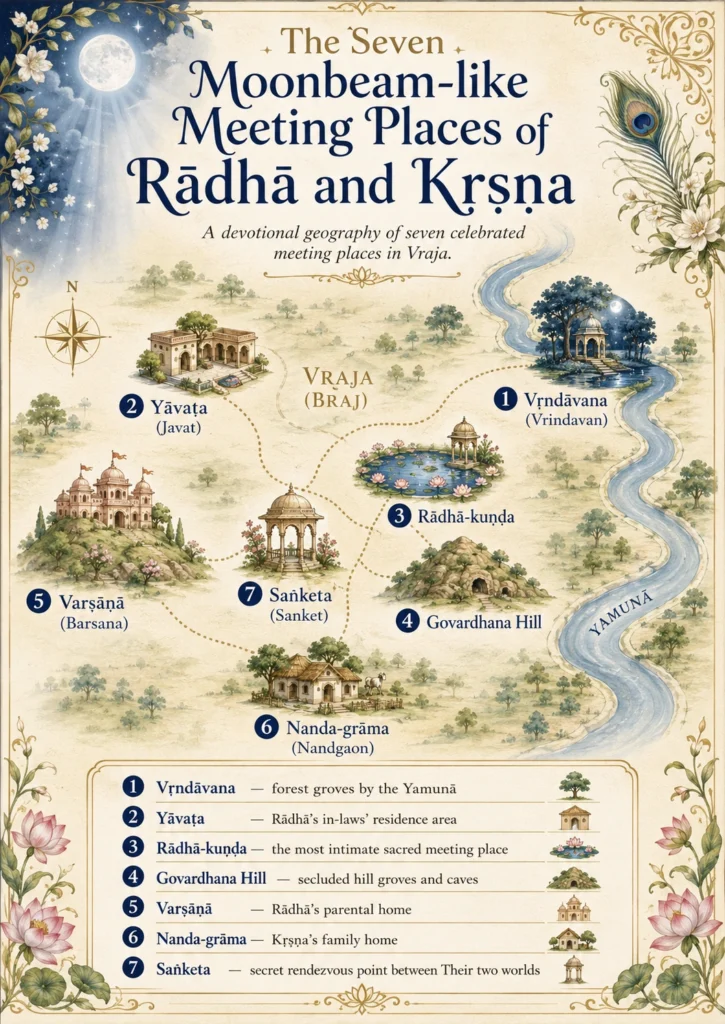
A devotional map of the seven, under the modern heading discussed at the end of this article.
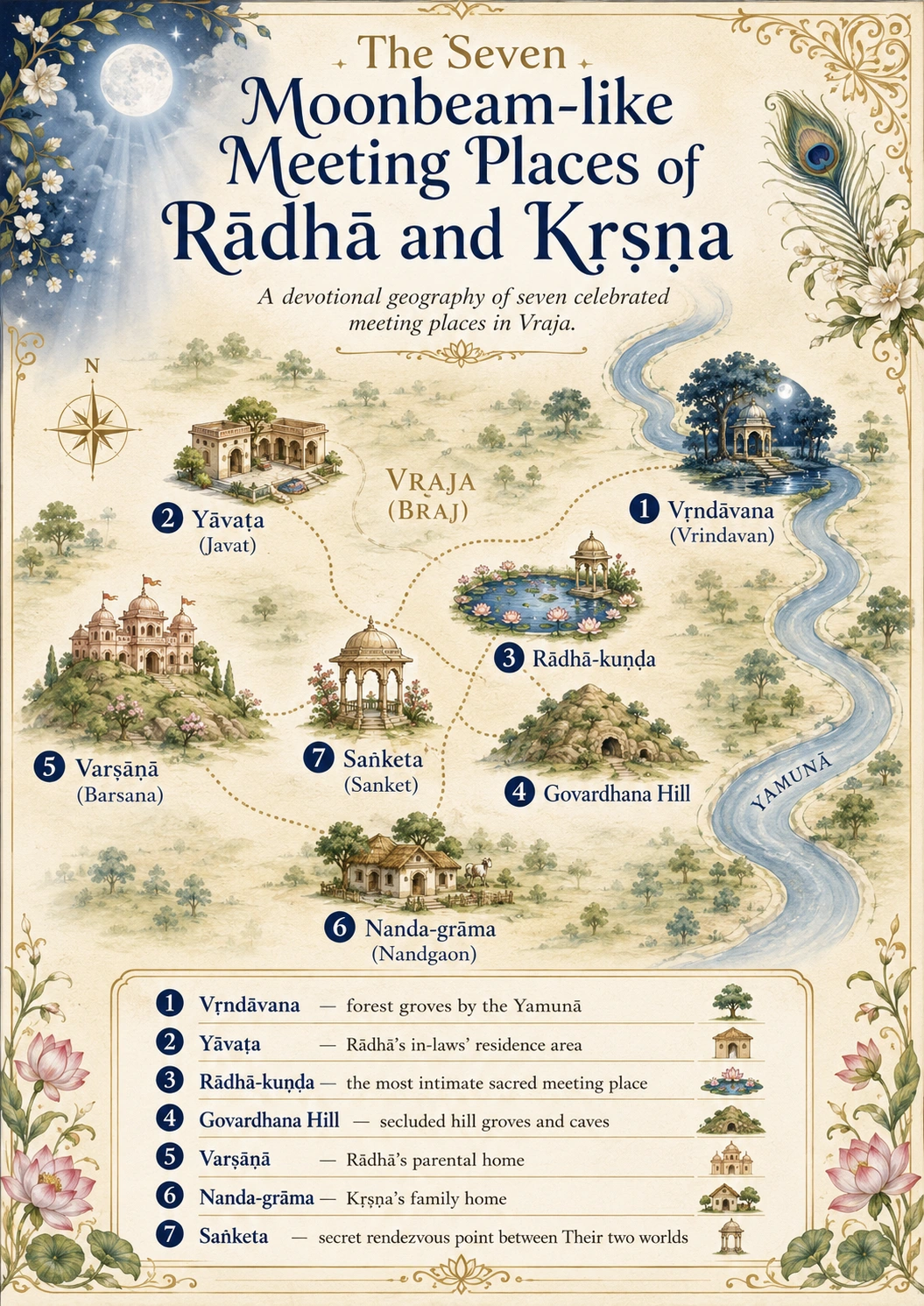
The sevenfold list itself should be treated with some caution. The exact expression “moonbeam-like meeting places” appears in modern English devotional compilations, but no early Sanskrit verse enumerating these seven together under that title has yet been identified. The individual places, however, are deeply rooted in Gauḍīya Vaiṣṇava literature and Vraja pilgrimage tradition. See the note at the end of this article.
1. Vṛndāvana — the Forest of Intimate Līlā
When Gauḍīya texts speak of Vṛndāvana they do not mean merely the modern town. They mean the sacred forest realm of Vraja: Yamunā banks, flowering groves, secluded kuñjas, creepers, trees, forest paths, ponds, mountain hollows — places hidden from ordinary vision. These are precisely the environments in which Rādhā and Kṛṣṇa’s most confidential youthful pastimes unfold. Raghunātha dāsa Gosvāmī praises it in his Vraja-vilāsa-stava:
वैदग्ध्योत्तरनर्मकर्मठसखीवृन्दैः परीतं रसैः
प्रत्येकं तरुकुञ्जवल्लरिगिरिद्रोणीषु रात्रिन्दिवम् ।
नानाकेलिभरेण यत्र रमते तन्नव्ययूनोर्युगं
तत्पादाम्बुजगन्धबन्धुरतरं वृन्दावनं तद्भजे ॥
vaidagdhyottara-narma-karmaṭha-sakhī-vṛndaiḥ parītaṁ rasaiḥ
pratyekaṁ taru-kuñja-vallari-giri-droṇīṣu rātrindivam |
nānā-keli-bhareṇa yatra ramate tan navya-yūnor yugaṁ
tat-pādāmbuja-gandha-bandhurataraṁ vṛndāvanaṁ tad bhaje ||
“I worship Vṛndāvana, made exceedingly fragrant by Their lotus feet, where the ever-youthful Couple, surrounded by sakhīs expert in clever joking and rasa, sport day and night among every tree, bower, creeper and mountain hollow.” — Vraja-vilāsa-stava 7
This gives a much fuller picture than imagining one particular tree or one particular spot. The whole forest becomes an architecture of intimacy.
A key word in this literature is कुञ्ज, kuñja — a secluded grove, arbour or leafy bower formed from flowering vines, trees, leaves, branches and blossoms. The kuñja provides privacy, and that privacy matters because Rādhā-Kṛṣṇa līlā often depends on secrecy. Vṛndāvana’s forests do not merely provide scenery; they actively facilitate the Divine Couple’s meetings.
2. Yāvaṭa — Love Under Social Obstruction
Yāvaṭa, also written Yāvaṭ, Jāvaṭ or Javat, occupies a very different emotional position. In the Gauḍīya līlā tradition it is Śrī Rādhā’s married residence, where She lives within the household associated with Abhimanyu, Her mother-in-law Jaṭilā and Her sister-in-law Kuṭilā. This creates one of the central dramatic conditions of the līlā: Rādhā cannot openly go to Kṛṣṇa whenever She desires. Meetings therefore require signals, messages, excuses, disguises, careful planning, and the assistance of the sakhīs.
Bhaktivinoda Ṭhākura preserves this sacred geography in a later Bengali meditation:
বৃষভানু-পুরে, জনম লইব, যাবটে বিবাহ হবে ।
ব্রজ-গোপী-ভাব, হইবে স্বভাব, আন ভাব না রহিবে ॥
vṛṣabhānu-pure janama loibo, yāvate vivāha ha’be |
vraja-gopī-bhāva hoibe svabhāva, āna-bhāva nā rahibe ||
“I shall take birth in Vṛṣabhānu’s town, and my marriage will take place in Yāvaṭa. The mood of a Vraja-gopī will become my very nature, and no other disposition will remain.”
This is a comparatively late Bengali devotional text, not an ancient Sanskrit source, but it reflects the established Gauḍīya sacred geography very clearly.
Yāvaṭa represents love under obstruction. The barriers surrounding Rādhā do not merely prevent union — they intensify longing, ingenuity, anticipation, risk, secrecy and emotional tension. The sakhīs must devise ways to bring Rādhā and Kṛṣṇa together without attracting the attention of Jaṭilā and Kuṭilā. Yāvaṭa is therefore especially associated with the dynamics of hidden and difficult-to-obtain union.
3. Rādhā-kuṇḍa — the Supreme Centre of Intimate Prema
Rādhā-kuṇḍa should not be treated as merely one sacred meeting place among seven equals. Within Gauḍīya Vaiṣṇava theology it occupies an extraordinary position. Śrī Rūpa Gosvāmī establishes an explicit hierarchy of sacred places in Upadeśāmṛta 9:
वैकुण्ठाज्जनितो वरा मधुपुरी तत्रापि रासोत्सवाद्
वृन्दारण्यमुदारपाणिरमणात्तत्रापि गोवर्धनः ।
राधाकुण्डमिहापि गोकुलपतेः प्रेमामृताप्लावनात्
कुर्यादस्य विराजतो गिरितटे सेवां विवेकी न कः ॥
vaikuṇṭhāj janito varā madhu-purī tatrāpi rāsotsavād
vṛndāraṇyam udāra-pāṇi-ramaṇāt tatrāpi govardhanaḥ |
rādhā-kuṇḍam ihāpi gokula-pateḥ premāmṛtāplāvanāt
kuryād asya virājato giri-taṭe sevāṁ vivekī na kaḥ ||
— Upadeśāmṛta 9
premāmṛtāplāvanāt
A celebrated verse from the Padma Purāṇa, repeatedly quoted in Gauḍīya literature, states the matter still more strongly:
यथा राधा प्रिया विष्णोस्तस्याः कुण्डं प्रियं तथा ।
सर्वगोपिषु सैवैका विष्णोरत्यन्तवल्लभा ॥
yathā rādhā priyā viṣṇos
tasyāḥ kuṇḍaṁ priyaṁ tathā |
sarva-gopīṣu saivaikā
viṣṇor atyanta-vallabhā ||
“Just as Rādhā is dear to Kṛṣṇa, so Her kuṇḍa is dear to Him. Among all the gopīs, She alone is supremely dear to Him.” — Padma Purāṇa, quoted at Caitanya-caritāmṛta, Madhya 8.99
The kuṇḍa is not simply holy because something once happened there. Its sacredness is understood as inseparable from Rādhā Herself. Raghunātha dāsa Gosvāmī goes further still:
श्रीवृन्दाविपिनं सुरम्यमपि तच्छ्रीमान् स गोवर्धनः
सा रासस्थलिकाप्यलं रसमयी किं तावदन्यस्थलम् ।
यस्याप्यंश लवेन नार्हति मनाक् साम्यं मुकुन्दस्य तत्
प्राणेभ्योऽप्यधिकप्रियेव दयितं तत्कुण्डमेवाश्रये ॥
śrī-vṛndā-vipinaṁ suramyam api tac chrīmān sa govardhanaḥ
sā rāsa-sthalikāpy alaṁ rasamayī kiṁ tāvad anya-sthalam |
yasyāpy aṁśa-lavena nārhati manāk sāmyaṁ mukundasya tat
prāṇebhyo ’py adhika-priyeva dayitaṁ tat-kuṇḍam evāśraye ||
Even beautiful Vṛndāvana, Govardhana and the rāsa-sthalī, he says, cannot equal even a fraction of the glory of Rādhā-kuṇḍa.
Within Gauḍīya sacred geography, Rādhā-kuṇḍa is the concentrated geographical expression of Rādhā-Mādhava prema.
4. Govardhana — the Greatest Servant of Hari
The Śrīmad-Bhāgavatam gives the hill one of its most famous titles, हरिदासवर्य, hari-dāsa-varya, “the best of Hari’s servants.” The gopīs say:
हन्तायमद्रिरबला हरिदासवर्यो
यद्रामकृष्णचरणस्पर्शप्रमोदः ।
मानं तनोति सहगोगणयोस्तयोर्यत्
पानीयसूयवसकन्दरकन्दमूलैः ॥
hantāyam adrir abalā hari-dāsa-varyo
yad rāma-kṛṣṇa-caraṇa-sparśa-pramodaḥ |
mānaṁ tanoti saha-go-gaṇayos tayor yat
pānīya-sūyavasa-kandara-kanda-mūlaiḥ ||
“O friends, this hill is the best of Hari’s servants. Delighted by the touch of Rāma and Kṛṣṇa’s feet, he honours Them and Their cows with water, soft grass, caves, roots and fruits.” — Śrīmad-Bhāgavatam 10.21.18
The verse already reveals Govardhana’s essential theological function: he serves. He supplies water, grass, fruits, roots, shade, caves and secluded places. Later Gauḍīya authors interpret that service in increasingly intimate terms. Raghunātha dāsa Gosvāmī praises his caves:
गान्धर्वामुरभिद्विलासविगलत्काश्मीररज्यद्गुहस्
तत्खट्टायितरत्नसुन्दरशिलो गोवर्धनः पातु वः ॥
gāndharvā-murabhid-vilāsa-vigalat-kāśmīra-rajyad-guhas
tat-khaṭṭāyita-ratna-sundara-śilo govardhanaḥ pātu vaḥ ||
“May Govardhana protect you, whose caves are coloured by saffron fallen during the pastimes of Gāndharvā and Kṛṣṇa, and whose beautiful jewelled stones serve as Their couches.” — Vraja-vilāsa-stava 51
Elsewhere he states simply श्रीराधासहितो गुहासु रमते, śrī-rādhā-sahito guhāsu ramate — “Kṛṣṇa sports in the caves together with Śrī Rādhā.”
This is why Govardhana should not be reduced to the modern list’s phrase “upon the top of the hill.” The older literature associates Their meetings with the hill’s caves, slopes, groves, valleys, kuṇḍas and secluded hollows. Govardhana is a servant precisely because his geography creates opportunities for confidential līlā.
5. Varṣāṇā — Rādhā’s Parental World
Modern Barsānā is traditionally identified with the sacred settlement of Vṛṣabhānupura, the residence of Rādhā’s father Vṛṣabhānu Mahārāja and Her mother Kīrtidā-devī. It is therefore one of the principal sacred places associated with Rādhā’s family identity, and She is repeatedly celebrated as वृषभानुनन्दिनी, Vṛṣabhānu-nandinī, “the beloved daughter of Vṛṣabhānu,” or वृषभानुजा, Vṛṣabhānujā.
One geographical distinction is worth preserving. Vraja traditions frequently associate Rāvala with Rādhā’s appearance or earliest childhood, while Barsānā / Vṛṣabhānupura is associated with the later residence of Vṛṣabhānu’s family. It is therefore safest to describe Barsānā as Rādhā’s parental home and the residence of Vṛṣabhānu Mahārāja, rather than stating without qualification that it is Her birthplace.
Varṣāṇā represents Rādhā in Her parental world. Here She is Vṛṣabhānu’s daughter and Kīrtidā’s daughter, surrounded by Her girlfriends and situated within Her own family environment. That produces an important contrast with Yāvaṭa: Varṣāṇā is associated with Rādhā’s parental belonging, Yāvaṭa with the restrictions of Her married household. The contrast becomes part of the emotional geography of the līlā.
6. Nandagrāma — Kṛṣṇa’s Family Home
Modern Nandgaon corresponds to the sacred place widely called Nandagrāma, and in Gauḍīya Sanskrit literature Nandīśvara or Nandīśvara-giri. It is the residence of Nanda Mahārāja, Mother Yaśodā, Kṛṣṇa, Balarāma and the household of the king of Vraja. Raghunātha dāsa Gosvāmī writes:
यत्र श्रीः परितो भ्रमत्यविरतं तास्ता महासिद्धयः
स्फीताः सृष्टिरलं गवामुदयनी वासोऽपि गोष्ठौकसाम् ।
वात्सल्यात्परिपालितो विहरते कृष्णः पितृभ्यां सुखैस्
तन्नन्दीश्वरमालयं व्रजपतेर्गोष्ठोत्तमाङ्गं भजे ॥
yatra śrīḥ parito bhramaty avirataṁ tās tā mahā-siddhayaḥ
sphītāḥ sṛṣṭir alaṁ gavām udayanī vāso ’pi goṣṭhaukasām |
vātsalyāt paripālito viharate kṛṣṇaḥ pitṛbhyāṁ sukhais
tan nandīśvaram ālayaṁ vraja-pater goṣṭhottamāṅgaṁ bhaje ||
“I worship Nandīśvara, the residence of the king of Vraja, where Kṛṣṇa joyfully lives, protected with parental affection by His father and mother.” — Vraja-vilāsa-stava 8
One of the most important daily-līlā traditions associated with Nandagrāma is Rādhā’s cooking service for Kṛṣṇa. This is not merely a modern village story: Raghunātha dāsa Gosvāmī explicitly praises Kuṇḍalatā, who brings Rādhā to Nanda’s household:
सख्येनालं परमरुचिरा नर्मभव्येन राधां
पाकार्थं या व्रजपतिमहिष्याज्ञया सन्नयन्ती ।
प्रेम्णा शश्वत्पथि पथि हरेर्वार्तया तर्पयन्ती
तुष्यत्वेतां परमिह भजे कुण्डपूर्वां लतां ताम् ॥
sakhyenālaṁ parama-rucirā narma-bhavyena rādhāṁ
pākārthaṁ yā vraja-pati-mahiṣy-ājñayā sannayantī |
premṇā śaśvat pathi pathi harer vārtayā tarpayantī
tuṣyatv etāṁ param iha bhaje kuṇḍa-pūrvāṁ latāṁ tām ||
“I worship Kuṇḍalatā, who, by the order of the queen of Vraja, brings Rādhā for the purpose of cooking and continually delights Her along the way with loving talk about Hari.” — Vraja-vilāsa-stava 32
The “queen of Vraja” here is Yaśodā. Rādhā’s cooking service thus creates a socially acceptable reason for Her to enter Kṛṣṇa’s household — but within the confidential līlā it also becomes an opportunity for glances, messages, encounters and secret arrangements by the sakhīs.
The two villages represent the parental centres of the two lovers: Varṣāṇā or Vṛṣabhānupura is Rādhā’s family home, and Nandagrāma or Nandīśvara is Kṛṣṇa’s. Between these two worlds lies another especially meaningful location.
7. Saṅketa — the Appointed Rendezvous
Perhaps no name in this list expresses its function more perfectly than सङ्केत, saṅketa. The Sanskrit word can mean a sign, signal, indication, secret agreement, appointment or prearranged rendezvous. In romantic poetry it denotes the secret agreement by which lovers know where to meet, when to meet, or what signal announces that a meeting is possible. Saṅketa therefore functions both as a concept and as a sacred geographical place.
The Caitanya-caritāmṛta uses the word in exactly this sense:
সঙ্কেত-বেণু-নাদে রাধা আনি’ কুঞ্জঘরে ।
কুঞ্জেরে চলিলা কৃষ্ণ ক্রীড়া করিবারে ॥
saṅketa-veṇu-nāde rādhā āni’ kuñja-ghare |
kuñjere calilā kṛṣṇa krīḍā karibāre ||
“By the signal of His flute, Kṛṣṇa brought Rādhā to a bower, and then He entered the kuñja to perform pastimes with Her.” — Caitanya-caritāmṛta, Antya 17.24
The crucial expression is saṅketa-veṇu-nāda, “the flute sound serving as a secret signal.” The flute is therefore not simply music; it can function as coded communication.
Later Vraja pilgrimage literature explicitly describes a Saṅketa-kuñja, a bower associated with the sakhīs arranging meetings. A Bengali passage from the Bhakti-ratnākara tradition says:
এই ‘সঙ্কেত কুঞ্জ’ সখী সঙ্কেত করিয়া
রাই কানু দোঁহারে আনেন যত্ন পাইয়া ॥
ei saṅketa-kuñja sakhī saṅketa kariyā
rāi kānu doṅhāre ānen yatna pāiyā ||
“At this Saṅketa-kuñja, the sakhīs carefully arrange the signal and bring Rāi and Kānu together.”
Saṅketa is the geography of coordination. Traditionally it is situated in the sacred corridor between the regions of Barsānā and Nandagrāma — Rādhā’s familial world on one side, Kṛṣṇa’s on the other, and the appointed meeting place between them. It acts almost as a threshold between Their two social identities.
The Geography of the Seven Places
These seven should not be imagined as seven identical points on a pilgrimage itinerary. They represent different emotional environments, and they fall into two groups. The first is a circuit of household worlds:
Beyond these household environments lie the progressively freer sacred landscapes — Vṛndāvana, then Govardhana, then Rādhā-kuṇḍa. This second progression is especially significant because it closely corresponds to the theological hierarchy given by Rūpa Gosvāmī in the Upadeśāmṛta.
From Social Space to Confidential Space
The geography can be read almost as a movement from public to private, from social identity to intimate identity. At Varṣāṇā, Rādhā is the daughter of Vṛṣabhānu. At Yāvaṭa, She lives within the social constraints of Her married household. At Nandagrāma, Kṛṣṇa is Yaśodā and Nanda’s son. At Saṅketa, Their separate worlds begin to meet through secret signs. In Vṛndāvana, the forest provides freedom from household surveillance. At Govardhana, caves and secluded groves intensify the privacy. At Rādhā-kuṇḍa, Gauḍīya theology locates the deepest concentration of prema.
This is why sacred geography matters so much in Vraja theology. The place is not merely where the līlā happens — the character of the place helps generate the character of the līlā.
Aiśvarya Is Almost Absent Here
Another theological observation follows. These meeting places are not primarily associated with Kṛṣṇa as the creator of the universe, the speaker of the Bhagavad-gītā, the king of Dvārakā or the destroyer of demons. They belong to the world of mādhurya — intimacy, sweetness, familiarity and love. Here Kṛṣṇa is primarily Nanda’s son, the cowherd boy, the flute player, Rādhā’s beloved; and Rādhā is Vṛṣabhānu’s daughter, the beloved of Kṛṣṇa, the centre of the sakhīs’ service and the supreme embodiment of prema. These sacred places express not divine majesty but divine intimacy.
The Sakhīs Make the Geography Function
Rādhā and Kṛṣṇa rarely move through this sacred geography entirely alone. Their meetings depend upon Lalitā, Viśākhā, Vṛndā-devī, Kuṇḍalatā, Subala and various other confidential assistants. They carry messages, interpret signals, distract elders, create excuses, arrange pathways, prepare kuñjas, observe whether a meeting is safe, and bring the Divine Couple together.
The geography of Vraja is therefore also a geography of sevā. These places are sacred not merely because Rādhā and Kṛṣṇa stand there, but because countless associates help arrange Their happiness.
Vṛndā-devī is especially important, traditionally understood as the presiding organizer of the forests of Vṛndāvana. In later līlā literature she coordinates flowers, birds, breezes, forest bowers, pathways, messengers and the timing of meetings. This adds another layer of meaning to the sacred geography: Vṛndāvana is not chaotic wilderness, but behaves almost like a perfectly organized environment designed for Rādhā-Kṛṣṇa sevā.
The Seven Places in Summary
A Note on “Seven Moonbeam-like Meeting Places”
The phrase “seven moonbeam-like meeting places of Rādhā and Kṛṣṇa” is beautiful and may certainly be retained as a devotional poetic heading. It should not, however, presently be presented as though it were a securely identified technical Sanskrit category.
A cautious formulation would be: seven celebrated meeting places of Śrī Rādhā and Kṛṣṇa in Vraja, traditionally described in some modern devotional compilations as the “seven moonbeam-like meeting places.” If an early Sanskrit source for the exact sevenfold enumeration is eventually identified, the terminology can be refined further.
The Deeper Meaning of Vraja Geography
For a visitor these may appear to be villages, ponds, hills, forest sites and pilgrimage stops. For Gauḍīya devotional literature they are emotional landscapes. Each place contains a different relationship between separation and union, freedom and restriction, family and secrecy, expectation and fulfilment.
Rādhā does not experience Kṛṣṇa in exactly the same way at Yāvaṭa as She does at Rādhā-kuṇḍa. Kṛṣṇa does not appear in Nandagrāma exactly as He does within a Govardhana cave. Saṅketa is not the same emotional world as Varṣāṇā. The geography changes the rasa — which is one reason Gauḍīya authors speak about remembering, serving and residing mentally within particular līlā-sthalīs. The physical place and the emotional līlā become inseparable.
These seven places reveal something fundamental about the theology of Vraja: Rādhā and Kṛṣṇa’s love does not occur in an abstract spiritual space. It has paths, homes, forests, hills, lakes, signals, meeting points, obstacles and destinations. Varṣāṇā gives us Rādhā’s parental world; Yāvaṭa gives us separation and social restriction; Nandagrāma gives us Kṛṣṇa’s family world; Saṅketa connects those two worlds; Vṛndāvana opens the secluded forest; Govardhana provides caves, valleys and hidden bowers; and Rādhā-kuṇḍa becomes the supreme concentration of intimate prema.
The result is one of the most distinctive features of Gauḍīya Vaiṣṇava spirituality: sacred geography becomes the geography of love. Vraja is not merely the place where Rādhā and Kṛṣṇa once met. In the devotional imagination of the tradition, every path, grove, hill and kuṇḍa remembers Their meeting.
Primary Sources
Textual caution. The individual places are well established in Gauḍīya sacred geography, but the exact sevenfold classification and the expression “moonbeam-like meeting places” remain insufficiently traced to an early Sanskrit source. For source-accurate presentation the list should be described as a traditional modern devotional grouping built from genuinely important Vraja līlā-sthalīs, rather than as a securely identified classical Sanskrit technical category.