

Śrī Rādhā’s Lotus Hands: The Thirty-Five Auspicious Marks
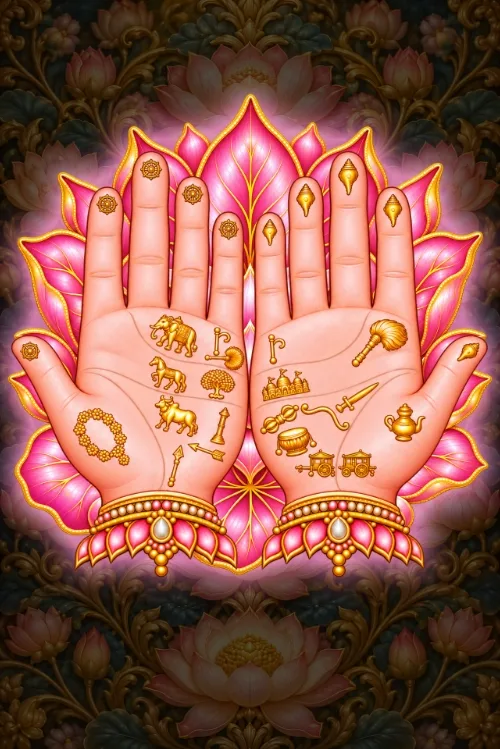
Their scriptural descriptions, hidden meanings, and extraordinary significance in the loving service of Śrī Kṛṣṇa
Śrīmatī Rādhārāṇī’s lotus hands are described in Gauḍīya Vaiṣṇava literature as possessing extraordinary beauty and auspiciousness. Their reddish radiance resembles freshly blossomed lotus flowers, while the brilliance of Her fingernails is compared to the gentle light of many moons. Sacred emblems appear on Her palms and fingers: conchshells, elephants, horses, a thunderbolt, a sword, a sacrificial pillar, a flower garland, ceremonial fans, and many other remarkable signs.
According to the detailed Sanskrit descriptions preserved in the commentaries on Śrīla Rūpa Gosvāmī’s Ujjvala-nīlamaṇi, Śrī Rādhā’s lotus hands bear thirty-five categories of auspicious marks: eighteen on Her left hand and seventeen on Her right. These include the characteristic lines of Her palms and the symbols adorning Her fingertips.
The emblems suggest royalty, spiritual power, auspiciousness, protection, beauty, and prosperity. Yet their deepest significance is revealed in a surprising explanation from Kṛṣṇadāsa Kavirāja Gosvāmī: the marks upon Rādhā’s hands resemble the articles used in serving Her beloved Kṛṣṇa.
This changes the meaning of the entire collection. The hands of the supreme goddess are not merely adorned with signs of divine authority. They are understood to embody the perfection of loving service.
The Scriptural Foundations of Rādhā’s Thirty-Five Marks
Three Sanskrit works are especially important for understanding the auspicious markings upon Śrī Rādhā’s hands.
The first is Śrī Rādhā-Kṛṣṇa-gaṇoddeśa-dīpikā, composed by Śrīla Rūpa Gosvāmī in the sixteenth century. Its second part describes the forms, ornaments, beauty, qualities, and distinguishing characteristics of Rādhā, Kṛṣṇa, and Their companions. Verses 159–161 describe Rādhā’s beautiful lotus hands and name several of their auspicious markings.
The second is Rūpa Gosvāmī’s Ujjvala-nīlamaṇi, particularly Chapter Four, Verse Twenty-Four, and the commentaries of Śrīla Jīva Gosvāmī and Śrīla Viśvanātha Cakravartī Ṭhākura. These commentaries provide the most important detailed enumeration: eighteen marks on the left hand and seventeen on the right.
The third is Govinda-līlāmṛta, composed by Kṛṣṇadāsa Kavirāja Gosvāmī. Its twelfth canto offers an especially beautiful interpretation of the markings as articles connected with Rādhā’s intimate service to Kṛṣṇa.
Together, these sources establish both the traditional iconography and its deeper devotional significance.
When Footprints Reveal Rādhā’s Presence
The immediate setting of Ujjvala-nīlamaṇi 4.24 is a charming pastime in which Rādhā has concealed Herself. Her footprints, however, reveal that She is nearby.
The Sanskrit verse addresses Kṛṣṇa:
aghahara bhaja tuṣṭiṁ paśya yac candralekhā-
valaya-kusuma-vallī-kuṇḍalākāra-bhāgbhiḥ
abhidadhati nilīnām atra saubhāgya-rekhā-
vitatibhir anuviddhāḥ suṣṭhu rādhāṁ padāṅkāḥ
“O destroyer of sin, rejoice! Look at these footprints, adorned with auspicious lines resembling the crescent moon, bracelet, flower, creeper, and earring. They clearly reveal that Rādhā is concealed here.”
Ujjvala-nīlamaṇi 4.24
The verse describes Her footprints rather than Her hands. However, the commentators take the opportunity to discuss the wider collection of auspicious signs appearing upon Her transcendental body.
Jīva Gosvāmī and Viśvanātha Cakravartī explain the markings of Her feet and then turn to the symbols of Her palms. Their descriptions establish the eighteen-left and seventeen-right arrangement.
This distinction is important. The complete thirty-five-mark list is not presented directly in one verse of the Śrīmad-Bhāgavatam, nor is it the literal subject of Rūpa Gosvāmī’s verse about the footprints. It is preserved through the Sanskrit commentarial tradition associated with his work.
The Thirty-Five Auspicious Marks: The Corrected Traditional List
Some modern English compilations reproduce the familiar count of thirty-five while using terms that differ from those found in the Sanskrit commentaries. For example, they sometimes identify the five left fingertip marks as discs, describe the bull as a cow, substitute a flag for the sacrificial pillar, and place an iron club where the Sanskrit names a ceremonial fly-whisk.
For clarity, the following inventory follows the more precise Sanskrit terminology preserved in the Ujjvala-nīlamaṇi commentaries.
Left Lotus Hand: Eighteen Auspicious Marks
Five nandyāvarta emblems — Nandyāvarta
An auspicious geometric emblem of prosperity and favorable fortune, built from elaborate turning forms. Indian art draws it nearer an intricate svastika than the plain disc of the popular English lists.
Elephant — Kuñjara
Strength, dignity, and royal splendor. The story of Gajendra in the Eighth Canto turns that strength to its opposite lesson: refuge in the Lord outreaches any power of one’s own.
Elephant goad — Aṅkuśa
A hooked implement small enough to guide an elephant’s immense strength. The restless mind is the elephant, so the goad stands for guidance and the redirection of energy rather than its destruction.
Fan — Vyajana
A fan for cooling comfort, and so an emblem of attention to another’s happiness rather than of conquest — one of the countless delicate services of Vṛndāvana.
Horse — Vājī
Speed, energy, nobility, and readiness for action. Love for Kṛṣṇa is not passive sentiment, and the horse carries the devotee’s eagerness to act for the beloved’s happiness.
Auspicious tree — Śrī-vṛkṣa
Śrī, auspiciousness, joined to vṛkṣa, tree. The groves of Vraja are the setting of the pastimes rather than their scenery, and a tree gives shade unasked — generosity, and service.
Bull or ox — Vṛṣa
Strength, endurance, and agricultural prosperity, and in wider usage dharma itself. The Sanskrit is vṛṣa, bull or ox, not dhenu, cow, as the popular English lists have it.
Sacrificial pillar — Yūpa
A Vedic sacrificial post, standing for dedication and the surrender of something valued. The commentary says yūpa, not dhvaja: a flag is a banner on a standard, and this is not one.
Sharp arrow — Bāṇa
Direction, concentration, and the reaching of a precise target. Turned to devotion, it is consciousness fixed on Kṛṣṇa, its energies no longer wandering among innumerable temporary objects.
Javelin — Tomara
A heavier thrusting weapon than the arrow, carrying force and determination. Devotionally it suggests the power of pure dedication to remove obstacles; arrow and javelin are counted apart for that reason.
Garland — Mālā
The most intimate of the hand marks. Vraja’s pastimes turn on the making, offering, and exchange of flower garlands, so a mālā stands for affection expressed through personal service.
Great life line — Paramāyū-rekhā
The paramāyū-rekhā, running from between the index and middle fingers toward the lower outer palm. The lines belong to the palm’s natural arrangement; they are not objects placed upon it.
Second auspicious palm line — Rekhā
The second line crosses from the little-finger side toward the space between thumb and index finger. The commentaries describe the lines by their paths, not by the names of modern palmistry.
Third auspicious palm line — Rekhā
The third begins near the wrist beneath the thumb, curves upward, and joins another line. Rādhā’s form is not subject to material destiny, so the lines read as auspiciousness, not prediction.
Right Lotus Hand: Seventeen Auspicious Marks
Five conchshells — Śaṅkha
Auspiciousness, sacred sound, purification, and the proclamation of victory. The conch is sounded in worship and holds sanctified water in temple ritual.
Elephant goad — Aṅkuśa
The goad appears on this palm too, and the repetition is no error: the commentarial lists include the emblem in both hands. Great strength guided by a small instrument.
Palace — Prāsāda
Royal dignity, sovereignty, and a residence fit for an exalted person. The emblem stands in tension with the pastoral simplicity of Vraja, where Rādhā’s most intimate relationships unfold.
Sword — Asi
Authority, protection, and discernment, and a blade that cuts away ignorance. Read devotionally, it is the strength of divine love overcoming whatever is unfavorable to Kṛṣṇa’s happiness.
Ceremonial drum — Dundubhi
A kettledrum announcing ceremonies, victories, and the arrival of exalted persons. Dundubhi does not mean trumpet, despite that rendering in some devotional compilations.
Bow — Kodaṇḍa
Controlled power and concentrated intention. Kodaṇḍa does not say whether the bow is strung; illustrations often show it unstrung, which is a convention rather than the Sanskrit term.
Thunderbolt — Vajra
Indra’s weapon, and the power to break through what seems immovable. Upon Rādhā’s hand that force reads as the irresistible potency of divine love rather than as destruction.
Pair of carts — Śakaṭa-yuga
Two vehicles counted as a single category. Carts belong to village life and agricultural abundance, and in Vraja they carry the ordinary practical service that fills the pastoral day.
Ceremonial pitcher — Bhṛṅgāra
A refined vessel, neither the ascetic’s kamaṇḍalu nor the plain kalaśa: water carried for washing, refreshing, and honoring — household work become intimate service.
Fly-whisk — Cāmara
Waved before deities and exalted persons, and placed below the index finger by the commentary. In Vṛndāvana its royal honor becomes something personal: the offering of comfort.
Great life line — Paramāyū-rekhā
The commentators state that a comparable threefold arrangement appears upon the right palm. This is its paramāyū-rekhā, the great life line.
Second auspicious palm line — Rekhā
The second of the right palm’s three lines. Six lines in all, three to each palm, make up part of the traditional count of thirty-five.
Third auspicious palm line — Rekhā
The third of the right palm’s three lines, described by its path across the palm rather than by the vocabulary of modern palmistry.
The two hands therefore contain thirty-five counted markings. Importantly, thirty-five means thirty-five counted signs or categories, not necessarily thirty-five different kinds of objects. Some emblems appear repeatedly: the five fingertips of each hand each bear a sign, and the elephant goad is described on both palms. The two carts, meanwhile, constitute one category.
The original texts also distinguish between marks whose location is specified and those whose position is left to an aesthetically appropriate arrangement. This distinction is essential for faithful iconography.
Rādhā’s Left Lotus Hand: Eighteen Marks
1–5. The Five Nandyāvarta Emblems
At the tips of the five fingers of Rādhā’s left hand are five auspicious signs called nandyāvartas.
Jīva Gosvāmī states:
aṅgulīnām agrato nandy-āvartāḥ pañca
“At the tips of the fingers are five nandyāvarta marks.”
Ujjvala-nīlamaṇi 4.24, Jīva Gosvāmī’s commentary
The word nandyāvarta refers to a traditional auspicious geometric emblem. It is associated with prosperity, favorable fortune, and elaborate turning or spiral-like forms. In Indian art, the nandyāvarta may resemble an expanded or intricate svastika pattern rather than an ordinary spoked wheel.
This explains an important ambiguity in modern devotional illustrations. Some English lists call these signs “discs,” and certain artistic traditions represent them with circular forms. However, the Sanskrit description is more precise: it names nandyāvartas, not simply cakras.
The difference should be preserved. A disc is usually represented as a wheel, while a nandyāvarta possesses its own auspicious geometric identity.
The spiritual association is appropriate to Rādhā’s supreme position in Gauḍīya theology. Her hands are said to embody extraordinary auspiciousness, and the five markings extending across Her fingertips present that auspiciousness as a defining feature of Her beauty.
An exact geometric reconstruction of these signs cannot be established from this brief Sanskrit statement alone. Traditional artistic precedents may therefore be consulted, provided their interpretive nature is acknowledged.
6. The Elephant — Kuñjara
The elephant appears below the ring finger of Rādhā’s left palm.
In Sanskrit literature and Indian sacred art, the elephant is associated with strength, dignity, prosperity, royal authority, and magnificence. Elephants frequently appear in ceremonial processions, divine assemblies, and descriptions of royal splendor.
Their spiritual significance is illustrated in the famous story of Gajendra, the elephant king whose surrender to the Supreme Lord is celebrated in the Eighth Canto of the Śrīmad-Bhāgavatam. The story demonstrates that genuine refuge in God transcends physical strength and worldly status.
Within a meditation upon Rādhā, the elephant may be understood as representing extraordinary power placed in the service of divine love.
This is a contemplative interpretation rather than a meaning expressly assigned to the emblem by the hand-mark commentary. Its scripturally specified feature is its identity as an elephant and its position below the ring finger.
7. The Elephant Goad — Aṅkuśa
The elephant goad appears below the little finger of the left palm.
An aṅkuśa is a hooked implement traditionally used to guide an elephant. Though small in comparison with the enormous animal, it can direct the elephant’s immense strength.
The image has a natural spiritual significance. The restless mind is frequently compared to an elephant, powerful yet difficult to control. The goad therefore suggests guidance, discipline, and the redirection of energy toward a higher purpose.
In Gauḍīya devotional understanding, the goal of spiritual discipline is not the destruction of one’s capacities but their dedication to Kṛṣṇa. The mind, senses, intelligence, and emotions become perfected when engaged in loving service.
It is noteworthy that the elephant and elephant goad appear as separate marks. The animal represents strength; the instrument represents the power to guide it. They should not be combined into a single image.
The commentary also describes an elephant goad on Rādhā’s right palm. Thus the same emblem appears on both hands, although the overall collections of markings differ.
8. The Fan — Vyajana
The left hand bears a fan called vyajana.
The term refers to a fan used to provide cooling comfort. Depending on the artistic context, it may be represented as a hand-held fan of palm leaf, woven material, or another traditional design.
This emblem is especially beautiful when understood in the atmosphere of Vṛndāvana.
In the intimate pastimes of Rādhā and Kṛṣṇa, service is expressed through countless delicate acts: preparing flower garlands, arranging resting places, offering fragrant substances, decorating the divine couple, and gently fanning Them.
The fan becomes a symbol of attention to another person’s happiness. Its purpose is not conquest or domination, but comfort.
The Sanskrit descriptions make an important distinction between vyajana and cāmara. Rādhā’s left palm bears the fan, while Her right palm bears the ceremonial fly-whisk.
Although both are used for fanning, they should not automatically be represented by identical illustrations.
9. The Horse — Vājī
The horse is associated with the great life line of Rādhā’s left palm.
In traditional Indian literature, horses symbolize speed, energy, nobility, courage, and readiness for action. They are associated with royal processions, chariots, military strength, and ceremonial occasions.
Their appearance upon Rādhā’s palm may be contemplated as an expression of spiritual eagerness.
Love for Kṛṣṇa is not portrayed as passive sentiment. It is dynamic, responsive, and constantly seeking opportunities to serve. The eagerness of the devotee to act for the happiness of the beloved provides a meaningful devotional interpretation of the horse.
The Sanskrit commentary specifically places the horse in relation to the paramāyū-rekhā, the great life line. It does not independently explain the horse as a symbol of eagerness; that significance arises through broader devotional contemplation.
10. The Auspicious Tree — Śrī-vṛkṣa
The left palm bears an auspicious tree called śrī-vṛkṣa.
The Sanskrit expression joins śrī, meaning beauty, prosperity, splendor, or auspiciousness, with vṛkṣa, meaning tree.
Trees occupy an extraordinary place in the sacred geography of Vṛndāvana. They provide shade, flowers, fruit, fragrance, shelter, and suitable places for divine pastimes. The groves of Vraja are not merely background scenery; they form part of the intimate environment in which Rādhā and Kṛṣṇa exchange loving pastimes.
The tree can therefore represent generosity and service.
A tree gives shade even to those who have not planted it. It offers fruit without demanding payment. Its branches provide shelter, while its flowers spread fragrance without discrimination.
These qualities naturally suggest the selfless disposition of a devotee.
Some later glosses identify śrī-vṛkṣa with a particular auspicious tree, including the bilva. The detailed hand-mark enumeration itself, however, does not establish one universally required botanical species.
11. The Bull — Vṛṣa
One of the most important corrections to the popular English list concerns this emblem.
The Sanskrit term is vṛṣa, meaning bull or ox, rather than the more specific word dhenu, meaning cow.
The bull traditionally symbolizes strength, endurance, fertility, and agricultural prosperity. In broader Sanskrit religious symbolism, it is also associated with righteousness, dharma.
This association is especially meaningful in a society centered upon cows, agriculture, and pastoral life.
A further connection may be noticed in Rādhā’s own family. Her father is known as Vṛṣabhānu, a name containing the Sanskrit word vṛṣabha, meaning bull.
Although the resemblance is suggestive, the hand-mark commentary does not explicitly identify the bull with Her father. It would therefore be speculative to present that association as the emblem’s definitive meaning.
The text places the bull in relation to the middle auspicious line of Her palm.
12. The Sacrificial Pillar — Yūpa
The yūpa is a Vedic sacrificial post or pillar.
This is another important correction. Some modern English lists describe a flag in this position, but the Sanskrit commentary uses the word yūpa, not dhvaja.
The two objects are different.
A flag is a banner carried upon a pole or standard, while the yūpa is a post associated with Vedic sacrifice. Traditional sacrificial posts could be fashioned from wood and shaped according to ritual requirements.
In the broader religious vocabulary of India, sacrifice represents dedication, offering, sacred duty, and the surrender of something valuable for a higher purpose.
Within the theology of Rādhā’s lotus hands, the sacrificial post may therefore be contemplated as a symbol of complete dedication to Kṛṣṇa.
The deepest form of sacrifice in bhakti is not merely the offering of external objects, but the surrender of one’s desires, activities, and very existence in loving service.
The emblem should be understood as a sacrificial post rather than an elaborate victory monument or flagstaff.
13. The Sharp Arrow — Bāṇa
The Sanskrit term bāṇa denotes an arrow.
A traditional arrow consists of a straight shaft, a pointed head, and a suitable rear section, often with fletching to stabilize its movement.
An arrow represents direction, concentration, speed, and the ability to reach a precise target.
In devotional interpretation, these qualities may be applied to the focused character of spiritual love. When consciousness becomes fully directed toward Kṛṣṇa, its energies cease to wander among innumerable temporary objects.
This does not mean that the Ujjvala-nīlamaṇi commentary explicitly describes the arrow as a psychological symbol. It identifies the emblem, while the deeper significance may be contemplated through the wider tradition.
The arrow should remain visually distinct from the javelin, which is a separate mark.
14. The Javelin — Tomara
The tomara is a javelin or spear-like weapon traditionally used for thrusting or throwing.
Unlike the relatively light arrow, the tomara is a heavier weapon, generally associated with a substantial shaft and a pronounced metal point.
In Sanskrit martial literature, such weapons symbolize force, determination, and the capacity to overcome opposition.
When interpreted devotionally, they may suggest the power of pure dedication to remove obstacles and unfavorable influences.
The presence of both arrow and javelin is significant because they represent distinct weapon forms. Neither should be confused with the sword or the thunderbolt described elsewhere.
15. The Garland — Mālā
The garland is among the most intimately meaningful marks upon Rādhā’s hands.
A mālā may refer to a garland or a string of objects, but in the devotional atmosphere of Vraja, flower garlands possess particular significance.
Rādhā and Kṛṣṇa’s pastimes frequently include the preparation, offering, exchange, and wearing of fragrant flower garlands. Their companions arrange blossoms into elaborate decorations, bringing beauty and sweetness into Their intimate exchanges.
A garland is therefore a natural symbol of affection expressed through personal service.
Unlike the regal or martial emblems, the mālā carries no necessary suggestion of force or authority. It represents beauty offered freely for the happiness of another.
For this reason, it anticipates the deeper explanation of the hand markings found in Govinda-līlāmṛta: Rādhā’s hands bear the signs of articles used in serving Kṛṣṇa.
Rādhā’s Right Lotus Hand: Seventeen Marks
1–5. The Five Conchshells — Śaṅkha
The fingertips of Rādhā’s right hand each bear a conchshell mark.
The Sanskrit states:
aṅgulīnām agrataḥ śaṅkhāḥ pañca
“At the tips of the fingers are five conchshells.”
Ujjvala-nīlamaṇi 4.24, Jīva Gosvāmī’s commentary
In Vaiṣṇava tradition, the conch is associated with auspiciousness, divine authority, sacred sound, purification, and the proclamation of victory.
Conchshells are sounded during worship and ceremonial occasions. They are also used to hold sanctified water in temple rituals.
The conch is particularly associated with Viṣṇu and His manifestations. Its appearance upon Rādhā’s fingertips therefore contributes to the larger impression of divine auspiciousness.
The contrast between Her two hands is noteworthy: the left fingertips bear five nandyāvarta signs, while the right fingertips bear five conchshells.
6. The Elephant Goad — Aṅkuśa
The right palm also bears an elephant goad.
The Sanskrit commentary places it beneath the little finger.
Its repetition on both palms need not be treated as an error. The detailed commentarial lists independently include the emblem in both hands.
The goad symbolizes the ability to guide great strength through a relatively small instrument.
Within the devotional interpretation, this suggests that love and divine grace possess a power greater than outward force. The restless mind, although difficult to control through ordinary effort, can be directed through sincere devotion.
7. The Palace — Prāsāda
The right palm bears a palace, or prāsāda.
A palace represents royal dignity, splendor, beauty, sovereignty, and a suitable residence for an exalted personality.
In the context of Vṛndāvana, the emblem can evoke the beautiful residences, decorated courtyards, jeweled interiors, and splendid arrangements associated with the divine pastimes.
Gauḍīya theology regards Rādhā as the supreme goddess of the spiritual realm, although Her most intimate relationships are expressed within the apparently simple pastoral environment of Vraja.
The palace therefore combines two dimensions of Her identity: transcendent majesty and intimate sweetness.
The Sanskrit hand-mark enumeration does not prescribe a particular architectural design. The number of towers, windows, and ornamental details remains a matter of iconographic convention.
8. The Sword — Asi
The Sanskrit word asi means sword.
In Indian religious and royal symbolism, the sword is associated with authority, protection, determination, discernment, and the defeat of opposition.
Its sharp blade can also suggest the cutting away of ignorance and confusion.
In meditation upon Rādhā, the sword may be understood as expressing the strength of divine love, which overcomes everything unfavorable to the happiness of Kṛṣṇa.
This is a devotional interpretation rather than an explanation individually assigned to the sword by the Sanskrit commentary.
The sword should remain visually distinct from the arrow, javelin, elephant goad, and thunderbolt.
9. The Ceremonial Drum — Dundubhi
The dundubhi is a ceremonial drum or kettledrum.
In traditional Indian literature, such drums announce royal ceremonies, public celebrations, military victories, and the arrival of exalted personalities.
The Sanskrit term does not ordinarily mean a trumpet, despite that English rendering appearing in some devotional compilations.
As an auspicious marking, the drum naturally suggests proclamation, celebration, and triumphant sound.
Its deeper devotional interpretation may be understood as the announcement of Rādhā’s extraordinary glory.
In Vṛndāvana, however, true glory is not measured merely through worldly fame. It is revealed through the highest perfection of love for Kṛṣṇa.
10. The Bow — Kodaṇḍa
The right palm bears a bow, called kodaṇḍa.
The word designates a bow but does not, by itself, explicitly establish whether the weapon is strung or unstrung.
Some modern devotional lists describe this mark as an unstrung bow, and that convention may be followed in illustration. It should nevertheless be distinguished from the exact Sanskrit terminology.
The bow symbolizes direction, controlled power, concentrated intention, and the potential to act.
In the devotional context, it may also evoke the power of attraction. Just as an archer directs an arrow toward a chosen target, the fully awakened heart is directed toward the Supreme Beloved.
The bow may thus be contemplated as an emblem of the focused and irresistible nature of divine love.
11. The Thunderbolt — Vajra
The vajra represents extraordinary strength and the power to break through seemingly immovable obstacles.
In Vedic and Purāṇic literature, the vajra is associated with Indra, whose thunderbolt weapon possesses tremendous destructive force.
Yet the broader spiritual meaning of the emblem is not limited to physical destruction. It suggests power capable of overcoming deeply established opposition.
In the devotional interpretation of Rādhā’s hands, the vajra can represent the irresistible potency of divine love.
For iconographic accuracy, the vajra should resemble a recognizable traditional thunderbolt weapon rather than an ordinary zigzag flash of lightning.
12. The Pair of Carts — Śakaṭa-yuga
The Sanskrit expression śakaṭa-yuga means a pair of carts.
Although the emblem consists of two vehicles, it is counted as one category in the seventeen-mark enumeration.
Carts are naturally associated with transportation, village life, agricultural abundance, and practical service.
Their presence fits the pastoral environment of Vraja, where daily activities unfold among cowherd families, agricultural work, village pathways, and the movement of goods and supplies.
Within devotional meditation, the carts may suggest readiness to carry whatever is needed for service.
This meaning is an interpretation of their functional character rather than a specific explanation stated in the commentary.
13. The Ceremonial Pitcher — Bhṛṅgāra
The bhṛṅgāra is a ceremonial water vessel or pitcher.
The term is associated with vessels used in refined or royal settings, sometimes made from precious metals.
This differs from the ordinary ascetic waterpot, or kamaṇḍalu, and from the more general auspicious waterpot, kalaśa.
In religious and ceremonial life, water vessels are associated with purification, hospitality, refreshment, and the honoring of exalted guests.
The pitcher therefore has an especially beautiful significance when interpreted through the intimate service of Rādhā and Kṛṣṇa.
Water may be brought for washing, refreshing, or serving the beloved. What might appear to be an ordinary household object becomes an expression of affection when offered with devotion.
14. The Ceremonial Fly-Whisk — Cāmara
The right palm bears a cāmara, a ceremonial fly-whisk traditionally made with long, flowing hairs attached to a handle.
Its location is explicitly stated:
tarjanī-tale cāmaram
“Below the index finger is a fly-whisk.”
Ujjvala-nīlamaṇi 4.24, Jīva Gosvāmī’s commentary
The cāmara is associated with royal honor and divine worship. It is traditionally waved before exalted persons and temple deities.
But in the devotional world of Vṛndāvana, its meaning becomes personal and intimate.
The fly-whisk offers comfort. It is used to fan the beloved gently, with careful attention to every movement and need.
It therefore represents a form of service in which the smallest action is transformed by affection.
This emblem should not be confused with the vyajana, the fan named on Rādhā’s left palm. Nor should it be replaced by the parigha, the heavy iron club appearing in some popular English lists.
The Three Auspicious Lines on Each Palm
In addition to the individual emblems, each palm bears three auspicious lines.
Together these six lines contribute to the traditional count of thirty-five.
Modern English descriptions commonly identify them as the life line, fate line, and good-fortune or enjoyment line. These labels are convenient, but the Sanskrit commentaries provide a more specific description based upon the paths of the lines across the palm.
The first is called paramāyū-rekhā, the great life line. It extends from the region between the index and middle fingers toward the lower outer palm.
The second line is described as running from the region near the little-finger side toward the area between the thumb and index finger.
The third begins near the wrist beneath the thumb, curves upward, and joins another line.
The commentators state that a comparable threefold arrangement is present upon the right palm.
Their significance should not be reduced to the predictive meanings familiar from modern commercial palmistry.
In the Gauḍīya understanding, Rādhā’s transcendental form is not subject to ordinary material destiny. The lines upon Her hands are therefore treated as expressions of auspiciousness and divine beauty rather than indicators of an uncertain future.
The three lines are part of the natural arrangement of the palm, not separate objects placed upon it.
Why Are Rādhā’s Hands Compared to Lotus Flowers?
The imagery of lotus hands carries a meaning deeper than ordinary physical beauty.
In Śrī Rādhā-Kṛṣṇa-gaṇoddeśa-dīpikā, Rūpa Gosvāmī describes Rādhā’s hands as resembling reddish lotus blossoms, illuminated by the moonlike brilliance of Her fingernails.
The lotus is one of the most important symbols in Indian spiritual literature. It grows in water yet remains unstained by its surroundings. Its shape suggests beauty, purity, delicacy, and the unfolding of spiritual consciousness.
The comparison therefore expresses both transcendence and tenderness.
Rādhā’s hands are supremely beautiful, yet they are also understood to be completely spiritual. Their significance does not arise merely from their appearance but from the divine love expressed through them.
This distinction leads directly to the central theological principle of Gauḍīya Vaiṣṇavism: Rādhā is the supreme embodiment of the Lord’s internal pleasure potency, known as hlādinī-śakti.
Rādhā as the Supreme Pleasure Potency of Kṛṣṇa
The Caitanya-caritāmṛta provides a profound explanation of Rādhā’s spiritual identity.
রাধা—পূর্ণশক্তি, কৃষ্ণ—পূর্ণশক্তিমান্ ।
দুই বস্তু ভেদ নাই, শাস্ত্র–পরমাণ ॥
rādhā — pūrṇa-śakti, kṛṣṇa — pūrṇa-śaktimān
dui vastu bheda nāi, śāstra-paramāṇa
“Rādhā is the complete divine potency, and Kṛṣṇa is the possessor of that complete potency. According to the evidence of scripture, the two are not different.”
Caitanya-caritāmṛta, Ādi-līlā 4.96
This verse establishes the philosophical foundation of Rādhā’s position within Gauḍīya theology.
Kṛṣṇa is understood as the supreme possessor of all energies, while Rādhā is the fullest manifestation of His internal pleasure potency.
They are distinct persons who exchange eternal loving relationships, yet they are understood to be inseparable in the highest spiritual reality.
The nature of this potency is further explained in the same chapter.
হ্লাদিনীর সার ‘প্রেম’, প্রেমসার ‘ভাব’ ।
ভাবের পরমকাষ্ঠা, নাম—‘মহাভাব’ ॥
hlādinīra sāra ‘prema’, prema-sāra ‘bhāva’
bhāvera parama-kāṣṭhā, nāma — ‘mahā-bhāva’
“The essence of the divine pleasure potency is love of God. The essence of that love is spiritual emotion, and the highest perfection of that emotion is called mahābhāva.”
Caitanya-caritāmṛta, Ādi-līlā 4.68
In the Gauḍīya tradition, Rādhā is understood as the supreme embodiment of mahābhāva, the fullest development of divine love.
Her auspicious markings must therefore be interpreted within the reality of that love.
The emblems of sovereignty, beauty, power, prosperity, and service are not merely external decorations. They are contemplated as expressions of a transcendental personality whose entire existence is dedicated to the happiness of Kṛṣṇa.
The Most Beautiful Explanation: Every Mark Becomes an Instrument of Service
The deepest interpretation of Rādhā’s lotus hands appears in Kṛṣṇadāsa Kavirāja Gosvāmī’s Govinda-līlāmṛta, Canto Twelve, Verse Sixty-Six.
The verse is also quoted in the commentary of Viṣṇudāsa on Ujjvala-nīlamaṇi 4.24.
bhṛṅgārāmbhoja-mālā-vyajana-śaśikalā-kuṇḍala-cchatra-yūpaiḥ
śaṅkha-śrī-vṛkṣa-vedyāsana-kusumalatā-cāmara-svastikādyaiḥ
saubhāgyāṅkair amībhir yuta-kara-yugalā rādhikā rājate ‘sau
manye tat-tan-miṣāt sva-priya-paricaraṇasyopacārān bibharti
“Śrī Rādhikā shines with Her two hands adorned by auspicious signs resembling the ceremonial pitcher, lotus, garland, fan, crescent moon, earring, umbrella, sacrificial post, conch, auspicious tree, altar, seat, flowering creeper, fly-whisk, svastika, and other emblems. I think She bears these signs because they represent the articles used in serving Her beloved.”
Govinda-līlāmṛta 12.66
The final statement reveals the extraordinary spiritual significance of the entire collection.
The marks are not merely evidence of divine rank. They represent objects connected with the personal service of Kṛṣṇa.
A garland may be offered to adorn Him. A fan or fly-whisk may be used to cool Him. A pitcher may provide water for His refreshment. A decorated seat may offer Him a comfortable resting place. An umbrella may provide shelter, while flowers and creepers may beautify the groves in which He performs His pastimes.
In this interpretation, even the emblems of royalty become instruments of loving attention.
The supreme goddess possesses unlimited opulence, yet the highest expression of that opulence is service to Her beloved.
This is one of the defining features of Gauḍīya Vaiṣṇava theology: spiritual perfection is not primarily measured by power, sovereignty, or even liberation, but by the purity and intensity of love.
The verse also reveals why Sanskrit sources do not always list exactly the same emblems. Govinda-līlāmṛta names some marks absent from the strict thirty-five-mark enumeration, including the crescent moon, earring, altar, and svastika.
These are overlapping descriptions rather than necessarily identical inventories. The literary purpose of the verse is to reveal the spiritual character of Her hands, not to establish the exact same numerical classification as every commentary.
The Secret of Rādhā’s Loving Service
The Caitanya-caritāmṛta gives another concise and beautiful description of Rādhā.
গোবিন্দানন্দিনী, রাধা, গোবিন্দমোহিনী ।
গোবিন্দসর্বস্ব, সর্বকান্তা–শিরোমণি ॥
govindānandinī rādhā, govinda-mohinī
govinda-sarvasva, sarva-kāntā-śiromaṇi
“Rādhā is She who gives pleasure to Govinda, She who enchants Govinda. She is everything to Him, and the crown jewel of all His beloved consorts.”
Caitanya-caritāmṛta, Ādi-līlā 4.82
This verse expresses the intimate nature of Rādhā’s supremacy.
She is not simply the possessor of extraordinary beauty and opulence. She is the one who brings the highest happiness to Kṛṣṇa Himself.
Within the devotional world of Vraja, this supreme love is expressed through countless acts of personal service. These are arranged and assisted by the sakhīs, Rādhā’s intimate companions.
The Caitanya-caritāmṛta explains the significance of their service.
সখী বিনা এই লীলায় অন্যের নাহি গতি ।
সখীভাবে যে তাঁরে করে অনুগতি ॥
রাধাকৃষ্ণ-কুঞ্জসেবা-সাধ্য সেই পায় ।
সেই সাধ্য পাইতে আর নাহিক উপায় ॥
sakhī vinā ei līlāya anyera nāhi gati
sakhī-bhāve ye tāṅre kare anugati
rādhā-kṛṣṇa-kuñja-sevā-sādhya sei pāya
sei sādhya pāite āra nāhika upāya
“Without following the mood of the sakhīs, one cannot enter these intimate pastimes. By following their devotional disposition, one may attain the goal of serving Rādhā and Kṛṣṇa in the secluded groves of Vṛndāvana. There is no other means of attaining that particular service.”
Caitanya-caritāmṛta, Madhya-līlā 8.204–205
The importance of the sakhīs lies in their absolute dedication to the happiness of the divine couple.
They arrange meetings, prepare decorations, offer fragrant substances, carry messages, provide comfort, and perform innumerable delicate services.
In this setting, the objects depicted upon Rādhā’s hands acquire their fullest meaning. They are connected with the same world of loving service that Her companions perpetually cultivate.
The fly-whisk, fan, garland, pitcher, flowers, and palace are no longer merely conventional signs of good fortune. They become expressions of divine intimacy.
Do the Sanskrit Sources Always Describe Thirty-Five Marks?
The thirty-five-mark count is supported by the detailed commentarial enumeration, but an important distinction is necessary.
Different Sanskrit works preserve different lists of auspicious markings, and not every list uses the same method of classification.
Rūpa Gosvāmī’s Rādhā-Kṛṣṇa-gaṇoddeśa-dīpikā offers a broader description of Her palms, including signs that do not appear among the thirty-five categories in the more restricted enumeration.
Jīva Gosvāmī’s commentary on Ujjvala-nīlamaṇi 4.24 explicitly provides eighteen marks for the left hand and seventeen for the right.
The same commentary also gives a shorter enumeration for the feet: seven categories on the left foot and eight on the right. Thus, according to that particular classification, Her four extremities contain fifty auspicious marks in total.
The arithmetic is:
Seven on the left foot, eight on the right foot, eighteen on the left hand, and seventeen on the right hand: fifty altogether.
A fuller Gauḍīya tradition describes nineteen categories on Rādhā’s two feet, eleven on the left and eight on the right. Combining that later nineteen-mark foot arrangement with the thirty-five-hand-mark arrangement gives fifty-four counted categories.
These totals should not be treated as contradictions to be concealed or ignored. They arise from differences in textual enumeration and the inclusion or separate counting of additional signs.
The critical distinction is between the traditional devotional identity of the markings and the particular numerical classification adopted by a given source.
A faithful article or illustration should establish which recension it follows, rather than combining different lists without explanation.
Are Twenty-Four Marks Shared by Rādhā and Kṛṣṇa?
A widely circulated devotional comparison states that Kṛṣṇa’s two hands bear thirty-three auspicious marks, Rādhā’s bear thirty-five, and twenty-four marks are common to both.
The familiar calculation is:
35 + 33 − 24 = 44
This has been used to explain the traditional total of forty-four auspicious marks associated with Śrī Gaurāṅga Mahāprabhu.
The arithmetic itself is correct. If two collections contain thirty-five and thirty-three counted members, and twenty-four correspond to one another, their combined total after subtracting the overlap is forty-four.
The problem lies in establishing the exact overlap from the Sanskrit sources.
The popular English lists count the five discs, five conchshells, six palm lines, and several shared emblems such as the elephant goad, sword, flag, tree, arrow, bow, whisk, and iron club.
But the Sanskrit commentaries make distinctions that alter this comparison.
Rādhā’s left fingertips bear nandyāvartas rather than ordinary discs. Her left palm includes a sacrificial post rather than a flag. Her right palm bears a fly-whisk rather than the heavy iron club appearing in some popular inventories.
These differences mean that the figure twenty-four cannot simply be accepted as a precisely verified intersection between two independently established Sanskrit lists.
The theological comparison, however, rests upon a well-established Gauḍīya principle.
Śrī Caitanya Mahāprabhu is worshiped as the united manifestation of Rādhā and Kṛṣṇa.
রাধাকৃষ্ণ এক আত্মা, দুই দেহ ধরি’ ।
অন্যোন্যে বিলসে রস আস্বাদন করি’ ॥
rādhā-kṛṣṇa eka ātmā, dui deha dhari’
anyonye vilase rasa āsvādana kari’
“Rādhā and Kṛṣṇa are one spiritual reality, manifesting in two forms through which They relish the sweetness of Their mutual love.”
Caitanya-caritāmṛta, Ādi-līlā 4.56
In Gauḍīya theology, Śrī Caitanya manifests the unity of Rādhā and Kṛṣṇa, assuming Rādhā’s devotional mood and golden complexion.
This provides a meaningful theological foundation for comparing Their auspicious marks.
Yet the mathematical equation should be treated as a later devotional explanation unless its exact numerical premises can be independently demonstrated from the Sanskrit texts.
The unity of Rādhā and Kṛṣṇa is a theological conclusion supported by the Caitanya-caritāmṛta. The precise arithmetic of the overlapping hand marks is a separate historical and iconographic question.
How Should the Thirty-Five Marks Be Understood?
The Sanskrit descriptions establish a rich collection of sacred emblems, but their meanings operate on more than one level.
At the most immediate level, they identify Rādhā’s extraordinary auspiciousness. Her hands possess signs traditionally associated with beauty, prosperity, royal splendor, sacred authority, and divine power.
At another level, the emblems invite spiritual contemplation. The elephant and goad suggest strength and guidance. The horse suggests energy. The tree suggests shelter and generosity. The sacrificial pillar suggests dedication. The arrow, javelin, sword, bow, and thunderbolt suggest power, concentration, and the ability to overcome obstacles.
The garland, fan, fly-whisk, pitcher, and palace suggest a different aspect of divinity: comfort, beauty, hospitality, refinement, and loving attention.
Not every symbolic interpretation is individually prescribed in the original Sanskrit commentaries. Some arise through the broader vocabulary of Indian sacred art and the devotional culture of Vraja.
The third and highest level is explicitly illuminated by Govinda-līlāmṛta 12.66.
The emblems represent articles connected with service to Kṛṣṇa.
This understanding transforms the entire collection.
The fan is not merely a sign of royal dignity; it is an instrument for cooling the beloved. The garland is not simply an ornament; it is an offering of affection. The pitcher is not merely a symbol of prosperity; it becomes an article of refreshment and care.
Even the emblems of power and sovereignty are ultimately subordinate to the supreme purpose of loving devotion.
The significance of Rādhā’s lotus hands therefore cannot be understood through symbolism alone. Their meaning emerges fully only within the theology of Her relationship with Kṛṣṇa.
The Supreme Mystery of Rādhā’s Lotus Hands
In ordinary experience, the hands symbolize action. Through them, people create, protect, offer, receive, build, comfort, and serve.
The hands of a ruler express authority. The hands of a warrior express strength. The hands of an artist express beauty, while the hands of a loving companion express tenderness.
The auspicious markings upon Śrī Rādhā’s palms bring all these dimensions together.
They include symbols of majesty and power, yet also the simple articles required for intimate personal service.
This reflects a central paradox of Gauḍīya Vaiṣṇava theology.
Rādhā is understood as the supreme divine potency, the embodiment of the highest spiritual love, and the very source of the Lord’s pleasure. Yet the perfection of Her exalted position is expressed through the sweetness of Her service to Kṛṣṇa.
Her greatness does not diminish Her tenderness. Her supremacy does not prevent Her from performing the simplest acts of love.
Indeed, in the devotional vision of Vraja, those acts are the highest expression of Her divine nature.
The hands adorned with the thunderbolt, sword, palace, and auspicious emblems are also the hands that prepare garlands, offer refreshment, and lovingly care for Kṛṣṇa.
The thirty-five marks thus reveal more than a collection of extraordinary symbols.
They express a world in which every possession, every ability, and every action finds its fulfillment in love.
Śrī Rādhā’s lotus hands embody the supreme mystery of devotion: the greatest spiritual opulence is not the power to command, but the love that delights in serving the beloved.
Principal Sanskrit and Bengali Sources
The following works form the textual foundation of this article. Original Sanskrit passages have been presented in standard transliteration, with English translations. Bengali passages have been given in Bengali script, transliteration, and translation.
Śrī Ujjvala-nīlamaṇi — Śrīla Rūpa Gosvāmī, Chapter 4, Verse 24
The primary starting point for the detailed study of Rādhā’s auspicious bodily markings. The commentaries of Jīva Gosvāmī, Viśvanātha Cakravartī Ṭhākura, and Viṣṇudāsa provide the most important information concerning the thirty-five hand marks.
An edited Sanskrit text containing all three commentaries is available from the Gauḍīya Grantha Mandira.
A searchable reproduction of the same edited Sanskrit text is available here.
The relevant discussion appears around pages 123–125 of the Sanskrit edition.
Śrī Rādhā-Kṛṣṇa-gaṇoddeśa-dīpikā — Śrīla Rūpa Gosvāmī
Part Two, verses 159–161, provides a broader description of Rādhā’s lotus hands, fingernails, ornaments, and auspicious markings. This work is important for identifying the larger range of signs attributed to Her transcendental form.
Śrī Govinda-līlāmṛta — Śrīla Kṛṣṇadāsa Kavirāja Gosvāmī
Canto Twelve, Verse Sixty-Six, provides the especially significant interpretation of Rādhā’s hand marks as articles of service to Kṛṣṇa.
The original verse is also preserved in Viṣṇudāsa’s commentary on Ujjvala-nīlamaṇi 4.24, included in the Sanskrit edition listed above.
A searchable Sanskrit text of Govinda-līlāmṛta, with commentary, is available here.
Śrī Caitanya-caritāmṛta — Kṛṣṇadāsa Kavirāja Gosvāmī
The following passages explain Rādhā’s theological identity, the nature of hlādinī-śakti, and Her relationship with Kṛṣṇa.
- Ādi-līlā 4.56 — Rādhā and Kṛṣṇa as one spiritual reality
- Ādi-līlā 4.68 — The progression from divine love to mahābhāva
- Ādi-līlā 4.82 — Rādhā as Govindānandinī, the giver of pleasure to Govinda
- Ādi-līlā 4.96 — Rādhā as the complete divine potency
- Madhya-līlā 8.204–205 — The importance of the sakhīs and the intimate service of Rādhā and Kṛṣṇa
Śrī Caitanya-śikṣāmṛta — Śrīla Bhaktivinoda Ṭhākura
A later Gauḍīya theological work containing a concise summary of Rādhā’s auspicious bodily marks, including the eighteen-left and seventeen-right hand arrangement. It is useful for comparison with the earlier Sanskrit commentaries.
Traditional English Compilations of the Lotus Hand Markings
These preserve the popular thirty-five-mark and forty-four-mark comparisons. They are useful as evidence of modern devotional reception, although their English emblem names should be checked against the original Sanskrit.
Textual conclusion: The thirty-five-mark classification is supported by the Gauḍīya commentarial tradition. Nevertheless, the exact identification of several emblems, their placement, and their comparison with Kṛṣṇa’s and Gaurāṅga’s marks require attention to the original Sanskrit wording. The most authoritative interpretation remains the one given in Govinda-līlāmṛta: the auspicious signs on Rādhā’s lotus hands are intimately connected with Her loving service to Śrī Kṛṣṇa.