

The Boatman with the Flute
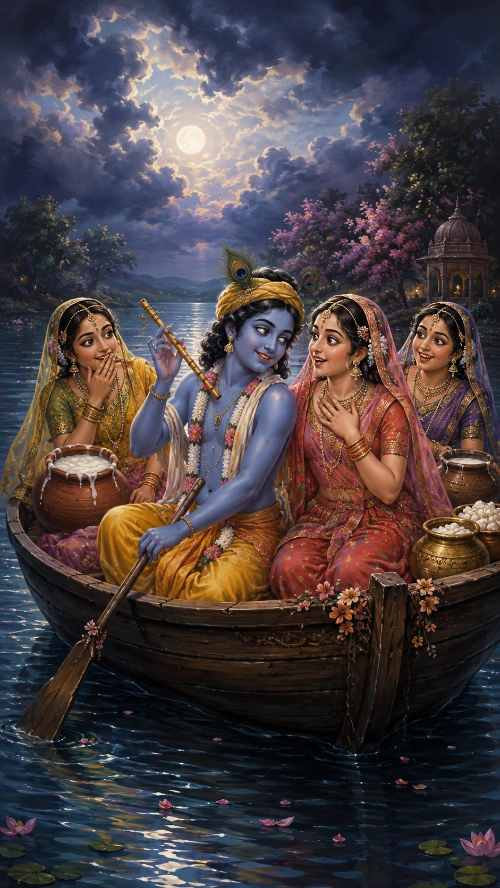
The Boatman with the Flute: Kṛṣṇa, the Gopīs and the Crossing of Mānasī-gaṅgā
A Puruṣottama-month Kṛṣṇa-kathā on the boatman of Mānasī-gaṅgā. The gopīs hire a young ferryman to carry them across with their pots of milk and butter; he stops rowing, demands to be fed, complains the boat is overloaded, and has them throw their pots and then their ornaments into the water. Only when a storm rises and Rādhārāṇī clings to his neck does the moon come out and the flute appear from beneath his garment.
Dear devotees, dear Vaiṣṇavīs, we continue our Kṛṣṇa-kathā during the month of Puruṣottama. This month is especially auspicious to hear stories about Kṛṣṇa, retell them, share them with others, and remember Him. Let us recite the auspicious prayers.
oṁ ajñāna-timirāndhasya
jñānāñjana-śalākayā
cakṣur unmīlitaṁ yena
tasmai śrī-gurave namaḥ
“I was born in the darkest ignorance, and my spiritual master opened my eyes with the torch of knowledge. I offer my respectful obeisances unto him.”
nama oṁ viṣṇu-pādāya
kṛṣṇa-preṣṭhāya bhū-tale
śrīmate bhaktivedānta-
svāmin iti nāmine
“I offer my respectful obeisances unto His Divine Grace A. C. Bhaktivedanta Swami, who is very dear to Lord Kṛṣṇa, having taken shelter at His lotus feet.”
namas te sārasvate deve
gaura-vāṇī-pracāriṇe
nirviśeṣa-śūnyavādi-
pāścātya-deśa-tāriṇe
“Our respectful obeisances unto you, O servant of Sarasvatī Gosvāmī. You are kindly preaching the message of Lord Caitanyadeva and delivering the Western countries, which are filled with impersonalism and voidism.”
Today we will remember a very sweet story connected with Kṛṣṇa’s līlās and the gopīs. It is told in such a romantic and poetic style that all of nature surrounding them seems to participate in preparing the setting for this līlā.
The Forest Prepares the Setting
At that time, sweet and fragrant nectar was dripping from the blossoms of the mango trees, and its sweetness attracted swarms of bumblebees. The forest of Vṛndāvana swayed in the breeze, and that breeze was said to come from the Malaya Mountains, where sandalwood grows. And we know that the fragrance of Kṛṣṇa’s body is described as containing several exquisite aromas — sandalwood, musk, saffron and camphor. Thus all of nature seemed to be preparing the surroundings for a particular playful joke of Kṛṣṇa, one that would ultimately bring pleasure to the gopīs.
The bushes and flowering creepers were covered with blossoms, and around them hovered bumblebees intoxicated by nectar. Their humming caressed the ear even more sweetly than the sound of Vedic hymns. The bumblebees seemed to be singing their own particular melodies, while the gentle breeze cooled the entire forest of Vṛndāvana. There were trees entwined with flowering vines, and the movement of the trees and creepers looked like a dance. Flowers spread their fragrance everywhere, while sweet juice seemed to drip from ripe pomegranates.
And suddenly, all the beauty of nature — the flowers, the bees, the humming of the bees — was eclipsed by the beauty of the gopīs. They were walking toward Mānasī-gaṅgā, carrying pots of milk, butter and yogurt upon their lovely heads. And in front of them all moved Śrīmatī Rādhārāṇī, gliding like a swan across the water.
She was so beautiful that nothing could compare with her beauty. The beauty of her eyes resembled freshly blossomed blue lotuses. The beauty of her face surpassed the beauty of all blooming lotuses. Her radiance made even gold feel ashamed of its own brilliance.
The Boatman Stops Rowing
And there, on the bank of Mānasī-gaṅgā, a young boatman sat in the only old and somewhat dilapidated boat. When the gopīs saw him, they were delighted, because they needed to cross to the other shore. They called out to him: “Please take us across to the other side, and we will give you sweets and butter in payment.”
So they climbed into the boat, and the young man began rowing. But suddenly he put down the oars. He settled himself comfortably and said: “I am not going to row any farther.”
Rādhārāṇī was surprised. “Why? What happened? Why have you stopped rowing?” The boatman simply replied: “I am tired, and I am very hungry. Until you feed me, I will not take up the oars again.”
The gopīs began looking at him suspiciously and protested: “What an impudent fellow you are! We promised to give you sweets and butter once you take us safely to the other shore, but now you are already demanding payment before you have even finished your work!”
And then everyone heard a loud hungry rumbling from his stomach — the kind of sound a person’s stomach makes when he badly wants something to eat. The boatman said: “There! Can you hear the sound coming from my poor, hungry stomach? I am tired and starving. Until you feed me, I will not touch the oars.”
The gopīs realised that the young man was not going to change his mind. “All right. Here, have some yogurt.” He drank it all down. Then he lay down on his left side and said: “According to the principles of Āyurveda, after eating one should lie on the left side for eight minutes. So now I need to take a little nap. And let two of the gopīs massage my feet, while two others massage my arms.”
From the corners of his lotus-like eyes, he mischievously glanced toward Rādhārāṇī. Rādhārāṇī, of course, did not like this idea at all. At first she answered gently and humbly, but then she became increasingly forceful and fierce. She said: “Yes, certainly. Two girls will take hold of your legs, and two others will take hold of your arms — and they will throw you overboard unless you immediately begin rowing us to the other shore!”
The boatman sighed regretfully: “Oh, my digestion…” But nevertheless he took up the oars again.
Overboard
After some time, however, he once again put the oars aside and exclaimed: “Ah! We are overloaded! This boat is old, there are too many of you, and you have too many pots. The boat is beginning to leak. Unless you throw some of your pots overboard, we are all going to drown!”
The gopīs became genuinely frightened. They began rushing about the boat, gasping in alarm, and started throwing their pots overboard. But the boatman was still not satisfied. “That is not enough! The boat is still sinking. Throw your gold ornaments overboard too. They are very heavy.”
The girls protested: “Our ornaments? No, no, no! We cannot do that. They are gifts and are very precious to us!” But eventually they obeyed. They could see that the boat really seemed to be taking on water.
So they threw all their precious ornaments overboard — and, along with them, their attachment to those ornaments. The jewels disappeared beneath the water.
Then the boatman cried: “Disaster! Disaster! We are in mortal danger! Throw your clothes overboard too!” At this point Rādhārāṇī became truly angry. “We will certainly throw you overboard if you do not start rowing immediately!” So the boatman bent to the oars once more.
The Storm, and the Moon
And then, completely unexpectedly, the sky became covered with heavy leaden clouds. A strong, cold wind began to blow. Lightning flashed across the sky, and deep thunder rolled. Great waves rose upon Mānasī-gaṅgā. Water began splashing over the sides of the boat and pouring inside.
The boatman saw the fear in the eyes of Śrīmatī Rādhārāṇī and her companions. And in order to increase their anxiety even further, he secretly began rocking the boat himself. Now the gopīs and Śrīmatī Rādhārāṇī became genuinely terrified. “We are all going to drown! How terrible!”
Rādhārāṇī became so frightened of falling into the water that she wrapped both arms around the boatman’s neck and pressed herself tightly against him. At that very moment, the clouds quickly dispersed. The waves became calm. And the radiant moon appeared in the sky.
Then Rādhā understood that this boatman was none other than her beloved Śyāmasundara. She began to smile. Waves of happiness appeared upon her cheeks, and her eyebrows danced like the bow of the god of love. Her glance became like an intoxicated bumblebee — and poetically, that bumblebee pierced the blossoming flower of Kṛṣṇa’s heart with its sting.
The Flute Beneath the Garment
The gopīs, however, were astonished when they saw Śrīmatī Rādhārāṇī embracing what appeared to be a strange boatman. “Rādhā! You are embracing some unknown young man!” they exclaimed in protest.
Then Rādhārāṇī reached beneath Kṛṣṇa’s garment and pulled out His flute. It was three fingers in length. It was decorated with sapphires, with rubies glowing at its ends, and it was covered in brilliantly shining gold. She showed it to her friends. “Look, sakhīs! It is Kṛṣṇa! He has tricked us again. And we fell for His joke so completely — we believed Him perfectly!”
Everyone in the boat breathed a sigh of relief. They understood that this frightening adventure had been nothing more than another playful joke of Kṛṣṇa. And they began to smile.
Kṛṣṇa returned to the gopīs all their pots of yogurt and butter. He also returned all their beautiful ornaments. The gopīs calmed down and settled comfortably in the boat. Then Kṛṣṇa began taking them for a leisurely ride while softly singing a graceful melody. The gopīs picked up Kṛṣṇa’s tune and repeated it in their beautiful, delicate, crystal-clear voices. Their happiness knew no bounds. Jaya!
Nothing is actually lost. The pots come back, the ornaments come back, the storm was never a storm. What the gopīs give up in the middle of the boat ride is not property but their hold on it — and the class marks that moment deliberately: overboard went the ornaments, and with them the attachment to the ornaments.
Such sweet līlās take place in Vraja. By narrating these stories, our ācāryas call us to develop the desire to enter these relationships through our mind, our mood and our service. Hare Kṛṣṇa, dear devotees.