

The Doubting Soul
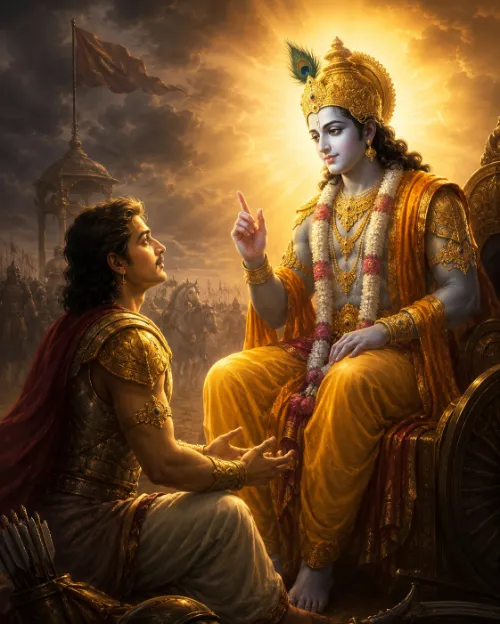
Faith Brave Enough to Ask, Knowledge Deep Enough to Answer
The Bhagavad-gītā contains one of the harshest lines in Sanskrit literature about unresolved doubt — and it is regularly misread as a warning against asking questions. That reading cannot survive contact with the text, because the man Kṛṣṇa is speaking to spends the entire dialogue doubting, questioning, and objecting, and is never once told to stop.
अज्ञश्चाश्रद्दधानश्च
संशयात्मा विनश्यति ।
नायं लोकोऽस्ति न परो
न सुखं संशयात्मनः ॥
ajñaś cāśraddadhānaś ca
saṁśayātmā vinaśyati
nāyaṁ loko ’sti na paro
na sukhaṁ saṁśayātmanaḥ
“The ignorant, the faithless, and the person characterized by doubt comes to ruin. For the doubting person there is neither this world, nor the next, nor happiness.”
“But ignorant and faithless persons who doubt the revealed scriptures do not attain God consciousness; they fall down. For the doubting soul there is happiness neither in this world nor in the next.”
Bhagavad-gītā 4.40
The traditional translation makes the devotional context explicit, but two of its phrases should be distinguished from the literal Sanskrit: the verse contains neither “revealed scriptures” nor “God consciousness.” What Kṛṣṇa names is three conditions.
That last term carries the weight, and it does not mean “someone who has a question.” If it did, the Gītā would contradict itself on nearly every page. Arjuna questions Kṛṣṇa repeatedly, asks for clarification, points out apparent contradictions, and says outright this is my doubt, please destroy it — and Kṛṣṇa does not rebuke him. He teaches him.
The warning concerns something else: doubt that has stopped functioning as a stage of inquiry and become a settled inability to receive knowledge, reach conviction, or act.
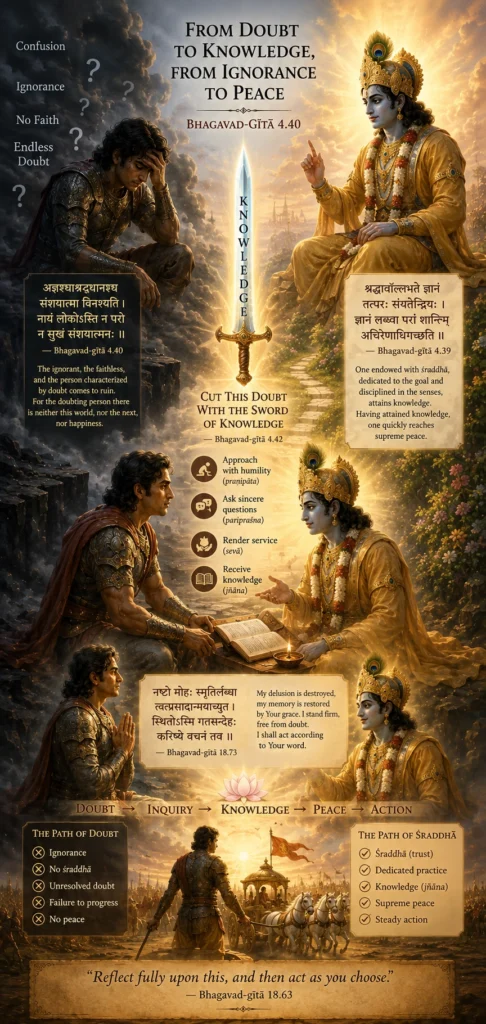
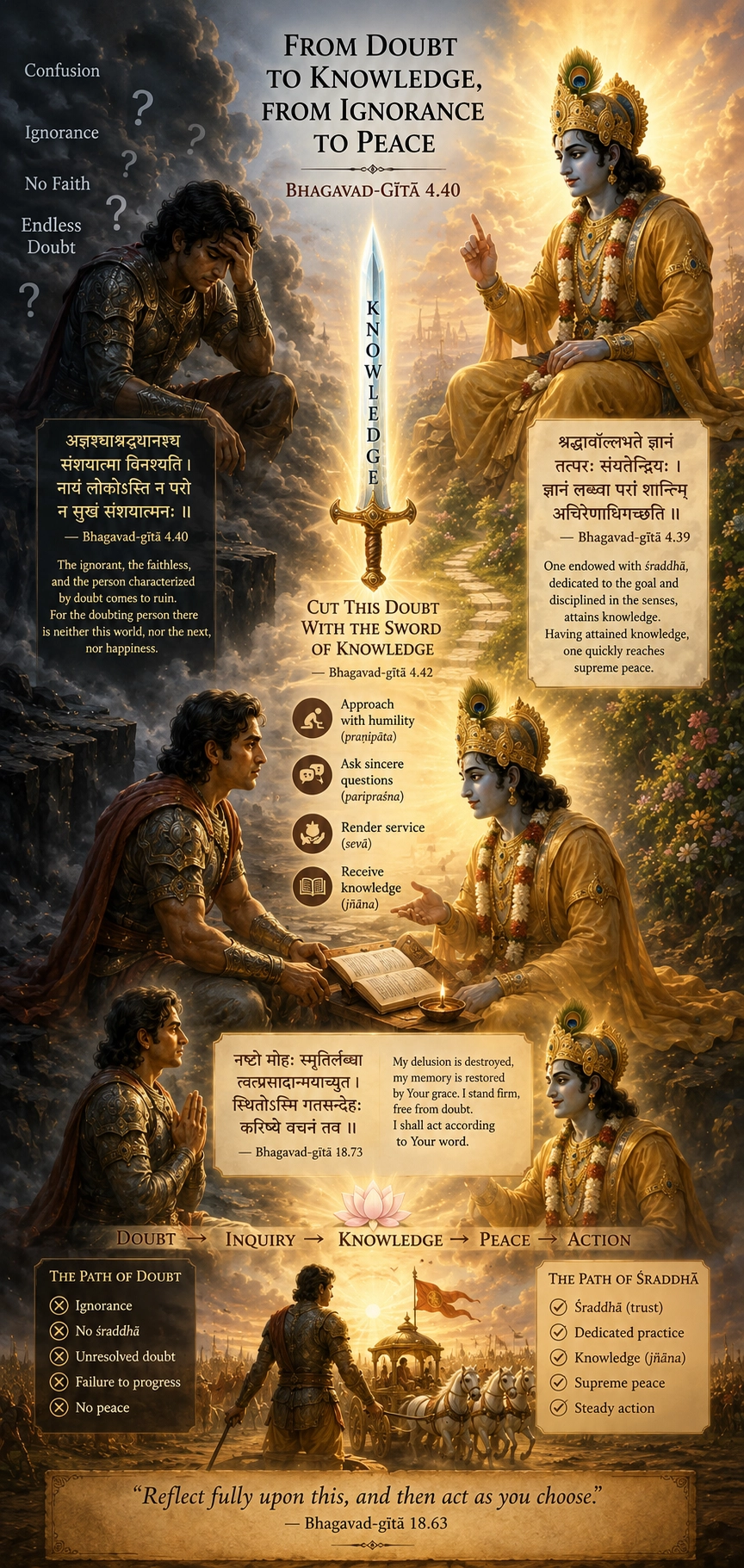
The whole argument on one sheet: the path of doubt set against the path of śraddhā, the sword of knowledge from 4.42 down the center, and the movement from faith through inquiry and knowledge to peace and action.
The Verse Is a Negative Mirror
Verse 4.40 is built as the photographic negative of the one immediately before it:
श्रद्धावाँल्लभते ज्ञानं
तत्परः संयतेन्द्रियः ।
ज्ञानं लब्ध्वा परां शान्तिम्
अचिरेणाधिगच्छति ॥
śraddhāvāḻ labhate jñānaṁ
tat-paraḥ saṁyatendriyaḥ
jñānaṁ labdhvā parāṁ śāntim
acireṇādhigacchati
“One endowed with śraddhā, dedicated to the goal and disciplined in the senses, attains knowledge. Having attained knowledge, one quickly reaches supreme peace.”
Bhagavad-gītā 4.39
So the contrast is not believer against skeptic. It is a person willing to learn, inquire, practice and let uncertainty mature into knowledge, against a person whose uncertainty has become permanent paralysis.
“One Who Does Not Know”
अज्ञः
ajñaḥ
— from a-, not, and jña, knowing. Which is not the same as calling someone stupid. A person may have considerable academic learning and remain ajña about the questions the Gītā is asking: what the self is, how consciousness relates to the body, what karma is, what survives death, what liberation means. And someone with little formal education may understand a great deal of it. The word concerns knowledge of reality, not intellectual sophistication.
Nor is ignorance itself the serious problem. Saying I do not know is where all genuine education starts, and someone who does not know but wants to learn remains teachable. The difficulty arrives when ignorance combines with the absence of trust and hardens into a doubt that refuses every route out of itself.
What Śraddhā Actually Means
अश्रद्दधानः
aśraddadhānaḥ
— one who lacks:
श्रद्धा
śraddhā.
Usually translated “faith,” and the English word misleads badly here, because the Gītā does not define faith as believing without asking. In this very chapter Kṛṣṇa recommends the opposite:
तद्विद्धि प्रणिपातेन
परिप्रश्नेन सेवया ।
उपदेक्ष्यन्ति ते ज्ञानं
ज्ञानिनस्तत्त्वदर्शिनः ॥
tad viddhi praṇipātena
paripraśnena sevayā
upadekṣyanti te jñānaṁ
jñāninas tattva-darśinaḥ
“Understand that truth by approaching those who know it, with humility, serious inquiry, and service. Those who possess knowledge and have seen reality will teach that knowledge to you.”
Bhagavad-gītā 4.34
The middle term of that instruction is paripraśna — serious, thorough, persistent questioning. The faithful student is not the one who never asks. The faithful student asks because they believe truth can actually be known.
Which suggests a more useful gloss: śraddhā is trust sufficient to seriously enter a path of knowing. Every demanding discipline requires something like it — a student begins by trusting that the subject is worth studying, that the method may reveal something real, that the teacher knows something they do not, and that sustained work leads somewhere. That trust is not yet knowledge. It is what makes knowledge possible:
श्रद्धावाँल्लभते ज्ञानम्
śraddhāvāḻ labhate jñānam
“One endowed with śraddhā attains knowledge.”
Śraddhā does not replace jñāna. It opens the door to it. Kṛṣṇadāsa Kavirāja’s Bengali definition puts the emphasis in the same place:
‘শ্রদ্ধা’-শব্দে — বিশ্বাস কহে সুদৃঢ় নিশ্চয় ।
কৃষ্ণে ভক্তি কৈলে সর্বকর্ম কৃত হয় ॥
“The word śraddhā means firm and confident conviction that by performing bhakti to Kṛṣṇa all essential spiritual purposes are fulfilled.”
Caitanya-caritāmṛta, Madhya-līlā 22.62
— sudṛḍha niścaya, firm conviction. And in 4.39 śraddhā leads immediately to tat-paraḥ, dedication, and saṁyatendriyaḥ, discipline of the senses. So mature śraddhā has moved past this might be true to I will engage seriously enough to find out.
Which is why Kṛṣṇa later says the thing shapes the person:
सत्त्वानुरूपा सर्वस्य
श्रद्धा भवति भारत ।
श्रद्धामयोऽयं पुरुषो
यो यच्छ्रद्धः स एव सः ॥
sattvānurūpā sarvasya
śraddhā bhavati bhārata
śraddhā-mayo ’yaṁ puruṣo
yo yac-chraddhaḥ sa eva saḥ
“The śraddhā of each person corresponds to that person’s inner condition. A person is formed by śraddhā; according to the nature of one’s śraddhā, so one becomes.”
Bhagavad-gītā 17.3
What someone fundamentally trusts determines what they pursue, what they practice, what they sacrifice for, what they treat as meaningful — and eventually what kind of person they become. Śraddhā is not one belief among many. It organizes a life.
The Person Characterized by Doubt
संशयात्मा
saṁśayātmā
From saṁśaya, doubt or indecision, and ātman, self — literally, one whose inner condition is doubt. Rendering it “a person dominated by doubt” is interpretive but conveys the force. It is not describing momentary uncertainty; it points to a condition in which doubt has become habitual enough that the person cannot move past it. Every thoughtful person experiences uncertainty. The danger is when uncertainty stops serving inquiry and becomes an identity.
Arjuna is the counter-example, and the Gītā puts him there deliberately. He opens by admitting confusion outright:
कार्पण्यदोषोपहतस्वभावः
पृच्छामि त्वां धर्मसम्मूढचेताः ।
यच्छ्रेयः स्यान्निश्चितं ब्रूहि तन्मे
शिष्यस्तेऽहं शाधि मां त्वां प्रपन्नम् ॥
kārpaṇya-doṣopahata-svabhāvaḥ
pṛcchāmi tvāṁ dharma-sammūḍha-cetāḥ
yac chreyaḥ syān niścitaṁ brūhi tan me
śiṣyas te ’haṁ śādhi māṁ tvāṁ prapannam
“My nature is overcome by weakness, and my mind is bewildered concerning dharma. I ask You to tell me decisively what is truly good for me. I am Your disciple; instruct me, for I have taken refuge in You.”
Bhagavad-gītā 2.7
— and then says pṛcchāmi tvām, I ask You. That is uncertainty working constructively. Later he is blunter still:
एतन्मे संशयं कृष्ण
छेत्तुमर्हस्यशेषतः ।
त्वदन्यः संशयस्यास्य
छेत्ता न ह्युपपद्यते ॥
etan me saṁśayaṁ kṛṣṇa
chettum arhasy aśeṣataḥ
tvad-anyaḥ saṁśayasyāsya
chettā na hy upapadyate
“This is my doubt, O Kṛṣṇa. Please cut it away completely. Apart from You, I see no one capable of destroying this doubt.”
Bhagavad-gītā 6.39
Kṛṣṇa plainly does not object to Arjuna saying I doubt. What matters is the next move: Arjuna wants the doubt chettum, cut away. He does not make it his permanent address.
The first uses doubt as an instrument; the second turns it into a prison.
Not the Same as a Critical Thinker
The Gītā does not idealize intellectual passivity — it explicitly teaches paripraśna. So the opposite of saṁśayātmā is not someone who believes everything. The real contrast is between disciplined inquiry capable of reaching knowledge and a skepticism that cannot permit knowledge to become established.
A critical thinker says show me why this should be accepted. A chronic doubter eventually arrives at no possible evidence could ever justify confidence — and at that point skepticism has begun undermining the possibility of knowing anything at all.
Indian philosophy is precise about this, because it prizes:
विवेक
viveka
— discernment, which asks which is true and which is false and aims at resolution. Doubt can be an early stage of that. It is not meant to be the final one:
What “Perishes” Means
संशयात्मा विनश्यति
saṁśayātmā vinaśyati
The verb can mean perishes, is ruined, fails, comes to destruction — and it should not be read as the eternal self ceasing to exist, which the Gītā nowhere teaches. The sense is that the person’s spiritual undertaking fails: knowledge does not become established, peace does not emerge, action stays unstable. It describes existential failure, not ontological annihilation.
And there is a plain reason chronic doubt produces that. Meaningful action requires some threshold of confidence — at some point one must choose this direction rather than that, this method rather than endless comparison, this conclusion rather than perpetual suspension. If every possibility remains equally doubted forever, serious action becomes impossible. Hence:
नायं लोकोऽस्ति न परः
nāyaṁ loko ’sti na paraḥ
“For him there is neither this world nor the next.”
Deliberately strong language, and in its immediate context it means that one who cannot become established in knowledge and practice fails both in present spiritual life and in the destination that path leads toward. It does not mean the doubter literally ceases to exist here.
The principle has a recognizable application beyond formal religious practice, though it is an application rather than the verse’s meaning. Ordinary life needs enough trust to sustain friendship, education, cooperation, research and long-term work; absolute distrust makes commitment nearly impossible. That is not an argument against healthy caution — only the observation that a person cannot live meaningfully if every possible basis for trust is permanently dissolved.
No Happiness for the Doubting Person
न सुखं संशयात्मनः
na sukhaṁ saṁśayātmanaḥ
“There is no happiness for the one characterized by doubt.”
A chronically doubting mind cannot rest. Every conclusion reopens, every commitment stays provisional, every decision gets revisited, every relationship can become suspect. The mind stays caught in perhaps — but perhaps not. Analytical ability may remain perfectly sharp; peace does not follow it. Which is exactly the contrast with 4.39, where knowledge is attained and supreme peace comes with it.
Resolved understanding is not the same as dogmatism, and the distinction is worth guarding. A mature person can say: this is what I presently understand to be true, and I will act accordingly, while remaining open to genuine correction. That is quite different from because absolute certainty about every detail is impossible, no commitment is ever legitimate. The Gītā wants stable knowledge, not intellectual stubbornness.
The Remedy Is Knowledge
This is the safeguard that governs the whole discussion. Kṛṣṇa never tells Arjuna to suppress his doubts. He says:
योगसन्न्यस्तकर्माणं
ज्ञानसञ्छिन्नसंशयम् ।
आत्मवन्तं न कर्माणि
निबध्नन्ति धनञ्जय ॥
yoga-sannyasta-karmāṇaṁ
jñāna-sañchinna-saṁśayam
ātmavantaṁ na karmāṇi
nibadhnanti dhanañ-jaya
“Actions do not bind one who has renounced action through yoga, whose doubt has been cut away by knowledge, and who is established in the self, O Dhanañjaya.”
Bhagavad-gītā 4.41
whose decisive phrase is:
ज्ञानसञ्छिन्नसंशयम्
jñāna-sañchinna-saṁśayam
— one whose doubt has been cut through knowledge. Not through fear, not censorship, not forced belief. And he closes the chapter with the image the whole argument has been building toward:
तस्मादज्ञानसम्भूतं
हृत्स्थं ज्ञानासिनात्मनः ।
छित्त्वैनं संशयं योगम्
आतिष्ठोत्तिष्ठ भारत ॥
tasmād ajñāna-sambhūtaṁ
hṛt-sthaṁ jñānāsinātmanaḥ
chittvainaṁ saṁśayaṁ yogam
ātiṣṭhottiṣṭha bhārata
“Therefore, with the sword of knowledge, cut away this doubt born from ignorance and situated in the heart. Take your stand in yoga and arise, O Bhārata.”
Bhagavad-gītā 4.42
That last word matters. The Gītā is not trying to make Arjuna intellectually certain and leave him sitting down. The movement runs confusion → inquiry → knowledge → doubt cut away → yoga → action. Knowledge does its job when it restores the capacity to live rightly.
Two verses before the warning, Kṛṣṇa had already named the instrument:
न हि ज्ञानेन सदृशं
पवित्रमिह विद्यते ।
तत्स्वयं योगसंसिद्धः
कालेनात्मनि विन्दति ॥
na hi jñānena sadṛśaṁ
pavitram iha vidyate
tat svayaṁ yoga-saṁsiddhaḥ
kālenātmani vindati
“In this world there is nothing so purifying as knowledge. One perfected through yoga discovers that knowledge within oneself in due course of time.”
Bhagavad-gītā 4.38
and qualified it with kālena, in due course — an acknowledgment that realized understanding may need time, practice, discipline and maturation. Śraddhā is what keeps a seeker engaged while that ripens.
An Older Formulation
The image of doubt being cut by realization is older than the Gītā:
भिद्यते हृदयग्रन्थिश्
छिद्यन्ते सर्वसंशयाः ।
क्षीयन्ते चास्य कर्माणि
तस्मिन्दृष्टे परावरे ॥
bhidyate hṛdaya-granthiś
chidyante sarva-saṁśayāḥ
kṣīyante cāsya karmāṇi
tasmin dṛṣṭe parāvare
“When the Supreme Reality is seen, the knot of the heart is broken, all doubts are cut away, and one’s karmas are exhausted.”
Muṇḍaka Upaniṣad 2.2.8
whose crucial phrase is:
छिद्यन्ते सर्वसंशयाः
chidyante sarva-saṁśayāḥ
and the Bhāgavatam preserves an almost identical formulation:
भिद्यते हृदयग्रन्थिश्
छिद्यन्ते सर्वसंशयाः ।
क्षीयन्ते चास्य कर्माणि
दृष्ट एवात्मनीश्वरे ॥
bhidyate hṛdaya-granthiś
chidyante sarva-saṁśayāḥ
kṣīyante cāsya karmāṇi
dṛṣṭa evātmanīśvare
“The knot of the heart is broken, all doubts are cut away, and one’s karmic bondage comes to an end when the Lord is directly realized.”
Śrīmad-Bhāgavatam 1.2.21
Both place two events side by side: the hṛdaya-granthi, knot of the heart, is broken, and doubt is cut. Which carries an implication worth drawing out carefully — not every doubt is purely intellectual. Sometimes accepting a conclusion would require change, humility, renunciation or surrender, and attachment then influences what the intellect is willing to accept. That is not an explicit theory stated in the verse; it is suggested by the proximity of the two clauses. Realized knowledge has to reach further than ideas — into desire, attachment, identity and life.
Faith and Inquiry Are Not Rivals
Too little śraddhā produces refusal to engage; too little inquiry produces gullibility. The Gītā’s method combines praṇipāta, humility, with paripraśna, serious questioning, and sevā, practical engagement — which yields a model of learning that is humble enough to listen, intelligent enough to question, sincere enough to practice, patient enough to learn, and courageous enough to act when clarity arrives.
Which raises a fair question about the published translation. The Sanskrit of 4.40 contains no word for śāstra — so why does Prabhupāda render it “faithless persons who doubt the revealed scriptures”? Because the translation makes the traditional epistemic context explicit: spiritual knowledge is not generated by private speculation alone but received through valid sources, particularly śāstra and realized teachers. So aśraddadhāna is read as one who lacks sufficient trust in genuine spiritual testimony for that testimony to function as an avenue of knowledge. It is interpretive rather than word-for-word, and worth identifying as such.
But accepting śāstra as authoritative has never meant do not think. The Gītā is itself an extended exercise in reasoning: Kṛṣṇa argues, distinguishes, answers objections, uses analogy, resolves apparent contradictions, and invites Arjuna to understand. Near the end He says something remarkable for a text often presented as demanding obedience:
विमृश्यैतदशेषेण
यथेच्छसि तथा कुरु ॥
vimṛśyaitad aśeṣeṇa
yathecchasi tathā kuru
“Reflect fully upon all this, and then act as you choose.”
Bhagavad-gītā 18.63
Kṛṣṇa teaches. Arjuna reflects. Then Arjuna chooses — and only after that does Kṛṣṇa give His most intimate invitation to surrender. Surrender does not arrive as the destruction of intelligence; it comes after dialogue, reasoning, inquiry, reflection and relationship.
How Arjuna Ends
नष्टो मोहः स्मृतिर्लब्धा
त्वत्प्रसादान्मयाच्युत ।
स्थितोऽस्मि गतसन्देहः
करिष्ये वचनं तव ॥
naṣṭo mohaḥ smṛtir labdhā
tvat-prasādān mayācyuta
sthito ’smi gata-sandehaḥ
kariṣye vacanaṁ tava
“My delusion has been destroyed and my memory restored by Your grace, O Acyuta. I stand firm, free from doubt, and I shall act according to Your word.”
Bhagavad-gītā 18.73
गतसन्देहः
gata-sandehaḥ
— one whose doubt has gone. That is the actual answer to 4.40, and the way he reached it is the point: he did not become free of doubt by refusing to question. He became free of it because he questioned intelligently.
That is not one subsection of the Gītā. It is the architecture of the entire dialogue.
स्थितोऽस्मि
sthito ’smi
“I stand firm.”
Doubt Is a Stage, Not a Destination
Doubt is genuinely useful. It shows that something remains unclear, stimulates questions, exposes contradictions, guards against superficiality, and protects against gullibility. But it is supposed to lead somewhere. When it becomes the permanent destination it stops doing the work doubt exists to do, and turns into self-consuming uncertainty instead.
Which means a healthy spiritual path has no reason to fear questions, and a genuine teacher should not. The Gītā explicitly honors paripraśna: a student should be able to ask why, and how, and what this verse actually says, and whether a translation is literal or interpretive, and how the passages fit together, and how any of it is meant to be practiced. Treated honestly, such questions strengthen śraddhā. Suppressed, they tend to return later as deeper confusion.
Though not every question seeks understanding. One can ask in order to defeat, to mock, to display intelligence, or to avoid any possibility of commitment. Constructive inquiry contains at least some willingness to be changed by the answer — which is precisely why the Gītā pairs questioning with humility. Questioning without humility becomes combat; humility without questioning becomes passivity.
And śraddhā does not require certainty about every detail. A beginner may hold many unresolved questions and still have it, because śraddhā can mean: I have enough confidence in this path to keep investigating, practicing and learning while my understanding develops. That is more honest than performing a certainty one does not have — and 4.38 explicitly allows that knowledge may be realized kālena, in due course, some things becoming intelligible only through practice, experience and character.
Two Translations
Staying close to the Sanskrit:
“The ignorant, the faithless, and the doubting person comes to ruin. For the doubting person there is neither this world, nor the next, nor happiness.”
And an openly interpretive rendering, whose purpose is to convey the force of saṁśayātmā without implying that sincere questioning is what stands condemned:
“The ignorant person, one who lacks the trust needed to seriously receive spiritual knowledge, and especially one whose inner life remains trapped in unresolved doubt fails to attain the goal. For one imprisoned in such doubt there is neither stable fulfillment here nor attainment of the higher goal, nor genuine peace.”
The Whole Teaching in One Sequence
Read carelessly, 4.40 sounds like an instruction never to doubt spiritual teaching — and the rest of the Gītā disproves that reading on its own. Arjuna doubts, questions, challenges, and asks repeatedly for clarification, and Kṛṣṇa answers not with fear or censorship or a demand for intellectual passivity, but with knowledge. The danger the verse names is not the temporary uncertainty of an intelligent seeker. It is a condition in which doubt has grown so deep that one can no longer trust enough to learn, learn enough to know, know enough to decide, or decide enough to act. What the Gītā asks for instead is śraddhā courageous enough to inquire, knowledge deep enough to resolve doubt, and conviction strong enough to rise.