

Why Śaṅkarācārya Praises the Man Who Owns Almost Nothing
What the loincloth actually stands for in this hymn
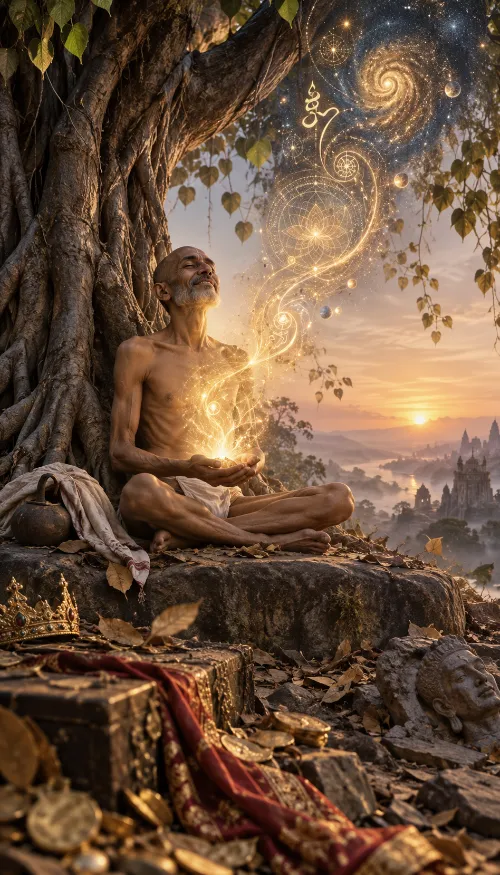
A man owns almost nothing. He has no house, no wealth, no elaborate wardrobe, and perhaps not even a begging bowl. He eats whatever comes unsolicited, sleeps beneath a tree, and wears little more than a kaupīna, the simple loincloth of an Indian renunciate.
Ordinary society might call him poor. A short Sanskrit hymn traditionally attributed to Ādi Śaṅkarācārya calls him:
Why? Not because poverty itself is sacred. Not because clothing oneself minimally automatically produces wisdom. And not because physical discomfort is spiritually superior to comfort.
The poem’s answer is much deeper:
The renunciate is fortunate because he has discovered a source of fulfillment that no longer depends upon external acquisition.
He delights in Vedānta. He is content with little. His senses are peaceful. His inner life is free from ordinary sorrow. What appears externally as deprivation is presented internally as freedom.
The famous abbreviated line— vedānta-vākyeṣu sadā ramantaḥ kaupīnavantaḥ khalu bhāgyavantaḥ —comes from the first verse of the Kaupīna-pañcakam, “Five Verses on the Loincloth-Clad Ascetic,” a short work traditionally ascribed to Śaṅkarācārya.
The complete stanza reveals what the famous refrain actually means.
The complete opening verse
Kaupīna-pañcakam 1
वेदान्तवाक्येषु सदा रमन्तो
भिक्षान्नमात्रेण च तुष्टिमन्तः ।
विशोकमन्तःकरणे चरन्तः
कौपीनवन्तः खलु भाग्यवन्तः ॥
vedānta-vākyeṣu sadā ramanto
bhikṣānna-mātreṇa ca tuṣṭimantaḥ
viśokam antaḥ-karaṇe carantaḥ
kaupīnavantaḥ khalu bhāgyavantaḥ
“Always delighting in the teachings of Vedānta, satisfied with nothing more than food obtained as alms, moving through life with an inner being free from sorrow—the loincloth-clad renunciates are indeed truly fortunate.”
The complete stanza is much richer than the abbreviated quotation. It identifies three characteristics of the “fortunate” ascetic: delight in Vedānta, contentment with little, and inward freedom from sorrow.
The kaupīna is therefore not the cause of his realization. It is the outward sign of an inward condition.
Ramantaḥ: they do not merely study Vedānta—they delight in it
The first line says: vedānta-vākyeṣu sadā ramantaḥ The crucial verb is: ramantaḥ from the Sanskrit root √ram:
to delight, rejoice, take pleasure, revel.
The poem does not merely say:
“They read Vedānta.”
Nor even:
“They study Vedānta diligently.”
It says:
“They delight in the statements of Vedānta.”
This changes the whole picture. For such a renunciate, Vedānta is no longer merely intellectual labor. It has become the place where the mind naturally wants to dwell. What ordinary consciousness seeks in: entertainment, possession, status, pleasure, novelty, the renunciate finds in contemplation of ultimate reality.
The center of pleasure has shifted.
What are Vedānta-vākyas?
The compound: vedānta-vākya means:
“a statement or teaching of Vedānta.”
It should not be restricted too narrowly to the aphorisms of the Brahma-sūtra. In classical usage, Vedānta fundamentally refers to the Upaniṣads, the concluding and philosophical portion of Vedic revelation, together with the works that systematize their teaching.
A later traditional Advaita manual, the Vedānta-sāra, states:
वेदान्तो नाम उपनिषत्प्रमाणं तदुपकारीणि शारीरकसूत्रादीनि च ।
vedānto nāma upaniṣat-pramāṇaṁ tad-upakārīṇi śārīraka-sūtrādīni ca
“Vedānta means the authoritative revelation of the Upaniṣads, together with auxiliary works such as the Śārīraka-sūtras.”
So the ascetic “delighting in Vedānta” naturally evokes meditation upon Upaniṣadic teachings concerning: Ātman, Brahman, liberation, impermanence, and the unreality of ordinary possessiveness.
The famous mahāvākyas stand behind the image
Within the Advaita tradition, some of the most famous Vedāntic sentences are the great Upaniṣadic mahāvākyas. For example:
अहं ब्रह्मास्मि ।
ahaṁ brahmāsmi
“I am Brahman.”
And:
तत्त्वमसि ।
tat tvam asi
“That thou art.”
And:
अयमात्मा ब्रह्म ।
ayam ātmā brahma
“This Self is Brahman.”
These are not merely philosophical slogans within Advaita. They become subjects of: śravaṇa — hearing, manana — reflection, and: nididhyāsana — profound contemplative assimilation.
Thus vedānta-vākyeṣu sadā ramantaḥ describes a mind that repeatedly returns to the revelation of the Self and Brahman until that becomes more attractive than ordinary worldly occupation.
Bhikṣānna-mātreṇa: enough is enough
The next line says: bhikṣānna-mātreṇa ca tuṣṭimantaḥ
Thus:
“Satisfied with nothing more than food obtained as alms.”
The important concept is not begging itself. It is: tuṣṭi — contentment. The ascetic does not spend his life maximizing consumption. He asks a radically different question:
How little is actually necessary for the body to continue while consciousness remains devoted to liberation?
His economy is an economy of sufficiency rather than accumulation.
The world says “more”; the renunciate says “enough”
This is one of the deepest psychological contrasts in the hymn. Ordinary desire says:
“If I acquire one more thing, then I will be satisfied.”
The ascetic ideal says:
“Satisfaction cannot be postponed until acquisition ends, because acquisition has no natural endpoint.”
The solution is not to finish accumulating. It is to become: tuṣṭa content. This is why apparent poverty can coexist with the poem’s emphatic: bhāgyavantaḥ “fortunate ones.”
Viśokam antaḥ-karaṇam: poverty without sorrow
The third line is equally important: viśokam antaḥ-karaṇe carantaḥ The key word is: viśoka free from sorrow. And: antaḥ-karaṇa the “inner instrument”—mind, intellect, ego, inner consciousness.
So the ideal ascetic is not portrayed as: hungry, resentful, miserable, and secretly longing for the possessions of householders. If that were his condition, the hymn could hardly call him fortunate.
His simplicity is meaningful because:
the inner demand for external completion has subsided.
He owns little because he needs little, not because he is merely deprived.
The refrain: kaupīnavantaḥ khalu bhāgyavantaḥ
Now the famous line makes sense. kaupīnavantaḥ those possessing a kaupīna khalu indeed, certainly bhāgyavantaḥ fortunate, blessed. A kaupīna is the minimal loincloth associated with renunciation.
But the poem is not proposing an equation: less clothing = more enlightenment. Rather:
The loincloth visually represents a life from which almost every nonessential dependency has been removed.
The refrain is paradoxical because society normally identifies fortune with abundance. The hymn identifies fortune with freedom from need.
Verse two turns the world’s economy upside down
A common recension continues:
Kaupīna-pañcakam 2
मूलं तरोः केवलमाश्रयन्तः
पाणिद्वयं भोक्तुममन्त्रयन्तः ।
कन्थामिव श्रीमपि कुत्सयन्तः
कौपीनवन्तः खलु भाग्यवन्तः ॥
mūlaṁ taroḥ kevalam āśrayantaḥ
pāṇi-dvayaṁ bhoktum amantrayantaḥ
kanthām iva śrīm api kutsayantaḥ
kaupīnavantaḥ khalu bhāgyavantaḥ
“Taking only the foot of a tree as shelter, using their two hands as the means for eating, regarding even worldly prosperity as no more valuable than a patched cloth—the loincloth-clad renunciates are indeed fortunate.”
The poem now removes several pillars of conventional security. No house: a tree is enough. No elaborate utensils: two hands are enough. No fascination with wealth: prosperity itself has lost its hypnotic power.
Even the begging bowl becomes optional
The image of: pāṇi-dvayam “the two hands” is particularly striking. The ascetic does not even need to turn simplicity into a new collection of specialized ascetic possessions.
His hands can become his bowl. This is renunciation pushed almost to the edge of material necessity. The point is not theatrical poverty. It is:
radical reduction of dependence.
Why does he treat śrī like an old cloth?
The line says: kanthām iva śrīm api kutsayantaḥ Here: śrī can mean prosperity, wealth, splendor, worldly magnificence. kanthā is a patched or worn cloth. What society treats with reverence, the renunciate sees as spiritually insignificant.
That is a deliberate inversion. The ordinary person sees treasure. The ascetic sees:
something temporary, unable to solve the fundamental problem of birth and death.
But the hymn is not glorifying deprivation for its own sake
This becomes unmistakable in another stanza:
स्वानन्दभावे परितुष्टिमन्तः
सुशान्तसर्वेन्द्रियवृत्तिमन्तः ।
अहर्निशं ब्रह्मसुखे रमन्तः
कौपीनवन्तः खलु भाग्यवन्तः ॥
svānanda-bhāve parituṣṭimantaḥ
suśānta-sarvendriya-vṛttimantaḥ
ahar-niśaṁ brahma-sukhe ramantaḥ
kaupīnavantaḥ khalu bhāgyavantaḥ
“Completely satisfied in the bliss of the Self, with all movements of the senses deeply pacified, delighting day and night in the happiness of Brahman—the loincloth-clad renunciates are indeed fortunate.”
Now the philosophical logic becomes explicit. He does not need little because he has crushed himself through deprivation. He needs little because he possesses: svānanda the bliss of the Self, and: brahma-sukha the happiness of Brahman.
External simplicity is therefore the result of internal fullness.
Renunciation is not emptiness—it is replacement
This distinction is crucial. A superficial definition says:
“Renunciation means giving things up.”
The deeper Vedāntic idea is:
Renunciation becomes stable when something greater replaces what has been relinquished.
Otherwise the person may leave home physically while carrying the whole world inside his mind. He may abandon wealth and spend every day thinking about wealth. He may renounce reputation and become proud of being renowned as a renunciate.
He may give up possessions while becoming intensely possessive of his spiritual identity. The Kaupīna-pañcakam describes something more radical:
the center of satisfaction itself has changed.
The Upaniṣads already describe this renunciant ideal
The famous hymn stands within a much older tradition. The Bṛhadāraṇyaka Upaniṣad describes people who, after realizing the Self, relinquish the great ambitions around which ordinary life is organized.
एतं वै तमात्मानं विदित्वा
ब्राह्मणाः पुत्रैषणायाश्च वित्तैषणायाश्च
लोकैषणायाश्च व्युत्थायाथ भिक्षाचर्यं चरन्ति ।
etaṁ vai tam ātmānaṁ viditvā
brāhmaṇāḥ putraiṣaṇāyāś ca vittaiṣaṇāyāś ca
lokaiṣaṇāyāś ca vyutthāyātha bhikṣācaryaṁ caranti
“Having known this Self, the knowers of Brahman rise beyond the desire for sons, the desire for wealth, and the desire for worlds, and thereafter live the life of mendicants.”
Bṛhadāraṇyaka Upaniṣad 3.5.1
Three great drives are named: putraiṣaṇā — the desire for progeny and continuation, vittaiṣaṇā — the desire for wealth, lokaiṣaṇā — the desire for worlds, status, or future attainment.
The renunciate is not merely giving up objects. He is dismantling the desires that make those objects existentially necessary.
The real renunciation happens in the heart
The Kaṭha Upaniṣad states this even more clearly.
यदा सर्वे प्रमुच्यन्ते
कामा येऽस्य हृदि श्रिताः ।
अथ मर्त्योऽमृतो भवत्य्
अत्र ब्रह्म समश्नुते ॥
yadā sarve pramucyante
kāmā ye ’sya hṛdi śritāḥ
atha martyo ’mṛto bhavaty
atra brahma samaśnute
“When all the desires lodged in the heart are released, then the mortal becomes immortal and attains Brahman here.”
Kaṭha Upaniṣad 2.3.14
The decisive location is: hṛdi “in the heart.” External abandonment without internal release is incomplete. And the verse says: atra “here.” The state of freedom is not merely a reward postponed until death.
It begins with transformation of consciousness.
Why ritual achievement eventually becomes insufficient
The Muṇḍaka Upaniṣad gives one of the classical arguments for renunciation.
परीक्ष्य लोकान् कर्मचितान् ब्राह्मणो
निर्वेदमायान्नास्त्यकृतः कृतेन ।
तद्विज्ञानार्थं स गुरुमेवाभिगच्छेत्
समित्पाणिः श्रोत्रियं ब्रह्मनिष्ठम् ॥
parīkṣya lokān karma-citān brāhmaṇo
nirvedam āyān nāsty akṛtaḥ kṛtena
tad-vijñānārthaṁ sa gurum evābhigacchet
samit-pāṇiḥ śrotriyaṁ brahma-niṣṭham
“Having examined the worlds obtained by action, the discerning person should become dispassionate, understanding that the uncreated cannot be attained through what is produced by action. To know that reality he should approach a guru who is learned in revelation and firmly established in Brahman.”
Muṇḍaka Upaniṣad 1.2.12
The powerful sentence is:
nāsty akṛtaḥ kṛtena
“The uncreated cannot be attained through what is created by action.”
No finite quantity of ritual action can mechanically manufacture the Infinite. This is the philosophical background behind the renunciate’s withdrawal from an endless economy of ritual reward.
The kaupīna belongs to an established ascetic tradition
The loincloth itself is not an invention of this poem. Indian renunciant literature repeatedly treats the kaupīna as the bare minimum of clothing for the wandering ascetic.
The Śrīmad-Bhāgavatam says:
बिभृयाच्चेन्मुनिर्वासः
कौपीनाच्छादनं परम् ।
त्यक्तं न दण्डपात्राभ्याम्
अन्यत् किञ्चिदनापदि ॥
bibhṛyāc cen munir vāsaḥ
kaupīnācchādanaṁ param
tyaktaṁ na daṇḍa-pātrābhyām
anyat kiñcid anāpadi
“If the sage wears clothing beyond the kaupīna, he may use only a simple covering. Except in an emergency, after renouncing possessions he should keep nothing beyond his staff and waterpot.”
Śrīmad-Bhāgavatam 11.18.15
So the Kaupīna-pañcakam reflects a recognizable ascetic ideal:
reduce material life to what is necessary, so consciousness can be directed toward transcendence.
Yet the Bhagavad-gītā warns: external renunciation is not enough
This qualification is indispensable.
अनाश्रितः कर्मफलं
कार्यं कर्म करोति यः ।
स संन्यासी च योगी च
न निरग्निर्न चाक्रियः ॥
anāśritaḥ karma-phalaṁ
kāryaṁ karma karoti yaḥ
sa sannyāsī ca yogī ca
na niragnir na cākriyaḥ
“One who performs the work that should be done without depending upon its fruits is truly a sannyāsī and a yogī—not merely one who abandons sacrificial fire or external activity.”
Bhagavad-gītā 6.1
This verse destroys a simplistic interpretation of the loincloth ideal. One can wear the costume of renunciation and remain inwardly attached. Conversely, someone may outwardly perform duties while inwardly becoming free from possessiveness.
Thus:
kaupīna is the symbol; nondependence is the substance.
The final verse exists in more than one important recension
The Kaupīna-pañcakam is a short text transmitted in somewhat different forms. One widely circulated Advaita recension concludes:
ब्रह्माक्षरं पावनमुच्चरन्तो
ब्रह्माहमस्मीति विभावयन्तः ।
भिक्षाशिनो दिक्षु परिभ्रमन्तः
कौपीनवन्तः खलु भाग्यवन्तः ॥
brahmākṣaraṁ pāvanam uccaranto
brahmāham asmīti vibhāvayantaḥ
bhikṣāśino dikṣu paribhramantaḥ
kaupīnavantaḥ khalu bhāgyavantaḥ
“Uttering the purifying syllable of Brahman, contemplating ‘I am Brahman,’ living upon alms and wandering through the directions—the loincloth-clad renunciates are indeed fortunate.”
This version makes the Advaita orientation unmistakable: brahmāham asmi “I am Brahman.”
But another old recension gives a Śaiva conclusion
Other traditional witnesses preserve:
पञ्चाक्षरं पावनमुच्चरन्तः
पतिं पशूनां हृदि भावयन्तः ।
भिक्षाशना दिक्षु परिभ्रमन्तः
कौपीनवन्तः खलु भाग्यवन्तः ॥
pañcākṣaraṁ pāvanam uccarantaḥ
patiṁ paśūnāṁ hṛdi bhāvayantaḥ
bhikṣāśanā dikṣu paribhramantaḥ
kaupīnavantaḥ khalu bhāgyavantaḥ
“Uttering the sacred five-syllabled mantra, contemplating within the heart the Lord of creatures, living on alms and wandering through the directions—the loincloth-clad renunciates are indeed fortunate.”
Here: pañcākṣaram refers naturally to: namaḥ śivāya the five-syllabled Śaiva mantra. And: paśūnāṁ patiḥ “Lord of creatures” is Śiva as Paśupati. This textual variation matters.
It shows that the short hymn circulated in different traditional forms and should not always be printed as though every line were universally fixed.
Is the poem really by Śaṅkarācārya?
The traditional answer is: yes, it is attributed to him. The historically cautious answer is:
we cannot establish that attribution with the same confidence as Śaṅkara’s major philosophical commentaries.
Hundreds of hymns and minor treatises circulate under the name of Śaṅkarācārya. Modern scholarship generally distinguishes between works whose authorship is comparatively secure—such as the major bhāṣyas and Upadeśasāhasrī—and a much larger traditional corpus whose attribution is possible, respected, and old, but not independently demonstrable.
Therefore the safest scholarly formulation is:
“The Kaupīna-pañcakam, traditionally attributed to Ādi Śaṅkarācārya…”
This does not dismiss the tradition. It simply distinguishes: traditional authorship from: historically demonstrable authorship.
Why this verse appears in the Caitanya-caritāmṛta tradition
The story becomes particularly interesting when this famous Śaṅkara verse is quoted in connection with Śrī Caitanya Mahāprabhu.
সন্ন্যাসী হইয়া করে গায়ন, নাচন ।
না করে বেদান্ত-পাঠ, করে সংকীর্তন ॥
sannyāsī ha-iyā kare gāyana, nācana
nā kare vedānta-pāṭha, kare saṅkīrtana
“Although He has become a sannyāsī, He sings and dances. Instead of studying Vedānta, He performs saṅkīrtana.”
Caitanya-caritāmṛta, Ādi 7.41
This is the criticism directed toward Caitanya by the sannyāsīs of Vārāṇasī. Their objection is revealing. They are not accusing Him of ordinary immorality. They are effectively saying:
“This is not how a serious sannyāsī behaves.”
A sannyāsī should sit quietly. Study Vedānta. Contemplate. Control emotion. Caitanya instead: chants, dances, cries, and performs public saṅkīrtana.
This is precisely where the famous Śaṅkara line becomes relevant
The traditional expectation could be summarized by:
vedānta-vākyeṣu sadā ramantaḥ
“The renunciates continually delight in Vedāntic statements.”
So Prabhupāda’s citation of the Kaupīna-pañcakam in this context is not accidental. It explains why the Vārāṇasī sannyāsīs find Caitanya’s behavior strange. By their standard, the ideal renunciate is: contemplative, philosophical, Vedāntically absorbed.
Caitanya appears: musical, emotional, public, devotional. But Gauḍīya theology does not answer by rejecting Vedānta. It asks:
What is Vedānta ultimately meant to reveal?
The Gauḍīya response: Kṛṣṇa is the goal of the Vedas
The Bhagavad-gītā gives the key verse.
सर्वस्य चाहं हृदि सन्निविष्टो
मत्तः स्मृतिर्ज्ञानमपोहनं च ।
वेदैश्च सर्वैरहमेव वेद्यो
वेदान्तकृद्वेदविदेव चाहम् ॥
sarvasya cāhaṁ hṛdi sanniviṣṭo
mattaḥ smṛtir jñānam apohanaṁ ca
vedaiś ca sarvair aham eva vedyo
vedānta-kṛd veda-vid eva cāham
“I am situated in everyone’s heart. From Me arise remembrance, knowledge and forgetfulness. By all the Vedas I alone am to be known. I am the author of Vedānta and indeed the knower of the Vedas.”
Bhagavad-gītā 15.15
The decisive line is:
vedaiś ca sarvair aham eva vedyaḥ
“By all the Vedas, I alone am to be known.”
Thus the Gauḍīya counterargument is not:
“Vedānta is unnecessary.”
It is:
“If Vedānta is meant to bring one to Bhagavān, then absorption in Bhagavān through nāma is not abandonment of Vedānta’s goal.”
The disagreement concerns what realization of Vedānta ultimately looks like.
Caitanya and Śaṅkara are therefore closer than a caricature suggests
A simplistic opposition would say: Śaṅkara = dry intellectualism Caitanya = emotional chanting. That is historically and philosophically crude. The Kaupīna-pañcakam itself is not dry.
Its language is full of: ramantaḥ — delight, tuṣṭi — satisfaction, svānanda — inner bliss, brahma-sukha — happiness in Brahman. Likewise Caitanya’s path is not anti-intellectual.
The Caitanya-caritāmṛta contains enormous amounts of: Vedānta, Bhāgavata theology, logic, Sanskrit citation, ontology, rasa theory. The difference is not: reason versus emotion.
It is primarily about the nature of ultimate reality and the culmination of realization.
A fascinating parallel: both traditions use the verb √ram
Śaṅkara’s hymn says: vedānta-vākyeṣu sadā ramantaḥ
“always delighting in Vedāntic teachings.”
The Bhagavad-gītā describes devotees with strikingly similar language.
मच्चित्ता मद्गतप्राणा
बोधयन्तः परस्परम् ।
कथयन्तश्च मां नित्यं
तुष्यन्ति च रमन्ति च ॥
mac-cittā mad-gata-prāṇā
bodhayantaḥ parasparam
kathayantaś ca māṁ nityaṁ
tuṣyanti ca ramanti ca
“With their minds fixed upon Me and their lives given to Me, My devotees enlighten one another and constantly speak about Me. They become satisfied and delight in doing so.”
Bhagavad-gītā 10.9
Again: tuṣyanti “they are satisfied” and: ramanti “they delight.” The spiritual psychology is remarkably similar. In both cases, the practitioner has discovered a form of joy that reduces dependence upon ordinary sensual stimulation.
The major difference lies in what is understood as the final object of realization.
Advaita says: delight in Brahman
The Kaupīna-pañcakam speaks of:
brahma-sukhe ramantaḥ
“delighting in the happiness of Brahman.”
The liberated renunciate finds completeness in realization of Brahman and the Self.
The Gītā’s bhakta says: delight in Bhagavān
The devotee says:
kathayantaś ca māṁ nityam
tuṣyanti ca ramanti ca
“Speaking of Me constantly, they become satisfied and delighted.”
Thus the two traditions share a critique of: external dependence, compulsive desire, worldly accumulation. But they develop different accounts of the highest positive fulfillment.
For Advaita: Brahman-realization. For Gauḍīya Vaiṣṇavism: loving relationship with Bhagavān, ultimately Kṛṣṇa.
Caitanya does not merely refuse to study Vedānta
The narrative gives another important example in Sārvabhauma Bhaṭṭācārya’s relationship with Caitanya. After Caitanya accepts sannyāsa, Sārvabhauma worries that the young renunciate may not properly maintain the discipline of the order.
He therefore begins teaching Him Vedānta.
বেদান্ত পড়াইতে তবে আরম্ভ করিলা ।
স্নেহ-ভক্তি করি’ কিছু প্রভুরে কহিলা ॥
vedānta paḍāite tabe ārambha karilā
sneha-bhakti kari’ kichu prabhure kahilā
“He then began to teach Caitanya Mahāprabhu Vedānta, speaking to Him with affection and devotion.”
Caitanya-caritāmṛta, Madhya 6.120
Caitanya listens. The debate that follows is therefore not:
“Should Vedānta be read at all?”
It becomes:
“How should Vedānta be interpreted?”
That is a much deeper disagreement.
The loincloth and the dancing sannyāsī
At first glance the ideal renunciate of the Kaupīna-pañcakam and Caitanya Mahāprabhu seem almost opposite. One sits beneath a tree absorbed in Vedānta. The other dances through the streets chanting Kṛṣṇa’s names.
But beneath the difference lies a shared renunciant principle:
neither should depend upon conventional worldly pleasures for fulfillment.
The Advaitin turns inward toward Brahman. The Gauḍīya Vaiṣṇava turns wholly toward Kṛṣṇa. Both reject the idea that fulfillment comes from accumulating objects. Where they differ most sharply is in the final nature of spiritual reality and the final form of liberated happiness.
This gives the kaupīna a broader spiritual meaning
The kaupīna can symbolize: material minimalism. But more deeply it symbolizes: the removal of competing shelters. A person may possess very little materially and still be deeply dependent upon: praise, status, identity, intellectual superiority.
Conversely, a devotee might possess practical necessities while remaining inwardly unattached. The visible kaupīna therefore points toward an invisible renunciation:
What do I believe I need in order to be complete?
That is the real question.
The richest man may be the one who needs least
This is perhaps the poem’s sharpest challenge to ordinary culture. We usually measure wealth by: what someone can afford to acquire. The hymn measures wealth by: how little someone requires for inward completeness.
These are almost opposite calculations. The billionaire who cannot tolerate losing status may be psychologically poor. The renunciate who sleeps beneath a tree and remains inwardly satisfied may, by the poem’s criterion, be: bhāgyavān truly fortunate.
But this should not become romanticized poverty
There is an important practical distinction. Poverty imposed upon someone by: war, injustice, illness, economic collapse, or deprivation is not automatically spiritual liberation.
The Kaupīna-pañcakam praises voluntary renunciation supported by realization, not involuntary suffering. The ascetic is fortunate because he is: tuṣṭimān content, and: viśoka free from sorrow.
Without that inner freedom, the external condition alone proves nothing.
Nor should the verse be imitated mechanically
The poem belongs to a specific ascetic ideal. It is not necessarily instructing every student, householder, parent, or working person to abandon clothing and live beneath a tree.
The deeper principle can be practiced universally:
reduce unnecessary dependence, distinguish needs from desires, cultivate contentment, and place spiritual realization above accumulation.
The literal kaupīna belongs to the renunciate. The spiritual question belongs to everyone.
The full teaching can be expressed as a progression
The hymn’s logic is:
- Vedāntic realization
- inner satisfaction
- pacification of desire
- reduced dependence
- material simplicity
- freedom.
A crude imitation reverses that:
- put on a loincloth
- “therefore I must be realized.”
The text itself supports the first sequence, not the second.
Why the famous abbreviated citation remains powerful
The shortened couplet is:
वेदान्तवाक्येषु सदा रमन्तः
कौपीनवन्तः खलु भाग्यवन्तः ॥
vedānta-vākyeṣu sadā ramantaḥ
kaupīnavantaḥ khalu bhāgyavantaḥ
“Those who continually delight in the teachings of Vedānta, though possessing little more than a loincloth, are indeed truly fortunate.”
Its power comes from placing two things together that ordinary society rarely connects: philosophical abundance and: material poverty. He possesses almost nothing outside.
He possesses a whole universe of contemplation inside.
The deepest paradox of the poem
The renunciate gives up much. Yet the poem repeatedly calls him fortunate. Why? Because the renunciation is not experienced as loss. It is the side effect of a discovery.
He has discovered: something greater than what he abandoned. This is why the positive vocabulary dominates: ramantaḥ — rejoicing tuṣṭimantaḥ — satisfied svānanda — inner bliss brahma-sukha — happiness in Brahman bhāgyavantaḥ — truly fortunate.
The poem is therefore not ultimately about austerity. It is about a different source of happiness.
What Śaṅkara’s line does—and does not—say
The famous line does not mean:
“Wear little clothing and you become spiritually advanced.”
It means:
The person who has become inwardly satisfied through realization may require almost nothing externally, and such freedom is a far greater fortune than material abundance.
Nor does: vedānta-vākyeṣu sadā ramantaḥ mean merely:
“Memorize philosophical statements.”
It suggests:
live so deeply in Vedāntic realization that truth itself becomes your delight.
That is much more demanding.
The Caitanya-caritāmṛta turns the question in another direction
The Vārāṇasī sannyāsīs ask, in effect:
“Why is Caitanya not behaving like the ideal Vedānta-absorbed renunciate?”
The Gauḍīya reply becomes:
Because for Caitanya, the truth to which Vedānta points is directly tasted in Kṛṣṇa-nāma.
So one side emphasizes: vedānta-vākyeṣu ramantaḥ delighting in Vedāntic statements. The other emphasizes: kṛṣṇa-saṅkīrtana delighting in Kṛṣṇa’s names. Yet both insist that true spiritual life must offer a joy more compelling than worldly consumption.
That makes the comparison far more interesting than a simple sectarian opposition.
The deepest meaning
The Kaupīna-pañcakam performs a radical reversal of ordinary values. Society says:
Fortunate is the person who has much.
The hymn says:
Fortunate is the person who needs little because he has found something greater.
Society says:
Security means possessing more.
The renunciate says:
Freedom means requiring less.
Society says:
Pleasure lies in external objects.
The Vedāntin replies:
brahma-sukha—happiness in Brahman.
And the poem condenses the whole spiritual revolution into one unforgettable refrain:
कौपीनवन्तः खलु भाग्यवन्तः
kaupīnavantaḥ khalu bhāgyavantaḥ
“Those clothed in little more than a loincloth are indeed the fortunate ones.”
But the most important words actually come earlier:
वेदान्तवाक्येषु सदा रमन्तः
vedānta-vākyeṣu sadā ramantaḥ
They do not merely possess Vedānta books.
They do not merely argue about Vedānta.
They delight in what Vedānta reveals.
And that is why their poverty is not the point. Their freedom from needing the world to make them whole is the point. The kaupīna is simply what that freedom looks like from the outside.
Principal texts
The principal textual background includes the Kaupīna-pañcakam traditionally attributed to Ādi Śaṅkarācārya; Bṛhadāraṇyaka Upaniṣad 3.5.1; Kaṭha Upaniṣad 2.3.14; Muṇḍaka Upaniṣad 1.2.12; Bhagavad-gītā 6.1, 10.9 and 15.15; Śrīmad-Bhāgavatam 11.18.15; and Caitanya-caritāmṛta Ādi 7.41 and Madhya 6.120.