

When Even Wanting Liberation Gets in the Way
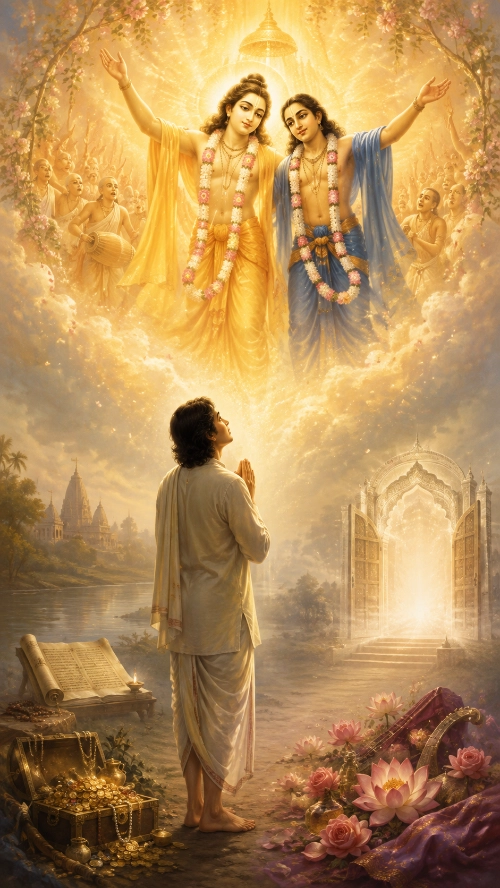
Beyond Dharma, Artha, Kāma, and Mokṣa
Near the opening of the Caitanya-caritāmṛta, Kṛṣṇadāsa Kavirāja Gosvāmī makes a claim that is considerably more radical than it first appears. He lists the four classical goals of human life — righteousness, prosperity, pleasure, and liberation — and calls the desire for them kaitava: cheating. And of the four, he singles out the desire for liberation as the most serious case.
অজ্ঞান–তমের নাম কহিয়ে ‘কৈতব’ ।
ধর্ম–অর্থ–কাম–মোক্ষ–বাঞ্ছা আদি সব ॥
ajñāna-tamera nāma kahiye kaitava
dharma-artha-kāma-mokṣa-vāñchā ādi saba
“The darkness of ignorance is called kaitava—all desires for dharma, artha, kāma, mokṣa, and so forth.”
“The darkness of ignorance is called kaitava, the way of cheating, which begins with religiosity, economic development, sense gratification and liberation.”
Caitanya-caritāmṛta, Ādi-līlā 1.90
Published translations convey the general direction, but one word in the Bengali does most of the work:
বাঞ্ছা
vāñchā
— desire, wish, aspiration. That single term makes the statement far subtler than “dharma is bad” or “liberation is bad.” What is identified with kaitava is dharma-artha-kāma-mokṣa-vāñchā: the desiring of these things as independently sought results. The problem is not necessarily the object. It is the attempt to make Bhagavān serve an ulterior personal project.
Where the Verse Sits
The statement does not stand alone. Kṛṣṇadāsa has just compared Śrī Caitanya Mahāprabhu and Śrī Nityānanda Prabhu to the sun and moon rising together:
সূর্যচন্দ্র হরে যৈছে সব অন্ধকার ।
বস্তু প্রকাশিয়া করে ধর্মের প্রচার ॥
sūrya-candra hare yaiche saba andhakāra
vastu prakāśiyā kare dharmera pracāra
“Just as the sun and moon remove darkness and reveal things as they truly are, these two brothers reveal reality and spread true dharma.”
এই মত দুই ভাই জীবের অজ্ঞান–
তমোনাশ করি’ কৈল তত্ত্ববস্তু–দান ॥
ei mata dui bhāi jīvera ajñāna-
tamo-nāśa kari’ kaila tattva-vastu-dāna
“In this way the two brothers destroy the living beings’ darkness of ignorance and bestow knowledge of spiritual reality.”
And it is that darkness — ajñāna-tamas — which verse 1.90 then identifies as kaitava. This is the striking move. Ignorance is not being defined as atheism, immorality, or philosophical confusion. Self-interested religion is placed inside the problem.
A person may believe in God, perform rituals, study śāstra, live morally, undertake austerities, even seek liberation — and if Bhagavān ultimately remains the means by which some independent goal is reached, the original self-centered orientation has not actually gone anywhere.
What Kaitava Means
The Sanskrit word carries a specific flavor:
कैतव
kaitava
— deception, fraud, cheating, pretense: something that outwardly appears to be one thing while inwardly serving another purpose. Applied to religion, it need not mean the religious act is fabricated. The practice may be entirely scripturally sanctioned. The distortion is in the motive, and it hides inside perfectly ordinary questions:
The apparent center is Bhagavān. The actual center can remain my desired result. That is what kaitava names here: religion distorted by ulterior motive.
The Bhāgavatam Opens by Rejecting It
Having defined the term, Kṛṣṇadāsa immediately quotes one of the foundational verses of the Śrīmad-Bhāgavatam:
धर्मः प्रोज्झितकैतवोऽत्र परमो निर्मत्सराणां सतां
वेद्यं वास्तवमत्र वस्तु शिवदं तापत्रयोन्मूलनम् ।
श्रीमद्भागवते महामुनिकृते किं वा परैरीश्वरः
सद्यो हृद्यवरुध्यतेऽत्र कृतिभिः शुश्रूषुभिस्तत्क्षणात् ॥
dharmaḥ projjhita-kaitavo ’tra paramo nirmatsarāṇāṁ satāṁ
vedyaṁ vāstavam atra vastu śiva-daṁ tāpa-trayonmūlanam
śrīmad-bhāgavate mahā-muni-kṛte kiṁ vā parair īśvaraḥ
sadyo hṛdy avarudhyate ’tra kṛtibhiḥ śuśrūṣubhis tat-kṣaṇāt
“Herein the highest dharma, from which all kaitava has been completely cast away, is taught for the pure-hearted who are free from envy. Here the ultimate reality is made known—the auspicious truth that uproots the threefold miseries. What need is there of any other scripture? In this Śrīmad-Bhāgavatam, composed by the great sage, the Lord is immediately captured within the heart of the sincere and receptive hearer.”
Śrīmad-Bhāgavatam 1.1.2
The decisive phrase is the first one:
धर्मः प्रोज्झितकैतवः
dharmaḥ projjhita-kaitavaḥ
— dharma from which kaitava has been thoroughly cast away. The word projjhita is unusually forceful: completely rejected, thoroughly expelled. The Bhāgavatam announces in its second verse that its subject is not religion practiced for a separate result.
Śrīdhara Svāmī on the Prefix
Kṛṣṇadāsa then reaches for the classical commentator. Explaining the force of the prefix pra- in projjhita, Śrīdhara Svāmī writes:
प्रशब्देन मोक्षाभिसन्धिरपि निरस्तः
pra-śabdena mokṣābhisandhir api nirastaḥ
“By the prefix pra, even the deliberate intention for mokṣa is rejected.”
Śrīdhara Svāmī on Śrīmad-Bhāgavatam 1.1.2
The operative expression is:
मोक्षाभिसन्धि
mokṣābhisandhi
— the deliberate intention or aim of liberation. So the inclusion of liberation-desire within kaitava is not an idiosyncratic Gauḍīya reading invented for the occasion. Kṛṣṇadāsa grounds it explicitly in the older Bhāgavata commentarial tradition.
Why the Desire for Liberation Is the Foremost Case
Between the Bhāgavata verse and Śrīdhara’s gloss, Kṛṣṇadāsa gives his strongest formulation:
তার মধ্যে মোক্ষবাঞ্ছা কৈতবপ্রধান ।
যাহা হৈতে কৃষ্ণভক্তি হয় অন্তর্ধান ॥
tāra madhye mokṣa-vāñchā kaitava-pradhāna
yāhā haite kṛṣṇa-bhakti haya antardhāna
“Among them, the desire for mokṣa is the foremost form of kaitava, because through it Kṛṣṇa-bhakti disappears.”
Caitanya-caritāmṛta, Ādi-līlā 1.92
Why single out liberation rather than sensual enjoyment? Because gross desire is easy to recognize. The desire for liberation can look completely spiritual. A person may have genuinely renounced wealth, status, sensual enjoyment, family prestige, heavenly reward, even identification with the body — and one self-centered demand can still remain intact underneath all of it: I must obtain my liberation. The self has not moved from the center; it has only refined what it is asking for.
This needs an immediate qualification, because the teaching is easy to garble. Gauḍīya Vaiṣṇavism does not claim that remaining materially bound is preferable to being liberated, and it does not reject the eternal liberated existence of Bhagavān’s associates. Bhakti itself frees the jīva from karma, ignorance, bondage and the guṇas. What is criticized is mokṣa-vāñchā — making liberation the independent goal — and the criticism is sharpest where liberation is imagined as an absorption in which the eternal relationship of servant and served disappears.
The issue is not freedom itself. It is placing freedom above love.
The Four Goals, and a Fifth
The verse invokes the classical fourfold framework:
धर्म
अर्थ
काम
मोक्ष
dharma
artha
kāma
mokṣa
In many Indian systems these form an ascending structure: dharma regulates life, artha supports it, kāma gives legitimate enjoyment within dharma, and mokṣa transcends material life altogether. Gauḍīya Vaiṣṇavism then adds something past all four:
পঞ্চম পুরুষার্থ সেই প্রেম–মহাধন ।
কৃষ্ণের মাধুর্য–রস করায় আস্বাদন ॥
pañcama puruṣārtha sei prema-mahādhana
kṛṣṇera mādhurya-rasa karāya āsvādana
“That great treasure of prema is the fifth goal of human life; through it one tastes the sweetness of Kṛṣṇa.”
Caitanya-caritāmṛta, Ādi-līlā 7.144
পঞ্চম পুরুষার্থ—প্রেমানন্দামৃতসিন্ধু ।
মোক্ষাদি আনন্দ যার নহে এক বিন্দু ॥
pañcama puruṣārtha — premānandāmṛta-sindhu
mokṣādi ānanda yāra nahe eka bindu
“The fifth goal of life is the ocean of nectarean bliss of prema. The happiness of mokṣa and the other goals cannot compare even with one drop of it.”
Caitanya-caritāmṛta, Ādi-līlā 7.85
So the hierarchy appears to run dharma → artha → kāma → mokṣa → prema. But reading it that way is still slightly misleading, because prema does not operate as a fifth and better reward.
The First Four Can All Ask “What Will I Get?”
Each of the conventional goals can be phrased as an acquisition, and the refinement increases without the underlying structure changing at all:
The object changes each time. The grammatical subject does not: I want. Prema is the only one of the five that moves the sentence — from acquisition toward self-giving.
This is why enjoying the world and escaping the world can turn out to share a center. One person says “I want to enjoy this world”; another says “I want to escape it forever.” They look like opposites, and from the standpoint of pure bhakti they may both still revolve around my preferred condition — one wanting favorable material experience, the other wanting its absence. Prema introduces a third posture: place me wherever You wish, and let me serve.
“Birth After Birth”
Śrī Caitanya Mahāprabhu expresses that mood without any hedging:
न धनं न जनं न सुन्दरीं
कवितां वा जगदीश कामये ।
मम जन्मनि जन्मनीश्वरे
भवताद्भक्तिरहैतुकी त्वयि ॥
na dhanaṁ na janaṁ na sundarīṁ
kavitāṁ vā jagad-īśa kāmaye
mama janmani janmanīśvare
bhavatād bhaktir ahaitukī tvayi
“O Lord of the universe, I do not desire wealth, followers, beauty, or worldly distinction. Birth after birth, let there be causeless devotion to You.”
Śikṣāṣṭaka 4, in Caitanya-caritāmṛta, Antya-līlā 20.29
The two most radical words in it are:
जन्मनि जन्मनि
janmani janmani
— birth after birth. A liberation-centered spirituality naturally prays, let this be my final birth. Mahāprabhu’s prayer says in effect that whether another birth comes is secondary, so long as devotion remains. This is not a glorification of suffering or of bondage. It is a complete reordering of priorities, in which service has become more important than the devotee’s own preferred existential condition.
The same verse supplies the technical term:
भक्तिरहैतुकी
bhaktir ahaitukī
— devotion without an ulterior cause. It recalls the celebrated Bhāgavata definition of the highest dharma:
स वै पुंसां परो धर्मो
यतो भक्तिरधोक्षजे ।
अहैतुक्यप्रतिहता
ययात्मा सुप्रसीदति ॥
sa vai puṁsāṁ paro dharmo
yato bhaktir adhokṣaje
ahaituky apratihatā
yayātmā suprasīdati
“The supreme dharma for humanity is that by which bhakti to the transcendent Lord arises—without ulterior motive and without interruption—by which the self becomes completely satisfied.”
Śrīmad-Bhāgavatam 1.2.6
Pure devotion, on this definition, is not a transaction in which worship is given and a result expected in return. The relationship itself is the fulfillment.
Devotees Who Decline Liberation
Kapiladeva states the point about as directly as it can be stated:
सालोक्यसार्ष्टिसामीप्य-
सारूप्यैकत्वमप्युत ।
दीयमानं न गृह्णन्ति
विना मत्सेवनं जनाः ॥
sālokya-sārṣṭi-sāmīpya-
sārūpyaikatvam apy uta
dīyamānaṁ na gṛhṇanti
vinā mat-sevanaṁ janāḥ
“My devotees do not accept residence in My realm, sharing My opulence, proximity to Me, a form resembling Mine, or even oneness when these are offered without service to Me.”
Śrīmad-Bhāgavatam 3.29.13
The verse lists the classical forms of liberation — sālokya, residing in the Lord’s realm; sārṣṭi, sharing His opulence; sāmīpya, proximity to Him; sārūpya, a form resembling His; and ekatva, oneness. But everything turns on a single qualifying phrase:
विना मत्सेवनम्
vinā mat-sevanam
— without service to Me. That qualification prevents a serious misreading. The verse does not say that living in Bhagavān’s realm or possessing a spiritual body is undesirable. It says: not if separated from sevā. Which means the Gauḍīya critique of liberation is not “liberation is bad.” It is that nothing — not even liberation — should replace loving service as the goal.
Rūpa Gosvāmī’s Definition
The foundational Gauḍīya definition of uttama-bhakti makes the same requirement structural:
अन्याभिलाषिताशून्यं
ज्ञानकर्माद्यनावृतम् ।
आनुकूल्येन कृष्णानु-
शीलनं भक्तिरुत्तमा ॥
anyābhilāṣitā-śūnyaṁ
jñāna-karmādy-anāvṛtam
ānukūlyena kṛṣṇānu-
śīlanaṁ bhaktir uttamā
“Highest bhakti is favorable cultivation directed toward Kṛṣṇa, free from extraneous desires and unobscured by jñāna, karma, and other processes pursued independently of bhakti.”
Bhakti-rasāmṛta-sindhu 1.1.11
with its famous opening expression:
अन्याभिलाषिताशून्यम्
anyābhilāṣitā-śūnyam
— free from other independent desires. This does not mean having no desire at all. Bhakti is intensely desirous: the devotee wants to remember Kṛṣṇa, hear about Him, serve Him, please Him, serve Vaiṣṇavas, and love more deeply. What the definition empties out is anya-abhilāṣa, desire independent of Kṛṣṇa’s service.
The ideal is therefore not psychological blankness. The devotee does not pray to stop wanting; the prayer is that wanting should stop being separate from Kṛṣṇa. Bhakti does not destroy the capacity to desire — it changes its direction, from what can Bhagavān do for me to what may I do for Bhagavān, and so from God as means to God as beloved end.
Even Dharma Can Become Kaitava
How can righteousness itself be implicated? Because dharma can be used instrumentally. Religious duties can be performed while thinking I want prosperity, or heaven, or prestige, or a better next birth. The activity may be authentically religious; the distortion lies in treating religion wholly as a mechanism for producing something else. The Bhāgavatam accordingly redirects the conventional goals one by one:
धर्मस्य ह्यापवर्ग्यस्य
नार्थोऽर्थायोपकल्पते ।
नार्थस्य धर्मैकान्तस्य
कामो लाभाय हि स्मृतः ॥
dharmasya hy āpavargyasya
nārtho ’rthāyopakalpate
nārthasya dharmaikāntasya
kāmo lābhāya hi smṛtaḥ
“Dharma is meant ultimately for liberation from bondage and should not be performed merely for material gain. Material gain obtained through dharma is likewise not meant simply for the cultivation of sense gratification.”
Śrīmad-Bhāgavatam 1.2.9
कामस्य नेन्द्रियप्रीतिर्
लाभो जीवेत यावता ।
जीवस्य तत्त्वजिज्ञासा
नार्थो यश्चेह कर्मभिः ॥
kāmasya nendriya-prītir
lābho jīveta yāvatā
jīvasya tattva-jijñāsā
nārtho yaś ceha karmabhiḥ
“Desire is not ultimately meant for mere gratification of the senses. One should acquire only what is necessary to maintain life, for the true purpose of human life is inquiry into reality; nothing else should be the ultimate aim of one’s activities.”
Śrīmad-Bhāgavatam 1.2.10
The movement is toward tattva-jijñāsā, inquiry into truth — and, in the surrounding context, toward bhakti.
None of which makes dharma, artha and kāma intrinsically evil. Gauḍīya Vaiṣṇavism does not require every practitioner to abandon employment, property, family, social responsibility or ordinary enjoyment. A devotee may earn, maintain a household, raise children, hold a profession, take part in society. The decisive question is what sits at the center. Wealth held as independent acquisition binds; resources received and used in service do not. Family as an extension of possessiveness binds; family life as a field of responsibility and bhakti does not. The problem is rarely the object — it is independent proprietorship.
Why Liberation Is Subtler Than Enjoyment
Sensual desire announces itself: I want enjoyment. Self-interest of that kind is easy to spot in oneself. The desire for liberation can be far quieter. A seeker may have given up nearly everything — no obvious greed, no sensual ambition, no thirst for status, no interest in heaven — and one aspiration can still remain: I want my own liberation. The ego has stopped saying “give me the world” and started saying “remove me from the world.” Prema goes one step past both: keep me wherever You wish, only let Your service remain.
Kṛṣṇadāsa puts the contrast compactly:
কৃষ্ণভক্ত — নিষ্কাম, অতএব ‘শান্ত’ ।
ভুক্তি-মুক্তি-সিদ্ধি — কামী সকলি ‘অশান্ত’ ॥
kṛṣṇa-bhakta — niṣkāma, ataeva śānta
bhukti-mukti-siddhi-kāmī — sakali aśānta
“The Kṛṣṇa-bhakta is niṣkāma and therefore peaceful. Those who desire enjoyment, liberation, or mystic perfection are all restless.”
Caitanya-caritāmṛta, Madhya-līlā 19.149
Why should these be associated with restlessness? Because in each case consciousness stays fixed on something still to be acquired. The devotee’s wealth is of a different kind: sevā, the opportunity to serve, is already in hand.
This also clarifies niṣkāma. Literally it reads as “without desire,” but in this context it does not mean emotional emptiness — advanced devotion contains enormous longing. It means freedom from independent, self-serving desire. Niṣkāma is not the absence of passion; it is the absence of a self-centered motive.
Freedom from chains is genuinely valuable. But once the chains are gone, a further question appears: what is the liberated self for? Gauḍīya Vaiṣṇavism answers with relationship, service, rasa, prema. Liberation removes an obstruction; prema supplies the positive content.
Bilvamaṅgala Ṭhākura states the resulting hierarchy memorably:
भक्तिस्त्वयि स्थिरतरा भगवन् यदि स्याद्
दैवेन नः फलति दिव्यकिशोरमूर्तिः ।
मुक्तिः स्वयं मुकुलिताञ्जलिः सेवतेऽस्मान्
धर्मार्थकामगतयः समयप्रतीक्षाः ॥
bhaktis tvayi sthiratarā bhagavan yadi syād
daivena naḥ phalati divya-kiśora-mūrtiḥ
muktiḥ svayaṁ mukulitāñjaliḥ sevate ’smān
dharmārtha-kāma-gatayaḥ samaya-pratīkṣāḥ
“O Bhagavān, if firm bhakti to You becomes established, Your divine youthful form reveals itself to us. Liberation herself then stands before us with folded hands to render service, while the goals of dharma, artha, and kāma wait for their opportunity to serve.”
Kṛṣṇa-karṇāmṛta 107
The point is not spiritual bravado. It is order of precedence. If liberation is pursued as the supreme acquisition, it looks like the final treasure. Once prema is the treasure, liberation becomes secondary — and the devotee no longer needs to bargain, I will serve You if You free me.
Not “I Want Nothing From Kṛṣṇa”
Even that formulation can mislead. A devotee may pray for mercy, for remembrance, for service, for shelter, for the association of Vaiṣṇavas, for the removal of obstacles to bhakti. Asking is not inherently impure. The distinction is between asking for the relationship and using the relationship to obtain something unrelated to it. A child who asks “may I stay with you?” is asking something entirely different from one who cares only about what can be got.
This does not mean Bhagavān never blesses His devotees. It means His blessings have stopped being the condition of their love.
A Test, and a Warning About Using It
The teaching can be turned inward through one uncomfortable question: if Bhagavān did not give me the secondary result I wanted, would I still wish to serve Him? If the honest answer is no, devotion may still contain a transaction. As the heart moves toward yes — because service itself is what is wanted — the orientation of pure bhakti is emerging.
Which is exactly why this passage should never be used as a label for other people. “Their religion is kaitava, ours is pure” misses the entire point. Someone may belong formally to a Gauḍīya institution while approaching Kṛṣṇa for status, security, recognition, power, money, emotional validation — or personal salvation. Someone else with little formal knowledge may gradually develop selfless devotion. Kaitava is a question of orientation, not of group identity, and the term is most useful as a mirror.
Prema Reorders the Four From Within
Once prema is the center, the conventional goals do not simply get discarded. They get transformed:
Prema does not simply sit fifth in a list. It changes what the other four mean.
Kṛṣṇadāsa calls it a treasure for a reason:
প্রেম–মহাধন
prema-mahādhana
Dharma yields merit; artha yields resources; kāma yields pleasure; mokṣa yields freedom from bondage. Prema gives Bhagavān Himself, in relationship. The comparison is not quantitative — it is not simply more happiness than liberation. It is a different category of fulfillment.
Why This Rests on the Jīva’s Identity
The whole argument finally rests on Mahāprabhu’s definition of what a living being is:
জীবের ‘স্বরূপ’ হয় — কৃষ্ণের ‘নিত্যদাস’ ।
jīvera svarūpa haya — kṛṣṇera nitya-dāsa
“The constitutional nature of the jīva is to be Kṛṣṇa’s eternal servant.”
Caitanya-caritāmṛta, Madhya-līlā 20.108
If the jīva’s eternal identity is relational, the problem with kaitava becomes obvious. Kaitava asks how Bhagavān can serve my independent project. Pure bhakti asks how I may live according to the relationship I am already in. The first puts the jīva at the center; the second puts Kṛṣṇa there.
Which returns us to the phrase the passage started from:
অজ্ঞান–তমের নাম কহিয়ে ‘কৈতব’
ajñāna-tamera nāma kahiye kaitava
“The darkness of ignorance is called kaitava.”
Why should self-interested spirituality count as ignorance? Because it misreads what the self is. If I take my ultimate identity to be an independent enjoyer, I pursue kāma. If I take Bhagavān to exist in order to bless my separate project, religion becomes transaction. If I take my final goal to be my own isolated liberation, even renunciation stays centered on me. But if:
jīvera svarūpa haya — kṛṣṇera nitya-dāsa
“The jīva’s true nature is eternal service to Kṛṣṇa,”
— then spiritual knowledge means recovering the orientation of service. Ignorance here is not a lack of information. It is a misplaced center.
Seen this way, the deepest renunciation is not giving up money, family, pleasure, social identity, or even the desire for heaven. It is giving up the demand that spiritual life must culminate in my preferred result. Mahāprabhu’s janmani janmani says precisely that: the devotee stops negotiating, and prays instead that devotion remain, whatever condition is given.
The Argument in One Sequence
Which can be reduced further still. The first four goals each ask, in their own register, what happens to me? Prema asks what may I give? That is the whole of the shift.
What the Verse Is Really Challenging
Ādi 1.90 is not merely a rejection of worldly ambition. Its critique reaches religion practiced for profit, for pleasure, for heaven, for status, for power, for liberation — and finally any spirituality in which Bhagavān remains secondary to an independently desired outcome. The question it puts is whether God is being treated as the means or as the beloved end, and its answer is that even the most exalted-looking aspiration is incomplete until loving service has itself become the goal.
Liberation may come. Freedom from karma may come. The spiritual world may come. But the devotee’s heart has stopped saying give me these things and started saying give me service. That is why, in Gauḍīya theology, prema is not simply ranked higher than mokṣa — it changes the very meaning of spiritual success.