

Śrī Rādhā’s Lotus Feet: The Nineteen Auspicious Marks
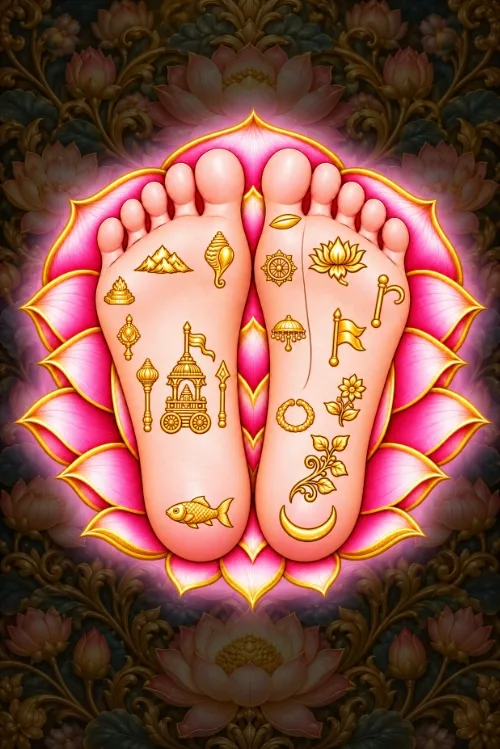
The sacred signs that reveal the Queen of Vṛndāvana, the love that conquers Kṛṣṇa, and the mystery of Rādhā and Kṛṣṇa united as Śrī Gaurāṅga.
In the sacred literature of Vṛndāvana, even a footprint can reveal the deepest mysteries of divine love. The soft lotus feet of Śrīmatī Rādhārāṇī are described as bearing extraordinary auspicious signs—symbols of beauty, sovereignty, protection, and spiritual perfection. Yet their greatest significance is not found in their shapes or numbers. It lies in the remarkable truth that Śrī Kṛṣṇa, the Supreme Lord, cherishes those feet as the treasure of His own life.
According to a celebrated Gauḍīya Vaiṣṇava tradition, Rādhā’s lotus feet bear nineteen auspicious marks: eight on Her right foot and eleven on Her left. These include the lotus, conch, moon, flower, elephant goad, chariot, sacrificial altar, and other sacred emblems. The tradition is preserved in Sanskrit works associated with Śrī Rūpa Gosvāmī and Śrī Viśvanātha Cakravartī Ṭhākura, particularly the Ujjvala-nīlamaṇi and its commentaries.
These descriptions are part of a larger spiritual vision. Śrī Rādhā is not understood in Gauḍīya theology merely as Kṛṣṇa’s beloved companion. She is the supreme embodiment of divine love, the personal manifestation of His pleasure potency, and the one whose devotion captivates even the all-attractive Lord.
To understand the nineteen marks is therefore to approach a much greater subject: the mystery of why Kṛṣṇa, who is worshiped by all, Himself worshipfully honors the feet of Rādhā.
1. Why Are Rādhā’s Feet Called Lotus Feet?
The Sanskrit expression caraṇāravinda means “lotus feet,” while pāda-padma conveys the same image: feet compared to the sacred lotus.
The lotus occupies a special place in Indian spiritual symbolism. Its petals are soft and beautiful; it rises from water without becoming soiled by the mud beneath it; and its blossom is associated with purity, auspiciousness, and transcendence. The image therefore communicates qualities beyond ordinary physical beauty.
When Vaiṣṇava poets describe Rādhā’s feet as lotus-like, they are expressing several meanings at once. Her feet are extraordinarily tender and beautiful. They are completely spiritual, untouched by material contamination. They are also the ultimate shelter of those who aspire to serve Kṛṣṇa through the path of divine love.
In devotional language, taking shelter of someone’s feet signifies humility, trust, surrender, and service. The feet represent the point where divine compassion becomes accessible to the devotee.
Rādhā’s feet possess an additional distinction. They are honored not only by Her devotees but by Kṛṣṇa Himself. Consequently, their significance cannot be understood simply through ordinary ideas of hierarchy. They reveal a relationship in which pure love possesses a power greater than majesty.
2. Śrī Rūpa Gosvāmī: Rādhā’s Footprints Reveal Her Presence
One of the earliest important Gauḍīya descriptions of Rādhā’s distinctive footprints appears in Śrī Rūpa Gosvāmī’s Ujjvala-nīlamaṇi (4.24), a major Sanskrit treatise devoted to the intimate devotional relationships of Rādhā, Kṛṣṇa, and the gopīs of Vṛndāvana.
अघहर भज तुष्टिं पश्य यच्चन्द्रलेखा-
वलयकुसुमवल्लीकुण्डलाकारभाग्भिः ।
अभिदधति निलीनामत्र सौभाग्यरेखा-
विततिभिरनुविद्धाः सुष्ठु राधां पदाङ्काः ॥
agha-hara bhaja tuṣṭiṁ paśya yac candralekhā-
valaya-kusuma-vallī-kuṇḍalākāra-bhāgbhiḥ
abhidadhati nilīnām atra saubhāgya-rekhā-
vitatibhir anuviddhāḥ suṣṭhu rādhāṁ padāṅkāḥ
“O destroyer of Agha, take delight! Behold these footprints, beautifully adorned with auspicious lines resembling a crescent moon, bracelet, flower, flowering creeper, and earring. They clearly reveal that Rādhā is concealed here.”
Ujjvala-nīlamaṇi, 4.24
The scene is enchanting. Rādhā has hidden Herself, and Kṛṣṇa is searching for Her. Yet even when Her form is concealed, the markings of Her feet betray Her presence. The ground itself becomes a witness to Her identity.
Viśvanātha Cakravartī explains that these words are spoken by Madhumaṅgala, Kṛṣṇa’s intimate friend. Another traditional commentator, Viṣṇudāsa, identifies the speaker as Subala. Although the commentaries differ on this narrative detail, both preserve the essential meaning: Rādhā’s footprints are so distinctive that they unmistakably reveal Her.
The Sanskrit expression saubhāgya-rekhā is especially significant. It means an auspicious line or marking associated with extraordinary good fortune and excellence. These signs are therefore not described as arbitrary decorations. They are natural indications of Rādhā’s incomparable spiritual distinction.
Significantly, Rūpa Gosvāmī’s verse names only several markings. The complete nineteen-mark arrangement comes from the later, more detailed exegetical tradition, particularly Viśvanātha Cakravartī’s commentary.
3. The Sanskrit Verse That Enumerates All Nineteen Marks
A devotional composition known as Śrī Rūpa-cintāmaṇi, traditionally attributed to Viśvanātha Cakravartī Ṭhākura, explicitly celebrates the nineteen marks on Rādhā’s two feet.
छत्रारि-ध्वज-वल्ली-पुष्प-वलयान् पद्मोर्ध्वरेखाङ्कुशान्
अर्धेन्दुं च यवं च वाममनु या शक्तिं गदां स्यन्दनम् ।
वेदि-कुण्डल-मत्स्य-पर्वत-दरं धत्तेऽन्वसव्यं पदं
तां राधां चिरमूनविंशति-महालक्ष्म्यर्चिताङ्घ्रिं भजे ॥
cchatrāri-dhvaja-vallī-puṣpa-valayān padmordhva-rekhāṅkuśān
ardhenduṁ ca yavaṁ ca vāmam anu yā śaktiṁ gadāṁ syandanam
vedi-kuṇḍala-matsya-parvata-daraṁ dhatte ‘nv asavyaṁ padaṁ
tāṁ rādhāṁ ciram ūna-viṁśati-mahā-lakṣmy-arcitāṅghriṁ bhaje
“I eternally worship Śrī Rādhā, whose lotus feet are adorned with nineteen magnificent auspicious signs. Her left foot bears the umbrella, disc, flag, creeper, flower, bracelet, lotus, upward line, elephant goad, crescent moon, and barleycorn. Her right foot bears the spear, club, chariot, sacrificial altar, earring, fish, mountain, and conch.”
Śrī Rūpa-cintāmaṇi, verse 2
The expression ūna-viṁśati literally means “one less than twenty”—nineteen. The verse therefore provides an explicit numerical foundation for the familiar arrangement of eleven marks on the left foot and eight on the right.
This is reinforced by Viśvanātha’s Ānanda-candrikā commentary on Ujjvala-nīlamaṇi 4.24, where his separate descriptions conclude with the words:
ity ekādaśa … ity aṣṭau; militvā ūna-viṁśati.
“Thus eleven … thus eight; together, nineteen.”
Ānanda-candrikā on Ujjvala-nīlamaṇi 4.24
The nineteen marks are thus supported by an identifiable Sanskrit commentarial tradition, not merely by modern diagrams or devotional illustrations.
4. The Eight Auspicious Marks on Rādhā’s Right Lotus Foot
The right foot bears eight signs associated with spiritual strength, auspiciousness, movement, protection, and divine sovereignty.
The traditional positions given here follow Viśvanātha Cakravartī’s Ānanda-candrikā. Their devotional meanings are contemplative interpretations rather than fixed definitions supplied individually by the Sanskrit commentary.
Sacrificial Altar — Vedi
The altar recalls sacred offering and self-dedication. Spiritually, it suggests that the heart becomes a place of sacrifice when selfish desires are surrendered in loving service to Rādhā and Kṛṣṇa.
Mountain — Parvata
A mountain suggests stability, majesty, and unwavering shelter. It may evoke Govardhana, the sacred mountain of Vraja, although the Sanskrit passage itself names simply a mountain rather than specifying Govardhana.
Conch — Śaṅkha or Dara
The conch is an emblem of auspiciousness and divine proclamation. Its sacred sound suggests the awakening of spiritual consciousness and the call toward devotion.
Earring — Kuṇḍala
The earring expresses grace, ornamentation, and beauty. Devotionally, it can also suggest attentive hearing of divine names and pastimes—the process of śravaṇa.
Club — Gadā
The club represents strength and the overcoming of opposition. In spiritual meditation, it evokes the power of divine grace to overcome obstacles such as pride, anger, and selfishness.
Chariot — Ratha or Syandana
The chariot suggests movement and purposeful progress. It can symbolize the soul’s journey toward serving Rādhā and Kṛṣṇa.
Spear — Śakti
The spear signifies penetrating power, courage, and decisiveness. It invites contemplation of the spiritual determination required to overcome illusion and divided loyalties.
Fish — Matsya
Just as a fish cannot live without water, the devoted soul cannot attain its fulfillment without divine love. The fish becomes an image of complete dependence upon the nourishing ocean of prema.
An important linguistic distinction concerns the fourth mark. The Sanskrit kuṇḍala means an earring or ear ornament. It is not the same word as kunda, a type of jasmine, or kuṇḍa, a pond or reservoir. The simple translation “earring” is therefore more precise than the sometimes-used expression “Kunda earrings.”
Likewise, śakti here refers to a spear or lance, not merely to the abstract concept of spiritual energy. Although the word has broader philosophical meanings, its immediate significance in this inventory is iconographic.
These eight symbols create a striking contrast. Rādhā’s feet are described as softer than lotus petals, yet they bear the emblems of power, firmness, and sovereignty. The apparent contradiction reflects a central feature of Gauḍīya theology: the highest spiritual power is revealed not in domination, but in pure love.
5. The Eleven Auspicious Marks on Rādhā’s Left Lotus Foot
Rādhā’s left foot bears eleven signs whose imagery is especially rich in beauty, protection, nourishment, growth, and divine intimacy.
Barleycorn — Yava
Barley is associated with nourishment, fertility, and auspicious prosperity. In devotion, it suggests that spiritual life grows and bears fruit through Rādhā’s mercy.
Disc — Cakra or Ari
The disc expresses divine protection and the destruction of obstacles. It recalls the power of spiritual knowledge to dispel ignorance.
Upward Line — Ūrdhva-rekhā
It naturally suggests spiritual elevation and the transformation of consciousness from worldly attachment to devotion.
Lotus — Padma or Kamala
The lotus symbolizes purity, beauty, transcendence, and spiritual awakening. It also reflects the sacred beauty of Vṛndāvana and the divine couple’s eternal pastimes.
Umbrella — Chatra
Traditionally a sign of royal dignity and protection, the umbrella is understood devotionally as the shelter Rādhā provides to those who seek Her mercy.
Elephant Goad — Aṅkuśa
An elephant goad directs a powerful animal. Symbolically, it can represent Rādhā’s ability to guide the restless mind and bring even powerful desires under devotion’s direction.
Flag — Dhvaja
A flag signifies victory and sovereignty. In the devotional setting of Vraja, it expresses the triumph of divine love over selfishness and fear.
Bracelet or Jeweled Bangle — Valaya
The bracelet is an ornament of beauty and intimate affection. It evokes love’s binding power and the inseparable relationship between Rādhā, Kṛṣṇa, and Their devotees.
Flower — Puṣpa or Kusuma
The flower represents the blossoming of devotion, spiritual fragrance, tenderness, and the offering of beauty for Kṛṣṇa’s pleasure.
Flowering Creeper — Vallī or Kusuma-vallī
The creeper suggests the living growth of devotion. Like a delicate vine requiring support, loving service flourishes through association, care, and spiritual nourishment.
Crescent Moon — Ardhendu or Ardha-candra
The moon suggests gentleness, beauty, and cooling relief. Devotionally, it symbolizes the soothing mercy that pacifies the burning distress of separation from Kṛṣṇa.
The left foot has a particularly graceful arrangement. Barleycorn, disc, umbrella, and bracelet form one sequence. The lotus and flag occupy another region, while the flower, creeper, and crescent enrich the heel. The upward line connects the imagery with a sense of movement or ascent.
It is essential to distinguish the traditional identification of a mark from its devotional explanation. Viśvanātha describes each symbol’s position and appearance. Reflections on nourishment, inner transformation, surrender, and spiritual growth belong to the wider devotional vocabulary and later interpretive tradition.
This distinction preserves both scriptural accuracy and the richness of spiritual meditation.
6. The Bhāgavatam: When Footprints Reveal the Most Beloved Gopī
The importance of divine footprints is already evident in the Śrīmad-Bhāgavatam, particularly in the tenth canto’s description of Kṛṣṇa’s rāsa-līlā.
During the nocturnal pastimes in Vṛndāvana, Kṛṣṇa disappears from the gopīs’ assembly. Overcome by separation, they wander through the forest searching for Him. Eventually they discover footprints upon the ground.
At first they recognize Kṛṣṇa’s footprints by their distinctive auspicious markings.
पदानि व्यक्तमेतानि नन्दसूनोर्महात्मनः ।
लक्ष्यन्ते हि ध्वजाम्भोजवज्राङ्कुशयवादिभिः ॥
padāni vyaktam etāni
nanda-sūnor mahātmanaḥ
lakṣyante hi dhvajāmbhoja-
vajrāṅkuśa-yavādibhiḥ
“These footprints clearly belong to the glorious son of Nanda, for they are distinguished by the signs of the flag, lotus, thunderbolt, elephant goad, barleycorn, and other auspicious marks.”
Śrīmad-Bhāgavatam, 10.30.25
The gopīs can identify Kṛṣṇa without seeing His face. The marks on His feet reveal who has passed through the forest.
But the scene soon becomes more mysterious. Beside Kṛṣṇa’s footprints, the gopīs discover another set of impressions. They realize that He has been walking with one particular gopī, giving Her an intimacy that He has not bestowed upon the others.
Their astonishment is expressed in one of the most important verses concerning Śrī Rādhā in the Bhāgavatam.
अनयाराधितो नूनं भगवान् हरिरीश्वरः ।
यन्नो विहाय गोविन्दः प्रीतो यामनयद्रहः ॥
anayārādhito nūnaṁ
bhagavān harir īśvaraḥ
yan no vihāya govindaḥ
prīto yām anayad rahaḥ
“Surely this gopī has worshiped Lord Hari perfectly. Otherwise, why would Govinda, being so pleased with Her, leave us behind and take Her to a secluded place?”
Śrīmad-Bhāgavatam, 10.30.28
The Sanskrit expression anayā ārādhitaḥ—”by Her He has been perfectly worshiped”—is central to the Gauḍīya interpretation.
Although the verse does not explicitly state Rādhā’s name as a separate word, Gauḍīya commentators identify this specially favored gopī as Śrī Rādhā. Viśvanātha Cakravartī observes that the name has been subtly revealed through ārādhitaḥ, as though the narrator had attempted to conceal Her identity but could not entirely suppress it.
This interpretation is also preserved in Śrī Caitanya-caritāmṛta, Madhya-līlā 8.100.
The Tenderness of Her Feet
The narrative continues with an exceptionally delicate observation. At one point, the gopīs notice that the second set of footprints has disappeared. They conclude that the tender soles of Kṛṣṇa’s beloved were being troubled by the grass and shoots of the forest, and that Kṛṣṇa must have lifted Her onto His shoulders.
This detail transforms the meaning of the footprints. They not only reveal identity and spiritual distinction; they expose Kṛṣṇa’s extraordinary tenderness toward His beloved.
The Supreme Lord, whose feet are themselves objects of worship, carries Rādhā so that Her feet will not suffer.
In this scene, the divine relationship is revealed not by a declaration of power but by an act of loving concern.
7. Kṛṣṇa Requests Rādhā’s Feet Upon His Head
Perhaps the most astonishing literary expression of Rādhā’s supremacy in divine love occurs in Jayadeva Gosvāmī’s Gīta-govinda, the celebrated Sanskrit poem depicting the intimate emotions of Rādhā and Kṛṣṇa.
In the reconciliation scene, Kṛṣṇa addresses Rādhā with an extraordinary request:
देहि पदपल्लवमुदारम् ।
dehi pada-pallavam udāram
“Place Your magnificent, tender lotus-bud-like foot upon Me.”
Gīta-govinda, tenth canto, nineteenth song, commonly cited as 10.8
In the fuller poetic passage, Kṛṣṇa asks Rādhā to place Her tender foot upon His head as an ornament and as a remedy for the torment of separation.
The implications are profound.
Kṛṣṇa is the Supreme Lord, the source of all divine manifestations, the one whose feet are sought by sages, gods, and devotees. Yet in the intimate pastimes of Vṛndāvana, He honors Rādhā’s feet upon His own head.
This does not signify that Kṛṣṇa has lost His divine nature. Rather, Gauḍīya theology sees in this episode the extraordinary power of prema, the pure love that governs the most intimate relationship between the divine couple.
In ordinary life, authority commonly seeks recognition and obedience. In Vṛndāvana, divine love transcends such relationships. Kṛṣṇa, who is supremely independent, willingly becomes dependent upon the affection of His devotees—and most completely upon Rādhā’s love.
Thus the sacred marks upon Her feet are not simply signs of auspiciousness. They belong to the one whose love captivates the Supreme Lord Himself.
8. Śrī Rādhā: The Embodiment of Mahābhāva
The deeper significance of the nineteen marks becomes clearer through the theological identity of Śrī Rādhā.
The Śrī Caitanya-caritāmṛta explains that Kṛṣṇa possesses an eternal internal spiritual potency, of which hlādinī is the bliss-giving aspect. Rādhā is the supreme personal manifestation of that potency, and Her love reaches the highest possible development of spiritual emotion, known as mahābhāva.
মহাভাবস্বরূপা শ্রীরাধা-ঠাকুরাণী ।
সর্বগুণখনি কৃষ্ণকান্তাশিরোমণি ॥
mahābhāva-svarūpā śrī-rādhā-ṭhākurāṇī
sarva-guṇa-khani kṛṣṇa-kāntā-śiromaṇi
“Śrī Rādhā Ṭhākurāṇī is the embodiment of mahābhāva. She is the treasury of all excellent qualities and the crown jewel among Kṛṣṇa’s beloved companions.”
Caitanya-caritāmṛta, Ādi 4.69
Mahābhāva does not mean ordinary intense emotion. It represents the highest spiritual culmination of pure love for Kṛṣṇa, free from the selfish desire for personal enjoyment.
The Caitanya-caritāmṛta explains the progression from prema, pure divine love, to bhāva, profound spiritual emotion, and ultimately to mahābhāva. Rādhā is not merely someone who experiences this state. She is described as its very embodiment.
Another celebrated Bengali verse declares:
গোবিন্দানন্দিনী, রাধা, গোবিন্দমোহিনী ।
গোবিন্দসর্বস্ব, সর্বকান্তাশিরোমণি ॥
govindānandinī rādhā, govinda-mohinī
govinda-sarvasva, sarva-kāntā-śiromaṇi
“Rādhā gives bliss to Govinda and enchants Govinda. She is everything to Him and the crown jewel of all His beloveds.”
Caitanya-caritāmṛta, Ādi 4.82
The word govinda-mohinī is especially revealing: Rādhā enchants Govinda. Kṛṣṇa is celebrated as the all-attractive Lord, yet Rādhā possesses the extraordinary capacity to attract Him.
This explains the special dignity attributed to Her feet. Their sacred signs express the identity of one whose spiritual love is unsurpassed.
9. Are the Nineteen Marks Described Identically in Every Scripture?
Although the nineteen-mark arrangement has become especially prominent in Gauḍīya devotional practice and iconography, classical descriptions are not entirely uniform.
This is an important distinction for both scholarship and accurate sacred art.
Śrī Jīva Gosvāmī, in his Locana-rocanī commentary on Ujjvala-nīlamaṇi 4.24, enumerates seven markings on the left foot and eight on the right. His arrangement includes some connected or composite designs, particularly in the region of the crescent and flowering creeper.
Śrī Viśvanātha Cakravartī, commenting upon the same verse in his Ānanda-candrikā, gives eleven marks on the left and eight on the right. His classification separates and specifies additional signs, producing the familiar nineteen-mark arrangement.
Both commentators preserve sacred traditions regarding Rādhā’s bodily signs, but they do not offer identical numerical inventories.
There are also poetic descriptions with a somewhat different selection of emblems.
A Different Description in Govinda-līlāmṛta
Śrī Kṛṣṇadāsa Kavirāja Gosvāmī’s Govinda-līlāmṛta contains a remarkable Sanskrit description of Rādhā’s feet. The verse is cited as 12.51 in one transmitted edition and 11.51 in another reference tradition.
Among the signs it names are the conch, crescent moon, barleycorn, lotus, elephant, chariot, plough, elephant goad, arrow, flag, bow, svastika, fish, and lance.
The passage employs the language of royal victory. Rādhā’s red-lac-colored feet, adorned with auspicious emblems, are poetically compared to a victorious sovereign surrounded by the instruments of conquest.
The imagery is especially revealing. Her feet possess the symbolic authority of a universal monarch, yet their victory is understood through the supremacy of divine love.
This passage includes signs not found in the standard nineteen-mark inventory, such as the elephant, plough, arrow, and bow.
An additional traditional passage associated with Rādhā-Kṛṣṇa-gaṇoddeśa-dīpikā also names such emblems as the elephant, small drum, and svastika.
These variations suggest that sacred-foot iconography developed through several interrelated textual and contemplative traditions.
The most accurate conclusion is therefore not that every classical source insists upon exactly the same nineteen designs. Rather, the nineteen-mark system is a clearly documented and highly influential Gauḍīya arrangement, especially associated with Viśvanātha Cakravartī’s interpretation.
For a visual representation intended to follow that specific tradition, the eleven-left and eight-right arrangement is the appropriate reference.
10. Rādhā and Kṛṣṇa: Nineteen Marks on Each
The same Śrī Rūpa-cintāmaṇi tradition that celebrates Rādhā’s nineteen marks also describes nineteen auspicious marks on Kṛṣṇa’s feet.
In its conventional arrangement, Kṛṣṇa’s right foot bears eleven types of markings, while His left foot bears eight.
Together, the two inventories create an intriguing relationship.
Both Rādhā and Kṛṣṇa possess the lotus, upward line, barleycorn, disc, umbrella, elephant goad, flag, conch, fish, and crescent moon. This gives ten shared kinds of symbols across their respective inventories.
Other symbols distinguish their feet. The sacrificial altar, mountain, earring, club, chariot, spear, bracelet, flower, and flowering creeper appear in Rādhā’s nineteen-mark list but not in Kṛṣṇa’s corresponding list.
Kṛṣṇa’s list, meanwhile, includes the thunderbolt, svastika, jambu fruit, octagonal emblem, bow, cow’s hoofprint, triangle, waterpots, and sky or ether mark.
When treated simply as sets of named symbols, the two inventories therefore contain twenty-eight distinct types:
19 + 19 − 10 = 28
This mathematical observation concerns the names of the symbols, not the total number of physical impressions that might appear in a composite divine form. The same symbol could theoretically occur in different positions or more than once, depending upon the particular iconographic tradition.
The relationship between the divine couple, however, cannot be reduced to the mathematics of their markings.
The deeper question is theological: how can Rādhā and Kṛṣṇa be simultaneously one divine reality and two eternally distinct persons?
11. Rādhā and Kṛṣṇa United as Śrī Gaurāṅga
Gauḍīya Vaiṣṇava theology answers this question through the appearance of Śrī Caitanya Mahāprabhu, also known as Śrī Gaurāṅga, the golden Lord.
According to this tradition, Caitanya is Kṛṣṇa Himself, appearing with Rādhā’s emotional disposition and golden radiance.
The doctrine is beautifully expressed in an important Sanskrit verse attributed to Svarūpa Dāmodara and preserved in Śrī Caitanya-caritāmṛta, Ādi-līlā 1.5.
राधा कृष्णप्रणयविकृतिर्ह्लादिनी शक्तिरस्माद्
एकात्मानावपि भुवि पुरा देहभेदं गतौ तौ ।
चैतन्याख्यं प्रकटमधुना तद्द्वयं चैक्यमाप्तं
राधाभावद्युतिसुवलितं नौमि कृष्णस्वरूपम् ॥
rādhā kṛṣṇa-praṇaya-vikṛtir hlādinī śaktir asmād
ekātmānāv api bhuvi purā deha-bhedaṁ gatau tau
caitanyākhyaṁ prakaṭam adhunā tad-dvayaṁ caikyam āptaṁ
rādhā-bhāva-dyuti-suvalitaṁ naumi kṛṣṇa-svarūpam
“Śrī Rādhā is the manifestation of Kṛṣṇa’s divine love and internal pleasure potency. Although Rādhā and Kṛṣṇa are one in spiritual identity, They eternally appear in two forms. Now They have become united in the manifestation known as Śrī Caitanya. I bow to Him, who is Kṛṣṇa Himself, adorned with Rādhā’s loving emotions and golden radiance.”
Caitanya-caritāmṛta, Ādi 1.5
The same principle appears in simpler Bengali:
রাধাকৃষ্ণ এক আত্মা, দুই দেহ ধরি’ ।
অন্যোন্যে বিলসে রস আস্বাদন করি’ ॥
rādhā-kṛṣṇa eka ātmā, dui deha dhari’
anyonye vilase rasa āsvādana kari’
“Rādhā and Kṛṣṇa are one spiritual reality, yet They assume two forms in order to exchange and relish the sweetness of divine love.”
Caitanya-caritāmṛta, Ādi 4.56
The following verse explains their union:
সেই দুই এক এবে চৈতন্য গোসাঞি ।
রস আস্বাদিতে দোঁহে হৈলা একঠাঁই ॥
sei dui eka ebe caitanya gosāñi
rasa āsvādite doṅhe hailā eka-ṭhāṅi
“Those two have now become one as Lord Caitanya, appearing together in a single form to relish divine love.”
Caitanya-caritāmṛta, Ādi 4.57
The teaching is profound. In Rādhā and Kṛṣṇa, divine love is experienced through the relationship between lover and beloved. In Caitanya, Kṛṣṇa seeks to experience that same love from Rādhā’s perspective.
He does not merely wish to be loved. He wishes to understand the extraordinary sweetness of loving Kṛṣṇa as Rādhā loves Him.
Thus the traditional formulation Rādhā + Kṛṣṇa = Gaurāṅga expresses a well-established Gauḍīya theological principle.
But it does not automatically establish a particular number of symbols on Gaurāṅga’s soles.
12. Does Gaurāṅga Have Thirty-Two Marks on His Feet?
Some devotional diagrams attribute thirty-two auspicious marks to the lotus feet of Śrī Gaurāṅga, occasionally explaining the number through a combination of Rādhā’s nineteen marks and Kṛṣṇa’s nineteen marks, with six shared marks subtracted.
The formula is presented as:
19 + 19 − 6 = 32
Although the arithmetic is correct, the proposed explanation is not demonstrated by the commonly circulated inventories. Those inventories share ten symbol types, not six.
More importantly, Śrī Caitanya-caritāmṛta contains two distinct descriptions that must not be confused.
The Sacred Footprints of the Child Gaurāṅga
In Ādi-līlā 14.7, Kṛṣṇadāsa Kavirāja describes the extraordinary marks that appeared in the home of Jagannātha Miśra and Śacīdevī during Caitanya’s childhood.
গৃহে দুই জন দেখি লঘুপদ-চিহ্ন ।
তাহে শোভে ধ্বজ, বজ্র, শঙ্খ, চক্র, মীন ॥
gṛhe dui jana dekhi laghu-pada-cihna
tāhe śobhe dhvaja, vajra, śaṅkha, cakra, mīna
“His two parents saw tiny footprints in their home, adorned with the auspicious marks of the flag, thunderbolt, conch, disc, and fish.”
Caitanya-caritāmṛta, Ādi 14.7
These five explicitly named symbols demonstrate that Caitanya’s lotus feet possessed divine markings recognizable from Vaiṣṇava iconography.
The text, however, does not supply an exhaustive list of thirty-two sole markings.
Thirty-Two Characteristics of a Great Personality
A few verses later, the family astrologer Nīlāmbara Cakravartī observes that the child bears thirty-two bodily characteristics of a mahāpuruṣa, an extraordinary or great personality.
বত্রিশ লক্ষণ—মহাপুরুষ-ভূষণ ।
এই শিশু অঙ্গে দেখি সে সব লক্ষণ ॥
batriśa lakṣaṇa — mahāpuruṣa-bhūṣaṇa
ei śiśu aṅge dekhi se saba lakṣaṇa
“The thirty-two characteristics are the ornaments of a great personality, and I see all those characteristics upon the body of this child.”
Caitanya-caritāmṛta, Ādi 14.14
The next verse specifies these characteristics in Sanskrit.
पञ्चदीर्घः पञ्चसूक्ष्मः सप्तरक्तः षडुन्नतः ।
त्रिह्रस्वपृथुगम्भीरो द्वात्रिंशल्लक्षणो महान् ॥
pañca-dīrghaḥ pañca-sūkṣmaḥ
sapta-raktaḥ ṣaḍ-unnataḥ
tri-hrasva-pṛthu-gambhīro
dvātriṁśal-lakṣaṇo mahān
“A great personality possesses thirty-two distinguishing bodily characteristics: five long features, five fine features, seven reddish features, six elevated features, and three each that are short, broad, and deep.”
Caitanya-caritāmṛta, Ādi 14.15
These are characteristics of the entire body, not thirty-two separate pictorial signs on the feet.
Consequently, the thirty-two bodily characteristics of Gaurāṅga should not be treated as direct scriptural proof of thirty-two emblems upon His soles.
Preserving this distinction strengthens, rather than diminishes, theological authenticity. The oneness of Rādhā and Kṛṣṇa in Gaurāṅga rests upon substantial scriptural foundations. It does not depend upon a numerical calculation of their foot markings.
13. Why Devotees Meditate on the Marks
The Sanskrit terms cihna, rekhā, and lakṣaṇa refer, in their different contexts, to distinguishing signs, lines, and characteristics. In devotional meditation, the marks of Rādhā’s feet provide visible forms through which the mind can contemplate an invisible spiritual reality.
The umbrella inspires remembrance of divine shelter. The elephant goad directs a restless mind toward Kṛṣṇa. The lotus suggests purity and spiritual beauty. The flag expresses love’s victory. The flowering creeper recalls devotion growing toward its highest fulfillment.
Taken together, these symbols offer a contemplative vocabulary of spiritual life.
Yet the central purpose is not to acquire an esoteric catalog of emblems. Nor is the contemplation of these marks presented as a mechanical technique guaranteeing spiritual advancement. In the Gauḍīya tradition, meditation becomes meaningful through devotion, humility, hearing, chanting, and service.
The forms and marks are spiritually significant because of the divine persons to whom they belong.
For devotees of Rādhā and Kṛṣṇa, the ultimate aspiration is not simply to see the sacred symbols but to develop genuine affection for the service of the divine couple.
This theme reaches its fullest expression in the prayers of the Vaiṣṇava poets.
14. Rādhā’s Feet: The Treasure of Govinda’s Life
The Sanskrit devotional work Śrī Rādhā-rasa-sudhā-nidhi, traditionally attributed by Gauḍīya Vaiṣṇavas to Śrī Prabodhānanda Sarasvatī, contains a particularly moving prayer.
सत्प्रेमसिन्धुमकरन्दरसौघधारा-
सारानजस्रमभितः स्रवदाश्रितेषु ।
श्रीराधिके तव कदा चरणारविन्दं
गोविन्दजीवनधनं शिरसा वहामि ॥
sat-prema-sindhu-makaranda-rasaugha-dhārā-
sārān ajasram abhitaḥ sravad āśriteṣu
śrī-rādhike tava kadā caraṇāravindaṁ
govinda-jīvana-dhanaṁ śirasā vahāmi
“O Śrī Rādhikā! Your lotus feet continually shower streams of nectar from the ocean of pure divine love upon those who take shelter of You. When shall I carry upon my head those lotus feet, the treasure of Govinda’s very life?”
Śrī Rādhā-rasa-sudhā-nidhi, verse 22
The expression govinda-jīvana-dhanam deserves special attention.
Govinda is Kṛṣṇa. Jīvana means life, and dhana means wealth or treasure.
Thus Rādhā’s feet are celebrated as the treasure of Govinda’s life.
There can scarcely be a stronger devotional declaration of their significance.
The same feet that are described with nineteen auspicious symbols are considered the refuge of devotees, the source of divine love, and the treasured object of Kṛṣṇa’s own affection.
The prayer expresses an aspiration not for material prosperity, liberation, or supernatural power, but for the privilege of serving and honoring Rādhā’s feet.
The devotional significance therefore moves far beyond the visible markings. What matters most is the pure love embodied by their possessor.
A textual note: The authorship of Rādhā-rasa-sudhā-nidhi is disputed between traditions. Gauḍīya Vaiṣṇavas commonly attribute it to Prabodhānanda Sarasvatī, while the Rādhāvallabhī tradition attributes it to Śrī Hita Harivaṁśa. Its importance as a devotional work celebrating Rādhā’s supremacy is recognized in both settings.
15. The Ultimate Meaning of the Nineteen Marks
The nineteen auspicious marks of Śrī Rādhā’s lotus feet bring together several levels of religious meaning.
At the level of sacred iconography, they distinguish Her extraordinary identity. The lotus, conch, moon, mountain, flower, chariot, and other emblems express auspiciousness, beauty, and spiritual sovereignty.
At the level of divine narrative, Her footprints disclose Her presence when She is concealed and reveal the intensity of Kṛṣṇa’s affection when He searches for Her or carries Her through the forests of Vraja.
At the theological level, the markings belong to the supreme manifestation of Kṛṣṇa’s pleasure potency, the embodiment of mahābhāva, whose love reaches a perfection beyond ordinary comprehension.
At the devotional level, the marks become objects of remembrance, drawing the mind toward shelter, humility, surrender, and loving service.
But the highest meaning emerges in the relationship between Rādhā and Kṛṣṇa Himself.
Kṛṣṇa is the Supreme Lord, yet He takes extraordinary delight in Rādhā’s affection. He searches for Her, serves Her, honors Her feet, and ultimately, according to Gauḍīya theology, appears as Śrī Caitanya to experience the world of divine love through Her own spiritual emotions.
The significance of Rādhā’s nineteen marks is therefore not exhausted by their number.
Their greatness lies in the love they reveal.
The feet of Śrī Rādhā are distinguished by nineteen auspicious signs. Yet their supreme ornament is something greater than any symbol: the love that enchants even Śrī Kṛṣṇa, the all-attractive Lord.
Principal Scriptural and Literary Sources
- Śrī Rūpa Gosvāmī — Ujjvala-nīlamaṇi, especially Rādhā-prakaraṇa 4.24, together with the Locana-rocanī commentary of Śrī Jīva Gosvāmī and the Ānanda-candrikā of Śrī Viśvanātha Cakravartī. These are central sources for the forms, locations, and traditional enumeration of Rādhā’s auspicious marks.
- Śrī Rūpa-cintāmaṇi, verses 1–2, traditionally attributed to Śrī Viśvanātha Cakravartī Ṭhākura. A direct poetic enumeration of the nineteen marks associated with Kṛṣṇa and the nineteen associated with Rādhā.
- Śrīmad-Bhāgavatam, 10.30.24–33. The discovery of Kṛṣṇa’s footprints, the appearance of the mysterious companion’s footprints, and the recognition of the gopī especially beloved by Kṛṣṇa.
- Śrī Kṛṣṇadāsa Kavirāja Gosvāmī — Govinda-līlāmṛta, descriptive passage on Rādhā’s feet, numbered 12.51 in one transmitted edition and 11.51 in another reference tradition.
- Jayadeva Gosvāmī — Gīta-govinda, tenth canto, nineteenth song. Kṛṣṇa’s extraordinary appeal to Rādhā in the reconciliation scene.
- Śrī Rādhā-rasa-sudhā-nidhi, verse 22. The prayer celebrating Rādhā’s feet as the treasure of Govinda’s life.
- Śrī Kṛṣṇadāsa Kavirāja Gosvāmī — Caitanya-caritāmṛta, Ādi-līlā 1.5; 4.55–69, 4.82; 14.7–16; and Madhya-līlā 8.100. The text identifies Rādhā, Kṛṣṇa, and Śrī Caitanya, and describes divine footprints and the thirty-two bodily characteristics of a great personality.