

Nārada said:
You have told me, O guru, everything I wanted to know relating to the Lord. Now I want to hear about the unsurpassed path of contemplation [i.e. mānasa sevā].
Śiva replied:
Your question is good, O vipra, desiring the best for the whole world. I will tell you about it even though it is a secret. Therefore listen to what I say.
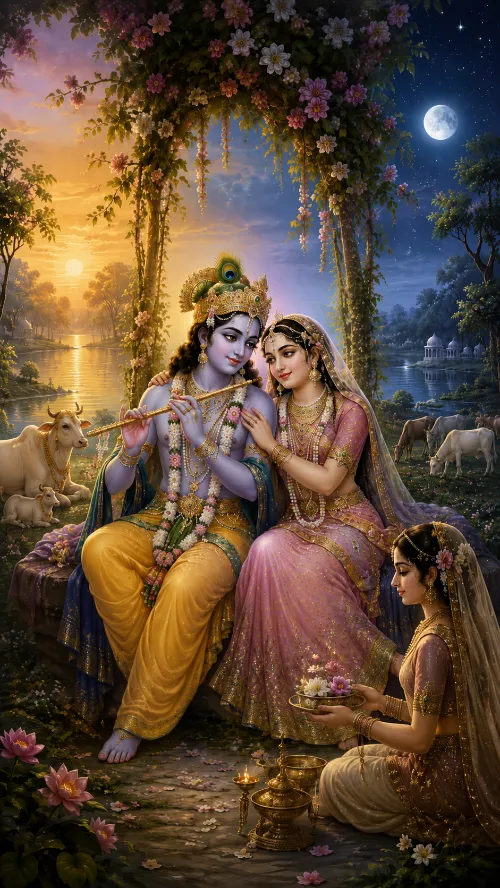
The servants, friends, parents and lovers of Hari, all eternal and full of good qualities, live here in Vṛndāvana, O best of sages. Just as they are described in the Purāṇas, in their prakaṭa līlā, so they do exist in the land of Vṛndāvana in their nitya līlā. He comes and goes eternally between the forest and the cowherd village and herds cows with His friends without killing demons. Also, His lovers, thinking themselves His paramours, please their dearest in secret.
One should think of oneself there among them in the form of an enchanting woman, possessed of youth and beauty, just past puberty, conversant with many arts and crafts, suitable for Kṛṣṇa’s enjoyment, but who, though requested by Kṛṣṇa, is opposed to enjoyment with Him; a follower of Rādhā intent upon her service, loving Rādhā even more than Kṛṣṇa, bringing about, out of love and with great care, the meetings of those two each day, and overwhelmed with the joys of their service. Visualizing oneself in this way, one should perform service there beginning from Brāhma Muhūrta until late at night [i.e. aṣṭa-kāla-līlā-sevā].
Nārada said:
I want to hear of Hari’s daily līlā as it really is. Without knowing that līlā, how indeed can Hari be served in one’s mind?
Śiva said:
I do not know that līlā of Hari as it really is, O Nārada. Go to see Vṛndādevī; she will describe this līlā to you. Not far from here, near Keśī Tīrtha, lives that servant of Govinda, surrounded by her friends.
Sūta said:
Being advised thus, Nārada circumambulated Śiva and, overjoyed, bowed repeatedly to him. Then that truest of sages went to Vṛndā’s residence. Vṛndā, too, seeing Nārada, bowed repeatedly and said: “O best of sages, how is it that you have come here?”
Nārada replied:
I want to know from you of the daily deeds of Hari. Describe them to me from the very beginning, if I am fit to hear it, O beautiful one.
Vṛndā said:
Even though it is a secret, I will tell you, O Nārada, for you are a devotee of Kṛṣṇa. You, however, should not reveal it. This is the greatest of mysteries.
In the midst of beautiful Vṛndāvana, which is adorned with fifty bowers, in a bower of desire trees, in a cottage of divine jewels, They, Rādhā and Kṛṣṇa, are asleep on a bed, intensely embracing each other. Though They are awakened after a while by birds who follow my orders, They feel such joy in Their intense embrace and such distress at the thought of breaking it, that They do not want to get up from the bed even a little. Then, being repeatedly awakened from all sides by groups of Śārikās and parrots with various speeches, They rise from bed. Seeing the couple sitting up, Their joyful girlfriends then enter and serve Them as is suitable for that time. Once again, at the words of the Śārikās, the couple gets up from Their bed and returns to Their homes, filled with fear and anxiety.
Being awakened at daybreak by His mother, Kṛṣṇa, along with Baladeva, rises from bed and, after brushing His teeth, goes with His mother’s permission to the cowpen, surrounded by His friends.
Rādhā, too, is awakened by her friends, O vipra, and she rises from her bed. After brushing her teeth, she rubs oil onto her body. Then, going to the bathing platform, she is bathed by her servants. She next goes to her dressing room, where her friends decorate her with various shining ornaments, fragrances, garlands, and unguents. Then, after carefully begging her mother-in-law, Jaṭilā, for permission, Yaśodā calls Rādhā and her friends to cook fine food for Kṛṣṇa at His house.
Nārada asked:
Why does Yaśodā call Rādhā to cook if there are good ladies, headed by Rohiṇī, at Kṛṣṇa’s house who can cook?
Vṛndā replied:
O great sage, previously a boon was given to her by Durvāsā, as I have heard earlier from Kātyāyanī, that “Whatever you cook, O lady, shall be, by my grace, as sweet as nectar and shall increase the duration of life of its eater.” Thus, good lady Yaśodā, fond of her son, daily calls her, thinking: “In this way my son will be long-living through His desire for tasty foods.”
Hearing that Rādhā should go to Nanda’s house and being permitted to do so, she too is pleased and goes there along with her friends and cooks.
Kṛṣṇa, having milked some cows and had others milked by His friends, returns at the request of His father to His house, surrounded by friends. Having rubbed His body with oil, He is bathed happily by His servants.
Wearing clean clothes, garlanded, His body anointed with sandalwood, appearing with His hair parted in two above His neck and forehead, beautified by the curls and sandalwood mark on His forehead, shaped like a moon, His arms and hands shining with bracelets, armlets and jeweled rings, with a pearl necklace shining on His chest and makara-shaped earrings, He, being repeatedly called by His mother, takes the hand of a friend and enters the dining room, following Baladeva.
Then He, along with His brother and friends, enjoys different kinds of food, making His friends laugh with a variety of jokes and laughing along with them. After eating and rinsing His mouth, He rests for a while on a shining cot, dividing up and chewing the betel nut given to Him by His servants.
Kṛṣṇa, dressed as a cowherder, with the herd before Him, is followed down the path to the pastures affectionately by all the residents of Vraja. Bowing to His father and mother and, with glances at the rest of the gathering, He turns them back, as it is proper, and heads towards the forest.
After entering the forest, He plays with His friends for a while. He happily amuses Himself with various games in that forest. Then, tricking all of them, He goes joyfully, accompanied by only two or three dear friends, to the tryst, eager to meet His dear one.
Rādhā too, after watching Kṛṣṇa go to the forest, returns home, and out of desire to be with her dear one, she, on the pretext of worshipping the sun-god, fools her elders and goes to the forest in order to gather flowers. Thus, the two, with great effort, meet in the forest and spend the day there happily in various games. Sometimes they sit together on a swing and are pushed by their friends. Sometimes Hari, His flute having dropped from His hand and being hidden by His lover, is scolded by His “insulted” girlfriends as He searches for it. They keep Him laughing with many jokes there.
Sometimes, happily entering a forested stretch blown by spring breezes, they sprinkle each other with sandal- and flower-scented waters using sprinklers and smear each other with ointments. Girlfriends, too, sprinkle Them, and are sprinkled in return by the couple throughout those groves filled with spring breezes.
O twice-born, sometimes the couple, along with Their friends, become tired from many games suited to those various moments and, finding the base of a tree, O most true of sages, They sit on shining seats and drink honey wine. Then, becoming intoxicated by that honey wine, their eyes drooping with sleep, They take hold of each other’s hands and fall to the arrows of desire. Desiring to make love, They enter a bower along the path, Their words and minds faltering, and They enjoy Themselves there like leaders of elephants. The friends too, being intoxicated with honey, their eyes laden with sleep, all lie down in pretty bowers all around. Kṛṣṇa too, being powerful, visits all of them simultaneously with separate bodies, being repeatedly urged on by His dearest. After giving them pleasure, as a king of elephants does to his female elephants, He goes with His dearest and them to a pond in order to play.
The couple, with Their friends, enjoy Themselves splashing water on each other. They are then adorned with clothes, garlands, sandal paste and shining ornaments, right there on the shore of that pond in a shining, bejeweled house.
I arrange fruits and roots in advance, O sage, and Hari eats first, served by His beloved. He then goes, accompanied by two or three ladies, to a bed made of flowers. Being served with betel nut, a yak-tail fan, foot massages and so forth, He, smiling and thinking of His dear one, is pleased by them.
Rādhikā too, when Hari is asleep, though her heart is with Him, eats His remnants among her friends. She is pleased in her heart. Then, after eating a little, she goes to the bedroom to gaze upon the lotus-like face of her lover, like a cakora bird gazing upon the moon, and ladies there offer her His chewed betel. She eats betel, dividing it among her friends. Kṛṣṇa, covered with cloth, wanting to hear their uninhibited conversation with each other, though not asleep, pretends as if He were; and they, learning the truth somehow by inference, make faces, bite their tongues with their teeth and look at each other’s faces. As though dissolved in an ocean of embarrassment, they do not say anything for a while. Then, after a moment, they pull the cloth from His body and say, “A fine sleep you have gone to,” making Him laugh and laughing themselves.
Thus, the pair, enjoying Themselves with Their friends through various humorous remarks, taste the happiness of sleep for a while, O truest of sages. Then They sit happily among Their friends on a broad, shining seat and, wagering each other’s garlands, kisses, embraces and clothes, play dice with love amidst the banter of merriment. His dear one scolds Him when, though beaten, He says, “I have won,” and begins to take her garlands and things.
After being scolded, Kṛṣṇa, with His hand on His lotus face, becomes despondent and makes up His mind to go on, saying, “If you have defeated me, O lady, let what I wagered—kisses and so forth—be taken.” She does just that. He behaves like that to see the furrowing of her brow and to hear her scolding speech.
Then, both hearing the words and calls of parrots and śārīs [= śārikās], They, desiring to return home, leave that place. Kṛṣṇa, taking leave of His lover, heads towards the cows, and she goes to the temple of the sun along with her circle of friends. Going off a little way, Hari turns back and, putting on the disguise of a brāhmaṇa, goes to the temple of the sun. There He is invited by the girlfriends and helps them worship the sun with fabricated Vedic hymns pregnant with humor. Then the clever girls, recognizing Him as their lover, become absorbed in an ocean of joy and lose all track of self and other. In this way they spend two and a half muhūrtas, O sage, and then the gopīs go to their houses, and Kṛṣṇa goes to the cows.
Kṛṣṇa joins with all His friends and, collecting together the cows from all around, returns to the village, joyfully playing His flute, O sage. Then Nanda and all the other cowherders, including the women and children, hearing the sound of Hari’s flute and seeing the surface of the sky spread with a veil of cow dust, give up all their activities and go towards Kṛṣṇa, anxious to see Him.
On the main road at the village gate, all the residents of the village wait as Kṛṣṇa approaches and greets them in succession with looks, touches, words, and smiling glances. He greets the cowherd elders with verbal and physical obeisance and prostrations. He greets His parents and Rohiṇī, O Nārada, and, with decorum, through indications of His sidelong glances, He greets His beloved.
Thus, after being suitably greeted by the residents of Vraja and taking the cows into the cowshed, at His parents’ request He goes home with His brother.
After bathing and having something to eat and drink there, He, with permission of His mother, goes again to the cowshed, desiring to milk the cows, and after milking some, having some milked and having some watered, He who pursues hundreds of feelings returns home with His father. There, along with His father, His uncles, their sons and Balarāma, He eats varieties of foods—some chewed, some sucked and so forth.
Thinking of Him, Rādhikā then, even before being asked, sends cooked foods to His house through her friends, and Hari, praising those dishes, enjoys them along with His father and others. He then goes with them to the assembly hall, which is replete with bards and other performers.
Girlfriends, who previously brought food, return with many of those dishes and some of Kṛṣṇa’s leftovers, sent by Yaśodā. Bringing it with them, they offer all to Rādhikā, and she then, having eaten along with her friends in proper order, waits surrounded by them, ready to meet her lover. I then send some friend from here who guides her to a house made of shining jewels in this bower of desire trees near Yamunā. Dressed in attire suitable for either a light or dark night, she departs surrounded by her friends.
After watching various wonderful performances there in the assembly hall, listening to beautiful songs of Kātyāyanī, and then pleasing performers with money, grains and other things according to custom, Kṛṣṇa, honored by people there, returns home with His mother and friends. When, after feeding Him, His mother leaves, He comes there unnoticed to the house appointed by His lover. Joining each other, those two enjoy here among the forests for two and a half muhūrtas of night [seven and a half hours]. They enjoy various amusements headed by the circle of rāsa dance, the dance of love, and much laughter. Then the sleepy lovers enter the bower unnoticed by the birds and, being alone, fall asleep on an enchanting love bed made of flowers, being served there by their personal servants.
Thus the entire daily activity of Hari has been told to you. Even sinners are liberated by hearing this, O Nārada.
Nārada said:
O lady, there can be no doubt that I am fortunate to have been blessed by you, for Hari’s daily līlā has now been revealed to me.
Sūta said:
Having said this, after circumambulating her and being worshipped by her, Nārada, the best of sages, disappeared, O Brāhmaṇa. I too have made all this known in proper order.
One should forever utter with care the unsurpassed pair of mantras, as this was attained previously by Rudra from the lips of Kṛṣṇa. He told it to Nārada, and Nārada told it to me. Now, after performing the purification, I have told you this. You too should keep this most amazing secret confidential.
Śaunaka said:
I have achieved my goal by your direct grace, O guru, since you have revealed the secret of secrets to me.
Sūta said:
Devoting yourself to these truths and reciting the mantras day and night, no doubt you will attain the service of Him without delay. I too, O Brāhmaṇa, go to the eternal abode of the Supreme in the company of the guru of gurus, the daughter of Bhānu—Rādhā—and of the Lord of the cowherd girls.
This most purifying account, great in might, was told by Maheśa. Those devoted human beings who hear it will go to the eternal realm of Acyuta. It bestows fortune, fame, long life, health, desired objectives and success; causes the attainment of heaven and liberation; and destroys sin. Those human beings intent on Viṣṇu who hear it regularly with devotion will not in any way return again from Viṣṇu’s realm.