

Ananta Śeṣa
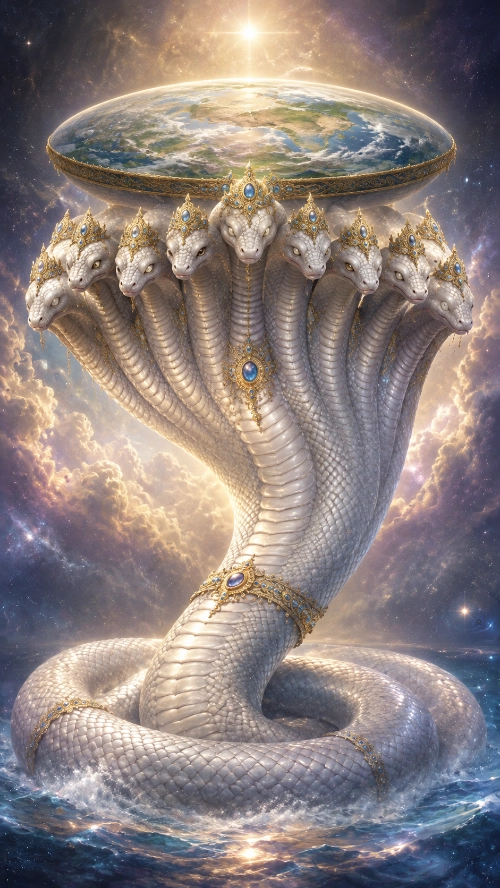
Ananta Śeṣa, Who Bears the Earth
Meaning: śeṣa means “remainder,” “that which remains.” He is also known as Ananta, “the endless” or “infinite one.”
Ananta Śeṣa is one of the greatest of all Nāgas and one of the most important cosmic beings in Hindu scripture. He is a son of the sage Kaśyapa and Kadru and belongs to the same great serpent lineage as Vāsuki, Takṣaka, Karkoṭaka and the other famous Nāgas.
The Mahābhārata places Ananta Śeṣa at the beginning of this lineage: Ananta Śeṣa is born first, followed by Vāsuki and then the other principal serpents. He therefore stands as the eldest among the prominent Nāgas.
His most important early biography occurs in the Āstīka Parva of the Mahābhārata. Ananta Śeṣa becomes deeply dissatisfied with the conduct of his serpent brothers. He tells Brahmā that they are constantly jealous of one another and harbor intense hostility toward Vinatā and her son Garuḍa. Unwilling to participate in their quarrels and wickedness, Ananta Śeṣa separates himself from them and undertakes severe austerities.
He performs tapas at sacred places including Gandhamādana, Badarikāśrama, Gokarṇa, Puṣkara and the Himalayas, living only on air and bringing his senses and passions completely under control.
Brahmā eventually appears before him and offers him a boon. Ananta Śeṣa does not ask for wealth, power or dominion. Instead, he asks that his mind remain permanently fixed upon dharma, tranquility and ascetic discipline.
Pleased by Ananta Śeṣa’s extraordinary self-restraint, Brahmā gives him a cosmic task: he commands him to descend beneath the earth and hold it steady, together with its mountains, forests, oceans, cities and all living beings.
Ananta Śeṣa obeys. Entering beneath the earth, he supports the entire world upon his head. In this role he is called Ananta, the “Endless One,” dwelling beneath the earth and sustaining it by Brahmā’s command.
Significantly, Brahmā also gives Garuḍa to Ananta as a friend. This is especially striking because Garuḍa is traditionally the great enemy of the serpent race. Ananta Śeṣa is therefore distinguished from many of the other Nāgas not only by his asceticism but also by his freedom from their inherited hostility.
Later Purāṇic tradition develops Ananta Śeṣa’s cosmic identity still further. The Bhāgavata Purāṇa describes Ananta with thousands of hoods, so immense that the entire terrestrial sphere resting upon one of them appears no larger than a tiny mustard seed.
Ananta Śeṣa’s best-known role, however, is his intimate association with Viṣṇu/Nārāyaṇa. In the Bhāgavata Purāṇa, Kṛṣṇa and Arjuna behold the enormous thousand-hooded Ananta, radiant with jewels upon his many heads, while Mahā-Viṣṇu rests upon him as upon a divine serpent couch.
Ananta is described as brilliant white like Mount Kailāsa, while his many necks and tongues are dark blue. This image became one of the most famous representations of Viṣṇu: the Supreme Lord reclining upon the endless cosmic serpent.
The Bhāgavata Purāṇa also identifies Ananta with Saṅkarṣaṇa. Before Kṛṣṇa appears on earth, this divine Ananta-Saṅkarṣaṇa manifests as Baladeva or Balarāma, Kṛṣṇa’s elder brother. Thus the tradition connects the cosmic serpent who supports the worlds with the personal form of Balarāma.
This association is reflected in Ananta’s iconography. He is described as white and bearing a plough, both of which are characteristic attributes of Balarāma.
- the eldest of the principal Nāgas, born to Kaśyapa and Kadru;
- a great ascetic devoted to dharma, tranquility and self-restraint;
- a Nāga who separates himself from the violence and jealousy of his serpent brothers;
- the cosmic supporter of the earth;
- the thousand-hooded Ananta, the “Endless One”;
- the divine serpent couch of Viṣṇu/Nārāyaṇa;
- Saṅkarṣaṇa, who manifests on earth as Balarāma in the Vaiṣṇava Purāṇic tradition.