

Dīkṣā: More Than a Ceremony
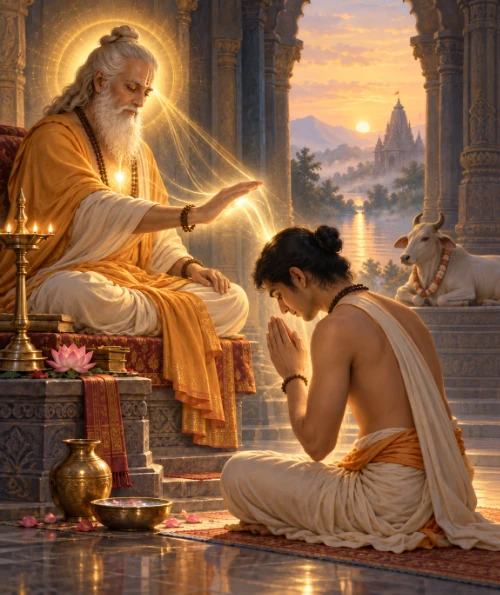
Touch, Gaze, Mind, Ritual, and the Transmission of Sacred Knowledge
The Brahmāṇḍa Purāṇa describes several levels and modes of spiritual transmission: through touch, gaze, the guru’s inward intention, formal ritual, and—in the extraordinary case called śāmbhavī-dīkṣā—an immediate awakening of knowledge through the guru’s mere presence, word, glance, or touch.
The parallel discussion in the Kulārṇava Tantra goes still further. It first groups touch, gaze, and mental initiation together as three forms requiring no elaborate ritual, and then gives a broader sevenfold classification of dīkṣā.
Vaiṣṇava texts, meanwhile, place the emphasis elsewhere: dīkṣā gives divine knowledge, purification, mantra, sambandha—a defined relationship with Bhagavān—and entry into a disciplined life of worship.
The common idea behind all these traditions is therefore much deeper than “receiving a mantra.” Dīkṣā is a transition of spiritual identity and eligibility: something is purified, something is transmitted, and a new sacred relationship is established.
The primary source is the Brahmāṇḍa Purāṇa, Uttarabhāga, Lalitopākhyāna, Chapter 43, especially verses 3–8.
The setting is also significant. This is not a generic manual of initiation detached from any theology. The passage occurs in the Lalitopākhyāna, in a dialogue between the sage Agastya and Hayagrīva, and concerns the realization and worship of Śrī Devī, especially Kāmākṣī/Lalitā. It therefore belongs directly to the Śrīvidyā-Śākta environment.
Agastya asks:
अश्वानन महाप्राज्ञ करुणामृतवारिधे ।
श्रीदेवीदर्शने दीक्षा यादृशी तां निवेदय ॥
aśvānana mahāprājña karuṇāmṛta-vāridhe |
śrī-devī-darśane dīkṣā yādṛśī tāṃ nivedaya ||
“O horse-faced Hayagrīva, greatly wise, ocean of the nectar of compassion, explain to me the initiation connected with the realization of Śrī Devī.”
Brahmāṇḍa Purāṇa 43.1
So the discussion begins not with administrative membership in a religious institution, but with dīkṣā as a means of spiritual realization.
Dīkṣā Is an Ancient Idea
The word dīkṣā is considerably older than the Purāṇic and Tantric systems in which mantra initiation became highly developed. In Vedic ritual, it already denotes consecration: the sacrificer passes from ordinary existence into a special sacred condition before performing the sacrifice.
The Vājasaneyi Saṃhitā states:
व्रतेन दीक्षामाप्नोति दीक्षयाप्नोति दक्षिणाम् ।
दक्षिणा श्रद्धामाप्नोति श्रद्धया सत्यमाप्यते ॥
vratena dīkṣām āpnoti dīkṣayāpnoti dakṣiṇām |
dakṣiṇā śraddhām āpnoti śraddhayā satyam āpyate ||
“Through the vow one attains consecration; through consecration one attains the sacrificial gift; through the gift comes faith, and through faith truth is attained.”
Vājasaneyi Saṃhitā 19.30
In the elaborate Soma sacrifices, Vedic dīkṣā symbolically changes the sacrificer’s status. Brāhmaṇa literature can portray him as entering an embryonic condition and undergoing a symbolic death and rebirth.
This is not identical to later mantra-dīkṣā. Yet there is a striking continuity: dīkṣā marks a threshold. One enters it as an ordinary person and emerges ritually reconstituted for sacred action.
Tantric and Āgamic traditions intensify that idea. The transformation is no longer merely eligibility to perform a sacrifice; it may involve mantra, purification of subtle structures, destruction of bondage, identification with the deity, and the descent of spiritual power.
Sparśa-dīkṣā: Initiation Through Touch
The first form described in the Brahmāṇḍa Purāṇa is sparśa-dīkṣā, initiation through touch.
हस्ते शिवपुरं ध्यात्वा जपेन्मूलाङ्गमालिनीम् ।
गुरुः स्पृशेच्छिष्यतनुं स्पर्शदीक्षेयमीरिता ॥
haste śivapuraṃ dhyātvā japen mūlāṅgamālinīm |
guruḥ spṛśec chiṣya-tanuṃ sparśa-dīkṣeyam īritā ||
“Having performed the prescribed meditation and mantra recitation in his hand, the guru touches the body of the disciple. This is declared to be sparśa-dīkṣā, initiation by touch.”
Brahmāṇḍa Purāṇa 43.3
The important point is easily missed if this is reduced simply to “initiation by touching.”
The guru does not casually touch someone and thereby make him initiated. Meditation and mantra precede the touch. The hand has itself become ritually consecrated. Touch is the final vehicle through which an already invoked sacred potency is communicated.
In this understanding, therefore, the hand is the instrument; the true content of the initiation is the spiritual potency carried through it.
Dṛg-dīkṣā: Initiation Through the Gaze
The next mode is even subtler.
निमील्य नयने ध्यात्वा श्रीकामाक्षीं प्रसन्नधीः ।
सम्यक्पश्येद्गुरुः शिष्यं दृग्दीक्षा सेयमुच्यते ॥
nimīlya nayane dhyātvā śrī-kāmākṣīṃ prasanna-dhīḥ |
samyak paśyed guruḥ śiṣyaṃ dṛg-dīkṣā seyam ucyate ||
“Closing his eyes and meditating upon Śrī Kāmākṣī with a serene mind, the guru then properly beholds the disciple. This is called dṛg-dīkṣā, initiation through the gaze.”
Brahmāṇḍa Purāṇa 43.4
The Sanskrit text reads dṛg-dīkṣā. The dictionary form is dṛk, “sight” or “the faculty of seeing”; before d in the compound it becomes dṛg- through normal Sanskrit phonetic transformation. Thus both “dṛk-dīkṣā” and “dṛg-dīkṣā” may be encountered, but dṛg-dīkṣā is the actual form found in this verse.
Again, the crucial act occurs before the outward gesture. The guru first closes his ordinary vision and meditates on the deity. Only then does he open his eyes toward the disciple.
The implication is profound: the gaze is no longer treated as merely psychological attention. It has become a vehicle of consecrated awareness.
Śāmbhavī-dīkṣā: When Knowledge Arises Immediately
Immediately after dṛg-dīkṣā, the Purāṇa says:
गुरोरालोकमात्रेण भाषणात्स्पर्शनादपि ।
सद्यः सञ्जायते ज्ञानं सा दीक्षा शाम्भवी मता ॥
guror āloka-mātreṇa bhāṣaṇāt sparśanād api |
sadyaḥ sañjāyate jñānaṃ sā dīkṣā śāmbhavī matā ||
“By the guru’s mere glance, by his speech, or even by his touch, knowledge arises immediately. That initiation is regarded as Śāmbhavī.”
Brahmāṇḍa Purāṇa 43.5
This verse changes how we should understand the entire classification.
Śāmbhavī-dīkṣā is not merely another physical technique. Its outward vehicle may be a glance, a word, or a touch—the same external acts that appear elsewhere. What distinguishes it is the result:
sadyaḥ sañjāyate jñānam — “knowledge arises immediately.”
Thus two gurus might both touch a disciple, yet the text would not necessarily classify the two events the same way. One may be formal sparśa-dīkṣā. Another may be called śāmbhavī because the contact produces immediate spiritual awakening.
This shows the categories overlap. They are describing initiation from different angles: sometimes by medium, sometimes by ritual structure, and sometimes by depth or immediacy of spiritual effect.
What Is Actually Being Transmitted?
The next verse gives the theological foundation:
देव्या देहो यथा प्रोक्तो गुरुदेहस्तथैव च ।
तत्प्रसादेन शिष्योऽपि तद्रूपः सम्प्रकाशते ॥
devyā deho yathā prokto guru-dehas tathaiva ca |
tat-prasādena śiṣyo ’pi tad-rūpaḥ samprakāśate ||
“As the body of the Goddess has been described, so also is the body of the guru; through his grace the disciple too shines forth in that form.”
Brahmāṇḍa Purāṇa 43.6
Within the theology of this particular Śrīvidyā text, the guru is not functioning merely as an instructor who passes information from one mind to another. The guru has been ritually and contemplatively identified with the divine reality he transmits.
The key word is prasāda — grace.
The sequence is therefore not merely:
teacher → information → student.
It is closer to:
deity → realized/consecrated guru → grace → transformed disciple.
One should not universalize the exact Śrīvidyā metaphysics to every Hindu school. But the basic idea—that initiation works because the guru is a living mediator of a tradition rather than merely a person pronouncing syllables—appears widely.
Mānasī-dīkṣā: Initiation Through the Guru’s Mind
The next passage is perhaps the most striking:
चिरं शुश्रूषया सम्यक्तोषितो देशिकेश्वरः ।
तूष्णीं सङ्कल्पयेच्छिष्यं सा दीक्षा मानसी मता ॥
ciraṃ śuśrūṣayā samyak toṣito deśikeśvaraḥ |
tūṣṇīṃ saṅkalpayec chiṣyaṃ sā dīkṣā mānasī matā ||
“When the eminent preceptor has been fully satisfied by the disciple’s service over a long period, he silently forms the intention concerning the disciple. This is regarded as mānasī-dīkṣā, mental initiation.”
Brahmāṇḍa Purāṇa 43.7
“Mental initiation” can sound vague in English. The Sanskrit is much more precise.
It does not describe a disciple sitting somewhere and imagining he has been initiated. Nor does it mean the guru is merely thinking casually about someone.
The verse establishes two prerequisites: ciraṃ śuśrūṣayā — prolonged devoted service, and samyak toṣitaḥ — the guru has become thoroughly satisfied. Only then does the guru silently make the saṅkalpa, the intentional spiritual resolve concerning the disciple.
And then comes the surprising statement:
दीक्षाणामपि सर्वासामियमेवोत्तमोत्तमा ।
आदौ कुर्यात्क्रियादीक्षां तत्प्रकारः प्रवक्ष्यते ॥
dīkṣāṇām api sarvāsām iyam evottamottamā |
ādau kuryāt kriyā-dīkṣāṃ tat-prakāraḥ pravakṣyate ||
“Of all forms of initiation, this indeed is the highest of the highest. At the beginning, however, kriyā-dīkṣā should be performed; its procedure will now be explained.”
Brahmāṇḍa Purāṇa 43.8
This is one of the most important verses in the entire discussion.
Mānasī-dīkṣā is declared the highest, yet formal kriyā-dīkṣā is still prescribed at the beginning.
That strongly suggests that the text does not consider inward transmission and outward ritual mutually exclusive. The formal rite establishes the disciple within the discipline; deeper forms of transmission may operate within or beyond that ritual framework.
Kriyā-dīkṣā: Formal Ritual Initiation
The handwritten gloss “by rite” is correct, but far too brief.
From verse 9 onward, the Brahmāṇḍa Purāṇa describes an extensive initiation procedure. It includes an auspicious time, bathing and purification, control of food and speech, recollection of the guru, entry into the place of worship, nyāsa, recitation of sacred texts, worship of Tripurāmbikā with sixteen forms of offering, consecrated vessels, offerings, prostration, purification of the disciple, mantra transmission, abhiṣeka or ritual bathing, mantra-japa, and subsequent observances.
At one point the mantra is communicated directly into the disciple’s ear; elsewhere the disciple is ritually purified and consecrated with water from the sacred vessel.
So kriyā-dīkṣā is not merely “the guru says a mantra.” It is a complete ritual reconstitution of the disciple.
The physical rite creates a sacred boundary: before it, the person is an aspirant; afterward, the disciple has received a mantra, a guru relationship, ritual authority, obligations, and a place within a living spiritual discipline.
The Kulārṇava Tantra Gives the Missing Framework
The Kulārṇava Tantra is particularly valuable because it contains striking parallels to the Brahmāṇḍa Purāṇa passage and organizes the material more systematically.
It first separates three forms of initiation that do not depend upon elaborate ritual performance:
स्पर्शाख्या देवि दृक्संज्ञा मानसाख्या महेश्वरि ।
क्रियायासादिरहिता देवि दीक्षा त्रिधा स्मृता ॥
sparśākhyā devi dṛk-saṃjñā mānasākhyā maheśvari |
kriyāyāsādi-rahitā devi dīkṣā tridhā smṛtā ||
“O Devī, initiation called sparśa, that designated dṛk, and that called mānasa are remembered as three forms of dīkṣā free from ritual exertion and similar procedures.”
Kulārṇava Tantra 14.34
Thus touch, gaze, and mind form a special triad.
The text then explains them through three memorable analogies.
यथा पक्षी स्वपक्षाभ्यां शिशून् संवर्द्धयेच्छनैः ।
स्पर्शदीक्षोपदेशश्च तादृशः कथितः प्रिये ॥
yathā pakṣī sva-pakṣābhyāṃ śiśūn saṃvardhayec chanaiḥ |
sparśa-dīkṣopadeśaś ca tādṛśaḥ kathitaḥ priye ||
“As a bird gradually nourishes its young through the contact of its wings, so is instruction through sparśa-dīkṣā.”
Kulārṇava Tantra 14.35
स्वापत्यानि यथा मत्स्यो वीक्षणेनैव पोषयेत् ।
दृग्भ्यां दीक्षोपदेशश्च तादृशः परमेश्वरि ॥
svāpatyāni yathā matsyo vīkṣaṇenaiva poṣayet |
dṛgbhyāṃ dīkṣopadeśaś ca tādṛśaḥ parameśvari ||
“As a fish nourishes its offspring merely by looking upon them, so is initiation through the eyes.”
Kulārṇava Tantra 14.36
यथा कूर्मः स्वतनयान् ध्यानमात्रेण पोषयेत् ।
वेधदीक्षोपदेशश्च मानसः स्यात् तथाविधः ॥
yathā kūrmaḥ sva-tanayān dhyāna-mātreṇa poṣayet |
vedha-dīkṣopadeśaś ca mānasaḥ syāt tathāvidhaḥ ||
“As a tortoise nourishes its young by meditation alone, so is the mental transmission known as vedha-dīkṣā.”
Kulārṇava Tantra 14.37
These are traditional symbolic analogies, not claims about modern zoology. They illustrate progressively subtler modes of connection: proximity and contact, sight, and finally inward consciousness without physical contact.
The Real Principle Is Śaktipāta
Immediately after the three analogies, the Kulārṇava Tantra gives the principle that makes sense of all of them:
शक्तिपातानुसारेण शिष्योऽनुग्रहमर्हति ।
यत्र शक्तिर्न पतति तत्र सिद्धिर्न जायते ॥
śaktipātānusāreṇa śiṣyo ’nugraham arhati |
yatra śaktir na patati tatra siddhir na jāyate ||
“The disciple receives grace according to the descent of spiritual potency. Where that potency does not descend, spiritual accomplishment does not arise.”
Kulārṇava Tantra 14.38
This prevents a crude interpretation of the entire subject.
Touch is not powerful simply because skin touches skin. A gaze is not initiation merely because a guru looks at someone. Words are not transformative merely because they have been spoken.
The external action is the vehicle. What matters is śaktipāta—literally the “descent of power”—together with anugraha, grace.
That is why these texts can imagine the same spiritual transmission operating through touch, sight, speech, ritual, or the mind. The physical channel changes; the underlying principle does not.
Seven Types of Dīkṣā
The very next verse of the Kulārṇava Tantra gives a broader taxonomy:
क्रियावर्णकलास्पर्शवाग्दृङ्मानससंज्ञया ।
दीक्षा मोक्षप्रदा देवि सप्तधा परिकीर्तिता ॥
kriyā-varṇa-kalā-sparśa-vāg-dṛṅ-mānasa-saṃjñayā |
dīkṣā mokṣa-pradā devi saptadhā parikīrtitā ||
“O Devī, liberation-giving dīkṣā is proclaimed to be sevenfold: kriyā, varṇa, kalā, sparśa, vāk, dṛk, and mānasa.”
Kulārṇava Tantra 14.39
This gives us the larger picture. Kriyā-dīkṣā is external ritual initiation. Varṇa-dīkṣā works through the sacred letters, ritually placing them within the disciple, dissolving them into the supreme reality and reconstituting them. Kalā-dīkṣā works through the subtle cosmic powers or kalās mapped through the disciple’s body. Sparśa-dīkṣā operates through consecrated touch. Vāk-dīkṣā uses spiritually empowered speech or mantra. Dṛg-dīkṣā works through the gaze. Mānasa-dīkṣā operates through inward mental transmission.
Significantly, śāmbhavī-dīkṣā then appears separately in the subsequent explanation:
गुरोरालोकमात्रेण भाषणात् स्पर्शनादपि ।
सद्यः सञ्जायते ज्ञानं सा दीक्षा शाम्भवी मता ॥
guror āloka-mātreṇa bhāṣaṇāt sparśanād api |
sadyaḥ sañjāyate jñānaṃ sā dīkṣā śāmbhavī matā ||
“By the guru’s mere glance, speech, or touch, knowledge arises immediately; this is considered Śāmbhavī initiation.”
Kulārṇava Tantra 14.56
Remarkably, this is essentially the same verse found in the Brahmāṇḍa Purāṇa.
That confirms an important conclusion: Śāmbhavī is not simply an eighth physical technique. It describes an extraordinary intensity of transmission in which realization occurs immediately.
This Is Not Permission for Casual “Initiation by a Look”
These passages can easily be romanticized. The surrounding text does the opposite.
The Kulārṇava Tantra insists upon authentic transmission and an ācārya:
विना दीक्षां न मोक्षः स्यात्तदुक्तं शिवशासने ।
सा च न स्याद्विनाचार्यमित्याचार्यपरम्परा ॥
vinā dīkṣāṃ na mokṣaḥ syāt tad uktaṃ śiva-śāsane |
sā ca na syād vinācāryam ity ācārya-paramparā ||
“According to the Śaiva teaching, there is no liberation without dīkṣā; and dīkṣā does not exist without an ācārya. Hence there is the succession of teachers.”
Kulārṇava Tantra 14.3
This statement is within the Kulārṇava’s own theological framework, not a universal rule accepted identically by every Hindu tradition. But its meaning inside that system is unmistakable: extraordinary initiation does not abolish lineage.
The text continues:
देवास्तमेव शंसन्ति पारम्पर्यप्रवर्त्तकम् ।
गुरुं मन्त्रागमाभिज्ञं समयाचारपालकम् ॥
devās tam eva śaṃsanti pāramparya-pravartakam |
guruṃ mantrāgamābhijñaṃ samayācāra-pālakam ||
“The gods praise that guru who continues the lineage, who understands mantra and āgama, and who preserves the required sacred discipline.”
Kulārṇava Tantra 14.5
The same chapter says that guru and disciple should examine one another before initiation. The guru tests the disciple’s qualification; the disciple is explicitly permitted to examine the guru’s spiritual competence, knowledge, practice, mantra-siddhi, and capacity to transmit knowledge.
This is an important corrective. Traditional texts do not support the notion that any charismatic individual can simply announce that a glance, hug, dream, or casual thought has initiated someone.
Transmission presupposes qualification, lineage, intention, and relationship.
The Vaiṣṇava Definition of Dīkṣā
When we move from Śrīvidyā and Kaula sources into the Vaiṣṇava tradition, the metaphysical vocabulary changes. Yet the central idea of dīkṣā as transformation rather than mere ceremony remains.
The Hari-bhakti-vilāsa quotes a famous definition from the Viṣṇu-yāmala:
दिव्यं ज्ञानं यतो दद्यात् कुर्यात् पापस्य सङ्क्षयम् ।
तस्माद् दीक्षेति सा प्रोक्ता देशिकैस् तत्त्वकोविदैः ॥
divyaṃ jñānaṃ yato dadyāt kuryāt pāpasya saṅkṣayam |
tasmād dīkṣeti sā proktā deśikais tattva-kovidaiḥ ||
“Because it bestows divine knowledge and brings about the destruction of sin, it is called dīkṣā by teachers who know the truth.”
Viṣṇu-yāmala, quoted in Hari-bhakti-vilāsa 2.9
This is often treated as the classical Vaiṣṇava definition of dīkṣā.
It is best understood as a traditional theological nirukti, a sacred explanation of what the word signifies, rather than as a modern historical-linguistic derivation of the Sanskrit word.
Its point is functional:
The next verse makes the disciple’s surrender explicit:
अतो गुरुं प्रणम्यैवं सर्वस्वं विनिवेद्य च ।
गृह्णीयाद् वैष्णवं मन्त्रं दीक्षापूर्वं विधानतः ॥
ato guruṃ praṇamyaivaṃ sarvasvaṃ vinivedya ca |
gṛhṇīyād vaiṣṇavaṃ mantraṃ dīkṣā-pūrvaṃ vidhānataḥ ||
“Therefore, having bowed to the guru and offered everything to him, one should receive the Vaiṣṇava mantra through dīkṣā according to the prescribed procedure.”
Hari-bhakti-vilāsa 2.10
Dīkṣā is thus simultaneously mantra reception, surrender, purification, authorization, and entry into a relationship.
What Is “Divine Knowledge”?
Śrī Jīva Gosvāmī gives an especially important explanation in the Bhakti-sandarbha. Commenting upon the expression divyaṃ jñānam, “divine knowledge,” he writes:
दिव्यं ज्ञानं ह्यत्र श्रीमति मन्त्रे भगवत्स्वरूपज्ञानं, तेन भगवता सम्बन्धविशेषज्ञानं च ।
divyaṃ jñānaṃ hy atra śrīmati mantre bhagavat-svarūpa-jñānaṃ, tena bhagavatā sambandha-viśeṣa-jñānaṃ ca.
“Here ‘divine knowledge’ means knowledge of Bhagavān’s own form contained within the sacred mantra, and through it knowledge of one’s particular relationship with Bhagavān.”
Bhakti-sandarbha, Anuccheda 283 in commonly used numbering
This is one of the deepest Gauḍīya explanations of initiation.
A mantra is not understood merely as a password, magical formula, or string of phonemes. It reveals Bhagavān and sambandha—the spiritual relationship between Bhagavān and the devotee.
Thus initiation is not merely the transfer of sound.
It is the beginning of seeing oneself, Bhagavān, worship, and one’s life through the relationship embodied in that mantra.
The Bhāgavata: Grace From the Ācārya Leads to Worship
The Śrīmad Bhāgavatam gives a concise foundation for this idea:
लब्ध्वानुग्रह आचार्यात् तेन सन्दर्शितागमः ।
महापुरुषमभ्यर्चेन्मूर्त्याभिमतयात्मनः ॥
labdhvānugraha ācāryāt tena sandarśitāgamaḥ |
mahā-puruṣam abhyarcen mūrtyābhimatayātmanaḥ ||
“Having received the grace of the ācārya and having been shown the scriptural path by him, one should worship the Supreme Person in the form most cherished by oneself.”
Śrīmad Bhāgavatam 11.3.48
Jīva Gosvāmī reads the anugraha—the grace received from the ācārya—in this context as mantra-dīkṣā.
Again the same pattern appears:
grace → transmission → scriptural method → worship.
Dīkṣā does not terminate in the ceremony. The ceremony begins a life of practice.
Caitanya-caritāmṛta: Dīkṣā as Self-Surrender
Kṛṣṇadāsa Kavirāja expresses this in striking Bengali:
দীক্ষা-কালে ভক্ত করে আত্ম-সমর্পণ ।
সেই-কালে কৃষ্ণ তারে করে আত্মসম ॥
সেই দেহ করে তার চিদানন্দময় ।
অপ্রাকৃত-দেহে তাঁর চরণ ভজয় ॥
dīkṣā-kāle bhakta kare ātma-samarpaṇa |
sei-kāle kṛṣṇa tāre kare ātma-sama ||
sei deha kare tāra cid-ānandamaya |
aprākṛta-dehe tāṅra caraṇa bhajaya ||
“At the time of dīkṣā the devotee surrenders the self. At that time Kṛṣṇa accepts and spiritualizes the devotee as His own. He makes the devotee’s existence conscious and blissful, and in that supramundane identity the devotee serves His feet.”
Caitanya-caritāmṛta, Antya 4.192–193
This language should not be read as abolishing the Gauḍīya distinction between Kṛṣṇa and the individual jīva. Rather, it describes consecration: what previously belonged to ordinary ego-centered existence is surrendered and reoriented toward Kṛṣṇa.
This gives a beautiful Vaiṣṇava counterpart to the older initiatory idea of death and rebirth.
One does not literally acquire a different biological body at the ceremony. The devotee’s embodied life is reclaimed for service.
Yet the Holy Name Is Not Dependent on Initiation
Gauḍīya theology adds an essential qualification.
The importance of mantra-dīkṣā does not mean the initiation ritual produces the divine potency of Kṛṣṇa’s name.
The Caitanya-caritāmṛta says:
দীক্ষা-পুরশ্চর্যা-বিধি অপেক্ষা না করে ।
জিহ্বা-স্পর্শে আ-চণ্ডাল সবারে উদ্ধারে ॥
dīkṣā-puraścaryā-vidhi apekṣā nā kare |
jihvā-sparśe ā-caṇḍāla sabāre uddhāre ||
“The Holy Name does not depend upon dīkṣā, preliminary rites, or ritual procedure. By touching the tongue, it can deliver everyone, even one considered a caṇḍāla.”
Caitanya-caritāmṛta, Madhya 15.108
This is not a rejection of dīkṣā. The same tradition carefully codifies initiation and gives it profound theological importance.
Rather, it distinguishes the intrinsic power of nāma from the initiatory system surrounding mantra, arcana, guru-disciple sambandha, and regulated worship.
Kṛṣṇa’s name is not manufactured by a ritual. Dīkṣā places the disciple within a particular sacred relationship and discipline.
That distinction matters greatly in Gauḍīya Vaiṣṇavism.
So What Is Dīkṣā Actually Doing?
When these sources are read together—without pretending that Śrīvidyā, Kaula Śāktism, and Gauḍīya Vaiṣṇavism are identical—a remarkably coherent pattern emerges.
Dīkṣā is consecration: the aspirant crosses a boundary from ordinary religious interest into an intentionally sacred life.
It is purification: different traditions describe this as removal of sin, impurity, karmic bondage, or limiting conditions.
It is transmission: mantra, knowledge, grace, śakti, or a spiritually charged intention passes through the guru-disciple relationship.
It is authorization: the disciple becomes qualified to undertake particular mantras, forms of worship, or initiatory practices that are not treated as anonymous public techniques.
It is relationship: initiation establishes a living link to guru, lineage, deity, mantra, and—in the Vaiṣṇava reading—to one’s sambandha with Bhagavān.
And finally, it is reorientation of identity. The initiated person is no longer supposed simply to add a mantra to an otherwise unchanged life. The deeper meaning of the rite is that one’s body, speech, mind, values, and actions increasingly belong to the sacred relationship into which one has entered.
Why Touch, Gaze, Speech, and Mind Can All Be Called Dīkṣā
At first, the classifications can appear contradictory. Is dīkṣā fourfold, fivefold, sevenfold, or something else?
The contradiction disappears once we recognize that these texts are classifying different dimensions of initiation.
Sparśa, dṛg, vāk, and mānasa describe channels of transmission: touch, gaze, speech, and mind.
Kriyā describes a ritual structure.
Varṇa and kalā describe particular subtle technologies or objects of initiatory transformation.
Śāmbhavī describes primarily the intensity and immediacy of the result: spiritual knowledge arises at once.
Thus there is no need to force all of them into a single flat list.
This also explains the apparent paradox in the Brahmāṇḍa Purāṇa: mānasī-dīkṣā can be “the highest of the highest,” while kriyā-dīkṣā is nevertheless performed first.
The outer rite and the inner transmission are not competitors.
The Brahmāṇḍa Purāṇa, Uttarabhāga, Lalitopākhyāna 43.3–8 mentions:
- sparśa-dīkṣā, transmission through consecrated touch;
- dṛg-dīkṣā, transmission through the guru’s spiritually focused gaze;
- śāmbhavī-dīkṣā, immediate awakening of knowledge through the guru’s glance, speech, or touch;
- mānasī-dīkṣā, inward initiation through the guru’s silent spiritual resolve after prolonged service and satisfaction, which the text calls the highest form;
- kriyā-dīkṣā, the formal ritual initiation involving purification, worship, mantra transmission, abhiṣeka, and prescribed observances.
The Kulārṇava Tantra then shows that this should not be mistaken for an exhaustive fivefold classification. It separately describes sparśa, dṛk, and mānasa as three non-elaborate modes, and elsewhere gives seven modes—kriyā, varṇa, kalā, sparśa, vāk, dṛk, and mānasa—while retaining śāmbhavī as an exceptional immediate form of awakening.
The deepest principle, therefore, is not the external mechanism.
- The rite is the vessel.
- The guru-disciple relationship is the channel.
- Grace or spiritual potency is the active principle.
- Knowledge, purification, sambandha, and transformation are the intended result.
That is what the traditional sources mean by dīkṣā.