

Serpents of Śiva
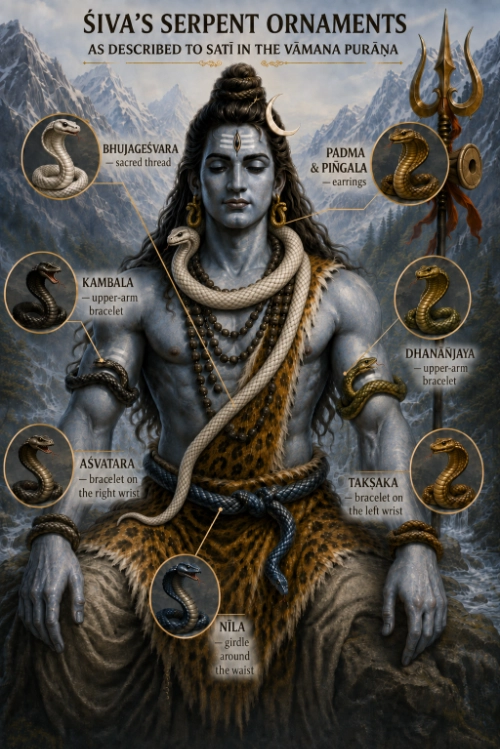
The Nāgas Śiva Wears
In the opening chapter of the Vāmana Purāṇa, Śiva describes his serpent ornaments to Satī — naming which Nāga he wears, and where.
These are not ordinary snakes but prominent Nāgas — semi-divine serpent beings. The seven named ones all occur among the principal serpents listed in the Mahābhārata.
Bhujageśvara
The Vāmana Purāṇa gives this serpent no personal name. Śiva simply calls him bhujageśvara. The accessible Sanskrit witnesses agree on that reading, and none supplies a name.
ममोपवीतं भुजगेश्वरः शुभे
कर्णेऽपि पद्मश्च तथैव पिङ्गलः ।
केयूरमेकं मम कम्बलस्त्वहिर्
द्वितीयमन्यो भुजगो धनञ्जयः ॥ १.२५ ॥
mamopavītaṃ bhujageśvaraḥ śubhe
karṇe ’pi padmaś ca tathaiva piṅgalaḥ |
keyūram ekaṃ mama kambalas tv ahir
dvitīyam anyo bhujago dhanañjayaḥ ||
“O auspicious one, the lord of serpents is my sacred thread; on my ears are Padma and likewise Piṅgala. One armlet of mine is the serpent Kambala, the second another serpent, Dhanañjaya.”
Vāmana Purāṇa 1.25 · GRETIL, after A. S. Gupta, All India Kashiraj Trust, 1967
It would therefore be unsafe to identify him as either Śeṣa or Vāsuki without evidence from another textual tradition. Both identifications circulate, but they are interpretation rather than what this text says.
Padma
Padma is named among the principal Nāgas in the Mahābhārata, alongside Mahāpadma — so the two should not automatically be treated as the same being.
Outside lists of important serpents and the description of Śiva’s ornaments, no substantial independent biography of this particular Padma appears to survive.
Piṅgala
Piṅgala is included among the chief Nāgas born in the serpent race of Kadru.
Unlike Takṣaka or Aśvatara, he does not appear to have a developed independent story in the major epics or Purāṇas.
Kambala
Kambala is closely associated with Aśvatara, described as his brother or companion. Their most important story appears in the Mārkaṇḍeya Purāṇa: Aśvatara worships Sarasvatī and asks that Kambala be restored to him, and that both receive complete knowledge of musical sound. Sarasvatī grants them mastery of notes, rāgas, rhythms, tempos and instruments. The two Nāgas then go to Mount Kailāsa and worship Śiva by singing seven compositions accompanied by stringed music.
Kambala is therefore portrayed not merely as a serpent but as a celestial musician and devotee of Śiva.
Dhanañjaya
This Dhanañjaya is a Nāga and should not be confused with Arjuna, who bears the same epithet. He is listed among the principal serpents in the Mahābhārata and among the powerful Nāga chiefs inhabiting Pātāla. The Bhāgavata Purāṇa groups him with Nāga rulers possessing expansive hoods and formidable temperaments, and the Brahmāṇḍa Purāṇa mentions a city or residence belonging to him in the netherworld.
No extended personal narrative comparable to that of Takṣaka or Aśvatara appears to be preserved.
Aśvatara
Aśvatara has the richest biography after Takṣaka. He is a benevolent Nāga king whose two sons befriend Prince Ṛtadhvaja, also called Kuvalayāśva. When the prince’s beloved wife Madālasā dies, Aśvatara determines to restore her.
He performs severe austerities and praises Sarasvatī. After receiving mastery of music together with Kambala, the two Nāgas sing before Śiva at Kailāsa. Pleased, Śiva offers a boon. Aśvatara asks that Madālasā be reborn as his daughter in the exact form and age she had when she died, retaining the memory of her previous life. Śiva grants it, and Madālasā emerges from Aśvatara’s middle hood as he exhales.
He is subsequently described as:
- peaceful, and honoured even by heavenly beings;
- ruler of a magnificent realm in Pātāla;
- adorned with divine garments, jewels and pearl garlands;
- seated upon a golden throne;
- compassionate toward the human prince Kuvalayāśva.
Kambala and Aśvatara are elsewhere identified as sons of Kadru, and are said to accompany the sun during particular months.
Takṣaka
Takṣaka is one of the most famous Nāga kings, and his stories belong chiefly to the Mahābhārata. He and his family were associated with the Khāṇḍava forest. Takṣaka was absent when Kṛṣṇa, Arjuna and Agni burned it, but his wife was killed and his son Aśvasena escaped.
He later caused the death of King Parīkṣit, fulfilling a brāhmaṇa boy’s curse that the king would die of snakebite within seven days. Parīkṣit’s son Janamejaya consequently began the enormous sarpa-sattra, a serpent sacrifice intended to exterminate Takṣaka and the entire serpent race.
Takṣaka sought refuge with Indra, but the sacrificial mantras began dragging both of them toward the fire. The sage Āstīka intervened and persuaded Janamejaya to stop the sacrifice, saving Takṣaka and the surviving Nāgas.
Nīla
Nīla is listed as a prominent Nāga born in the race of Kadru in the Mahābhārata. A great Nāga king named Nīla is also central to the Kashmiri Nīlamata Purāṇa, where he is sovereign of the Nāgas — dark like a blue lotus or a mass of rainclouds, possessing seven hundred radiant hoods — and teaches the rites and festivals by which human beings may safely inhabit Kashmir.
This may reflect the same traditional figure, but the texts do not explicitly identify the Kashmiri king Nīla as Śiva’s waist-serpent, so the connection should remain tentative.
- Bhujageśvara is given no personal name at all — calling him Śeṣa or Vāsuki goes beyond this text.
- Takṣaka has the major Mahābhārata biography.
- Aśvatara and Kambala are musical Nāga brothers or companions, devoted to Sarasvatī and Śiva.
- Nīla has an extensive — though possibly separate — Kashmiri tradition.
- Padma, Piṅgala and Dhanañjaya are remembered chiefly as prominent Nāga chiefs, with few individual stories preserved.