

The Traditional Weapons of Dhanurveda
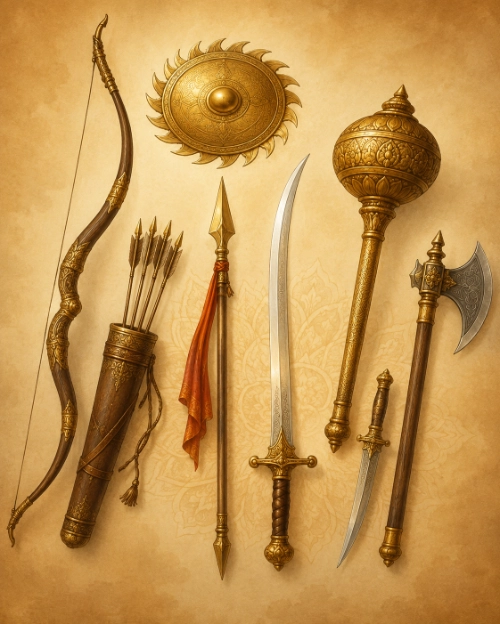
Four Classes of Āyudha and Seven Forms of Combat
Dhanurveda—literally the “knowledge of the bow”—is the traditional Indian science of warfare, weaponry, archery, military training, and combat. Although the bow occupies a central place in the discipline, Dhanurveda encompasses a much broader range of weapons and methods of fighting.
The text commonly known as the Vasiṣṭha Dhanurveda-saṁhitā organizes weapons according to the fundamental way they are used. It gives four principal classes of āyudha, “weapons”:
चतुर्विधमायुधम् ।
मुक्तममुक्तं मुक्तामुक्तं यन्त्रमुक्तञ्चेति ॥
caturvidham āyudham |
muktam amuktaṁ muktāmuktaṁ yantramuktaṁ ceti ||
“Weapons are of four kinds: mukta, amukta, muktāmukta, and yantramukta.”
Vasiṣṭha Dhanurveda-saṁhitā 1.4
These four categories describe weapons not primarily by shape or material but by their mode of deployment:
- Mukta — weapons released or hurled
- Amukta — weapons retained in the hand
- Muktāmukta — weapons capable of being either released or retained
- Yantramukta — projectiles released through a device or mechanism
This classification is one of the clearest organizing principles of classical Indian martial theory.
Were There Exactly 117 Weapons?
Modern glossaries and inventories of the Dhanurveda-saṁhitā identify at least 117 names of weapons, missiles, arrowheads, implements, and weapon-related devices in the text.
It is therefore reasonable to speak of approximately 117 traditional weapons associated with the Dhanurveda-saṁhitā, but an important qualification is necessary.
The Sanskrit text does not begin by declaring: “There are exactly 117 weapons divided into four groups.” The number 117 is instead produced by modern indexing and enumeration of the many weapon names occurring throughout the work.
For this reason, a more accurate heading is Traditional Weapons of Dhanurveda, with the explanation that modern inventories identify approximately 117 distinct weapon terms in the Vasiṣṭha Dhanurveda-saṁhitā.
Not every term represents an entirely different basic weapon. Some refer to:
- different types of arrows;
- different arrowheads;
- specialized blades;
- ritual or divine weapons;
- variants of spears and axes;
- hooks and cutting instruments;
- missiles;
- devices;
- or named forms of a larger weapon family.
Thus “117 weapons” should be understood as an inventory of weapon terminology, not necessarily 117 completely unrelated technological designs.
The Purpose of Dhanurveda
The Dhanurveda-saṁhitā itself defines the ethical purpose of martial knowledge:
दुष्टदस्युचोरादिभ्यः साधुसंरक्षणं धर्मतः ।
प्रजापालनं धनुर्वेदस्य प्रयोजनम् ॥
duṣṭa-dasyu-corādibhyaḥ sādhu-saṁrakṣaṇaṁ dharmataḥ |
prajā-pālanaṁ dhanurvedasya prayojanam ||
“The purpose of Dhanurveda is the righteous protection of good people from the wicked, bandits, thieves, and others, and the protection of the subjects.”
Vasiṣṭha Dhanurveda-saṁhitā 1.5
The science is therefore presented not simply as the ability to kill or defeat an opponent, but as an aspect of protection, political responsibility, military discipline, and preservation of social order.
I. Mukta — Released or Hurled Weapons
The Sanskrit root √muc means “to release,” “let go,” or “discharge.”
A mukta weapon is therefore fundamentally a weapon that leaves the warrior’s hand and travels independently toward the target. Typical examples include throwing weapons and missiles.
Cakra — Discus
Cakra literally means “wheel” or “disc.”
As a weapon it refers to a circular projectile, often imagined with a sharpened perimeter. The divine Sudarśana-cakra of Viṣṇu is the most famous mythological example, but circular throwing weapons also appear independently in martial terminology.
The essential principle is rotational projectile use.
Bhiṇḍipāla
The exact physical form of the bhiṇḍipāla varies in lexicographical explanations.
It is generally understood as a projectile weapon, variously interpreted as a short spear, heavy dart, throwing staff, sling-like missile, or similar implement. It is therefore better to avoid overly precise modern reconstructions unless a specific text defines its construction.
Tomara — Javelin or Heavy Dart
The tomara is a piercing missile, commonly translated as:
- javelin,
- iron dart,
- short spear,
- or heavy throwing spear.
It occurs frequently in Sanskrit battle literature. Its defining function is penetration through a sharp point delivered at distance.
Prāsa — Spear or Javelin
The prāsa is another important spear-like weapon. It can be translated as “spear” or “javelin.”
It should not be defined too narrowly as a weapon used only for throwing, because Sanskrit descriptions and martial contexts can permit a broader spear-like function.
II. Amukta — Weapons Retained in the Hand
Amukta literally means “not released.” These are weapons normally retained by the combatant during use.
Instead of travelling independently toward the opponent, the weapon remains connected to the warrior’s body through the hand and arm. Typical examples include swords, maces, clubs, hammers, and daggers.
Asi / Khaḍga — Sword
Asi and khaḍga are important Sanskrit terms for the sword.
The khaḍga receives substantial attention in traditional military literature, which discusses such matters as:
- blade length;
- balance;
- shape;
- sharpness;
- construction;
- suitable materials;
- and methods of combat.
Sword fighting depends upon cutting, thrusting, parrying, positioning, and movement rather than releasing the weapon.
Gadā — Mace
The gadā is the great Indian war mace. It may consist of a long shaft terminating in a heavy striking head and is designed to deliver enormous concussive force.
Famous mythological masters include:
The gadā requires strength, footwork, rotational movement, timing, and control of momentum. Its martial discipline was sophisticated enough to develop into the specialized art of gadā-yuddha, mace combat.
Kṣurikā / Churikā — Dagger or Knife
The Sanskrit kṣurikā means a small cutting weapon—a knife, razor-like blade, or dagger.
It belongs naturally to close combat, where speed, precision, and proximity replace the long reach of bows and spears. The Dhanurveda-saṁhitā itself includes kṣurikā among the seven major forms of combat.
Mudgara — Heavy Club or Hammer
The mudgara is a heavy striking implement, frequently translated as:
- hammer,
- mallet,
- heavy club,
- or mace-like weapon.
Its effect depends primarily upon impact rather than cutting.
III. Muktāmukta — Weapons Both Released and Retained
Muktāmukta combines mukta — released — with amukta — unreleased. It therefore designates a weapon or weapon system capable of functioning in both modes.
This is the most conceptually interesting of the four categories because it recognizes that the same weapon may change tactical function according to circumstances.
A spear, for example, may be retained for thrusting or cast at an enemy. A noose may leave the hand while remaining physically controlled through its rope.
The specific classification of individual weapons can vary, so the following should be treated as functional examples, not as an explicit canonical list attached to Dhanurveda-saṁhitā 1.4.
Paraśu — Battle-Axe
The paraśu is an axe, especially famous as the characteristic weapon of Paraśurāma.
An axe can function as a retained cutting weapon, yet lighter forms can also be thrown. It therefore illustrates the principle of dual-purpose deployment particularly well.
Kunta — Spear or Lance
The kunta is a spear or lance. It may be used to:
- thrust;
- maintain distance;
- charge;
- pierce;
- and, depending upon form and context, be cast.
The Dhanurveda-saṁhitā regards kunta fighting as important enough to list it among the seven major forms of combat.
Śūla
Śūla is a broad weapon term referring to a pointed spear, spike, or lance-like weapon. It should not automatically be translated as triśūla.
Triśūla
Triśūla specifically means tri — three — and śūla — spike, spear, point — and therefore denotes the three-pronged trident, famously associated with Śiva.
Thus śūla ≠ necessarily triśūla. A triśūla is a particular type of śūla.
Pāśa — Noose or Lasso
The pāśa is a cord, noose, or lasso used for:
- entangling;
- capturing;
- restraining;
- pulling;
- or immobilizing an opponent.
The divine pāśa is especially associated with Varuṇa and Yama.
“Weighted combat rope” may describe some reconstructed applications, but the Sanskrit term itself does not require that the rope always be weighted. The safest translation is “noose or combat lasso.”
IV. Yantramukta — Weapons Released Through a Device
Yantra means a device, contrivance, mechanism, apparatus, or machine. Yantramukta therefore means “released by means of a device.”
This category is often misunderstood because the English word “machine” can evoke modern industrial machinery.
In the Sanskrit martial sense, however, even a bow qualifies as a yantra: the warrior does not directly throw the arrow with his hand. Energy is stored in the bent bow and bowstring and then transferred to the projectile.
Thus the defining principle is mechanically assisted release.
Dhanus and Śara — Bow and Arrow
The clearest example is dhanus — bow — and śara / bāṇa / iṣu — arrow.
The archer applies muscular energy to the bow, which stores that energy elastically. Releasing the string converts the stored energy into projectile motion. The arrow is consequently a classic yantramukta projectile.
Dhanurveda devotes particularly extensive attention to archery, including:
- construction of bows;
- bow materials;
- bowstrings;
- arrow construction;
- arrowheads;
- stance;
- drawing;
- aiming;
- release;
- rapid shooting;
- distance;
- penetration;
- moving targets;
- and training.
Kṣepaṇī
The word kṣepaṇī derives from the idea of casting or propelling. Depending on textual context, it may refer to a projectile device such as a sling or another apparatus used to discharge missiles.
It should therefore be translated cautiously as “projectile-throwing device” or, where the context permits, “sling.” Calling every kṣepaṇī a large mechanical catapult would be too specific.
The Problem of Bhūśuṇḍī
The bhūśuṇḍī is particularly difficult. Later dictionaries and modern writers have variously interpreted the term as:
- a projectile weapon;
- a tubular weapon;
- a missile launcher;
- a gun-like implement;
- or even an early firearm.
But the surviving terminology is insufficient to establish confidently that the classical Dhanurvedic bhūśuṇḍī was an explosive or thermal projectile weapon in the modern technological sense.
It should therefore not be described as “an ancient gun” or “an early explosive tube weapon” without substantial additional evidence.
The source-critical description should be: Bhūśuṇḍī — a weapon or projectile device whose precise historical form remains uncertain.
This preserves the Sanskrit evidence without projecting later firearms technology backwards into an earlier text.
A Functional Summary of the Four Classes
The fourfold system can therefore be understood simply:
The Seven Forms of Combat
The Vasiṣṭha Dhanurveda-saṁhitā proceeds from the classification of weapons to a second scheme: seven forms of fighting. The Sanskrit is explicit:
धनुश्चक्रञ्च कुन्तञ्च खड्गञ्च क्षुरिका गदा ।
सप्तमं बाहुयुद्धं स्यादेवं युद्धानि सप्तधा ॥
dhanuś cakraṁ ca kuntaṁ ca khaḍgaṁ ca kṣurikā gadā |
saptamaṁ bāhu-yuddhaṁ syād evaṁ yuddhāni saptadhā ||
“Bow, discus, spear, sword, dagger, mace—and the seventh is combat with the arms. Thus the forms of combat are sevenfold.”
Vasiṣṭha Dhanurveda-saṁhitā 1.9 (numbered 1.8 in some electronic recensions)
The Sanskrit expression is yuddhāni saptadhā, “the forms of combat are sevenfold.” Therefore “Seven Forms of Combat” is more literal than “Seven Primary Disciplines of Warfare.”
1. Dhanu — Archery
Dhanu refers to combat with the bow. Archery receives the greatest technical development in much of Dhanurvedic literature. It requires mastery of:
- stance;
- grip;
- nocking;
- drawing;
- aiming;
- controlled breathing;
- release;
- rapid shooting;
- distance estimation;
- and target penetration.
The bow is thus both a weapon and an entire martial discipline.
2. Cakra — Discus Combat
Cakra-yuddha concerns the use of the circular missile. The warrior must control:
- grip;
- rotation;
- angle;
- release;
- range;
- and trajectory.
The weapon depends upon a completely different biomechanics from the bow or spear.
3. Kunta — Spear and Lance Combat
Kunta-yuddha concerns spear or lance fighting. Its tactical advantages include:
- greater reach;
- thrusting;
- maintaining distance;
- penetrating attacks;
- defensive interception;
- and potentially throwing.
Spears have been among the most universal weapons of warfare precisely because of this combination of reach and structural simplicity.
4. Khaḍga — Sword Combat
Khaḍga-yuddha is sword fighting. Its disciplines include:
- cutting;
- thrusting;
- parrying;
- deflection;
- footwork;
- distance;
- timing;
- and, where applicable, coordination with a shield.
The sword is fundamentally an amukta weapon: its effectiveness depends upon remaining physically integrated with the warrior’s movement.
5. Kṣurikā — Dagger and Knife Combat
The kṣurikā represents close-range bladed combat. Compared with the sword, the weapon sacrifices reach for:
- speed;
- concealability;
- manoeuvrability;
- precision;
- and effectiveness at very close distance.
Its explicit inclusion among the seven forms demonstrates that Dhanurveda did not treat warfare simply as long-range archery and battlefield formation.
6. Gadā — Mace Combat
Gadā-yuddha is fighting with the mace. It depends upon:
- strength;
- momentum;
- rotational power;
- balance;
- footwork;
- and the ability to recover safely after heavy strikes.
Because the mace generates great impact energy, uncontrolled movement can expose the fighter after a missed blow. Mastery therefore requires considerably more than simple physical strength.
7. Bāhu-yuddha — Unarmed Combat
बाहुयुद्धम्
bāhu-yuddham
The seventh form is bāhu-yuddham — literally “combat with the arms.” This refers to unarmed or primarily unarmed fighting:
- grappling;
- wrestling;
- holds;
- throws;
- bodily control;
- and close combat.
Thus Dhanurveda extends beyond weapons altogether. A warrior was expected to remain capable of fighting even after weapons were lost or broken.
Levels of Martial Mastery
Immediately after listing the seven forms of combat, the Dhanurveda-saṁhitā gives a hierarchy based upon how many forms a practitioner has mastered:
आचार्यः सप्तयुद्धः स्याच्चतुर्भिर्भार्गवः स्मृतः ।
द्वाभ्यां चैव भवेद्योध एकेन गणको भवेत् ॥
ācāryaḥ sapta-yuddhaḥ syāc caturbhir bhārgavaḥ smṛtaḥ |
dvābhyāṁ caiva bhaved yodha ekena gaṇako bhavet ||
“One skilled in all seven forms of combat is an ācārya; one skilled in four is called a Bhārgava; one skilled in two is a yodha, and one skilled in a single form is a gaṇaka.”
Vasiṣṭha Dhanurveda-saṁhitā 1.10
This makes clear that the sevenfold list is not simply an inventory of weapons. It describes fields of martial competence.
The ideal martial teacher is the sapta-yuddha ācārya, one who understands all seven.
A Different Fivefold System in the Agni Purāṇa
An important distinction must be made between the Vasiṣṭha Dhanurveda-saṁhitā and the martial chapters of the Agni Purāṇa. The two traditions are related, but their classification systems are not identical.
The Agni Purāṇa gives a fivefold division:
यन्त्रमुक्तं पाणिमुक्तं मुक्तसन्धारितं तथा ।
अमुक्तं बाहुयुद्धं च पञ्चधा तत् प्रकीर्तितम् ॥
yantramuktaṁ pāṇimuktaṁ muktasaṁdhāritaṁ tathā |
amuktaṁ bāhu-yuddhaṁ ca pañcadhā tat prakīrtitam ||
“Weapon use is declared to be fivefold: released by a mechanism, released by the hand, released and retained/recovered, unreleased, and combat with the arms.”
Agni Purāṇa, martial section
The five categories are therefore:
- Yantramukta — released by a device
- Pāṇimukta — released by the hand
- Muktasaṁdhārita — released but retained, recovered, intercepted, or otherwise controlled
- Amukta — not released
- Bāhu-yuddha — bodily/unarmed combat
This is closely related to the fourfold system, but it develops the logic differently.
Pāṇimukta — “Released by the Hand”
The word pāṇi means “hand,” so pāṇimukta = “released from the hand.” Typical examples are hand-thrown missiles such as stones, tomara, javelins, and similar projectiles.
This corresponds broadly to the mukta category of the fourfold system.
Yantramukta in the Agni Purāṇa
Here the bow provides the obvious model. The projectile is not thrown directly by the warrior’s hand. Instead: human force → mechanism → projectile.
This is the core principle behind yantramukta. It does not by itself imply firearms, gunpowder, explosives, or sophisticated siege engines.
Amukta in the Agni Purāṇa
This category corresponds to weapons retained during combat: sword, club, mace, dagger, and similar weapons. The warrior’s body and weapon remain part of a single kinetic system.
Bāhu-yuddha
The Agni Purāṇa makes bodily combat a category in its own right. This again demonstrates that classical Indian martial science conceptualized warfare as a continuum: projectile weapon → thrown weapon → hand weapon → unarmed combat.
Two Systems, Not One
The distinction can therefore be summarized clearly.
The three systems overlap conceptually, but they should not be merged into a single supposedly universal list.
Weapon Type and Combat Discipline Are Different Things
Another important distinction follows from these passages.
Mukta, amukta, muktāmukta, and yantramukta classify how weapons operate. By contrast, dhanu, cakra, kunta, khaḍga, kṣurikā, gadā, and bāhu-yuddha classify modes of fighting.
Therefore: weapon classification ≠ combat discipline.
A kunta may be considered according to whether it is retained or thrown, but kunta-yuddha is the larger martial skill of fighting with spear and lance. Likewise, the arrow is a yantramukta projectile, while dhanu-yuddha is the complete discipline of archery.
The Central Idea of Dhanurvedic Weapon Classification
The sophistication of the system lies not primarily in the number of individual weapons. It lies in the recognition of different relationships between warrior, weapon, and target.
The weapon may:
- remain attached to the warrior;
- leave the warrior completely;
- leave while remaining controllable;
- or be propelled through another device.
This produces four fundamentally different martial problems:
Dhanurveda therefore studies not merely objects but systems of force, distance, movement, control, and release.
Corrected Summary
Four Classes of Āyudha
1. Mukta — released or hurled weapons. Representative examples:
- Cakra — discus
- Bhiṇḍipāla — projectile weapon of uncertain exact form
- Tomara — javelin or heavy dart
- Prāsa — spear or javelin
2. Amukta — weapons normally retained in the hand. Representative examples:
- Asi / Khaḍga — sword
- Gadā — mace
- Kṣurikā / Churikā — dagger or knife
- Mudgara — hammer or heavy club
3. Muktāmukta — weapons capable of both released and retained use. Possible functional examples:
- Paraśu — battle-axe
- Kunta — spear or lance
- Śūla — spear or spike
- Pāśa — noose or lasso
The exact classification of individual examples may vary according to how the weapon is employed.
4. Yantramukta — projectiles released through a device or mechanism. The clearest example:
- Dhanus + Śara — bow and arrow
Other projectile devices may belong to this conceptual category, but uncertain weapons should not be technologically reconstructed without textual evidence. Bhūśuṇḍī, in particular, should presently be described simply as a weapon or projectile device of uncertain historical form, not confidently as an ancient firearm.
Seven Forms of Combat
धनुश्चक्रञ्च कुन्तञ्च खड्गञ्च क्षुरिका गदा ।
सप्तमं बाहुयुद्धं स्यादेवं युद्धानि सप्तधा ॥
- Dhanu — archery
- Cakra — discus combat
- Kunta — spear and lance combat
- Khaḍga — sword fighting
- Kṣurikā — dagger and knife combat
- Gadā — mace fighting
- Bāhu-yuddha — unarmed combat, grappling, and wrestling
Together they form the sapta-yuddha, the sevenfold martial curriculum described by the text.
The surviving Dhanurvedic tradition presents a considerably more sophisticated martial system than a simple list of ancient weapons.
The Vasiṣṭha Dhanurveda-saṁhitā first distinguishes four fundamental types of weapon — mukta, amukta, muktāmukta, yantramukta — and then seven principal forms of combat: dhanu, cakra, kunta, khaḍga, kṣurikā, gadā, bāhu-yuddha. A related but distinct system in the Agni Purāṇa recognizes yantramukta, pāṇimukta, muktasaṁdhārita, amukta and bāhu-yuddha.
Modern indexes may identify around 117 individual weapon terms in the Dhanurveda-saṁhitā, but these should not be mistaken for an ancient canonical statement that “Dhanurveda consists of exactly 117 weapons.”
More importantly, Dhanurveda classifies martial technology according to how force is generated, how a weapon is controlled, whether it leaves the hand, and how the warrior engages the opponent. Its subject is therefore broader than weapon collecting.
It is a systematic science of weapons, biomechanics, projectile motion, combat distance, training, tactical use, and martial discipline, organized around the fundamental principle stated by the text itself:
साधुसंरक्षणं धर्मतः प्रजापालनम्
sādhu-saṁrakṣaṇaṁ dharmataḥ prajā-pālanam
“the righteous protection of the good and the protection of the people.”