Brahmahatyā as an Embodied Consequence
The chapter begins with Brahmā’s severed skull remaining fixed to Rudra’s palm. The guilt of the act manifests independently as Brahmahatyā, a terrifying female figure with a dark complexion and blood-red hair. Identifying herself specifically as the consequence of Brahmā’s killing, she enters Rudra’s body and subjects him to severe suffering. The narrative, therefore, distinguishes between the skull, as the visible residue of the deed, and Brahmahatyā, as its internal moral and ritual pollution.
The Failure of General Purificatory Means
Afflicted by Brahmahatyā, Rudra seeks Nara and Nārāyaṇa at Badarikāśrama but does not find them. He then attempts purification by bathing in the Yamunā and Sarasvatī, and in numerous renowned sacred regions, including Puṣkara, Naimiṣāraṇya, Dharmāraṇya, Māgadha, and Saindhava. The Yamunā dries up, and the Sarasvatī disappears, suggesting that Rudra’s impurity is so powerful that even sacred waters withdraw from it. Neither pilgrimage, ritual bathing, residence at holy places, nor yogic discipline releases him.
Viṣṇu as the Revealer of the Specific Expiation
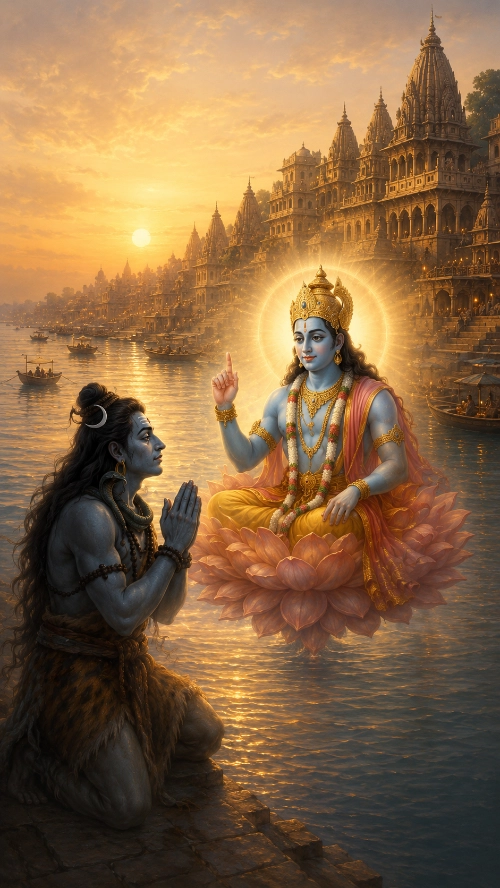
Despondent, Śiva reaches Kurujāṅgala and approaches Viṣṇu with folded hands. His hymn presents Vāsudeva as both nirguṇa—beyond the cosmic qualities—and as the source of the functional manifestations of Brahmā, Viṣṇu, and Rudra through rajas, sattva, and tamas. Śiva acknowledges that he is a manifestation associated with tamas and admits he acted without proper consideration. Viṣṇu is praised not only as the cosmic elements and faculties but also as dharma, sacrifice, truth, austerity, compassion, the Vedas, and the ultimate tīrtha.
Vārāṇasī as a Divinely Constituted Sacred Field
Viṣṇu directs Śiva to the supreme sacred region associated with Yogaśāyin. The Varaṇā and Asi rivers are described as issuing from the deity’s right and left feet, and the territory between them forms the sacred domain of Vārāṇasī. Its sanctity is therefore presented as intrinsic rather than merely conventional: the city is physically and cosmologically connected with the divine body. It is proclaimed the foremost tīrtha in the three worlds, without equal in heaven, on earth, or in the subterranean realms.
Sacredness, Urban Beauty, and Liberation
The chapter contains an elaborate poetic description of Vārāṇasī as a city where sacred learning, artistic refinement, sensual beauty, and liberating power coexist. Its temples reach the celestial bodies, its paintings deceive bees and men, and the sounds of women’s ornaments rival the precision of Vedic recitation. Through puns and restrictive poetic constructions, the text portrays its inhabitants as free from violence, arrogance, vice, ignoble conduct, and moral deviation. Even those devoted to worldly enjoyment are said to attain dissolution into Śiva there.
Two Stages of Purification
After Śiva bathes at the sacred sites of Vārāṇasī and worships Lola, Daśāśvamedha, and Keśava, Brahmahatyā is destroyed. Nevertheless, Brahmā’s skull remains attached to his hand. This establishes a technical distinction between release from sin and removal of its physical or ascetic sign. Keśava therefore directs him to a particular lotus-filled pool, worshipped by gods and Gandharvas, where the final stage of expiation must occur.
The Origin of Kapālamocana
Śiva bathes in the designated pool according to Vedic procedure, whereupon the skull falls from his palm. The event establishes Śiva’s epithet Kapālin, “the Skull-bearer,” and gives the tīrtha the name Kapālamocana, “Release from the Skull.” The chapter thus functions as a tīrtha-māhātmya: it explains the origin, name, ritual efficacy, and theological authority of Kapālamocana while presenting Vārāṇasī as a sacred field in which Śaiva, Vaiṣṇava, and solar manifestations cooperate to remove sin.