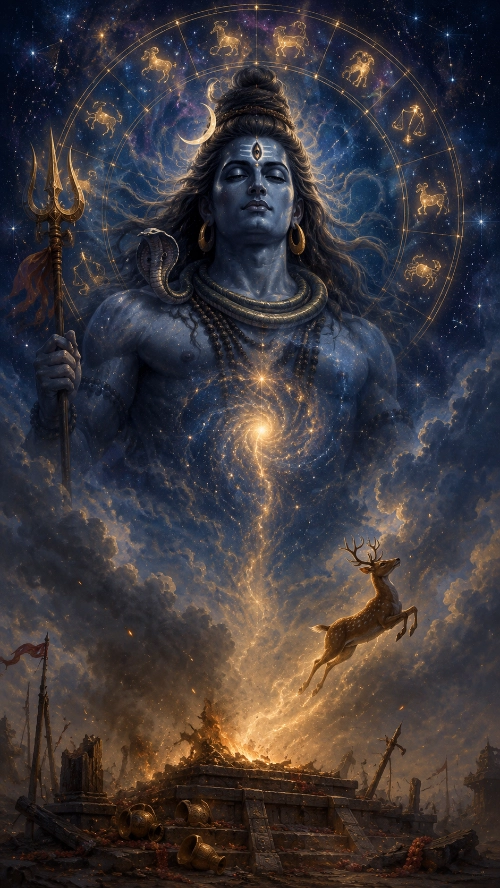
The chapter opens with the collapse of Dakṣa’s sacrificial assembly before the wrath of Śiva. Viṣṇu withdraws, the Vasus become associated with the sacred Sītā Sarasvatī, and the eleven Rudras return into Śaṅkara as differentiated manifestations dissolving into their source. While many gods flee, the sages led by Kaśyapa attempt to appease Rudra through the recitation of the Śatarudriya, revealing that Vedic praise and submission—not resistance—are the proper response to Śiva’s overwhelming power.
The Punishment of the Gods
Śiva’s destruction is presented as precise and symbolically proportionate. Pūṣan challenges him, baring his teeth, and consequently has them shattered; Bhaga directs a hostile gaze at Śiva and loses his eyes. Other deities are struck down by Śiva’s palms, feet, trident, or fiery gaze. These punishments demonstrate that the divine faculties of sight, speech, nourishment, and ritual authority remain effective only while aligned with Rudra’s sovereignty.
The destruction culminates in the annihilation of the three sacred fires, signifying the complete interruption of the Vedic sacrificial mechanism. Yajña itself becomes personified, assumes the form of a celestial deer, and flees into the sky accompanied by Dakṣiṇā, the sacrificial fee. Śiva pursues it with a Pāśupata arrow, transforming the destruction of one ritual enclosure into a cosmic event involving sacrifice, time, and the celestial sphere.
Śiva as Kālarūpī
Śiva then divides his manifestation: one aspect remains at the sacrificial ground as Jaṭādhara, while another expands through the heavens as Kālarūpī, the embodiment of Time. This celestial form is mapped systematically onto the twelve zodiacal signs. Meṣa forms the head, Vṛṣa the face, Mithuna the arms, Karkaṭaka the flanks, Siṃha the heart, Kanyā the abdomen, Tulā the navel, Vṛścika the generative organ, Dhanu the thighs, Makara the knees, Kumbha the lower legs, and Mīna the feet.
Each sign is defined according to its constituent nakṣatra divisions and planetary ruler. The description closely follows the traditional allocation of twenty-seven lunar mansions across the twelve rāśis: Aśvinī through part of Kṛttikā constitute Meṣa, the remaining portions of Kṛttikā with Rohiṇī and Mṛgaśīrṣa form Vṛṣa, and the sequence continues mathematically through Revatī in Mīna. The zodiac is therefore presented not as an independent astronomical structure but as the articulated body of Śiva in his temporal and cosmic manifestation.
Forms and Habitats of the Zodiacal Signs
The chapter further describes the iconography, movement, and natural habitat of each sign. Meṣa is ram-shaped and associated with livestock, grain, and grassy land; Vṛṣa is bovine and agricultural; Mithuna is a male–female pair connected with music, art, recreation, and domestic spaces. Karkaṭaka is aquatic and crab-like; Siṃha inhabits forests and caves; and Kanyā appears as a maiden carrying grain and a lamp while mounted on a boat.
The remaining signs are likewise given concrete environments and symbolic functions. Tulā is represented by a merchant holding a balance in urban marketplaces; Vṛścika inhabits pits, stones, poison, and insects; Dhanu is a horse-bodied archer associated with warfare; Makara is a composite aquatic creature; Kumbha is a water-bearing man connected with taverns and gambling houses; and Mīna consists of two joined fish dwelling in sacred waters. Through these descriptions, astrology is integrated with zoology, geography, social activity, ritual space, and cosmological symbolism.
Cosmological Significance
The chapter ultimately presents Śiva as the power that both destroys ritual disorder and reorganizes the cosmos. Dakṣa’s sacrifice fails because it excludes and opposes Rudra, but its destruction generates a larger revelation: sacrifice becomes celestial, the heavens become Śiva’s body, and the zodiac becomes the visible anatomy of Time. The narrative, therefore, unites Śaiva theology, Vedic ritual, astral science, sacred geography, and cosmic anthropology within a single Purāṇic framework.
Why did Bhaga lose his eyes?
This belongs to the Dakṣa-yajña-bhaṅga myth — the destruction of Dakṣa’s sacrifice — found across the Śiva Purāṇa, Kālikā Purāṇa, Mahābhārata, and the Vāmana Purāṇa’s own version of this episode.
The story, briefly: Dakṣa performs a great sacrifice but deliberately excludes Śiva from receiving a share of the oblations (either as an insult, or — in the Satī-death versions — compounded by the further insult to Satī). Śiva, enraged, produces a fearsome being (usually Vīrabhadra, sometimes Bhairava) who storms the sacrificial ground and mutilates the assembled gods one by one, each in a way that fits what that god did during the sacrifice. Dakṣa’s own head is cut off and replaced with a goat’s. Among the casualties: Pūṣan has his teeth knocked out, and Bhaga has his eyes torn out.
The symbolism, specifically for Bhaga: Bhaga is the Vedic deity of “share, portion, apportionment” — the god who presides over the fair distribution of sacrificial offerings and of fortune and wealth generally (this is the same root that gives you भाग्य, “fortune”). At Dakṣa’s sacrifice, Bhaga’s role would have been precisely to oversee/witness the distribution of oblations, and he watched Śiva’s portion being denied without objecting. So the punishment is organ-specific and exact: the very faculty that let him passively witness the injustice — his eyes — is the faculty destroyed. He’s blinded for having seen and stayed silent.
This is the same logic running through the whole massacre: Pūṣan’s teeth are broken because he ate his share of the offerings (complicit by participation, punished through the organ of eating); other gods lose hands, get beaten, or flee in terror, each penalty mapped onto their specific role or organ of complicity in the moment Śiva was slighted. It’s a very characteristic Purāṇic device — divine retribution isn’t generic, it’s legible: the wound itself narrates the sin.