Andhaka’s Legitimation and Acquisition of Divine Power
The ninth chapter of the Vāmana Purāṇa begins by clarifying how Andhaka, formerly blind, became eligible for kingship. Pulastya explains that Andhaka recovered his sight while his father, Hiraṇyākṣa, was still alive, and that he was later installed by Prahlāda in his hereditary position. After his consecration, Andhaka performed austerities to propitiate the three-eyed Śiva and obtained extensive protections: he could not be conquered or slain by gods, Siddhas, sages, or serpents, nor could he be burned by fire or affected by water. He then appointed Śukra as his royal priest, combining ascetic power, divine favor, dynastic legitimacy, and priestly counsel.
From Earthly Sovereignty to Cosmic Imperialism
Andhaka’s rule quickly develops into a campaign of universal conquest. He first defeats the kings of the earth and compels them to join his forces as military auxiliaries. Only after consolidating terrestrial power does he advance toward Mount Meru and challenge the gods. This progression reflects a characteristic Purāṇic model of imperial expansion: conquest begins in the human realm and culminates in an attempt to overturn the established cosmic hierarchy. Indra responds by securing Amarāvatī, mobilizing the celestial armies, and marching out with the Lokapālas and other divine classes.
The Organization of the Celestial Army
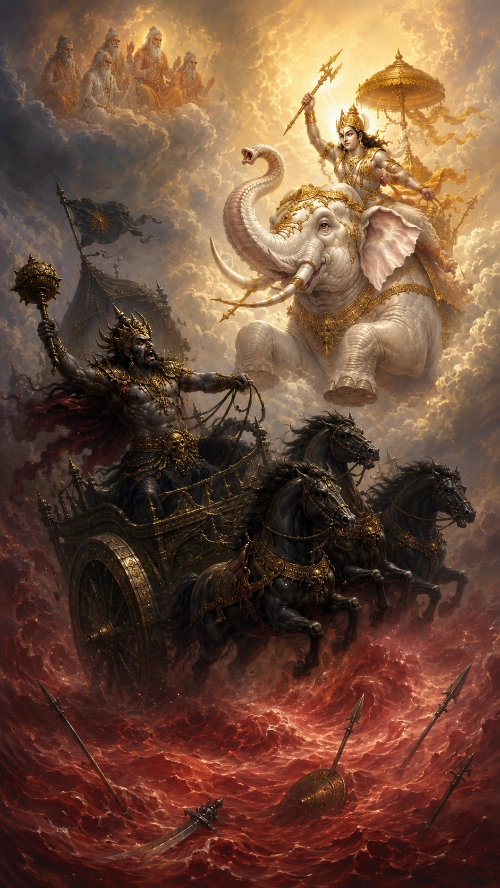
The divine host is presented as a carefully ordered coalition rather than an undifferentiated mass. The twelve Ādityas occupy the front, the eleven Rudras form the rear, and the Vasus, Viśvedevas, Sādhyas, Aśvins, Maruts, Yakṣas, and Vidyādharas occupy the center. The chapter then pauses the battle narrative to catalog their vehicles. Indra rides the white elephant born from Rudra’s palm, Yama rides the black buffalo Pauṇḍraka, Varuṇa rides the aquatic Śiśumāra named Jaladhi, and Kubera rides a gigantic anthropomorphic being born from Ambikā’s feet. The mounts are thus described as divine emanations possessing their own supernatural origins.
Symbolism of the Divine and Asuric Vehicles
The catalog expands beyond familiar individual mounts, assigning characteristic vehicles to entire classes of beings. The Rudras use Gandharvas, serpent-lords, and Surabhī-born bulls; the Moon’s chariot is drawn by five hundred geese; the Vasus ride elephants; the Kinnaras ride serpents; the Maruts ride deer; and the Kavis ride parrots. The Asura forces are organized with comparable magnificence: Andhaka possesses a vast thousand-spoked chariot drawn by black horses, while Prahlāda rides a luminous golden chariot drawn by eight moon-coloured horses. Maya has a celebrated chariot, Śambara an aerial vehicle, Dundubhi a great serpent, and Ayaḥśaṅku a lion. These vehicles communicate the rank, nature, and symbolic attributes of their riders.
The Structure of the God–Asura Duels
Once the two armies meet, the larger conflict resolves into a sequence of paired combats. Andhaka confronts Indra, Prahlāda faces Yama, Virocana advances against Varuṇa, Jambha opposes Kubera, Śambara engages Vāyu, and Maya fights Agni. These pairings create both military and symbolic correspondences: rulers confront rulers, magical powers oppose elemental forces, and the divine and Asuric hierarchies are arranged as parallel structures. Prahlāda’s participation is especially significant, since his personal righteousness does not remove him from the collective obligations of the Daitya lineage.
The Battlefield as a River of Blood
The climactic battle is described through an extended river metaphor. Blood becomes water, chariots become whirlpools, arrows become fish, spears become makaras, elephant foreheads become tortoises, intestines become aquatic weeds, and banners resemble foam. Warriors cross this dreadful current using their chariots as rafts, while vultures, jackals, Piśācas, and Rākṣasas feast upon the dead. The battlefield consequently resembles both a cremation ground and an inverted sacrificial space, where human and divine bodies become offerings to beings associated with death and impurity.
Heroic Death and Cosmic Spectatorship
Despite the horror of the battle, the conclusion introduces the ideal of heroic transcendence. Sages and Siddhas observe the combat from the sky; martial instruments resound; and Apsarases receive the warriors who die facing the enemy. The chapter, therefore, combines political theology, mythological classification, military spectacle, and epic imagery. Andhaka’s campaign is not merely a war for territory: it is an attempt to replace the cosmic order, fought by two highly organized supernatural societies and interpreted through the Purāṇic ideals of sovereignty, fate, martial courage, and posthumous reward.